

Google Chrome on Windows prior to version 148.0.7778.96 is affected by CVE-2026-7973, a medium-severity Chromium vulnerability in Dawn that may allow a remote attacker to escape the browser sandbox through a crafted HTML page. The vulnerability arrived in public trackers on May 6, 2026, as part of the Chrome 148 stable security wave, and it is already the sort of bug that makes vulnerability management teams squint at the metadata rather than the headline. The interesting part is not merely that Chrome needs patching again. It is that the record exposes how messy modern browser risk has become when one engine, one graphics stack, several vendors, and multiple vulnerability databases all try to describe the same blast radius.
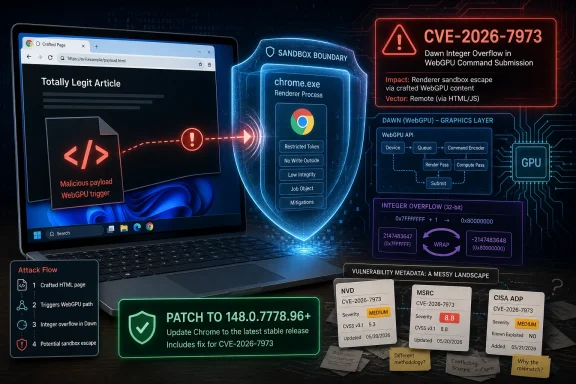
CVE-2026-7973 is described as an integer overflow in Dawn, the graphics abstraction layer used by Chromium’s WebGPU implementation. In plain terms, integer overflows happen when software performs a calculation that exceeds the range a variable can safely hold, and the result wraps into an unexpected value. In graphics and GPU-adjacent code, that can be especially dangerous because calculations often shape memory sizes, buffer offsets, resource counts, and command boundaries.
The official Chromium severity is Medium, which may sound reassuring until one reads the impact language: a remote attacker could potentially perform a sandbox escape by convincing a user to open a crafted HTML page. That phrasing places the bug in a familiar browser-security pattern. The first stage is not “own the machine instantly”; it is “get code or influence inside a renderer or browser-adjacent context, then cross a boundary that was supposed to contain the damage.”
That is why the CISA ADP CVSS score of 8.8 looks harsher than Chromium’s own severity label. CVSS sees network reachability, low attack complexity, no privileges required, user interaction required, and high confidentiality, integrity, and availability impact. Chromium’s internal severity, meanwhile, is typically shaped by exploitability, component exposure, sandbox layering, and how a bug fits into the project’s own triage model. Both views can be true at the same time.
For administrators, the severity label is less important than the operational conclusion. If a bug can be triggered through web content and may contribute to a sandbox escape, it belongs in the fast lane. Browser patching is not ordinary application maintenance anymore; it is part of perimeter defense, endpoint hardening, and incident prevention.
That ambition comes with a security cost. WebGPU is built around exposing powerful hardware acceleration to untrusted web content while preserving browser isolation. Any code that translates web-visible API calls into lower-level GPU operations has to be unusually strict about validation, memory accounting, and platform-specific behavior.
The CVE description narrows the affected configuration to Google Chrome on Windows before 148.0.7778.96. That Windows qualifier matters because graphics drivers, GPU process behavior, sandbox policies, and platform APIs vary by operating system. A bug in a cross-platform component can still be practically exploitable only on one platform, or at least only confirmed on one platform at disclosure time.
This is where browser security has become more like operating-system security. A modern browser is not just an HTML parser and JavaScript engine. It is a compositor, PDF viewer, networking stack, graphics runtime, media pipeline, extension host, password manager, synchronization client, and application platform. Dawn sits in the part of the browser where the web reaches toward hardware, and history suggests that boundary will keep producing interesting bugs.
On the face of it, that makes sense. The CVE description says Google Chrome on Windows. If the confirmed vulnerable product is Chrome and the confirmed affected operating system is Windows, an AND configuration is a reasonable way to encode the scope. The vulnerable application CPE is Chrome; the operating-system CPE constrains the environment.
The problem is that CPEs are a blunt instrument for the browser ecosystem. They are good at naming products, weaker at describing shared codebases, downstream forks, embedded Chromium runtimes, channel differences, and vendor-specific patch timing. A scanner may see “Chromium-based browser” and want a neat list of every downstream product. The CVE record may only be authoritative for Google Chrome because that is what the assigning CNA or vendor disclosed.
So are we missing a CPE? For the Chrome record itself, probably not in the narrow sense: Chrome on Windows before 148.0.7778.96 is the core affected configuration. But for practical enterprise exposure management, the answer is unsatisfying. Security teams should not treat the absence of Edge, Brave, Vivaldi, Electron, or other Chromium-derived software in that CPE block as proof of immunity. It means the public record, at that point in time, is scoped to Chrome.
That distinction is not academic. CPE-driven vulnerability management tools often become policy engines by accident. If the CPE says Chrome, Chrome gets patched. If Edge or an Electron app is not listed, it may fall into a slower process, even though the vulnerable code lineage could be shared or closely related. CPE is useful metadata; it is not a substitute for understanding software supply chains.
This is where casual readers often misread the record. A vulnerability page hosted by Microsoft can look like a Windows vulnerability, especially when the CPE configuration includes Microsoft Windows as the platform condition. But CVE-2026-7973 is not described as a kernel bug, a Win32 subsystem flaw, or a defect in Microsoft’s operating-system code. It is described as a Chromium vulnerability in Dawn affecting Google Chrome on Windows before a fixed browser version.
Edge complicates the picture because it is Chromium-based but not identical to Chrome. Microsoft maintains its own release cadence, branding, enterprise policies, and update mechanisms. When Chromium fixes land, Edge generally receives the relevant security changes through Microsoft’s browser update process, but the exact version mapping is vendor-specific. Administrators should therefore check Edge’s own security release notes and installed versions rather than assume the Chrome version number directly maps to Edge.
The larger lesson is that Chromium has become a shared infrastructure layer for the web. Google may disclose a bug. Microsoft may mirror or interpret it through MSRC. NVD may enrich it with CPE and CVSS data. CISA ADP may add a score before NVD has completed its own assessment. Each participant adds value, but the combined record can look contradictory to anyone expecting a single canonical answer.
For CVE-2026-7973, the CISA ADP vector is severe because the theoretical impact is complete compromise of confidentiality, integrity, and availability after user interaction. That is plausible for a sandbox escape class issue: escaping the sandbox can turn a contained renderer problem into a broader compromise path. Even if exploitation requires a crafted page and a user visit, that is a low bar on the modern internet.
Chromium’s Medium label may reflect that the issue is not known to be exploited in the wild, may require a paired bug for a full chain, may be constrained to particular configurations, or may have mitigation layers that reduce reliability. The public record does not provide enough detail to know which of those factors drove the rating. The underlying Chromium issue is permission-restricted, which is normal for recently patched security bugs.
Administrators should resist the temptation to average the two labels into complacency. The right operational translation is simple: this is not necessarily a drop-everything zero-day emergency, but it is also not a routine low-risk defect. It is a browser content-handling bug with a possible sandbox escape path. That belongs in the next managed update wave, not next quarter’s maintenance backlog.
Reporting around the release indicates that Chrome 148 fixed more than 100 security vulnerabilities, including several more severe issues than CVE-2026-7973. That context matters because administrators may not be patching for one CVE so much as for an entire browser security tranche. A medium bug in a large security release can still ride alongside critical renderer and use-after-free fixes.
This is the quiet tyranny of browser patching. Every update is both a security event and a compatibility event. Enterprises must balance extension behavior, line-of-business web apps, browser policies, sign-in flows, printing quirks, GPU acceleration problems, and remote-work realities. But attackers do not wait for change advisory boards to feel emotionally ready.
The best organizations have stopped treating Chrome and Edge as ordinary desktop software. They manage them more like security-sensitive runtime platforms, closer to VPN clients, endpoint agents, or exposed server middleware. Version drift in the browser fleet is now measurable risk.
A crafted HTML page is not a science-fiction attack surface. It can arrive through a phishing email, a compromised legitimate site, a poisoned ad slot, a malicious forum post, a documentation page clone, a fake invoice portal, or a link in a chat channel. The web’s central convenience is also its central security problem: visiting content is normal behavior.
Sandbox escape language also matters because modern browser exploitation is often chained. One vulnerability gets execution or memory corruption in a constrained process; another crosses a privilege boundary; a third persists, steals tokens, or launches a local payload. A single CVE writeup may describe only one link in that chain, not the full campaign an attacker would build from it.
That is why browser security teams care about reducing chainable primitives. An integer overflow in a GPU-related component may not sound dramatic to a non-specialist, but if it helps move from web content toward a less confined process, it becomes valuable. Attackers do not need every bug to be a masterpiece. They need compatible parts.
Many vulnerability scanners, asset platforms, and compliance dashboards ingest NVD data, vendor advisories, and CPE mappings on their own schedules. Some will flag CVE-2026-7973 quickly. Others will wait for NVD enrichment. Some will misread platform conditions. Others may produce duplicate findings when Chrome, Edge, and Chromium packages are detected separately.
This is one reason the “missing CPE” prompt matters. If a record is under-scoped, scanners may miss affected software. If it is over-scoped, they may produce noise and erode trust. Either failure mode is expensive at enterprise scale.
The pragmatic move is to use the fixed version as the operational anchor. For Google Chrome on Windows, anything before 148.0.7778.96 should be treated as exposed to this CVE. For other Chromium-based browsers, administrators should consult the vendor’s own release notes and verify whether the relevant Chromium security fixes have landed. For unmanaged systems, the advice is even simpler: open the browser’s About page and force the update check.
Dawn sharpens this concern because graphics and GPU features may be used by applications that do not look like traditional browsing. Web technologies increasingly power collaboration tools, design applications, dashboards, AI interfaces, and internal portals. The boundary between “the browser” and “the app” keeps dissolving.
Windows administrators have a particularly complicated job because Chromium browsers coexist with WebView2, Edge, Chrome, third-party browsers, packaged enterprise apps, and user-installed tools. A Chrome CPE does not inventory all of that. It only names one visible product. The vulnerable code path, or a related one, may exist in places that vulnerability management does not model cleanly.
That does not mean panic is warranted. It means asset visibility has to evolve. Knowing which browser is the default is not enough. Teams need to know which Chromium runtimes exist, how they update, whether they are managed, and whether security fixes arrive through the browser vendor, the OS, an application vendor, or an internal packaging process.
For CVE-2026-7973, the most important control is boring: get to Chrome 148.0.7778.96 or later on Windows. The second most important control is making sure the browser actually relaunches after updating. Chrome can download an update but continue running the old vulnerable code until users restart, which turns “patched” into a polite fiction.
Enterprise policies can help here, but only if they are used aggressively enough. Managed Chrome and Edge environments can enforce update checks, set relaunch notification windows, and limit how long users can defer browser restarts. Those policies sometimes irritate users, but the alternative is a fleet full of browsers that are technically updated and practically stale.
Security teams should also watch for the false comfort of Extended Stable channels. Extended Stable can be appropriate in controlled environments, and it receives security fixes, but it is not a license to ignore version verification. The right question is not “Which channel are we on?” but “Which security fixes are actually present on endpoints today?”
This creates an asymmetry. Attackers can reverse-engineer patches, compare builds, and hunt for the changed code. Defenders often see only the CVE summary, severity, affected version, and component name. The public has enough information to patch, but not enough to fully reason about exploitability.
That is uncomfortable, but it is the bargain browser vendors have settled on. Rapid patch first, technical transparency later. Given the speed at which browser bugs can be weaponized, that bargain is defensible.
For IT pros, the lack of detail should not delay action. Waiting for a proof of concept before patching a browser sandbox escape candidate is backwards. By the time a clean proof of concept circulates, the window for calm remediation may already have closed.
The most defensible interpretation is narrow but actionable. Chrome on Windows before 148.0.7778.96 is vulnerable. Microsoft is tracking the CVE because Edge and the Windows browser ecosystem depend on Chromium. NVD enrichment may continue to change as more metadata arrives. Security tooling should be checked against installed browser versions rather than trusted blindly.
The CWE entry is also odd. The user-provided record shows CWE-472, “External Control of Assumed-Immutable Web Parameter,” even though the description calls the bug an integer overflow. That mismatch may reflect early enrichment, CNA-supplied classification, or a mapping artifact. It is another reminder that the prose description and vendor advisory often matter more than a single weakness label.
In an ideal world, vulnerability records would perfectly describe affected products, affected versions, exploit preconditions, weakness classes, downstream dependencies, and patch states. In the real world, records are living documents. The safest teams treat them as starting points.
For individual users, the path is familiar: open Chrome’s menu, go to Help, open About Google Chrome, let the update apply, and relaunch. For managed environments, administrators should use their existing browser management stack, endpoint management platform, or software deployment tool to confirm installed versions and force relaunch where policy permits.
Edge administrators should check Microsoft’s Edge security release notes and deployed Edge versions separately. It is tempting to use Chrome’s version number as a proxy for Chromium patch state, but Edge has its own numbering and release pipeline. The correct control is vendor-specific verification, not guesswork.
Security teams should also keep an eye on browsers that do not participate in central management. Developer workstations, local admin machines, lab systems, jump boxes, kiosks, and contractor devices have a way of escaping the neat diagrams in asset inventories. Those are precisely the systems where a browser exploit can become more than a browser incident.
The useful conclusions are concrete, not theatrical:
Source: NVD / Chromium Security Update Guide - Microsoft Security Response Center
 The Medium Bug With High-Severity Consequences
CVE-2026-7973 is described as an integer overflow in Dawn, the graphics abstraction layer used by Chromium’s WebGPU implementation. In plain terms, integer overflows happen when software performs a calculation that exceeds the range a variable can safely hold, and the result wraps into an unexpected value. In graphics and GPU-adjacent code, that can be especially dangerous because calculations often shape memory sizes, buffer offsets, resource counts, and command boundaries.The official Chromium severity is Medium, which may sound reassuring until one reads the impact language: a remote attacker could potentially perform a sandbox escape by convincing a user to open a crafted HTML page. That phrasing places the bug in a familiar browser-security pattern. The first stage is not “own the machine instantly”; it is “get code or influence inside a renderer or browser-adjacent context, then cross a boundary that was supposed to contain the damage.”
That is why the CISA ADP CVSS score of 8.8 looks harsher than Chromium’s own severity label. CVSS sees network reachability, low attack complexity, no privileges required, user interaction required, and high confidentiality, integrity, and availability impact. Chromium’s internal severity, meanwhile, is typically shaped by exploitability, component exposure, sandbox layering, and how a bug fits into the project’s own triage model. Both views can be true at the same time.
For administrators, the severity label is less important than the operational conclusion. If a bug can be triggered through web content and may contribute to a sandbox escape, it belongs in the fast lane. Browser patching is not ordinary application maintenance anymore; it is part of perimeter defense, endpoint hardening, and incident prevention.
Dawn Is No Longer an Obscure Corner of Chromium
Dawn deserves more attention than it usually receives in public vulnerability writeups. It is Chromium’s implementation layer for WebGPU, the modern web standard designed to give web applications more direct, efficient access to GPU capabilities. That makes it important for games, creative tools, machine-learning workloads, visualization, and the broader push to make browser applications feel less like documents and more like native software.That ambition comes with a security cost. WebGPU is built around exposing powerful hardware acceleration to untrusted web content while preserving browser isolation. Any code that translates web-visible API calls into lower-level GPU operations has to be unusually strict about validation, memory accounting, and platform-specific behavior.
The CVE description narrows the affected configuration to Google Chrome on Windows before 148.0.7778.96. That Windows qualifier matters because graphics drivers, GPU process behavior, sandbox policies, and platform APIs vary by operating system. A bug in a cross-platform component can still be practically exploitable only on one platform, or at least only confirmed on one platform at disclosure time.
This is where browser security has become more like operating-system security. A modern browser is not just an HTML parser and JavaScript engine. It is a compositor, PDF viewer, networking stack, graphics runtime, media pipeline, extension host, password manager, synchronization client, and application platform. Dawn sits in the part of the browser where the web reaches toward hardware, and history suggests that boundary will keep producing interesting bugs.
The CPE Record Is Awkward, But Not Necessarily Wrong
The user-facing question in the NVD record is blunt: “Are we missing a CPE here?” In this case, the initial NIST configuration reportedly used an AND relationship: Google Chrome versions up to but excluding 148.0.7778.96, combined with Microsoft Windows. That is an attempt to express a product-and-platform condition rather than a standalone “Chrome everywhere” vulnerability.On the face of it, that makes sense. The CVE description says Google Chrome on Windows. If the confirmed vulnerable product is Chrome and the confirmed affected operating system is Windows, an AND configuration is a reasonable way to encode the scope. The vulnerable application CPE is Chrome; the operating-system CPE constrains the environment.
The problem is that CPEs are a blunt instrument for the browser ecosystem. They are good at naming products, weaker at describing shared codebases, downstream forks, embedded Chromium runtimes, channel differences, and vendor-specific patch timing. A scanner may see “Chromium-based browser” and want a neat list of every downstream product. The CVE record may only be authoritative for Google Chrome because that is what the assigning CNA or vendor disclosed.
So are we missing a CPE? For the Chrome record itself, probably not in the narrow sense: Chrome on Windows before 148.0.7778.96 is the core affected configuration. But for practical enterprise exposure management, the answer is unsatisfying. Security teams should not treat the absence of Edge, Brave, Vivaldi, Electron, or other Chromium-derived software in that CPE block as proof of immunity. It means the public record, at that point in time, is scoped to Chrome.
That distinction is not academic. CPE-driven vulnerability management tools often become policy engines by accident. If the CPE says Chrome, Chrome gets patched. If Edge or an Electron app is not listed, it may fall into a slower process, even though the vulnerable code lineage could be shared or closely related. CPE is useful metadata; it is not a substitute for understanding software supply chains.
Microsoft’s Presence Makes the Metadata More Confusing
The CVE appears in the Microsoft Security Response Center update guide because Microsoft tracks Chromium vulnerabilities relevant to Microsoft Edge and the Windows ecosystem. That does not automatically mean Windows itself is vulnerable in the same way as Chrome, nor does it mean every Windows installation has an OS-level flaw. It means Microsoft has a stake in communicating Chromium-derived risk to its users and administrators.This is where casual readers often misread the record. A vulnerability page hosted by Microsoft can look like a Windows vulnerability, especially when the CPE configuration includes Microsoft Windows as the platform condition. But CVE-2026-7973 is not described as a kernel bug, a Win32 subsystem flaw, or a defect in Microsoft’s operating-system code. It is described as a Chromium vulnerability in Dawn affecting Google Chrome on Windows before a fixed browser version.
Edge complicates the picture because it is Chromium-based but not identical to Chrome. Microsoft maintains its own release cadence, branding, enterprise policies, and update mechanisms. When Chromium fixes land, Edge generally receives the relevant security changes through Microsoft’s browser update process, but the exact version mapping is vendor-specific. Administrators should therefore check Edge’s own security release notes and installed versions rather than assume the Chrome version number directly maps to Edge.
The larger lesson is that Chromium has become a shared infrastructure layer for the web. Google may disclose a bug. Microsoft may mirror or interpret it through MSRC. NVD may enrich it with CPE and CVSS data. CISA ADP may add a score before NVD has completed its own assessment. Each participant adds value, but the combined record can look contradictory to anyone expecting a single canonical answer.
The Score Gap Says More About Browser Triage Than About Risk
The Medium-versus-High split is not a clerical error; it is a reminder that severity systems answer different questions. Chromium’s severity rating is designed for an engineering project that fixes hundreds of bugs across channels and components. CVSS is designed to produce a standardized risk score from exploit conditions and potential impacts. Enterprise patch priority is a third system, shaped by asset exposure, exploit availability, business criticality, and compensating controls.For CVE-2026-7973, the CISA ADP vector is severe because the theoretical impact is complete compromise of confidentiality, integrity, and availability after user interaction. That is plausible for a sandbox escape class issue: escaping the sandbox can turn a contained renderer problem into a broader compromise path. Even if exploitation requires a crafted page and a user visit, that is a low bar on the modern internet.
Chromium’s Medium label may reflect that the issue is not known to be exploited in the wild, may require a paired bug for a full chain, may be constrained to particular configurations, or may have mitigation layers that reduce reliability. The public record does not provide enough detail to know which of those factors drove the rating. The underlying Chromium issue is permission-restricted, which is normal for recently patched security bugs.
Administrators should resist the temptation to average the two labels into complacency. The right operational translation is simple: this is not necessarily a drop-everything zero-day emergency, but it is also not a routine low-risk defect. It is a browser content-handling bug with a possible sandbox escape path. That belongs in the next managed update wave, not next quarter’s maintenance backlog.
Chrome 148 Is a Security Release Wearing a Feature Release Badge
Chrome 148 arrived as a stable-channel promotion for Windows, macOS, and Linux, with Windows and macOS receiving 148.0.7778.96 or 148.0.7778.97 and Linux receiving 148.0.7778.96. Google said the release would roll out over the coming days and weeks, which is standard language but always uncomfortable when security fixes are involved. The gap between “available” and “installed everywhere” is where attackers, red teams, and opportunistic exploit kit authors like to live.Reporting around the release indicates that Chrome 148 fixed more than 100 security vulnerabilities, including several more severe issues than CVE-2026-7973. That context matters because administrators may not be patching for one CVE so much as for an entire browser security tranche. A medium bug in a large security release can still ride alongside critical renderer and use-after-free fixes.
This is the quiet tyranny of browser patching. Every update is both a security event and a compatibility event. Enterprises must balance extension behavior, line-of-business web apps, browser policies, sign-in flows, printing quirks, GPU acceleration problems, and remote-work realities. But attackers do not wait for change advisory boards to feel emotionally ready.
The best organizations have stopped treating Chrome and Edge as ordinary desktop software. They manage them more like security-sensitive runtime platforms, closer to VPN clients, endpoint agents, or exposed server middleware. Version drift in the browser fleet is now measurable risk.
User Interaction Is Not Much of a Barrier
The CVSS vector includes user interaction, and that fact often softens the perceived urgency. It should not. Browser vulnerabilities almost always involve user interaction because the browser’s job is to fetch and render content that users request, click, search, preview, or are redirected toward.A crafted HTML page is not a science-fiction attack surface. It can arrive through a phishing email, a compromised legitimate site, a poisoned ad slot, a malicious forum post, a documentation page clone, a fake invoice portal, or a link in a chat channel. The web’s central convenience is also its central security problem: visiting content is normal behavior.
Sandbox escape language also matters because modern browser exploitation is often chained. One vulnerability gets execution or memory corruption in a constrained process; another crosses a privilege boundary; a third persists, steals tokens, or launches a local payload. A single CVE writeup may describe only one link in that chain, not the full campaign an attacker would build from it.
That is why browser security teams care about reducing chainable primitives. An integer overflow in a GPU-related component may not sound dramatic to a non-specialist, but if it helps move from web content toward a less confined process, it becomes valuable. Attackers do not need every bug to be a masterpiece. They need compatible parts.
Scanners Will Lag Behind the Reality
The NVD record’s change history shows the public vulnerability data still being enriched on May 6, 2026. NVD had not yet provided its own CVSS assessment at the time reflected in the user’s data, while CISA ADP had already supplied a CVSS 3.1 score. That sequencing is normal, but it creates a real-world timing problem.Many vulnerability scanners, asset platforms, and compliance dashboards ingest NVD data, vendor advisories, and CPE mappings on their own schedules. Some will flag CVE-2026-7973 quickly. Others will wait for NVD enrichment. Some will misread platform conditions. Others may produce duplicate findings when Chrome, Edge, and Chromium packages are detected separately.
This is one reason the “missing CPE” prompt matters. If a record is under-scoped, scanners may miss affected software. If it is over-scoped, they may produce noise and erode trust. Either failure mode is expensive at enterprise scale.
The pragmatic move is to use the fixed version as the operational anchor. For Google Chrome on Windows, anything before 148.0.7778.96 should be treated as exposed to this CVE. For other Chromium-based browsers, administrators should consult the vendor’s own release notes and verify whether the relevant Chromium security fixes have landed. For unmanaged systems, the advice is even simpler: open the browser’s About page and force the update check.
The Enterprise Browser Is Now a Supply-Chain Problem
Chromium’s success has standardized much of the web platform, but it has also concentrated risk. When a security issue lands in shared Chromium code, the fix must move through Google Chrome, Microsoft Edge, Chromium packages on Linux, embedded browsers, Electron applications, and various downstream products. Some update automatically. Some depend on operating-system repositories. Some are bundled inside applications users do not think of as browsers at all.Dawn sharpens this concern because graphics and GPU features may be used by applications that do not look like traditional browsing. Web technologies increasingly power collaboration tools, design applications, dashboards, AI interfaces, and internal portals. The boundary between “the browser” and “the app” keeps dissolving.
Windows administrators have a particularly complicated job because Chromium browsers coexist with WebView2, Edge, Chrome, third-party browsers, packaged enterprise apps, and user-installed tools. A Chrome CPE does not inventory all of that. It only names one visible product. The vulnerable code path, or a related one, may exist in places that vulnerability management does not model cleanly.
That does not mean panic is warranted. It means asset visibility has to evolve. Knowing which browser is the default is not enough. Teams need to know which Chromium runtimes exist, how they update, whether they are managed, and whether security fixes arrive through the browser vendor, the OS, an application vendor, or an internal packaging process.
Patch Cadence Is the New Browser Hardening
There was a time when browser hardening meant disabling plugins, restricting ActiveX, blocking third-party toolbars, and arguing about Java. Today, those controls are mostly historical footnotes. The browser security fight has moved to update velocity, site isolation, sandbox integrity, exploit mitigation, extension governance, and identity protection.For CVE-2026-7973, the most important control is boring: get to Chrome 148.0.7778.96 or later on Windows. The second most important control is making sure the browser actually relaunches after updating. Chrome can download an update but continue running the old vulnerable code until users restart, which turns “patched” into a polite fiction.
Enterprise policies can help here, but only if they are used aggressively enough. Managed Chrome and Edge environments can enforce update checks, set relaunch notification windows, and limit how long users can defer browser restarts. Those policies sometimes irritate users, but the alternative is a fleet full of browsers that are technically updated and practically stale.
Security teams should also watch for the false comfort of Extended Stable channels. Extended Stable can be appropriate in controlled environments, and it receives security fixes, but it is not a license to ignore version verification. The right question is not “Which channel are we on?” but “Which security fixes are actually present on endpoints today?”
The Public Bug Is Restricted Because the Race Is Still On
The Chromium issue linked to CVE-2026-7973 is permission-restricted, which can frustrate researchers and defenders looking for technical detail. That restriction is also standard practice. Vendors often limit access to vulnerability details until most users have received the fix, reducing the chance that a patch diff or bug discussion becomes a recipe for exploitation.This creates an asymmetry. Attackers can reverse-engineer patches, compare builds, and hunt for the changed code. Defenders often see only the CVE summary, severity, affected version, and component name. The public has enough information to patch, but not enough to fully reason about exploitability.
That is uncomfortable, but it is the bargain browser vendors have settled on. Rapid patch first, technical transparency later. Given the speed at which browser bugs can be weaponized, that bargain is defensible.
For IT pros, the lack of detail should not delay action. Waiting for a proof of concept before patching a browser sandbox escape candidate is backwards. By the time a clean proof of concept circulates, the window for calm remediation may already have closed.
The CPE Line Should Not Be the End of the Investigation
For WindowsForum readers who live in the weeds of vulnerability data, CVE-2026-7973 is a useful case study in how to read a record skeptically. The Chrome application CPE plus Windows OS CPE likely reflects the disclosed affected configuration. It does not necessarily prove that no other Chromium consumer is affected. It also does not transform the issue into a Windows operating-system vulnerability.The most defensible interpretation is narrow but actionable. Chrome on Windows before 148.0.7778.96 is vulnerable. Microsoft is tracking the CVE because Edge and the Windows browser ecosystem depend on Chromium. NVD enrichment may continue to change as more metadata arrives. Security tooling should be checked against installed browser versions rather than trusted blindly.
The CWE entry is also odd. The user-provided record shows CWE-472, “External Control of Assumed-Immutable Web Parameter,” even though the description calls the bug an integer overflow. That mismatch may reflect early enrichment, CNA-supplied classification, or a mapping artifact. It is another reminder that the prose description and vendor advisory often matter more than a single weakness label.
In an ideal world, vulnerability records would perfectly describe affected products, affected versions, exploit preconditions, weakness classes, downstream dependencies, and patch states. In the real world, records are living documents. The safest teams treat them as starting points.
The Version Number Is the Cleanest Truth in the Record
Near-term response does not require deep knowledge of Dawn internals. It requires version enforcement. On Windows, Chrome should be at 148.0.7778.96 or later to clear the CVE as described. If an endpoint is below that, it needs an update and a browser restart.For individual users, the path is familiar: open Chrome’s menu, go to Help, open About Google Chrome, let the update apply, and relaunch. For managed environments, administrators should use their existing browser management stack, endpoint management platform, or software deployment tool to confirm installed versions and force relaunch where policy permits.
Edge administrators should check Microsoft’s Edge security release notes and deployed Edge versions separately. It is tempting to use Chrome’s version number as a proxy for Chromium patch state, but Edge has its own numbering and release pipeline. The correct control is vendor-specific verification, not guesswork.
Security teams should also keep an eye on browsers that do not participate in central management. Developer workstations, local admin machines, lab systems, jump boxes, kiosks, and contractor devices have a way of escaping the neat diagrams in asset inventories. Those are precisely the systems where a browser exploit can become more than a browser incident.
The Small Chrome Entry That Teaches the Bigger Lesson
CVE-2026-7973 is not the biggest vulnerability in the Chrome 148 release, but it is one of the more instructive ones. A medium Chromium bug with a high CVSS score, a Windows-specific description, a restricted issue tracker entry, an MSRC page, an NVD CPE prompt, and a graphics component most users have never heard of tells us a lot about modern endpoint risk.The useful conclusions are concrete, not theatrical:
- Chrome on Windows should be updated to 148.0.7778.96 or later, and the browser must be relaunched for the fix to matter.
- The current CPE configuration appears to describe Chrome constrained to Windows, but it should not be read as a guarantee that all Chromium-derived products are irrelevant.
- Microsoft’s tracking of the CVE does not make this a Windows OS flaw; it reflects the Chromium dependency chain that also matters to Edge.
- The difference between Chromium’s Medium severity and CISA ADP’s 8.8 score is a normal consequence of different scoring systems, not proof that one side is wrong.
- Vulnerability scanners should be validated against real installed browser versions because public metadata may lag, shift, or underrepresent downstream exposure.
- Dawn and WebGPU deserve continued attention because the web’s move toward richer hardware acceleration expands the amount of security-critical code reachable from a page.
Source: NVD / Chromium Security Update Guide - Microsoft Security Response Center
