

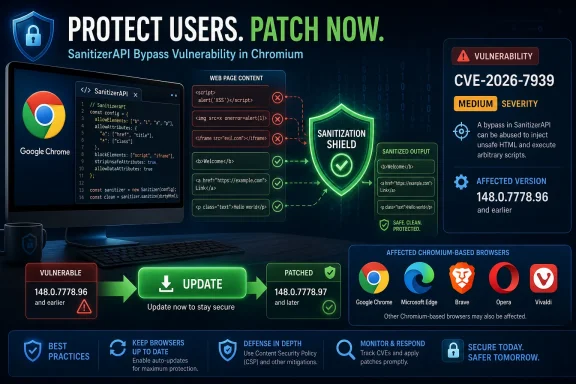
Google assigned CVE-2026-7939 on May 6, 2026, to a medium-severity Chrome flaw in the SanitizerAPI that, before version 148.0.7778.96, could let a remote attacker inject arbitrary scripts or HTML through a crafted web page. That dry sentence is the kind of advisory language admins skim every week, but the bug sits in one of the browser’s most politically important security promises: that the platform can safely process hostile web content at industrial scale. The practical fix is straightforward — update Chrome, and watch Chromium-based browsers such as Edge — but the more interesting story is how a “medium” UXSS issue exposes the fragility of modern browser trust. Sanitization is supposed to be the part of the web stack that makes dangerous markup boring; CVE-2026-7939 is a reminder that boring is a hard engineering target.
The vulnerability description is short, but it says a lot. “Inappropriate implementation” is Chromium’s broad bucket for a mistake in how a feature behaves, not necessarily a classic memory corruption bug or a cleanly named parser failure. The affected component, SanitizerAPI, is designed to help developers remove dangerous content from HTML before it reaches the document in a form that can execute script.
That makes this different from the headline-grabbing Chrome bugs that involve use-after-free conditions, renderer escapes, or critical Blink flaws. CVE-2026-7939 is not presented as a sandbox breakout, and the published CVSS 3.1 score from CISA-ADP is 5.4, with user interaction required and low confidentiality and integrity impact. In ordinary patch-management shorthand, that is the sort of vulnerability that gets queued behind “critical” and “known exploited.”
But UXSS — universal cross-site scripting — is not ordinary XSS. A site-level XSS bug typically belongs to one application; a UXSS bug belongs to the browser’s interpretation of the web. If a browser-level sanitization feature can be coerced into allowing markup or script that should have been neutralized, the blast radius depends less on one sloppy website and more on how many sites trusted the browser to do the dull security work correctly.
That is why “medium” should not be read as “minor.” It should be read as “not known, from public data, to be a one-click takeover.” For defenders, the distinction matters. For attackers, a browser bug that crosses origin assumptions or injects active content is still an invitation to experiment.
Historically, the answer was custom sanitization libraries. Some were excellent. Some were a ball of regex and prayer. Most lived under constant pressure from browser quirks, new HTML elements, URL parsing edge cases, namespace weirdness, SVG, MathML, template elements, shadow DOM, and a long tail of “this cannot possibly execute” assumptions that eventually did.
SanitizerAPI is part of the browser industry’s attempt to centralize that job. Instead of every developer re-learning the same traps, the platform can expose a built-in mechanism for taking unsafe markup and returning a safer representation. In theory, that moves the defensive boundary closer to the parser itself, where the browser has the best knowledge of what the markup means.
That is the promise CVE-2026-7939 dents. When the feature meant to reduce application-level XSS risk has its own inappropriate implementation, the failure is not just another bug. It is a failure in the security abstraction developers are being encouraged to trust.
Microsoft’s MSRC entry for CVE-2026-7939 is therefore not a courtesy footnote. It is the Windows ecosystem acknowledging the same upstream Chromium exposure. Microsoft Edge’s security model rides on Chromium’s release train for a large portion of browser engine vulnerabilities, even when Edge has its own policies, management templates, updater behavior, and enterprise deployment tooling.
This is the modern browser bargain. Standardizing around Chromium has brought compatibility, rapid patch propagation, and fewer engine-specific oddities for developers. It has also concentrated risk. A bug in a Chromium component can become, overnight, a cross-vendor patch-management event.
That does not mean monoculture is always worse than fragmentation. The old Internet Explorer-versus-Firefox-versus-WebKit world had its own security tax, and uneven standards support created plenty of footguns. But today’s defenders have to treat Chromium like infrastructure, not an application. It is closer to TLS libraries, DNS resolvers, and identity agents than it is to a normal desktop app.
The annoying part is that Chrome’s rollout model is intentionally gradual. Google often says stable releases roll out over days or weeks, and that is good product engineering for catching regressions. It is less comforting when the release contains a long list of security fixes and public CVE identifiers begin appearing in scanners and dashboards.
In unmanaged environments, users are told Chrome updates automatically. In managed environments, that sentence is only half true. Update services can be disabled, blocked, deferred, superseded by software distribution tools, trapped behind maintenance windows, or delayed because the browser process never fully exits. A machine can appear healthy in inventory while still running the pre-fix build for days.
That is why browser patching has become an operational discipline. The relevant question is not whether Google shipped the fix. The relevant question is whether every browser executable on every endpoint has actually crossed the fixed version boundary.
Browsers are interaction machines. Users click links in email, Teams, Slack, Discord, search results, QR-code landing pages, helpdesk tickets, shared documents, advertising redirects, and internal dashboards. The modern enterprise has invested heavily in stopping obviously malicious attachments, which has made browser-delivered attacks more attractive rather than less.
A crafted HTML page is not exotic. It is the native payload format of the web. If a vulnerability requires a user to load a page, the attacker’s job is social engineering and traffic acquisition, not malware delivery in the old sense.
That does not mean CVE-2026-7939 should be treated as an active zero-day campaign. The public information does not say that. It means the “UI:R” label should be interpreted in context: interaction is required, but interaction is exactly what users do all day.
The public description for CVE-2026-7939 says arbitrary scripts or HTML could be injected. It does not provide a proof of concept, and the linked Chromium issue is access-restricted, which is normal until enough users have updated. That lack of detail is not secrecy theater; it is how browser vendors reduce copycat exploitation while patches propagate.
Still, defenders can reason about impact categories. Script injection can expose session-bound data, modify page behavior, spoof UI, tamper with forms, or act as a bridge to other weaknesses. HTML injection can be used for phishing, credential collection, clickjacking-style deception, or triggering downstream parser behavior. The real-world impact depends on the exploit primitive, the target page, and what same-origin or browser-level guarantees are bypassed.
The reason UXSS has such a reputation is that it attacks confidence itself. Users cannot inspect origin boundaries. Admins cannot train their way out of browser parsing behavior. Developers cannot easily compensate for a browser bug in a feature that is supposed to compensate for developer mistakes.
That is the machine-readable version of the advisory, and it will drive many compliance findings. It also explains why admins sometimes see a vulnerability report before they see a neat vendor narrative. The data pipeline from CVE assignment to NVD enrichment to scanner plugin to dashboard is not instantaneous, and each step may present the same risk in a slightly different vocabulary.
The “are we missing a CPE?” note in the NVD-style text is not unusual. CPE mapping is a blunt instrument in a world where software distribution is messy. Chrome may be installed per-user or per-machine, bundled into golden images, deployed through enterprise tools, updated by Google Update, packaged as a Linux distro component, delivered as a snap, or embedded in systems that report their browser versions poorly.
For Windows shops, the point is simple: inventory accuracy is now part of vulnerability management. If your tooling cannot reliably distinguish Chrome 148.0.7778.96 from a prior build, it cannot reliably tell you whether CVE-2026-7939 is fixed.
That creates a two-clock problem. Google may ship Chrome stable first, while Microsoft validates and ships Edge updates through its own channel. In many cases the delay is short, but enterprises still need to track both. A patched Chrome does not patch Edge, and a patched Edge does not patch Chrome.
This is where browser consolidation has changed the job of Windows administration. In the old model, “Patch Tuesday” was the center of gravity. In the Chromium model, browser security is a rolling release stream that does not politely wait for the second Tuesday of the month. Critical and high-severity bugs can trigger emergency updates, and even medium bugs become visible quickly because scanners know browsers are exposed to untrusted content.
The best-run shops have already adjusted. They treat browsers as high-frequency security products with their own service-level objectives. The rest still discover browser drift when an audit report lands or a user submits a screenshot of the “Update” badge.
But medium-severity bugs are the daily grind of browser security. They are the flaws attackers chain, the bugs that become more interesting when paired with phishing, the issues that bypass a specific mitigation, or the cases that matter only in a particular application flow. A medium UXSS issue in a sanitization component is exactly the kind of thing that may be dull in isolation and uncomfortable in context.
Severity labels are built for triage, not judgment. They help decide order of operations, but they are not a substitute for understanding attack surface. A browser parsing hostile markup is a different risk profile from a medium bug in a local-only feature most users never touch.
The right response is not panic. It is cadence. Browser updates should be routine enough that a medium Chromium bug does not require a war room, and visible enough that admins can prove the fix landed.
That advice remains correct. CVE-2026-7939 does not mean developers should abandon SanitizerAPI and return to hand-written filters. It means platform security features must be patched and monitored like any other dependency. A browser API is not a magic object outside the vulnerability lifecycle.
The more subtle lesson is architectural. Defense in depth still matters even when using a platform sanitizer. Content Security Policy, Trusted Types, strict DOM insertion patterns, careful handling of user-generated content, and reduced reliance on dangerous sinks all remain relevant. Sanitization is a layer, not absolution.
For enterprise developers, the bug is also a reminder to keep browser version assumptions out of the realm of faith. If an internal app relies on modern browser security features, the organization has to maintain the browser versions that make those features trustworthy. “It works in Chrome” is not a security statement unless Chrome is current.
But browser vendors have good reason to hold back. Publishing a minimal advisory while hundreds of millions of clients are still waiting for updates is safer than handing attackers a map. Once enough users have patched, details often become more available, researchers publish write-ups, and the ecosystem learns more.
This is one of the few areas where opacity can serve users rather than vendors. The window between patch release and broad deployment is dangerous. Public proof-of-concept code during that window turns a fixed bug into a race against every lazy update process on the planet.
The burden then shifts to defenders: do not wait for exploit details to decide whether a browser bug matters. If the affected component handles web content and the fixed version is available, the rational move is to deploy the fixed version.
CVE-2026-7939 is not dramatic enough to expose that weakness by itself, which is exactly the problem. Browser patch failures often remain invisible until a higher-profile zero-day arrives. By then, the fleet already contains stale browsers, stuck updaters, and users trained to ignore restart prompts.
The operational answer is not complicated, but it requires ownership. Browser versions should be in inventory. Update channels should be intentional. Relaunch deadlines should be enforced. Exceptions should expire. Security teams should be able to ask, on any given day, how many endpoints are below a fixed Chrome or Edge version and get a real answer.
That capability is more valuable than a heroic response to one CVE. It turns browser security from an emergency habit into a managed system.
For IT teams, the interesting work begins after the package is available. They need to verify installed versions across endpoints, confirm that auto-update is not blocked, account for per-user installs, and check managed browsers that do not update until all windows close. They also need to look beyond Google Chrome if Edge or other Chromium-based browsers are present.
This is where the vulnerability’s medium severity can be useful. It is an opportunity to test the browser update pipeline without the pressure of an actively exploited emergency. If the organization cannot close a medium Chrome UXSS bug quickly, it should assume it will struggle when the next critical renderer bug lands.
A mature response should produce evidence, not just reassurance. The fixed version should appear in endpoint telemetry, vulnerability scanners should age out the finding, and helpdesk tickets should not become the primary discovery mechanism for failed updates.
But centralization creates sharper failure modes. A bug in one application sanitizer affects one application. A bug in a browser sanitizer can affect many applications that converged on the same safer abstraction. The benefit of shared infrastructure is that one patch can fix the world; the cost is that one flaw can worry the world.
This is not an argument against SanitizerAPI. It is an argument against treating any security abstraction as final. The best engineering cultures use platform features enthusiastically but still design for the possibility that a layer fails. The worst treat a browser API as a compliance checkbox.
CVE-2026-7939 lands in that uneasy middle. It is not the biggest Chrome bug of the week. It may not even be the most exploitable. But it points directly at the tension inside modern security engineering: we need safer defaults, and we need to remember that safer defaults are still code.
Source: NVD / Chromium Security Update Guide - Microsoft Security Response Center
 A Medium Bug Lands in the Browser’s Most Dangerous Neighborhood
The vulnerability description is short, but it says a lot. “Inappropriate implementation” is Chromium’s broad bucket for a mistake in how a feature behaves, not necessarily a classic memory corruption bug or a cleanly named parser failure. The affected component, SanitizerAPI, is designed to help developers remove dangerous content from HTML before it reaches the document in a form that can execute script.That makes this different from the headline-grabbing Chrome bugs that involve use-after-free conditions, renderer escapes, or critical Blink flaws. CVE-2026-7939 is not presented as a sandbox breakout, and the published CVSS 3.1 score from CISA-ADP is 5.4, with user interaction required and low confidentiality and integrity impact. In ordinary patch-management shorthand, that is the sort of vulnerability that gets queued behind “critical” and “known exploited.”
But UXSS — universal cross-site scripting — is not ordinary XSS. A site-level XSS bug typically belongs to one application; a UXSS bug belongs to the browser’s interpretation of the web. If a browser-level sanitization feature can be coerced into allowing markup or script that should have been neutralized, the blast radius depends less on one sloppy website and more on how many sites trusted the browser to do the dull security work correctly.
That is why “medium” should not be read as “minor.” It should be read as “not known, from public data, to be a one-click takeover.” For defenders, the distinction matters. For attackers, a browser bug that crosses origin assumptions or injects active content is still an invitation to experiment.
SanitizerAPI Was Built to Retire a Class of Mistakes
Web security has spent two decades trying to tame HTML’s flexibility. The web lets pages mix documents, scripts, styles, URLs, embedded objects, event handlers, and user-generated content inside a syntax designed long before today’s threat model existed. Every forum post editor, webmail composer, CMS comment field, enterprise portal, and chat client has had to answer the same question: how do we accept rich content without accepting code execution?Historically, the answer was custom sanitization libraries. Some were excellent. Some were a ball of regex and prayer. Most lived under constant pressure from browser quirks, new HTML elements, URL parsing edge cases, namespace weirdness, SVG, MathML, template elements, shadow DOM, and a long tail of “this cannot possibly execute” assumptions that eventually did.
SanitizerAPI is part of the browser industry’s attempt to centralize that job. Instead of every developer re-learning the same traps, the platform can expose a built-in mechanism for taking unsafe markup and returning a safer representation. In theory, that moves the defensive boundary closer to the parser itself, where the browser has the best knowledge of what the markup means.
That is the promise CVE-2026-7939 dents. When the feature meant to reduce application-level XSS risk has its own inappropriate implementation, the failure is not just another bug. It is a failure in the security abstraction developers are being encouraged to trust.
The Browser Is Now the Supply Chain
For WindowsForum readers, Chrome vulnerabilities are never just Chrome vulnerabilities. Chromium is the engine underneath Google Chrome, Microsoft Edge, Brave, Vivaldi, Opera, and a long list of embedded or enterprise-specific browsers and webviews. On Windows fleets, the same class of bug can arrive as a Chrome update, an Edge advisory, a third-party browser package, an application runtime issue, or a compliance scanner finding with a slightly different name.Microsoft’s MSRC entry for CVE-2026-7939 is therefore not a courtesy footnote. It is the Windows ecosystem acknowledging the same upstream Chromium exposure. Microsoft Edge’s security model rides on Chromium’s release train for a large portion of browser engine vulnerabilities, even when Edge has its own policies, management templates, updater behavior, and enterprise deployment tooling.
This is the modern browser bargain. Standardizing around Chromium has brought compatibility, rapid patch propagation, and fewer engine-specific oddities for developers. It has also concentrated risk. A bug in a Chromium component can become, overnight, a cross-vendor patch-management event.
That does not mean monoculture is always worse than fragmentation. The old Internet Explorer-versus-Firefox-versus-WebKit world had its own security tax, and uneven standards support created plenty of footguns. But today’s defenders have to treat Chromium like infrastructure, not an application. It is closer to TLS libraries, DNS resolvers, and identity agents than it is to a normal desktop app.
The Version Number Is the Only Safe Boundary
The clean line for this vulnerability is Chrome prior to 148.0.7778.96. Google’s stable-channel update promoted Chrome 148 for Windows, macOS, and Linux, with version 148.0.7778.96 for Linux and 148.0.7778.96 or 148.0.7778.97 for Windows and Mac. That is the practical boundary administrators should care about.The annoying part is that Chrome’s rollout model is intentionally gradual. Google often says stable releases roll out over days or weeks, and that is good product engineering for catching regressions. It is less comforting when the release contains a long list of security fixes and public CVE identifiers begin appearing in scanners and dashboards.
In unmanaged environments, users are told Chrome updates automatically. In managed environments, that sentence is only half true. Update services can be disabled, blocked, deferred, superseded by software distribution tools, trapped behind maintenance windows, or delayed because the browser process never fully exits. A machine can appear healthy in inventory while still running the pre-fix build for days.
That is why browser patching has become an operational discipline. The relevant question is not whether Google shipped the fix. The relevant question is whether every browser executable on every endpoint has actually crossed the fixed version boundary.
“User Interaction Required” Is Not Much Comfort on the Web
The CVSS vector for CVE-2026-7939 includes user interaction. That tends to lower urgency in dashboards because it implies the attacker cannot exploit the bug without persuading a user to visit or interact with crafted content. On the open web, that is a very low bar.Browsers are interaction machines. Users click links in email, Teams, Slack, Discord, search results, QR-code landing pages, helpdesk tickets, shared documents, advertising redirects, and internal dashboards. The modern enterprise has invested heavily in stopping obviously malicious attachments, which has made browser-delivered attacks more attractive rather than less.
A crafted HTML page is not exotic. It is the native payload format of the web. If a vulnerability requires a user to load a page, the attacker’s job is social engineering and traffic acquisition, not malware delivery in the old sense.
That does not mean CVE-2026-7939 should be treated as an active zero-day campaign. The public information does not say that. It means the “UI:R” label should be interpreted in context: interaction is required, but interaction is exactly what users do all day.
UXSS Is Dangerous Because It Breaks the User’s Mental Model
Classic cross-site scripting is bad because hostile code can run in the context of a trusted site. UXSS is worse in concept because the browser itself is the confused deputy. Instead of one website failing to sanitize input, the browser may allow a crafted page to inject content or script in a way that violates assumptions across origins, contexts, or security boundaries.The public description for CVE-2026-7939 says arbitrary scripts or HTML could be injected. It does not provide a proof of concept, and the linked Chromium issue is access-restricted, which is normal until enough users have updated. That lack of detail is not secrecy theater; it is how browser vendors reduce copycat exploitation while patches propagate.
Still, defenders can reason about impact categories. Script injection can expose session-bound data, modify page behavior, spoof UI, tamper with forms, or act as a bridge to other weaknesses. HTML injection can be used for phishing, credential collection, clickjacking-style deception, or triggering downstream parser behavior. The real-world impact depends on the exploit primitive, the target page, and what same-origin or browser-level guarantees are bypassed.
The reason UXSS has such a reputation is that it attacks confidence itself. Users cannot inspect origin boundaries. Admins cannot train their way out of browser parsing behavior. Developers cannot easily compensate for a browser bug in a feature that is supposed to compensate for developer mistakes.
The CPE Trail Tells Admins Where the Scanner Will Go Next
The NVD change record matters because scanners and asset systems do not live on prose descriptions. They live on CPEs, version ranges, and product mappings. For CVE-2026-7939, the configuration indicates Google Chrome versions up to, but excluding, 148.0.7778.96, with operating-system CPEs for Windows, Linux, and macOS.That is the machine-readable version of the advisory, and it will drive many compliance findings. It also explains why admins sometimes see a vulnerability report before they see a neat vendor narrative. The data pipeline from CVE assignment to NVD enrichment to scanner plugin to dashboard is not instantaneous, and each step may present the same risk in a slightly different vocabulary.
The “are we missing a CPE?” note in the NVD-style text is not unusual. CPE mapping is a blunt instrument in a world where software distribution is messy. Chrome may be installed per-user or per-machine, bundled into golden images, deployed through enterprise tools, updated by Google Update, packaged as a Linux distro component, delivered as a snap, or embedded in systems that report their browser versions poorly.
For Windows shops, the point is simple: inventory accuracy is now part of vulnerability management. If your tooling cannot reliably distinguish Chrome 148.0.7778.96 from a prior build, it cannot reliably tell you whether CVE-2026-7939 is fixed.
Edge Turns Chromium Bugs Into Microsoft Patch Events
The user-facing source here is Microsoft’s update guide, and that is important for Windows environments because many organizations standardize on Edge even while allowing Chrome for compatibility. Edge is Chromium-based, so upstream Chromium vulnerabilities often appear in Microsoft’s security ecosystem even when the original bug was reported through Chrome channels.That creates a two-clock problem. Google may ship Chrome stable first, while Microsoft validates and ships Edge updates through its own channel. In many cases the delay is short, but enterprises still need to track both. A patched Chrome does not patch Edge, and a patched Edge does not patch Chrome.
This is where browser consolidation has changed the job of Windows administration. In the old model, “Patch Tuesday” was the center of gravity. In the Chromium model, browser security is a rolling release stream that does not politely wait for the second Tuesday of the month. Critical and high-severity bugs can trigger emergency updates, and even medium bugs become visible quickly because scanners know browsers are exposed to untrusted content.
The best-run shops have already adjusted. They treat browsers as high-frequency security products with their own service-level objectives. The rest still discover browser drift when an audit report lands or a user submits a screenshot of the “Update” badge.
The Critical Bugs Steal the Headlines, but Medium Bugs Fill the Calendar
Chrome 148 reportedly fixed well over 100 security vulnerabilities, including multiple critical issues. In a release like that, CVE-2026-7939 can easily disappear into the middle of the table. That is understandable; defenders have limited time, and critical memory-safety bugs in Blink or use-after-free bugs in exposed components deserve immediate attention.But medium-severity bugs are the daily grind of browser security. They are the flaws attackers chain, the bugs that become more interesting when paired with phishing, the issues that bypass a specific mitigation, or the cases that matter only in a particular application flow. A medium UXSS issue in a sanitization component is exactly the kind of thing that may be dull in isolation and uncomfortable in context.
Severity labels are built for triage, not judgment. They help decide order of operations, but they are not a substitute for understanding attack surface. A browser parsing hostile markup is a different risk profile from a medium bug in a local-only feature most users never touch.
The right response is not panic. It is cadence. Browser updates should be routine enough that a medium Chromium bug does not require a war room, and visible enough that admins can prove the fix landed.
The Sanitizer Lesson Is Bigger Than Chrome
Developers have been told for years to stop building their own security primitives. Do not roll your own crypto. Do not invent your own authentication protocol. Do not parse HTML with regex. Use the platform, use maintained libraries, and let specialists absorb the complexity.That advice remains correct. CVE-2026-7939 does not mean developers should abandon SanitizerAPI and return to hand-written filters. It means platform security features must be patched and monitored like any other dependency. A browser API is not a magic object outside the vulnerability lifecycle.
The more subtle lesson is architectural. Defense in depth still matters even when using a platform sanitizer. Content Security Policy, Trusted Types, strict DOM insertion patterns, careful handling of user-generated content, and reduced reliance on dangerous sinks all remain relevant. Sanitization is a layer, not absolution.
For enterprise developers, the bug is also a reminder to keep browser version assumptions out of the realm of faith. If an internal app relies on modern browser security features, the organization has to maintain the browser versions that make those features trustworthy. “It works in Chrome” is not a security statement unless Chrome is current.
Restricted Bug Details Are a Feature, Not a Cover-Up
One predictable complaint after every Chrome security release is that the interesting bug details are hidden. The Chromium issue for CVE-2026-7939 is marked as requiring permission, which leaves defenders with a CVE description, severity, affected versions, and not much else. That can be frustrating for security teams trying to assess exploitability.But browser vendors have good reason to hold back. Publishing a minimal advisory while hundreds of millions of clients are still waiting for updates is safer than handing attackers a map. Once enough users have patched, details often become more available, researchers publish write-ups, and the ecosystem learns more.
This is one of the few areas where opacity can serve users rather than vendors. The window between patch release and broad deployment is dangerous. Public proof-of-concept code during that window turns a fixed bug into a race against every lazy update process on the planet.
The burden then shifts to defenders: do not wait for exploit details to decide whether a browser bug matters. If the affected component handles web content and the fixed version is available, the rational move is to deploy the fixed version.
Enterprise Browser Management Is Still Too Casual
Many organizations have mature Windows patching, endpoint detection, identity controls, and cloud posture management, yet browser management remains oddly informal. Chrome and Edge are allowed to auto-update because that seems convenient, but no one owns the exception list. Group Policy settings accumulate over years. Legacy line-of-business apps quietly force update deferrals. Kiosk machines and shared workstations fall between teams.CVE-2026-7939 is not dramatic enough to expose that weakness by itself, which is exactly the problem. Browser patch failures often remain invisible until a higher-profile zero-day arrives. By then, the fleet already contains stale browsers, stuck updaters, and users trained to ignore restart prompts.
The operational answer is not complicated, but it requires ownership. Browser versions should be in inventory. Update channels should be intentional. Relaunch deadlines should be enforced. Exceptions should expire. Security teams should be able to ask, on any given day, how many endpoints are below a fixed Chrome or Edge version and get a real answer.
That capability is more valuable than a heroic response to one CVE. It turns browser security from an emergency habit into a managed system.
The Patch Is Simple; Proving It Is Not
For individual users, the advice is almost insultingly easy: open the browser’s About page, let the update apply, and relaunch. For Linux users, the answer may be package-manager dependent. For Windows and macOS users, the fixed Chrome line is 148.0.7778.96 or 148.0.7778.97, depending on platform and channel.For IT teams, the interesting work begins after the package is available. They need to verify installed versions across endpoints, confirm that auto-update is not blocked, account for per-user installs, and check managed browsers that do not update until all windows close. They also need to look beyond Google Chrome if Edge or other Chromium-based browsers are present.
This is where the vulnerability’s medium severity can be useful. It is an opportunity to test the browser update pipeline without the pressure of an actively exploited emergency. If the organization cannot close a medium Chrome UXSS bug quickly, it should assume it will struggle when the next critical renderer bug lands.
A mature response should produce evidence, not just reassurance. The fixed version should appear in endpoint telemetry, vulnerability scanners should age out the finding, and helpdesk tickets should not become the primary discovery mechanism for failed updates.
The Real Signal in CVE-2026-7939 Is Dependency Humility
The web platform keeps absorbing responsibilities that used to live in applications. Password managers, passkeys, sandboxing, site isolation, permissions, storage partitioning, certificate enforcement, private network protections, and sanitization all move security logic deeper into the browser. That is generally good. The browser has more expertise and more leverage than the average application team.But centralization creates sharper failure modes. A bug in one application sanitizer affects one application. A bug in a browser sanitizer can affect many applications that converged on the same safer abstraction. The benefit of shared infrastructure is that one patch can fix the world; the cost is that one flaw can worry the world.
This is not an argument against SanitizerAPI. It is an argument against treating any security abstraction as final. The best engineering cultures use platform features enthusiastically but still design for the possibility that a layer fails. The worst treat a browser API as a compliance checkbox.
CVE-2026-7939 lands in that uneasy middle. It is not the biggest Chrome bug of the week. It may not even be the most exploitable. But it points directly at the tension inside modern security engineering: we need safer defaults, and we need to remember that safer defaults are still code.
The Chrome 148 Fix Should Change More Than a Version Number
The practical response to this vulnerability is narrow, but the institutional lesson is broad. CVE-2026-7939 should be treated as a prompt to verify how quickly Chromium updates move through the environment, how accurately browser versions are inventoried, and how much trust internal applications place in browser-provided sanitization.- Chrome installations should be updated to 148.0.7778.96 or later, with Windows and macOS fleets accepting 148.0.7778.96 or 148.0.7778.97 as the relevant fixed stable builds.
- Microsoft Edge and other Chromium-based browsers should be tracked separately, because fixing Chrome does not automatically fix every Chromium consumer on a Windows endpoint.
- Vulnerability scanners may surface the issue through CPE-based mappings, so asset inventory must be accurate enough to distinguish fixed and vulnerable browser builds.
- The “medium” severity rating should not be used as an excuse for indefinite deferral, because UXSS flaws involve browser trust boundaries rather than one isolated web application.
- Development teams using browser sanitization features should keep defense-in-depth controls such as CSP, Trusted Types, and safe DOM insertion patterns in place.
Source: NVD / Chromium Security Update Guide - Microsoft Security Response Center
