

Google and Microsoft disclosed CVE-2026-7944 on May 6, 2026, as a Chromium flaw in Persistent Cache fixed in Google Chrome before version 148.0.7778.96 and tracked for Microsoft Edge because Edge inherits the Chromium codebase. The bug is not the loudest item in Chrome 148, but it is one of the more revealing. It sits at the uncomfortable seam where modern browser security assumes the renderer may already be compromised, and where a “medium” severity label can still describe a meaningful escape from a critical containment boundary.
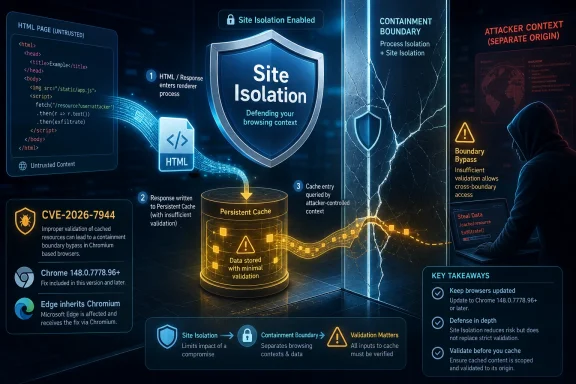
CVE-2026-7944 is described as insufficient validation of untrusted input in Chromium’s Persistent Cache. In plain English, Chrome accepted or processed data in a way it should not have, and a remote attacker who had already compromised the renderer process could use a crafted HTML page to bypass Site Isolation.
That prerequisite matters. This is not a simple drive-by bug where visiting a page immediately hands over the machine. The attacker first needs a renderer compromise — the kind of primitive usually supplied by a separate memory corruption bug in Blink, V8, WebRTC, graphics, media, or another exposed browser component.
But that prerequisite is also why the bug deserves attention. Chrome’s renderer is designed to be hostile territory. Google’s security model assumes that attackers will, from time to time, win code execution inside a renderer, and Site Isolation exists to stop that win from becoming cross-site data theft or a broader browser escape. A bug that weakens that layer is not merely “another medium.” It is a reminder that browser security is now less about a single fortress wall and more about how well the inner bulkheads hold after the first compartment floods.
That release was not a modest polish build. Google said it included 127 security fixes, with three critical vulnerabilities at the top of the advisory: an integer overflow in Blink and use-after-free flaws in Mobile and Chromoting. The volume alone changes the story for administrators. CVE-2026-7944 is one entry in a large patch train, but patch trains are how browser risk is actually delivered to enterprises.
For Windows shops, that matters twice. Chrome is everywhere, but Chromium is also the engine under Microsoft Edge, and Microsoft’s Security Response Center tracks Chromium CVEs that affect Edge even when the engineering fix originates upstream. In practice, this means the operational question is not “Did Google patch Chrome?” but “Have all Chromium-based browsers in the fleet moved past the vulnerable build line?”
The answer is often messier than the dashboard suggests. Consumer Chrome may update itself quickly. Enterprise Chrome may be held by policy. Edge may follow Microsoft’s channel cadence. VDI images, kiosks, lab machines, point-of-sale terminals, and “temporary” unmanaged systems can sit on old builds long after the headline has moved on.
The important phrase in the CVE description is “bypass site isolation.” That does not automatically mean total system compromise. It means the attacker may be able to defeat a boundary that is supposed to keep one site’s data away from another site’s compromised renderer process.
That is exactly the kind of boundary the modern web depends on. Users keep work mail, password managers, admin portals, collaboration suites, cloud consoles, banking sites, and social accounts open in adjacent tabs. The browser is not a document viewer anymore; it is the shell around most users’ daily identity.
So a Site Isolation bypass has a different flavor from a crash bug. It speaks to confidentiality and containment. If paired with a renderer exploit, it may help turn “I can run code in a sandboxed web content process” into “I can reach data or state I should not be able to reach.”
It is also a good example of why security teams should not let CVSS do all the thinking. A low score reflects the fact that the flaw requires a compromised renderer and appears to have limited direct impact on its own. It does not reflect how browser exploit chains are assembled.
Attackers rarely care whether a chain’s second or third link looks unimpressive in isolation. A renderer memory corruption bug, a sandbox weakness, a Site Isolation bypass, and a token theft opportunity may each carry different scores, but together they define the real-world incident path. CVE-2026-7944 is interesting precisely because it appears to live in that chainable middle ground.
That does not make it an emergency on the level of an actively exploited zero-day. There is no public evidence in the advisory text that CVE-2026-7944 was exploited in the wild. But it does mean that patch priority should be driven by exposure and browser criticality, not by the word “low” alone.
That makes it security-sensitive by design. If the browser stores something from the web and later reuses it, the validation rules around that object become part of the security model. If those rules are incomplete, stale, or inconsistent between components, cached state can become a confused deputy.
The CVE description does not provide enough detail to say exactly how Persistent Cache was mishandled. Google, as usual, restricts bug details while users are still updating, and the Chromium issue is permission-gated. That restraint is frustrating for researchers and defenders, but it is sensible when the bug might still be useful to attackers reverse-engineering the patch.
Even without the exploit recipe, the category is familiar. Input validation bugs in browser internals often come from assumptions about format, origin, lifetime, or trust level. The dangerous part is not that the browser saw hostile input; browsers do that constantly. The dangerous part is that some later component may have treated hostile input as already-clean browser state.
That does not mean Edge was uniquely vulnerable in some Microsoft-specific way. CVE-2026-7944 is a Chromium vulnerability. The Edge relevance comes from code inheritance and release integration. When Chromium fixes a security flaw in shared code, downstream Chromium browsers must ingest and ship the fix.
For administrators, this should collapse the artificial distinction between “browser patching” and “Windows patching.” Edge security updates, Chrome stable updates, WebView2 runtimes, and application-embedded Chromium components all sit in the same risk neighborhood. If a desktop standard image contains multiple Chromium consumers, checking only one version number is not enough.
The hard part is inventory. Edge is relatively visible through Microsoft tooling. Chrome is visible where management has been configured properly. Electron apps, bundled Chromium runtimes, and abandoned vendor packages are less visible. CVE-2026-7944 may be a Chrome CVE by name, but the broader lesson is that Chromium has become platform infrastructure.
CPEs are supposed to make vulnerability management machine-readable. In browser land, they are always trying to describe a moving target. Chrome exists on multiple platforms, Edge consumes Chromium, Chromium forks ship under other names, and application frameworks embed browser components without always mapping cleanly to the same vendor-product-version taxonomy.
This is why scanners can under-report or over-report Chromium exposure. A host may show Chrome fixed and Edge fixed but still carry a vulnerable embedded runtime. Another host may show a vulnerable CPE because an old executable remains on disk even though it is no longer launched. Vulnerability metadata is essential, but it is not the same thing as asset truth.
The practical response is to use CPE data as a starting point, not as a verdict. Security teams should correlate browser self-reported versions, package manager data, endpoint telemetry, software inventory, and actual launch paths. The closer the asset is to sensitive workflows, the less comfortable anyone should be with a single scanner field.
That said, CVE-2026-7944 is not the first link in the chain. The attacker must already have compromised the renderer. In real campaigns, that role is usually played by a separate vulnerability, sometimes an n-day quickly adapted after a patch lands, sometimes a zero-day reserved for higher-value targets.
This is where timing matters. When Google ships a 127-fix release, attackers and defenders both start diffing. Attackers look for patches that can be turned into reliable exploits against slow-moving users. Defenders look for high-risk components, exposed versions, and indicators that an issue may be easier to weaponize than the advisory implies.
For CVE-2026-7944, the right posture is not panic. It is compression of exposure time. The faster endpoints move to Chrome 148.0.7778.96 or later — and the corresponding fixed Edge build — the smaller the window for anyone to build a useful chain around the old behavior.
A Site Isolation bypass lands directly in that world. It is about whether one compromised web context can reach across boundaries that users and administrators assume are firm. Even a low-confidentiality impact can matter if the exposed data includes session state, cross-site responses, internal application fragments, or enough information to support a follow-on attack.
This is especially relevant for organizations that rely heavily on browser-based single sign-on. The stronger the identity layer becomes, the more valuable the browser session becomes. Hardware-backed authentication, conditional access, passkeys, and device compliance can reduce credential theft, but they also increase the attacker’s incentive to steal or abuse live session context.
That does not mean CVE-2026-7944 defeats those controls. It means browser containment bugs should be read through the lens of identity security, not merely endpoint hygiene. The browser is where the user is already authenticated.
A phased rollout is good engineering. It limits the blast radius of regressions and gives telemetry time to catch problems. But security teams responsible for high-risk users cannot outsource urgency to the default wave. Executives, finance teams, developers with production access, help desk staff, domain admins, and users of sensitive SaaS applications should not be waiting passively for the browser to get around to it.
This is where update rings should be sharper than they often are. A small pilot ring should move immediately, a broad production ring should follow quickly if no breakage appears, and high-risk cohorts should have an emergency path. Browser updates are frequent enough that this process must be boring, automated, and measurable.
The friction is usually not technical. It is organizational. Teams fear breaking web apps, particularly internal legacy apps that depend on undocumented behavior. That fear is rational, but it cannot become a standing exception that leaves the most exposed application in the company permanently behind.
The same logic applies to Edge. Windows users who live mostly in Edge should check Edge’s update page and restart. Those who use both browsers should update both. A patched Chrome installation does not patch Edge, and a patched Edge installation does not patch Chrome.
Users should also be wary of fake update prompts. Real Chrome and Edge updates happen through the browser’s built-in update mechanism or managed enterprise software channels, not through random web pages offering a “critical browser security patch.” Browser CVEs routinely become bait for malware campaigns, and the safest path is the dull official one.
There is no need for exotic mitigations for ordinary users if the browser is current. Disabling web features, changing obscure flags, or installing more extensions can easily make things worse. The clean answer is to move to the fixed version and keep automatic updates enabled.
That makes it a classic modern browser vulnerability. It is not a Hollywood exploit by itself. It is a component in the layered contest between attackers who assemble chains and defenders who try to keep each layer patched, monitored, and architecturally meaningful.
The most concrete actions are straightforward:
Source: NVD / Chromium Security Update Guide - Microsoft Security Response Center
 A Medium Bug Lands in the Most Important Part of the Browser
CVE-2026-7944 is described as insufficient validation of untrusted input in Chromium’s Persistent Cache. In plain English, Chrome accepted or processed data in a way it should not have, and a remote attacker who had already compromised the renderer process could use a crafted HTML page to bypass Site Isolation.That prerequisite matters. This is not a simple drive-by bug where visiting a page immediately hands over the machine. The attacker first needs a renderer compromise — the kind of primitive usually supplied by a separate memory corruption bug in Blink, V8, WebRTC, graphics, media, or another exposed browser component.
But that prerequisite is also why the bug deserves attention. Chrome’s renderer is designed to be hostile territory. Google’s security model assumes that attackers will, from time to time, win code execution inside a renderer, and Site Isolation exists to stop that win from becoming cross-site data theft or a broader browser escape. A bug that weakens that layer is not merely “another medium.” It is a reminder that browser security is now less about a single fortress wall and more about how well the inner bulkheads hold after the first compartment floods.
Chrome 148 Was a Security Release Wearing a Version Number
The fix arrived as part of Chrome 148 for desktop, promoted to the stable channel on May 5, 2026, for Windows, macOS, and Linux. Google listed Chrome 148.0.7778.96 for Linux and 148.0.7778.96/97 for Windows and macOS, with rollout over the usual days-and-weeks window.That release was not a modest polish build. Google said it included 127 security fixes, with three critical vulnerabilities at the top of the advisory: an integer overflow in Blink and use-after-free flaws in Mobile and Chromoting. The volume alone changes the story for administrators. CVE-2026-7944 is one entry in a large patch train, but patch trains are how browser risk is actually delivered to enterprises.
For Windows shops, that matters twice. Chrome is everywhere, but Chromium is also the engine under Microsoft Edge, and Microsoft’s Security Response Center tracks Chromium CVEs that affect Edge even when the engineering fix originates upstream. In practice, this means the operational question is not “Did Google patch Chrome?” but “Have all Chromium-based browsers in the fleet moved past the vulnerable build line?”
The answer is often messier than the dashboard suggests. Consumer Chrome may update itself quickly. Enterprise Chrome may be held by policy. Edge may follow Microsoft’s channel cadence. VDI images, kiosks, lab machines, point-of-sale terminals, and “temporary” unmanaged systems can sit on old builds long after the headline has moved on.
Site Isolation Is the Browser’s Blast Door, Not Its Marketing Feature
Site Isolation is one of Chrome’s most consequential security changes of the last decade. It forces pages from different sites into different processes and uses the browser process to reduce the amount of sensitive cross-site data available to a compromised renderer. It became central after Spectre made speculative side channels impossible to ignore, but its value extends beyond Spectre-style attacks.The important phrase in the CVE description is “bypass site isolation.” That does not automatically mean total system compromise. It means the attacker may be able to defeat a boundary that is supposed to keep one site’s data away from another site’s compromised renderer process.
That is exactly the kind of boundary the modern web depends on. Users keep work mail, password managers, admin portals, collaboration suites, cloud consoles, banking sites, and social accounts open in adjacent tabs. The browser is not a document viewer anymore; it is the shell around most users’ daily identity.
So a Site Isolation bypass has a different flavor from a crash bug. It speaks to confidentiality and containment. If paired with a renderer exploit, it may help turn “I can run code in a sandboxed web content process” into “I can reach data or state I should not be able to reach.”
The CVSS Score Undersells the Operational Shape of the Risk
CISA’s ADP score for CVE-2026-7944 is listed as CVSS 3.1 base 3.1, low severity, with network attack vector, high attack complexity, no privileges required, user interaction required, unchanged scope, low confidentiality impact, and no integrity or availability impact. That is a defensible score under the formula.It is also a good example of why security teams should not let CVSS do all the thinking. A low score reflects the fact that the flaw requires a compromised renderer and appears to have limited direct impact on its own. It does not reflect how browser exploit chains are assembled.
Attackers rarely care whether a chain’s second or third link looks unimpressive in isolation. A renderer memory corruption bug, a sandbox weakness, a Site Isolation bypass, and a token theft opportunity may each carry different scores, but together they define the real-world incident path. CVE-2026-7944 is interesting precisely because it appears to live in that chainable middle ground.
That does not make it an emergency on the level of an actively exploited zero-day. There is no public evidence in the advisory text that CVE-2026-7944 was exploited in the wild. But it does mean that patch priority should be driven by exposure and browser criticality, not by the word “low” alone.
Persistent Cache Is a Small Name for a Big Attack Surface
Browser cache code is not glamorous. It is the plumbing that makes pages fast, apps feel local, and repeated visits less expensive. Persistent storage is also where untrusted web content meets browser-managed state, process boundaries, origin rules, eviction logic, serialization, and performance shortcuts.That makes it security-sensitive by design. If the browser stores something from the web and later reuses it, the validation rules around that object become part of the security model. If those rules are incomplete, stale, or inconsistent between components, cached state can become a confused deputy.
The CVE description does not provide enough detail to say exactly how Persistent Cache was mishandled. Google, as usual, restricts bug details while users are still updating, and the Chromium issue is permission-gated. That restraint is frustrating for researchers and defenders, but it is sensible when the bug might still be useful to attackers reverse-engineering the patch.
Even without the exploit recipe, the category is familiar. Input validation bugs in browser internals often come from assumptions about format, origin, lifetime, or trust level. The dangerous part is not that the browser saw hostile input; browsers do that constantly. The dangerous part is that some later component may have treated hostile input as already-clean browser state.
The Microsoft Angle Is Not Cosmetic for Windows Admins
The user-supplied MSRC link is significant because Microsoft’s presence can make a Chromium bug visible to Windows administrators who might otherwise treat Chrome advisories as a Google-only matter. Edge is part of the Windows estate, ships by default, and is commonly allowed through enterprise controls even when third-party browsers are restricted.That does not mean Edge was uniquely vulnerable in some Microsoft-specific way. CVE-2026-7944 is a Chromium vulnerability. The Edge relevance comes from code inheritance and release integration. When Chromium fixes a security flaw in shared code, downstream Chromium browsers must ingest and ship the fix.
For administrators, this should collapse the artificial distinction between “browser patching” and “Windows patching.” Edge security updates, Chrome stable updates, WebView2 runtimes, and application-embedded Chromium components all sit in the same risk neighborhood. If a desktop standard image contains multiple Chromium consumers, checking only one version number is not enough.
The hard part is inventory. Edge is relatively visible through Microsoft tooling. Chrome is visible where management has been configured properly. Electron apps, bundled Chromium runtimes, and abandoned vendor packages are less visible. CVE-2026-7944 may be a Chrome CVE by name, but the broader lesson is that Chromium has become platform infrastructure.
The CPE Question Shows How Vulnerability Metadata Still Lags Reality
The NVD change history for CVE-2026-7944 shows CPE configuration added for Google Chrome versions before 148.0.7778.96 across Windows, Linux, and macOS. It also includes the familiar “Are we missing a CPE here?” prompt. That little line is more revealing than it looks.CPEs are supposed to make vulnerability management machine-readable. In browser land, they are always trying to describe a moving target. Chrome exists on multiple platforms, Edge consumes Chromium, Chromium forks ship under other names, and application frameworks embed browser components without always mapping cleanly to the same vendor-product-version taxonomy.
This is why scanners can under-report or over-report Chromium exposure. A host may show Chrome fixed and Edge fixed but still carry a vulnerable embedded runtime. Another host may show a vulnerable CPE because an old executable remains on disk even though it is no longer launched. Vulnerability metadata is essential, but it is not the same thing as asset truth.
The practical response is to use CPE data as a starting point, not as a verdict. Security teams should correlate browser self-reported versions, package manager data, endpoint telemetry, software inventory, and actual launch paths. The closer the asset is to sensitive workflows, the less comfortable anyone should be with a single scanner field.
The Real Patch Target Is the Exploit Chain
A crafted HTML page is a deceptively ordinary delivery mechanism. It means the attack surface is the web itself: a link, an ad slot, a compromised site, a malicious redirect, a phishing lure, or any other path that gets a user’s browser to render attacker-controlled content. The CVE still requires user interaction under the CVSS vector, but “user interaction” on the web is a low bar.That said, CVE-2026-7944 is not the first link in the chain. The attacker must already have compromised the renderer. In real campaigns, that role is usually played by a separate vulnerability, sometimes an n-day quickly adapted after a patch lands, sometimes a zero-day reserved for higher-value targets.
This is where timing matters. When Google ships a 127-fix release, attackers and defenders both start diffing. Attackers look for patches that can be turned into reliable exploits against slow-moving users. Defenders look for high-risk components, exposed versions, and indicators that an issue may be easier to weaponize than the advisory implies.
For CVE-2026-7944, the right posture is not panic. It is compression of exposure time. The faster endpoints move to Chrome 148.0.7778.96 or later — and the corresponding fixed Edge build — the smaller the window for anyone to build a useful chain around the old behavior.
Browser Updates Are Now Identity Protection
The old mental model treated browsers as client software. Patch them because they might crash, leak memory, or let malware run. That model is obsolete. The browser is now the control plane for identity, SaaS access, device posture checks, privileged admin consoles, and corporate data flows.A Site Isolation bypass lands directly in that world. It is about whether one compromised web context can reach across boundaries that users and administrators assume are firm. Even a low-confidentiality impact can matter if the exposed data includes session state, cross-site responses, internal application fragments, or enough information to support a follow-on attack.
This is especially relevant for organizations that rely heavily on browser-based single sign-on. The stronger the identity layer becomes, the more valuable the browser session becomes. Hardware-backed authentication, conditional access, passkeys, and device compliance can reduce credential theft, but they also increase the attacker’s incentive to steal or abuse live session context.
That does not mean CVE-2026-7944 defeats those controls. It means browser containment bugs should be read through the lens of identity security, not merely endpoint hygiene. The browser is where the user is already authenticated.
Enterprises Should Treat “Days and Weeks” as a Risk Statement
Google’s stable-channel language that updates roll out over the coming days or weeks is normal. For consumers, automatic updates are still one of the great security successes of modern software. For enterprises, that phrase should trigger a different reflex: can we prove our exposure window?A phased rollout is good engineering. It limits the blast radius of regressions and gives telemetry time to catch problems. But security teams responsible for high-risk users cannot outsource urgency to the default wave. Executives, finance teams, developers with production access, help desk staff, domain admins, and users of sensitive SaaS applications should not be waiting passively for the browser to get around to it.
This is where update rings should be sharper than they often are. A small pilot ring should move immediately, a broad production ring should follow quickly if no breakage appears, and high-risk cohorts should have an emergency path. Browser updates are frequent enough that this process must be boring, automated, and measurable.
The friction is usually not technical. It is organizational. Teams fear breaking web apps, particularly internal legacy apps that depend on undocumented behavior. That fear is rational, but it cannot become a standing exception that leaves the most exposed application in the company permanently behind.
For Home Users, the Fix Is Boring on Purpose
The consumer advice is simple: update Chrome, restart the browser, and do not assume the update applied just because the browser was open yesterday. Chrome’s updater is good, but the fixed code does not protect a running session until the browser actually restarts into the patched version.The same logic applies to Edge. Windows users who live mostly in Edge should check Edge’s update page and restart. Those who use both browsers should update both. A patched Chrome installation does not patch Edge, and a patched Edge installation does not patch Chrome.
Users should also be wary of fake update prompts. Real Chrome and Edge updates happen through the browser’s built-in update mechanism or managed enterprise software channels, not through random web pages offering a “critical browser security patch.” Browser CVEs routinely become bait for malware campaigns, and the safest path is the dull official one.
There is no need for exotic mitigations for ordinary users if the browser is current. Disabling web features, changing obscure flags, or installing more extensions can easily make things worse. The clean answer is to move to the fixed version and keep automatic updates enabled.
The Practical Reading of CVE-2026-7944 Is Narrow but Not Small
CVE-2026-7944 is not the headline-grabbing flaw in Chrome 148, and there is no public sign that it is being exploited in the wild. It is still a useful test of whether an organization understands browser risk in 2026. The bug is narrow in its prerequisite, but not small in what it touches: renderer compromise assumptions, cache trust, Site Isolation, Chromium downstreams, and patch visibility.That makes it a classic modern browser vulnerability. It is not a Hollywood exploit by itself. It is a component in the layered contest between attackers who assemble chains and defenders who try to keep each layer patched, monitored, and architecturally meaningful.
The most concrete actions are straightforward:
- Chrome on desktop should be updated to 148.0.7778.96 or later, with Windows and macOS systems also accepting the 148.0.7778.97 build where that is the delivered stable version.
- Microsoft Edge should be checked separately because Edge inherits Chromium fixes through Microsoft’s own release channel, not through Chrome’s updater.
- Administrators should verify update completion after browser restart, because a downloaded browser update does not fully protect a still-running old process.
- Vulnerability teams should not rely solely on the low CVSS score when prioritizing browser updates that affect containment layers such as Site Isolation.
- Asset inventories should include Chromium-based applications and embedded runtimes where possible, because CPE coverage rarely captures the full browser-derived attack surface.
- High-risk user groups should have a faster browser update ring than the general fleet when a large Chromium security release lands.
Source: NVD / Chromium Security Update Guide - Microsoft Security Response Center
