

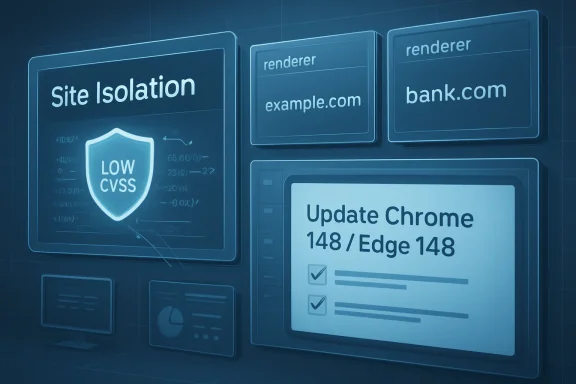
Google and Microsoft documented CVE-2026-7966 on May 6–7, 2026, as a Chromium SiteIsolation input-validation flaw fixed in Chrome 148.0.7778.96 and Microsoft Edge 148.0.7778.xxx, allowing a renderer-compromising attacker to bypass site isolation with a crafted HTML page. The important part is not the low CVSS score. It is that the bug sits inside the machinery modern browsers use to contain the damage after something else has already gone wrong. For Windows users and enterprise admins, this is another reminder that browser patching is now part of endpoint isolation strategy, not just application maintenance.
CVE-2026-7966 is not the sort of vulnerability that produces breathless “update now or be owned” copy on its own. CISA’s ADP assessment gives it a CVSS 3.1 base score of 3.1, marked Low, with high attack complexity, required user interaction, and only limited confidentiality impact. Chromium rated it Medium. That sounds almost soothing.
It should not. The description says the attacker must already have compromised the renderer process, which means this flaw is not the initial break-in. It is a possible next move after a different bug, malicious document, compromised ad path, or renderer exploit has placed the attacker inside a browser component that is supposed to be heavily boxed in.
That is the layered reality of browser exploitation in 2026. Attackers rarely want a single bug; defenders rarely survive because of a single wall. Chrome, Edge, and other Chromium-based browsers rely on a chain of mitigations: process separation, sandboxing, origin checks, memory safety improvements, exploit hardening, and rapid update channels. A flaw in SiteIsolation matters because it threatens one of the architectural promises made after the web became too hostile to trust tabs merely because they lived in the same window.
The phrase insufficient validation of untrusted input is security-advisory wallpaper. It appears so often that even experienced admins can gloss over it. But paired with SiteIsolation, it says something more specific: an input the browser should have distrusted could influence a component whose job is to keep sites separated even when active content is hostile.
The basic idea is straightforward enough. Content from different sites should be separated into different renderer processes, so a compromise in one renderer does not casually expose cross-site data from another. This model became especially prominent after speculative-execution attacks showed that memory boundaries inside a single process could not be treated as inviolable just because JavaScript was not supposed to read something.
For ordinary users, this is invisible. For admins, it is one reason modern browsers consume so much memory and why disabling security features to save resources is usually a false economy. The extra process boundaries are not there because browser engineers enjoy inefficiency. They exist because the old model — many origins sharing too much fate — became indefensible.
That is why a bypass in SiteIsolation deserves more attention than its score suggests. The bug does not mean every vulnerable Chrome or Edge install could be remotely taken over by a single click. It means one of the containment systems could be weakened after a renderer compromise, and the attacker could use a crafted HTML page to cross a boundary the browser was designed to enforce.
The scoring is not wrong. On its face, CVE-2026-7966 requires a meaningful precondition: renderer compromise. An attacker who cannot get that far cannot use this bug in the way the advisory describes. That makes it a poor candidate for panic and a poor justification for breaking change windows in environments that already run disciplined browser updates.
But CVSS is weakest when it is asked to represent exploit-chain value. A bug that is not impressive by itself can become valuable when paired with another vulnerability. Browser attacks are often composites: first gain code execution or a foothold in a renderer, then escape a sandbox, then bypass an isolation boundary, then reach credentials, cookies, local files, intranet resources, or cross-origin data.
That is the useful reading here. CVE-2026-7966 is not a house fire; it is a missing fire door. Nobody should describe it as a standalone catastrophe. Nobody responsible for a fleet should ignore it merely because the numerical score looks small.
For WindowsForum readers, the Microsoft angle is practical. Edge is not an optional third-party browser in many Windows environments. It is integrated into Windows workflows, Microsoft 365 authentication journeys, enterprise policy baselines, WebView2-dependent applications, and the management expectations of Microsoft shops. A Chromium bug therefore becomes an Edge bug operationally, even when the root fix lands upstream.
The MSRC page lists Microsoft Edge as the affected product family with customer action required and a fixed build number in the 148.0.7778.xxx line. That is exactly how Chromium vulnerabilities often arrive in Microsoft land: not as Patch Tuesday centerpieces, but as browser-channel updates that sit adjacent to the monthly Windows servicing rhythm. Organizations that treat Edge updates as background noise are accepting a different patch cadence than the one the product actually needs.
This matters because browser updates are now among the fastest-moving security dependencies on a Windows endpoint. The old mental model — Windows gets patched monthly, browsers update when convenient — is obsolete. Edge, Chrome, and WebView2 move on a web-security clock, not a traditional OS-servicing clock.
Reporting around the release noted a much broader security update, with more than 100 fixes and several critical vulnerabilities elsewhere in the browser stack. That context changes how admins should think about this individual CVE. CVE-2026-7966 may be Medium or Low depending on which severity system you are looking at, but it is traveling in a train of browser fixes that includes far more urgent defects.
That is one reason single-CVE triage can be misleading for browsers. If a scanner flags CVE-2026-7966, the right response is not to debate this one bug in isolation for three meetings. The right response is to ask whether the browser is on the fixed Chrome or Edge 148 build line and whether the update mechanism is functioning across the fleet.
There is also the detail-release problem. Google commonly restricts access to bug details until a majority of users have updated. That is not secrecy for its own sake; it is damage control. Once a patch is public, attackers can diff, infer, and experiment. The gap between disclosure and full deployment is where “medium” browser bugs can become much more interesting to the wrong people.
But renderer compromise is not a theoretical condition in the browser threat model. Renderers process HTML, CSS, JavaScript, images, fonts, media, WebAssembly, and an ever-expanding collection of APIs that websites use to behave like applications. They are precisely where attackers spend enormous effort because they are exposed to untrusted content all day.
Modern Chromium architecture assumes renderers can be compromised. That is the point of sandboxing and process isolation. If a renderer falls, the browser should still prevent the attacker from reading data belonging to another site, reaching privileged browser components, or escaping into the operating system.
A SiteIsolation bypass therefore lives in the after breach, before damage zone. It is a containment issue. In enterprise risk terms, that makes it relevant to blast radius. It may not increase the odds that an attacker can get an initial foothold, but it may affect what the attacker can learn or reach once that foothold exists.
The web’s security model is built on the idea that hostile input can be rendered safely. A user can visit a news site, a supplier portal, a compromised WordPress page, a shared dashboard, or a malicious link in a chat message, and the browser will ingest a complicated document full of active content while enforcing boundaries. That is a heroic assumption, and the browser industry spends much of its engineering budget trying to make it true.
CVE-2026-7966 is a small failure inside that assumption. The problem is not that HTML exists; it is that browser components must continuously decide which process, origin, site, and security context should handle what. If validation is incomplete in the wrong place, a document can nudge the browser into a state its designers did not intend.
This is also why user training has limited value against this class of bug. Yes, user interaction is required in the scoring vector. But “do not visit malicious pages” is not a control; it is a wish. In a world of compromised legitimate sites, ad-tech supply chains, phishing links, and collaboration tools, patching the parser and isolation machinery is the control.
That backend bookkeeping matters more than many practitioners admit. Vulnerability scanners, asset systems, SBOM tools, and patch dashboards depend on CPE mappings to decide whether a given system is affected. When mappings are missing, late, broad, or awkwardly structured, the vulnerability-management layer can mislead teams in either direction.
The user-facing question — “Are we missing a CPE here?” — is not just an NVD page artifact. It captures a real operational problem. Chromium is not a single product in the field. It is a codebase consumed by Chrome, Edge, Brave, Vivaldi, Electron apps, embedded browsers, WebView frameworks, Linux distributions, and platform-specific packaging systems. A CVE can begin in Chromium but reach users through many products with different versioning schemes and update responsibilities.
For this specific case, Microsoft’s listing helps by tying the Chromium issue to Edge and its fixed 148.0.7778.xxx build line. But the broader CPE ecosystem remains imperfect. If an organization depends entirely on CPE matching to know whether it is safe, it will miss the messy middle where Chromium code is present but the product name is not “Google Chrome.”
On Windows, WebView2 has become the quiet substrate for many modern desktop experiences. Developers use it because it lets applications render web content with the Edge engine rather than shipping a full custom browser stack. That is often a security win, provided the runtime updates correctly and administrators actually monitor it.
The challenge is inventory. A fleet may have Chrome, Edge, WebView2 Runtime, Electron-based collaboration apps, password managers with embedded web views, vendor support tools, and internal applications that all depend on Chromium-derived components in different ways. Not every Chromium CVE applies to every consumer of the codebase, but assuming “we patched Edge, therefore we patched Chromium everywhere” is too neat.
CVE-2026-7966 is a good prompt for that audit. SiteIsolation behavior may vary depending on the embedding context, feature flags, and product choices. Still, the larger lesson stands: organizations need to know where Chromium lives, not merely which browser is pinned to the taskbar.
Enterprises usually solve this with update rings: canary, pilot, broad deployment, and exception handling. That model works only if the rings are short enough for browser risk. A thirty-day browser patch cycle may feel disciplined in a legacy desktop-management world, but it is slow when public exploit research can begin as soon as patched code ships.
The right target is not reckless instant deployment everywhere. Browser updates can break line-of-business applications, authentication flows, extensions, printing workflows, and kiosk deployments. But the default should be rapid adoption with fast rollback capability, not slow adoption with slow discovery.
For home users, the message is simpler. Open the browser’s About page and let the updater do its job. For managed Windows environments, the message is less charming: prove that your Edge and Chrome policies are not silently pinning machines to vulnerable builds because an exception created six months ago was never removed.
That is why SiteIsolation remains such an important battleground. Attackers do not need every boundary to fail. They need one chain that moves them from untrusted content to valuable data. Defenders, meanwhile, need a chain of boundaries to hold even when one piece fails.
CVE-2026-7966 appears to sit on the defensive side of that contest. It is not the flashy exploit primitive; it is the defensive assumption under stress. If the renderer is compromised, SiteIsolation should keep different sites apart. A bypass means that assumption needed correction.
This is also why browser vendors’ habit of shipping frequent security fixes is not evidence that browsers are uniquely bad. It is evidence that browsers are uniquely exposed and aggressively maintained. A product that parses the public internet for billions of users will always produce a steady flow of CVEs. The question is whether the update pipeline is fast enough to turn those CVEs into closed windows rather than open doors.
The MSRC entry for CVE-2026-7966 makes the point indirectly. Microsoft did not discover or assign the Chromium CVE, but it documented the issue because Edge consumes the affected open-source code. That is the correct supply-chain posture. Customers should mirror it by tracking Edge security releases with the same seriousness they apply to Windows cumulative updates.
Group Policy, Intune, Configuration Manager, browser update policies, and enterprise extension controls all matter here. A browser can be current on paper but weakened by risky extensions, disabled isolation features, unmanaged flags, or stale embedded runtimes. Version compliance is necessary, not sufficient.
The practical check is boring and therefore often skipped. Confirm the installed Edge build, confirm Chrome where present, confirm WebView2 Runtime servicing, confirm update channels, and confirm that security exceptions have owners and expiration dates. The organizations that do this well will not have dramatic stories to tell about CVE-2026-7966. That is the point.
The harder part is proving coverage. In a mixed environment, Chrome may be updated by Google Update, enterprise software distribution, Linux package management, Snap packaging, or manual user action. Edge may be updated by Edge Update, WSUS-adjacent enterprise practices, Intune policies, or offline installers in constrained networks. Some VDI and kiosk images may be reverted every session unless the base image is updated.
Linux adds another wrinkle. Ubuntu’s security page marks its chromium-browser package as not affected across several releases because modern Ubuntu chromium-browser packaging is effectively a path to the Chromium snap rather than a traditional distro-maintained browser package. That is accurate in its own ecosystem, but it illustrates why vulnerability status depends on packaging reality, not just upstream names.
The big trap is assuming the scanner’s silence equals safety. If the scanner recognizes Google Chrome but not a Chromium-based vendor app, or sees Edge but not WebView2, the dashboard may look cleaner than the endpoint actually is. CVE-2026-7966 is not the worst-case example of that problem, but it is a useful rehearsal.
A low-scored SiteIsolation bypass in a browser deserves a different treatment from a low-scored issue in an obscure local utility. Browser bugs are exposed to untrusted input at scale. They are frequently chained. They sit in products that users interact with all day. They also have unusually mature update mechanisms, which lowers the cost of remediation compared with many enterprise applications.
That does not mean CVE-2026-7966 should outrank every critical server vulnerability. It means it should be swept up promptly in normal browser update operations and not deferred because it lacks drama. The operational question is not “Is this the scariest CVE of the week?” It is “Why would we leave a browser isolation fix unapplied once a stable update exists?”
This distinction matters for security culture. Good patch management is not a series of heroic emergency responses. It is the routine elimination of known weaknesses before they become convenient links in someone else’s exploit chain.
Source: NVD / Chromium Security Update Guide - Microsoft Security Response Center
 The Browser Sandbox Is Only as Strong as Its Boring Middle Layers
CVE-2026-7966 is not the sort of vulnerability that produces breathless “update now or be owned” copy on its own. CISA’s ADP assessment gives it a CVSS 3.1 base score of 3.1, marked Low, with high attack complexity, required user interaction, and only limited confidentiality impact. Chromium rated it Medium. That sounds almost soothing.It should not. The description says the attacker must already have compromised the renderer process, which means this flaw is not the initial break-in. It is a possible next move after a different bug, malicious document, compromised ad path, or renderer exploit has placed the attacker inside a browser component that is supposed to be heavily boxed in.
That is the layered reality of browser exploitation in 2026. Attackers rarely want a single bug; defenders rarely survive because of a single wall. Chrome, Edge, and other Chromium-based browsers rely on a chain of mitigations: process separation, sandboxing, origin checks, memory safety improvements, exploit hardening, and rapid update channels. A flaw in SiteIsolation matters because it threatens one of the architectural promises made after the web became too hostile to trust tabs merely because they lived in the same window.
The phrase insufficient validation of untrusted input is security-advisory wallpaper. It appears so often that even experienced admins can gloss over it. But paired with SiteIsolation, it says something more specific: an input the browser should have distrusted could influence a component whose job is to keep sites separated even when active content is hostile.
Site Isolation Was Built for the World We Actually Got
Site Isolation was not invented as a nice-to-have browser tidiness feature. It became central because the web stopped being a collection of pages and became a runtime for banking, identity, messaging, line-of-business portals, admin consoles, SaaS dashboards, and device-management interfaces. The browser is now the front door to almost everything worth stealing.The basic idea is straightforward enough. Content from different sites should be separated into different renderer processes, so a compromise in one renderer does not casually expose cross-site data from another. This model became especially prominent after speculative-execution attacks showed that memory boundaries inside a single process could not be treated as inviolable just because JavaScript was not supposed to read something.
For ordinary users, this is invisible. For admins, it is one reason modern browsers consume so much memory and why disabling security features to save resources is usually a false economy. The extra process boundaries are not there because browser engineers enjoy inefficiency. They exist because the old model — many origins sharing too much fate — became indefensible.
That is why a bypass in SiteIsolation deserves more attention than its score suggests. The bug does not mean every vulnerable Chrome or Edge install could be remotely taken over by a single click. It means one of the containment systems could be weakened after a renderer compromise, and the attacker could use a crafted HTML page to cross a boundary the browser was designed to enforce.
The Low Score Tells the Truth, but Not the Whole Truth
The CVSS vector attached by CISA-ADP is almost modest: network attack vector, high complexity, no privileges required, user interaction required, unchanged scope, low confidentiality impact, and no integrity or availability impact. In a vulnerability-management dashboard, that lands far below the critical remote-code-execution bugs that dominate weekly triage meetings.The scoring is not wrong. On its face, CVE-2026-7966 requires a meaningful precondition: renderer compromise. An attacker who cannot get that far cannot use this bug in the way the advisory describes. That makes it a poor candidate for panic and a poor justification for breaking change windows in environments that already run disciplined browser updates.
But CVSS is weakest when it is asked to represent exploit-chain value. A bug that is not impressive by itself can become valuable when paired with another vulnerability. Browser attacks are often composites: first gain code execution or a foothold in a renderer, then escape a sandbox, then bypass an isolation boundary, then reach credentials, cookies, local files, intranet resources, or cross-origin data.
That is the useful reading here. CVE-2026-7966 is not a house fire; it is a missing fire door. Nobody should describe it as a standalone catastrophe. Nobody responsible for a fleet should ignore it merely because the numerical score looks small.
Microsoft’s Edge Entry Is a Supply-Chain Footnote With Real Operational Consequences
The Microsoft Security Response Center entry is terse because the bug belongs to Chromium. Microsoft’s role is downstream: Edge consumes Chromium, Chromium addressed the vulnerability, and the latest Microsoft Edge build is no longer vulnerable. That wording can make these advisories feel administrative, as if they are catalog entries rather than security events.For WindowsForum readers, the Microsoft angle is practical. Edge is not an optional third-party browser in many Windows environments. It is integrated into Windows workflows, Microsoft 365 authentication journeys, enterprise policy baselines, WebView2-dependent applications, and the management expectations of Microsoft shops. A Chromium bug therefore becomes an Edge bug operationally, even when the root fix lands upstream.
The MSRC page lists Microsoft Edge as the affected product family with customer action required and a fixed build number in the 148.0.7778.xxx line. That is exactly how Chromium vulnerabilities often arrive in Microsoft land: not as Patch Tuesday centerpieces, but as browser-channel updates that sit adjacent to the monthly Windows servicing rhythm. Organizations that treat Edge updates as background noise are accepting a different patch cadence than the one the product actually needs.
This matters because browser updates are now among the fastest-moving security dependencies on a Windows endpoint. The old mental model — Windows gets patched monthly, browsers update when convenient — is obsolete. Edge, Chrome, and WebView2 move on a web-security clock, not a traditional OS-servicing clock.
Chrome 148 Was Not a One-Bug Release
CVE-2026-7966 arrived as part of the Chrome 148 stable-channel release for desktop, with Chrome 148.0.7778.96 for Linux and 148.0.7778.96/97 for Windows and macOS. Google’s stable-channel post said the release would roll out over the coming days and weeks, which is normal phrasing but important for defenders who assume “released” means “installed everywhere.”Reporting around the release noted a much broader security update, with more than 100 fixes and several critical vulnerabilities elsewhere in the browser stack. That context changes how admins should think about this individual CVE. CVE-2026-7966 may be Medium or Low depending on which severity system you are looking at, but it is traveling in a train of browser fixes that includes far more urgent defects.
That is one reason single-CVE triage can be misleading for browsers. If a scanner flags CVE-2026-7966, the right response is not to debate this one bug in isolation for three meetings. The right response is to ask whether the browser is on the fixed Chrome or Edge 148 build line and whether the update mechanism is functioning across the fleet.
There is also the detail-release problem. Google commonly restricts access to bug details until a majority of users have updated. That is not secrecy for its own sake; it is damage control. Once a patch is public, attackers can diff, infer, and experiment. The gap between disclosure and full deployment is where “medium” browser bugs can become much more interesting to the wrong people.
The Renderer Compromise Requirement Is a Warning Label, Not a Comfort Blanket
The advisory’s most important clause is the one that may tempt readers to relax: the attacker had to have compromised the renderer process. In ordinary English, that means CVE-2026-7966 is not described as a first-click takeover. Something else has to get the attacker into the renderer first.But renderer compromise is not a theoretical condition in the browser threat model. Renderers process HTML, CSS, JavaScript, images, fonts, media, WebAssembly, and an ever-expanding collection of APIs that websites use to behave like applications. They are precisely where attackers spend enormous effort because they are exposed to untrusted content all day.
Modern Chromium architecture assumes renderers can be compromised. That is the point of sandboxing and process isolation. If a renderer falls, the browser should still prevent the attacker from reading data belonging to another site, reaching privileged browser components, or escaping into the operating system.
A SiteIsolation bypass therefore lives in the after breach, before damage zone. It is a containment issue. In enterprise risk terms, that makes it relevant to blast radius. It may not increase the odds that an attacker can get an initial foothold, but it may affect what the attacker can learn or reach once that foothold exists.
Crafted HTML Still Carries an Uncomfortable Amount of Power
The exploit delivery described here is a crafted HTML page. That sounds almost quaint compared with malware loaders, signed driver abuse, cloud token theft, or kernel exploitation. Yet crafted web content remains one of the most efficient attack surfaces on the planet because everyone’s browser is expected to parse it.The web’s security model is built on the idea that hostile input can be rendered safely. A user can visit a news site, a supplier portal, a compromised WordPress page, a shared dashboard, or a malicious link in a chat message, and the browser will ingest a complicated document full of active content while enforcing boundaries. That is a heroic assumption, and the browser industry spends much of its engineering budget trying to make it true.
CVE-2026-7966 is a small failure inside that assumption. The problem is not that HTML exists; it is that browser components must continuously decide which process, origin, site, and security context should handle what. If validation is incomplete in the wrong place, a document can nudge the browser into a state its designers did not intend.
This is also why user training has limited value against this class of bug. Yes, user interaction is required in the scoring vector. But “do not visit malicious pages” is not a control; it is a wish. In a world of compromised legitimate sites, ad-tech supply chains, phishing links, and collaboration tools, patching the parser and isolation machinery is the control.
NVD’s CPE Trail Shows the Messiness Behind Clean Dashboards
The NVD change history for CVE-2026-7966 shows an initial analysis that added a Chrome CPE configuration for versions before 148.0.7778.96, combined with platform CPEs for Windows, Linux, and macOS. It also shows the CVE moving from Chrome’s submission to CISA-ADP scoring and NIST enrichment on the same day.That backend bookkeeping matters more than many practitioners admit. Vulnerability scanners, asset systems, SBOM tools, and patch dashboards depend on CPE mappings to decide whether a given system is affected. When mappings are missing, late, broad, or awkwardly structured, the vulnerability-management layer can mislead teams in either direction.
The user-facing question — “Are we missing a CPE here?” — is not just an NVD page artifact. It captures a real operational problem. Chromium is not a single product in the field. It is a codebase consumed by Chrome, Edge, Brave, Vivaldi, Electron apps, embedded browsers, WebView frameworks, Linux distributions, and platform-specific packaging systems. A CVE can begin in Chromium but reach users through many products with different versioning schemes and update responsibilities.
For this specific case, Microsoft’s listing helps by tying the Chromium issue to Edge and its fixed 148.0.7778.xxx build line. But the broader CPE ecosystem remains imperfect. If an organization depends entirely on CPE matching to know whether it is safe, it will miss the messy middle where Chromium code is present but the product name is not “Google Chrome.”
The Enterprise Blind Spot Is WebView2 and Chromium in Places Nobody Audits
Chrome and Edge are the easy part. They have visible version numbers, update services, enterprise policies, and scanner plugins. The harder part is Chromium-derived code embedded in applications that users do not think of as browsers.On Windows, WebView2 has become the quiet substrate for many modern desktop experiences. Developers use it because it lets applications render web content with the Edge engine rather than shipping a full custom browser stack. That is often a security win, provided the runtime updates correctly and administrators actually monitor it.
The challenge is inventory. A fleet may have Chrome, Edge, WebView2 Runtime, Electron-based collaboration apps, password managers with embedded web views, vendor support tools, and internal applications that all depend on Chromium-derived components in different ways. Not every Chromium CVE applies to every consumer of the codebase, but assuming “we patched Edge, therefore we patched Chromium everywhere” is too neat.
CVE-2026-7966 is a good prompt for that audit. SiteIsolation behavior may vary depending on the embedding context, feature flags, and product choices. Still, the larger lesson stands: organizations need to know where Chromium lives, not merely which browser is pinned to the taskbar.
Update Cadence Has Become a Security Boundary
The Chrome 148 release language says the update rolls out over days and weeks. That is acceptable for consumer convenience but awkward for enterprise risk management. A staged rollout reduces the blast radius of bad updates, but it also creates a temporary population of systems that are publicly known to be behind.Enterprises usually solve this with update rings: canary, pilot, broad deployment, and exception handling. That model works only if the rings are short enough for browser risk. A thirty-day browser patch cycle may feel disciplined in a legacy desktop-management world, but it is slow when public exploit research can begin as soon as patched code ships.
The right target is not reckless instant deployment everywhere. Browser updates can break line-of-business applications, authentication flows, extensions, printing workflows, and kiosk deployments. But the default should be rapid adoption with fast rollback capability, not slow adoption with slow discovery.
For home users, the message is simpler. Open the browser’s About page and let the updater do its job. For managed Windows environments, the message is less charming: prove that your Edge and Chrome policies are not silently pinning machines to vulnerable builds because an exception created six months ago was never removed.
Site Isolation Bugs Are Small Windows Into a Larger Browser War
The modern browser is a containment platform pretending to be an application. It renders pages, but it also brokers identity, runs untrusted code, stores secrets, mediates device access, syncs data, enforces enterprise policy, and increasingly hosts AI-enhanced workflows. Every one of those roles increases the value of crossing an internal boundary.That is why SiteIsolation remains such an important battleground. Attackers do not need every boundary to fail. They need one chain that moves them from untrusted content to valuable data. Defenders, meanwhile, need a chain of boundaries to hold even when one piece fails.
CVE-2026-7966 appears to sit on the defensive side of that contest. It is not the flashy exploit primitive; it is the defensive assumption under stress. If the renderer is compromised, SiteIsolation should keep different sites apart. A bypass means that assumption needed correction.
This is also why browser vendors’ habit of shipping frequent security fixes is not evidence that browsers are uniquely bad. It is evidence that browsers are uniquely exposed and aggressively maintained. A product that parses the public internet for billions of users will always produce a steady flow of CVEs. The question is whether the update pipeline is fast enough to turn those CVEs into closed windows rather than open doors.
Windows Admins Should Treat Edge as a First-Class Security Product
There is still a tendency in some Windows environments to think of Edge as a default app rather than a security-sensitive platform. That view is outdated. Edge inherits Chromium’s security posture, participates in Microsoft’s enterprise management stack, and often serves as the access layer for Microsoft 365, Entra-authenticated apps, SaaS tools, and internal portals.The MSRC entry for CVE-2026-7966 makes the point indirectly. Microsoft did not discover or assign the Chromium CVE, but it documented the issue because Edge consumes the affected open-source code. That is the correct supply-chain posture. Customers should mirror it by tracking Edge security releases with the same seriousness they apply to Windows cumulative updates.
Group Policy, Intune, Configuration Manager, browser update policies, and enterprise extension controls all matter here. A browser can be current on paper but weakened by risky extensions, disabled isolation features, unmanaged flags, or stale embedded runtimes. Version compliance is necessary, not sufficient.
The practical check is boring and therefore often skipped. Confirm the installed Edge build, confirm Chrome where present, confirm WebView2 Runtime servicing, confirm update channels, and confirm that security exceptions have owners and expiration dates. The organizations that do this well will not have dramatic stories to tell about CVE-2026-7966. That is the point.
The Patch Is Straightforward; the Inventory Is Not
For Chrome, the fixed baseline is 148.0.7778.96 or later on Linux and 148.0.7778.96/97 or later on Windows and macOS, depending on the platform build served. For Edge, Microsoft’s advisory points to the 148.0.7778.xxx fixed line. Those numbers are the easy part.The harder part is proving coverage. In a mixed environment, Chrome may be updated by Google Update, enterprise software distribution, Linux package management, Snap packaging, or manual user action. Edge may be updated by Edge Update, WSUS-adjacent enterprise practices, Intune policies, or offline installers in constrained networks. Some VDI and kiosk images may be reverted every session unless the base image is updated.
Linux adds another wrinkle. Ubuntu’s security page marks its chromium-browser package as not affected across several releases because modern Ubuntu chromium-browser packaging is effectively a path to the Chromium snap rather than a traditional distro-maintained browser package. That is accurate in its own ecosystem, but it illustrates why vulnerability status depends on packaging reality, not just upstream names.
The big trap is assuming the scanner’s silence equals safety. If the scanner recognizes Google Chrome but not a Chromium-based vendor app, or sees Edge but not WebView2, the dashboard may look cleaner than the endpoint actually is. CVE-2026-7966 is not the worst-case example of that problem, but it is a useful rehearsal.
The CVSS Number Should Not Decide the Patch Window Alone
Security teams have spent years trying to escape vulnerability overload by prioritizing CVEs with scores, exploitability signals, asset criticality, and exposure. That is necessary. It is also dangerous when the score becomes a substitute for judgment.A low-scored SiteIsolation bypass in a browser deserves a different treatment from a low-scored issue in an obscure local utility. Browser bugs are exposed to untrusted input at scale. They are frequently chained. They sit in products that users interact with all day. They also have unusually mature update mechanisms, which lowers the cost of remediation compared with many enterprise applications.
That does not mean CVE-2026-7966 should outrank every critical server vulnerability. It means it should be swept up promptly in normal browser update operations and not deferred because it lacks drama. The operational question is not “Is this the scariest CVE of the week?” It is “Why would we leave a browser isolation fix unapplied once a stable update exists?”
This distinction matters for security culture. Good patch management is not a series of heroic emergency responses. It is the routine elimination of known weaknesses before they become convenient links in someone else’s exploit chain.
The Quiet SiteIsolation Fix Leaves a Loud Checklist
CVE-2026-7966 is a modest advisory with a larger message: Chromium’s internal boundaries are part of the endpoint security model, and they need the same disciplined care as operating-system patches. The immediate response should be calm, verifiable, and quick.- Chrome desktop installations should be updated to 148.0.7778.96 or later, with Windows and macOS systems accepting the 148.0.7778.96/97 fixed builds served through the stable channel.
- Microsoft Edge installations should be moved to the 148.0.7778.xxx fixed line identified by Microsoft, rather than waiting for the next convenient monthly Windows patch cycle.
- Administrators should verify update policy health across Chrome, Edge, and WebView2 Runtime instead of relying on user restarts or staged rollout assumptions.
- Vulnerability teams should treat the low CVSS score as context, not permission to ignore a browser containment flaw that can matter inside an exploit chain.
- Asset owners should look beyond the obvious browsers and identify Chromium-derived components inside applications, kiosks, VDI images, and managed runtimes.
Source: NVD / Chromium Security Update Guide - Microsoft Security Response Center
