

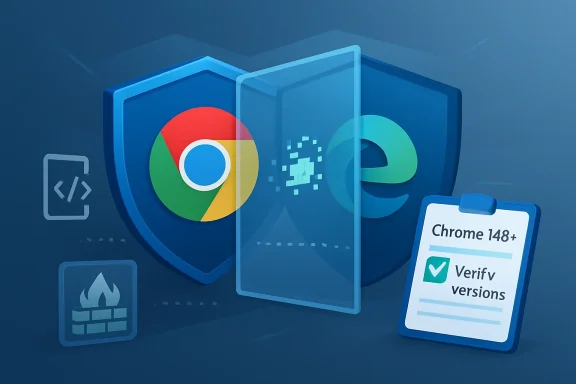
The Low-Severity Label Hides a High-Value Boundary
CVE-2026-8010 lives in SiteIsolation, one of Chrome’s most important post-Spectre security investments. Site isolation is the browser’s attempt to turn the web’s chaotic mix of tabs, frames, origins, and embedded content into separate process boundaries that attackers cannot casually cross.
That makes this bug more interesting than its “low” Chromium severity suggests. The flaw is not described as a standalone remote-code-execution bug. It requires the attacker to have already compromised the renderer process, which is a major precondition and explains why Chrome’s own rating is restrained.
But the browser security model is built in layers, and renderer compromise is not hypothetical in the real world. Memory corruption bugs in Blink, V8, graphics libraries, media parsers, and WebRTC have repeatedly given attackers the first stage they need. Once that happens, the difference between “contained in a renderer” and “able to pierce site isolation” becomes the difference between a contained incident and a much more useful exploit chain.
That is why defenders should read this CVE less as a fire alarm and more as a structural warning. The vulnerability sits at the seam between compromise and containment. Bugs at that seam do not always start attacks, but they can decide how far attacks go.
Chrome 148 Was Not a Routine Patch Drop
The fix arrived in Chrome 148.0.7778.96 for Linux and 148.0.7778.96/97 for Windows and macOS, part of a broader stable-channel release that patched a large batch of security issues. Google’s initial release note for Chrome 148 framed the update as a normal stable promotion, but the security metadata that followed made clear that this was a heavy patch train.
That matters because CVE-2026-8010 is not being patched in isolation. It arrives alongside critical and high-severity bugs that are much easier for security teams to prioritize on paper. In any realistic patch meeting, a low-severity SiteIsolation bypass risks being drowned out by remote code execution, use-after-free, or integer overflow flaws.
That would be a mistake. Browser exploitation is rarely a single-CVE morality play. Attackers combine primitives: one bug to run code, another to escape a sandbox, another to cross a boundary, another to persist or steal. A low-rated bypass can become strategically important when it is paired with a higher-rated bug elsewhere in the same release.
This is the uncomfortable truth behind modern browser advisories: the CVSS score is useful, but it is not a map of exploit value. A vulnerability that requires a compromised renderer may be less urgent than a drive-by renderer exploit, but it is exactly the kind of bug sophisticated operators look for after the first door has opened.
Site Isolation Is the Browser’s Internal Firewall
Site isolation is often explained as a performance-costly security feature, but that undersells it. It is closer to an internal firewall for the browser, keeping content from different sites in separate renderer processes so that a compromised process cannot freely inspect or manipulate sensitive cross-site data.
The need for this model became painfully obvious after Spectre-class attacks showed that process boundaries mattered even inside the browser. Same-origin policy had long been the conceptual boundary of the web. Site isolation tried to make that boundary harder by backing it with operating-system process separation.
CVE-2026-8010 is described as “insufficient validation of untrusted input” in that machinery. That phrasing is broad, but the attack shape is revealing: a remote attacker, after compromising the renderer, could use a crafted HTML page to bypass site isolation. In plain English, a malicious page could exploit bad assumptions in the browser’s isolation logic once the attacker already had a foothold.
That is not a casual phishing bug. It is a second-stage security-control bypass. The attacker needs user interaction, according to CISA’s CVSS vector, and the confidentiality, integrity, and availability impacts are each scored low. Still, the “low-low-low” impact pattern should not be mistaken for irrelevance. In a browser, reading the wrong cross-site data or influencing the wrong frame can be enough to turn a limited compromise into account theft or session abuse.
The deeper issue is that site isolation is supposed to remain dependable even when renderers are hostile. Chrome’s architecture assumes renderer processes are risky places. If a renderer compromise can confuse the isolation layer, the bug cuts against one of the browser’s central defensive assumptions.
Microsoft Edge Inherits the Chromium Weather
The user-facing product name may be Microsoft Edge, but the security weather system here is Chromium. When a Chromium vulnerability lands in Chrome, Edge administrators have to ask two questions: whether Edge is affected and when Microsoft’s Chromium-based browser receives the corresponding fix.
Microsoft’s Security Update Guide entry for CVE-2026-8010 is therefore not just a courtesy mirror. It is part of the operational handoff from Google’s upstream browser project to Microsoft’s enterprise browser estate. Edge has become a Windows-native product in branding, policy integration, and management experience, but its rendering engine makes it part of the same vulnerability stream.
This is why Windows administrators cannot treat Chrome advisories as “some other browser’s problem.” Many organizations run both Chrome and Edge. Some standardize on Edge but still allow Chrome for developer workflows, SaaS compatibility, or user preference. Others think they have standardized, only to discover unmanaged Chromium variants during inventory.
CVE-2026-8010 is a good example of why browser inventory should be boring and automated. If your vulnerability scanner sees Chrome before 148.0.7778.96, the answer is straightforward: update. If your estate includes Edge, Brave, Opera, Vivaldi, Electron apps, or embedded Chromium components, the answer becomes more complicated. The Chromium patch does not magically secure every downstream consumer at the same moment.
For WindowsForum readers, the practical lesson is blunt: “Chromium-based” is not a single patch state. It is a family resemblance. Every vendor has to ship, every updater has to run, and every managed endpoint has to receive the build.
The CPE Confusion Is a Symptom, Not the Disease
The NVD entry’s affected software configuration is notable because it ties vulnerable Google Chrome versions before 148.0.7778.96 to Windows, Linux, and macOS platform CPEs. That kind of CPE expression often looks odd to practitioners because Chrome is the vulnerable application, while the operating systems are merely the platforms on which vulnerable builds run.
This is why “Are we missing a CPE?” is not just a bureaucratic question. Vulnerability management depends on these identifiers for matching, prioritization, reporting, and compliance dashboards. If the CPE expression is too broad, scanners can generate noise. If it is too narrow, assets fall through the cracks.
In this case, the operational truth is simpler than the metadata. Chrome before 148.0.7778.96 is vulnerable on supported desktop platforms. Windows, Linux, and macOS matter because those are the platforms covered by the desktop stable update. The OS is the stage, not the flaw.
Still, defenders should pay attention to metadata drift. NVD initially had no NIST CVSS score for the vulnerability, while CISA’s ADP enrichment supplied a CVSS 3.1 score of 6.3, medium severity. That discrepancy is not scandalous; it is how vulnerability databases behave in the first days after disclosure. But it does mean automated prioritization can swing as enrichment catches up.
For enterprise teams, this argues against blindly trusting a single feed in the first 24 to 72 hours. Chrome’s vendor severity, CISA’s enrichment, NVD’s CPE modeling, scanner plugin logic, and MSRC’s Edge mapping can all arrive on slightly different clocks. The patch is usually clearer than the paperwork.
The Renderer Precondition Is Comforting Until It Is Not
The most important phrase in the description is “who had compromised the renderer process.” That condition prevents CVE-2026-8010 from being a simple drive-by nightmare. The attacker first needs another vulnerability, a malicious extension scenario, or some other path to make the renderer hostile.
That is real mitigation. Browser teams design around exploit chains, and a bug that cannot be reached until after renderer compromise deserves a different priority than one that directly gives code execution from a web page. Security severity is supposed to reflect those preconditions.
But this is also where enterprise risk models often become too tidy. Attackers do not care whether their chain is made of one CVE or three. If Chrome 148 patched more than 100 vulnerabilities, including severe renderer-adjacent issues, defenders should assume that at least some attackers will study the release as a menu of chainable opportunities.
A SiteIsolation bypass can be valuable even if it does not deliver native code execution. It may help an attacker read data across boundaries, manipulate assumptions about origins, or reduce the reliability of containment. The phrase “crafted HTML page” should also keep defenders honest: the delivery vehicle is the web itself, not a rare local attack surface.
The right mental model is not “low means ignore.” It is “low means this probably needs a partner.” In browser security, partner bugs are not rare.
Patch Cadence Has Become the Browser Security Model
Chrome’s stable-channel rhythm is now one of the internet’s quietest but most important security systems. The browser updates constantly because the browser is where untrusted code, identity tokens, documents, video, conferencing, password managers, and enterprise SaaS all collide.
That cadence creates frustration for users and administrators. Chrome and Edge seem to update forever. Kiosk devices fall behind. VDI images fossilize. Change freezes collide with browser release trains. Some organizations still treat browsers as desktop applications rather than as exposed security infrastructure.
CVE-2026-8010 argues for the opposite view. The browser is not an app in the old sense. It is a programmable runtime facing the public internet, carrying privileged access to the user’s authenticated life. If a firewall, VPN appliance, or email gateway shipped a boundary-bypass fix, security teams would not shrug because the vendor called it low.
The difference is that browser patching has been normalized to the point of invisibility. Automatic updates make consumers safer, but they can also lull enterprises into assuming the problem solved itself. In managed Windows environments, update policy, restart behavior, background services, user privilege, and application control can all interfere with the clean story.
That is why the most mature browser programs measure deployed version, not merely configured policy. “Auto-update enabled” is a hope. “Every active Chrome and Edge instance is at or above the fixed build” is evidence.
Windows Shops Need to Look Beyond the Chrome Icon
The obvious remediation is to update Chrome to 148.0.7778.96 or later, and to ensure Windows and macOS systems receive 148.0.7778.96/97 where appropriate. But Windows environments have a broader Chromium problem than the Chrome desktop shortcut.
Microsoft Edge is the first follow-up. Edge’s Chromium base means Microsoft’s advisory stream matters even if the original CVE source is Chrome. Enterprises using Microsoft Intune, Group Policy, Configuration Manager, or third-party patching should verify Edge stable builds as deliberately as Chrome builds.
Then come the shadow surfaces. Electron applications bundle Chromium components. Some enterprise apps embed web views. Developer tools may include their own browser runtimes. Security teams do not need to panic every time Chromium ships a fix, but they should know which applications bring their own Chromium copy and which rely on system components.
This is where asset management becomes a security control rather than an accounting exercise. If you cannot answer which Chromium-based browsers and runtimes exist in your environment, you cannot confidently answer whether a Chromium vulnerability has been remediated. CVE-2026-8010 may be a low-severity bug, but it points at a high-severity visibility problem.
Admins should also resist the temptation to wait for exploit chatter before acting. Public exploitation is not currently the defining feature of this CVE, but browser vulnerabilities age quickly. Once patches ship, attackers can diff code, study regression tests, and infer the shape of the bug. The disclosure clock is also an adversary research clock.
Severity Inflation Is Real, but So Is Boundary Erosion
There is a reasonable counterargument here: not every browser CVE deserves a red-alert treatment. Security teams are buried under medium findings, scanner dashboards, emergency advisories, KEV deadlines, and executive questions. Treating every input-validation bug as a crisis leads to exhaustion and worse prioritization.
That argument is correct as far as it goes. CVE-2026-8010 should not displace an actively exploited remote-code-execution vulnerability on an internet-facing server. It should not trigger melodrama. It should not be sold to leadership as the end of site isolation.
But the opposite failure is more common with browser internals: dismissing anything below high severity as patch-window noise. Browser boundary bugs are uncomfortable because their importance depends on context. In a quiet release, this CVE might look minor. In a release with numerous serious browser bugs, it looks like a possible support beam in an exploit chain.
The industry has spent years teaching defenders to prioritize by CVSS, then years explaining why CVSS is insufficient. CVE-2026-8010 is a textbook example. The base score can describe access complexity, privileges, user interaction, and impact. It cannot fully describe how valuable the bug becomes when another vulnerability gives the attacker the precondition.
The better model is chain-aware prioritization. Ask not only “what can this CVE do alone?” but “what defensive boundary does this CVE weaken if something else goes wrong?” Site isolation is one of those boundaries. Weakening it matters.
The Enterprise Browser Is Now a Managed Security Platform
The browser used to be patched like productivity software. Today, it should be managed like an endpoint security platform. That means version control, telemetry, policy enforcement, extension governance, crash monitoring, and rapid rollback planning all belong in the same conversation.
For Chrome and Edge, the administrative levers are mature. Enterprises can control update channels, force relaunch notifications, restrict extensions, enable enhanced protections, and audit versions. The challenge is not that the tools do not exist. The challenge is that many organizations apply them unevenly.
CVE-2026-8010 sits in a part of the browser most users will never understand and most help desks will never discuss. No end user can be expected to know whether a crafted HTML page is trying to bypass site isolation after renderer compromise. That abstraction is the whole point of managed computing: users browse; the platform absorbs the complexity.
Yet user behavior still matters because the CVSS vector includes user interaction. A victim has to visit or interact with malicious content. In 2026, that is not a high bar. SaaS links, shared documents, advertising, chat messages, compromised websites, and identity-provider flows all route users through the browser all day.
This is why awareness training alone is the wrong answer. The browser must be patched before users are asked to be perfect. The enterprise has spent two decades telling people not to click suspicious links while simultaneously making the browser the front door to every business process. Architecture has to carry more weight than intuition.
The Patch Is Simple; Proving It Landed Is the Work
For consumers, the advice is almost boring: open the browser’s About page, let it update, and restart. Chrome’s auto-update machinery should do the right thing for most users within the rollout window, but “within days or weeks” is not the same as “already protected.”
For admins, the work is verification. Query managed endpoints for Chrome and Edge versions. Confirm Chrome is at least 148.0.7778.96 on Linux and at least the fixed 148.0.7778.96/97 line on Windows and macOS. Confirm Edge’s corresponding Chromium update has reached the channels your organization actually uses.
Do not forget dormant and semi-managed systems. Conference-room PCs, lab machines, shared kiosks, build agents, jump boxes, training laptops, and VDI gold images often miss the first wave of browser remediation. Attackers do not require your asset to be convenient; they only require it to be vulnerable and reachable by a user.
The other useful move is to review browser relaunch policy. Many organizations successfully download browser updates but fail to restart the browser process for days. In a world where tabs are treated like long-running workspaces, the updated binary may sit unused while the vulnerable process continues to handle untrusted content.
There is a cultural piece here, too. Users should not be punished for needing restarts; they should be given predictable prompts, grace periods, and clear deadlines. Browser patching works best when it is treated as hygiene, not as a surprise interruption.
The Signal in CVE-2026-8010 Is Bigger Than the Bug
The concrete facts are modest: a Chrome SiteIsolation input-validation flaw, fixed before version 148.0.7778.96, disclosed May 6, 2026, and scored medium by CISA’s ADP data while Chromium labels it low severity. The broader signal is that browser containment remains a contested surface.
That is not a criticism of Chrome’s architecture. On the contrary, the existence of site isolation has raised the cost of exploitation. Attackers now need more steps, more precision, and more browser-specific knowledge to achieve the same outcomes they once reached more directly.
But every added boundary becomes a target. Sandboxes get attacked. Origin checks get attacked. Navigation logic gets attacked. IPC validation gets attacked. Site isolation gets attacked because it works well enough to be worth bypassing.
This is the paradox of mature security engineering. The better the defense, the more interesting its edges become. CVE-2026-8010 is one of those edge bugs: not spectacular by itself, but meaningful because of where it sits.
Chrome 148 Turns a Quiet Bypass Into an Inventory Test
This is the part of the story that should survive the patch cycle. CVE-2026-8010 will soon disappear into the normal churn of browser advisories, but the questions it raises should remain in every Windows shop’s operating rhythm.
- Organizations should verify deployed browser versions rather than assuming Chrome or Edge automatic updates have completed.
- Chrome versions before 148.0.7778.96 should be treated as vulnerable on desktop platforms covered by the advisory.
- Edge administrators should track Microsoft’s Chromium-based update path separately from Google’s Chrome release note.
- Security teams should treat renderer-postcondition bugs as potential exploit-chain components, not as automatic non-events.
- Vulnerability managers should expect early metadata changes in NVD, CISA enrichment, scanner plugins, and vendor advisories during the first days after disclosure.
- Asset inventories should include Chromium-based browsers and embedded runtimes that may not update on Chrome’s schedule.
The right response to CVE-2026-8010 is not panic; it is disciplined velocity. Patch the browser, prove the patch landed, and use the moment to tighten the machinery that will have to work again next week. Chromium’s security story is now a permanent race between isolation and the bugs that erode it, and the organizations that win will be the ones that treat every “minor” boundary fix as a rehearsal for the major one still coming.
References
- Security Update Guide - Microsoft Security Response Center NVD / Chromium