

A Low-Severity Chrome Bug Still Deserves a Seat at the Patch Table
CVE-2026-8012 sits in the category security teams tend to file under “not today unless someone makes us.” It is not described as a sandbox escape, not marked as exploited in the wild, and not one of the critical memory-safety bugs that usually dominate Chrome release coverage. On paper, it is a low-severity Chromium flaw requiring a compromised renderer process and user interaction.
That paper rating is accurate, but incomplete. A vulnerability that requires renderer compromise is not a first step; it is a second step. In modern browser exploitation, those second steps matter because attackers rarely win with a single bug anymore. They chain renderer bugs, logic errors, policy bypasses, UXSS primitives, sandbox weaknesses, and platform-specific behaviors into something that looks far more dangerous than any one CVE row suggests.
The phrase that should make WindowsForum readers slow down is UXSS, or universal cross-site scripting. Ordinary XSS is usually scoped to a vulnerable website. UXSS means the browser itself mishandles a boundary in a way that can let script run where it should not. Even when the preconditions are restrictive, that class of bug deserves attention because it attacks the browser’s role as the referee between origins.
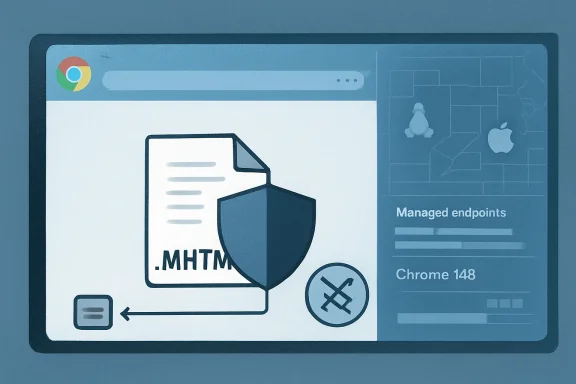
The MHTML angle adds another layer of old-web weirdness. MHTML is the archive format that bundles a web page and its resources into a single file-like package, a format long associated with saved pages, enterprise workflows, legacy document handling, and historical attack surface. Browser security has spent decades trying to make web origins comprehensible; archive formats have a habit of making those boundaries feel less crisp.
The CPE Record Looks Boring, Which Is Why It Matters
The user-facing question here is whether the NVD record is “missing a CPE.” As of the change history provided, NIST added a configuration for Google Chrome versions before 148.0.7778.96, with operating-system applicability entries for Windows, Linux, and macOS. That means the core Chrome CPE appears to be present, at least for the product NVD is currently modeling.
But the CPE question is not merely clerical. CPEs drive scanner logic, asset correlation, dashboards, executive reporting, vulnerability SLAs, and the dreaded compliance spreadsheet that turns a browser patch into a meeting. If a record under-models the ecosystem, organizations can miss affected software; if it over-models it, teams drown in false positives.
For this CVE, the obvious product named in the CVE text is Google Chrome. The supplied NVD change history says the affected configuration is Chrome before 148.0.7778.96, with Windows, Linux, and macOS as platforms. That is a reasonable CPE representation for Chrome itself.
The more complicated question is Chromium-based browsers. Microsoft’s MSRC page exists because Microsoft tracks Chromium CVEs relevant to Edge, but that does not automatically mean the NVD Chrome CPE should include Microsoft Edge. CPEs are product-specific identifiers, and Edge has its own product identity, release cadence, and update packaging. A Chrome CVE can be relevant to Edge without the Chrome CPE being the right place to describe Edge exposure.
That distinction matters for vulnerability managers. If your scanner only keys off the NVD CPE for google:chrome, it may not flag Edge, Brave, Opera, Vivaldi, Electron apps, or embedded Chromium runtimes that incorporate the same upstream code. If your scanner separately tracks Chromium lineage and vendor advisories, it may catch more of the real-world exposure. The CPE is a map, not the terrain.
Microsoft’s Presence Turns a Chrome Bug Into a Windows Fleet Problem
The MSRC listing is a reminder that Chromium vulnerabilities do not stay inside Google’s house. Microsoft Edge is a Chromium-based browser and is part of the default Windows experience, which means Chromium security debt is now Windows fleet security debt. That has been true for years, but each new CVE makes the abstraction concrete again.
For administrators, the practical question is not whether this is “a Chrome bug” or “an Edge bug.” The practical question is whether managed endpoints have received a Chromium engine build that contains the fix. On Windows, that means checking both Google Chrome and Microsoft Edge where both are installed, because many corporate devices run both whether IT likes it or not.
This is where browser update policy becomes more important than browser preference. Chrome’s stable update fixed the issue in 148.0.7778.96 on Linux and 148.0.7778.96 or .97 on Windows and macOS. Edge must incorporate Chromium security updates through Microsoft’s own channel releases. Security teams should verify installed browser versions rather than assuming that one vendor’s publication date equals another vendor’s patch state.
The Windows angle also complicates user behavior. Home users may think Windows Update covers “the browser,” but Chrome updates through Google’s updater and Edge updates through Microsoft’s Edge update mechanism. Enterprise users may be subject to rings, deferrals, update pinning, app control, or gold-image lag. The same CVE can be closed on one machine and still open on the next desk over.
Renderer Compromise Is Not a Comforting Precondition
The most tempting sentence in the CVE description is “who had compromised the renderer process.” That sounds like a major caveat, and it is. A remote attacker cannot simply wave CVE-2026-8012 at a fresh Chrome tab and get arbitrary script injection from nothing.
But renderer compromise is not science fiction. The renderer is where hostile web content is processed, and it is historically one of the most attacked zones in a browser. When a separate renderer vulnerability gives an attacker a foothold, logic bugs that manipulate origin, document, archive, or script handling can become useful chain components.
This is why CVSS can feel unsatisfying in browser land. The CISA-ADP vector given for the flaw scores it as 5.4 medium, with network attack vector, low complexity, no privileges required, user interaction required, and low confidentiality and integrity impact. That sounds modest. Yet in a chain, a modest primitive can be the hinge between “we crashed a process” and “we crossed a boundary.”
Chromium’s own low severity label is not meaningless. It reflects the maintainers’ understanding of exploitability and impact under their severity rubric. But enterprise defenders should not confuse vendor severity with operational priority. If a browser update rolls out with more than a hundred security fixes, the right question is rarely “which single CVE scares me most?” It is “how fast can I make the whole browser current?”
MHTML Is Legacy Glue With Modern Consequences
MHTML survives because computing is full of things that should have disappeared but instead became plumbing. It packages a page and associated resources into one archived representation, useful for saving, transporting, or rendering web content outside the original live context. That utility is exactly why security engineers keep worrying about it.
The web security model assumes active documents have origins, scripts have constraints, and resources belong somewhere. Archive formats can blur those intuitions. They create questions about what origin applies, what content is trusted, how embedded resources are parsed, and whether a browser treats packaged content more like a file, a page, or a hybrid of both.
CVE-2026-8012 is described as “inappropriate implementation in MHTML,” which is vague by design while bug details remain restricted. That vagueness is normal for Chrome advisories immediately after release, especially when maintainers want users patched before publishing technical breadcrumbs. Still, the description tells us enough: a crafted HTML page, after renderer compromise, could inject arbitrary scripts or HTML.
That puts the bug in the broader family of boundary-confusion flaws. It is not necessarily about MHTML files landing in inboxes or users double-clicking saved archives. The advisory says a crafted HTML page is the delivery mechanism. The MHTML component appears to be the misbehaving subsystem or parsing path that made the injection possible.
For legacy-heavy environments, that matters. Regulated organizations, government agencies, law firms, industrial operators, and long-lived intranet shops often have strange browser-adjacent workflows involving archived pages, exported reports, and document-like web content. Even when a specific CVE is not directly weaponized against those workflows, the pattern is familiar: old compatibility surfaces remain attack surfaces.
Chrome 148 Was Not a One-Bug Release
The May 2026 Chrome 148 stable desktop update was a large security release, not a surgical patch for CVE-2026-8012. Google’s release moved stable desktop builds to 148.0.7778.96 on Linux and 148.0.7778.96 or .97 on Windows and macOS. Reporting around the release counted 127 security fixes, including three critical vulnerabilities.
That context changes how administrators should think about this particular CVE. CVE-2026-8012 may be low or medium depending on whose scoring lens you use, but it arrived in a release carrying far more severe issues. If your patch process debates this one MHTML flaw in isolation, it is already looking at the wrong unit of work.
Browser patching is cumulative. You do not get to apply only the psychologically satisfying critical fix and ignore the low-severity logic bug next to it. The build number is the security boundary. Either the endpoint has the fixed build, or it does not.
The same logic applies to vulnerability reporting. A dashboard that displays CVE-2026-8012 as medium while hiding the rest of the Chrome 148 security payload can mislead decision-makers. A dashboard that buries it as low while the browser remains several stable releases behind is worse. The operational asset is the browser version, not the individual CVE badge.
The Scanner Will Be Less Nuanced Than the Risk
NVD’s enrichment trail shows a familiar delay pattern. The CVE arrived from Chrome on May 6, CISA-ADP added scoring and CWE data later that day, and NIST added initial CPE configuration on May 7. That is fast by the standards of public vulnerability metadata, but still slower than the pace at which auto-updaters, vendor blogs, security tools, and social chatter move.
During that window, scanners may disagree. Some will flag Chrome before 148.0.7778.96. Some will bundle this CVE into a “Google Chrome multiple vulnerabilities” plugin. Some will treat Edge separately. Some will miss Chromium forks until their vendors publish matching advisories. Some will report platform CPEs in ways that look alarming but merely indicate supported operating environments.
This is why “Are we missing a CPE?” is a good question but not the whole one. The better operational question is whether your vulnerability source, endpoint inventory, and browser update telemetry agree on the installed executable versions. If they do not, the CPE argument becomes academic theater.
Security teams should also be careful with the platform entries. Seeing Windows, Linux, and macOS in the configuration does not mean the operating systems themselves contain the vulnerability. It means the vulnerable application runs on those operating systems. That distinction is obvious to practitioners and surprisingly easy to lose in automated reports.
The most useful scanner behavior here is version-aware detection. If Chrome is older than 148.0.7778.96, flag it. If Edge or another Chromium browser has not yet incorporated the upstream fix, track the vendor’s patched build. If an embedded Chromium runtime ships inside an application, ask whether that application vendor rebased. The cleanest CPE is still only one ingredient.
UXSS Is the Browser Bug Class That Refuses to Stay Small
Universal cross-site scripting has an old-school ring to it, but it remains a serious browser concept. The web’s security model depends on origin separation: one site should not read or modify another site’s content merely because both are open in the same browser. A UXSS bug is frightening because it suggests the browser, not a single website, made the wrong call.
CVE-2026-8012 does not read like a standalone account-takeover bug. The precondition of renderer compromise is substantial. But once that precondition is met, arbitrary script or HTML injection can become a way to interfere with content in contexts the attacker should not control.
This is where low-severity labels can flatten important distinctions. A denial-of-service bug that crashes a tab and a UXSS primitive gated behind renderer compromise may both land in the lower half of a patch list, but defenders should think about them differently. One is nuisance availability impact; the other can be an ingredient in trust-boundary abuse.
The web has also become the operating system for many enterprise workflows. Admin portals, password managers, SSO flows, ticketing systems, device dashboards, remote access consoles, internal documentation, payroll, and code review all live in the browser. A browser-origin boundary bug is not just a web bug. It is a business-application boundary bug.
That does not mean panic is appropriate. It means browser patch SLAs should be measured in days, not quarters. The modern browser is too privileged, too exposed, and too central to be treated like a utility app that can wait for the next maintenance image.
The Real Patch Problem Is the Browsers You Forgot You Had
Chrome and Edge are the obvious endpoints. The less obvious ones are where organizations get hurt. Chromium appears in Electron applications, embedded web views, kiosk shells, vendor tools, remote support clients, collaboration apps, and line-of-business software that behaves like a desktop program while quietly dragging a browser engine behind it.
Not every Chromium CVE maps cleanly to every embedded runtime. A bug in an enabled component may be irrelevant if the application does not expose that path. A sandboxed webview may have different constraints. A vendor may backport a fix without changing the visible version string users recognize.
But defenders cannot manage what they do not inventory. If the only browser compliance metric is “Chrome updated,” the organization may miss a constellation of Chromium-derived code. That does not mean every Electron app needs emergency treatment for CVE-2026-8012 specifically; it means the browser-engine supply chain deserves its own asset category.
Windows environments are particularly full of this ambiguity because Edge WebView2 has become a common application substrate. WebView2 is serviced by Microsoft, which is far better than each app shipping a forgotten browser engine forever. Still, the direction of travel is clear: more applications are browser-shaped, and more vulnerabilities will arrive through browser-shaped plumbing.
The operational answer is not to ban Chromium. That would be fantasy. The answer is to standardize update channels, reduce unmanaged browser sprawl, watch for pinned enterprise versions, and make browser-engine patch state visible in the same way organizations already track operating-system build state.
The Severity Argument Should Not Become a Scheduling Excuse
Security teams often need severity labels because they cannot patch everything instantly. That is reality. But browser vulnerabilities are a poor place to apply slow, severity-only triage because the update package is cheap, cumulative, and user-exposed.
If a server-side product needs downtime, regression testing, database migrations, or vendor validation, a low CVE may reasonably wait. A browser update is different. The compatibility risk is real in some enterprises, but the default should be rapid rollout with measured rings, not prolonged deferral until a CVE gets a scarier score.
Chrome’s own enterprise update tooling exists because organizations need control without indefinite stagnation. The same is true for Edge policies. The best-run environments do not choose between chaos and paralysis; they stage updates quickly, monitor breakage, and keep rollback options narrow.
CVE-2026-8012 is a useful test case because it does not shout. There is no public exploit claim in the supplied advisory text. There is no emergency headline attached to this specific bug. Yet it is fixed in a major security release that also addresses more severe vulnerabilities. If your process lets this build linger because one CVE is “only medium,” the process is miscalibrated.
The better mental model is browser freshness. If the stable channel has moved and the security release contains many fixes, the organization should know how long it takes for managed endpoints to converge. Anything beyond a short, intentional testing window should be visible as risk, not hidden as routine drift.
The CPE Gap Is Really an Ecosystem Gap
So, are we missing a CPE here? For Google Chrome itself, the NVD change history you provided indicates that the Chrome application CPE has been added for versions before 148.0.7778.96, with Windows, Linux, and macOS platform applicability. That answers the narrow question.
For the broader ecosystem, the answer is more nuanced. NVD’s Chrome CPE will not, by itself, express every Chromium-based browser or embedded runtime that may inherit the vulnerable code. Microsoft’s MSRC listing gives Edge administrators a signal, but each downstream vendor still needs to publish, package, and distribute its own fixed build.
That is not a defect unique to this CVE. It is a structural limitation in how vulnerability identity, product identity, and open-source dependency reuse intersect. Chromium is both a product foundation and a vendor ecosystem. CVE records prefer discrete affected products. Attackers prefer whatever is actually installed.
A vulnerability manager looking for a perfect CPE graph will be disappointed. A practical defender will map three layers instead: the named product in the CVE, the upstream component lineage, and the local software inventory. The last layer is the one that determines whether the organization is exposed.
This also argues for humility in automated compliance. If a scanner says “Chrome fixed,” verify the version. If it says “Windows affected,” confirm it means Chrome-on-Windows rather than Windows itself. If it says nothing about Edge, check Edge separately. And if it says nothing about packaged Chromium runtimes, do not assume they do not exist.
The Build Number Is the Only Answer That Survives Contact With Reality
The practical response to CVE-2026-8012 is pleasantly unromantic. Chrome should be at 148.0.7778.96 or later on Linux and at the fixed 148.0.7778.96 or .97 line on Windows and macOS. Edge and other Chromium-based browsers should be checked against their vendors’ security release notes and updated to builds that incorporate the Chromium 148 security fixes.
For individual users, the answer is to open the browser’s About page and let the updater run. For enterprises, the answer is to query management telemetry, not trust humans to click buttons. For vulnerability teams, the answer is to normalize browser version reporting so Chrome, Edge, and Chromium-derived applications do not live in separate blind spots.
The more subtle response is to stop over-indexing on the adjective attached to the CVE. Low, medium, high, and critical are useful triage shortcuts, not substitutes for context. A low-severity UXSS-related browser bug in a large cumulative security release should move with the release, not languish as a standalone debate.
This is especially true in Windows environments where browsers are both user tools and application platforms. The user thinks of Chrome or Edge as a window to the web. The enterprise should think of them as privileged, internet-facing runtimes that process hostile code all day long. That framing makes patch urgency easier to justify.
The Chrome 148 Lesson Fits in One Patch Window
CVE-2026-8012 is not the scariest vulnerability in Chrome 148, but it is one of the better teaching examples because it exposes the seams between severity scoring, CPE modeling, Chromium reuse, and enterprise patch reality. The right response is not panic. It is disciplined browser hygiene.
- The NVD CPE entry described in the change history appears to cover Google Chrome before 148.0.7778.96 on Windows, Linux, and macOS.
- The CPE entry should not be treated as proof that every Chromium-based browser or embedded Chromium runtime has been modeled.
- The attacker precondition of renderer compromise lowers standalone exploitability, but it does not make a UXSS-capable primitive irrelevant in exploit chains.
- Chrome 148 is a cumulative security release, so administrators should prioritize reaching the fixed build rather than debating CVE-2026-8012 in isolation.
- Microsoft Edge administrators should verify Edge’s own fixed build path through Microsoft’s release process instead of assuming Chrome’s version number applies directly.
- Vulnerability reports that list Windows, Linux, or macOS here are describing Chrome’s supported platforms, not an operating-system flaw in those platforms.
The browser security story of 2026 is not that every Chromium CVE is catastrophic; it is that the browser has become too central for organizations to treat its patch stream as background noise. CVE-2026-8012 will likely disappear into the long tail of Chrome advisories, but the process it tests will not. The teams that come out ahead will be the ones that know their browser inventory, trust build numbers over labels, and patch Chromium as the shared infrastructure it has quietly become.
References
- Security Update Guide - Microsoft Security Response Center NVD / Chromium