

Microsoft’s Security Update Guide now lists CVE-2026-8376, a Perl vulnerability affecting versions through 5.43.10, in which 32-bit builds can suffer a heap buffer overflow while compiling regular expressions that repeat a fixed string. The bug is narrow, old-fashioned, and still worth taking seriously. It does not indict Windows itself, but it does expose a familiar weak point in modern operations: small language runtimes embedded deep inside tooling stacks. For Windows administrators, the lesson is less “panic about Perl” than “stop assuming legacy architecture means legacy risk has disappeared.”
CVE-2026-8376 is the sort of vulnerability that looks, at first glance, like it belongs to another era. It involves 32-bit builds, integer overflow, heap allocation, and regular-expression compilation — the kind of memory-safety machinery most users never see and most vendors would rather not discuss. But that is exactly why it matters.
Perl is not the glamour layer of today’s software stack. It is not the new AI agent framework, the cloud-native orchestration plane, or the desktop feature Microsoft wants to demo on stage. It is infrastructure glue: build scripts, package tooling, monitoring checks, old admin utilities, text-processing jobs, and compatibility layers that persist because they work.
That kind of software tends to live beyond the visibility of dashboards. A Windows shop may not think of itself as a Perl environment, yet still have Perl somewhere in developer workstations, Git hooks, CI runners, vendor installers, backup scripts, security scanners, or Windows Subsystem for Linux distributions. The danger is not that every Windows 11 laptop is suddenly exposed. The danger is that organizations often do not know where their interpreters are until a CVE forces the inventory conversation.
The affected condition is specific: Perl versions through 5.43.10, on 32-bit builds, compiling a crafted regular expression involving a repeated fixed string. That specificity will tempt some teams to dismiss the issue outright. They should resist doing so until they have answered the operational question that matters: where, exactly, are 32-bit Perl builds still present, and can any of them compile regular expressions influenced by untrusted input?
That sounds esoteric because it is. But the resulting class of error is not esoteric at all. An integer calculation wraps, memory allocation is made too small, and a later copy writes beyond the end of the heap buffer. The formal weakness classification is integer overflow leading to buffer overflow, a pattern that has been haunting C and C-adjacent code for decades.
The important detail is that the overflow is triggered during regex compilation, not during the later matching of text against an already-compiled pattern. That narrows the realistic attack surface. Applications that compile only trusted, hard-coded regexes are in a different position from applications that allow users, tenants, plugins, or configuration files to provide patterns.
This is where the story becomes more interesting for administrators. Many defenses focus on malicious data flowing into an application, while regex engines add a second channel: malicious syntax. If a product lets users provide search patterns, routing rules, filtering expressions, validation patterns, log queries, or text-processing templates, the program may be compiling attacker-controlled code-like input without anyone describing it that way.
But “most” is not the same as “all.” The Windows ecosystem has a long tail of 32-bit components because backward compatibility is one of the platform’s defining bargains. Industrial software, old vendor agents, point-of-sale systems, embedded management tools, legacy monitoring plug-ins, and installer frameworks can survive across hardware refreshes and OS upgrades.
That long tail is especially visible in mixed Windows and Linux estates. A Windows-first organization may run Perl in WSL, Cygwin, MSYS2, Strawberry Perl, ActivePerl-derived installations, Git-related tooling, container images, or Linux VMs used by Windows developers. Some of those environments are modern and 64-bit. Some are not. The only safe answer is inventory, not intuition.
The 32-bit condition also changes how security teams should prioritize, not whether they should care. This is unlikely to be the next mass-exploited Windows worm. It is, however, exactly the kind of bug that can matter in a specific product, a specific appliance, or a specific build chain where old architecture and attacker-supplied patterns intersect.
The discrepancy is a useful reminder that vulnerability management is not a scoreboard. A 9.8 rating can describe a bug whose exploitability depends on a narrow configuration. A “minor issue” in one Linux distribution can still be important if a vendor appliance exposes the exact vulnerable path to untrusted users.
For WindowsForum readers, the right response is to separate generic severity from local exposure. If your estate has no 32-bit Perl builds, the risk collapses. If your estate has 32-bit Perl but does not compile untrusted regex patterns, the risk is reduced. If you have a service that accepts user-supplied regexes and runs them through a vulnerable 32-bit interpreter, the issue becomes materially more serious.
This is where asset context beats feed aggregation. A vulnerability scanner may flag Perl packages broadly. A software bill of materials may show Perl but not architecture. An endpoint inventory may show architecture but not whether regex compilation touches untrusted input. None of those data points alone is enough.
That distinction matters because it changes the patching path. Administrators should not expect this to be fixed by a routine Windows cumulative update unless a Microsoft-shipped product or component includes the affected code and receives its own servicing action. In most environments, remediation will come through the Perl distribution, the operating system package manager, the vendor that bundled Perl, or the container image maintainer.
The Microsoft Knowledge Base disclaimer attached to the user-supplied notice is boilerplate, but its presence is unintentionally apt. This is a case where the authoritative alert is not the same thing as a one-click fix. The burden shifts to customers and vendors to identify where the runtime exists and who owns the update channel.
That is uncomfortable but normal in 2026. Microsoft’s ecosystem is no longer just Windows binaries delivered through Windows Update. It includes Linux workloads on Azure, GitHub-hosted projects, developer toolchains, container registries, third-party agents, and open-source packages pulled into commercial products. A Perl CVE can matter to a Microsoft customer without being a Microsoft code defect.
That perception is wrong. A regex is a compact program for a specialized virtual machine. It can consume CPU, allocate memory, trigger parser bugs, and expose assumptions in engine internals. CVE-2026-8376 is not the familiar denial-of-service story about catastrophic backtracking; it is a memory-corruption bug in the act of building the regex itself.
This distinction should influence review practices. Applications that let users create advanced search filters, log-alerting rules, data-loss-prevention patterns, email-routing patterns, or content-moderation rules need to treat those patterns as untrusted input. The question is not merely whether a regex can run too slowly. It is whether the engine can safely parse and compile the pattern at all.
The safest design is to avoid compiling arbitrary user-provided regexes in privileged, long-running, or shared-process contexts. When that is not possible, teams should constrain syntax, cap repetition counts, isolate compilation, apply time and memory limits, and prefer maintained runtimes with current security updates. Those controls sound mundane because good security often does.
For administrators, the practical task is to identify which Perl stream they are actually running. A system package on Debian or Ubuntu is updated differently from Strawberry Perl on Windows. A vendor appliance may include its own embedded interpreter. A container image may pin an older base layer. A build agent may have been installed manually years ago and never revisited.
This is where many organizations still struggle with open-source response. They know how to patch Windows. They know how to patch Microsoft 365. They may even know how to patch browsers and endpoint agents. But scripting runtimes installed outside centralized software management can fall between teams.
The fix may be straightforward once ownership is clear: upgrade to a fixed Perl release or apply the upstream patch where supported. The harder part is usually governance. Who owns the Perl runtime on a developer workstation? Who owns the one inside a CI image? Who owns the one shipped inside a backup product? CVE-2026-8376 is a useful forcing function because the technical scope is narrow enough to investigate without boiling the ocean.
Developer machines are one obvious place. Windows-based developers often carry multiple runtimes: native Windows packages, WSL distributions, Git tooling, package managers, and container tooling. If an old 32-bit Perl build exists anywhere in that mix, it may not be visible to standard Windows software inventory.
Build and deployment infrastructure deserves equal attention. CI systems routinely parse user-controlled repository content: tests, scripts, metadata, configuration files, templates, and sometimes regex patterns embedded in project files. If an attacker can influence a repository that a build agent processes, “local” parsing bugs can become remote in practice.
Security tooling is another candidate. Scanners, log processors, compliance agents, and monitoring plugins frequently lean on pattern matching. A tool designed to inspect hostile input can become vulnerable if it compiles hostile patterns rather than merely matching hostile text. That distinction should be part of any triage conversation.
Finally, do not ignore products that bundle their own runtimes. Commercial Windows software has a habit of shipping private copies of open-source components, sometimes hidden deep under installation directories. Those copies do not always follow the host operating system’s patch cadence. If a vendor ships Perl, the vendor has to tell customers whether it is affected.
That phrase should prompt administrators to look for features, not just binaries. Does the application allow custom filters? Can users define monitoring rules? Are regexes accepted through an API? Can a tenant upload configuration? Can plugins provide validation patterns? Can a web interface test user-supplied expressions?
Those questions matter because attack surface is often created by convenience features. A help-desk search tool that lets staff use regexes may not seem security-critical. A log viewer that lets users build complex filters may not look like code execution territory. A data-import pipeline that treats regexes as harmless configuration may have more trust in its input than it should.
In a multi-user environment, “trusted input” is a slippery phrase. A regex written by an administrator is one thing. A regex submitted by an authenticated low-privilege user is another. A regex loaded from a repository controlled by an external contributor is another still. Risk increases as the author of the pattern moves farther away from the owner of the process compiling it.
Perl’s internals, like many mature runtimes, contain deep C machinery. That machinery is fast, battle-tested, and complicated. It also means an application written in a high-level scripting style can still inherit memory-safety risks from the interpreter underneath.
This is not a knock on Perl specifically. The same lesson applies to Python, Ruby, PHP, JavaScript engines, image libraries, compression libraries, XML parsers, font renderers, and codecs. The upper layer may feel safe while the lower layer is parsing attacker-influenced bytes with manual memory management.
CVE-2026-8376 is a reminder that memory-safety migration is not just about choosing safer languages for new projects. It is also about reducing exposure to legacy runtimes, isolating parsers, maintaining dependencies, and avoiding designs that feed untrusted syntax into privileged components. The industry is moving in the right direction, but the attack surface is still full of side doors.
That means endpoint management teams, Linux administrators, developers, and security engineers may all need to compare notes. The vulnerable runtime could be native Windows software, a WSL package, a container base image, a Unix-like toolchain, or a vendor component. Treating it as somebody else’s problem is how small CVEs become persistent risk.
The best mitigation is to update to a fixed Perl build once one is available through the relevant channel. Where updates are not immediately possible, administrators should reduce or eliminate untrusted regex compilation on 32-bit Perl builds. If that sounds too specific to operationalize, the compensating control is broader: move the workload to a maintained 64-bit runtime and isolate parsing from privileged processes.
Vendor pressure also matters. If a commercial product includes Perl, customers should ask whether it ships a 32-bit build, which version is included, whether regex compilation is exposed to user-controlled input, and when a fix will ship. The absence of an answer is itself useful risk information.
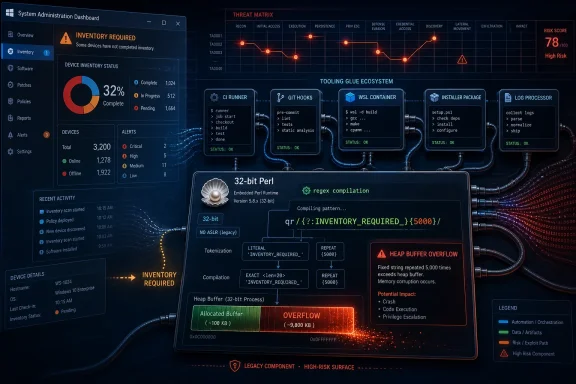 A Small Runtime Bug Lands in a Big Supply-Chain World
CVE-2026-8376 is the sort of vulnerability that looks, at first glance, like it belongs to another era. It involves 32-bit builds, integer overflow, heap allocation, and regular-expression compilation — the kind of memory-safety machinery most users never see and most vendors would rather not discuss. But that is exactly why it matters.Perl is not the glamour layer of today’s software stack. It is not the new AI agent framework, the cloud-native orchestration plane, or the desktop feature Microsoft wants to demo on stage. It is infrastructure glue: build scripts, package tooling, monitoring checks, old admin utilities, text-processing jobs, and compatibility layers that persist because they work.
That kind of software tends to live beyond the visibility of dashboards. A Windows shop may not think of itself as a Perl environment, yet still have Perl somewhere in developer workstations, Git hooks, CI runners, vendor installers, backup scripts, security scanners, or Windows Subsystem for Linux distributions. The danger is not that every Windows 11 laptop is suddenly exposed. The danger is that organizations often do not know where their interpreters are until a CVE forces the inventory conversation.
The affected condition is specific: Perl versions through 5.43.10, on 32-bit builds, compiling a crafted regular expression involving a repeated fixed string. That specificity will tempt some teams to dismiss the issue outright. They should resist doing so until they have answered the operational question that matters: where, exactly, are 32-bit Perl builds still present, and can any of them compile regular expressions influenced by untrusted input?
The Vulnerability Is Narrow, but the Failure Mode Is Not
The technical heart of the bug is a mismatch between characters and bytes. In Perl’s regular-expression compiler, the affected code checked the size of a joined substring buffer in characters rather than bytes. Under the right conditions, a large minimum repetition count could cause the byte-length calculation to overflow the signed size type used on 32-bit builds.That sounds esoteric because it is. But the resulting class of error is not esoteric at all. An integer calculation wraps, memory allocation is made too small, and a later copy writes beyond the end of the heap buffer. The formal weakness classification is integer overflow leading to buffer overflow, a pattern that has been haunting C and C-adjacent code for decades.
The important detail is that the overflow is triggered during regex compilation, not during the later matching of text against an already-compiled pattern. That narrows the realistic attack surface. Applications that compile only trusted, hard-coded regexes are in a different position from applications that allow users, tenants, plugins, or configuration files to provide patterns.
This is where the story becomes more interesting for administrators. Many defenses focus on malicious data flowing into an application, while regex engines add a second channel: malicious syntax. If a product lets users provide search patterns, routing rules, filtering expressions, validation patterns, log queries, or text-processing templates, the program may be compiling attacker-controlled code-like input without anyone describing it that way.
The 32-Bit Constraint Is a Comfort, Not an Excuse
The most obvious mitigating factor is that CVE-2026-8376 concerns 32-bit Perl builds. In 2026, that should sharply reduce exposure on mainstream Windows desktops and servers. Most current enterprise endpoints, cloud servers, and developer machines are 64-bit, and many organizations have spent years purging 32-bit runtime dependencies for performance, compatibility, and security reasons.But “most” is not the same as “all.” The Windows ecosystem has a long tail of 32-bit components because backward compatibility is one of the platform’s defining bargains. Industrial software, old vendor agents, point-of-sale systems, embedded management tools, legacy monitoring plug-ins, and installer frameworks can survive across hardware refreshes and OS upgrades.
That long tail is especially visible in mixed Windows and Linux estates. A Windows-first organization may run Perl in WSL, Cygwin, MSYS2, Strawberry Perl, ActivePerl-derived installations, Git-related tooling, container images, or Linux VMs used by Windows developers. Some of those environments are modern and 64-bit. Some are not. The only safe answer is inventory, not intuition.
The 32-bit condition also changes how security teams should prioritize, not whether they should care. This is unlikely to be the next mass-exploited Windows worm. It is, however, exactly the kind of bug that can matter in a specific product, a specific appliance, or a specific build chain where old architecture and attacker-supplied patterns intersect.
Severity Scores Tell Only Half the Story
NVD has shown a critical CVSS 3.1 score for the issue, while other analysis has treated the practical impact more conservatively. That split is not unusual. CVSS tries to describe a theoretical vulnerability under standardized assumptions; distributors and response teams often have to decide how it behaves in real deployments.The discrepancy is a useful reminder that vulnerability management is not a scoreboard. A 9.8 rating can describe a bug whose exploitability depends on a narrow configuration. A “minor issue” in one Linux distribution can still be important if a vendor appliance exposes the exact vulnerable path to untrusted users.
For WindowsForum readers, the right response is to separate generic severity from local exposure. If your estate has no 32-bit Perl builds, the risk collapses. If your estate has 32-bit Perl but does not compile untrusted regex patterns, the risk is reduced. If you have a service that accepts user-supplied regexes and runs them through a vulnerable 32-bit interpreter, the issue becomes materially more serious.
This is where asset context beats feed aggregation. A vulnerability scanner may flag Perl packages broadly. A software bill of materials may show Perl but not architecture. An endpoint inventory may show architecture but not whether regex compilation touches untrusted input. None of those data points alone is enough.
Microsoft’s Listing Is a Signal About the Ecosystem, Not a Windows Patch
The presence of CVE-2026-8376 in Microsoft’s Security Update Guide does not mean Windows itself is the vulnerable product. Microsoft tracks a broad range of vulnerabilities relevant to its customers, including third-party and open-source components that may affect Microsoft environments, developer workflows, Azure-hosted workloads, or packaged software.That distinction matters because it changes the patching path. Administrators should not expect this to be fixed by a routine Windows cumulative update unless a Microsoft-shipped product or component includes the affected code and receives its own servicing action. In most environments, remediation will come through the Perl distribution, the operating system package manager, the vendor that bundled Perl, or the container image maintainer.
The Microsoft Knowledge Base disclaimer attached to the user-supplied notice is boilerplate, but its presence is unintentionally apt. This is a case where the authoritative alert is not the same thing as a one-click fix. The burden shifts to customers and vendors to identify where the runtime exists and who owns the update channel.
That is uncomfortable but normal in 2026. Microsoft’s ecosystem is no longer just Windows binaries delivered through Windows Update. It includes Linux workloads on Azure, GitHub-hosted projects, developer toolchains, container registries, third-party agents, and open-source packages pulled into commercial products. A Perl CVE can matter to a Microsoft customer without being a Microsoft code defect.
Regex Engines Remain a Quiet Attack Surface
Regular expressions are one of computing’s great conveniences and one of its most underestimated attack surfaces. Security teams have learned to watch for SQL injection, command injection, deserialization bugs, and unsafe file parsing. Regex compilation often receives less attention because patterns feel like configuration, not executable logic.That perception is wrong. A regex is a compact program for a specialized virtual machine. It can consume CPU, allocate memory, trigger parser bugs, and expose assumptions in engine internals. CVE-2026-8376 is not the familiar denial-of-service story about catastrophic backtracking; it is a memory-corruption bug in the act of building the regex itself.
This distinction should influence review practices. Applications that let users create advanced search filters, log-alerting rules, data-loss-prevention patterns, email-routing patterns, or content-moderation rules need to treat those patterns as untrusted input. The question is not merely whether a regex can run too slowly. It is whether the engine can safely parse and compile the pattern at all.
The safest design is to avoid compiling arbitrary user-provided regexes in privileged, long-running, or shared-process contexts. When that is not possible, teams should constrain syntax, cap repetition counts, isolate compilation, apply time and memory limits, and prefer maintained runtimes with current security updates. Those controls sound mundane because good security often does.
The Patch Path Runs Through Maintainers and Distributions
The upstream fix was merged into Perl’s development branch before public disclosure. That is good news, but it does not instantly protect every deployed copy. Language runtimes reach users through a chain of maintainers, distributors, package repositories, operating systems, container images, and vendor bundles.For administrators, the practical task is to identify which Perl stream they are actually running. A system package on Debian or Ubuntu is updated differently from Strawberry Perl on Windows. A vendor appliance may include its own embedded interpreter. A container image may pin an older base layer. A build agent may have been installed manually years ago and never revisited.
This is where many organizations still struggle with open-source response. They know how to patch Windows. They know how to patch Microsoft 365. They may even know how to patch browsers and endpoint agents. But scripting runtimes installed outside centralized software management can fall between teams.
The fix may be straightforward once ownership is clear: upgrade to a fixed Perl release or apply the upstream patch where supported. The harder part is usually governance. Who owns the Perl runtime on a developer workstation? Who owns the one inside a CI image? Who owns the one shipped inside a backup product? CVE-2026-8376 is a useful forcing function because the technical scope is narrow enough to investigate without boiling the ocean.
Windows Shops Should Look Beyond the Desktop
A Windows administrator reading about a Perl vulnerability may instinctively think of local installations. That is a start, but not the end. The more interesting exposure may live in the parts of the environment that orbit Windows without being Windows itself.Developer machines are one obvious place. Windows-based developers often carry multiple runtimes: native Windows packages, WSL distributions, Git tooling, package managers, and container tooling. If an old 32-bit Perl build exists anywhere in that mix, it may not be visible to standard Windows software inventory.
Build and deployment infrastructure deserves equal attention. CI systems routinely parse user-controlled repository content: tests, scripts, metadata, configuration files, templates, and sometimes regex patterns embedded in project files. If an attacker can influence a repository that a build agent processes, “local” parsing bugs can become remote in practice.
Security tooling is another candidate. Scanners, log processors, compliance agents, and monitoring plugins frequently lean on pattern matching. A tool designed to inspect hostile input can become vulnerable if it compiles hostile patterns rather than merely matching hostile text. That distinction should be part of any triage conversation.
Finally, do not ignore products that bundle their own runtimes. Commercial Windows software has a habit of shipping private copies of open-source components, sometimes hidden deep under installation directories. Those copies do not always follow the host operating system’s patch cadence. If a vendor ships Perl, the vendor has to tell customers whether it is affected.
The Real Risk Is Untrusted Pattern Compilation
The phrase “attacker-controlled regular expression” is the hinge of the advisory. Without that condition, the vulnerability is largely theoretical in many deployments. With it, the vulnerability becomes a memory-corruption issue in a parser reachable by an attacker.That phrase should prompt administrators to look for features, not just binaries. Does the application allow custom filters? Can users define monitoring rules? Are regexes accepted through an API? Can a tenant upload configuration? Can plugins provide validation patterns? Can a web interface test user-supplied expressions?
Those questions matter because attack surface is often created by convenience features. A help-desk search tool that lets staff use regexes may not seem security-critical. A log viewer that lets users build complex filters may not look like code execution territory. A data-import pipeline that treats regexes as harmless configuration may have more trust in its input than it should.
In a multi-user environment, “trusted input” is a slippery phrase. A regex written by an administrator is one thing. A regex submitted by an authenticated low-privilege user is another. A regex loaded from a repository controlled by an external contributor is another still. Risk increases as the author of the pattern moves farther away from the owner of the process compiling it.
Memory Safety Keeps Reappearing Through Side Doors
The software industry has spent years talking about memory-safe languages, and rightly so. Rust, Go, Java, C#, and managed runtimes reduce entire classes of memory-corruption bugs. But modern systems are not written in one language, and they do not retire old C code on a schedule that matches conference slides.Perl’s internals, like many mature runtimes, contain deep C machinery. That machinery is fast, battle-tested, and complicated. It also means an application written in a high-level scripting style can still inherit memory-safety risks from the interpreter underneath.
This is not a knock on Perl specifically. The same lesson applies to Python, Ruby, PHP, JavaScript engines, image libraries, compression libraries, XML parsers, font renderers, and codecs. The upper layer may feel safe while the lower layer is parsing attacker-influenced bytes with manual memory management.
CVE-2026-8376 is a reminder that memory-safety migration is not just about choosing safer languages for new projects. It is also about reducing exposure to legacy runtimes, isolating parsers, maintaining dependencies, and avoiding designs that feed untrusted syntax into privileged components. The industry is moving in the right direction, but the attack surface is still full of side doors.
The Sensible Response Is Inventory, Isolation, and Vendor Pressure
For most WindowsForum readers, the response should be measured. This is not a reason to rip Perl out of every environment by Friday afternoon. It is a reason to find where Perl exists, determine whether it is 32-bit, and understand whether any affected instance compiles untrusted regular expressions.That means endpoint management teams, Linux administrators, developers, and security engineers may all need to compare notes. The vulnerable runtime could be native Windows software, a WSL package, a container base image, a Unix-like toolchain, or a vendor component. Treating it as somebody else’s problem is how small CVEs become persistent risk.
The best mitigation is to update to a fixed Perl build once one is available through the relevant channel. Where updates are not immediately possible, administrators should reduce or eliminate untrusted regex compilation on 32-bit Perl builds. If that sounds too specific to operationalize, the compensating control is broader: move the workload to a maintained 64-bit runtime and isolate parsing from privileged processes.
Vendor pressure also matters. If a commercial product includes Perl, customers should ask whether it ships a 32-bit build, which version is included, whether regex compilation is exposed to user-controlled input, and when a fix will ship. The absence of an answer is itself useful risk information.
The Perl Bug Exposes Five Places Windows Teams Still Lose Visibility
The concrete response to CVE-2026-8376 is not complicated, but it crosses enough ownership boundaries that it can still be missed. Teams that handle it well will use the advisory as a small audit of runtime visibility rather than a one-off ticket.- Perl versions through 5.43.10 are the affected range, but the practical exposure depends heavily on whether the deployed build is 32-bit.
- The vulnerable path is triggered when a 32-bit Perl build compiles an attacker-controlled regular expression with a repeated fixed string.
- Windows Update should not be assumed to remediate this unless the affected Perl copy is part of a Microsoft-serviced component.
- Developer tooling, WSL distributions, CI runners, container images, and vendor-bundled runtimes deserve as much attention as desktop installations.
- Where patching is delayed, administrators should prevent untrusted regex compilation on affected 32-bit builds or move the workload to a maintained 64-bit runtime.
- Vendors that bundle Perl should provide customers with architecture, version, exposure, and remediation details rather than a generic “under investigation” notice.
References
- Primary source: MSRC
Published: 2026-06-19T01:40:20-07:00
Security Update Guide - Microsoft Security Response Center
 msrc.microsoft.com
- Related coverage: acunetix.com
Vulnerabilities - Acunetix
 www.acunetix.com
- Related coverage: thehackerwire.com
CVE-2026-8376 - Critical Vulnerability - TheHackerWire
TheHackerWire - Your daily source for cybersecurity news, CVE alerts, hacking tutorials, and security tool reviews. Stay ahead of cyber threats.www.thehackerwire.com
- Related coverage: endorlabs.com
Endor Patches | CVE-2026-8376, CVE-2026-8376 perl
 www.endorlabs.com
- Related coverage: db.gcve.eu
- Related coverage: secualive.jp
Secualive
ウェブアプリケーション診断、セキュリティに関する情報を提供しているサイトです。すぐに脆弱性診断を実施したい、予算が少ないが診断が必要な場合はSecuAliveが解決できます。secualive.jp
