

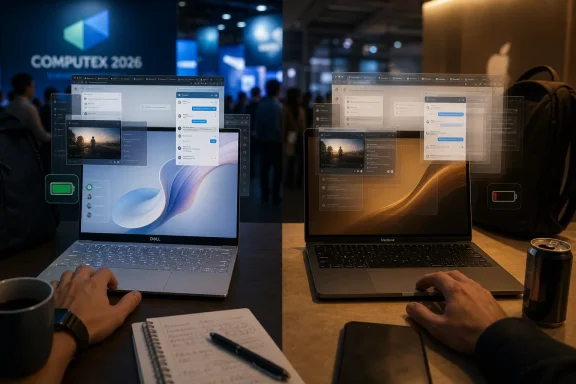
Dell’s new XPS 13, announced around Computex 2026 with a $699 retail price and student pricing that can match Apple’s $599 MacBook Neo, is the clearest sign yet that Windows PC makers finally understand what Apple changed in the budget laptop market. The problem is that Dell can copy Apple’s hardware priorities more easily than Microsoft can copy Apple’s software discipline. That gap matters because the cheapest great laptop is no longer judged only by its spec sheet. It is judged by whether it still feels fast, calm, and premium after a normal user has opened too many tabs and forgotten to close half of them.
The most disruptive thing about the MacBook Neo is not that Apple found a way to sell a Mac laptop for $599. It is that Apple made a $599 laptop feel as if it belongs to the same family as machines costing far more. For years, the low end of the Windows laptop market survived on a quiet bargain: buyers accepted dull screens, flexible plastic, weak speakers, mediocre touchpads, and indifferent battery life because the price was right.
Apple’s intervention changed the bargain. The MacBook Neo took the parts of a laptop that users experience every minute — chassis, display, trackpad, speakers, battery life, responsiveness — and treated them as the product rather than as optional upgrades. That is a very Apple move, but it is also a very rational one. Nobody falls in love with a benchmark score while squinting at a washed-out panel.
Dell appears to have read the room. The new XPS 13 is not merely a cheaper Dell laptop with a better logo. It is an attempt to drag some of the old XPS premium language into the price band where Windows machines have historically looked and felt disposable. At a reported 2.2 pounds, with an OLED option, a backlit keyboard, and a claimed 17 hours of battery life, it is not trying to win the spreadsheet by accident. It is trying to win the hand, the eye, and the backpack.
That is the right fight. The uncomfortable question is whether Windows 11 lets Dell finish it.
This time, Dell seems closer to the mark. The appeal of the MacBook Neo is not that it is the most powerful computer in its class. It is that it does not constantly remind you that it is cheap. It opens quickly, runs quietly, lasts long enough to escape charger anxiety, and wraps the whole experience in materials that feel intentional.
The XPS line has always understood at least part of that equation. Dell’s best XPS machines helped define the modern Windows ultrabook: slim bezels, dense screens, machined-metal restraint, and a willingness to compete with the MacBook Air on design rather than simply undercut it on price. Bringing that sensibility down to $699 is not a small move. It is a recognition that the old budget Windows formula has run out of cultural oxygen.
There are tradeoffs, of course. A $699 laptop cannot be a perfect premium machine in disguise. But the most interesting detail is that Dell is not treating “entry level” as permission to make something unpleasant. If the MacBook Neo’s trick was to make buyers feel lucky rather than compromised, the XPS 13 is Dell’s attempt to say Windows can still do that too.
The hardware case, at least on paper, is surprisingly strong. OLED gives Dell a visible talking point Apple does not match at the Neo’s base price. A backlit keyboard addresses one of Apple’s more conspicuous omissions. Touch support, if configured as reported, remains a Windows advantage in a world where Apple still keeps the Mac and iPad interaction models apart.
That is why this device matters beyond one SKU. Dell is not just answering Apple. It is setting a minimum standard for what a serious Windows laptop below $800 should look like in 2026.
Memory is one of the most misunderstood parts of the consumer laptop market because it is both easy to quantify and hard to feel until it is too late. A buyer sees 8GB on two machines and assumes parity. A reviewer opens too many browser tabs, launches a few background apps, starts a video call, and suddenly the difference between a well-managed system and a merely adequate one becomes obvious.
Apple has spent years making unified memory, aggressive app suspension, fast storage, and tight hardware-software integration work as a single experience. That does not mean 8GB is magically unlimited on a Mac. It does mean macOS often degrades more gracefully under ordinary pressure. Users can be sloppy, and the system absorbs more of the sloppiness before it turns into stutter.
Windows has a harder job. It supports a vast hardware ecosystem, decades of application assumptions, drivers of wildly varying quality, OEM utilities, background services, game launchers, security agents, update processes, and the accumulated archaeology of compatibility. That openness is part of why Windows remains indispensable. It is also why 8GB on Windows can feel like a ceiling while 8GB on Apple silicon can feel like a floor.
This is where Dell’s beautiful hardware risks becoming a showcase for Microsoft’s unfinished business. A laptop can have a premium chassis and still feel budget if switching between apps becomes a negotiation. The user does not care whether the culprit is memory pressure, a driver, an antivirus process, a web browser, or Windows itself. The user experiences the machine as slow.
Microsoft’s renewed talk about performance, reliability, and polish is therefore not a branding exercise. It is an admission that the operating system’s feel has become strategically important again. Windows 11 has improved in many ways since launch, but it still carries a reputation among enthusiasts for background churn, UI inconsistency, and moments where the system appears to be doing something more important than responding to the person in front of it.
That reputation matters most at the low end. A $2,000 workstation can brute-force its way through a lot of OS inefficiency. A $699 ultraportable cannot. The cheaper and thinner the machine, the more every background process, animation hitch, memory spike, and power-management decision matters.
This is a reversal of the old PC logic. In the past, software bloat was annoying but survivable because hardware improvements were so rapid and so widely distributed. Today, the most important competition in the budget premium category may be efficiency rather than raw capability. Apple is not just selling a laptop; it is selling the idea that restraint can be a feature.
Windows has never been built around restraint in the same way. Its genius is breadth. Its weakness is also breadth. The XPS 13 puts that contradiction in a 2.2-pound frame.
That is why Apple’s choices sting. The A18 Pro chip is not positioned like a traditional laptop processor, but it gives the machine the kind of single-core responsiveness that makes ordinary computing feel immediate. The aluminum body signals durability and status. The display and speakers make media consumption feel less like a punishment. Battery life changes how often the user thinks about the charger.
These are not luxuries in the modern laptop experience. They are the things that determine whether a computer fades into the background or constantly irritates its owner. Cheap Windows laptops have too often treated them as afterthoughts, then tried to compensate with bigger numbers elsewhere.
Dell seems to have recognized that Apple’s cheapest Mac is still fundamentally an Apple product. That means the XPS 13 cannot merely be “good for the price” in the old sense. It has to be good in the ways users notice before they open Task Manager. It has to survive a Best Buy table test, a student backpack, a kitchen counter, a cramped airplane tray, and a browser session that has become a cry for help.
On visible hardware, Dell may even have the more exciting story. OLED at this price is a real escalation. A backlit keyboard is not a minor nicety for anyone who works at night. Windows touch support still gives PC makers a form-factor vocabulary Apple refuses to use on the Mac.
But Apple’s advantage is not only visible. It lives in the quiet moments between actions, the milliseconds where the system either feels ready or reluctant. That is the part Dell cannot machine out of aluminum.
Normal people do not close tabs. They leave chat apps running. They stream music while shopping, writing, uploading photos, and joining a meeting five minutes late. They install printer utilities, cloud-sync tools, RGB software, password managers, VPN clients, and browser extensions they barely remember approving.
This is where the MacBook Neo has reportedly surprised reviewers and early users. It should not be a workstation, and nobody should pretend that 8GB of memory is ideal for sustained professional workloads. Yet the machine appears to handle ordinary chaos better than its paper specs suggest. That creates a dangerous perception for Windows OEMs: Apple is making less feel like enough.
Windows laptops with 8GB of RAM can absolutely be usable. For web browsing, schoolwork, media playback, email, document editing, and light productivity, many buyers will be fine. The problem is that “fine” is no longer the target Apple has set. The target is premium-feeling headroom at a mass-market price.
That distinction is brutal for the PC market. A laptop can pass every basic-use test and still lose the narrative if the Mac feels smoother doing the same work. The buyer does not need to understand memory compression, swap behavior, or scheduler design. They only need to feel that one machine gets out of the way and the other periodically asks for patience.
For WindowsForum readers, this is familiar territory. The argument is not that Windows is unusable. It is that Windows machines at the low end have less margin for neglect. When OEMs ship lean hardware, Microsoft’s inefficiencies become the user’s problem.
It is clever because the budget laptop market desperately needs better signals. Consumers know Inspiron, Aspire, IdeaPad, and Pavilion as broad families with wildly variable quality. XPS carries a cleaner promise. If Dell can make XPS mean “premium experience at a reachable price,” it has a story no generic budget line can easily match.
It is risky because brand equity is fragile. If the new XPS 13 feels compromised in ways buyers associate with cheap PCs, the XPS name absorbs that disappointment. A premium badge can elevate an affordable product, but it can also make its limitations more visible.
That pressure will be especially intense because the MacBook Neo is not burdened by a confusing product stack. Apple’s lineup is simpler, and simplicity is a competitive weapon. A buyer sees a $599 MacBook and understands the proposition immediately: this is the affordable Mac. Dell has to explain configurations, student pricing, display options, processor classes, memory, storage, and the difference between promise and real-world battery life.
This is the persistent PC disadvantage. Choice is powerful for enthusiasts and IT departments. It is exhausting for mainstream buyers. Apple’s cheapest laptop benefits from being legible.
Dell can still win many customers, particularly those who need Windows, prefer touch, rely on specific x86 applications, or want hardware features Apple omits. But the company cannot afford for the base model to feel like the one buyers should have avoided. In this category, the entry configuration is the message.
But enterprise environments also make the 8GB question more complicated. Corporate Windows images rarely become lighter after deployment. Endpoint detection agents, management clients, VPN software, compliance tools, collaboration suites, browser policies, and background sync services all consume resources before the user opens a single spreadsheet.
That does not mean the XPS 13 is doomed in business settings. It means the base model may be a consumer-friendly headline and an IT headache if organizations treat it as a universal fleet device. The same laptop that feels fine for a student writing papers could feel cramped for a managed worker living inside Teams, Outlook, Edge, OneDrive, security tooling, and a dozen web apps.
Apple faces management overhead too, but the MacBook Neo’s appeal in education and light enterprise is obvious. If Apple can provide a machine that students like, parents understand, and administrators can manage without constant performance complaints, it pressures both Chromebooks and low-end Windows fleets. Dell’s answer must be not only attractive but operationally boring.
That is a high bar. IT pros do not buy vibes. They buy lifecycle predictability, repair options, warranty terms, driver stability, firmware behavior, deployment workflows, and the likelihood that a machine will not generate tickets because it was underspecified on day one.
A $699 XPS 13 with excellent build quality could be a very smart fleet option in the right configuration. But if the best version is meaningfully more expensive than the headline model, Apple’s pricing story remains dangerous. The market remembers the number it saw first.
Part of the answer is obvious: ship less junk. OEM utilities, trialware, redundant control panels, notification-hungry services, and vendor overlays have long undermined the Windows experience. Even when individual components are defensible, the total effect can make a new PC feel busy before the user has done anything.
Another part is harder: Microsoft has to keep sanding Windows 11 until its baseline behavior feels lighter. Performance is not only about app launch times. It is about whether the Start menu is instant, whether search feels local and predictable, whether updates stay out of the user’s way, whether sleep and wake are reliable, whether battery estimates inspire trust, and whether the system stops feeling like a collection of eras wearing the same coat.
This is where the MacBook Neo is so irritatingly effective. Apple controls enough of the stack to make the cheap machine feel like a designed object. Windows PCs often feel like negotiated settlements among Microsoft, Intel or AMD, the OEM, component vendors, software partners, and whatever utilities survived the imaging process.
A “budget-premium mode” for Windows would not require turning Windows into macOS. It would require treating low-memory, low-power, thin-and-light systems as first-class targets rather than assuming users can upgrade their way out of friction. It would mean stricter startup behavior, better defaults, clearer background activity, stronger OEM image standards, and perhaps a more aggressive push toward configurations that should no longer be sold as premium if they cannot sustain premium feel.
That last point is uncomfortable. If Windows 11 cannot reliably feel excellent on an 8GB laptop in 2026, then the ecosystem should either fix Windows or stop pretending 8GB is enough for premium-branded machines. Apple can make that number look good because Apple owns more of the problem. Dell does not.
The MacBook Neo makes “good enough” feel defensive. If Apple can sell a laptop that feels premium enough for many ordinary users at $599, the Windows world has to justify why its similarly priced machines still feel like compromises. The answer cannot simply be that Windows supports more things. Most mainstream buyers are not buying all theoretical possibilities. They are buying the machine they will touch tonight.
Dell’s XPS 13 is important because it challenges the lazy version of the Windows budget market. It says a cheap Windows laptop does not have to look cheap. It says a mainstream buyer deserves a good screen, a good keyboard, a good body, and battery life that does not collapse under normal use. It says the PC industry can respond to Apple with taste instead of panic.
But the software side of the experience remains unresolved. The fear is not that the XPS 13 will be a bad laptop. It may be one of the most interesting Windows notebooks of the year. The fear is that it will show exactly how far PC hardware has come — and how much Microsoft still has to do.
A machine like this sharpens every Windows annoyance. If the display is beautiful, UI stutter looks worse. If the chassis feels premium, background sluggishness feels more insulting. If the battery claim is ambitious, every mysterious drain becomes a referendum. Premium hardware raises expectations, and Windows must meet them at the same price Dell is trying to hit.
That is the real Apple effect. The MacBook Neo did not merely create a cheaper Mac. It raised the emotional standard for cheap laptops.
The early facts are concrete enough to frame the stakes:
 Apple Moved the Fight From Specs to Feel
The most disruptive thing about the MacBook Neo is not that Apple found a way to sell a Mac laptop for $599. It is that Apple made a $599 laptop feel as if it belongs to the same family as machines costing far more. For years, the low end of the Windows laptop market survived on a quiet bargain: buyers accepted dull screens, flexible plastic, weak speakers, mediocre touchpads, and indifferent battery life because the price was right.Apple’s intervention changed the bargain. The MacBook Neo took the parts of a laptop that users experience every minute — chassis, display, trackpad, speakers, battery life, responsiveness — and treated them as the product rather than as optional upgrades. That is a very Apple move, but it is also a very rational one. Nobody falls in love with a benchmark score while squinting at a washed-out panel.
Dell appears to have read the room. The new XPS 13 is not merely a cheaper Dell laptop with a better logo. It is an attempt to drag some of the old XPS premium language into the price band where Windows machines have historically looked and felt disposable. At a reported 2.2 pounds, with an OLED option, a backlit keyboard, and a claimed 17 hours of battery life, it is not trying to win the spreadsheet by accident. It is trying to win the hand, the eye, and the backpack.
That is the right fight. The uncomfortable question is whether Windows 11 lets Dell finish it.
Dell Learned the Right Lesson From Cupertino
The PC industry often responds to Apple by copying the wrong thing. It chases thinness when the real story is integration. It chases color when the real story is confidence. It chases a price point while missing the reason buyers tolerate Apple’s compromises.This time, Dell seems closer to the mark. The appeal of the MacBook Neo is not that it is the most powerful computer in its class. It is that it does not constantly remind you that it is cheap. It opens quickly, runs quietly, lasts long enough to escape charger anxiety, and wraps the whole experience in materials that feel intentional.
The XPS line has always understood at least part of that equation. Dell’s best XPS machines helped define the modern Windows ultrabook: slim bezels, dense screens, machined-metal restraint, and a willingness to compete with the MacBook Air on design rather than simply undercut it on price. Bringing that sensibility down to $699 is not a small move. It is a recognition that the old budget Windows formula has run out of cultural oxygen.
There are tradeoffs, of course. A $699 laptop cannot be a perfect premium machine in disguise. But the most interesting detail is that Dell is not treating “entry level” as permission to make something unpleasant. If the MacBook Neo’s trick was to make buyers feel lucky rather than compromised, the XPS 13 is Dell’s attempt to say Windows can still do that too.
The hardware case, at least on paper, is surprisingly strong. OLED gives Dell a visible talking point Apple does not match at the Neo’s base price. A backlit keyboard addresses one of Apple’s more conspicuous omissions. Touch support, if configured as reported, remains a Windows advantage in a world where Apple still keeps the Mac and iPad interaction models apart.
That is why this device matters beyond one SKU. Dell is not just answering Apple. It is setting a minimum standard for what a serious Windows laptop below $800 should look like in 2026.
The 8GB Decision Is Where the Old PC Math Returns
Then comes the memory configuration, and with it the entire history of budget Windows compromises. The base XPS 13 reportedly starts with 8GB of RAM, just as the MacBook Neo does. On paper, that sounds fair. In practice, it is the line where equality of numbers can hide inequality of experience.Memory is one of the most misunderstood parts of the consumer laptop market because it is both easy to quantify and hard to feel until it is too late. A buyer sees 8GB on two machines and assumes parity. A reviewer opens too many browser tabs, launches a few background apps, starts a video call, and suddenly the difference between a well-managed system and a merely adequate one becomes obvious.
Apple has spent years making unified memory, aggressive app suspension, fast storage, and tight hardware-software integration work as a single experience. That does not mean 8GB is magically unlimited on a Mac. It does mean macOS often degrades more gracefully under ordinary pressure. Users can be sloppy, and the system absorbs more of the sloppiness before it turns into stutter.
Windows has a harder job. It supports a vast hardware ecosystem, decades of application assumptions, drivers of wildly varying quality, OEM utilities, background services, game launchers, security agents, update processes, and the accumulated archaeology of compatibility. That openness is part of why Windows remains indispensable. It is also why 8GB on Windows can feel like a ceiling while 8GB on Apple silicon can feel like a floor.
This is where Dell’s beautiful hardware risks becoming a showcase for Microsoft’s unfinished business. A laptop can have a premium chassis and still feel budget if switching between apps becomes a negotiation. The user does not care whether the culprit is memory pressure, a driver, an antivirus process, a web browser, or Windows itself. The user experiences the machine as slow.
Microsoft’s Optimization Debt Is Now a Hardware Problem
For years, Windows could lean on the assumption that hardware would bail it out. Faster CPUs, more RAM, larger SSDs, and better cooling covered a multitude of sins. If a midrange laptop felt sluggish, the market answer was often simple: buy the better model. That answer gets uglier when Apple is offering an inexpensive Mac that seems to need less hardware to feel composed.Microsoft’s renewed talk about performance, reliability, and polish is therefore not a branding exercise. It is an admission that the operating system’s feel has become strategically important again. Windows 11 has improved in many ways since launch, but it still carries a reputation among enthusiasts for background churn, UI inconsistency, and moments where the system appears to be doing something more important than responding to the person in front of it.
That reputation matters most at the low end. A $2,000 workstation can brute-force its way through a lot of OS inefficiency. A $699 ultraportable cannot. The cheaper and thinner the machine, the more every background process, animation hitch, memory spike, and power-management decision matters.
This is a reversal of the old PC logic. In the past, software bloat was annoying but survivable because hardware improvements were so rapid and so widely distributed. Today, the most important competition in the budget premium category may be efficiency rather than raw capability. Apple is not just selling a laptop; it is selling the idea that restraint can be a feature.
Windows has never been built around restraint in the same way. Its genius is breadth. Its weakness is also breadth. The XPS 13 puts that contradiction in a 2.2-pound frame.
Apple’s Cheap Laptop Is Expensive in All the Right Places
The MacBook Neo’s importance is easier to understand if you stop thinking of it as a cheap MacBook Air and start thinking of it as a direct attack on the emotional weakness of budget PCs. It does not need to win every benchmark. It needs to make the buyer feel that they did not settle.That is why Apple’s choices sting. The A18 Pro chip is not positioned like a traditional laptop processor, but it gives the machine the kind of single-core responsiveness that makes ordinary computing feel immediate. The aluminum body signals durability and status. The display and speakers make media consumption feel less like a punishment. Battery life changes how often the user thinks about the charger.
These are not luxuries in the modern laptop experience. They are the things that determine whether a computer fades into the background or constantly irritates its owner. Cheap Windows laptops have too often treated them as afterthoughts, then tried to compensate with bigger numbers elsewhere.
Dell seems to have recognized that Apple’s cheapest Mac is still fundamentally an Apple product. That means the XPS 13 cannot merely be “good for the price” in the old sense. It has to be good in the ways users notice before they open Task Manager. It has to survive a Best Buy table test, a student backpack, a kitchen counter, a cramped airplane tray, and a browser session that has become a cry for help.
On visible hardware, Dell may even have the more exciting story. OLED at this price is a real escalation. A backlit keyboard is not a minor nicety for anyone who works at night. Windows touch support still gives PC makers a form-factor vocabulary Apple refuses to use on the Mac.
But Apple’s advantage is not only visible. It lives in the quiet moments between actions, the milliseconds where the system either feels ready or reluctant. That is the part Dell cannot machine out of aluminum.
The Browser Tab Is the New Benchmark
The old laptop review ritual was built around synthetic benchmarks, export times, and battery rundown tests. Those still matter, but the budget premium market is increasingly judged by a messier standard: how does the machine behave when used badly by a normal person?Normal people do not close tabs. They leave chat apps running. They stream music while shopping, writing, uploading photos, and joining a meeting five minutes late. They install printer utilities, cloud-sync tools, RGB software, password managers, VPN clients, and browser extensions they barely remember approving.
This is where the MacBook Neo has reportedly surprised reviewers and early users. It should not be a workstation, and nobody should pretend that 8GB of memory is ideal for sustained professional workloads. Yet the machine appears to handle ordinary chaos better than its paper specs suggest. That creates a dangerous perception for Windows OEMs: Apple is making less feel like enough.
Windows laptops with 8GB of RAM can absolutely be usable. For web browsing, schoolwork, media playback, email, document editing, and light productivity, many buyers will be fine. The problem is that “fine” is no longer the target Apple has set. The target is premium-feeling headroom at a mass-market price.
That distinction is brutal for the PC market. A laptop can pass every basic-use test and still lose the narrative if the Mac feels smoother doing the same work. The buyer does not need to understand memory compression, swap behavior, or scheduler design. They only need to feel that one machine gets out of the way and the other periodically asks for patience.
For WindowsForum readers, this is familiar territory. The argument is not that Windows is unusable. It is that Windows machines at the low end have less margin for neglect. When OEMs ship lean hardware, Microsoft’s inefficiencies become the user’s problem.
The XPS Brand Has to Prove It Can Live Below Flagship Pricing
Dell reviving or repositioning XPS around affordability is itself a notable shift. XPS has spent much of its modern life as Dell’s answer to the premium MacBook buyer: aspirational, minimalist, and priced accordingly. Taking that brand downmarket is both clever and risky.It is clever because the budget laptop market desperately needs better signals. Consumers know Inspiron, Aspire, IdeaPad, and Pavilion as broad families with wildly variable quality. XPS carries a cleaner promise. If Dell can make XPS mean “premium experience at a reachable price,” it has a story no generic budget line can easily match.
It is risky because brand equity is fragile. If the new XPS 13 feels compromised in ways buyers associate with cheap PCs, the XPS name absorbs that disappointment. A premium badge can elevate an affordable product, but it can also make its limitations more visible.
That pressure will be especially intense because the MacBook Neo is not burdened by a confusing product stack. Apple’s lineup is simpler, and simplicity is a competitive weapon. A buyer sees a $599 MacBook and understands the proposition immediately: this is the affordable Mac. Dell has to explain configurations, student pricing, display options, processor classes, memory, storage, and the difference between promise and real-world battery life.
This is the persistent PC disadvantage. Choice is powerful for enthusiasts and IT departments. It is exhausting for mainstream buyers. Apple’s cheapest laptop benefits from being legible.
Dell can still win many customers, particularly those who need Windows, prefer touch, rely on specific x86 applications, or want hardware features Apple omits. But the company cannot afford for the base model to feel like the one buyers should have avoided. In this category, the entry configuration is the message.
Enterprise IT Will See a Different Machine Than Consumers Do
For home users, the XPS 13 versus MacBook Neo comparison is mostly about feel, price, and ecosystem. For IT departments, the stakes are different. A low-cost, well-built Windows ultraportable from Dell could be attractive for education, frontline work, light corporate fleets, and hybrid workers who need portability more than raw power.But enterprise environments also make the 8GB question more complicated. Corporate Windows images rarely become lighter after deployment. Endpoint detection agents, management clients, VPN software, compliance tools, collaboration suites, browser policies, and background sync services all consume resources before the user opens a single spreadsheet.
That does not mean the XPS 13 is doomed in business settings. It means the base model may be a consumer-friendly headline and an IT headache if organizations treat it as a universal fleet device. The same laptop that feels fine for a student writing papers could feel cramped for a managed worker living inside Teams, Outlook, Edge, OneDrive, security tooling, and a dozen web apps.
Apple faces management overhead too, but the MacBook Neo’s appeal in education and light enterprise is obvious. If Apple can provide a machine that students like, parents understand, and administrators can manage without constant performance complaints, it pressures both Chromebooks and low-end Windows fleets. Dell’s answer must be not only attractive but operationally boring.
That is a high bar. IT pros do not buy vibes. They buy lifecycle predictability, repair options, warranty terms, driver stability, firmware behavior, deployment workflows, and the likelihood that a machine will not generate tickets because it was underspecified on day one.
A $699 XPS 13 with excellent build quality could be a very smart fleet option in the right configuration. But if the best version is meaningfully more expensive than the headline model, Apple’s pricing story remains dangerous. The market remembers the number it saw first.
Windows Needs a Budget-Premium Mode
The deeper issue is that Windows lacks a clearly enforced budget-premium discipline. Microsoft and OEMs can make excellent PCs. They can make powerful workstations, sleek convertibles, gaming monsters, enterprise tanks, and developer-friendly laptops. What they have struggled to make consistently is an inexpensive machine that feels curated from boot to shutdown.Part of the answer is obvious: ship less junk. OEM utilities, trialware, redundant control panels, notification-hungry services, and vendor overlays have long undermined the Windows experience. Even when individual components are defensible, the total effect can make a new PC feel busy before the user has done anything.
Another part is harder: Microsoft has to keep sanding Windows 11 until its baseline behavior feels lighter. Performance is not only about app launch times. It is about whether the Start menu is instant, whether search feels local and predictable, whether updates stay out of the user’s way, whether sleep and wake are reliable, whether battery estimates inspire trust, and whether the system stops feeling like a collection of eras wearing the same coat.
This is where the MacBook Neo is so irritatingly effective. Apple controls enough of the stack to make the cheap machine feel like a designed object. Windows PCs often feel like negotiated settlements among Microsoft, Intel or AMD, the OEM, component vendors, software partners, and whatever utilities survived the imaging process.
A “budget-premium mode” for Windows would not require turning Windows into macOS. It would require treating low-memory, low-power, thin-and-light systems as first-class targets rather than assuming users can upgrade their way out of friction. It would mean stricter startup behavior, better defaults, clearer background activity, stronger OEM image standards, and perhaps a more aggressive push toward configurations that should no longer be sold as premium if they cannot sustain premium feel.
That last point is uncomfortable. If Windows 11 cannot reliably feel excellent on an 8GB laptop in 2026, then the ecosystem should either fix Windows or stop pretending 8GB is enough for premium-branded machines. Apple can make that number look good because Apple owns more of the problem. Dell does not.
The MacBook Neo Has Turned “Good Enough” Into a Trap
Budget Windows laptops used to win by being sufficient. They were good enough for school, good enough for browsing, good enough for bills, good enough for streaming, good enough for the price. That phrase did enormous work for the PC industry.The MacBook Neo makes “good enough” feel defensive. If Apple can sell a laptop that feels premium enough for many ordinary users at $599, the Windows world has to justify why its similarly priced machines still feel like compromises. The answer cannot simply be that Windows supports more things. Most mainstream buyers are not buying all theoretical possibilities. They are buying the machine they will touch tonight.
Dell’s XPS 13 is important because it challenges the lazy version of the Windows budget market. It says a cheap Windows laptop does not have to look cheap. It says a mainstream buyer deserves a good screen, a good keyboard, a good body, and battery life that does not collapse under normal use. It says the PC industry can respond to Apple with taste instead of panic.
But the software side of the experience remains unresolved. The fear is not that the XPS 13 will be a bad laptop. It may be one of the most interesting Windows notebooks of the year. The fear is that it will show exactly how far PC hardware has come — and how much Microsoft still has to do.
A machine like this sharpens every Windows annoyance. If the display is beautiful, UI stutter looks worse. If the chassis feels premium, background sluggishness feels more insulting. If the battery claim is ambitious, every mysterious drain becomes a referendum. Premium hardware raises expectations, and Windows must meet them at the same price Dell is trying to hit.
That is the real Apple effect. The MacBook Neo did not merely create a cheaper Mac. It raised the emotional standard for cheap laptops.
The XPS 13’s Real Test Starts After the Spec Sheet Ends
The first wave of reaction to Dell’s new XPS 13 will understandably focus on whether it is a MacBook Neo killer. That framing is useful but incomplete. The more important question is whether the Windows ecosystem can deliver a premium-feeling low-cost laptop without leaning on upgrades that erase the price advantage.The early facts are concrete enough to frame the stakes:
- Dell’s new XPS 13 brings the XPS design language into a much more aggressive price band, with a $699 retail starting point and student pricing intended to meet Apple more directly.
- Apple’s MacBook Neo reset expectations by making a $599 laptop feel premium in the parts of the experience users notice most.
- Dell appears to have answered with strong visible hardware choices, including a light chassis, long claimed battery life, OLED availability, and a backlit keyboard.
- The base 8GB memory configuration is the pressure point because Windows 11 has less room for inefficiency on thin, affordable machines.
- The XPS 13 may be excellent for ordinary Windows users, but heavy multitasking and managed enterprise workloads will expose whether the base configuration is truly premium or merely attractive.
- Microsoft’s performance and reliability work now matters directly to OEM competitiveness, not just enthusiast satisfaction.
References
- Primary source: PCWorld
Published: 2026-06-05T15:10:33.917108
Dell copied Apple’s best MacBook Neo ideas. Windows may ruin it | PCWorld
Dell’s new XPS 13 borrows the MacBook Neo’s best ideas with premium hardware, long battery life, and a sharp OLED screen. But with only 8GB of RAM, Windows may still keep it from matching Apple’s budget laptop breakthrough.www.pcworld.com - Related coverage: tomshardware.com
Dell XPS 13 targets MacBook Neo with Intel's Wildcat Lake — $699 starting price, $599 for students | Tom's Hardware
Dell's thinnest XPS 13 ever.www.tomshardware.com - Related coverage: techradar.com
The best laptops of Computex 2026: top machines from Dell, MSI, Acer, and even Microsoft! | TechRadar
The most exciting laptops that are coming soonwww.techradar.com - Related coverage: windowscentral.com
I tried the new $599 Dell XPS 13, and I can't believe how good it is: MacBook Neo is no longer the best deal in computing, this is | Windows Central
Dell's new XPS 13 is the new best deal in laptops, surpassing the MacBook Neo with a better display, ports, build quality, and performance for the same price.www.windowscentral.com - Related coverage: tomsguide.com
Dell just announced the new $699 XPS 13 — and it could be a MacBook Neo killer | Tom's Guide
The new $699 Dell XPS 13 could be a true rival to the MacBook Neo. Here's what you need to know about the thinnest and most affordable XPS laptop yet.www.tomsguide.com - Related coverage: itpro.com
Dell sets the stage for a MacBook Neo showdown with budget XPS 13 laptop range | IT Pro
Dell has announced the launch of the new XPS 13 laptop range as the company sets the stage for a showdown with the MacBook Neo.www.itpro.com
- Related coverage: pcgamer.com
New data predicts PC sales will tank in 2026 but Apple is doubling MacBook Neo production according to reports | PC Gamer
Supply or demand?www.pcgamer.com - Related coverage: macrumors.com
Apple Announces $599 'MacBook Neo' With A18 Pro Chip
Apple today announced the "MacBook Neo," an all-new kind of low-cost Mac featuring the A18 Pro chip for $599. The MacBook Neo is the first Mac to be powered by an iPhone chip; the A18 Pro debuted in 2024's iPhone 16 Pro models. Apple says it is up to 50% faster for everyday tasks...www.macrumors.com - Related coverage: macworld.com
Apple's MacBook Neo is $599? Whoa. | Macworld
Apple's budget laptop comes in cool colors and gets an A18 Pro.www.macworld.com - Related coverage: 9to5mac.com
MacBook Neo now available for pre-order, starts at $599 - 9to5Mac
Apple has just unveiled its new, budget-friendly MacBook Neo, and you can pre-order the new model now, starting at $599.9to5mac.com - Official source: apple.com
Dile hola a la MacBook Neo - Apple
Apple presentó hoy la MacBook Neo, una nueva laptop que ofrece toda la magia de la Mac a un precio sorprendente.www.apple.com - Related coverage: arstechnica.com
The $599 MacBook Neo is Apple's long-awaited colorful, lower-cost MacBook - Ars Technica
Cute, colorful laptop takes the place of the old $599 M1 MacBook Air.arstechnica.com - Related coverage: osxdaily.com
Colorful MacBook Neo Released by Apple, Starts at $599 - OS X Daily
Colorful MacBook Neo Released by Apple, Starts at $599 - OS X Dailyosxdaily.com
- Related coverage: techxplore.com
