

Dell’s new XPS 13, announced at Computex 2026 with a $699 consumer starting price and a $599 student promotion, is being positioned as the first serious Windows answer to Apple’s low-cost MacBook Neo in the premium ultraportable lane. The comparison is flattering to Dell, but it also exposes the old Windows PC bargain: good hardware can be undermined by a base configuration that feels designed for a spec sheet rather than a user’s next four years. The anxiety around 8 GB of RAM is not forum nitpicking. It is the central test of whether the Windows ecosystem can respond to Apple’s price disruption without repeating the mistakes that made cheap PCs feel cheap in the first place.
The important part of Dell’s XPS 13 announcement is not that the company found a way to sell another thin laptop. Dell has been doing that for years, and the XPS brand has long carried the burden of being the PC world’s cleanest answer to the MacBook Air. The important part is that Dell appears to have understood what Apple’s MacBook Neo changed: the low end of the premium market is no longer allowed to look low end.
Apple’s gambit with the MacBook Neo was not merely price. It was the refusal to make the entry model feel visually or materially apologetic. A $599 MacBook that still looks like a MacBook resets expectations for students, families, and office buyers who have been trained to associate sub-$700 Windows laptops with plastic shells, dim panels, mushy trackpads, and bargain-bin compromises.
Dell’s new XPS 13 attacks that opening with the right kind of product. It reportedly weighs about 2.2 pounds, uses a premium chassis, offers a 13.4-inch display at a resolution above the usual budget-laptop baseline, and keeps the XPS identity intact rather than creating a visibly cheaper “education” offshoot. That matters because buyers do not only compare CPUs and storage tables. They compare the feeling of the thing they carry every day.
This is why the Hardware Canucks line that Dell may have built a “better MacBook Neo” landed so neatly. On paper, Dell can point to advantages Apple often withholds at the low end: broader display options, Windows compatibility, multi-monitor flexibility, more configurable RAM, and a potentially replaceable SSD depending on the exact configuration and service path. The XPS 13 has a credible argument that it is not just cheaper than yesterday’s XPS; it is more generous than Apple’s cheapest Mac.
But the trap in PC land has always been that “configurable” can mean “good if you pay more.” Apple’s MacBook Neo is controversial because it fixes users at 8 GB of memory, but Apple also controls the silicon, the memory architecture, the operating system, the background services, and the app ecosystem in a way Dell does not. Dell can make the aluminum better. It cannot make Windows 11 behave like macOS simply by pricing the laptop more aggressively.
That does not mean 8 GB is unusable. A modern Windows 11 laptop with 8 GB of memory, an efficient processor, and a fast SSD can handle web browsing, Office documents, streaming, school portals, messaging, and lightweight productivity. Plenty of people use such machines every day without catastrophe. The problem is not whether Windows 11 can run in 8 GB. The problem is whether an 8 GB Windows laptop sold in 2026 as a premium competitor should be treated as a wise long-term purchase.
Microsoft’s official Windows 11 floor remains far below the enthusiast conversation. The operating system can be installed on hardware with 4 GB of RAM, though that figure has always been more of an admission ticket than a recommendation for a pleasant modern PC. The market, meanwhile, has moved. For mainstream use, 16 GB has become the practical comfort zone, and for heavier multitasking, gaming, creative work, and development, 32 GB is increasingly framed as the place where buyers stop worrying.
That shift is not just about Windows itself. It is about the web becoming an application platform, communication tools becoming persistent background runtimes, and AI features trying to carve out local resources even on machines never bought for AI. A student laptop today is not just a Word-and-browser box. It is a browser with 20 tabs, a video call, a PDF reader, cloud sync, password manager, security software, note-taking app, and maybe an Android phone bridge all trying to coexist.
When users recoil at “Windows 11 on 8 GB,” they are not reading a requirements table. They are remembering friction. They are remembering machines that technically met the requirement but aged quickly, especially after feature updates, browser changes, and OEM preload creep. The XPS 13’s challenge is that it carries a premium badge, and premium badges make people less forgiving of baseline compromises.
Unified memory on Apple silicon is not magic, but it changes the performance envelope. macOS’s memory compression, app lifecycle behavior, and tight hardware-software tuning can make constrained memory less immediately punishing for ordinary tasks. Apple also does not have to account for the same diversity of drivers, utilities, security agents, OEM software, and enterprise management layers that Windows machines routinely carry.
This is the real reason “8 GB on a Mac” and “8 GB on Windows” are not identical claims. They are not simply two numbers on two spec sheets. They describe two ecosystems with different assumptions about background activity, hardware abstraction, and vendor incentives. Apple’s low-memory machines can still choke under pressure, particularly with heavy browser loads, creative apps, virtual machines, and developer workflows. But the average MacBook Neo buyer may encounter fewer visible penalties in the light-use scenarios Apple targets.
Windows has different strengths. It remains the default platform for a huge amount of business software, games, peripherals, niche utilities, repair workflows, and institutional IT. A Dell XPS 13 can fit into a Microsoft 365 school or business environment in a way a MacBook Neo may not. It can run the Windows applications that still define many workplaces. It can be managed by Intune, imaged, secured, audited, and integrated into fleets that have never seriously considered macOS.
But those advantages do not erase the memory issue. In fact, they sharpen it. The more Windows is valued for flexibility, compatibility, and background integration, the more questionable an 8 GB premium base model becomes. A machine meant to participate in the full Windows world should have enough headroom for that world.
That is not inherently dishonest. Configuration choice is one of the Windows ecosystem’s best traits. Unlike the MacBook Neo, which reportedly locks buyers into 8 GB, the XPS 13 can be configured with more memory. That means Dell can serve both the lowest-price shopper and the buyer who understands that RAM is not where to save $100 or $150 on a sealed ultraportable.
But there is a difference between offering an upgrade and making the base model feel strategically underbuilt. If the XPS 13’s entry configuration pairs 8 GB of RAM with 256 GB of storage, Dell is asking buyers to accept two constraints at once. The SSD capacity can fill quickly after Windows, recovery partitions, Office, cached cloud files, photos, videos, and a few large applications. The memory ceiling will be felt whenever the user tries to multitask beyond the narrow lanes of “student laptop” marketing.
The XPS brand complicates this further. XPS is not Inspiron. It carries an implicit promise that Dell has already made the obvious quality decisions for the buyer. A base XPS that demands an immediate RAM upgrade to feel future-proof risks turning the entry price into a technicality. That may be normal in PC retail, but it is precisely the sort of normal that Apple has exploited.
The better version of this product story would be simple: 16 GB as the default, 512 GB as the sensible base, and $699 as a temporary promotional miracle if Dell could make the economics work. The memory market makes that difficult, especially with industry pressure from AI hardware and broader DRAM pricing volatility. Still, users are not wrong to judge the machine by the configuration Dell chose to lead with.
Memory anxiety is therefore not just a technical complaint. It is a referendum on Windows’ accumulation problem. Every new strategic priority seems to arrive as another resident process, another tray icon, another background updater, another cloud service, another feature that may be useful to someone but still occupies space in everyone’s mental model of the operating system.
This is where Apple’s advantage becomes psychological as much as architectural. A MacBook Neo buyer may not know what memory compression is. They may not understand unified memory. They may not even know how much RAM is in the machine. They simply expect that the laptop will behave like a Mac. Windows users, by contrast, have been trained to inspect the fine print because the ecosystem has too often punished trust.
That is a hard problem for Microsoft, because the company cannot fix it with a single “lighter Windows” marketing push. It has to prove, over several release cycles, that Windows 11 and its successor-era features can run leanly on mainstream hardware without requiring enthusiasts to debloat, disable, uninstall, or apologize. If Microsoft wants OEMs to compete with Apple at $599 and $699, it must treat resource discipline as a platform feature, not an optimization footnote.
The irony is that Microsoft has every reason to want this Dell machine to succeed. A credible premium-feeling Windows laptop at MacBook Neo pricing would be a platform win. It would keep students and cost-conscious buyers inside the Windows ecosystem before they drift into Apple’s hardware, Apple’s services, and eventually Apple’s workplace expectations. But if the first wave of buyers comes away saying “nice laptop, not enough RAM,” the lesson learned may be the opposite of what Microsoft and Dell intend.
That makes it easier to understand why Dell would lead with 8 GB. A $699 premium ultraportable with a good screen and high-quality chassis does not leave infinite room for generosity. Every component choice becomes a negotiation among margin, marketing, battery life, thermals, weight, and shelf-price psychology. Apple can hide some of this through its own silicon economics and tightly controlled product stack. Windows OEMs fight on thinner, more visible battlefields.
But “understandable” is not the same as “good.” If RAM is expensive, it becomes even more important not to waste it. That puts pressure on Microsoft to reduce idle memory use, on Dell to avoid unnecessary preload, and on reviewers to test the base model rather than only the nicer configuration. A constrained machine can be acceptable if the whole stack is designed around constraint. It becomes maddening when the hardware is constrained and the software behaves as if it has room to sprawl.
The Steam Deck comparison floating around the broader conversation is useful because it shows how component economics can force painful pricing decisions even on beloved devices. But handheld gaming PCs and premium productivity laptops face different expectations. A student buying a Dell XPS 13 is not signing up to manage memory pressure like an enthusiast. They are buying a daily computer, and daily computers are judged by whether they disappear into the work.
This is the line Dell has to walk. If the base XPS 13 is marketed as a sharp, affordable MacBook Neo rival, it must be reviewed as that exact machine: 8 GB RAM, base storage, retail software load, normal update state, mainstream apps, and a messy real-world browser session. If it passes that test, Dell deserves credit. If it does not, the “better MacBook Neo” line will look like a hardware compliment that ignored the operating system.
The XPS 13 is not a netbook, and it would be unfair to pretend otherwise. Dell is bringing a much more serious machine to the fight. The chassis, display, weight, processor generation, and brand position all suggest a laptop that belongs in the premium conversation. That is exactly why the memory debate matters. Dell is close enough to Apple’s formula that the remaining compromises stand out.
The old Windows defense was that buyers could choose. Want more RAM? Configure it. Want more storage? Pay for it. Want a different port selection, display, processor, service plan, or operating system edition? The PC ecosystem has you covered. That flexibility remains valuable, especially for enthusiasts and IT departments.
But Apple’s low-cost Mac strategy attacks the buyer who does not want to configure. It attacks the parent buying a student laptop, the college freshman comparing two machines at a glance, the office worker replacing an aging notebook, and the casual user who wants “the good one” without becoming a procurement specialist. For those buyers, the base model is not a starting point. It is the product.
That means Windows OEMs need to rethink what a base configuration communicates. In 2016, 8 GB on a premium ultraportable was comfortable. In 2020, it was tolerable for mainstream work. In 2026, it is a statement that the buyer’s workload will remain modest and the operating system will remain disciplined. One of those assumptions is outside Dell’s control, and the other is outside the buyer’s.
That review should start from a cold retail setup, not a clean-room image. It should include Windows updates, Dell utilities, Microsoft account prompts, OneDrive defaults, Edge behavior, browser tab pressure, Office workloads, video calls, streaming, sleep and resume, and the sort of background noise that ordinary users accumulate. It should test memory pressure over days, not just benchmark bursts. It should ask whether the laptop feels premium after the third week, not just during the first boot.
Battery life also needs scrutiny. Low memory can increase SSD paging under pressure, and SSD paging can affect responsiveness and power behavior. A laptop can post excellent streaming battery numbers and still feel sticky when the user is switching between a call, a browser, a document, and a cloud-synced folder. The best ultraportables are not merely long-lived; they are consistent.
Storage deserves the same realism. A 256 GB SSD is less spacious than it appears once Windows, recovery tools, updates, app caches, and user data arrive. If the SSD is replaceable, that is a meaningful advantage over Apple, but it is not the same as giving the average buyer enough storage on day one. Most users do not buy a premium ultraportable expecting to open it.
This is where WindowsForum readers should be especially unsentimental. We like upgrade paths. We like serviceability. We like the fact that a PC can be tuned, repaired, reimaged, and extended. But a mass-market laptop cannot rely on enthusiast rescue to justify its base model. The product has to stand on its own.
But enterprise and education deployments are also where 8 GB can become a false economy. Managed Windows environments often add endpoint detection, device management agents, VPN clients, print utilities, compliance tools, browser extensions, and collaboration software. Each one may be justified. Together, they turn memory headroom into operational headroom.
A school buying a fleet of 8 GB machines may save money up front and spend the difference in support tickets, complaints, premature replacement cycles, and teacher workarounds. A small business may discover that the cheapest XPS 13 is fine for a front-desk browser workflow but inadequate for a manager living in Excel, Teams, Outlook, a CRM, and remote desktop sessions. The difference between 8 GB and 16 GB is not glamorous, but it is often the difference between a machine that feels fresh and one that feels just good enough.
There is also a lifecycle question. Windows laptops are not bought for a single semester or a single release branch. They are bought into an update future. Over three or four years, Windows will change, browsers will get heavier, collaboration suites will expand, and local AI features may become harder to ignore. A base machine that is adequate in June 2026 may feel boxed in by 2028.
That is why IT buyers tend to be conservative about RAM. They are not buying for the clean install. They are buying for the supported image, the third year, the user who never closes tabs, and the security stack that cannot be removed. For them, the XPS 13’s existence is encouraging, but the base configuration is likely to be the decoy rather than the deployment target.
Dell can win those buyers if it makes the XPS 13 feel like a real premium alternative rather than a cheaper compromise. The hardware appears to move in that direction. The price is aggressive. The student promotion is pointed. The product lands in exactly the segment where Apple has been trying to normalize the idea that “cheap Mac” no longer means “old Mac.”
The RAM concern should therefore be read less as hostility and more as demand. Windows users want this machine to be good. They want Dell to force Apple to respond. They want a $699 laptop that does not look or feel disposable. They want the XPS line to stop being aspirational only after discounts and configurations push it above mainstream reach.
But Windows loyalty has become conditional. Enthusiasts and IT pros will not pretend that 8 GB means the same thing everywhere just because it helps the platform narrative. If Dell wants the “better MacBook Neo” crown, it has to win not only on ports, pixels, and price, but on the lived experience of Windows under constraint. That is a harder test than any launch slide.
Here is the practical read for Windows buyers watching this fight unfold:
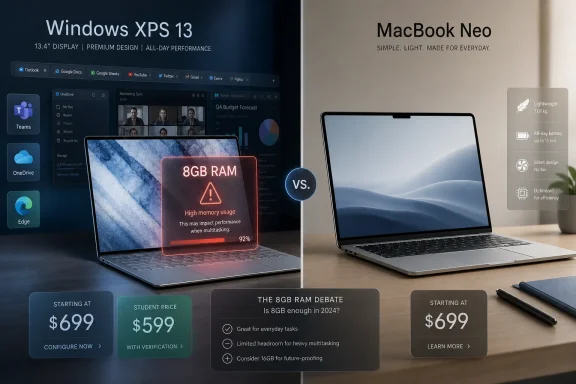 Dell Finally Learned the Right Lesson From Apple’s Cheapest Mac
The important part of Dell’s XPS 13 announcement is not that the company found a way to sell another thin laptop. Dell has been doing that for years, and the XPS brand has long carried the burden of being the PC world’s cleanest answer to the MacBook Air. The important part is that Dell appears to have understood what Apple’s MacBook Neo changed: the low end of the premium market is no longer allowed to look low end.Apple’s gambit with the MacBook Neo was not merely price. It was the refusal to make the entry model feel visually or materially apologetic. A $599 MacBook that still looks like a MacBook resets expectations for students, families, and office buyers who have been trained to associate sub-$700 Windows laptops with plastic shells, dim panels, mushy trackpads, and bargain-bin compromises.
Dell’s new XPS 13 attacks that opening with the right kind of product. It reportedly weighs about 2.2 pounds, uses a premium chassis, offers a 13.4-inch display at a resolution above the usual budget-laptop baseline, and keeps the XPS identity intact rather than creating a visibly cheaper “education” offshoot. That matters because buyers do not only compare CPUs and storage tables. They compare the feeling of the thing they carry every day.
This is why the Hardware Canucks line that Dell may have built a “better MacBook Neo” landed so neatly. On paper, Dell can point to advantages Apple often withholds at the low end: broader display options, Windows compatibility, multi-monitor flexibility, more configurable RAM, and a potentially replaceable SSD depending on the exact configuration and service path. The XPS 13 has a credible argument that it is not just cheaper than yesterday’s XPS; it is more generous than Apple’s cheapest Mac.
But the trap in PC land has always been that “configurable” can mean “good if you pay more.” Apple’s MacBook Neo is controversial because it fixes users at 8 GB of memory, but Apple also controls the silicon, the memory architecture, the operating system, the background services, and the app ecosystem in a way Dell does not. Dell can make the aluminum better. It cannot make Windows 11 behave like macOS simply by pricing the laptop more aggressively.
The 8 GB Question Is Really a Trust Question
The immediate online reaction to the XPS 13’s base memory configuration has been predictable because nearly everyone has lived through some version of the same story. A Windows PC looks like a bargain on the shelf. It boots quickly for the first week. Then the browser tabs multiply, Teams or Discord starts at login, OneDrive syncs, a vendor utility nags for updates, Windows Search indexes, the antivirus stack does its work, and the machine begins to feel less like a deal and more like a warning.That does not mean 8 GB is unusable. A modern Windows 11 laptop with 8 GB of memory, an efficient processor, and a fast SSD can handle web browsing, Office documents, streaming, school portals, messaging, and lightweight productivity. Plenty of people use such machines every day without catastrophe. The problem is not whether Windows 11 can run in 8 GB. The problem is whether an 8 GB Windows laptop sold in 2026 as a premium competitor should be treated as a wise long-term purchase.
Microsoft’s official Windows 11 floor remains far below the enthusiast conversation. The operating system can be installed on hardware with 4 GB of RAM, though that figure has always been more of an admission ticket than a recommendation for a pleasant modern PC. The market, meanwhile, has moved. For mainstream use, 16 GB has become the practical comfort zone, and for heavier multitasking, gaming, creative work, and development, 32 GB is increasingly framed as the place where buyers stop worrying.
That shift is not just about Windows itself. It is about the web becoming an application platform, communication tools becoming persistent background runtimes, and AI features trying to carve out local resources even on machines never bought for AI. A student laptop today is not just a Word-and-browser box. It is a browser with 20 tabs, a video call, a PDF reader, cloud sync, password manager, security software, note-taking app, and maybe an Android phone bridge all trying to coexist.
When users recoil at “Windows 11 on 8 GB,” they are not reading a requirements table. They are remembering friction. They are remembering machines that technically met the requirement but aged quickly, especially after feature updates, browser changes, and OEM preload creep. The XPS 13’s challenge is that it carries a premium badge, and premium badges make people less forgiving of baseline compromises.
Apple Gets Away With Less Because It Owns More
The MacBook Neo makes this comparison uncomfortable for Windows vendors because Apple has spent years teaching buyers that its base configurations, however stingy on paper, can still feel coherent in practice. That does not make Apple generous. Apple’s memory and storage upsells remain famously expensive, and an 8 GB Mac in 2026 is still an 8 GB computer. But Apple’s vertical integration gives it a cushion Dell does not have.Unified memory on Apple silicon is not magic, but it changes the performance envelope. macOS’s memory compression, app lifecycle behavior, and tight hardware-software tuning can make constrained memory less immediately punishing for ordinary tasks. Apple also does not have to account for the same diversity of drivers, utilities, security agents, OEM software, and enterprise management layers that Windows machines routinely carry.
This is the real reason “8 GB on a Mac” and “8 GB on Windows” are not identical claims. They are not simply two numbers on two spec sheets. They describe two ecosystems with different assumptions about background activity, hardware abstraction, and vendor incentives. Apple’s low-memory machines can still choke under pressure, particularly with heavy browser loads, creative apps, virtual machines, and developer workflows. But the average MacBook Neo buyer may encounter fewer visible penalties in the light-use scenarios Apple targets.
Windows has different strengths. It remains the default platform for a huge amount of business software, games, peripherals, niche utilities, repair workflows, and institutional IT. A Dell XPS 13 can fit into a Microsoft 365 school or business environment in a way a MacBook Neo may not. It can run the Windows applications that still define many workplaces. It can be managed by Intune, imaged, secured, audited, and integrated into fleets that have never seriously considered macOS.
But those advantages do not erase the memory issue. In fact, they sharpen it. The more Windows is valued for flexibility, compatibility, and background integration, the more questionable an 8 GB premium base model becomes. A machine meant to participate in the full Windows world should have enough headroom for that world.
The New XPS 13 Is a Better Product Than Its Base Model Suggests
The most generous read of Dell’s strategy is that the $699 XPS 13 exists to put a serious number in front of Apple, not necessarily to be the configuration most Windows enthusiasts should buy. In PC pricing, the starting price is the billboard. The real machine — the one with 16 GB or 32 GB of memory and enough storage to survive a few years — often lives one or two clicks deeper in the configurator.That is not inherently dishonest. Configuration choice is one of the Windows ecosystem’s best traits. Unlike the MacBook Neo, which reportedly locks buyers into 8 GB, the XPS 13 can be configured with more memory. That means Dell can serve both the lowest-price shopper and the buyer who understands that RAM is not where to save $100 or $150 on a sealed ultraportable.
But there is a difference between offering an upgrade and making the base model feel strategically underbuilt. If the XPS 13’s entry configuration pairs 8 GB of RAM with 256 GB of storage, Dell is asking buyers to accept two constraints at once. The SSD capacity can fill quickly after Windows, recovery partitions, Office, cached cloud files, photos, videos, and a few large applications. The memory ceiling will be felt whenever the user tries to multitask beyond the narrow lanes of “student laptop” marketing.
The XPS brand complicates this further. XPS is not Inspiron. It carries an implicit promise that Dell has already made the obvious quality decisions for the buyer. A base XPS that demands an immediate RAM upgrade to feel future-proof risks turning the entry price into a technicality. That may be normal in PC retail, but it is precisely the sort of normal that Apple has exploited.
The better version of this product story would be simple: 16 GB as the default, 512 GB as the sensible base, and $699 as a temporary promotional miracle if Dell could make the economics work. The memory market makes that difficult, especially with industry pressure from AI hardware and broader DRAM pricing volatility. Still, users are not wrong to judge the machine by the configuration Dell chose to lead with.
Windows 11 Has a Perception Problem Microsoft Cannot Benchmark Away
Microsoft has spent the Windows 11 era trying to make the operating system feel modern, secure, and AI-ready. Some of that work is real. Windows 11 is more polished than its reputation in many daily workflows, and on current hardware it can be fast, stable, and visually coherent. But Microsoft has also trained users to expect background ambition: widgets, Copilot integrations, cloud account prompts, Edge hooks, Teams remnants, OneDrive defaults, security layers, telemetry, and services that are individually defensible but collectively heavy.Memory anxiety is therefore not just a technical complaint. It is a referendum on Windows’ accumulation problem. Every new strategic priority seems to arrive as another resident process, another tray icon, another background updater, another cloud service, another feature that may be useful to someone but still occupies space in everyone’s mental model of the operating system.
This is where Apple’s advantage becomes psychological as much as architectural. A MacBook Neo buyer may not know what memory compression is. They may not understand unified memory. They may not even know how much RAM is in the machine. They simply expect that the laptop will behave like a Mac. Windows users, by contrast, have been trained to inspect the fine print because the ecosystem has too often punished trust.
That is a hard problem for Microsoft, because the company cannot fix it with a single “lighter Windows” marketing push. It has to prove, over several release cycles, that Windows 11 and its successor-era features can run leanly on mainstream hardware without requiring enthusiasts to debloat, disable, uninstall, or apologize. If Microsoft wants OEMs to compete with Apple at $599 and $699, it must treat resource discipline as a platform feature, not an optimization footnote.
The irony is that Microsoft has every reason to want this Dell machine to succeed. A credible premium-feeling Windows laptop at MacBook Neo pricing would be a platform win. It would keep students and cost-conscious buyers inside the Windows ecosystem before they drift into Apple’s hardware, Apple’s services, and eventually Apple’s workplace expectations. But if the first wave of buyers comes away saying “nice laptop, not enough RAM,” the lesson learned may be the opposite of what Microsoft and Dell intend.
The RAM Crunch Gives OEMs Cover, but Not a Free Pass
There is a real industry backdrop here. Memory pricing has been under pressure, and the AI boom has distorted component demand across the supply chain. DRAM, high-bandwidth memory, and server-side infrastructure spending all influence what consumer device makers can build profitably. When RAM prices rise, the cheapest mainstream configurations get squeezed first.That makes it easier to understand why Dell would lead with 8 GB. A $699 premium ultraportable with a good screen and high-quality chassis does not leave infinite room for generosity. Every component choice becomes a negotiation among margin, marketing, battery life, thermals, weight, and shelf-price psychology. Apple can hide some of this through its own silicon economics and tightly controlled product stack. Windows OEMs fight on thinner, more visible battlefields.
But “understandable” is not the same as “good.” If RAM is expensive, it becomes even more important not to waste it. That puts pressure on Microsoft to reduce idle memory use, on Dell to avoid unnecessary preload, and on reviewers to test the base model rather than only the nicer configuration. A constrained machine can be acceptable if the whole stack is designed around constraint. It becomes maddening when the hardware is constrained and the software behaves as if it has room to sprawl.
The Steam Deck comparison floating around the broader conversation is useful because it shows how component economics can force painful pricing decisions even on beloved devices. But handheld gaming PCs and premium productivity laptops face different expectations. A student buying a Dell XPS 13 is not signing up to manage memory pressure like an enthusiast. They are buying a daily computer, and daily computers are judged by whether they disappear into the work.
This is the line Dell has to walk. If the base XPS 13 is marketed as a sharp, affordable MacBook Neo rival, it must be reviewed as that exact machine: 8 GB RAM, base storage, retail software load, normal update state, mainstream apps, and a messy real-world browser session. If it passes that test, Dell deserves credit. If it does not, the “better MacBook Neo” line will look like a hardware compliment that ignored the operating system.
The Windows PC Industry Has Been Here Before
The PC industry has a long history of winning spec comparisons and losing user experience comparisons. Netbooks did this in the late 2000s. Cheap Windows tablets did it in the 2010s. Budget laptops have done it for years. The devices looked compelling because they made the right first impression on price, but many aged poorly because the configuration was built to hit a number rather than preserve dignity over time.The XPS 13 is not a netbook, and it would be unfair to pretend otherwise. Dell is bringing a much more serious machine to the fight. The chassis, display, weight, processor generation, and brand position all suggest a laptop that belongs in the premium conversation. That is exactly why the memory debate matters. Dell is close enough to Apple’s formula that the remaining compromises stand out.
The old Windows defense was that buyers could choose. Want more RAM? Configure it. Want more storage? Pay for it. Want a different port selection, display, processor, service plan, or operating system edition? The PC ecosystem has you covered. That flexibility remains valuable, especially for enthusiasts and IT departments.
But Apple’s low-cost Mac strategy attacks the buyer who does not want to configure. It attacks the parent buying a student laptop, the college freshman comparing two machines at a glance, the office worker replacing an aging notebook, and the casual user who wants “the good one” without becoming a procurement specialist. For those buyers, the base model is not a starting point. It is the product.
That means Windows OEMs need to rethink what a base configuration communicates. In 2016, 8 GB on a premium ultraportable was comfortable. In 2020, it was tolerable for mainstream work. In 2026, it is a statement that the buyer’s workload will remain modest and the operating system will remain disciplined. One of those assumptions is outside Dell’s control, and the other is outside the buyer’s.
Reviewers Must Test the Machine Dell Wants to Sell, Not the One We Wish It Sold
The first real answer will come from reviews, and the most useful reviews will not be the glamorous ones. A high-end XPS 13 with 32 GB of RAM and a larger SSD may be a delightful Windows ultraportable. It may also tell us very little about whether Dell has solved the MacBook Neo problem at $699 or $599 for students. The question is not whether the XPS 13 platform can be good. The question is whether the entry XPS 13 is good enough.That review should start from a cold retail setup, not a clean-room image. It should include Windows updates, Dell utilities, Microsoft account prompts, OneDrive defaults, Edge behavior, browser tab pressure, Office workloads, video calls, streaming, sleep and resume, and the sort of background noise that ordinary users accumulate. It should test memory pressure over days, not just benchmark bursts. It should ask whether the laptop feels premium after the third week, not just during the first boot.
Battery life also needs scrutiny. Low memory can increase SSD paging under pressure, and SSD paging can affect responsiveness and power behavior. A laptop can post excellent streaming battery numbers and still feel sticky when the user is switching between a call, a browser, a document, and a cloud-synced folder. The best ultraportables are not merely long-lived; they are consistent.
Storage deserves the same realism. A 256 GB SSD is less spacious than it appears once Windows, recovery tools, updates, app caches, and user data arrive. If the SSD is replaceable, that is a meaningful advantage over Apple, but it is not the same as giving the average buyer enough storage on day one. Most users do not buy a premium ultraportable expecting to open it.
This is where WindowsForum readers should be especially unsentimental. We like upgrade paths. We like serviceability. We like the fact that a PC can be tuned, repaired, reimaged, and extended. But a mass-market laptop cannot rely on enthusiast rescue to justify its base model. The product has to stand on its own.
IT Buyers Will See the Promise and the Paper Cut
For schools and small organizations, the XPS 13 could be genuinely interesting. A light, durable, premium-feeling Windows laptop at a student-friendly price has obvious appeal. It gives administrators a device that fits existing Windows management practices while offering users something closer to the hardware quality they associate with Apple.But enterprise and education deployments are also where 8 GB can become a false economy. Managed Windows environments often add endpoint detection, device management agents, VPN clients, print utilities, compliance tools, browser extensions, and collaboration software. Each one may be justified. Together, they turn memory headroom into operational headroom.
A school buying a fleet of 8 GB machines may save money up front and spend the difference in support tickets, complaints, premature replacement cycles, and teacher workarounds. A small business may discover that the cheapest XPS 13 is fine for a front-desk browser workflow but inadequate for a manager living in Excel, Teams, Outlook, a CRM, and remote desktop sessions. The difference between 8 GB and 16 GB is not glamorous, but it is often the difference between a machine that feels fresh and one that feels just good enough.
There is also a lifecycle question. Windows laptops are not bought for a single semester or a single release branch. They are bought into an update future. Over three or four years, Windows will change, browsers will get heavier, collaboration suites will expand, and local AI features may become harder to ignore. A base machine that is adequate in June 2026 may feel boxed in by 2028.
That is why IT buyers tend to be conservative about RAM. They are not buying for the clean install. They are buying for the supported image, the third year, the user who never closes tabs, and the security stack that cannot be removed. For them, the XPS 13’s existence is encouraging, but the base configuration is likely to be the decoy rather than the deployment target.
Dell’s Best Argument Is That Apple Left the Door Open
Apple’s MacBook Neo may have triggered this race, but it is not invulnerable. A low-cost Mac with fixed 8 GB memory and Apple’s usual constraints will not serve everyone. Some users need Windows applications. Some need broader peripheral compatibility. Some need multi-monitor workflows. Some need repairability or storage options. Some simply prefer Windows, especially in mixed work and gaming lives.Dell can win those buyers if it makes the XPS 13 feel like a real premium alternative rather than a cheaper compromise. The hardware appears to move in that direction. The price is aggressive. The student promotion is pointed. The product lands in exactly the segment where Apple has been trying to normalize the idea that “cheap Mac” no longer means “old Mac.”
The RAM concern should therefore be read less as hostility and more as demand. Windows users want this machine to be good. They want Dell to force Apple to respond. They want a $699 laptop that does not look or feel disposable. They want the XPS line to stop being aspirational only after discounts and configurations push it above mainstream reach.
But Windows loyalty has become conditional. Enthusiasts and IT pros will not pretend that 8 GB means the same thing everywhere just because it helps the platform narrative. If Dell wants the “better MacBook Neo” crown, it has to win not only on ports, pixels, and price, but on the lived experience of Windows under constraint. That is a harder test than any launch slide.
The $599 XPS 13 Makes One Thing Impossible to Ignore
The XPS 13’s launch price changes the conversation, but it does not settle it. Dell has put real pressure on Apple and on other Windows OEMs, and that alone makes the machine important. The uncomfortable part is that the laptop also puts pressure on Microsoft to make Windows worthy of the hardware partners trying to compete at this level.Here is the practical read for Windows buyers watching this fight unfold:
- The new XPS 13 is a credible premium Windows response to the MacBook Neo because Dell appears to be competing on materials, weight, display quality, and price at the same time.
- The 8 GB base model should be treated as a light-use configuration until independent reviews prove it can handle real Windows 11 multitasking without persistent slowdowns.
- The 16 GB configuration is likely to be the sensible floor for buyers who expect to keep the laptop for several years, especially students, office workers, and anyone living in browser tabs and collaboration apps.
- The ability to configure more RAM gives Dell an advantage over Apple’s fixed low-end MacBook Neo, but only if the upgrade pricing does not erase the value argument.
- Microsoft’s role is larger than it may want to admit, because Windows 11’s background footprint and service sprawl directly affect whether low-cost premium PCs can feel premium.
References
- Primary source: Notebookcheck
Published: Mon, 01 Jun 2026 07:26:00 GMT
"Dell made a better MacBook Neo" with new XPS 13 but users are concerned about Windows 11 on 8 GB RAM - Notebookcheck News
The Windows laptop space finally has a competitor to the Apple MacBook Neo with the new Dell XPS 13. The latest XPS 13 starts at $699 ($599 for students), is made from high-quality materials, and is super light. However, consumers are worried Windows 11 won't run well on just 8 GB of RAM. www.notebookcheck.net
- Official source: microsoft.com
Windows 11 Specs and System Requirements | Microsoft Windows
View Windows 11 specs, system requirements, and features from Microsoft. Learn about the device specifications, versions, and languages available for Windows 11.www.microsoft.com - Official source: support.microsoft.com
Windows 11 System Requirements | Microsoft Support
Learn about Windows 11 minimum system requirements and how to assess your upgrade eligibility.support.microsoft.com - Related coverage: windowscentral.com
"Prime competition for MacBook Neo": Dell's new XPS 13 starts at $599, and it has a few features that Apple lacks | Windows Central
Backlit keyboard, multi-monitor support, up to 32GB of RAM, and the latest Intel chips make the new XPS 13 one enticing laptop.www.windowscentral.com - Related coverage: boingboing.net
Dell counters the MacBook Neo with a $599 XPS 13 - Boing Boing
Dell just announced the new XPS 13, a well-timed response to the wildly successful MacBook Neo. It starts at $599 through September, but only for students and educators, and everyone…boingboing.net - Official source: learn.microsoft.com
Windows 11 requirements | Microsoft Learn
Hardware requirements to deploy Windows 11.learn.microsoft.com
- Related coverage: pcgamesn.com
Dell just took a huge swing at Apple and the Macbook Neo, with new Dell XPS 13 launching at $599 - PCGamesN
Normally priced at around $1,000, the new Dell XPS 13 brings the slim, and light aluminum laptop to a new low price, but not for everyone.www.pcgamesn.com - Related coverage: pcworld.com
Dell’s $599 XPS 13 is coming for the MacBook Neo’s lunch money | PCWorld
Dell announced a lighter, smaller XPS 13 at CES in January. At Computex, the company is unveiling it at an extremely aggressive price to challenge the Apple MacBook Neo, and with terrific battery life and an OLED display to boot.www.pcworld.com - Related coverage: gamesbeat.com
Dell unveils $699 XPS 13 laptop that weighs 2.2 pounds - GamesBeat
Become a member of GB MAX to gain exclusive access to the industry and to the most influential global B2B leadership community in the...gamesbeat.com - Related coverage: tomshardware.com
Microsoft now recommends 32GB of RAM as the future-proof 'no worries' config for gaming — 16GB becomes the new 'practical starting point' during the RAMageddon | Tom's Hardware
32 GB is no longer being considered as overkill.www.tomshardware.com - Related coverage: techradar.com
I loved a lot of things about the Dell XPS 14 (2026), but it won't make me ditch my MacBook Pro... yet | TechRadar
Dell’s MacBook rival is backwww.techradar.com - Related coverage: tomsguide.com
Windows fans mocked MacBook Neo’s 8GB RAM — my testing shows why that’s wrong | Tom's Guide
Is 8GB of RAM enough in 2026? The MacBook Neo review reveals how Apple\u2019s "just-in-time" unified memory challenges Windows 11\u2019s "hoarding" habits. See why the numbers don\u2019t tell the whole story in this pizza-fueled performance showdown.www.tomsguide.com - Related coverage: valleytechlogic.com
- Related coverage: i.dell.com
