

Microsoft’s Windows account responded this week to a viral X video mocking a Windows gaming laptop beside Apple’s MacBook Neo, countering with a $699 Dell XPS 13 that more directly matches Apple’s budget ultraportable on price, size, and premium positioning. The reply was a clean hit on the hardware comparison, but it also exposed the deeper problem Microsoft cannot solve with a clever quote-tweet. Windows PC makers can now meet Apple at the low end with credible machines. Microsoft still has to convince users that Windows 11 deserves to run on them.
The original viral clip was engineered to make Windows hardware look ridiculous. It placed Apple’s slim MacBook Neo next to what appears to be an HP Victus gaming laptop, then ran through visual tricks that favored thinness, rigidity, and minimalist design over performance, cooling, ports, and graphics hardware. That is not a product comparison so much as a category error with good lighting.
A budget gaming laptop and a fanless ultraportable are not built to win the same contest. One spends money on a GPU, thermal headroom, and a chassis large enough to move heat; the other spends money on industrial design, battery efficiency, and the kind of thin profile that photographs well in a social feed. If the goal is to ask which machine feels more refined when lifted by its lid, the answer was decided before the video started.
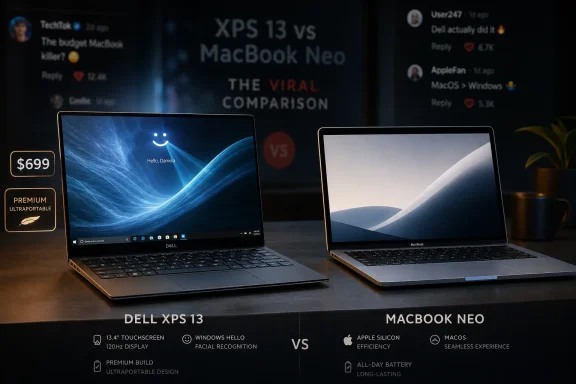
That is why Microsoft’s response was unusually effective. By putting the MacBook Neo up against the new Dell XPS 13, Microsoft moved the fight back into the correct weight class. The XPS 13 is a premium ultraportable, starts at $699 for general buyers, and drops to $599 for eligible students, placing it directly in the price lane Apple just made more expensive.
But the reaction to Microsoft’s post showed the limits of winning the right argument. Once the comparison became fair, a familiar refrain returned: the hardware looks good, but it runs Windows. That is the sentence Microsoft should fear more than any Apple ad.
That difference makes Windows harder to defend in viral culture. A bad $699 Windows laptop can stand in for all Windows laptops, even though a good $699 Windows laptop may be built by another vendor, use another chip, and target an entirely different buyer. Apple rarely suffers from that kind of category sprawl because the MacBook brand is tightly managed.
The HP Victus-style comparison exploited that asymmetry. It made a gaming laptop lose a fashion contest and then let viewers generalize the result to Windows hardware as a whole. The stickers, the flex, the thickness, the visible gaming-laptop bulk — all of it became visual shorthand for an ecosystem that is supposedly messy and inelegant.
The irony is that many Windows users immediately understood the trick. They know why gaming laptops are thicker. They know why a discrete GPU matters. They know that a student looking for Fortnite, Blender, CAD work, or Steam compatibility is not buying the same tool as someone who wants a silent note-taking machine.
Still, nuance travels slowly and mockery travels fast. The clip’s success was not proof that the MacBook Neo is the better computer for everyone. It was proof that Apple’s product story is easier to compress into ten seconds.
At the same $699 public starting price, Dell’s machine brings a 13.4-inch 2560×1600 touchscreen, a variable refresh display up to 120Hz, Windows Hello face authentication, Wi-Fi 7, a backlit keyboard, and a 512GB SSD. It weighs about 2.2 pounds and uses an aluminum chassis. Those are not token features sprinkled onto a cheap laptop; they are the ingredients of a real MacBook Neo rival.
The comparison becomes more interesting because Apple recently raised the MacBook Neo’s general starting price to $699. That turns Dell’s launch from a routine PC refresh into a direct pricing ambush. Apple had the halo of redefining the affordable premium laptop earlier this year; Dell now gets to say that Windows hardware can match the new price while offering a more expansive feature set.
The XPS 13 also attacks Apple where Apple is intentionally conservative. There is still no touchscreen MacBook. The base MacBook Neo remains locked to 8GB of RAM. The lower-end configuration does not deliver the same biometric story Dell can claim with Windows Hello facial recognition across the line.
This is the part Microsoft wanted users to notice. The Windows ecosystem is not just a collection of cheap compromises. At its best, it can be flexible, competitive, and technically aggressive in ways Apple refuses to be.
But the Neo also depends on buyers accepting Apple’s trade-offs. The base memory ceiling matters. The lack of a touchscreen matters. Port speed matters. The absence of a backlit keyboard and biometric sign-in on the lowest tier matters if those are features a Windows buyer already expects in a premium-feeling laptop.
Apple can get away with some of this because the MacBook brand carries enormous trust. Many buyers assume that if Apple omitted something, it was either unnecessary or reserved for a higher-end product. In the Windows world, the same omission is more likely to be read as cheapness.
That double standard is frustrating for PC makers, but it is not imaginary. Apple has spent years training customers to accept fewer choices in exchange for polish and predictability. Microsoft and its partners have spent years training customers to inspect the spec sheet carefully because two machines with the same Windows logo may deliver wildly different experiences.
The MacBook Neo therefore wins even when it loses individual categories. It sells an ecosystem promise. Dell sells a better feature mix. Microsoft’s problem is that the first pitch often feels calmer than the second.
The XPS 13 is a good example of that shift. A few years ago, a $699 Windows laptop with this kind of display, chassis, and weight would have sounded like a Black Friday doorbuster with a catch. In 2026, Dell is using it as a strategic weapon against Apple’s most disruptive MacBook.
Yet Microsoft is discovering that hardware progress does not automatically repair software sentiment. Windows 11 arrived with stricter hardware requirements, a redesigned Start menu, more Microsoft account pressure, more cloud integration, more advertising surfaces, and a slow but persistent push toward Copilot. Some of those choices are defensible in isolation. Together, they created an impression that Microsoft was more interested in steering users than serving them.
That perception now shadows every Windows laptop pitch. When Microsoft posts a sleek Dell machine, critics do not have to prove that the XPS 13 is bad. They only have to say that Windows is the problem.
This is the reputational tax Microsoft pays whenever it turns the operating system into a marketing platform. The OS can be faster, more secure, and more capable than the caricature suggests, but once users feel nagged, tracked, or interrupted, every improvement has to fight through resentment first.
That is a problem for a laptop like the XPS 13 because it makes even strong hardware feel conscripted into a broader corporate agenda. A key that should be a minor input change becomes a referendum on Microsoft’s priorities. The reaction is not always proportional, but it is real.
For enthusiasts and administrators, the frustration is easy to understand. Windows users have spent years disabling unwanted startup apps, removing bundled software, dodging prompts to use Edge, and untangling settings that seem to move between Control Panel, Settings, and cloud-linked account pages. Copilot arrived into that environment, not a blank slate.
Microsoft wants AI to feel like the next Start button. Many users still see it as another thing to turn off.
This is why the company cannot treat the Windows 11 reputation problem as a messaging issue alone. The backlash is not just about people misunderstanding the benefits of AI PCs or ignoring performance patches. It is about a long-running trust deficit over who Windows is being optimized for.
That is especially important in the $699 laptop fight. Budget-premium machines live in the gap between aspiration and constraint. They must feel expensive even when they are not. Any stutter, delay, or unexplained background activity breaks the spell.
But performance work has a visibility problem. A viral video can show a flexing lid. It cannot show six months of memory-management fixes. Microsoft can demonstrate Windows Hello and touch input in a short clip, but it is much harder to prove that Windows 11 has become less annoying, less heavy, or less eager to interrupt the user.
There is also a timing problem. Reputations lag reality. Windows Vista improved before its image recovered. Windows 8 never fully escaped the backlash to its original interface bet. Windows 11 may become smoother and more disciplined, but users who already filed it under “bloated” will not reopen the case because Microsoft posted a slick laptop video.
The XPS 13 can win a benchmark table today. Windows has to win back patience over years.
That does not mean enterprises will ignore the Neo. Apple’s lower entry price makes Mac fleets easier to justify in mixed environments, especially where developers, designers, executives, or education users already prefer macOS. If the Neo reduces the MacBook premium, it gives Apple another wedge into organizations that once treated Macs as exceptions.
But Windows still has structural advantages in many shops. Legacy applications, device management, endpoint security tooling, peripheral compatibility, and Windows-first workflows remain powerful anchors. For administrators, the question is not whether a MacBook lid wobbles less in a video. It is whether the machine integrates cleanly into the organization’s operating model.
That is where Microsoft’s hardware response matters. The company needs the Windows laptop shelf to look credible at every price point because procurement decisions are often psychological before they are technical. If buyers associate low-cost Windows machines with compromise and low-cost MacBooks with polish, Apple gains ground before the spreadsheet opens.
Dell’s XPS 13 helps rebalance that perception. It gives Microsoft and IT buyers a simple answer: yes, there is a premium-feeling Windows option in this price range. The harder follow-up is whether users will be happy living in Windows 11 once the box is opened.
Dell’s new XPS 13 appears to understand that lesson. A clean chassis, a simple student price, a direct MacBook comparison, and visible features like touch and Windows Hello all help buyers grasp the pitch quickly. That is exactly what Windows hardware needs more often.
Microsoft also needs its OEM partners to stop letting bad examples define the brand. The company does not build most Windows laptops, but it suffers when the market is flooded with machines that meet minimum expectations while feeling worse than their price. Every flimsy hinge and dim display becomes an argument for the Mac.
At the same time, Microsoft has to police its own contribution to the mess. A great laptop experience is not just silicon and aluminum. It is setup flow, update behavior, account choice, background services, driver reliability, sleep and wake consistency, and the absence of unwanted prompts during a workday.
If Windows wants to compete with Apple on “it just works,” the operating system has to stop treating user attention as inventory.
That is the most effective version of Microsoft’s argument. Not “Windows is cheaper.” Not “Apple is overpriced.” Not “look at this one misleading video.” The stronger claim is that Windows hardware can offer more agency at the same price.
Agency has always been the PC’s best argument. Users can choose the shape, ports, processor, memory, screen, repair model, and software stack that fit their work. The danger is that choice can look like chaos when Apple offers a simpler answer.
The XPS 13 works because it narrows that chaos. It gives Microsoft a single, coherent counterexample to the claim that Windows laptops are clunky by default. It is not the whole ecosystem; it is a showcase.
But showcases are fragile. If the user opens that showcase laptop and finds the usual Windows annoyances, the hardware victory evaporates.
 Microsoft Won the Spec Sheet and Still Picked a Harder Fight
The original viral clip was engineered to make Windows hardware look ridiculous. It placed Apple’s slim MacBook Neo next to what appears to be an HP Victus gaming laptop, then ran through visual tricks that favored thinness, rigidity, and minimalist design over performance, cooling, ports, and graphics hardware. That is not a product comparison so much as a category error with good lighting.A budget gaming laptop and a fanless ultraportable are not built to win the same contest. One spends money on a GPU, thermal headroom, and a chassis large enough to move heat; the other spends money on industrial design, battery efficiency, and the kind of thin profile that photographs well in a social feed. If the goal is to ask which machine feels more refined when lifted by its lid, the answer was decided before the video started.
That is why Microsoft’s response was unusually effective. By putting the MacBook Neo up against the new Dell XPS 13, Microsoft moved the fight back into the correct weight class. The XPS 13 is a premium ultraportable, starts at $699 for general buyers, and drops to $599 for eligible students, placing it directly in the price lane Apple just made more expensive.
But the reaction to Microsoft’s post showed the limits of winning the right argument. Once the comparison became fair, a familiar refrain returned: the hardware looks good, but it runs Windows. That is the sentence Microsoft should fear more than any Apple ad.
The Viral Clip Worked Because It Told a Simpler Story Than Reality
The Windows PC ecosystem has always been both Microsoft’s advantage and its curse. A buyer can choose a cheap school laptop, a workstation, a detachable tablet, a repairable business machine, a gaming notebook, a foldable, or a premium ultrabook, all running the same operating system. Apple’s MacBook lineup is narrower, more controlled, and easier to explain.That difference makes Windows harder to defend in viral culture. A bad $699 Windows laptop can stand in for all Windows laptops, even though a good $699 Windows laptop may be built by another vendor, use another chip, and target an entirely different buyer. Apple rarely suffers from that kind of category sprawl because the MacBook brand is tightly managed.
The HP Victus-style comparison exploited that asymmetry. It made a gaming laptop lose a fashion contest and then let viewers generalize the result to Windows hardware as a whole. The stickers, the flex, the thickness, the visible gaming-laptop bulk — all of it became visual shorthand for an ecosystem that is supposedly messy and inelegant.
The irony is that many Windows users immediately understood the trick. They know why gaming laptops are thicker. They know why a discrete GPU matters. They know that a student looking for Fortnite, Blender, CAD work, or Steam compatibility is not buying the same tool as someone who wants a silent note-taking machine.
Still, nuance travels slowly and mockery travels fast. The clip’s success was not proof that the MacBook Neo is the better computer for everyone. It was proof that Apple’s product story is easier to compress into ten seconds.
Dell Gave Microsoft the Laptop It Needed
The Dell XPS 13 was the obvious counterpunch because it removes the excuses. It is slim, light, clean, and built around the same premium-minimalist vocabulary Apple has dominated for years. More importantly, it is not a lumbering Windows bargain bin machine pretending to be something else.At the same $699 public starting price, Dell’s machine brings a 13.4-inch 2560×1600 touchscreen, a variable refresh display up to 120Hz, Windows Hello face authentication, Wi-Fi 7, a backlit keyboard, and a 512GB SSD. It weighs about 2.2 pounds and uses an aluminum chassis. Those are not token features sprinkled onto a cheap laptop; they are the ingredients of a real MacBook Neo rival.
The comparison becomes more interesting because Apple recently raised the MacBook Neo’s general starting price to $699. That turns Dell’s launch from a routine PC refresh into a direct pricing ambush. Apple had the halo of redefining the affordable premium laptop earlier this year; Dell now gets to say that Windows hardware can match the new price while offering a more expansive feature set.
The XPS 13 also attacks Apple where Apple is intentionally conservative. There is still no touchscreen MacBook. The base MacBook Neo remains locked to 8GB of RAM. The lower-end configuration does not deliver the same biometric story Dell can claim with Windows Hello facial recognition across the line.
This is the part Microsoft wanted users to notice. The Windows ecosystem is not just a collection of cheap compromises. At its best, it can be flexible, competitive, and technically aggressive in ways Apple refuses to be.
Apple’s Budget MacBook Is Strongest When Nobody Mentions the Compromises
The MacBook Neo is not a bad machine. Its appeal is obvious: it brings Apple’s laptop design language, macOS, strong battery life, silent operation, and the MacBook brand into a price tier Apple historically avoided. For students, families, and buyers who want an inexpensive route into the Apple ecosystem, that is a powerful proposition.But the Neo also depends on buyers accepting Apple’s trade-offs. The base memory ceiling matters. The lack of a touchscreen matters. Port speed matters. The absence of a backlit keyboard and biometric sign-in on the lowest tier matters if those are features a Windows buyer already expects in a premium-feeling laptop.
Apple can get away with some of this because the MacBook brand carries enormous trust. Many buyers assume that if Apple omitted something, it was either unnecessary or reserved for a higher-end product. In the Windows world, the same omission is more likely to be read as cheapness.
That double standard is frustrating for PC makers, but it is not imaginary. Apple has spent years training customers to accept fewer choices in exchange for polish and predictability. Microsoft and its partners have spent years training customers to inspect the spec sheet carefully because two machines with the same Windows logo may deliver wildly different experiences.
The MacBook Neo therefore wins even when it loses individual categories. It sells an ecosystem promise. Dell sells a better feature mix. Microsoft’s problem is that the first pitch often feels calmer than the second.
Windows Hardware Has Improved Faster Than Windows’ Image
The modern Windows laptop market is much better than its reputation. Displays have improved. Trackpads are no longer a guaranteed liability. Premium aluminum designs have moved down the stack. AMD, Intel, and Qualcomm have all pushed PC makers toward better battery life and thinner chassis. The best Windows ultraportables are no longer apologizing for themselves.The XPS 13 is a good example of that shift. A few years ago, a $699 Windows laptop with this kind of display, chassis, and weight would have sounded like a Black Friday doorbuster with a catch. In 2026, Dell is using it as a strategic weapon against Apple’s most disruptive MacBook.
Yet Microsoft is discovering that hardware progress does not automatically repair software sentiment. Windows 11 arrived with stricter hardware requirements, a redesigned Start menu, more Microsoft account pressure, more cloud integration, more advertising surfaces, and a slow but persistent push toward Copilot. Some of those choices are defensible in isolation. Together, they created an impression that Microsoft was more interested in steering users than serving them.
That perception now shadows every Windows laptop pitch. When Microsoft posts a sleek Dell machine, critics do not have to prove that the XPS 13 is bad. They only have to say that Windows is the problem.
This is the reputational tax Microsoft pays whenever it turns the operating system into a marketing platform. The OS can be faster, more secure, and more capable than the caricature suggests, but once users feel nagged, tracked, or interrupted, every improvement has to fight through resentment first.
The Copilot Era Made the Keyboard Political
Nothing illustrates the mood around Windows 11 better than the Copilot key. On paper, it is just another hardware shortcut, a way to invoke Microsoft’s AI assistant on modern PCs. In practice, it has become a symbol of Microsoft’s insistence that AI belongs at the center of the Windows experience whether users asked for it or not.That is a problem for a laptop like the XPS 13 because it makes even strong hardware feel conscripted into a broader corporate agenda. A key that should be a minor input change becomes a referendum on Microsoft’s priorities. The reaction is not always proportional, but it is real.
For enthusiasts and administrators, the frustration is easy to understand. Windows users have spent years disabling unwanted startup apps, removing bundled software, dodging prompts to use Edge, and untangling settings that seem to move between Control Panel, Settings, and cloud-linked account pages. Copilot arrived into that environment, not a blank slate.
Microsoft wants AI to feel like the next Start button. Many users still see it as another thing to turn off.
This is why the company cannot treat the Windows 11 reputation problem as a messaging issue alone. The backlash is not just about people misunderstanding the benefits of AI PCs or ignoring performance patches. It is about a long-running trust deficit over who Windows is being optimized for.
Performance Fixes Help, but Trust Is Slower Than a Scheduler
Microsoft has reportedly spent much of 2026 trying to address the complaints that made Windows 11 an easy target: memory leaks, slow startup behavior, File Explorer bugs, and interface sluggishness on lower-end hardware. The company’s work on latency and responsiveness matters because perceived speed is often more important than benchmark speed. If the Start menu opens instantly and apps feel snappy, users forgive a lot.That is especially important in the $699 laptop fight. Budget-premium machines live in the gap between aspiration and constraint. They must feel expensive even when they are not. Any stutter, delay, or unexplained background activity breaks the spell.
But performance work has a visibility problem. A viral video can show a flexing lid. It cannot show six months of memory-management fixes. Microsoft can demonstrate Windows Hello and touch input in a short clip, but it is much harder to prove that Windows 11 has become less annoying, less heavy, or less eager to interrupt the user.
There is also a timing problem. Reputations lag reality. Windows Vista improved before its image recovered. Windows 8 never fully escaped the backlash to its original interface bet. Windows 11 may become smoother and more disciplined, but users who already filed it under “bloated” will not reopen the case because Microsoft posted a slick laptop video.
The XPS 13 can win a benchmark table today. Windows has to win back patience over years.
Enterprise Buyers Will See a Different Contest
For IT departments, the MacBook Neo versus XPS 13 fight is less about social-media aesthetics and more about fleet logic. A $699 premium Windows ultraportable with Windows Hello, business-friendly configuration options, and Windows 11 Pro availability is a much more interesting procurement object than a viral post suggests. It fits into existing management, identity, security, and app-compatibility workflows.That does not mean enterprises will ignore the Neo. Apple’s lower entry price makes Mac fleets easier to justify in mixed environments, especially where developers, designers, executives, or education users already prefer macOS. If the Neo reduces the MacBook premium, it gives Apple another wedge into organizations that once treated Macs as exceptions.
But Windows still has structural advantages in many shops. Legacy applications, device management, endpoint security tooling, peripheral compatibility, and Windows-first workflows remain powerful anchors. For administrators, the question is not whether a MacBook lid wobbles less in a video. It is whether the machine integrates cleanly into the organization’s operating model.
That is where Microsoft’s hardware response matters. The company needs the Windows laptop shelf to look credible at every price point because procurement decisions are often psychological before they are technical. If buyers associate low-cost Windows machines with compromise and low-cost MacBooks with polish, Apple gains ground before the spreadsheet opens.
Dell’s XPS 13 helps rebalance that perception. It gives Microsoft and IT buyers a simple answer: yes, there is a premium-feeling Windows option in this price range. The harder follow-up is whether users will be happy living in Windows 11 once the box is opened.
The PC Ecosystem Needs Fewer Unforced Errors
The Windows world has a strange habit of winning on flexibility and then losing on presentation. Stickers on palm rests, confusing model names, shifting discounts, mismatched configurations, trialware, regional variants, and retailer-only SKUs all make the PC market feel harder than it needs to be. Apple’s genius is not only design; it is eliminating doubt at the moment of purchase.Dell’s new XPS 13 appears to understand that lesson. A clean chassis, a simple student price, a direct MacBook comparison, and visible features like touch and Windows Hello all help buyers grasp the pitch quickly. That is exactly what Windows hardware needs more often.
Microsoft also needs its OEM partners to stop letting bad examples define the brand. The company does not build most Windows laptops, but it suffers when the market is flooded with machines that meet minimum expectations while feeling worse than their price. Every flimsy hinge and dim display becomes an argument for the Mac.
At the same time, Microsoft has to police its own contribution to the mess. A great laptop experience is not just silicon and aluminum. It is setup flow, update behavior, account choice, background services, driver reliability, sleep and wake consistency, and the absence of unwanted prompts during a workday.
If Windows wants to compete with Apple on “it just works,” the operating system has to stop treating user attention as inventory.
The $699 Fight Is Really About Who Defines “Premium”
Apple’s MacBook Neo changed the conversation because it made a premium-feeling laptop available at a price that once belonged to compromise machines. Dell’s XPS 13 changes it again by arguing that premium should mean more than a clean shell and a familiar logo. Touch, faster display refresh, broader configuration options, and standard face unlock are all legitimate parts of the premium experience.That is the most effective version of Microsoft’s argument. Not “Windows is cheaper.” Not “Apple is overpriced.” Not “look at this one misleading video.” The stronger claim is that Windows hardware can offer more agency at the same price.
Agency has always been the PC’s best argument. Users can choose the shape, ports, processor, memory, screen, repair model, and software stack that fit their work. The danger is that choice can look like chaos when Apple offers a simpler answer.
The XPS 13 works because it narrows that chaos. It gives Microsoft a single, coherent counterexample to the claim that Windows laptops are clunky by default. It is not the whole ecosystem; it is a showcase.
But showcases are fragile. If the user opens that showcase laptop and finds the usual Windows annoyances, the hardware victory evaporates.
The Short Version Microsoft Should Not Ignore
The viral MacBook Neo clip was unfair, but Microsoft’s response only matters if the company understands why the clip landed. Dell supplied a credible answer on hardware. Windows 11 now has to supply one in daily use.- The original comparison was misleading because it judged a budget gaming laptop by ultraportable design standards.
- Microsoft’s Dell XPS 13 response was stronger because it matched Apple’s MacBook Neo in the same price and product category.
- The new XPS 13 gives Windows a serious $699 premium-laptop argument with touch, Windows Hello, a sharper high-refresh display, and broader configuration paths.
- Apple’s MacBook Neo remains dangerous because it sells simplicity, brand trust, and macOS cohesion more effectively than most Windows laptops sell choice.
- Microsoft’s biggest obstacle is no longer whether Windows hardware can compete, but whether users believe Windows 11 will respect their time, memory, and attention.
References
- Primary source: Windows Latest
Published: 2026-06-30T14:06:07.793390
Microsoft hits back at viral MacBook Neo mocking Windows hardware, but the Windows 11 reputation is the real fight
Microsoft quote-tweeted a viral MacBook Neo video with the Dell XPS 13, right after Apple's Neo price hike to $699. Here's how they compare. www.windowslatest.com
- Related coverage: techradar.com
Don't delay that MacBook upgrade — Apple's laptop price hikes could be much worse than the iPhone 18 Pro, analysts predict | TechRadar
MacBook price hike fears intensify, but it's a different story for the iPhone 18 Prowww.techradar.com - Related coverage: tomsguide.com
Best Buy still has the MacBook Neo for $599 — get it now before stock runs out | Tom's Guide
Apple raised the price of the MacBook Neo by $100, but you can still get it for $599 at Best Buy. This deal won't last long, so act now before it's too late.www.tomsguide.com - Related coverage: macrumors.com
Dell Unveils $699 Laptop With Features 'You Won't Find on a MacBook Neo'
Dell this week introduced a new version of the XPS 13, a laptop that it said is "contending with the MacBook Neo on price, and exceeding it on features". In the U.S., the XPS 13 starts at $699 for the general public and at $599 for eligible students, which is $100 more than the MacBook...www.macrumors.com - Official source: support.microsoft.com
Sign-In Options in Windows | Microsoft Support
Learn about the sign-in options in Windows settings.support.microsoft.com - Related coverage: tomshardware.com
Dell XPS 13 targets MacBook Neo with Intel's Wildcat Lake — $699 starting price, $599 for students | Tom's Hardware
Dell's thinnest XPS 13 ever.www.tomshardware.com
- Related coverage: tweaktown.com
Dell launches new $599 XPS 13 with Wildcat Lake, CNC-aluminum chassis, and 2.5K 120Hz display to rival the MacBook Neo
As Dell's lightest XPS to date, the Wildcat Lake variants configure up to a Core 5 320 and 16GB RAM with a claimed 17 hours of battery. www.tweaktown.com
- Related coverage: macrumors.ru
Dell представила ноутбук за $699 с функциями, «которых не найти в MacBook Neo» - MacRumors.ru
На этой неделе компания Dell представила новую версию XPS 13 — ноутбука, который, по словам производителя, «конкурирует с MacBook Neo по цене и превосходит его по функциональности». В США стоимость XPS 13 начинается от $699 для широкого круга покупателей и от $599 для студентов, что на $100...macrumors.ru
- Related coverage: boingboing.net
Dell counters the MacBook Neo with a $599 XPS 13 - Boing Boing
Dell just announced the new XPS 13, a well-timed response to the wildly successful MacBook Neo. It starts at $599 through September, but only for students and educators, and everyone…boingboing.net - Related coverage: hardware.slashdot.org
Dell Rivals Apple's MacBook Neo With $699 Touchscreen XPS 13 Laptop - Slashdot
Dell has introduced a redesigned $699 XPS 13 aimed squarely at Apple's budget MacBook Neo, offering a premium aluminum design, touch display, backlit keyboard, Wi-Fi 7, 512GB of base storage, and various other configuration options. Dell's machine costs more than Apple's entry model but tries to...hardware.slashdot.org - Related coverage: windowscentral.com
"My jaw dropped": Dell just launched its new $599 XPS 13, and I don't think the Windows 11 laptop market will ever be the same | Windows Central
The new best laptop for students (and anyone else who wants an affordable Windows 11 PC) is here.www.windowscentral.com - Related coverage: gagadget.com
Dell XPS 13 (2026) takes on the MacBook Neo at $699
Dell has launched the XPS 13 (2026), a slim Windows laptop aimed squarely at buyers considering Apple's new MacBook Neo. At $699 in the US — or $599 with a studgagadget.com - Related coverage: techlicious.com
Dell’s new XPS 13 answers the MacBook Neo with better specs
Dell's new XPS 13 offers a 2.5K 120Hz touchscreen and up to 32GB RAM starting at $599 for students. It's a strong MacBook Neo alternative, Intel chip aside.www.techlicious.com - Related coverage: itpro.com
Dell sets the stage for a MacBook Neo showdown with budget XPS 13 laptop range | IT Pro
Dell has announced the launch of the new XPS 13 laptop range as the company sets the stage for a showdown with the MacBook Neo.www.itpro.com
