

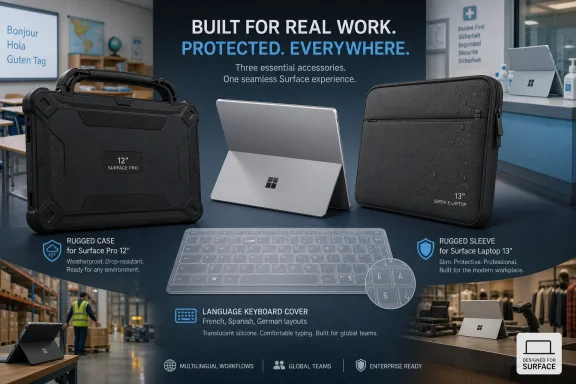
Microsoft announced its 2025 Designed for Surface Partner Awards on its Surface accessory site, naming The Joy Factory as Partner of the Year, STM’s Dux Rugged Case for the 13-inch Surface Laptop as Product of the Year, and JCPal’s VerSkin language keyboard covers as Innovative Solution of the Year. The announcement is small in the way accessory awards are small: no new silicon, no Windows feature flag, no dramatic product pivot. But it exposes a larger truth about Surface in 2025. Microsoft’s hardware strategy increasingly depends on whether third-party partners can turn elegant, sometimes fragile-feeling reference designs into machines that survive classrooms, clinics, warehouses, retail counters, and multilingual fleets.
Surface has always been sold as a first-party Windows ideal: the PC Microsoft wishes the rest of the industry would build. That framing made sense when the original Surface line was a provocation, a way to show OEMs that tablets, pens, kickstands, detachable keyboards, and high-DPI displays could belong in the same Windows conversation. More than a decade later, the story is less about proving the form factor and more about operationalizing it.
That is where Designed for Surface matters. The program exists to certify third-party accessories for compatibility with specific Surface devices, and Microsoft’s award language leans heavily on trust, standards, and real-world use cases. In plainer terms, it is Microsoft’s way of saying that the Surface experience does not end at the magnesium chassis or the Windows desktop.
This matters because Surface has drifted into a peculiar middle ground. It remains aspirational hardware, but Microsoft also wants it to be fleet hardware. A premium notebook or detachable tablet can look beautiful on a launch stage; it becomes an IT problem the moment it needs to survive three years in a school cart, on a nurse’s station, mounted to a forklift, or checked in and out by retail staff.
The 2025 winners are not glamorous in the conventional consumer-electronics sense. They are protective cases, rugged shells, and keyboard overlays. That is exactly why they are interesting. Microsoft’s most revealing Surface announcement this week is not about what the devices can do when unboxed, but what partners must add before many organizations can safely deploy them.
That language is doing a lot of work. Microsoft’s 12-inch Surface Pro is part of the company’s newer Copilot+ PC push, a smaller and relatively cheaper addition to the Surface lineup announced in 2025 alongside the 13-inch Surface Laptop. It is marketed around portability, AI-era Windows, and the familiar Surface promise that a tablet can become a laptop when needed.
But the kinds of organizations that buy rugged cases are not primarily shopping for sleekness. They are trying to reduce breakage, downtime, support tickets, and the awkward procurement math that happens when a device looks affordable until it starts failing in the field. A Surface Pro without a rugged enclosure is a flexible tablet; a Surface Pro inside an aXtion case becomes something closer to an operational endpoint.
That distinction is important for Microsoft’s enterprise ambitions. The company can talk about Copilot+ PCs and neural processing units, but frontline deployments often begin with simpler questions. Can the device be carried one-handed? Can it be dropped? Can it be wiped down? Can it be mounted? Can a worker use it without treating it like jewelry?
The Joy Factory’s award suggests Microsoft knows this. Surface may still be marketed with lifestyle photography and premium industrial design, but many of its most defensible business use cases depend on partners willing to wrap that design in plastic, rubber, straps, handles, and mounts.
A school district considering Surface devices is not just buying processors and displays. It is buying charging workflows, carry protection, keyboard durability, asset labeling, and repair expectations. A hospital department is thinking about cleaning protocols, drops, carts, gloves, and shift handoffs. A manufacturer is thinking about dust, moisture, vibration, and whether the device can be used while standing.
This is why a rugged case can be more strategically important than it looks. Microsoft does not need every Surface customer to buy a rugged shell, but it needs enough credible accessory options that Surface does not get screened out during procurement. If the accessory ecosystem is thin, IT teams retreat to safer, duller hardware with a longer history of docks, mounts, locks, and replacement parts.
The Designed for Surface badge is Microsoft’s answer to that anxiety. It tells buyers that a product has been tested for compatibility with specified Surface devices and that the accessory is not merely “close enough.” In consumer contexts, that may sound like branding. In managed fleets, it is risk reduction.
The danger for Microsoft is that every new Surface shape resets part of that ecosystem. A new screen size, port placement, keyboard geometry, camera position, or chassis dimension can break compatibility with older accessories. The 12-inch Surface Pro may be attractive because it is smaller and more affordable than larger models, but it also needs a fresh ring of cases and deployment tools before large organizations can treat it as boring infrastructure.
The 13-inch Surface Laptop was introduced in 2025 as a smaller Copilot+ PC option, starting below the larger flagship Surface Laptop models at launch. It arrived in a PC market where “AI PC” branding was becoming unavoidable and where Microsoft needed Windows hardware that could make the Copilot+ story feel more mainstream. The problem is that mainstream also means ordinary risk: backpacks, desks, crowded classrooms, shared workspaces, and users who do not baby devices.
A rugged laptop case is not exciting until the first cracked corner, dented lid, or warped hinge invoice hits the IT budget. Then it becomes the cheapest insurance in the room. STM’s award-winning case appears to be precisely the kind of accessory that lets Microsoft preserve the Surface Laptop’s identity while acknowledging that real deployments are messy.
Microsoft also emphasized that STM worked with the Designed for Surface team so the case could be available to customers on day one of launch. That detail deserves attention. Day-one accessory availability is not a luxury in commercial buying; it can decide whether a device is adopted during a refresh cycle or pushed to the next budget year.
IT departments rarely want to buy machines first and wait for the protective ecosystem later. A launch gap creates ambiguity. If cases, docks, keyboard covers, privacy screens, charging carts, and locks are not ready when devices ship, procurement teams see an unfinished platform.
A laptop that cannot be physically secured may be unsuitable for shared spaces. A tablet without a hand strap or mount may be unusable for mobile work. A device without region-specific keyboard support may create unnecessary procurement complexity. A premium machine without protective options may fail the total-cost-of-ownership test even if its purchase price looks reasonable.
This is especially true for Surface because Microsoft controls the platform more tightly than many Windows OEMs. A Dell, HP, or Lenovo business laptop often enters the market with a long tail of compatible docks, sleeves, locks, replacement keyboards, service options, and corporate buying channels. Surface must compete not only on design and Windows integration, but on the boring completeness of the deployment experience.
The STM award is therefore not just a pat on the back for a good case. It is Microsoft rewarding a partner for reducing friction at launch. If Surface is to be treated as a serious fleet option, Microsoft cannot afford a long accessory lag after every hardware revision.
That is a harder challenge than it sounds. Surface design is part of the brand, and Microsoft has historically been willing to change shapes, connectors, keyboard designs, and accessory compatibility in pursuit of the next form factor. Every such move may delight industrial designers, but it asks partners and customers to catch up.
Multilingual hardware is a persistent nuisance for organizations that operate across regions, teach languages, support international workers, or standardize on US English devices for purchasing simplicity. Keyboard layouts are one of those details that can derail a clean hardware plan. Buy too many region-specific devices and inventory becomes fragmented; buy one standard layout and some users are forced into awkward compromises.
A language keyboard cover is not the same as a native keyboard layout, and users who depend heavily on physical key placement may still prefer proper localized hardware. But JCPal’s solution attacks the practical middle: it makes a standard Surface Laptop more adaptable without requiring a separate device SKU. That matters in education, multinational businesses, public agencies, and shared-device environments.
Microsoft’s description frames the covers as inclusive, personal, and accessible. That is corporate language, but the underlying point is sound. Accessibility is not only about screen readers, adaptive controllers, or assistive switches. Sometimes it is about removing the small daily friction between a user and the machine assigned to them.
The elegance of the JCPal award is that it highlights an accessory doing two jobs at once. It protects the keyboard, and it changes the user-facing language layer. That is not as dramatic as a rugged case, but it may be more widely useful than it first appears.
In that environment, a silicone keyboard cover becomes a fleet-management tool. It lets an organization stretch a standard hardware purchase into more contexts. It may help a school support language instruction without maintaining separate localized laptops. It may help a multinational office temporarily adapt shared devices for workers moving between regions.
This is not the kind of innovation that wins keynote applause, because it is not trying to redefine the PC. It is trying to make the PC easier to live with. That distinction is often underrated in Microsoft’s hardware ecosystem.
The Surface brand has always pursued polish, but the Windows installed base is built on heterogeneity. People use Windows in warehouses, courtrooms, classrooms, labs, call centers, field offices, and kitchens. The more Microsoft asks customers to buy into a first-party Surface vision, the more it needs low-friction ways to adapt that vision to the untidy world.
JCPal’s award is a reminder that innovation can look like a cheap, flexible layer over a keyboard. For the user who needs that layer, it may matter more than another generative-AI demo.
Copilot+ PCs, Arm-based Snapdragon models, neural processing units, and AI features give Microsoft a fresh way to sell Windows hardware. Surface is the natural showcase because Microsoft can align device design, Windows features, and marketing. Yet many organizations do not refresh fleets because a laptop can summarize text or blur a webcam background more efficiently. They refresh because Windows 10 support ended, because hardware aged out, because security baselines changed, or because employees need reliable machines.
The 2025 Surface Pro 12-inch and Surface Laptop 13-inch were positioned as more accessible entries into the Copilot+ PC family. That was the right move if Microsoft wanted AI-capable Windows hardware to reach beyond flagship buyers. But lower starting prices and smaller devices do not automatically solve enterprise adoption. If anything, they increase pressure on accessories because smaller, lighter machines are more likely to move around.
The Designed for Surface awards show Microsoft emphasizing the mundane deployment layer: cases, covers, readiness at launch, partner engagement. That is sensible. But it also underlines how much Surface depends on an ecosystem that Microsoft does not fully control.
Apple has long understood the power of accessory certification as a platform signal. Microsoft’s Surface world is smaller and more PC-like, but the logic is similar: buyers want to know that the cable, case, dock, mount, cover, or keyboard will work as advertised. The badge becomes shorthand for confidence.
The difference is that Windows customers have been trained for decades to expect broad compatibility. Surface asks them to accept a more curated hardware experience. If Microsoft wants that bargain to work, the curated ecosystem must feel complete.
Microsoft’s announcement uses the expected language of collaboration and excellence, but the most important word is “compatibility.” Surface accessories are unusually dependent on physical precision. A rugged case for a detachable tablet must respect kickstand behavior, charging, pen storage, camera placement, microphone performance, buttons, heat, and docking. A laptop shell must protect without stressing hinges or making the device awkward to open. A keyboard cover must avoid interfering with typing, backlighting, heat, or display closure.
These details are easy to dismiss until they go wrong. A bad accessory can make good hardware feel bad. Worse, it can produce support issues that users attribute to the device itself.
For Windows enthusiasts, the lesson is that Surface is not only a family of PCs. It is a small hardware platform, with all the platform responsibilities that implies. Microsoft cannot simply ship a sleek new Surface and assume the rest of the market will fill in the gaps fast enough.
For sysadmins, the lesson is more practical. The accessory list should be evaluated alongside the device spec sheet. A Surface configuration that looks attractive on paper may be a poor fit if the certified ecosystem does not cover the organization’s real deployment model.
Then the Designed for Surface winners arrive, and the honored products are a rugged tablet case, a rugged laptop case, and language keyboard covers. That is not a contradiction. It is the market correcting the pitch.
AI capabilities may matter, especially as more Windows features and business applications learn to use NPUs. But the hardware still has to survive ordinary life. A device that can process local AI workloads but cracks during a field shift is not a productivity revolution. A laptop that supports the future of Windows but ships without usable protection for students is not ready for education. A machine that standardizes on a US keyboard while serving multilingual users has not solved the whole user experience.
The PC industry loves abstraction: performance per watt, TOPS, cloud integration, agentic workflows, hybrid work. Fleet buyers live with concreteness: broken hinges, missing chargers, incompatible docks, keyboard complaints, drop damage, and ticket queues. The Designed for Surface awards pull Microsoft’s Surface story back toward the concrete.
That is healthy. The most successful Windows hardware in the AI era will not merely be the hardware with the best AI benchmark. It will be the hardware that fits into existing operational systems with the least drama.
The 2025 award winners help make that case. The Joy Factory addresses frontline durability. STM addresses mainstream laptop protection and launch readiness. JCPal addresses language flexibility and keyboard protection. Together, they cover three ordinary reasons Surface might otherwise be rejected.
But awards are not the same as ecosystem maturity. Microsoft needs breadth, not just showcase examples. Buyers will want multiple options across price points, regions, form factors, and procurement channels. They will want confidence that a case or cover will be available not just at launch, but throughout the device’s lifecycle.
That lifecycle question is especially important now that Windows 10’s end of support has pushed many organizations into hardware planning. A refresh wave can be an opportunity for Surface, but only if Microsoft can meet the operational expectations of IT departments that are comparing Surface against deeply entrenched business PC vendors.
The accessory ecosystem can become a competitive advantage, but only if Microsoft treats it as infrastructure. That means early partner access, predictable device roadmaps where possible, clear compatibility matrices, and honest messaging when older accessories will not carry forward.
Surface’s future will not be decided only by processors, Copilot features, or whether Microsoft can make Windows feel newly intelligent. It will also be decided by whether the ecosystem around each device is ready on day one, trustworthy in year two, and boring enough for IT to stop worrying about it. In that sense, the 2025 Designed for Surface winners are not side characters in Microsoft’s hardware story. They are evidence that the next phase of Surface depends on making premium PCs less precious, more adaptable, and far easier to deploy in the real world.
 Microsoft’s Quiet Hardware Story Is Being Told in Cases and Keyboard Skins
Surface has always been sold as a first-party Windows ideal: the PC Microsoft wishes the rest of the industry would build. That framing made sense when the original Surface line was a provocation, a way to show OEMs that tablets, pens, kickstands, detachable keyboards, and high-DPI displays could belong in the same Windows conversation. More than a decade later, the story is less about proving the form factor and more about operationalizing it.That is where Designed for Surface matters. The program exists to certify third-party accessories for compatibility with specific Surface devices, and Microsoft’s award language leans heavily on trust, standards, and real-world use cases. In plainer terms, it is Microsoft’s way of saying that the Surface experience does not end at the magnesium chassis or the Windows desktop.
This matters because Surface has drifted into a peculiar middle ground. It remains aspirational hardware, but Microsoft also wants it to be fleet hardware. A premium notebook or detachable tablet can look beautiful on a launch stage; it becomes an IT problem the moment it needs to survive three years in a school cart, on a nurse’s station, mounted to a forklift, or checked in and out by retail staff.
The 2025 winners are not glamorous in the conventional consumer-electronics sense. They are protective cases, rugged shells, and keyboard overlays. That is exactly why they are interesting. Microsoft’s most revealing Surface announcement this week is not about what the devices can do when unboxed, but what partners must add before many organizations can safely deploy them.
The Joy Factory Win Shows Where Surface Actually Goes to Work
The Joy Factory’s Partner of the Year award is the clearest signal in the announcement. Microsoft praised the company for long-standing engagement with Designed for Surface and for rugged solutions built for demanding environments. The highlighted product, the aXtion Go MP for the 12-inch Surface Pro, extends the company’s military-grade, weatherproof case line to Microsoft’s newer compact Surface Pro form factor.That language is doing a lot of work. Microsoft’s 12-inch Surface Pro is part of the company’s newer Copilot+ PC push, a smaller and relatively cheaper addition to the Surface lineup announced in 2025 alongside the 13-inch Surface Laptop. It is marketed around portability, AI-era Windows, and the familiar Surface promise that a tablet can become a laptop when needed.
But the kinds of organizations that buy rugged cases are not primarily shopping for sleekness. They are trying to reduce breakage, downtime, support tickets, and the awkward procurement math that happens when a device looks affordable until it starts failing in the field. A Surface Pro without a rugged enclosure is a flexible tablet; a Surface Pro inside an aXtion case becomes something closer to an operational endpoint.
That distinction is important for Microsoft’s enterprise ambitions. The company can talk about Copilot+ PCs and neural processing units, but frontline deployments often begin with simpler questions. Can the device be carried one-handed? Can it be dropped? Can it be wiped down? Can it be mounted? Can a worker use it without treating it like jewelry?
The Joy Factory’s award suggests Microsoft knows this. Surface may still be marketed with lifestyle photography and premium industrial design, but many of its most defensible business use cases depend on partners willing to wrap that design in plastic, rubber, straps, handles, and mounts.
Ruggedization Is Not an Afterthought When the PC Leaves the Desk
The accessory industry is sometimes treated as an appendix to the PC business. That is a mistake. In enterprise deployments, accessories can determine whether a device is viable at all.A school district considering Surface devices is not just buying processors and displays. It is buying charging workflows, carry protection, keyboard durability, asset labeling, and repair expectations. A hospital department is thinking about cleaning protocols, drops, carts, gloves, and shift handoffs. A manufacturer is thinking about dust, moisture, vibration, and whether the device can be used while standing.
This is why a rugged case can be more strategically important than it looks. Microsoft does not need every Surface customer to buy a rugged shell, but it needs enough credible accessory options that Surface does not get screened out during procurement. If the accessory ecosystem is thin, IT teams retreat to safer, duller hardware with a longer history of docks, mounts, locks, and replacement parts.
The Designed for Surface badge is Microsoft’s answer to that anxiety. It tells buyers that a product has been tested for compatibility with specified Surface devices and that the accessory is not merely “close enough.” In consumer contexts, that may sound like branding. In managed fleets, it is risk reduction.
The danger for Microsoft is that every new Surface shape resets part of that ecosystem. A new screen size, port placement, keyboard geometry, camera position, or chassis dimension can break compatibility with older accessories. The 12-inch Surface Pro may be attractive because it is smaller and more affordable than larger models, but it also needs a fresh ring of cases and deployment tools before large organizations can treat it as boring infrastructure.
STM’s Dux Case Makes the 13-Inch Surface Laptop Less Precious
STM’s Dux Rugged Case for the 13-inch Surface Laptop won Product of the Year, and Microsoft’s description is revealing: protection, usability, and design, without compromising the Surface Laptop’s premium look and feel. That is the Surface contradiction in one sentence. Microsoft wants the device to feel refined, but enterprise buyers want it to endure being treated like a tool.The 13-inch Surface Laptop was introduced in 2025 as a smaller Copilot+ PC option, starting below the larger flagship Surface Laptop models at launch. It arrived in a PC market where “AI PC” branding was becoming unavoidable and where Microsoft needed Windows hardware that could make the Copilot+ story feel more mainstream. The problem is that mainstream also means ordinary risk: backpacks, desks, crowded classrooms, shared workspaces, and users who do not baby devices.
A rugged laptop case is not exciting until the first cracked corner, dented lid, or warped hinge invoice hits the IT budget. Then it becomes the cheapest insurance in the room. STM’s award-winning case appears to be precisely the kind of accessory that lets Microsoft preserve the Surface Laptop’s identity while acknowledging that real deployments are messy.
Microsoft also emphasized that STM worked with the Designed for Surface team so the case could be available to customers on day one of launch. That detail deserves attention. Day-one accessory availability is not a luxury in commercial buying; it can decide whether a device is adopted during a refresh cycle or pushed to the next budget year.
IT departments rarely want to buy machines first and wait for the protective ecosystem later. A launch gap creates ambiguity. If cases, docks, keyboard covers, privacy screens, charging carts, and locks are not ready when devices ship, procurement teams see an unfinished platform.
Day-One Accessories Are Part of the Product Now
The old PC model treated accessories as post-purchase add-ons. That model is increasingly out of date. For enterprise, education, public-sector, and frontline deployments, the accessory matrix is part of the product definition.A laptop that cannot be physically secured may be unsuitable for shared spaces. A tablet without a hand strap or mount may be unusable for mobile work. A device without region-specific keyboard support may create unnecessary procurement complexity. A premium machine without protective options may fail the total-cost-of-ownership test even if its purchase price looks reasonable.
This is especially true for Surface because Microsoft controls the platform more tightly than many Windows OEMs. A Dell, HP, or Lenovo business laptop often enters the market with a long tail of compatible docks, sleeves, locks, replacement keyboards, service options, and corporate buying channels. Surface must compete not only on design and Windows integration, but on the boring completeness of the deployment experience.
The STM award is therefore not just a pat on the back for a good case. It is Microsoft rewarding a partner for reducing friction at launch. If Surface is to be treated as a serious fleet option, Microsoft cannot afford a long accessory lag after every hardware revision.
That is a harder challenge than it sounds. Surface design is part of the brand, and Microsoft has historically been willing to change shapes, connectors, keyboard designs, and accessory compatibility in pursuit of the next form factor. Every such move may delight industrial designers, but it asks partners and customers to catch up.
JCPal’s Keyboard Covers Solve a Less Flashy Global Problem
JCPal’s VerSkin language keyboard covers won Innovative Solution of the Year, and at first glance the product sounds almost too simple: silicone covers that layer French, Spanish, or German keyboard legends over a US English Surface Laptop keyboard while also protecting against dust and spills. It is not a breakthrough in computing. It is a breakthrough in procurement sanity.Multilingual hardware is a persistent nuisance for organizations that operate across regions, teach languages, support international workers, or standardize on US English devices for purchasing simplicity. Keyboard layouts are one of those details that can derail a clean hardware plan. Buy too many region-specific devices and inventory becomes fragmented; buy one standard layout and some users are forced into awkward compromises.
A language keyboard cover is not the same as a native keyboard layout, and users who depend heavily on physical key placement may still prefer proper localized hardware. But JCPal’s solution attacks the practical middle: it makes a standard Surface Laptop more adaptable without requiring a separate device SKU. That matters in education, multinational businesses, public agencies, and shared-device environments.
Microsoft’s description frames the covers as inclusive, personal, and accessible. That is corporate language, but the underlying point is sound. Accessibility is not only about screen readers, adaptive controllers, or assistive switches. Sometimes it is about removing the small daily friction between a user and the machine assigned to them.
The elegance of the JCPal award is that it highlights an accessory doing two jobs at once. It protects the keyboard, and it changes the user-facing language layer. That is not as dramatic as a rugged case, but it may be more widely useful than it first appears.
The Best Accessory Is Sometimes the One That Avoids a New SKU
Enterprise IT is allergic to unnecessary variation. Every additional SKU can complicate imaging, inventory, warranty handling, spares, purchasing approvals, support documentation, and user training. Surface already has a product-line complexity problem, with consumer and business models, Arm and Intel variants, detachable and clamshell designs, and shifting accessory compatibility across generations.In that environment, a silicone keyboard cover becomes a fleet-management tool. It lets an organization stretch a standard hardware purchase into more contexts. It may help a school support language instruction without maintaining separate localized laptops. It may help a multinational office temporarily adapt shared devices for workers moving between regions.
This is not the kind of innovation that wins keynote applause, because it is not trying to redefine the PC. It is trying to make the PC easier to live with. That distinction is often underrated in Microsoft’s hardware ecosystem.
The Surface brand has always pursued polish, but the Windows installed base is built on heterogeneity. People use Windows in warehouses, courtrooms, classrooms, labs, call centers, field offices, and kitchens. The more Microsoft asks customers to buy into a first-party Surface vision, the more it needs low-friction ways to adapt that vision to the untidy world.
JCPal’s award is a reminder that innovation can look like a cheap, flexible layer over a keyboard. For the user who needs that layer, it may matter more than another generative-AI demo.
The Awards Reveal Microsoft’s Post-Premium Surface Problem
The deeper story behind the 2025 Designed for Surface awards is that Microsoft is trying to make Surface more deployable at the same time it is trying to make it more differentiated. Those goals can collide.Copilot+ PCs, Arm-based Snapdragon models, neural processing units, and AI features give Microsoft a fresh way to sell Windows hardware. Surface is the natural showcase because Microsoft can align device design, Windows features, and marketing. Yet many organizations do not refresh fleets because a laptop can summarize text or blur a webcam background more efficiently. They refresh because Windows 10 support ended, because hardware aged out, because security baselines changed, or because employees need reliable machines.
The 2025 Surface Pro 12-inch and Surface Laptop 13-inch were positioned as more accessible entries into the Copilot+ PC family. That was the right move if Microsoft wanted AI-capable Windows hardware to reach beyond flagship buyers. But lower starting prices and smaller devices do not automatically solve enterprise adoption. If anything, they increase pressure on accessories because smaller, lighter machines are more likely to move around.
The Designed for Surface awards show Microsoft emphasizing the mundane deployment layer: cases, covers, readiness at launch, partner engagement. That is sensible. But it also underlines how much Surface depends on an ecosystem that Microsoft does not fully control.
Apple has long understood the power of accessory certification as a platform signal. Microsoft’s Surface world is smaller and more PC-like, but the logic is similar: buyers want to know that the cable, case, dock, mount, cover, or keyboard will work as advertised. The badge becomes shorthand for confidence.
The difference is that Windows customers have been trained for decades to expect broad compatibility. Surface asks them to accept a more curated hardware experience. If Microsoft wants that bargain to work, the curated ecosystem must feel complete.
The Certification Badge Has to Mean More Than Marketing
Certification programs live or die by trust. If a Designed for Surface accessory fits poorly, blocks a camera, interferes with thermals, makes a keyboard unpleasant, breaks under normal use, or arrives months after a device ships, the badge loses weight. If it consistently saves buyers from trial-and-error purchasing, it becomes valuable.Microsoft’s announcement uses the expected language of collaboration and excellence, but the most important word is “compatibility.” Surface accessories are unusually dependent on physical precision. A rugged case for a detachable tablet must respect kickstand behavior, charging, pen storage, camera placement, microphone performance, buttons, heat, and docking. A laptop shell must protect without stressing hinges or making the device awkward to open. A keyboard cover must avoid interfering with typing, backlighting, heat, or display closure.
These details are easy to dismiss until they go wrong. A bad accessory can make good hardware feel bad. Worse, it can produce support issues that users attribute to the device itself.
For Windows enthusiasts, the lesson is that Surface is not only a family of PCs. It is a small hardware platform, with all the platform responsibilities that implies. Microsoft cannot simply ship a sleek new Surface and assume the rest of the market will fill in the gaps fast enough.
For sysadmins, the lesson is more practical. The accessory list should be evaluated alongside the device spec sheet. A Surface configuration that looks attractive on paper may be a poor fit if the certified ecosystem does not cover the organization’s real deployment model.
AI PCs Still Need Rubber, Silicone, and Procurement Discipline
The timing of these awards is almost comically grounded. The PC industry has spent the last two years trying to convince buyers that local AI acceleration changes the meaning of a laptop. Microsoft has been among the loudest voices in that campaign, using Copilot+ PCs to bind Windows 11, Arm silicon, NPUs, and new user experiences into a single upgrade narrative.Then the Designed for Surface winners arrive, and the honored products are a rugged tablet case, a rugged laptop case, and language keyboard covers. That is not a contradiction. It is the market correcting the pitch.
AI capabilities may matter, especially as more Windows features and business applications learn to use NPUs. But the hardware still has to survive ordinary life. A device that can process local AI workloads but cracks during a field shift is not a productivity revolution. A laptop that supports the future of Windows but ships without usable protection for students is not ready for education. A machine that standardizes on a US keyboard while serving multilingual users has not solved the whole user experience.
The PC industry loves abstraction: performance per watt, TOPS, cloud integration, agentic workflows, hybrid work. Fleet buyers live with concreteness: broken hinges, missing chargers, incompatible docks, keyboard complaints, drop damage, and ticket queues. The Designed for Surface awards pull Microsoft’s Surface story back toward the concrete.
That is healthy. The most successful Windows hardware in the AI era will not merely be the hardware with the best AI benchmark. It will be the hardware that fits into existing operational systems with the least drama.
Surface’s Ecosystem Must Earn the Enterprise Pitch
Microsoft’s enterprise pitch for Surface has always had a slight tension. On one hand, Surface is the premium, integrated Windows device line. On the other, enterprise buyers often prize standardization, serviceability, long-term availability, and predictable accessories over elegance. Microsoft has improved the Surface business story over time, but it still has to persuade buyers that the platform is not too precious or too idiosyncratic for scale.The 2025 award winners help make that case. The Joy Factory addresses frontline durability. STM addresses mainstream laptop protection and launch readiness. JCPal addresses language flexibility and keyboard protection. Together, they cover three ordinary reasons Surface might otherwise be rejected.
But awards are not the same as ecosystem maturity. Microsoft needs breadth, not just showcase examples. Buyers will want multiple options across price points, regions, form factors, and procurement channels. They will want confidence that a case or cover will be available not just at launch, but throughout the device’s lifecycle.
That lifecycle question is especially important now that Windows 10’s end of support has pushed many organizations into hardware planning. A refresh wave can be an opportunity for Surface, but only if Microsoft can meet the operational expectations of IT departments that are comparing Surface against deeply entrenched business PC vendors.
The accessory ecosystem can become a competitive advantage, but only if Microsoft treats it as infrastructure. That means early partner access, predictable device roadmaps where possible, clear compatibility matrices, and honest messaging when older accessories will not carry forward.
The Real Winners Are the IT Teams That Avoid Surprise
The 2025 Designed for Surface awards are less about trophies than about the shape of a mature Surface deployment. The products Microsoft chose to highlight are not decorative; they are answers to predictable objections from buyers who need devices to work outside ideal conditions.- The Joy Factory’s award signals that Microsoft sees rugged frontline use as central to Surface’s business credibility, not as a niche afterthought.
- STM’s day-one case availability shows that accessory readiness has become part of a successful Surface launch.
- JCPal’s language keyboard covers demonstrate that small, inexpensive accessories can solve real procurement and accessibility problems.
- The 12-inch Surface Pro and 13-inch Surface Laptop need partner support because new form factors create new compatibility gaps.
- Designed for Surface matters most when it reduces uncertainty for IT teams choosing hardware at scale.
- Microsoft’s AI PC pitch will only land in enterprises if the devices also satisfy ordinary durability, usability, and fleet-management requirements.
Surface’s future will not be decided only by processors, Copilot features, or whether Microsoft can make Windows feel newly intelligent. It will also be decided by whether the ecosystem around each device is ready on day one, trustworthy in year two, and boring enough for IT to stop worrying about it. In that sense, the 2025 Designed for Surface winners are not side characters in Microsoft’s hardware story. They are evidence that the next phase of Surface depends on making premium PCs less precious, more adaptable, and far easier to deploy in the real world.
References
- Primary source: Microsoft
Published: 2026-05-31T03:42:16.045169
Announcing the 2025 Designed for Surface Award Winners
For more than a decade, the Designed for Surface (DfS) program has worked closely with trusted partners to deliver certified, purpose-built accessories that meet Microsoft standards, ensure compatibility, and enhance the Surface experience across a wide range of real-world use cases.www.microsoft.com
- Related coverage: windowscentral.com
You can feel Windows 11 with the Surface Slim Pen 2 — no need for an overpriced Surface Pro 12 or Surface Laptop 8 | Windows Central
Microsoft’s Slim Pen 2 just gained system‑level haptic support, unlocking Windows 11’s new tactile feedback on older and cheaper Surface hardware.www.windowscentral.com - Related coverage: tomshardware.com
Microsoft announces colorful new 12-inch Surface Pro and 13-inch Surface Laptop with Snapdragon X Plus | Tom's Hardware
No Surface Connect port to be foundwww.tomshardware.com - Official source: blogs.windows.com
Introducing all-new Surface Copilot+ PCs: The Surface Pro, 12-inch and Surface Laptop, 13-inch
Copilot+ PCs continue to define the next wave of personal computing — fast, long lasting, secure PCs that are purpose-built to unlock AI experiences that empower us to get more done. Today, Microsoft and Surface expand the Copilot+ PC family with tblogs.windows.com - Related coverage: techspot.com
Microsoft unveils thinner, lighter Surface Laptop and Surface Pro, starting at $799 | TechSpot
Microsoft has expanded its Copilot+ PC family with two new Surface devices: the 12-inch Surface Pro tablet and the 13-inch Surface Laptop. Powered by Qualcomm's Snapdragon X...www.techspot.com - Related coverage: gadgets360.com
Microsoft Surface Laptop 13-Inch, Surface Pro 12-Inch Copilot+ PCs With Snapdragon X Plus Processor Launched | Technology News
Microsoft just revealed two new Surface Copilot+ PCs. The Surface Laptop 13-inch and the Surface Pro 12-inch run on an octa-core Snapdragon X Plus processor. They include a dedicated NPU capable of delivering 45 TOPS.www.gadgets360.com
- Related coverage: fonearena.com
- Related coverage: arstechnica.com
Microsoft’s 12-inch Surface Pro is cheaper but unfixes a decade-old design problem - Ars Technica
New Surface Pro undoes a key improvement first used in 2014's Surface Pro 3.arstechnica.com - Related coverage: techradar.com
Microsoft Surface Laptop 13-inch review: purple imperfect | TechRadar
The Surface Laptop 13-inch is stunning and great for general productivity, but it comes up short on completely overtaking the MacBook Airwww.techradar.com - Related coverage: tomsguide.com
Microsoft Build 2025: All the big AI news announced | Tom's Guide
Here's everything Microsoft announced at its AI-focused developer eventwww.tomsguide.com
