

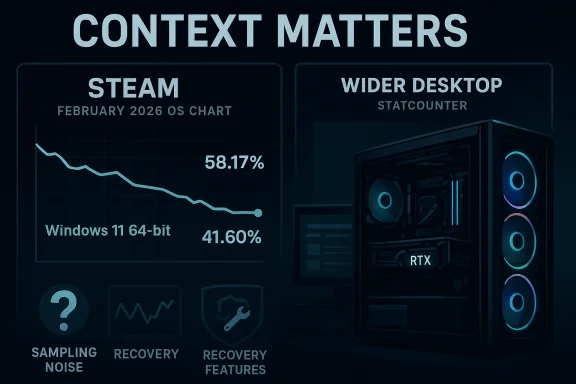
Gamers are not “massively leaving” Windows 11 so much as the latest Steam survey is showing a sharp, and possibly noisy, month-to-month swing that deserves context. Valve’s February 2026 Hardware & Software Survey puts Windows 11 64-bit at 58.17% among surveyed Steam systems, while Windows 10 64-bit rose to 41.60% in the same snapshot, reversing the usual direction of travel and suggesting a very specific composition change rather than a sudden mass migration away from Windows 11. By contrast, StatCounter’s broader desktop measurement still shows Windows 11 climbing in the wider Windows ecosystem, at 72.78% worldwide in February 2026 versus 26.27% for Windows 10, which makes the headline narrative look a lot less like a universal reversal and a lot more like a Steam-specific fluctuation.
That distinction matters because Steam’s data reflects a voluntary sample of active Steam users, not the entire PC market. A large swing in that survey can be driven by geography, cybercafé traffic, shared machines, temporary hardware changes, or sampling variance, and the February figure’s odd language distribution spike makes the data feel even more like a sampling artifact than a clean operating-system verdict. In other words, the evidence does not support the simple conclusion that gamers are fleeing Windows 11 en masse; it supports the more careful conclusion that the Steam audience may have shifted in a way that temporarily favored Windows 10 in that specific month.
Windows 11 has spent most of its life under a microscope because it arrived with a stronger security baseline, stricter hardware requirements, and a UI overhaul that split users into fans and skeptics. Microsoft’s bet was that modern security and a more consistent platform would eventually outweigh the friction of TPM 2.0 requirements, CPU gates, and the discomfort of change. That bet has slowly paid off in the mainstream desktop market, where StatCounter now shows Windows 11 well ahead of Windows 10 worldwide.
PC gamers, however, have never behaved exactly like the average desktop user. They are more sensitive to driver support, graphics stack behavior, latency, game compatibility, and update risk, which means a Windows release that looks “successful” in the general market can still face skepticism in gaming circles. Steam’s survey is therefore an important lens, but it is not a neutral census; it is a snapshot of an enthusiast-heavy ecosystem where hardware upgrades, regional usage patterns, and community sentiment can move quickly.
The timing also matters. Microsoft has continued to push Windows 11 features that appeal more directly to recovery, resiliency, and device management than to headline gaming performance. In February 2026 preview material, Microsoft highlighted Quick Machine Recovery turning on automatically for some Windows Professional devices, plus a built-in network speed test in the taskbar, reinforcing the idea that Windows 11 is being shaped as a more managed, more self-healing platform.
That broader product direction helps explain why the gaming debate keeps resurfacing. When an operating system changes its security posture, servicing model, and default behaviors, it can temporarily feel less predictable to users who value stability above all else. For a PC gamer, predictability is often the real feature, not a new button in Settings or a recovery flow they may never use. The February Steam numbers should therefore be read against a backdrop of ongoing platform change, not as proof of a collapse.
One clue is that the February survey also shows unexpectedly large shifts in other fields, including language usage. The dataset excerpt indicates Chinese becoming the dominant language on Steam by a wide margin, which suggests a distribution change in the survey pool itself. When one part of the sample swings that hard, it is prudent to treat platform-share changes as descriptive rather than causal.
StatCounter’s broader desktop dataset tells a different story. For February 2026, it shows Windows 11 at 72.78% and Windows 10 at 26.27% in worldwide desktop Windows version share, which is consistent with ongoing Windows 11 adoption in the wider internet-connected population. If Steam were truly showing a broad gamer revolt against Windows 11, you would expect at least some matching weakness in the wider market, and that does not appear in the external data.
Windows 11 carries both promise and baggage in this audience. On the promise side, it is the current platform for Microsoft’s newer gaming and security work, and it is the operating system most likely to receive future performance tuning, new recovery tools, and modern hardware integrations. On the baggage side, it still inherits the perception that Microsoft asks gamers to tolerate change that may not always produce visible gains. Perception is powerful here because the gaming community often judges Windows by its most frustrating edge cases.
Microsoft’s February 2026 release notes underscore the company’s desire to sell Windows 11 as more resilient, not less. The preview update highlights QMR, backup restoration improvements, and a taskbar-based network speed test, all of which are useful in a world where a broken boot sequence or flaky internet can ruin a gaming session before a game even launches. The trouble is that these are not the sort of features that produce instant hype in PC gaming circles.
The end-of-support timeline also changes behavior. When a platform is nearing retirement, users often delay major upgrades until a forcing event arrives, then move in clusters rather than gradually. For gamers, the migration calculus is even more personal because they worry about whether their favorite titles, peripherals, and tools will behave the same way after the move. That can create temporary plateaus or reversals in survey data without indicating a long-term trend change.
That said, the future still favors Windows 11 for obvious structural reasons. New hardware is shipping with Windows 11 by default, Microsoft keeps developing its modern platform features there first, and the wider desktop market is already well past the tipping point. The risk for Microsoft is not that Windows 11 disappears from gaming; it is that its gaming story gets defined by distrust rather than by capability.
The same update wave also added a built-in network speed test from the taskbar, which sounds minor until you think about game downloads, patch validation, and troubleshooting. Small utilities like that can reduce friction in exactly the places where gamers are most impatient. Microsoft is clearly trying to make Windows 11 feel less like a static OS and more like a service layer that actively helps the PC recover and stay online.
The catch is that these improvements do not necessarily erase suspicion. A gamer who has already had one bad update cycle will not be reassured by a new recovery button unless the button is never needed. That is the credibility problem Microsoft keeps facing: it can ship real progress, but it still has to overcome the memory of past regressions.
That matters because hardware and OS choice are linked. If a user is still on a six-core CPU and a relatively modest GPU, the incentive to swap operating systems is lower unless the new OS clearly helps with performance, compatibility, or support. In practice, many gamers upgrade components before they upgrade their entire mental model of the PC.
It also means the market has less room for broad narratives about “all gamers” preferring one OS or another. There are different tribes inside PC gaming: competitive players, modders, handheld users, hardware tinkerers, and casual Steam library accumulators. A single survey can reveal a direction, but it cannot flatten that diversity into one clean story.
This is a classic case where two data sets are both “right” and still tell different stories. Steam reflects an enthusiast gaming sample, while StatCounter reflects web-pageview-based desktop usage across the wider market. If Windows 11 is up in one and down in the other for a month, the safest interpretation is not panic; it is segmentation.
The practical implication is that Microsoft should not ignore Steam, but it also should not treat a single down month as a strategic failure. The company’s real challenge is to keep Windows 11 credible for enthusiasts while continuing to win the broad market. That means balancing visible polish with invisible reliability.
That pressure matters because Microsoft cannot take gaming for granted. Windows is still the default platform for the vast majority of Steam users, but the company has to earn that position continuously by supporting drivers, anti-cheat compatibility, graphics features, and recovery behavior that gamers can trust. If Windows 11 ever looks slower or more troublesome than a rival stack, even a small percentage shift can become a symbolic problem.
For Microsoft, the strategic answer is to make Windows 11 boring in the best possible way. It needs to be the platform that works without incident, updates without drama, and recovers without panic. That is a much tougher marketing job than announcing features, but it is the one that matters most to gamers.
Microsoft will also need to keep proving that Windows 11’s value is practical, not just aesthetic. Recovery features, taskbar utilities, and better management tools are useful, but gamers will judge the platform by whether it remains stable when real games, launchers, overlays, and drivers are all in motion at once. That is where confidence is earned.
Source: Inbox.lv Gamers Are Massively Leaving Windows 11
That distinction matters because Steam’s data reflects a voluntary sample of active Steam users, not the entire PC market. A large swing in that survey can be driven by geography, cybercafé traffic, shared machines, temporary hardware changes, or sampling variance, and the February figure’s odd language distribution spike makes the data feel even more like a sampling artifact than a clean operating-system verdict. In other words, the evidence does not support the simple conclusion that gamers are fleeing Windows 11 en masse; it supports the more careful conclusion that the Steam audience may have shifted in a way that temporarily favored Windows 10 in that specific month.
 Background
Windows 11 has spent most of its life under a microscope because it arrived with a stronger security baseline, stricter hardware requirements, and a UI overhaul that split users into fans and skeptics. Microsoft’s bet was that modern security and a more consistent platform would eventually outweigh the friction of TPM 2.0 requirements, CPU gates, and the discomfort of change. That bet has slowly paid off in the mainstream desktop market, where StatCounter now shows Windows 11 well ahead of Windows 10 worldwide.PC gamers, however, have never behaved exactly like the average desktop user. They are more sensitive to driver support, graphics stack behavior, latency, game compatibility, and update risk, which means a Windows release that looks “successful” in the general market can still face skepticism in gaming circles. Steam’s survey is therefore an important lens, but it is not a neutral census; it is a snapshot of an enthusiast-heavy ecosystem where hardware upgrades, regional usage patterns, and community sentiment can move quickly.
The timing also matters. Microsoft has continued to push Windows 11 features that appeal more directly to recovery, resiliency, and device management than to headline gaming performance. In February 2026 preview material, Microsoft highlighted Quick Machine Recovery turning on automatically for some Windows Professional devices, plus a built-in network speed test in the taskbar, reinforcing the idea that Windows 11 is being shaped as a more managed, more self-healing platform.
That broader product direction helps explain why the gaming debate keeps resurfacing. When an operating system changes its security posture, servicing model, and default behaviors, it can temporarily feel less predictable to users who value stability above all else. For a PC gamer, predictability is often the real feature, not a new button in Settings or a recovery flow they may never use. The February Steam numbers should therefore be read against a backdrop of ongoing platform change, not as proof of a collapse.
What the Steam Numbers Actually Say
The raw February Steam report is startling at first glance. Valve’s survey shows Windows 11 64-bit at 58.17% and Windows 10 64-bit at 41.60%, with Windows 7 now down near statistical noise at 0.06%. That is a dramatic change from the January and earlier trendlines, but it is the opposite of the article’s claim that Windows 11 “collapsed” while Windows 10 surged upward only because the underlying month-to-month pattern is highly unusual.Why the month-over-month delta is suspicious
A 12.34-point drop for Windows 11 and a 12.23-point rise for Windows 10 in a single month is not impossible, but it is unusual enough to demand caution. Steam’s survey is optional and anonymous, which is useful for privacy but not ideal for stable longitudinal interpretation. When a survey sample behaves this dramatically, the first question should be whether the mix of respondents changed rather than whether millions of gamers suddenly changed preference.One clue is that the February survey also shows unexpectedly large shifts in other fields, including language usage. The dataset excerpt indicates Chinese becoming the dominant language on Steam by a wide margin, which suggests a distribution change in the survey pool itself. When one part of the sample swings that hard, it is prudent to treat platform-share changes as descriptive rather than causal.
Steam is not the whole PC market
It is easy to confuse Steam audience data with a general PC census, but they are not the same thing. Steam sees active, connected users who run Valve’s client, and that audience skews toward gamers, enthusiasts, and regions with strong PC gaming adoption. That makes the survey extremely useful for gaming trends and hardware preferences, but less reliable as a standalone measure of global OS sentiment.StatCounter’s broader desktop dataset tells a different story. For February 2026, it shows Windows 11 at 72.78% and Windows 10 at 26.27% in worldwide desktop Windows version share, which is consistent with ongoing Windows 11 adoption in the wider internet-connected population. If Steam were truly showing a broad gamer revolt against Windows 11, you would expect at least some matching weakness in the wider market, and that does not appear in the external data.
Why Gamers Care More Than Everyone Else
Gamers are not merely users; they are stress testers. They notice frame-time spikes, driver regressions, overlay bugs, anti-cheat incompatibilities, and settings resets that ordinary office users may never encounter. That is why a Windows update can generate forum outrage long before any market-share statistic changes, and why Microsoft’s relationship with gaming communities has always been more fragile than its relationship with mainstream consumers.Windows 11 carries both promise and baggage in this audience. On the promise side, it is the current platform for Microsoft’s newer gaming and security work, and it is the operating system most likely to receive future performance tuning, new recovery tools, and modern hardware integrations. On the baggage side, it still inherits the perception that Microsoft asks gamers to tolerate change that may not always produce visible gains. Perception is powerful here because the gaming community often judges Windows by its most frustrating edge cases.
Compatibility anxiety is real
The gaming audience has been burned enough times to develop a strong upgrade instinct. If an update causes a title to crash, an anti-cheat service to fail, or a capture tool to misbehave, users remember. Even when issues are eventually fixed, the memory of that instability lingers longer than the patch notes. That makes any headline suggesting “Windows 11 is failing gamers” spread quickly, even when the underlying evidence is mixed.Microsoft’s February 2026 release notes underscore the company’s desire to sell Windows 11 as more resilient, not less. The preview update highlights QMR, backup restoration improvements, and a taskbar-based network speed test, all of which are useful in a world where a broken boot sequence or flaky internet can ruin a gaming session before a game even launches. The trouble is that these are not the sort of features that produce instant hype in PC gaming circles.
The Windows 10 Factor
Windows 10 remains central to the story because it is still the natural refuge for users who dislike Windows 11’s requirements or interface decisions. Even after its official end-of-support date in October 2025, many users and organizations are still on Windows 10, and some of those systems will continue to be represented in telemetry and web-usage data for months or even years. That lingering installed base helps explain why any “mass exit” story about Windows 11 is premature.The end-of-support timeline also changes behavior. When a platform is nearing retirement, users often delay major upgrades until a forcing event arrives, then move in clusters rather than gradually. For gamers, the migration calculus is even more personal because they worry about whether their favorite titles, peripherals, and tools will behave the same way after the move. That can create temporary plateaus or reversals in survey data without indicating a long-term trend change.
Why older systems can linger in gaming
A surprising amount of gaming hardware remains in active use well past the point where it would be considered “current.” Steam’s February survey still shows meaningful use of midrange configurations and a long tail of legacy systems, which means a lot of players care more about “good enough” than “latest.” A system that runs a game library reliably is often good enough for a gamer, especially if the upgrade brings no obvious performance reward.That said, the future still favors Windows 11 for obvious structural reasons. New hardware is shipping with Windows 11 by default, Microsoft keeps developing its modern platform features there first, and the wider desktop market is already well past the tipping point. The risk for Microsoft is not that Windows 11 disappears from gaming; it is that its gaming story gets defined by distrust rather than by capability.
Microsoft’s Recent Moves on Windows 11
Microsoft’s February 2026 update cycle is relevant because it shows the company trying to make Windows 11 feel safer and more self-repairing. Quick Machine Recovery is designed to help devices recover from widespread boot failures by pulling remediations through Windows Update in Windows RE, and Microsoft’s documentation says it is available on Windows 11 24H2 build 26100.4700 or later. That is not a gamer headline, but it is a signal that the platform is getting more serious about resilience.The same update wave also added a built-in network speed test from the taskbar, which sounds minor until you think about game downloads, patch validation, and troubleshooting. Small utilities like that can reduce friction in exactly the places where gamers are most impatient. Microsoft is clearly trying to make Windows 11 feel less like a static OS and more like a service layer that actively helps the PC recover and stay online.
Why this matters to gamers
For gamers, the ideal OS is invisible. It should boot quickly, avoid surprises, and stay out of the way of the GPU, the network stack, and the game launcher. Recovery tools matter because downtime matters, and so does the ability to diagnose a problem without downloading half the internet first. Microsoft’s recent feature set is aimed at those pain points, even if it is not marketed that way.The catch is that these improvements do not necessarily erase suspicion. A gamer who has already had one bad update cycle will not be reassured by a new recovery button unless the button is never needed. That is the credibility problem Microsoft keeps facing: it can ship real progress, but it still has to overcome the memory of past regressions.
Hardware and Configuration Trends
The Steam survey also offers a useful snapshot of what gamers are actually using, and it undercuts some of the sensational framing around OS churn. Valve’s February data points to a mainstream gaming machine built around 32 GB of RAM, a six-core processor, and an Nvidia GeForce RTX 3050 class GPU as the most common kind of setup among the surveyed audience. That is not bleeding-edge enthusiast hardware; it is the middle of the market, where stability and cost matter more than novelty.That matters because hardware and OS choice are linked. If a user is still on a six-core CPU and a relatively modest GPU, the incentive to swap operating systems is lower unless the new OS clearly helps with performance, compatibility, or support. In practice, many gamers upgrade components before they upgrade their entire mental model of the PC.
Midrange reality beats headline hype
The popularity of midrange hardware reinforces how incremental PC gaming has become. Most people are not chasing benchmark victories; they are trying to get a stable, familiar experience that runs their current library without drama. That means Windows 11’s fortunes in gaming will depend less on flashy feature announcements and more on whether it proves itself quiet, compatible, and unremarkable.It also means the market has less room for broad narratives about “all gamers” preferring one OS or another. There are different tribes inside PC gaming: competitive players, modders, handheld users, hardware tinkerers, and casual Steam library accumulators. A single survey can reveal a direction, but it cannot flatten that diversity into one clean story.
The StatCounter Contrast
The biggest reason the Inbox.lv framing should be treated cautiously is the contradiction with StatCounter. StatCounter’s February 2026 desktop data shows Windows 11 not retreating, but expanding further, suggesting the broader consumer and enterprise internet population continues to move toward Microsoft’s latest OS. That does not invalidate Steam, but it does show that gaming behavior and general desktop behavior are diverging in ways the headline obscures.This is a classic case where two data sets are both “right” and still tell different stories. Steam reflects an enthusiast gaming sample, while StatCounter reflects web-pageview-based desktop usage across the wider market. If Windows 11 is up in one and down in the other for a month, the safest interpretation is not panic; it is segmentation.
How to read the gap
The gap likely says more about audience composition than about operating-system quality. Gamers may temporarily cluster on a specific version because of a game release, a regional survey shift, or a wave of machines that recently changed hands. Meanwhile, mainstream users may keep migrating to Windows 11 for support, security, and OEM default reasons. The data does not require a single explanation, and forcing one often produces bad analysis.The practical implication is that Microsoft should not ignore Steam, but it also should not treat a single down month as a strategic failure. The company’s real challenge is to keep Windows 11 credible for enthusiasts while continuing to win the broad market. That means balancing visible polish with invisible reliability.
Competitive Implications
Windows still dominates PC gaming, but the competitive pressure is no longer theoretical. Valve’s own SteamOS ecosystem, Linux gaming improvements, and handheld PC momentum all give gamers alternative paths if Windows starts to feel bloated or fragile. Even when those alternatives remain niche, they act as leverage by reminding Microsoft that PC gamers have options now in a way they did not a decade ago.That pressure matters because Microsoft cannot take gaming for granted. Windows is still the default platform for the vast majority of Steam users, but the company has to earn that position continuously by supporting drivers, anti-cheat compatibility, graphics features, and recovery behavior that gamers can trust. If Windows 11 ever looks slower or more troublesome than a rival stack, even a small percentage shift can become a symbolic problem.
Why rivals benefit from uncertainty
Rivals do not need to win outright to gain ground. They only need enough uncertainty to make some users ask whether they still need Windows for every game or every PC configuration. That question is more common now because Linux gaming, compatibility layers, and specialized gaming distros have become practical enough to be discussed seriously rather than dismissed outright.For Microsoft, the strategic answer is to make Windows 11 boring in the best possible way. It needs to be the platform that works without incident, updates without drama, and recovers without panic. That is a much tougher marketing job than announcing features, but it is the one that matters most to gamers.
Strengths and Opportunities
Windows 11 still has real advantages in the gaming ecosystem, and the latest data should not obscure them. The operating system remains the dominant choice in the wider desktop market, it continues to receive meaningful feature work, and it sits at the center of Microsoft’s long-term PC strategy. That gives Microsoft a platform to improve from rather than a crisis to defend against.- Mainstream dominance gives Windows 11 enormous distribution leverage.
- Ongoing recovery features like Quick Machine Recovery improve resilience.
- Built-in troubleshooting tools reduce friction for gamers and IT teams alike.
- New hardware defaults continue to favor Windows 11 on fresh PCs.
- A large Steam install base keeps Microsoft close to gamer feedback loops.
- Security improvements strengthen the case for long-term platform trust.
- Feature velocity means Microsoft can still correct pain points faster than legacy rivals.
Risks and Concerns
The biggest risk is not that Windows 11 loses the gaming market outright. It is that each incremental issue, rumor, or incompatible update reinforces the idea that gamers are safer staying put on Windows 10 or trying something else entirely. That kind of reputational drag is hard to measure and even harder to reverse.- Survey noise can create misleading headlines and bad assumptions.
- Update regressions can damage trust quickly among gamers.
- Hardware friction still discourages some Windows 10 users from moving.
- Legacy loyalty keeps older systems alive longer than Microsoft would like.
- Alternative platforms are more credible than they used to be.
- Confidence gaps can persist even after Microsoft ships fixes.
- Regional sampling swings can distort the Steam picture from month to month.
Looking Ahead
The next few Steam survey cycles will matter more than the February anomaly. If Windows 11 rebounds, the “mass exodus” narrative will fade into the background where it belongs. If the gap persists, analysts will need to determine whether the issue is regional sample composition, a genuine gamer preference shift, or a broader trust problem tied to Windows 11 updates and usability.Microsoft will also need to keep proving that Windows 11’s value is practical, not just aesthetic. Recovery features, taskbar utilities, and better management tools are useful, but gamers will judge the platform by whether it remains stable when real games, launchers, overlays, and drivers are all in motion at once. That is where confidence is earned.
- Watch for the next Steam Hardware & Software Survey to see whether February was an outlier.
- Track whether Windows 11 share in Steam returns to its prior trendline.
- Compare Steam results with StatCounter and other desktop metrics for context.
- Monitor Microsoft’s update cadence for gaming-related regressions or fixes.
- Pay attention to whether newer Windows 11 recovery features reduce user frustration in practice.
Source: Inbox.lv Gamers Are Massively Leaving Windows 11
Last edited:
