

Digitate said on May 19, 2026, that its ignio platform has earned Microsoft’s Solutions Partner with certified software designation for Azure, including certified software recognition across Azure, Retail AI, Manufacturing AI, and Financial Services AI categories. The announcement is not merely another partner badge for a crowded cloud marketplace. It is a sign of where Microsoft wants enterprise AI to go next: away from demos and dashboards, and toward software trusted enough to act inside production operations.
For WindowsForum readers, the interesting part is not that Digitate has won a credential. The interesting part is that Microsoft’s partner economy is becoming a filter for enterprise AI risk. In an era when every vendor claims to have an agent, a copilot, or an autonomous platform, Microsoft is trying to make Azure Marketplace look less like an app catalog and more like a vetted procurement lane.
Microsoft’s Solutions Partner with certified software designation sits inside the Microsoft AI Cloud Partner Program, the successor-era framework that replaced older, looser notions of partner prestige with more specific measurements around technical fit, marketplace readiness, interoperability, and customer outcomes. That matters because enterprise software buyers have become allergic to the word AI when it arrives without proof. The market is now full of platforms that promise automation, anomaly detection, generative search, and operational intelligence, but CIOs still have to decide which ones are safe enough to wire into incident response, infrastructure management, and business-critical workflows.
Digitate’s announcement claims that fewer than 0.1 percent of the more than 41,000 solutions in Microsoft Azure Marketplace currently hold this certified software status. Even if one treats that figure as vendor-framed marketing, the direction of travel is clear. Microsoft wants certified software to act as a high-signal badge for buyers who do not have the time, budget, or appetite to individually audit every platform claiming Azure compatibility.
This is a very Microsoft way to solve the AI trust problem. Rather than simply telling customers to build everything on Azure AI services, Microsoft is also curating the ecosystem around Azure, attaching higher-value labels to third-party software that can demonstrate technical alignment and customer traction. That helps Microsoft twice: it strengthens Azure Marketplace as a procurement venue, and it gives Azure customers more reasons to run sensitive workloads within Microsoft’s commercial cloud perimeter.
The old partner badge economy often blurred sales alignment with technical credibility. The new model is still commercial, of course, but it is more visibly tied to software validation. That shift is important for IT buyers because it narrows the distinction between “this company works with Microsoft” and “this software has cleared Microsoft-defined checks for running in Microsoft customer environments.”
That matters because AIOps has become a category where nearly every vendor says some version of the same thing. They promise less noise, faster incident response, fewer tickets, lower mean time to resolution, and more resilient digital operations. The problem is not that those promises are irrelevant. The problem is that they are so common that buyers need a second-order signal to determine which platforms are mature enough for serious use.
A Microsoft certified software designation does not prove that ignio will work perfectly in every environment. It does not eliminate the need for pilots, security reviews, data governance analysis, or hard questions about automation boundaries. But it does give Digitate a stronger answer when an Azure-heavy enterprise asks whether the platform is aligned with Microsoft Cloud expectations.
The four designations cited in the announcement are also telling. Azure is the broad technical foundation, while Retail AI, Manufacturing AI, and Financial Services AI are industry-specific lanes where operational reliability is not abstract. Retailers care about availability across point-of-sale systems, inventory platforms, ecommerce front ends, and customer analytics. Manufacturers care about uptime, supply chain continuity, plant operations, and integration between IT and operational technology. Financial services firms care about resilience, compliance, transaction systems, and the blast radius of every automated decision.
That industry spread gives Digitate a more precise go-to-market story. It is not only saying, “We do AI operations.” It is saying that its platform has been validated against Microsoft’s expectations in verticals where downtime is expensive, regulation is real, and infrastructure complexity has already outgrown manual triage.
That distinction is crucial. Generative AI is good at producing text, summarizing logs, explaining incidents, drafting scripts, and helping humans understand messy information. Agentic AI is about giving software enough context and permission to do something with that information. In IT operations, that could mean correlating alerts, suppressing noise, opening or closing incidents, triggering remediation, scaling resources, restarting services, rolling back changes, or escalating only when human judgment is required.
This is where Digitate’s “ticketless IT” framing becomes both attractive and dangerous. It is attractive because IT teams are drowning in tickets, alerts, and repetitive operational work. It is dangerous because tickets are not just administrative clutter; they are often the audit trail, accountability structure, and control point for change.
The serious version of agentic IT is not a fantasy in which AI invisibly fixes everything while administrators sip coffee. It is a disciplined model in which systems take routine, well-understood, policy-bound actions automatically, while riskier interventions remain gated by human approval or change-management controls. The difference between those two models is the difference between useful automation and an outage with a clever brand name.
Digitate’s ignio platform is described around three familiar but important layers: observability, AI-driven analysis, and closed-loop automation. The first layer collects and correlates telemetry across infrastructure and business services. The second layer attempts to detect anomalies, predict failures, and identify root causes. The third layer executes fixes rather than merely recommending them.
That last layer is the real line in the sand. Plenty of tools can show dashboards. Plenty can generate incident summaries. Fewer can be trusted to act in production, and fewer still can do so across hybrid environments where Windows Server, Linux, Azure services, databases, legacy systems, SaaS platforms, and network dependencies are all entangled.
Certified software designations raise the stakes. If Azure Marketplace becomes the place where Microsoft customers can find not merely available software but validated software, then Microsoft gains influence over which vendors make shortlists. That does not mean uncertified vendors disappear. It means the certified tier becomes an advantage in enterprise sales cycles where every reduction in perceived risk matters.
For Digitate, the immediate benefit is credibility. The longer-term benefit is access. Certified partners can gain stronger marketplace visibility, co-sell alignment, and a clearer path into Microsoft’s field organization. In practical terms, that can mean more enterprise conversations with customers that already trust Azure, already spend heavily with Microsoft, and already want AI capabilities that do not require starting from scratch.
For Microsoft, the logic is equally direct. Azure consumption grows when customers run more workloads, buy more services, and attach more third-party solutions to the platform. If Microsoft can certify AIOps tools that make Azure estates easier to manage, it strengthens the argument that Azure is not just a place to host workloads but an operational ecosystem.
This is why the certification is more than a Digitate story. It is a marketplace story. Microsoft is trying to build a channel where AI software is not evaluated only by feature claims, but by a combination of technical integration, customer success evidence, and marketplace readiness.
This is especially true in hybrid Windows environments, where the operational surface area can be enormous. A single incident may involve Active Directory, Entra ID, Azure Monitor, endpoint management, Windows Server workloads, SQL Server, third-party monitoring tools, network appliances, backup systems, and business applications that predate the cloud. An AI platform that sees only part of that picture can still act with confidence, but confidence is not the same as correctness.
Data access is another hard issue. AIOps platforms are hungry by design. They need logs, metrics, events, traces, topology data, service maps, ticket histories, and sometimes business KPIs. The more context they have, the better their decisions may become. The more context they have, the more sensitive their data footprint becomes.
Then there is the question of accountability. If an autonomous remediation action causes a service interruption, who owns the incident? The vendor, the platform team, the change manager, the SRE who approved the policy, or the executive who signed off on automation? Mature organizations will answer those questions before deployment, not during the postmortem.
The best use of Microsoft’s designation is therefore not as a substitute for due diligence. It is as a starting signal. It says that Digitate has cleared a meaningful Microsoft-defined bar. It does not say that every enterprise should wire ignio into production with broad permissions on day one.
That is why the promise of agentic AI lands so strongly with CIOs. It speaks to a staffing and scalability problem, not merely a tooling problem. Hiring enough experienced operators, SREs, cloud engineers, security analysts, and application specialists to manually chase every alert is expensive and often impossible. Even when talent is available, repetitive incident work is a poor use of scarce expertise.
The automation pitch is therefore compelling. If a platform can resolve known incidents automatically, detect failure patterns earlier, and reduce alert fatigue, it can give human teams more time for architecture, resilience engineering, and security improvement. That is the optimistic case, and it is not imaginary.
The pessimistic case is that enterprises use AI automation to paper over fragile systems instead of fixing them. A self-healing platform can become an excuse to tolerate poor architecture, brittle dependencies, and underfunded operations teams. If the system keeps restarting the same failing service every night, the ticket count may fall while the underlying engineering debt grows.
This is where buyers should be blunt with vendors. The value of agentic operations is not just fewer incidents visible to humans. It is fewer incidents overall, better root-cause elimination, and more resilient systems over time. Automation that hides pain without reducing it is not autonomy. It is anesthesia.
That is why partners like Digitate matter to Microsoft. They bring domain-specific software into areas where Microsoft’s platform services alone may not be enough. Azure can provide compute, identity, data, AI models, monitoring services, and marketplace distribution. A vendor like Digitate can package operational intelligence and automation into a product aimed at specific enterprise pain points.
This is also why industry AI designations are strategically useful. Microsoft does not want AI to be perceived as a general-purpose experiment that sits beside the business. It wants AI to be embedded into retail operations, manufacturing processes, financial services resilience, healthcare workflows, sustainability reporting, and other verticals where budgets are tied to outcomes.
The certification of ignio in Retail AI, Manufacturing AI, and Financial Services AI fits that strategy. It gives Microsoft another example of AI moving from horizontal productivity into vertical operational systems. It also gives Digitate a way to tell customers that its platform is not merely compatible with Azure, but aligned with Microsoft’s industry cloud ambitions.
Still, the relationship is not charity. Microsoft benefits when partner solutions increase Azure stickiness. Digitate benefits when Microsoft’s endorsement reduces buyer hesitation. Customers benefit only if the certified software actually improves reliability, reduces toil, and respects enterprise controls.
Microsoft’s certified software designation is an attempt to impose structure on that noise. It does not settle every technical question, but it creates a more meaningful distinction than a press-release partnership. A vendor must demonstrate marketplace readiness, interoperability with Microsoft Cloud, customer success, and relevant technical criteria. That makes the badge more useful than a logo swap.
The risk is that designations become another layer of enterprise theater. If every major vendor eventually earns one, the signal weakens. If the requirements remain meaningful and selective, the signal strengthens. The claim that only a tiny fraction of Azure Marketplace solutions currently hold the status suggests Microsoft is still treating the designation as a scarce marker, though the long-term value will depend on how rigorously it maintains the bar.
For now, Digitate can credibly say that ignio has crossed a threshold many marketplace solutions have not. That should help in competitive evaluations, especially where Microsoft alignment is already a procurement requirement. It should not end the evaluation, but it may get Digitate into rooms where uncertified competitors face a harder first conversation.
The practical question is not whether AI will enter IT operations. It already has. The practical question is how much authority those systems receive, how their actions are governed, and whether administrators can understand and override them when necessary.
A Windows estate connected to Azure is especially fertile ground for this transition. Many organizations already rely on Microsoft tooling for identity, endpoint management, cloud monitoring, security analytics, and update governance. Adding certified partner software into that ecosystem is a natural next step, but it increases the importance of role-based access, least privilege, logging, and policy design.
The admins who will thrive in this environment are not the ones who reject automation out of hand. They are the ones who understand where automation is safe, where it is risky, and where it changes the failure mode of the entire environment. Agentic AI does not eliminate operational expertise. It raises the premium on people who can define good automation boundaries.
For WindowsForum readers, the interesting part is not that Digitate has won a credential. The interesting part is that Microsoft’s partner economy is becoming a filter for enterprise AI risk. In an era when every vendor claims to have an agent, a copilot, or an autonomous platform, Microsoft is trying to make Azure Marketplace look less like an app catalog and more like a vetted procurement lane.
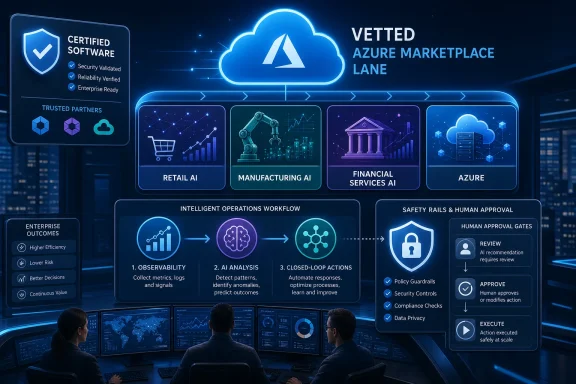 Microsoft Is Turning Certification Into an Enterprise AI Gatekeeper
Microsoft’s Solutions Partner with certified software designation sits inside the Microsoft AI Cloud Partner Program, the successor-era framework that replaced older, looser notions of partner prestige with more specific measurements around technical fit, marketplace readiness, interoperability, and customer outcomes. That matters because enterprise software buyers have become allergic to the word AI when it arrives without proof. The market is now full of platforms that promise automation, anomaly detection, generative search, and operational intelligence, but CIOs still have to decide which ones are safe enough to wire into incident response, infrastructure management, and business-critical workflows.Digitate’s announcement claims that fewer than 0.1 percent of the more than 41,000 solutions in Microsoft Azure Marketplace currently hold this certified software status. Even if one treats that figure as vendor-framed marketing, the direction of travel is clear. Microsoft wants certified software to act as a high-signal badge for buyers who do not have the time, budget, or appetite to individually audit every platform claiming Azure compatibility.
This is a very Microsoft way to solve the AI trust problem. Rather than simply telling customers to build everything on Azure AI services, Microsoft is also curating the ecosystem around Azure, attaching higher-value labels to third-party software that can demonstrate technical alignment and customer traction. That helps Microsoft twice: it strengthens Azure Marketplace as a procurement venue, and it gives Azure customers more reasons to run sensitive workloads within Microsoft’s commercial cloud perimeter.
The old partner badge economy often blurred sales alignment with technical credibility. The new model is still commercial, of course, but it is more visibly tied to software validation. That shift is important for IT buyers because it narrows the distinction between “this company works with Microsoft” and “this software has cleared Microsoft-defined checks for running in Microsoft customer environments.”
Digitate Gets More Than a Trophy
For Digitate, the designation gives ignio a stronger claim in the crowded AIOps market, where differentiation is increasingly difficult. The company has long positioned ignio as an autonomous enterprise operations platform that can observe systems, detect issues, infer causes, and automate fixes. The Microsoft designation gives that pitch a firmer cloud ecosystem anchor.That matters because AIOps has become a category where nearly every vendor says some version of the same thing. They promise less noise, faster incident response, fewer tickets, lower mean time to resolution, and more resilient digital operations. The problem is not that those promises are irrelevant. The problem is that they are so common that buyers need a second-order signal to determine which platforms are mature enough for serious use.
A Microsoft certified software designation does not prove that ignio will work perfectly in every environment. It does not eliminate the need for pilots, security reviews, data governance analysis, or hard questions about automation boundaries. But it does give Digitate a stronger answer when an Azure-heavy enterprise asks whether the platform is aligned with Microsoft Cloud expectations.
The four designations cited in the announcement are also telling. Azure is the broad technical foundation, while Retail AI, Manufacturing AI, and Financial Services AI are industry-specific lanes where operational reliability is not abstract. Retailers care about availability across point-of-sale systems, inventory platforms, ecommerce front ends, and customer analytics. Manufacturers care about uptime, supply chain continuity, plant operations, and integration between IT and operational technology. Financial services firms care about resilience, compliance, transaction systems, and the blast radius of every automated decision.
That industry spread gives Digitate a more precise go-to-market story. It is not only saying, “We do AI operations.” It is saying that its platform has been validated against Microsoft’s expectations in verticals where downtime is expensive, regulation is real, and infrastructure complexity has already outgrown manual triage.
Agentic AI Moves From Slideware To Runbooks
The phrase agentic AI has quickly become one of the most overloaded expressions in enterprise technology. In consumer AI, it often means a chatbot that can perform tasks across apps. In enterprise infrastructure, the stakes are higher. An agentic system is not simply answering questions; it is planning, executing, and adapting actions in order to achieve operational goals.That distinction is crucial. Generative AI is good at producing text, summarizing logs, explaining incidents, drafting scripts, and helping humans understand messy information. Agentic AI is about giving software enough context and permission to do something with that information. In IT operations, that could mean correlating alerts, suppressing noise, opening or closing incidents, triggering remediation, scaling resources, restarting services, rolling back changes, or escalating only when human judgment is required.
This is where Digitate’s “ticketless IT” framing becomes both attractive and dangerous. It is attractive because IT teams are drowning in tickets, alerts, and repetitive operational work. It is dangerous because tickets are not just administrative clutter; they are often the audit trail, accountability structure, and control point for change.
The serious version of agentic IT is not a fantasy in which AI invisibly fixes everything while administrators sip coffee. It is a disciplined model in which systems take routine, well-understood, policy-bound actions automatically, while riskier interventions remain gated by human approval or change-management controls. The difference between those two models is the difference between useful automation and an outage with a clever brand name.
Digitate’s ignio platform is described around three familiar but important layers: observability, AI-driven analysis, and closed-loop automation. The first layer collects and correlates telemetry across infrastructure and business services. The second layer attempts to detect anomalies, predict failures, and identify root causes. The third layer executes fixes rather than merely recommending them.
That last layer is the real line in the sand. Plenty of tools can show dashboards. Plenty can generate incident summaries. Fewer can be trusted to act in production, and fewer still can do so across hybrid environments where Windows Server, Linux, Azure services, databases, legacy systems, SaaS platforms, and network dependencies are all entangled.
The Azure Marketplace Is Becoming A Trust Marketplace
Azure Marketplace has always been partly a software storefront and partly a procurement mechanism. Its strategic value is that it lets customers buy third-party software through existing cloud commitments, enterprise agreements, and marketplace workflows. For many organizations, that matters as much as the technology itself. Procurement friction can kill a project before architecture review begins.Certified software designations raise the stakes. If Azure Marketplace becomes the place where Microsoft customers can find not merely available software but validated software, then Microsoft gains influence over which vendors make shortlists. That does not mean uncertified vendors disappear. It means the certified tier becomes an advantage in enterprise sales cycles where every reduction in perceived risk matters.
For Digitate, the immediate benefit is credibility. The longer-term benefit is access. Certified partners can gain stronger marketplace visibility, co-sell alignment, and a clearer path into Microsoft’s field organization. In practical terms, that can mean more enterprise conversations with customers that already trust Azure, already spend heavily with Microsoft, and already want AI capabilities that do not require starting from scratch.
For Microsoft, the logic is equally direct. Azure consumption grows when customers run more workloads, buy more services, and attach more third-party solutions to the platform. If Microsoft can certify AIOps tools that make Azure estates easier to manage, it strengthens the argument that Azure is not just a place to host workloads but an operational ecosystem.
This is why the certification is more than a Digitate story. It is a marketplace story. Microsoft is trying to build a channel where AI software is not evaluated only by feature claims, but by a combination of technical integration, customer success evidence, and marketplace readiness.
Enterprise IT Still Has To Ask The Uncomfortable Questions
A certification may reduce uncertainty, but it does not remove responsibility. Any organization considering agentic operations software still needs to define what the platform may observe, what it may decide, what it may change, and what it must never touch without approval. Those boundaries are not paperwork. They are the safety rails that separate automation from operational drift.This is especially true in hybrid Windows environments, where the operational surface area can be enormous. A single incident may involve Active Directory, Entra ID, Azure Monitor, endpoint management, Windows Server workloads, SQL Server, third-party monitoring tools, network appliances, backup systems, and business applications that predate the cloud. An AI platform that sees only part of that picture can still act with confidence, but confidence is not the same as correctness.
Data access is another hard issue. AIOps platforms are hungry by design. They need logs, metrics, events, traces, topology data, service maps, ticket histories, and sometimes business KPIs. The more context they have, the better their decisions may become. The more context they have, the more sensitive their data footprint becomes.
Then there is the question of accountability. If an autonomous remediation action causes a service interruption, who owns the incident? The vendor, the platform team, the change manager, the SRE who approved the policy, or the executive who signed off on automation? Mature organizations will answer those questions before deployment, not during the postmortem.
The best use of Microsoft’s designation is therefore not as a substitute for due diligence. It is as a starting signal. It says that Digitate has cleared a meaningful Microsoft-defined bar. It does not say that every enterprise should wire ignio into production with broad permissions on day one.
The Real Competition Is Not Dashboards, But Labor
The AIOps market is often described as a technology contest, but the deeper pressure is organizational. Enterprises are running more systems than their teams can reasonably manage by hand. Cloud adoption did not simplify operations; it redistributed complexity into APIs, identity layers, distributed services, ephemeral resources, and vendor-specific management planes.That is why the promise of agentic AI lands so strongly with CIOs. It speaks to a staffing and scalability problem, not merely a tooling problem. Hiring enough experienced operators, SREs, cloud engineers, security analysts, and application specialists to manually chase every alert is expensive and often impossible. Even when talent is available, repetitive incident work is a poor use of scarce expertise.
The automation pitch is therefore compelling. If a platform can resolve known incidents automatically, detect failure patterns earlier, and reduce alert fatigue, it can give human teams more time for architecture, resilience engineering, and security improvement. That is the optimistic case, and it is not imaginary.
The pessimistic case is that enterprises use AI automation to paper over fragile systems instead of fixing them. A self-healing platform can become an excuse to tolerate poor architecture, brittle dependencies, and underfunded operations teams. If the system keeps restarting the same failing service every night, the ticket count may fall while the underlying engineering debt grows.
This is where buyers should be blunt with vendors. The value of agentic operations is not just fewer incidents visible to humans. It is fewer incidents overall, better root-cause elimination, and more resilient systems over time. Automation that hides pain without reducing it is not autonomy. It is anesthesia.
Microsoft’s AI Strategy Needs Partners That Can Touch The Messy Parts
Microsoft’s own AI story is dominated by Copilot, Azure OpenAI, developer tooling, and productivity software. But enterprise AI adoption does not live only in polished demos. It lives in the messy operational middle, where companies need AI to interact with old systems, regulated workflows, custom applications, hybrid infrastructure, and business processes that resist clean diagrams.That is why partners like Digitate matter to Microsoft. They bring domain-specific software into areas where Microsoft’s platform services alone may not be enough. Azure can provide compute, identity, data, AI models, monitoring services, and marketplace distribution. A vendor like Digitate can package operational intelligence and automation into a product aimed at specific enterprise pain points.
This is also why industry AI designations are strategically useful. Microsoft does not want AI to be perceived as a general-purpose experiment that sits beside the business. It wants AI to be embedded into retail operations, manufacturing processes, financial services resilience, healthcare workflows, sustainability reporting, and other verticals where budgets are tied to outcomes.
The certification of ignio in Retail AI, Manufacturing AI, and Financial Services AI fits that strategy. It gives Microsoft another example of AI moving from horizontal productivity into vertical operational systems. It also gives Digitate a way to tell customers that its platform is not merely compatible with Azure, but aligned with Microsoft’s industry cloud ambitions.
Still, the relationship is not charity. Microsoft benefits when partner solutions increase Azure stickiness. Digitate benefits when Microsoft’s endorsement reduces buyer hesitation. Customers benefit only if the certified software actually improves reliability, reduces toil, and respects enterprise controls.
The Badge Is Valuable Because The Market Is Noisy
The current AI software market has a credibility problem. Vendors have learned that attaching the word “agent” to a product can make old automation sound new. Monitoring tools have become observability platforms. Observability platforms have become AIOps platforms. AIOps platforms have become agentic operations platforms. Somewhere in that branding progression, buyers still need to know what the software actually does.Microsoft’s certified software designation is an attempt to impose structure on that noise. It does not settle every technical question, but it creates a more meaningful distinction than a press-release partnership. A vendor must demonstrate marketplace readiness, interoperability with Microsoft Cloud, customer success, and relevant technical criteria. That makes the badge more useful than a logo swap.
The risk is that designations become another layer of enterprise theater. If every major vendor eventually earns one, the signal weakens. If the requirements remain meaningful and selective, the signal strengthens. The claim that only a tiny fraction of Azure Marketplace solutions currently hold the status suggests Microsoft is still treating the designation as a scarce marker, though the long-term value will depend on how rigorously it maintains the bar.
For now, Digitate can credibly say that ignio has crossed a threshold many marketplace solutions have not. That should help in competitive evaluations, especially where Microsoft alignment is already a procurement requirement. It should not end the evaluation, but it may get Digitate into rooms where uncertified competitors face a harder first conversation.
Windows Shops Should Read This As An Automation Weather Report
For Windows-heavy enterprises, the Digitate announcement is one more sign that operations tooling is moving toward autonomous action. The center of gravity is shifting from consoles that show administrators what happened to systems that decide what to do next. That shift will affect how teams design monitoring, incident response, identity permissions, change control, and compliance evidence.The practical question is not whether AI will enter IT operations. It already has. The practical question is how much authority those systems receive, how their actions are governed, and whether administrators can understand and override them when necessary.
A Windows estate connected to Azure is especially fertile ground for this transition. Many organizations already rely on Microsoft tooling for identity, endpoint management, cloud monitoring, security analytics, and update governance. Adding certified partner software into that ecosystem is a natural next step, but it increases the importance of role-based access, least privilege, logging, and policy design.
The admins who will thrive in this environment are not the ones who reject automation out of hand. They are the ones who understand where automation is safe, where it is risky, and where it changes the failure mode of the entire environment. Agentic AI does not eliminate operational expertise. It raises the premium on people who can define good automation boundaries.
The Useful Lesson Hidden Inside Digitate’s Microsoft Win
Digitate’s certification is a product milestone, but the broader lesson is about the changing rules of enterprise AI adoption. The market is moving from novelty to validation, and from validation to governed execution. That progression will define which AI tools become infrastructure and which remain demo-ware.- Digitate’s ignio platform has received Microsoft’s Solutions Partner with certified software designation for Azure, with additional recognition across Retail AI, Manufacturing AI, and Financial Services AI.
- Microsoft’s certified software model is designed to help enterprise buyers distinguish validated marketplace solutions from ordinary partner listings.
- The designation strengthens Digitate’s credibility in AIOps, but it does not replace customer-specific security, governance, and operational due diligence.
- Agentic AI in IT operations is important because it moves beyond recommendations into closed-loop action, which raises both productivity potential and control risks.
- Azure-heavy enterprises should treat certified partner software as a useful procurement signal, not as a guarantee that autonomous remediation is safe for every workload.
- The long-term value of Microsoft’s designation will depend on whether the company keeps the certification selective, technically meaningful, and tied to real customer outcomes.
References
- Primary source: BriefGlance
Published: Tue, 19 May 2026 14:58:00 GMT
Digitate's Agentic AI Platform Earns Elite Microsoft Certification - BriefGlance.com
Fewer than 0.1% of Azure solutions hold this status. Discover how Digitate's ignio™ platform and its 'Agentic AI' secured this rare validation.briefglance.com - Official source: partner.microsoft.com
Differentiate your capabilities with Solutions Partner designations
Attain a Solutions Partner designation and drive success with badging and benefits that help you stand out to customers.partner.microsoft.com
- Official source: learn.microsoft.com
Introduction to Solutions Partner with certified software designations - Partner Center | Microsoft Learn
Learn about Solutions Partner with certified software designations.learn.microsoft.com - Official source: blogs.microsoft.com
From vision to reality: Microsoft's partners embrace AI to deliver customer value - The Official Microsoft Blog
Artificial intelligence is a defining technology of our time. Over the past year we’ve begun to see how it can unlock profound possibilities for individuals, organizations and society — and it’s clear that we have only scratched the surface. For Microsoft and our partners across industries, AI...blogs.microsoft.com - Official source: appsource.microsoft.com
ignio AI Agent for Event Management for Azure Monitor
ignio EM is an enterprise-ready AI Agent that comes pre integrated with Azure Monitorappsource.microsoft.com
- Related coverage: windowsforum.com
Digitate ignio Gains Microsoft AI Cloud Certified Software Designations for Azure | Windows Forum
Digitate has been recognized on May 19, 2026, as a Microsoft Solutions Partner within the Microsoft AI Cloud Partner Program, with its ignio platform...windowsforum.com
- Related coverage: digitate.com
Partners
Join Elevate Partner Program for enhanced business outcomes. Digitate prioritizes Partner success, ensuring value. digitate.com
- Related coverage: itpro.com
Triple Microsoft designation defines serious, competitive, high-performing modern MSPs | ChannelPro
Triple Microsoft designation signals serious MSP capability through rigorous, performance-based accreditation standardswww.itpro.com - Official source: cdn-dynmedia-1.microsoft.com
- Related coverage: experteach.eu
- Official source: microsoft.github.io
- Related coverage: gadesoft.com
Blue machine hex-code on screen 3D render
Blue machine hex-code on screen. 3D renderwww.gadesoft.com
- Related coverage: catalogartifact.azureedge.net
a2a2528a-bdef-4c27-a7a2-f059a8e8e99d
Set realistic trendy different black smartphone mockup with white empty transparent, white, black touch screen, evolution of smartphones. Detailed mockup smartphone, model mobile.catalogartifact.azureedge.net
