

Microsoft’s DP-900 exam remains the entry point for Azure data certification in 2026, testing foundational knowledge of relational data, non-relational data, analytics workloads, and Azure data services rather than hands-on engineering depth. That makes it a useful credential, but also a ripe target for the low-effort “exam dumps” economy. The real story is not whether DP-900 can be passed quickly; it is whether candidates learn enough to make the certification mean anything after the badge lands in Microsoft Learn. For WindowsForum readers, the distinction matters because Azure data literacy is now part of the baseline vocabulary for admins, developers, analysts, and security-minded IT staff.
There is a familiar way to dismiss Microsoft’s fundamentals exams: call them entry-level, memorize the service names, take a few practice questions, and move on. DP-900 invites that treatment more than most because the subjects sound deceptively ordinary. Tables, files, schemas, transactions, analytics, dashboards, and streams are not exotic ideas to anyone who has spent time around business software.
But “fundamentals” in Microsoft certification language does not mean trivia. It means the exam is trying to measure whether a candidate can classify a workload before selecting a product. That is the difference between knowing that Azure Cosmos DB exists and recognizing why a globally distributed, low-latency document workload is not the same problem as a normalized order-entry database.
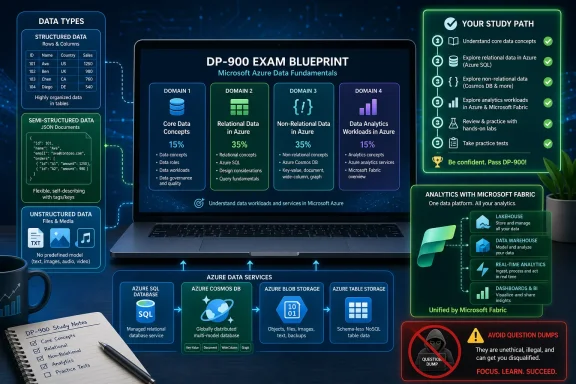
The current DP-900 skills outline, updated for exams measured from November 1, 2024 onward, reinforces that point. Microsoft groups the exam into four broad areas: core data concepts, relational data on Azure, non-relational data on Azure, and analytics workloads. The percentages are modestly distributed, with no single domain large enough to carry an unbalanced candidate through the exam.
That structure is the first clue that DP-900 is less about rote Azure naming and more about mental sorting. A candidate needs to understand what kind of data problem is being described, what trade-offs belong to that problem, and which Microsoft service family is likely to appear in the answer choices.
The danger is not merely ethical, though Microsoft’s exam security policies are clear enough that candidates should avoid anything claiming to reproduce live questions. The practical problem is that dumps train the wrong muscle. They encourage pattern matching against a fixed answer bank, while Microsoft’s fundamentals exams increasingly rely on short scenarios that test classification.
That matters especially for DP-900 because the exam’s vocabulary is not hard. A dump-trained candidate may learn that “Cosmos DB equals NoSQL” or “Synapse equals analytics,” but the exam can still ask a scenario where the difference between transactional and analytical workloads drives the answer. Memorization can get a candidate through a weak practice set and still leave them unable to explain why an OLTP system is different from an OLAP platform.
There is also a career risk. A fundamentals certification is often used as a conversation starter in interviews or internal role changes. If the badge says “Azure Data Fundamentals” and the holder cannot describe why structured, semi-structured, and unstructured data imply different storage and query patterns, the credential becomes a liability rather than a signal.
Older DP-900 study materials often center on Azure Synapse Analytics, Azure Databricks, Azure Stream Analytics, and Power BI as separate landmarks. That map is still useful, but it is incomplete in 2026. Microsoft now wants candidates to recognize Fabric as part of the large-scale analytics conversation, particularly where the platform integrates data movement, storage, analytics, and reporting experiences.
That does not mean candidates need to administer Fabric capacity, build lakehouses, or tune Spark jobs. DP-900 remains a fundamentals exam. The likely level of understanding is conceptual: knowing that Fabric sits in Microsoft’s modern analytics stack, that it brings multiple analytical experiences under one SaaS platform, and that it coexists with Azure services rather than erasing the rest of the portfolio overnight.
This is where outdated cram sheets become actively misleading. If a guide treats Azure Synapse as the uncontested center of Microsoft analytics and never mentions Fabric, it is teaching a world Microsoft has already revised. Candidates using pre-2024 material should not assume that the old service map is enough.
Core data concepts come first for a reason. Structured data fits neatly into rows and columns. Semi-structured data, such as JSON, carries tags or hierarchy without the rigidity of a classic relational schema. Unstructured data, such as images, audio, and documents, generally requires different storage and processing assumptions.
From there, the exam moves into workload shape. Transactional systems care about reads and writes, consistency, and day-to-day operations. Analytical systems care about aggregation, historical queries, large-scale processing, and reporting. Batch processing and stream processing are not just vocabulary terms; they describe different rhythms of business activity.
The relational section then asks whether the candidate understands why tables, keys, normalization, SQL statements, views, stored procedures, and indexes exist. The Azure service names matter, but they sit on top of old database ideas. Azure SQL Database, Azure SQL Managed Instance, SQL Server on Azure Virtual Machines, Azure Database for PostgreSQL, and Azure Database for MySQL make more sense when viewed as deployment and compatibility choices rather than random SKU names.
The non-relational section does the same for NoSQL and storage. Azure Blob storage, Azure Files, Azure Table storage, and Azure Cosmos DB are not interchangeable buckets. They represent different assumptions about access, structure, scale, latency, and query needs.
Azure SQL Database is the most platform-as-a-service version of the story. It is built for modern cloud database use where Microsoft abstracts much of the infrastructure and the customer focuses on the database. Azure SQL Managed Instance moves closer to traditional SQL Server compatibility while retaining many managed-service benefits. SQL Server on Azure Virtual Machines preserves the most control but also leaves the customer with more operational responsibility.
That distinction is not academic. It maps directly to real migration conversations. A business with a simple application database may want Azure SQL Database. A company moving a legacy SQL Server estate with instance-level dependencies may be better aligned with Managed Instance. A workload that requires OS-level control, specific agents, or unusual configuration may still land on a VM.
DP-900 will not ask candidates to design a complex migration architecture. But it can ask enough to reveal whether they understand why three SQL options exist. The exam’s trick is not that Microsoft hides the answer; it is that candidates often study the product names without studying the customer problem.
Azure Cosmos DB is Microsoft’s flagship service in that space, and its API model is a frequent source of confusion. Candidates encounter references to the NoSQL API, MongoDB API, Cassandra API, Gremlin API, and Table API. The important point is not to memorize a marketing paragraph for each one, but to connect each API with the data model and ecosystem it supports.
A document scenario is not the same as a graph scenario. A workload involving vertices and edges points in a different direction than one involving JSON-like documents. A key-value lookup pattern has different implications from a globally distributed application that needs flexible schema and low-latency access.
For Windows administrators and traditional database staff, this can be the most valuable part of DP-900. It forces a vocabulary shift away from “database equals SQL Server” and toward workload-driven storage. That is exactly the shift many organizations are still making as line-of-business applications, telemetry systems, and analytics platforms sprawl across cloud services.
Azure Synapse Analytics, Azure Databricks, Microsoft Fabric, Azure Stream Analytics, and Power BI represent different layers and philosophies in the analytics stack. Synapse historically emphasized enterprise data warehousing and integrated analytics. Databricks brought the managed Apache Spark and collaborative data engineering angle. Stream Analytics served the real-time event-processing story. Power BI completed the loop with modeling and visualization for business users.
Fabric complicates that neat diagram by trying to unify more of the analytics experience. For DP-900 purposes, that makes the exam more current but not necessarily deeper. Candidates should understand that Microsoft is pushing toward integrated analytics experiences where data engineering, warehousing, real-time analytics, and BI are less isolated than they once were.
This is also where the exam’s business relevance is strongest. Many candidates will never administer Cosmos DB or tune a SQL Managed Instance, but they will sit in meetings where someone says “lakehouse,” “dashboard,” “stream,” “warehouse,” or “Fabric.” DP-900 is useful if it gives them enough grounding to ask the next intelligent question.
DP-203, the Azure Data Engineer Associate exam, moves into implementation: pipelines, storage, transformation, security, monitoring, and optimization. DP-300 is more squarely about administering SQL-based environments. DP-100 enters the machine learning and data science workflow. PL-300 centers on Power BI modeling, reporting, and analytics.
DP-900 can help candidates choose among those paths. Someone who enjoys relational design, performance, and database operations may lean toward DP-300. Someone drawn to ingestion pipelines, lakehouses, Spark, and analytics architecture may consider DP-203 or Fabric-oriented certifications. Someone who prefers modeling and storytelling with data may find PL-300 more natural.
That pathfinding role is underrated. A $165 fundamentals exam, where that fee applies in the United States and may vary by market, is not just a badge purchase. It can be a low-risk way to determine whether Azure data work is actually interesting before spending months on a harder associate-level credential.
That has preparation implications. Candidates do not need to become experts, but they do need fast recognition. If a scenario describes normalized tables, joins, and transactional consistency, the candidate should not spend a minute deciding whether this sounds relational. If a scenario describes real-time event processing, the stream-versus-batch distinction should already be settled.
The best preparation therefore combines official learning material, hands-on exposure where practical, and legitimate practice questions that explain why wrong answers are wrong. Explanations matter more than answer keys. A practice test that only says “Correct: B” is barely better than a flashcard; a good one teaches the service-selection logic.
A two- to three-week plan is realistic for candidates who already have adjacent IT or business data experience. Complete beginners may need longer, particularly if database terminology is new. Experienced DBAs may move quickly through core concepts but should still spend time on Azure-specific service boundaries and modern analytics terminology.
A better target is durable fluency. Can the candidate explain the difference between transactional and analytical workloads without reading from a study guide? Can they describe why Blob storage, Table storage, Cosmos DB, and Azure SQL Database are not just four storage brands? Can they understand where Power BI ends and upstream data engineering begins?
This matters because DP-900 sits at the boundary between business and technical audiences. Microsoft explicitly positions it for people beginning to work with data in the cloud, not only for engineers. That audience includes analysts, project managers, junior admins, sales engineers, support staff, and executives who need enough understanding to avoid expensive misunderstandings.
In that sense, DP-900 is one of Microsoft’s more democratic certifications. It is not trying to prove that a candidate can implement a production analytics platform. It is trying to prove that they can participate in a cloud data conversation without confusing every database, file store, dashboard, and analytics service into one vague blob called “data.”
Only after that should candidates pin Azure services to the concepts. Azure SQL Database belongs in the relational managed database conversation. Cosmos DB belongs in the globally distributed NoSQL conversation. Blob storage belongs in object storage and unstructured data scenarios. Fabric, Synapse, Databricks, Stream Analytics, and Power BI belong in the analytics conversation, but not in identical roles.
This order prevents the classic fundamentals-exam failure mode: trying to memorize dozens of Microsoft service names as if they were isolated facts. Microsoft’s cloud portfolio changes, but the workload concepts are more stable. When a candidate understands the concept first, a new service name is easier to place.
Hands-on work helps even at this level. Creating a small Azure SQL database, browsing a Cosmos DB quickstart, looking at a Fabric workspace, or building a basic Power BI report can turn abstract product names into lived experience. DP-900 does not require deep implementation, but a few hours of exploration can replace days of brittle memorization.
Microsoft cannot solve that problem by making fundamentals exams punishingly difficult. If DP-900 became a stealth associate-level exam, it would fail its intended audience. The better defense is clarity: candidates should know exactly what the exam measures, employers should understand what the credential does and does not prove, and communities should steer newcomers toward legitimate preparation.
WindowsForum readers have a role here. Forums are often where nervous candidates ask whether a dump site is “safe,” whether a practice bank is “real,” or whether memorizing answers is enough. The responsible answer is blunt: if a resource claims to contain actual exam questions, avoid it. If it teaches concepts, provides explanations, maps to the current skills outline, and encourages official learning, it may be useful.
The difference is not pedantry. It is the difference between building competence and laundering a credential. In a labor market where cloud skills are already hard to evaluate, the community should not help degrade one of the entry-level signals that still has some value.
It is less valuable when treated as proof of operational ability. Nobody should be handed responsibility for a production data platform because they passed DP-900. The exam does not validate backup strategy design, performance tuning, access control architecture, data pipeline troubleshooting, or cost optimization.
That limitation is not a flaw. Fundamentals certifications are supposed to be foundations. The problem arises only when candidates, employers, or training vendors inflate the credential beyond its scope.
The right way to read DP-900 is therefore modest but positive. It is a useful certification for people entering Azure data work, provided they study the current objectives and learn the concepts behind the service names. It is not a magic ticket, and it is certainly not a reason to trust a dumps site promising guaranteed first-try success.
 DP-900 Is Easy Only If You Misunderstand What “Fundamentals” Means
There is a familiar way to dismiss Microsoft’s fundamentals exams: call them entry-level, memorize the service names, take a few practice questions, and move on. DP-900 invites that treatment more than most because the subjects sound deceptively ordinary. Tables, files, schemas, transactions, analytics, dashboards, and streams are not exotic ideas to anyone who has spent time around business software.But “fundamentals” in Microsoft certification language does not mean trivia. It means the exam is trying to measure whether a candidate can classify a workload before selecting a product. That is the difference between knowing that Azure Cosmos DB exists and recognizing why a globally distributed, low-latency document workload is not the same problem as a normalized order-entry database.
The current DP-900 skills outline, updated for exams measured from November 1, 2024 onward, reinforces that point. Microsoft groups the exam into four broad areas: core data concepts, relational data on Azure, non-relational data on Azure, and analytics workloads. The percentages are modestly distributed, with no single domain large enough to carry an unbalanced candidate through the exam.
That structure is the first clue that DP-900 is less about rote Azure naming and more about mental sorting. A candidate needs to understand what kind of data problem is being described, what trade-offs belong to that problem, and which Microsoft service family is likely to appear in the answer choices.
The Dumps Economy Sells Certainty Where Microsoft Tests Judgment
The source article frames DP-900 around “exam dumps,” updated practice questions, and first-try success. That language is common in the certification market, but it should make serious candidates cautious. There is a legitimate world of practice assessments, labs, learning paths, and sample questions; there is also a gray-to-black market of memorized or reconstructed exam content that undermines both the candidate and the credential.The danger is not merely ethical, though Microsoft’s exam security policies are clear enough that candidates should avoid anything claiming to reproduce live questions. The practical problem is that dumps train the wrong muscle. They encourage pattern matching against a fixed answer bank, while Microsoft’s fundamentals exams increasingly rely on short scenarios that test classification.
That matters especially for DP-900 because the exam’s vocabulary is not hard. A dump-trained candidate may learn that “Cosmos DB equals NoSQL” or “Synapse equals analytics,” but the exam can still ask a scenario where the difference between transactional and analytical workloads drives the answer. Memorization can get a candidate through a weak practice set and still leave them unable to explain why an OLTP system is different from an OLAP platform.
There is also a career risk. A fundamentals certification is often used as a conversation starter in interviews or internal role changes. If the badge says “Azure Data Fundamentals” and the holder cannot describe why structured, semi-structured, and unstructured data imply different storage and query patterns, the credential becomes a liability rather than a signal.
Microsoft Fabric Changes the Shape of the Exam Without Making It a Fabric Exam
The biggest modernization in the DP-900 orbit is Microsoft Fabric. Fabric entered Microsoft’s analytics story as a software-as-a-service umbrella for data engineering, data warehousing, data science, real-time analytics, and business intelligence. Its appearance in DP-900 does not turn the exam into DP-600 or DP-700, but it does update the mental map candidates need.Older DP-900 study materials often center on Azure Synapse Analytics, Azure Databricks, Azure Stream Analytics, and Power BI as separate landmarks. That map is still useful, but it is incomplete in 2026. Microsoft now wants candidates to recognize Fabric as part of the large-scale analytics conversation, particularly where the platform integrates data movement, storage, analytics, and reporting experiences.
That does not mean candidates need to administer Fabric capacity, build lakehouses, or tune Spark jobs. DP-900 remains a fundamentals exam. The likely level of understanding is conceptual: knowing that Fabric sits in Microsoft’s modern analytics stack, that it brings multiple analytical experiences under one SaaS platform, and that it coexists with Azure services rather than erasing the rest of the portfolio overnight.
This is where outdated cram sheets become actively misleading. If a guide treats Azure Synapse as the uncontested center of Microsoft analytics and never mentions Fabric, it is teaching a world Microsoft has already revised. Candidates using pre-2024 material should not assume that the old service map is enough.
The Real Exam Is a Workload Classification Test Wearing an Azure Badge
The DP-900 domains are easiest to understand if you stop thinking of them as four piles of flashcards. They are four stages in a decision tree. What kind of data is it? What kind of workload uses it? What kind of storage or processing pattern fits it? Which Azure service family is Microsoft associating with that pattern?Core data concepts come first for a reason. Structured data fits neatly into rows and columns. Semi-structured data, such as JSON, carries tags or hierarchy without the rigidity of a classic relational schema. Unstructured data, such as images, audio, and documents, generally requires different storage and processing assumptions.
From there, the exam moves into workload shape. Transactional systems care about reads and writes, consistency, and day-to-day operations. Analytical systems care about aggregation, historical queries, large-scale processing, and reporting. Batch processing and stream processing are not just vocabulary terms; they describe different rhythms of business activity.
The relational section then asks whether the candidate understands why tables, keys, normalization, SQL statements, views, stored procedures, and indexes exist. The Azure service names matter, but they sit on top of old database ideas. Azure SQL Database, Azure SQL Managed Instance, SQL Server on Azure Virtual Machines, Azure Database for PostgreSQL, and Azure Database for MySQL make more sense when viewed as deployment and compatibility choices rather than random SKU names.
The non-relational section does the same for NoSQL and storage. Azure Blob storage, Azure Files, Azure Table storage, and Azure Cosmos DB are not interchangeable buckets. They represent different assumptions about access, structure, scale, latency, and query needs.
Azure SQL Choices Are a Management Model Question in Disguise
One of the most frequently tested distinctions is the Azure SQL family. Candidates often memorize the names but miss the underlying axis: how much control do you need, and how much management burden are you willing to keep?Azure SQL Database is the most platform-as-a-service version of the story. It is built for modern cloud database use where Microsoft abstracts much of the infrastructure and the customer focuses on the database. Azure SQL Managed Instance moves closer to traditional SQL Server compatibility while retaining many managed-service benefits. SQL Server on Azure Virtual Machines preserves the most control but also leaves the customer with more operational responsibility.
That distinction is not academic. It maps directly to real migration conversations. A business with a simple application database may want Azure SQL Database. A company moving a legacy SQL Server estate with instance-level dependencies may be better aligned with Managed Instance. A workload that requires OS-level control, specific agents, or unusual configuration may still land on a VM.
DP-900 will not ask candidates to design a complex migration architecture. But it can ask enough to reveal whether they understand why three SQL options exist. The exam’s trick is not that Microsoft hides the answer; it is that candidates often study the product names without studying the customer problem.
Cosmos DB Is Where “NoSQL” Stops Being One Thing
The non-relational portion of DP-900 is another place where superficial study fails. “NoSQL” is a convenient label, but it covers several models: key-value, document, column-family, and graph patterns, among others. The exam expects candidates to recognize those patterns at a high level.Azure Cosmos DB is Microsoft’s flagship service in that space, and its API model is a frequent source of confusion. Candidates encounter references to the NoSQL API, MongoDB API, Cassandra API, Gremlin API, and Table API. The important point is not to memorize a marketing paragraph for each one, but to connect each API with the data model and ecosystem it supports.
A document scenario is not the same as a graph scenario. A workload involving vertices and edges points in a different direction than one involving JSON-like documents. A key-value lookup pattern has different implications from a globally distributed application that needs flexible schema and low-latency access.
For Windows administrators and traditional database staff, this can be the most valuable part of DP-900. It forces a vocabulary shift away from “database equals SQL Server” and toward workload-driven storage. That is exactly the shift many organizations are still making as line-of-business applications, telemetry systems, and analytics platforms sprawl across cloud services.
Analytics Is Where Microsoft’s Data Stack Becomes a Platform Story
The analytics domain has always been DP-900’s broadest conceptual field. It includes data ingestion, large-scale analytics, analytical stores, batch and streaming patterns, real-time analytics, and visualization. It is also where Microsoft’s product strategy is most visible.Azure Synapse Analytics, Azure Databricks, Microsoft Fabric, Azure Stream Analytics, and Power BI represent different layers and philosophies in the analytics stack. Synapse historically emphasized enterprise data warehousing and integrated analytics. Databricks brought the managed Apache Spark and collaborative data engineering angle. Stream Analytics served the real-time event-processing story. Power BI completed the loop with modeling and visualization for business users.
Fabric complicates that neat diagram by trying to unify more of the analytics experience. For DP-900 purposes, that makes the exam more current but not necessarily deeper. Candidates should understand that Microsoft is pushing toward integrated analytics experiences where data engineering, warehousing, real-time analytics, and BI are less isolated than they once were.
This is also where the exam’s business relevance is strongest. Many candidates will never administer Cosmos DB or tune a SQL Managed Instance, but they will sit in meetings where someone says “lakehouse,” “dashboard,” “stream,” “warehouse,” or “Fabric.” DP-900 is useful if it gives them enough grounding to ask the next intelligent question.
The Certification Path Is Real, but DP-900 Is Not a Shortcut to Engineering
The source material positions DP-900 as an entry point to DP-203, DP-300, DP-100, and PL-300. That is broadly fair, with an important caveat: DP-900 prepares the vocabulary, not the job skill. Passing it does not make someone a data engineer, database administrator, data scientist, or Power BI analyst.DP-203, the Azure Data Engineer Associate exam, moves into implementation: pipelines, storage, transformation, security, monitoring, and optimization. DP-300 is more squarely about administering SQL-based environments. DP-100 enters the machine learning and data science workflow. PL-300 centers on Power BI modeling, reporting, and analytics.
DP-900 can help candidates choose among those paths. Someone who enjoys relational design, performance, and database operations may lean toward DP-300. Someone drawn to ingestion pipelines, lakehouses, Spark, and analytics architecture may consider DP-203 or Fabric-oriented certifications. Someone who prefers modeling and storytelling with data may find PL-300 more natural.
That pathfinding role is underrated. A $165 fundamentals exam, where that fee applies in the United States and may vary by market, is not just a badge purchase. It can be a low-risk way to determine whether Azure data work is actually interesting before spending months on a harder associate-level credential.
The Logistics Are Less Important Than the Clock Pressure
DP-900 is usually described in practical terms: roughly 40 to 60 questions, a passing score of 700, and a short exam window. Microsoft’s public documentation emphasizes the passing score and the skill outline more reliably than third-party pages, while candidates’ real-world reports vary on exact question count and timing. The safest assumption is that the exam is short enough that hesitation hurts.That has preparation implications. Candidates do not need to become experts, but they do need fast recognition. If a scenario describes normalized tables, joins, and transactional consistency, the candidate should not spend a minute deciding whether this sounds relational. If a scenario describes real-time event processing, the stream-versus-batch distinction should already be settled.
The best preparation therefore combines official learning material, hands-on exposure where practical, and legitimate practice questions that explain why wrong answers are wrong. Explanations matter more than answer keys. A practice test that only says “Correct: B” is barely better than a flashcard; a good one teaches the service-selection logic.
A two- to three-week plan is realistic for candidates who already have adjacent IT or business data experience. Complete beginners may need longer, particularly if database terminology is new. Experienced DBAs may move quickly through core concepts but should still spend time on Azure-specific service boundaries and modern analytics terminology.
First-Try Passing Is the Wrong North Star
The certification industry loves “pass on your first try” because it is emotionally effective. Nobody wants to pay twice, reschedule twice, or explain a failed attempt. But first-try passing is a poor measure of whether a fundamentals credential has done its job.A better target is durable fluency. Can the candidate explain the difference between transactional and analytical workloads without reading from a study guide? Can they describe why Blob storage, Table storage, Cosmos DB, and Azure SQL Database are not just four storage brands? Can they understand where Power BI ends and upstream data engineering begins?
This matters because DP-900 sits at the boundary between business and technical audiences. Microsoft explicitly positions it for people beginning to work with data in the cloud, not only for engineers. That audience includes analysts, project managers, junior admins, sales engineers, support staff, and executives who need enough understanding to avoid expensive misunderstandings.
In that sense, DP-900 is one of Microsoft’s more democratic certifications. It is not trying to prove that a candidate can implement a production analytics platform. It is trying to prove that they can participate in a cloud data conversation without confusing every database, file store, dashboard, and analytics service into one vague blob called “data.”
A Better Study Plan Starts With Concepts, Then Pins Services to Them
The most efficient DP-900 study order is not necessarily the order of Microsoft’s product catalog. Start with data shapes. Learn structured, semi-structured, and unstructured data; then relational and non-relational models; then transactional and analytical workloads; then batch and streaming processing.Only after that should candidates pin Azure services to the concepts. Azure SQL Database belongs in the relational managed database conversation. Cosmos DB belongs in the globally distributed NoSQL conversation. Blob storage belongs in object storage and unstructured data scenarios. Fabric, Synapse, Databricks, Stream Analytics, and Power BI belong in the analytics conversation, but not in identical roles.
This order prevents the classic fundamentals-exam failure mode: trying to memorize dozens of Microsoft service names as if they were isolated facts. Microsoft’s cloud portfolio changes, but the workload concepts are more stable. When a candidate understands the concept first, a new service name is easier to place.
Hands-on work helps even at this level. Creating a small Azure SQL database, browsing a Cosmos DB quickstart, looking at a Fabric workspace, or building a basic Power BI report can turn abstract product names into lived experience. DP-900 does not require deep implementation, but a few hours of exploration can replace days of brittle memorization.
The Exam Dumps Pitch Exposes a Bigger Certification Problem
There is a reason “dumps” content keeps appearing around Microsoft fundamentals exams. The market is crowded with candidates who want a quick credential, employers who use certifications as filters, and websites that monetize anxiety. DP-900’s accessibility makes it especially attractive to that ecosystem.Microsoft cannot solve that problem by making fundamentals exams punishingly difficult. If DP-900 became a stealth associate-level exam, it would fail its intended audience. The better defense is clarity: candidates should know exactly what the exam measures, employers should understand what the credential does and does not prove, and communities should steer newcomers toward legitimate preparation.
WindowsForum readers have a role here. Forums are often where nervous candidates ask whether a dump site is “safe,” whether a practice bank is “real,” or whether memorizing answers is enough. The responsible answer is blunt: if a resource claims to contain actual exam questions, avoid it. If it teaches concepts, provides explanations, maps to the current skills outline, and encourages official learning, it may be useful.
The difference is not pedantry. It is the difference between building competence and laundering a credential. In a labor market where cloud skills are already hard to evaluate, the community should not help degrade one of the entry-level signals that still has some value.
The Badge Is Useful When It Starts a Better Conversation
DP-900’s value is highest when treated as a shared vocabulary badge. For a junior admin, it says they understand why data services are not all the same. For a business analyst, it says they can talk to engineering teams with fewer translation errors. For a DBA moving toward cloud work, it marks the first step in mapping familiar concepts onto Azure’s managed services.It is less valuable when treated as proof of operational ability. Nobody should be handed responsibility for a production data platform because they passed DP-900. The exam does not validate backup strategy design, performance tuning, access control architecture, data pipeline troubleshooting, or cost optimization.
That limitation is not a flaw. Fundamentals certifications are supposed to be foundations. The problem arises only when candidates, employers, or training vendors inflate the credential beyond its scope.
The right way to read DP-900 is therefore modest but positive. It is a useful certification for people entering Azure data work, provided they study the current objectives and learn the concepts behind the service names. It is not a magic ticket, and it is certainly not a reason to trust a dumps site promising guaranteed first-try success.
The DP-900 Shortcut Worth Taking Is the Honest One
The concrete advice for 2026 candidates is refreshingly simple: use the current Microsoft skills outline, study the concepts before the products, and treat practice questions as diagnostics rather than contraband. DP-900 is passable without months of preparation, but it still deserves enough seriousness to make the credential meaningful.- Candidates should use study material aligned to the November 1, 2024 skills outline or newer, because Microsoft Fabric now appears in the analytics portion of the exam.
- Candidates should understand the four domain weights as a balanced map of the exam rather than overinvesting in one favorite topic.
- Candidates should be able to distinguish Azure SQL Database, Azure SQL Managed Instance, and SQL Server on Azure Virtual Machines by compatibility, control, and management responsibility.
- Candidates should learn Cosmos DB through data models and APIs, not by memorizing “NoSQL” as a single catch-all answer.
- Candidates should avoid any resource claiming to provide live or reconstructed exam questions, because it creates both exam-security risk and shallow knowledge.
- Candidates should view DP-900 as preparation for better Azure data conversations, not as proof that they can engineer or administer a production data platform.
References
- Primary source: nerdbot
Published: 2026-06-09T13:20:10.742429
DP-900 Exam Dumps 2026: Pass Azure Data Fundamentals on Your First Try
The Microsoft Azure Data Fundamentals certification earned by passing the DP-900 exam — validates foundational knowledge of core data concepts andnerdbot.com - Official source: techcommunity.microsoft.com
DP-900: Microsoft Azure Data Fundamentals Study Guide
Microsoft Azure provides an array of services that enable businesses and organizations to undergo digital transformation by making quick and informed... techcommunity.microsoft.com
- Related coverage: examcert.app
Free DP-900 Practice Test 2026 | 400+ Questions | ExamCert
Free DP-900 Microsoft Azure Data Fundamentals practice test 2026 with 400+ questions. Updated mock exams, detailed explanations, exam simulation & study guide. Start practicing free today!www.examcert.app
- Related coverage: codecademy.com
DP-900: Microsoft Azure Data Fundamentals v1.1 Certification Prep | Codecademy
Study for the DP-900 Microsoft Azure data fundamentals certification exam covering cloud data services, analytics solutions, business intelligence and core data concepts.www.codecademy.com
- Official source: learn.microsoft.com
Microsoft Certified: Aspectos básicos de los datos de Azure - Certifications | Microsoft Learn
Demuestre sus conocimientos de los conceptos básicos de los datos relacionados con los servicios de datos de Microsoft Azure.learn.microsoft.com - Related coverage: arch-center.azureedge.net
Study guide for Exam DP-900: Microsoft Azure Data Fundamentals
PDF documentarch-center.azureedge.net
