Drauger OS 7.8 “Urgal,” reported by Linuxiac and LXer on June 28, 2026, is a new Ubuntu 26.04 LTS-based Linux gaming distribution release that swaps the old lightweight-desktop posture for KDE Plasma 6.6, Wayland by default, Linux kernel 7.0, and preinstalled gaming launchers. The headline sounds small if you already live in Linux land: another niche distro, another respin, another ISO for the weekend test bench. But Drauger’s move is more revealing than that. It shows how Linux gaming is being pulled away from hand-tuned hobbyist minimalism and toward curated, opinionated platforms that treat Proton, Steam, Wayland, Flatpak, and desktop polish as part of the same stack.
Drauger OS has always occupied an odd corner of the Linux gaming conversation. It is not SteamOS, with Valve’s commercial gravity behind it. It is not Nobara, which carries the aura of a Fedora remix shaped by a well-known Proton and Wine contributor. It is not Bazzite, which leans into the immutable, appliance-like model that feels increasingly natural for gaming PCs and handhelds.
Instead, Drauger is a small project with a blunt promise: take Ubuntu LTS, strip away some general-purpose assumptions, add gaming tools, tune for performance, and give players a faster route to actually launching games. That promise is both attractive and precarious. Gaming users want convenience, but they are also unusually exposed to regressions in graphics drivers, kernel behavior, anti-cheat support, controller input, desktop compositing, and Wine synchronization.
Version 7.8 matters because it no longer looks like a project clinging to the idea that a gaming desktop must be spartan to be fast. Moving to KDE Plasma 6.6 is a declaration that user experience, display handling, and modern desktop integration now matter as much as a low idle RAM figure. Linux gaming in 2026 is less about proving that the OS can stay out of the way and more about proving that the OS can coordinate a messy pile of moving parts.
That is the broader story behind Drauger 7.8. It is not merely “Ubuntu with Steam.” It is a distro trying to package the assumptions of modern Linux gaming into a coherent install image, even while the project’s own messaging admits it is not meant to be a polished everyday desktop for everyone.
That logic has aged. Modern Linux gaming is not primarily constrained by whether the desktop shell uses a few hundred extra megabytes of RAM. It is constrained by the quality of the graphics stack, the compositor, variable refresh support, HDR ambitions, multi-monitor behavior, Wayland maturity, frame pacing, input latency, and how gracefully the desktop cooperates with games that were never written for Linux in the first place.
KDE Plasma has become one of the more natural answers to that problem. Plasma 6’s Wayland-first posture gives gaming-focused distros access to a desktop that is both configurable and increasingly aligned with where the Linux graphics stack is going. For users coming from Windows, it also offers a recognizable desktop metaphor without forcing them into GNOME’s more opinionated workflow.
Drauger’s choice of Plasma 6.6 therefore says something important about where the community’s confidence has moved. KDE is no longer merely the “power user” desktop with endless settings panels. It is becoming the default answer for distributions that want modern display features without abandoning the traditional desktop experience.
For WindowsForum readers, that matters because the Windows-to-Linux gaming path has always been haunted by friction. A new user can accept learning Proton. They can tolerate occasional launch flags. They may even accept vendor-driver weirdness. But if the desktop itself feels alien, fragile, or unfinished, the experiment ends quickly. Plasma reduces that psychological distance.
That matters for a project whose development resources are necessarily modest. Building a gaming distribution from scratch is not realistic. Building a gaming layer on top of Ubuntu LTS is a way to borrow Canonical’s infrastructure while spending project energy on defaults, packaging choices, installer behavior, and the gaming experience.
The trade-off is that Ubuntu’s decisions become Drauger’s inheritance. If Ubuntu moves more aggressively toward Snap, Drauger must decide whether to accept, route around, or replace that choice. If Ubuntu’s release cadence freezes major components at a particular moment, Drauger must decide whether stability is worth being behind rolling gaming distros on Mesa, kernels, and desktop pieces. If Ubuntu makes a controversial desktop decision, downstream projects have to either absorb the blast or spend scarce resources undoing it.
Drauger 7.8’s use of Firefox as a Flatpak is a small but telling example. It is not just a browser packaging decision. It is a signal that some Ubuntu-based derivatives want Ubuntu’s foundation without all of Ubuntu’s desktop-policy baggage. For users who dislike Snap, that single choice may carry more emotional weight than any benchmark.
The LTS base also frames Drauger as a different kind of gaming distro from Arch-derived or Fedora-derived alternatives. It is not trying to win by having the newest everything every week. It is trying to win by being stable enough underneath while curating enough gaming-specific tooling above the waterline.
But for Linux gaming, synchronization is not academic. Windows games running through Wine or Proton depend on compatibility layers that translate Windows behavior into Linux behavior. When synchronization primitives are inefficient or mismatched, the cost can show up as stutter, lower frame rates, inconsistent frame pacing, or strange performance cliffs in certain games.
NTSYNC aims to improve that layer by handling Windows-style synchronization more efficiently in the Linux kernel. In practical terms, it is part of the continuing process of making Proton feel less like a heroic compatibility hack and more like a boring runtime. Boring is the goal. Boring means the player clicks Play and forgets the translation stack exists.
Drauger highlighting day-one NTSYNC support is therefore not marketing fluff. It is an attempt to anchor the distro’s gaming claim in a real piece of infrastructure. Whether users notice the effect will depend heavily on hardware, games, drivers, Proton versions, and workloads, but the direction is right: Linux gaming performance is now being fought in deep layers of the stack that ordinary users should not have to tune manually.
That is also why gaming distros continue to exist despite the huge improvements in mainstream Ubuntu, Fedora, and Arch. The value is not that a user cannot assemble these pieces alone. The value is that most users should not have to.
That is the reality of PC gaming now. The game library is fragmented, the launchers are fragmented, and compatibility knowledge is fragmented. A gaming OS that only installs Steam is not wrong, but it is incomplete. Steam is the center of gravity; it is not the entire map.
Heroic matters because Epic and GOG remain part of many PC gamers’ collections. Lutris matters because the long tail of Windows games, emulators, launchers, and oddball installers still needs a flexible community-managed approach. ProtonUp-Qt matters because Proton GE and related compatibility builds are often the difference between a game that technically runs and a game that runs well enough to keep installed.
This is where a distribution can feel more like a product. A clean Ubuntu install can become a gaming machine, but the first hour often involves adding repositories, installing launchers, checking Flatpak permissions, configuring drivers, and reading compatibility notes. Drauger’s pitch is that the first hour should be shorter.
There is a risk here too. Preinstall too much, and the distro feels bloated or stale. Preinstall too little, and the project becomes just another wallpaper over Ubuntu. Drauger’s app selection is narrow enough to preserve the gaming identity, but broad enough to acknowledge that “Linux gaming” is now a multi-launcher reality.
On one level, the distinction makes sense. A gaming distribution can focus on gaming and avoid pretending to be a universal desktop. Users who want LibreOffice, Kdenlive, Audacity, development tools, or enterprise VPN clients can install them. Linux packaging makes that possible, and Ubuntu’s repositories make it fairly easy.
On another level, the warning undercuts the product story. Most gaming PCs are also everyday PCs. They browse the web, join Discord calls, stream media, manage files, sync cloud storage, edit screenshots, handle schoolwork, and occasionally open a spreadsheet. Even a living-room console-like PC needs basic desktop reliability.
That creates a messaging problem. If Drauger wants to be a serious gaming OS, telling users it is not for daily use may protect the project from unrealistic expectations. But it may also steer cautious users toward Nobara, Bazzite, Pop!_OS, Kubuntu, or plain Fedora and Ubuntu installs that feel more comfortable as general-purpose machines.
The better interpretation is that Drauger is not trying to be a corporate workstation or a creator desktop. Fair enough. But the line between “gaming OS” and “daily desktop with gaming priorities” is thinner than ever. Steam Deck users browse, chat, mod, stream, and tinker. Windows gaming PCs are never only gaming PCs. Linux alternatives have to meet that same messy reality.
For gaming, Wayland’s promise is cleaner display handling, better security boundaries, improved high-DPI behavior, and a path toward modern features that X11 was never designed to handle elegantly. Variable refresh rate, mixed refresh displays, fractional scaling, and future HDR workflows all fit more naturally into the Wayland-era desktop story.
The risk is that gamers are very good at finding edge cases. Capture tools, overlays, remote play, unusual input devices, screen recording, streaming workflows, global hotkeys, older games, and proprietary drivers can all expose weak seams. A desktop stack can be mature for ordinary browsing and still aggravating for a specific game or peripheral.
Drauger is therefore making the same bet as much of the Linux desktop: the future is worth the transition pain. That is probably correct. But it means a gaming distro must be judged not only by what works on a clean boot, but by how well it handles the weird things gamers do after installation.
This is one of the reasons KDE is a sensible partner for the bet. Plasma’s configuration depth gives users escape hatches. It also gives distributions more room to shape defaults without removing control from experienced users.
Trust has several layers. Users need to know whether updates will arrive, whether security fixes will keep flowing, whether broken packages will be repaired, whether the installer is safe around existing disks, whether documentation is current, and whether the project will still be around when the next Ubuntu point release lands. For a small team, those expectations can be brutal.
Ubuntu LTS helps, but it does not solve everything. The base may continue to receive updates, but the distribution-specific glue still matters. Gaming launchers evolve, Proton evolves, KDE evolves, Flatpak permissions evolve, drivers evolve, and the kernel stack evolves. A gaming distro is not a static appliance unless it has the infrastructure and discipline to behave like one.
This is why the comparison with Bazzite and Nobara is unavoidable. Bazzite benefits from the appeal of an atomic model and the larger Universal Blue ecosystem. Nobara benefits from Fedora’s freshness and its association with practical gaming fixes. Drauger has to argue that Ubuntu LTS plus curated gaming defaults is enough.
That argument is not hopeless. There are users who prefer Debian-family systems, apt tooling, Ubuntu documentation, and LTS predictability. There are also users who want a conventional mutable desktop rather than an immutable image-based OS. Drauger can serve them, but it must make reliability its central feature, not an afterthought.
For that audience, Drauger’s Ubuntu base is an advantage. Ubuntu remains the Linux name many Windows users recognize first. KDE Plasma softens the desktop transition. Steam and Heroic reduce the intimidation factor. ProtonUp-Qt acknowledges that compatibility tuning exists without requiring the user to become a Wine expert on day one.
But the Windows comparison also raises the bar. Windows may be annoying, but it is still the default target for PC games, launchers, anti-cheat vendors, GPU utilities, RGB control panels, capture tools, and hardware companion apps. A Linux gaming distro has to do more than be philosophically appealing. It has to survive contact with the user’s actual library.
That is where projects like Drauger can be useful even when they are not the final destination. They compress the experiment. A Windows user can boot the live environment, install to spare hardware, sign into Steam, test a few games, and see how close the Linux gaming story has come. Even if they later choose Bazzite, Nobara, Kubuntu, or Arch, the specialized distro has done some evangelistic work.
The danger is that a rough experience can do the opposite. A broken installer, missing driver, stale package, or confusing warning can confirm old suspicions. Linux gaming’s reputation is better than it used to be, but it is still fragile among users who remember dependency hunts and forum archaeology.
The reported improvements to Quick Install, including copying network settings through NetworkManager and netplan, sound mundane. They are exactly the kind of mundane that matters. A gaming OS should not require users to re-solve Wi-Fi, networking, or basic system setup immediately after installation unless there is a good reason.
This is also where small projects can distinguish themselves. The big distributions must serve many use cases. A gaming distro can make narrower assumptions. It can optimize the path from bootable USB to installed desktop to logged-in launcher. Every removed annoyance is part of the product.
At the same time, custom installers are maintenance liabilities. Calamares and other established installers exist for a reason. If Edamame is reliable, Drauger gains identity and control. If it is fragile, the project inherits one of the scariest classes of bugs a desktop OS can have.
For enthusiasts, that may be acceptable. For mainstream users, the installer must be boring. The more Drauger wants to court Windows refugees and gaming-first users, the more it needs installation to feel uneventful.
The operating system itself is not the real storage problem. Shader caches, compatibility layers, multiple Proton versions, Flatpak runtimes, launchers, game prefixes, mods, redistributables, and the games themselves quickly dwarf the base install. A user testing a few modern titles can burn through a small SSD almost instantly.
That is why recommending an NVMe SSD is sensible. Game load times, shader behavior, asset streaming, and general responsiveness all benefit from fast storage. A distro that claims to be gaming-focused should not pretend that a tiny old SATA drive will provide the intended experience.
Still, storage expectations complicate casual testing. Many users will first try a niche distro in a virtual machine, on an old laptop, or on a spare SSD. Gaming performance in those contexts may not reflect the real target hardware. Drauger’s requirements implicitly say: this is not just a curiosity for a VM screenshot; it wants actual gaming PC resources.
That is another sign of Linux gaming’s maturation. The conversation has moved from “Can it run?” to “Can it run well enough that the OS disappears?” That second question demands better hardware assumptions.
Drauger’s Flatpak choice positions the distro with users who want Ubuntu’s base but not necessarily Canonical’s preferred app-distribution model. That is a familiar pattern among Ubuntu derivatives. The ecosystem repeatedly demonstrates that Ubuntu is valuable enough to build on and opinionated enough to route around.
Flatpak also makes sense for a gaming desktop because so much of the modern Linux application world has standardized around it. Heroic, Bottles, Discord alternatives, streaming tools, emulators, and utilities often arrive conveniently through Flatpak. Flatseal’s inclusion acknowledges the permission-management side of that reality.
There is a philosophical split here. Snap is tightly associated with Ubuntu and Canonical’s infrastructure. Flatpak feels more cross-distribution and desktop-community aligned. A gaming distro that wants to be Ubuntu-based but not Ubuntu-flavored can use Flatpak as a cultural signal.
The practical question is whether the result is coherent. Mixing apt packages, Flatpaks, third-party launchers, Proton builds, and gaming prefixes can become confusing. The best gaming distributions hide that complexity without denying it exists.
That means Drauger is not competing only with Windows. It is competing with other interpretations of Linux gaming. One says the future is immutable and image-based. Another says the future is Fedora with gaming patches. Another says the future is Arch-like freshness. Another says the future is just mainstream Ubuntu or Fedora with Steam installed.
Drauger’s interpretation is more conservative underneath and more curated on top. Ubuntu LTS supplies the floor. KDE Plasma supplies the desktop. Preinstalled launchers supply the on-ramp. Kernel 7.0 and NTSYNC supply the performance story. Flatpak supplies a partial answer to modern app delivery.
The question is whether that combination is distinctive enough. For some users, yes. For others, it may feel like Kubuntu plus gaming apps. That is the eternal challenge for downstream distributions: the closer they stay to the base, the harder it is to prove they need to exist; the farther they diverge, the harder they are to maintain.
Drauger’s best argument is not novelty. It is convenience with taste. If the project can keep that convenience reliable, it has a place.
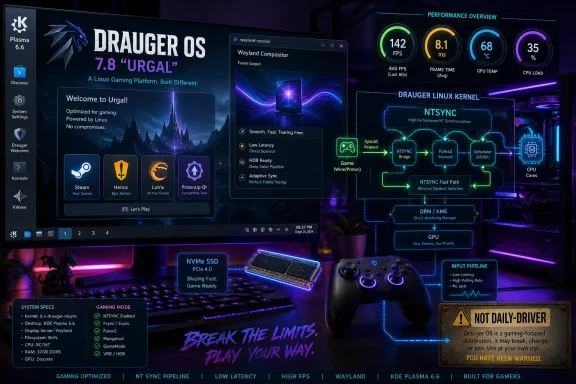 Drauger’s Bet Is That Gaming Linux Needs a Product, Not a Puzzle
Drauger OS has always occupied an odd corner of the Linux gaming conversation. It is not SteamOS, with Valve’s commercial gravity behind it. It is not Nobara, which carries the aura of a Fedora remix shaped by a well-known Proton and Wine contributor. It is not Bazzite, which leans into the immutable, appliance-like model that feels increasingly natural for gaming PCs and handhelds.Instead, Drauger is a small project with a blunt promise: take Ubuntu LTS, strip away some general-purpose assumptions, add gaming tools, tune for performance, and give players a faster route to actually launching games. That promise is both attractive and precarious. Gaming users want convenience, but they are also unusually exposed to regressions in graphics drivers, kernel behavior, anti-cheat support, controller input, desktop compositing, and Wine synchronization.
Version 7.8 matters because it no longer looks like a project clinging to the idea that a gaming desktop must be spartan to be fast. Moving to KDE Plasma 6.6 is a declaration that user experience, display handling, and modern desktop integration now matter as much as a low idle RAM figure. Linux gaming in 2026 is less about proving that the OS can stay out of the way and more about proving that the OS can coordinate a messy pile of moving parts.
That is the broader story behind Drauger 7.8. It is not merely “Ubuntu with Steam.” It is a distro trying to package the assumptions of modern Linux gaming into a coherent install image, even while the project’s own messaging admits it is not meant to be a polished everyday desktop for everyone.
KDE Plasma Is No Longer the Heavy Choice
For years, gaming distributions often reached for lightweight desktops because the logic seemed obvious. If every frame mattered, the desktop environment should consume as little as possible. Xfce became the sensible option: fast, conservative, familiar, and unlikely to surprise users with too much animation or abstraction.That logic has aged. Modern Linux gaming is not primarily constrained by whether the desktop shell uses a few hundred extra megabytes of RAM. It is constrained by the quality of the graphics stack, the compositor, variable refresh support, HDR ambitions, multi-monitor behavior, Wayland maturity, frame pacing, input latency, and how gracefully the desktop cooperates with games that were never written for Linux in the first place.
KDE Plasma has become one of the more natural answers to that problem. Plasma 6’s Wayland-first posture gives gaming-focused distros access to a desktop that is both configurable and increasingly aligned with where the Linux graphics stack is going. For users coming from Windows, it also offers a recognizable desktop metaphor without forcing them into GNOME’s more opinionated workflow.
Drauger’s choice of Plasma 6.6 therefore says something important about where the community’s confidence has moved. KDE is no longer merely the “power user” desktop with endless settings panels. It is becoming the default answer for distributions that want modern display features without abandoning the traditional desktop experience.
For WindowsForum readers, that matters because the Windows-to-Linux gaming path has always been haunted by friction. A new user can accept learning Proton. They can tolerate occasional launch flags. They may even accept vendor-driver weirdness. But if the desktop itself feels alien, fragile, or unfinished, the experiment ends quickly. Plasma reduces that psychological distance.
Ubuntu LTS Is the Safety Net and the Constraint
Drauger’s other major bet is Ubuntu 26.04 LTS. That is a pragmatic choice, and also a limiting one. Ubuntu LTS gives a small project a base with predictable security updates, broad hardware support, massive package availability, and a familiar troubleshooting surface. If a user searches for a problem, they are more likely to find an Ubuntu answer than a Drauger-specific answer.That matters for a project whose development resources are necessarily modest. Building a gaming distribution from scratch is not realistic. Building a gaming layer on top of Ubuntu LTS is a way to borrow Canonical’s infrastructure while spending project energy on defaults, packaging choices, installer behavior, and the gaming experience.
The trade-off is that Ubuntu’s decisions become Drauger’s inheritance. If Ubuntu moves more aggressively toward Snap, Drauger must decide whether to accept, route around, or replace that choice. If Ubuntu’s release cadence freezes major components at a particular moment, Drauger must decide whether stability is worth being behind rolling gaming distros on Mesa, kernels, and desktop pieces. If Ubuntu makes a controversial desktop decision, downstream projects have to either absorb the blast or spend scarce resources undoing it.
Drauger 7.8’s use of Firefox as a Flatpak is a small but telling example. It is not just a browser packaging decision. It is a signal that some Ubuntu-based derivatives want Ubuntu’s foundation without all of Ubuntu’s desktop-policy baggage. For users who dislike Snap, that single choice may carry more emotional weight than any benchmark.
The LTS base also frames Drauger as a different kind of gaming distro from Arch-derived or Fedora-derived alternatives. It is not trying to win by having the newest everything every week. It is trying to win by being stable enough underneath while curating enough gaming-specific tooling above the waterline.
NTSYNC Turns Kernel Plumbing Into a Gaming Feature
The most interesting technical item in the Drauger 7.8 story is not the desktop theme or the app selection. It is NTSYNC. The feature is easy to undersell because it sounds like exactly the kind of kernel acronym that makes normal users’ eyes glaze over.But for Linux gaming, synchronization is not academic. Windows games running through Wine or Proton depend on compatibility layers that translate Windows behavior into Linux behavior. When synchronization primitives are inefficient or mismatched, the cost can show up as stutter, lower frame rates, inconsistent frame pacing, or strange performance cliffs in certain games.
NTSYNC aims to improve that layer by handling Windows-style synchronization more efficiently in the Linux kernel. In practical terms, it is part of the continuing process of making Proton feel less like a heroic compatibility hack and more like a boring runtime. Boring is the goal. Boring means the player clicks Play and forgets the translation stack exists.
Drauger highlighting day-one NTSYNC support is therefore not marketing fluff. It is an attempt to anchor the distro’s gaming claim in a real piece of infrastructure. Whether users notice the effect will depend heavily on hardware, games, drivers, Proton versions, and workloads, but the direction is right: Linux gaming performance is now being fought in deep layers of the stack that ordinary users should not have to tune manually.
That is also why gaming distros continue to exist despite the huge improvements in mainstream Ubuntu, Fedora, and Arch. The value is not that a user cannot assemble these pieces alone. The value is that most users should not have to.
The Preinstalled Launcher Stack Is the Real Welcome Screen
Drauger 7.8 ships with the expected gaming front doors: Steam, Heroic Games Launcher, Lutris, and ProtonUp-Qt. That list tells you who the distro imagines its user to be. This is not a Linux purist’s gaming box. It is for someone with libraries scattered across Steam, Epic, GOG, standalone installers, community scripts, and multiple Proton or Wine versions.That is the reality of PC gaming now. The game library is fragmented, the launchers are fragmented, and compatibility knowledge is fragmented. A gaming OS that only installs Steam is not wrong, but it is incomplete. Steam is the center of gravity; it is not the entire map.
Heroic matters because Epic and GOG remain part of many PC gamers’ collections. Lutris matters because the long tail of Windows games, emulators, launchers, and oddball installers still needs a flexible community-managed approach. ProtonUp-Qt matters because Proton GE and related compatibility builds are often the difference between a game that technically runs and a game that runs well enough to keep installed.
This is where a distribution can feel more like a product. A clean Ubuntu install can become a gaming machine, but the first hour often involves adding repositories, installing launchers, checking Flatpak permissions, configuring drivers, and reading compatibility notes. Drauger’s pitch is that the first hour should be shorter.
There is a risk here too. Preinstall too much, and the distro feels bloated or stale. Preinstall too little, and the project becomes just another wallpaper over Ubuntu. Drauger’s app selection is narrow enough to preserve the gaming identity, but broad enough to acknowledge that “Linux gaming” is now a multi-launcher reality.
The Anti-Daily-Driver Message Is Honest, Awkward, and Strategically Dangerous
Drauger’s own description has long included a striking caveat: it is not intended for everyday use. The project notes that it does not ship common productivity and creative applications such as office suites or audio and video editing tools. That is an unusually honest warning, but it is also a strange one in 2026.On one level, the distinction makes sense. A gaming distribution can focus on gaming and avoid pretending to be a universal desktop. Users who want LibreOffice, Kdenlive, Audacity, development tools, or enterprise VPN clients can install them. Linux packaging makes that possible, and Ubuntu’s repositories make it fairly easy.
On another level, the warning undercuts the product story. Most gaming PCs are also everyday PCs. They browse the web, join Discord calls, stream media, manage files, sync cloud storage, edit screenshots, handle schoolwork, and occasionally open a spreadsheet. Even a living-room console-like PC needs basic desktop reliability.
That creates a messaging problem. If Drauger wants to be a serious gaming OS, telling users it is not for daily use may protect the project from unrealistic expectations. But it may also steer cautious users toward Nobara, Bazzite, Pop!_OS, Kubuntu, or plain Fedora and Ubuntu installs that feel more comfortable as general-purpose machines.
The better interpretation is that Drauger is not trying to be a corporate workstation or a creator desktop. Fair enough. But the line between “gaming OS” and “daily desktop with gaming priorities” is thinner than ever. Steam Deck users browse, chat, mod, stream, and tinker. Windows gaming PCs are never only gaming PCs. Linux alternatives have to meet that same messy reality.
Wayland by Default Is the Necessary Risk
Wayland has become the unavoidable future of the Linux desktop, and gaming distributions no longer get to treat it as a laboratory option. Drauger 7.8 using Wayland by default aligns with the direction of KDE Plasma and the broader desktop ecosystem. It also means users inherit both the gains and the remaining rough edges.For gaming, Wayland’s promise is cleaner display handling, better security boundaries, improved high-DPI behavior, and a path toward modern features that X11 was never designed to handle elegantly. Variable refresh rate, mixed refresh displays, fractional scaling, and future HDR workflows all fit more naturally into the Wayland-era desktop story.
The risk is that gamers are very good at finding edge cases. Capture tools, overlays, remote play, unusual input devices, screen recording, streaming workflows, global hotkeys, older games, and proprietary drivers can all expose weak seams. A desktop stack can be mature for ordinary browsing and still aggravating for a specific game or peripheral.
Drauger is therefore making the same bet as much of the Linux desktop: the future is worth the transition pain. That is probably correct. But it means a gaming distro must be judged not only by what works on a clean boot, but by how well it handles the weird things gamers do after installation.
This is one of the reasons KDE is a sensible partner for the bet. Plasma’s configuration depth gives users escape hatches. It also gives distributions more room to shape defaults without removing control from experienced users.
Small Distros Live or Die by Trust, Not Features
The hard part for Drauger is not assembling a compelling feature list. It is earning trust. Linux gaming users have seen specialized distributions appear, generate enthusiasm, stall, and fade. That history makes every niche gaming OS fight a credibility battle before the ISO even boots.Trust has several layers. Users need to know whether updates will arrive, whether security fixes will keep flowing, whether broken packages will be repaired, whether the installer is safe around existing disks, whether documentation is current, and whether the project will still be around when the next Ubuntu point release lands. For a small team, those expectations can be brutal.
Ubuntu LTS helps, but it does not solve everything. The base may continue to receive updates, but the distribution-specific glue still matters. Gaming launchers evolve, Proton evolves, KDE evolves, Flatpak permissions evolve, drivers evolve, and the kernel stack evolves. A gaming distro is not a static appliance unless it has the infrastructure and discipline to behave like one.
This is why the comparison with Bazzite and Nobara is unavoidable. Bazzite benefits from the appeal of an atomic model and the larger Universal Blue ecosystem. Nobara benefits from Fedora’s freshness and its association with practical gaming fixes. Drauger has to argue that Ubuntu LTS plus curated gaming defaults is enough.
That argument is not hopeless. There are users who prefer Debian-family systems, apt tooling, Ubuntu documentation, and LTS predictability. There are also users who want a conventional mutable desktop rather than an immutable image-based OS. Drauger can serve them, but it must make reliability its central feature, not an afterthought.
Windows Users Are the Hidden Audience
A Linux gaming distribution is never only speaking to existing Linux gamers. It is also speaking to Windows users who are curious, irritated, or strategically hedging. That audience has grown more interesting as Windows itself has become more cloud-connected, more ad-adjacent, more account-driven, and more aggressive about hardware and security baselines.For that audience, Drauger’s Ubuntu base is an advantage. Ubuntu remains the Linux name many Windows users recognize first. KDE Plasma softens the desktop transition. Steam and Heroic reduce the intimidation factor. ProtonUp-Qt acknowledges that compatibility tuning exists without requiring the user to become a Wine expert on day one.
But the Windows comparison also raises the bar. Windows may be annoying, but it is still the default target for PC games, launchers, anti-cheat vendors, GPU utilities, RGB control panels, capture tools, and hardware companion apps. A Linux gaming distro has to do more than be philosophically appealing. It has to survive contact with the user’s actual library.
That is where projects like Drauger can be useful even when they are not the final destination. They compress the experiment. A Windows user can boot the live environment, install to spare hardware, sign into Steam, test a few games, and see how close the Linux gaming story has come. Even if they later choose Bazzite, Nobara, Kubuntu, or Arch, the specialized distro has done some evangelistic work.
The danger is that a rough experience can do the opposite. A broken installer, missing driver, stale package, or confusing warning can confirm old suspicions. Linux gaming’s reputation is better than it used to be, but it is still fragile among users who remember dependency hunts and forum archaeology.
The Installer Is Where Confidence Begins
Drauger’s installer, Edamame, receives less attention than the desktop and kernel, but installer behavior is disproportionately important for a niche OS. Users forgive rough edges after installation more readily than they forgive uncertainty while partitioning disks. The installer is the moment when curiosity becomes commitment.The reported improvements to Quick Install, including copying network settings through NetworkManager and netplan, sound mundane. They are exactly the kind of mundane that matters. A gaming OS should not require users to re-solve Wi-Fi, networking, or basic system setup immediately after installation unless there is a good reason.
This is also where small projects can distinguish themselves. The big distributions must serve many use cases. A gaming distro can make narrower assumptions. It can optimize the path from bootable USB to installed desktop to logged-in launcher. Every removed annoyance is part of the product.
At the same time, custom installers are maintenance liabilities. Calamares and other established installers exist for a reason. If Edamame is reliable, Drauger gains identity and control. If it is fragile, the project inherits one of the scariest classes of bugs a desktop OS can have.
For enthusiasts, that may be acceptable. For mainstream users, the installer must be boring. The more Drauger wants to court Windows refugees and gaming-first users, the more it needs installation to feel uneventful.
The Storage Requirements Reveal the Shape of Modern Gaming
Drauger’s minimum storage requirement of 32 GB, with far more recommended for a good experience, is not shocking in the age of 100 GB games. But it is still revealing. A Linux gaming OS can be lean in theory and immediately become storage-hungry in practice.The operating system itself is not the real storage problem. Shader caches, compatibility layers, multiple Proton versions, Flatpak runtimes, launchers, game prefixes, mods, redistributables, and the games themselves quickly dwarf the base install. A user testing a few modern titles can burn through a small SSD almost instantly.
That is why recommending an NVMe SSD is sensible. Game load times, shader behavior, asset streaming, and general responsiveness all benefit from fast storage. A distro that claims to be gaming-focused should not pretend that a tiny old SATA drive will provide the intended experience.
Still, storage expectations complicate casual testing. Many users will first try a niche distro in a virtual machine, on an old laptop, or on a spare SSD. Gaming performance in those contexts may not reflect the real target hardware. Drauger’s requirements implicitly say: this is not just a curiosity for a VM screenshot; it wants actual gaming PC resources.
That is another sign of Linux gaming’s maturation. The conversation has moved from “Can it run?” to “Can it run well enough that the OS disappears?” That second question demands better hardware assumptions.
The Snap Escape Hatch Is Part of a Larger Ubuntu Derivative Pattern
Firefox as a Flatpak is a small package choice with large symbolic value. Ubuntu’s embrace of Snap has been one of the most divisive desktop decisions in the Debian-family world. Some users do not care. Others care deeply, particularly when startup time, theming, update behavior, confinement, or centralized control enter the discussion.Drauger’s Flatpak choice positions the distro with users who want Ubuntu’s base but not necessarily Canonical’s preferred app-distribution model. That is a familiar pattern among Ubuntu derivatives. The ecosystem repeatedly demonstrates that Ubuntu is valuable enough to build on and opinionated enough to route around.
Flatpak also makes sense for a gaming desktop because so much of the modern Linux application world has standardized around it. Heroic, Bottles, Discord alternatives, streaming tools, emulators, and utilities often arrive conveniently through Flatpak. Flatseal’s inclusion acknowledges the permission-management side of that reality.
There is a philosophical split here. Snap is tightly associated with Ubuntu and Canonical’s infrastructure. Flatpak feels more cross-distribution and desktop-community aligned. A gaming distro that wants to be Ubuntu-based but not Ubuntu-flavored can use Flatpak as a cultural signal.
The practical question is whether the result is coherent. Mixing apt packages, Flatpaks, third-party launchers, Proton builds, and gaming prefixes can become confusing. The best gaming distributions hide that complexity without denying it exists.
Linux Gaming Is Becoming a Stack War
Drauger 7.8 lands in a Linux gaming market that is more crowded and more serious than it was a few years ago. The Steam Deck changed expectations by proving that Linux could be an appliance-like gaming environment for millions of users. Proton turned compatibility from a science project into a mainstream assumption. Distros like Bazzite, Nobara, CachyOS, Garuda, and Pop!_OS each argue for a different balance of freshness, stability, polish, and control.That means Drauger is not competing only with Windows. It is competing with other interpretations of Linux gaming. One says the future is immutable and image-based. Another says the future is Fedora with gaming patches. Another says the future is Arch-like freshness. Another says the future is just mainstream Ubuntu or Fedora with Steam installed.
Drauger’s interpretation is more conservative underneath and more curated on top. Ubuntu LTS supplies the floor. KDE Plasma supplies the desktop. Preinstalled launchers supply the on-ramp. Kernel 7.0 and NTSYNC supply the performance story. Flatpak supplies a partial answer to modern app delivery.
The question is whether that combination is distinctive enough. For some users, yes. For others, it may feel like Kubuntu plus gaming apps. That is the eternal challenge for downstream distributions: the closer they stay to the base, the harder it is to prove they need to exist; the farther they diverge, the harder they are to maintain.
Drauger’s best argument is not novelty. It is convenience with taste. If the project can keep that convenience reliable, it has a place.
The Drauger 7.8 Signal Is Bigger Than the ISO
Drauger 7.8 should be read less as a revolution than as a snapshot of where desktop Linux gaming has arrived. Its most concrete choices point in the same direction: modern KDE, Wayland by default, Ubuntu LTS stability, NTSYNC-aware kernel plumbing, Flatpak-friendly app delivery, and a launcher set that assumes players own games across multiple ecosystems.- Drauger OS 7.8 “Urgal” is best understood as a gaming-focused Ubuntu 26.04 LTS remix rather than a general-purpose desktop distribution.
- The move to KDE Plasma 6.6 reflects a wider shift away from lightweight desktops as the default answer for gaming-focused Linux systems.
- Wayland by default is both a necessary modernization step and a potential source of edge-case pain for capture tools, overlays, older games, and unusual peripherals.
- NTSYNC support matters because Linux gaming performance increasingly depends on deep compatibility-layer improvements that users should not have to configure manually.
- The preinstalled mix of Steam, Heroic, Lutris, and ProtonUp-Qt recognizes that modern PC game libraries are fragmented across stores, launchers, and compatibility tools.
- Drauger’s biggest challenge is not features, but trust: users need confidence that a small gaming distro will remain updated, secure, and coherent after the initial install.
References
- Primary source: LXer
Published: Sun, 28 Jun 2026 15:37:53 GMT
Drauger OS Reworks Ubuntu LTS with KDE Plasma for Linux Gaming
Drauger OS 7.8 reworks Ubuntu 26.04 LTS with KDE Plasma into a niche Linux gaming distro, adding kernel 7.0, Wayland by default, and gaming-focused tweaks.lxer.com - Independent coverage: Linuxiac
Published: Sun, 28 Jun 2026 15:37:53 GMT
Drauger OS Reworks Ubuntu LTS with KDE Plasma for Linux Gaming
Drauger OS 7.8 reworks Ubuntu 26.04 LTS with KDE Plasma into a niche Linux gaming distro, adding kernel 7.0, Wayland by default, and gaming-focused tweaks.linuxiac.com - Related coverage: ubuntupit.com
- Related coverage: 9to5linux.com
- Related coverage: tobias-weiss.org
Ubuntu 26.04 LTS: What Breaks, What's New, and When to Upgrade | DevOps | Tobias Weiss
Canonical ships Ubuntu 26.04 'Resolute Raccoon' with kernel 7.0, GNOME 50, Wayland-only desktop, Nvidia CUDA and AMD ROCm in the box, and a dual-track container stack. Here's the DevOps migration guide.www.tobias-weiss.org - Related coverage: ap7i.com
ap7i.com | Ubuntu 26.04 LTS 'Resolute Raccoon': Wayland-Only, Rust-Forward
Canonical released Ubuntu 26.04 LTS — codenamed Resolute Raccoon for Steve Langasek — on April 23. It is the first Ubuntu LTS without an Xorg session, ships GNOME 50 on Linux 7.0, and replaces GNU coreutils with a Rust implementation by default.ap7i.com
- Related coverage: ubuntufree.com
What's New in Ubuntu Kylin 26.04, UKUI 4.22 Features - Ubuntu Free
See what’s new in Ubuntu Kylin 26.04, including Linux 7.0, core system updates, UKUI desktop changes, and improvements for daily desktop use.www.ubuntufree.com - Related coverage: world.hey.com
- Related coverage: docs.redhat.com
- Related coverage: drauger.org