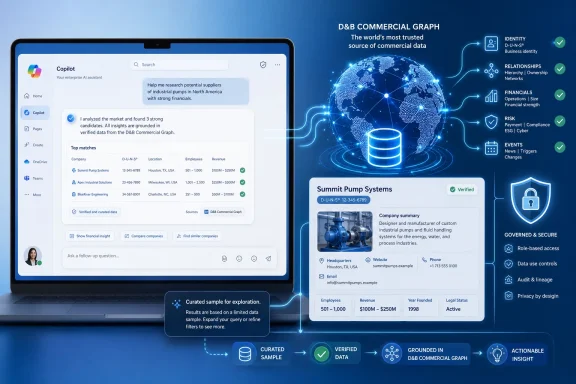
Dun & Bradstreet said on June 2, 2026, that its Graph Connector is now available in Microsoft 365 Copilot, giving developers and enterprise users no-cost access to a curated sample of verified business data from the D&B Commercial Graph. The announcement is not just another connector in Microsoft’s expanding Copilot ecosystem. It is a small but telling move in the larger contest over whether enterprise AI becomes useful by being smarter, or by being better grounded. Microsoft and Dun & Bradstreet are betting, sensibly, that the second problem is now the more urgent one.
The pitch is straightforward: bring verified business identity data into the place where workers are already asking AI to summarize, compare, draft, and decide. The connector exposes foundational information on tens of thousands of public and private companies, including summaries, locations, contact details, and ranges for employee count and annual revenue. That is not the full Dun & Bradstreet universe, and it is not being sold as one. It is a sample designed to let organizations test what happens when Copilot can reason against a cleaner commercial graph instead of the loose residue of emails, PDFs, CRM notes, and half-remembered account names.
That distinction matters. Generative AI in the enterprise has been marketed as a productivity layer, but its most stubborn failures often come from identity and context rather than prose. A model can write a polished account brief and still confuse subsidiaries, stale addresses, similarly named firms, or a prospect with a supplier. In sales, procurement, compliance, and partner discovery, the difference between “Acme Holdings” and the right legal entity is not pedantry. It is the difference between useful automation and expensive noise.
Microsoft 365 Copilot already leans on Microsoft Graph to make sense of tenant data such as documents, chats, calendars, meetings, and email. Graph connectors extend that model by bringing external systems into the same searchable and promptable fabric. Dun & Bradstreet’s move fits neatly into that architecture: it turns a slice of commercial reference data into something Copilot can use during ordinary knowledge work.
The interesting part is the price. Dun & Bradstreet is offering no-cost access to a curated sample, which lowers the barrier for experimentation while keeping the deeper commercial datasets and analytics as the obvious paid destination. In other words, the connector is both a developer aid and a funnel. That does not make it cynical; it makes it enterprise software.
Microsoft 365 Copilot’s promise depends on a controlled answer to that question. The product is valuable because it sits inside the productivity suite where work already happens, but that also means it inherits the mess of enterprise information architecture. Permissions, stale files, duplicated records, shadow spreadsheets, abandoned SharePoint sites, and poorly governed Teams channels all become part of the AI substrate if administrators do not tame them.
Dun & Bradstreet is entering that gap with the kind of data that enterprises have historically bought precisely because their internal systems are incomplete. A company’s formal identity, location, hierarchy, size band, and commercial footprint are not always reliably captured in a CRM record. They may be present in multiple systems, represented differently in each one, and maintained by teams with competing incentives. AI does not solve that problem by reading faster. It amplifies the quality of whatever it is handed.
That is why the phrase “verified business data” is doing a lot of work in the announcement. Dun & Bradstreet wants to position its Commercial Graph as a stabilizing layer for AI-assisted workflows, not merely as a database. Microsoft, for its part, benefits from connectors that make Copilot feel less like a chatbot over office documents and more like a reasoning interface across enterprise knowledge.
This is also where the practical appeal lies for IT leaders. A no-cost sample allows a team to test prompts, workflows, and governance boundaries before committing to broader data licensing. That is the right order of operations. Enterprise AI pilots have too often started with software entitlement and ended with a data cleanup project nobody budgeted for.
That is powerful because AI adoption is increasingly workflow-led. A sales operations team may not begin by building a formal app. It may begin by asking Copilot to summarize a target account, compare potential customers by region, or identify prospective partners in a sector. If those early answers are grounded in recognizable commercial data, the user experience shifts from “interesting demo” to “maybe we can use this.”
But “free” should not be confused with “complete.” The connector provides a curated sample of information on tens of thousands of companies, while Dun & Bradstreet’s broader value proposition remains its deeper data, identity resolution, analytics, and risk tooling. For serious supplier due diligence, sanctions screening, credit risk, master data management, or global corporate hierarchy mapping, a sample will not be enough. It is meant to prove the shape of the use case, not finish the job.
That limitation is not a flaw if buyers understand it. In fact, it may be healthier than pretending a connector can magically turn Copilot into a complete commercial intelligence platform. The better framing is narrower: Microsoft 365 Copilot can now be tested against a slice of verified business context, and that test may reveal where structured external data is worth paying for.
The risk is that business users will treat the presence of D&B data as a broad stamp of authority. A Copilot answer that includes a company summary and revenue range may feel more definitive than it is. Administrators and developers will need to design experiences that make the boundary between sample data, tenant data, and generated inference legible.
For developers building early-stage workflows, D&B data can serve as a grounding layer for prompts and agents. A prospecting assistant can pull company identity details before drafting outreach. A market research workflow can organize companies by geography or approximate size. A supplier discovery scenario can begin with verified commercial records rather than an uncontrolled web scrape or a brittle spreadsheet.
That matters because many AI prototypes fail at the handoff between language and data. The model can generate a plausible plan, but the plan depends on facts that must come from somewhere. If those facts are pulled from a verified commercial graph, the prototype has a better chance of surviving contact with real users.
The connector also makes Microsoft’s ecosystem more attractive to developers who do not want to build and maintain data ingestion pipelines from scratch. A connector-based approach shifts some of the work into Microsoft 365’s existing security, indexing, and search machinery. That does not eliminate architecture decisions, but it reduces the distance between “we have a data source” and “our users can ask useful questions about it.”
Still, developers should be careful not to confuse connector availability with application design. A good Copilot workflow needs prompt strategy, permissions discipline, source transparency, error handling, and a clear fallback path when the data is incomplete. The D&B connector can make the facts better. It cannot decide the business process.
But the governance picture becomes more complex as Copilot gains access to more external data. IT administrators will need to understand what data is indexed, who can query it, how results appear in Copilot, and whether generated answers blur together information from internal tenant content and third-party sources. The connector model is powerful precisely because it makes external data feel native. That is also why it needs careful controls.
There is also a compliance nuance. Dun & Bradstreet’s data is built for commercial identity and enterprise decision-making, but organizations still need policies around acceptable use. Sales and marketing research is one thing. Automated decisioning about suppliers, credit exposure, or risk categories is another. The more Copilot becomes part of operational judgment, the more organizations will need to document which systems of record are being used and how AI-generated summaries are reviewed.
The announcement’s early use cases are deliberately exploratory: sales and marketing, market and competitive research, supplier and partner discovery. Those are sensible places to start because they tolerate some ambiguity. An account research brief can be useful even if it includes ranges rather than precise figures. A supplier discovery prompt can narrow the field without making the final sourcing decision.
That is the right boundary for now. The connector should be seen as a way to test data-grounded workflows, not as a license to automate sensitive business judgments. In enterprise AI, the most dangerous output is not the obviously wrong answer. It is the answer that is polished, partially grounded, and just authoritative enough to skip review.
The distinction matters because Microsoft now uses the Copilot name across multiple surfaces. There is Copilot in Windows, Copilot in Microsoft 365, Copilot Studio, Copilot connectors, and various agent-building experiences. The D&B announcement belongs to the enterprise productivity side of that house. Its impact will be felt by users and administrators working inside Microsoft 365 experiences, not by consumers asking the Windows Copilot pane for general help.
For IT departments, that means the relevant questions are tenant governance, licensing, connector configuration, data access, and user education. Does the organization have Microsoft 365 Copilot deployed? Who can enable or use connectors? How will D&B data appear in search and Copilot experiences? What guidance will users receive about the difference between a generated answer and a verified source record?
Those questions are not glamorous, but they determine whether the feature becomes useful. Microsoft’s Copilot strategy increasingly depends on administrators accepting that AI is not just a client-side tool. It is a tenant-level information system. Once external business data becomes part of the Copilot experience, the admin center matters more than the Start menu.
This is also why Microsoft’s connector ecosystem should be watched closely. Each new connector increases Copilot’s reach, but it also increases the need for disciplined information management. The enterprise value of AI will not come from turning on every possible data source. It will come from connecting the right ones, for the right users, under the right controls.
The D-U-N-S Number remains central to that pitch. It gives Dun & Bradstreet a long-established identity anchor around which to structure commercial information. In AI terms, that is valuable because language models are bad at business identity when the world is messy. They can match names and infer relationships, but they do not inherently know which entity is the legally relevant one or whether two records refer to the same company.
A commercial graph gives AI something firmer to stand on. It does not make the model infallible, and it does not remove the need for human review. But it can reduce ambiguity in exactly the kinds of workflows where ambiguity drains productivity: account planning, supplier research, market mapping, and partner discovery.
The cleverness of the Microsoft integration is that it brings that trust layer into a tool workers may already be authorized to use. Instead of asking users to leave their productivity environment for a separate business intelligence or data product, the connector lets them start with a prompt. That is the direction enterprise software has been moving: less portal-hopping, more contextual retrieval.
The danger for Dun & Bradstreet is commoditization by interface. If users experience D&B data only as an ingredient inside Copilot, the brand may fade behind Microsoft’s assistant. The company appears to understand that risk, which is why the announcement emphasizes the path from sample data to deeper datasets and analytics. The connector is the handshake; the enterprise contract is the destination.
That marketplace framing explains why connectors matter. They are not flashy, and they will not get the same attention as new models or agent demos. But they are the plumbing that determines whether Copilot can answer questions grounded in the systems businesses actually use.
The D&B connector is therefore both modest and important. Modest because it is a curated sample, not a wholesale transformation of enterprise AI. Important because it shows how Microsoft’s Copilot layer can absorb specialized data providers without forcing users into separate applications.
This is the pattern to expect. Vertical data, compliance data, customer data, engineering data, support data, and financial data will all compete for placement inside AI work surfaces. The winners will be the providers whose information is structured enough for machines, trusted enough for administrators, and useful enough for workers who do not care where the answer came from as long as it is right.
That last condition is the hardest. Users will judge Copilot by outcomes, not architecture. If D&B grounding makes account research faster and cleaner, the connector will be praised. If it produces vague summaries from limited sample data, it will be ignored. Enterprise AI has become brutally practical that way.
The harder test is what happens next. Does the user know whether the answer came from D&B data, internal documents, or the model’s own synthesis? Can they inspect the underlying record? Does the answer respect organizational permissions and licensing terms? Can the business process tolerate ranges and summaries, or does it require precise, auditable data?
Those details decide whether the feature stays in the realm of convenience or becomes part of operational work. AI grounded in verified data sounds reassuring, but the enterprise will still demand traceability. “Copilot said so” is not a control.
That is why administrators should treat the connector as a pilot opportunity rather than a switch to flip indiscriminately. The right approach is to select a narrow workflow, define the data boundary, test answer quality, and document where human review remains mandatory. If that sounds dull, it is also how enterprise technology becomes real.
The broader lesson is that Copilot’s future will be shaped less by theatrical AI moments and more by data relationships like this one. Microsoft does not need every enterprise dataset to belong to Microsoft. It needs the important ones to become reachable through Microsoft 365.
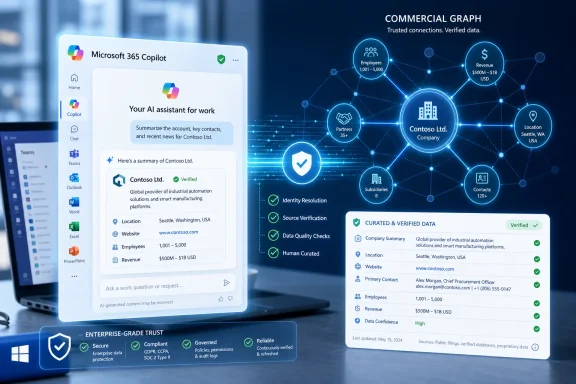 Copilot’s New Trick Is Not Generating Text, but Knowing the Company
The pitch is straightforward: bring verified business identity data into the place where workers are already asking AI to summarize, compare, draft, and decide. The connector exposes foundational information on tens of thousands of public and private companies, including summaries, locations, contact details, and ranges for employee count and annual revenue. That is not the full Dun & Bradstreet universe, and it is not being sold as one. It is a sample designed to let organizations test what happens when Copilot can reason against a cleaner commercial graph instead of the loose residue of emails, PDFs, CRM notes, and half-remembered account names.That distinction matters. Generative AI in the enterprise has been marketed as a productivity layer, but its most stubborn failures often come from identity and context rather than prose. A model can write a polished account brief and still confuse subsidiaries, stale addresses, similarly named firms, or a prospect with a supplier. In sales, procurement, compliance, and partner discovery, the difference between “Acme Holdings” and the right legal entity is not pedantry. It is the difference between useful automation and expensive noise.
Microsoft 365 Copilot already leans on Microsoft Graph to make sense of tenant data such as documents, chats, calendars, meetings, and email. Graph connectors extend that model by bringing external systems into the same searchable and promptable fabric. Dun & Bradstreet’s move fits neatly into that architecture: it turns a slice of commercial reference data into something Copilot can use during ordinary knowledge work.
The interesting part is the price. Dun & Bradstreet is offering no-cost access to a curated sample, which lowers the barrier for experimentation while keeping the deeper commercial datasets and analytics as the obvious paid destination. In other words, the connector is both a developer aid and a funnel. That does not make it cynical; it makes it enterprise software.
Microsoft’s AI Problem Has Become a Data Supply Problem
For the last three years, the AI conversation has been dominated by models: which one is faster, which one is cheaper, which one scores higher on benchmarks, and which one can fit inside a laptop. Inside large organizations, the more practical question has become less glamorous. What, exactly, is the model allowed to know?Microsoft 365 Copilot’s promise depends on a controlled answer to that question. The product is valuable because it sits inside the productivity suite where work already happens, but that also means it inherits the mess of enterprise information architecture. Permissions, stale files, duplicated records, shadow spreadsheets, abandoned SharePoint sites, and poorly governed Teams channels all become part of the AI substrate if administrators do not tame them.
Dun & Bradstreet is entering that gap with the kind of data that enterprises have historically bought precisely because their internal systems are incomplete. A company’s formal identity, location, hierarchy, size band, and commercial footprint are not always reliably captured in a CRM record. They may be present in multiple systems, represented differently in each one, and maintained by teams with competing incentives. AI does not solve that problem by reading faster. It amplifies the quality of whatever it is handed.
That is why the phrase “verified business data” is doing a lot of work in the announcement. Dun & Bradstreet wants to position its Commercial Graph as a stabilizing layer for AI-assisted workflows, not merely as a database. Microsoft, for its part, benefits from connectors that make Copilot feel less like a chatbot over office documents and more like a reasoning interface across enterprise knowledge.
This is also where the practical appeal lies for IT leaders. A no-cost sample allows a team to test prompts, workflows, and governance boundaries before committing to broader data licensing. That is the right order of operations. Enterprise AI pilots have too often started with software entitlement and ended with a data cleanup project nobody budgeted for.
The Free Sample Is a Product Strategy, Not a Gift
There is a familiar rhythm to this kind of launch. A vendor opens a narrow, curated lane into a larger proprietary dataset; developers and business teams experiment; successful experiments create demand for the paid version. The novelty here is not the strategy. It is the placement of the sample inside Microsoft 365 Copilot, where experimentation can happen close to everyday work rather than in a separate analytics sandbox.That is powerful because AI adoption is increasingly workflow-led. A sales operations team may not begin by building a formal app. It may begin by asking Copilot to summarize a target account, compare potential customers by region, or identify prospective partners in a sector. If those early answers are grounded in recognizable commercial data, the user experience shifts from “interesting demo” to “maybe we can use this.”
But “free” should not be confused with “complete.” The connector provides a curated sample of information on tens of thousands of companies, while Dun & Bradstreet’s broader value proposition remains its deeper data, identity resolution, analytics, and risk tooling. For serious supplier due diligence, sanctions screening, credit risk, master data management, or global corporate hierarchy mapping, a sample will not be enough. It is meant to prove the shape of the use case, not finish the job.
That limitation is not a flaw if buyers understand it. In fact, it may be healthier than pretending a connector can magically turn Copilot into a complete commercial intelligence platform. The better framing is narrower: Microsoft 365 Copilot can now be tested against a slice of verified business context, and that test may reveal where structured external data is worth paying for.
The risk is that business users will treat the presence of D&B data as a broad stamp of authority. A Copilot answer that includes a company summary and revenue range may feel more definitive than it is. Administrators and developers will need to design experiences that make the boundary between sample data, tenant data, and generated inference legible.
For Developers, the Connector Is an Invitation to Build Around Grounding
The developer angle is easy to understate because the announcement reads like a data partnership. But the phrase “Graph Connector in Microsoft 365 Copilot” points to a broader extensibility story. Microsoft wants Copilot to be the interface where enterprise users ask questions across internal and external knowledge sources, and connectors are one of the ways outside data gets into that experience.For developers building early-stage workflows, D&B data can serve as a grounding layer for prompts and agents. A prospecting assistant can pull company identity details before drafting outreach. A market research workflow can organize companies by geography or approximate size. A supplier discovery scenario can begin with verified commercial records rather than an uncontrolled web scrape or a brittle spreadsheet.
That matters because many AI prototypes fail at the handoff between language and data. The model can generate a plausible plan, but the plan depends on facts that must come from somewhere. If those facts are pulled from a verified commercial graph, the prototype has a better chance of surviving contact with real users.
The connector also makes Microsoft’s ecosystem more attractive to developers who do not want to build and maintain data ingestion pipelines from scratch. A connector-based approach shifts some of the work into Microsoft 365’s existing security, indexing, and search machinery. That does not eliminate architecture decisions, but it reduces the distance between “we have a data source” and “our users can ask useful questions about it.”
Still, developers should be careful not to confuse connector availability with application design. A good Copilot workflow needs prompt strategy, permissions discipline, source transparency, error handling, and a clear fallback path when the data is incomplete. The D&B connector can make the facts better. It cannot decide the business process.
The Enterprise Win Is Less Hallucination, More Governance Headache
The most attractive promise here is reduced risk. If Copilot is going to help employees identify companies, compare accounts, or reason about partners, grounding those outputs in verified business data should reduce the chance of obvious errors. In a world where hallucination has become shorthand for AI unreliability, that is a practical improvement.But the governance picture becomes more complex as Copilot gains access to more external data. IT administrators will need to understand what data is indexed, who can query it, how results appear in Copilot, and whether generated answers blur together information from internal tenant content and third-party sources. The connector model is powerful precisely because it makes external data feel native. That is also why it needs careful controls.
There is also a compliance nuance. Dun & Bradstreet’s data is built for commercial identity and enterprise decision-making, but organizations still need policies around acceptable use. Sales and marketing research is one thing. Automated decisioning about suppliers, credit exposure, or risk categories is another. The more Copilot becomes part of operational judgment, the more organizations will need to document which systems of record are being used and how AI-generated summaries are reviewed.
The announcement’s early use cases are deliberately exploratory: sales and marketing, market and competitive research, supplier and partner discovery. Those are sensible places to start because they tolerate some ambiguity. An account research brief can be useful even if it includes ranges rather than precise figures. A supplier discovery prompt can narrow the field without making the final sourcing decision.
That is the right boundary for now. The connector should be seen as a way to test data-grounded workflows, not as a license to automate sensitive business judgments. In enterprise AI, the most dangerous output is not the obviously wrong answer. It is the answer that is polished, partially grounded, and just authoritative enough to skip review.
Windows Shops Will Feel This Through Microsoft 365, Not the Desktop
For WindowsForum readers, the temptation is to view every Copilot announcement through the Windows 11 lens. That would be misleading here. This is primarily a Microsoft 365 Copilot and Microsoft Graph story, not a new desktop feature landing in the taskbar.The distinction matters because Microsoft now uses the Copilot name across multiple surfaces. There is Copilot in Windows, Copilot in Microsoft 365, Copilot Studio, Copilot connectors, and various agent-building experiences. The D&B announcement belongs to the enterprise productivity side of that house. Its impact will be felt by users and administrators working inside Microsoft 365 experiences, not by consumers asking the Windows Copilot pane for general help.
For IT departments, that means the relevant questions are tenant governance, licensing, connector configuration, data access, and user education. Does the organization have Microsoft 365 Copilot deployed? Who can enable or use connectors? How will D&B data appear in search and Copilot experiences? What guidance will users receive about the difference between a generated answer and a verified source record?
Those questions are not glamorous, but they determine whether the feature becomes useful. Microsoft’s Copilot strategy increasingly depends on administrators accepting that AI is not just a client-side tool. It is a tenant-level information system. Once external business data becomes part of the Copilot experience, the admin center matters more than the Start menu.
This is also why Microsoft’s connector ecosystem should be watched closely. Each new connector increases Copilot’s reach, but it also increases the need for disciplined information management. The enterprise value of AI will not come from turning on every possible data source. It will come from connecting the right ones, for the right users, under the right controls.
Dun & Bradstreet Is Selling Trust Into an AI Market That Knows It Needs Some
Dun & Bradstreet’s positioning is almost perfectly timed. Enterprises have moved beyond the novelty phase of generative AI and into the unpleasant work of making it dependable. That creates a market for vendors that can claim not just data volume, but data quality, structure, identity resolution, and provenance.The D-U-N-S Number remains central to that pitch. It gives Dun & Bradstreet a long-established identity anchor around which to structure commercial information. In AI terms, that is valuable because language models are bad at business identity when the world is messy. They can match names and infer relationships, but they do not inherently know which entity is the legally relevant one or whether two records refer to the same company.
A commercial graph gives AI something firmer to stand on. It does not make the model infallible, and it does not remove the need for human review. But it can reduce ambiguity in exactly the kinds of workflows where ambiguity drains productivity: account planning, supplier research, market mapping, and partner discovery.
The cleverness of the Microsoft integration is that it brings that trust layer into a tool workers may already be authorized to use. Instead of asking users to leave their productivity environment for a separate business intelligence or data product, the connector lets them start with a prompt. That is the direction enterprise software has been moving: less portal-hopping, more contextual retrieval.
The danger for Dun & Bradstreet is commoditization by interface. If users experience D&B data only as an ingredient inside Copilot, the brand may fade behind Microsoft’s assistant. The company appears to understand that risk, which is why the announcement emphasizes the path from sample data to deeper datasets and analytics. The connector is the handshake; the enterprise contract is the destination.
The Copilot Ecosystem Is Becoming a Marketplace for Context
Microsoft’s biggest advantage in enterprise AI is not that it owns the best chatbot interface. It is that it owns the productivity environment where a vast amount of business context already lives. Copilot’s long-term value depends on turning that environment into a governed marketplace of context: internal files, messages, meetings, workflows, CRM records, service tickets, and now verified external company data.That marketplace framing explains why connectors matter. They are not flashy, and they will not get the same attention as new models or agent demos. But they are the plumbing that determines whether Copilot can answer questions grounded in the systems businesses actually use.
The D&B connector is therefore both modest and important. Modest because it is a curated sample, not a wholesale transformation of enterprise AI. Important because it shows how Microsoft’s Copilot layer can absorb specialized data providers without forcing users into separate applications.
This is the pattern to expect. Vertical data, compliance data, customer data, engineering data, support data, and financial data will all compete for placement inside AI work surfaces. The winners will be the providers whose information is structured enough for machines, trusted enough for administrators, and useful enough for workers who do not care where the answer came from as long as it is right.
That last condition is the hardest. Users will judge Copilot by outcomes, not architecture. If D&B grounding makes account research faster and cleaner, the connector will be praised. If it produces vague summaries from limited sample data, it will be ignored. Enterprise AI has become brutally practical that way.
The Real Test Comes After the Demo Prompt
The immediate use cases are easy to imagine. A sales rep asks Copilot for a quick profile of a target company. A marketing analyst explores firms in a region. A procurement specialist looks for potential suppliers in a category. A developer prototypes an agent that enriches account notes with verified company context.The harder test is what happens next. Does the user know whether the answer came from D&B data, internal documents, or the model’s own synthesis? Can they inspect the underlying record? Does the answer respect organizational permissions and licensing terms? Can the business process tolerate ranges and summaries, or does it require precise, auditable data?
Those details decide whether the feature stays in the realm of convenience or becomes part of operational work. AI grounded in verified data sounds reassuring, but the enterprise will still demand traceability. “Copilot said so” is not a control.
That is why administrators should treat the connector as a pilot opportunity rather than a switch to flip indiscriminately. The right approach is to select a narrow workflow, define the data boundary, test answer quality, and document where human review remains mandatory. If that sounds dull, it is also how enterprise technology becomes real.
The broader lesson is that Copilot’s future will be shaped less by theatrical AI moments and more by data relationships like this one. Microsoft does not need every enterprise dataset to belong to Microsoft. It needs the important ones to become reachable through Microsoft 365.
The D&B Connector Makes Copilot’s Data Bet Easier to See
This launch is small enough to pilot and large enough to reveal the direction of travel. It shows Microsoft 365 Copilot becoming a place where external commercial data can be used directly in knowledge work, while giving Dun & Bradstreet a low-friction way to seed enterprise AI experiments.- The connector gives Microsoft 365 Copilot users no-cost access to a curated sample of D&B Commercial Graph data covering tens of thousands of companies.
- The available data is aimed at foundational business identification, including company summaries, locations, contact details, and ranges for employee count and revenue.
- The most natural early uses are sales research, market analysis, competitive mapping, and supplier or partner discovery.
- The sample is not a substitute for full D&B datasets, deeper analytics, or formal risk and compliance workflows.
- Administrators should evaluate permissions, source visibility, and user guidance before treating the connector as part of production decision-making.
- The announcement reinforces that Copilot’s enterprise value will depend increasingly on governed external data, not just better language generation.
References
- Primary source: Stock Titan
Published: 2026-06-02T21:50:32.516213
Microsoft 365 Copilot adds free Dun & Bradstreet data for AI tasks
Free D&B data in Microsoft 365 Copilot lets users test AI workflows on tens of thousands of companies, from sales targeting to supplier search.www.stocktitan.net - Official source: learn.microsoft.com
Microsoft 365 Copilot connectors overview | Microsoft Learn
Extend the knowledge in Microsoft 365 Copilot with Copilot connectors.learn.microsoft.com - Official source: developer.microsoft.com
Microsoft 365 Copilot Connectors | Connect external data sources
Connect content from external data services into Microsoft Graph to power experiences such as Microsoft 365 Copilot, Copilot Search, and Microsoft Search.developer.microsoft.com - Official source: support.microsoft.com
Understand Copilot connectors | Microsoft Support
Understand Copilot connectorssupport.microsoft.com - Related coverage: prnewswire.com
Dun & Bradstreet Brings Verified Business Data into Microsoft 365 Copilot
/PRNewswire/ -- Dun & Bradstreet today announced the availability of Graph Connector in Microsoft 365 Copilot, giving developers and enterprises no‑cost access... www.prnewswire.com
- Official source: devblogs.microsoft.com
Anatomy of a Microsoft Graph connector
Microsoft Graph connectors help bring your organization's content into Microsoft Graph and Semantic Index for Copilot.devblogs.microsoft.com
- Official source: enablement.microsoft.com
Microsoft Graph – Microsoft Adoption
Microsoft Graph grounds Microsoft 365 Copilot with your organization’s productivity data.enablement.microsoft.com - Official source: techcommunity.microsoft.com

Clarity around the different types of connectors available for Microsoft 365 Copilot | Microsoft Community Hub
Working with some of the largest and most technical of Microsoft's partners in the Global System Integrators (GSI) team, we are still often met with...
techcommunity.microsoft.com
- Official source: learn.microsoft.com.mcas.ms

Continue
learn.microsoft.com.mcas.ms
- Related coverage: windowscentral.com
How to set up Copilot Connectors on Windows 11 | Windows Central
Connectors let Copilot search across different services, and here's how to set up the feature on Windows 11.www.windowscentral.com - Official source: cdn-dynmedia-1.microsoft.com
Microsoft Copilot for Microsoft 365
Microsoft Copilot for Microsoft 365cdn-dynmedia-1.microsoft.com
- Official source: download.microsoft.com
- Related coverage: m365maps.com