

Funcom has opened Xbox pre-orders for Dune: Awakening ahead of its September 22, 2026 console launch, bringing the Arrakis survival RPG to Xbox Series X|S with pre-order cosmetics, single-player support, private multiplayer options, and cross-play limited to Xbox and the Windows PC Store. The Microsoft Store listing is more than a storefront formality. It marks the moment Dune: Awakening stops being a PC survival curiosity and becomes a console platform bet. For Xbox players, the important question is not simply whether the sandworm is coming; it is whether Funcom has turned a demanding online survival game into something that can survive the expectations of a living-room audience.
The Xbox listing for Dune: Awakening reads like a pitch aimed squarely at players who may have watched the PC launch from a distance but never wanted to live inside a server-first survival game. It promises an open-world Arrakis, base construction, crafting, ornithopters, factions, familiar characters, and a cinematic story built around an alternate-history premise: what if Paul Atreides was never born?
That framing matters. The console version is not being marketed only as a multiplayer sandbox where the most dedicated players dominate the spice fields. It is being sold as a survival RPG with scale, spectacle, and player choice — the sort of phrasing that sounds much more palatable on Xbox than the harder-edged “survival MMO” label that followed the game through much of its pre-release cycle.
The Microsoft Store page also emphasizes that the full game is available whether the player chooses single-player, private multiplayer, or public servers. That is the key commercial pivot. Funcom is telling Xbox owners that Dune: Awakening is not asking them to surrender to the worst habits of the genre before they get to enjoy the best parts of the fiction.
The pre-order bonuses are modest but revealing. The Terrarium of Muad’Dib gives the desert mouse a decorative home inside the player’s base, while the Sunset Dye Global Swatch applies a unique color pattern across outfits, vehicles, and weapons. These are not power items, and they do not pretend to be. They are the kind of identity-layer cosmetics that fit a game where building a stronghold is as much about self-expression as resource logistics.
That can be an advantage. Survival games often improve after launch because their rough edges are unusually visible. Resource rates, PvP incentives, travel friction, server performance, crafting bottlenecks, and endgame loops all expose themselves quickly once real players start doing what designers did not expect them to do.
But it also raises the standard. A console release that follows a PC launch cannot hide behind the romance of early discovery. Xbox players will expect a more mature build, a cleaner onboarding curve, and a control scheme that feels designed rather than translated. The listing’s confidence around single-player and scalable difficulty suggests Funcom understands that console audiences will judge the game partly on whether it respects time, attention, and controller ergonomics.
This is where the Xbox version becomes interesting for more than Dune fans. The console market has room for survival games, but it is less forgiving of opaque systems than PC communities that enjoy learning a game through wikis, Discord servers, and attritional experimentation. If Dune: Awakening wants to be more than a niche import, its harshness has to feel authored rather than accidental.
The survival genre has spent years wrestling with a basic problem: many players like gathering, building, crafting, and progression, but they do not necessarily want their enjoyment mediated by strangers. Public servers create memorable stories, but they also create griefing, imbalance, social pressure, and the creeping sense that the game is moving on without you. A single-player mode lets Funcom preserve the fantasy of Arrakis without forcing every player into the politics of server life.
That decision also fits the source material better than it might appear. Dune is full of systems — ecology, empire, religion, bloodlines, economics — but its power comes from individual perspective. A player alone in the desert, managing water, shelter, and movement, may actually feel closer to the fiction than a crowd of players turning the Deep Desert into a chaotic resource race.
The listing promises extensive customization options for single-player and private multiplayer servers. That is where the feature could become genuinely important. Scalable difficulty is not just an accessibility nicety here; it is the difference between Arrakis as an atmospheric RPG world and Arrakis as a second job.
Arrakis works as a game world only if movement feels consequential. The player has to care about crossing dunes, timing expeditions, reading terrain, escaping storms, and earning the right to fly over danger in an ornithopter they built themselves. The worm is the mechanical enforcement of that fantasy. It is the thing that makes open space hostile instead of empty.
That is a difficult balance. If the worm is too predictable, it becomes scenery. If it is too punitive, it becomes irritation. If travel is too slow, the game becomes drudgery; if travel is too easy, the desert loses its authority. The Xbox listing’s emphasis on climbing mountains with the Shigawire hook and flying across worm-infested deserts in player-built ornithopters suggests Funcom wants traversal to become a progression arc rather than a background activity.
The best version of Dune: Awakening is one where the player gradually transforms Arrakis from an unknowable threat into a readable environment without ever making it safe. That is a narrow design path, but it is also the path that separates a licensed survival game from a true Dune adaptation.
It is also probably necessary. A game that simply retells the Atreides-Harkonnen conflict around Paul would trap the player at the edge of someone else’s destiny. Funcom needs room for players to matter, and the easiest way to create that room is to alter the central prophecy. By removing Paul from the equation, Dune: Awakening creates a version of Arrakis where the player can rise without constantly colliding with canon.
That does not mean the game is abandoning familiar touchstones. The listing mentions Duke Leto, Feyd-Rautha, the Atreides and Harkonnen power structures, the disappearance of the Fremen, and the player’s own hidden past. This is not a clean reboot. It is a controlled deviation.
For Xbox players coming from Denis Villeneuve’s films rather than Frank Herbert’s novels, that may be the right compromise. The world will look and sound recognizable, but the story has enough freedom to make player agency credible. A licensed game does not need to preserve every plot point; it needs to preserve the pressure system that made the original compelling.
That means allegiance is not merely a dialogue choice. It can shape architecture, progression flavor, social alignment, and the way players imagine their place in the world. The listing’s promise of Atreides and Harkonnen building styles hints at how deeply the fiction can seep into ordinary systems. Even a wall panel or refinery layout becomes part of the role-play.
The danger is that faction identity becomes cosmetic theater rather than a meaningful structure. Players will forgive that if the base-building, crafting, and exploration are strong enough. They will not forgive it if the factions are sold as destiny and delivered as paint.
Funcom’s task is to make the houses feel like institutions rather than skins. That does not require every player to become a political mastermind, but it does require the world to react convincingly to power, reputation, and ambition. Dune without politics is just sand.
The appeal is obvious. The Bene Gesserit are not wizards, Mentats are not rogues, Swordmasters are not merely melee DPS, and Troopers are not just soldiers with bigger guns. Each school carries cultural baggage. Each implies training, worldview, discipline, and political utility.
That gives Funcom a richer palette than the usual survival game upgrade tree. A player who uses the Voice to control enemies is not simply pressing a crowd-control button; they are participating in one of the setting’s most recognizable power fantasies. A Mentat trap build can feel like calculation made physical. A Swordmaster build can turn close combat into ritual.
The risk, again, is genre gravity. Survival games tend to reduce everything to efficiency. Players optimize routes, builds, damage types, base layouts, and farming loops until the fiction becomes a spreadsheet. The challenge for Dune: Awakening is to make optimization feel like mastery of the Imperium rather than a betrayal of the atmosphere.
A base tells you what a player values. Some build factories. Some build fortresses. Some build shrines to symmetry. Some build practical ugliness and call it victory. In a Dune game, that instinct has unusually strong thematic support because power in the setting is always material: water, spice, shelter, machines, transport, and bodies.
Arrakis is a world where infrastructure is ideology. A spice refinery is not just a crafting station. It is a statement that the player has moved from victim of the desert to participant in its exploitation. An ornithopter is not just a vehicle. It is liberation from the tyranny of the sand.
That is why the Terrarium of Muad’Dib pre-order item is more clever than it first appears. It is small, decorative, and commercially harmless, but it gestures at the domestic side of survival. Even on Arrakis, players want a home, a trophy, a tiny symbol that says the base is not merely a warehouse with walls.
These details rarely dominate marketing copy, but they dominate player retention. A survival game asks players to repeat actions thousands of times. If those actions feel slightly clumsy on a controller, the irritation compounds. The difference between “deep” and “tedious” is often one menu too many.
Funcom has relevant experience here. Conan Exiles proved the studio can operate a survival game across console and PC ecosystems, even if it also demonstrated how messy long-running survival games can become. That history cuts both ways. It gives Funcom credibility, but it also gives players reason to scrutinize performance, server stability, and interface decisions.
The Xbox version will not be measured only against other licensed games. It will be measured against Grounded, Valheim, ARK, No Man’s Sky, Conan Exiles, and the broader console survival field. The Dune name opens the door; the feel of the first ten hours decides whether players stay.
Survival games benefit from sampling because their appeal is difficult to communicate in trailers. You do not know whether a loop works for you until you have gathered, crafted, died, rebuilt, and realized you are still thinking about your next run while away from the screen. Game Pass lowers the friction of that discovery.
But subscription access can also shorten patience. A player who paid full price may push through the awkward first hours because the purchase itself creates commitment. A Game Pass player can leave after a bad tutorial, an ugly menu, or a confusing death. The audience may be larger, but it is also more disposable.
That makes onboarding one of the most important parts of the console release. Funcom has to teach water discipline, sandworm avoidance, crafting logic, faction progression, combat, and base-building without turning the first evening into homework. The fantasy of Arrakis is harsh; the introduction cannot be.
Cross-play in survival games is not just a matchmaking switch. It affects server architecture, update certification, input balance, moderation, account systems, and community expectations. When building, PvP, long-term progression, and player economies are involved, a bad cross-play implementation can become a permanent source of resentment.
The Xbox-Windows Store connection is especially relevant for Microsoft’s ecosystem. It gives Xbox players a PC adjacency without promising universal parity. It also fits Microsoft’s broader strategy of treating Xbox less as a box under the television and more as a service layer spanning console and Windows.
Still, players will need clarity. If a friend owns the Steam version and another owns the Xbox version, assumptions can become frustration quickly. Store pages and launch messaging need to state the boundaries plainly, because survival games are social planning exercises as much as purchases.
That is not necessarily bad. A year of PC turbulence can make a console version better. It can reveal which systems were too punishing, which loops were too exploitable, and which features players actually used versus those that sounded good in previews. The important thing is whether Funcom treats the console launch as a relaunch moment rather than a late platform checkbox.
The single-player emphasis suggests the studio has absorbed at least one major lesson: not every player wants a public-server life. The broader promise of scalable private experiences suggests another: survival difficulty is more durable when players can tune it to their appetite rather than accept one official definition of pain.
The open question is endgame. Many survival games are strongest while the player is vulnerable and learning, then wobble once mastery arrives. Dune has a built-in answer — spice, politics, territory, and ecological danger — but translating that into sustainable gameplay is harder than writing it on a store page.
This is not being pitched as a pure combat game. It is not being pitched as a pure MMO. It is not even being pitched primarily as a competitive survival sandbox. The dominant fantasy is progression through adaptation: start fragile, learn the planet, build tools, gain skills, claim space, enter politics, and become powerful enough to move through Arrakis with intention.
That is a good fit for Dune. Frank Herbert’s universe has always been obsessed with adaptation — biological, political, religious, ecological, and psychological. The desert does not merely threaten characters; it changes them. A survival game can express that better than many more linear genres.
The phrase “Those who do, awaken” is marketing copy, but it lands because it understands the underlying arc. Survival is not the endpoint. Survival is the initiation.
That distinction should shape the Xbox version. Harsh weather, water scarcity, sandworms, and enemy raids can all be compelling if they produce stories. They become exhausting if they produce chores. The difference is whether the player feels they made a decision or merely forgot to satisfy a meter.
Single-player and private server customization are therefore not concessions. They are the feature set that could make Dune: Awakening viable for a broader audience. A player who wants a severe Arrakis can have it. A player who wants story, building, and exploration without endless punishment can tune toward that instead.
Purists may complain, but they should not. The survival genre has matured past the idea that one difficulty philosophy must rule everyone. If anything, Dune is the perfect setting for variable pressure: Arrakis should be terrifying, but not every player needs the same desert.
That logic is messy in practice. Steam remains the default PC storefront for many players, and Windows Store versions of PC games have historically faced skepticism around modding, file access, update behavior, and ecosystem lock-in. But Microsoft’s advantage is integration. If a player lives across Xbox, Windows, and Game Pass, the boundaries are increasingly commercial rather than conceptual.
Dune: Awakening becomes another test case for that strategy. Can a large online survival RPG feel coherent across Xbox hardware and Windows Store PC? Can friends coordinate without needing to parse platform fine print? Can Microsoft’s storefront make the purchasing and pre-order path feel less fragmented than the broader PC market?
For administrators and IT-minded readers, there is also the less glamorous angle: storage, bandwidth, patch cadence, and account management. Live survival games can be big, frequently updated, and socially sticky. In households and small offices where Xbox and Windows devices coexist, the platform plumbing matters.
That is the burden of working with a famous universe. Players do not simply ask whether the crafting loop is satisfying. They ask whether the desert feels ancient, whether the factions feel dangerous, whether the machines look plausible, whether the world respects the novels and films, and whether the sandworm still inspires awe after repeated encounters.
The Microsoft Store listing leans heavily on recognizable imagery: Fremen caves, Arrakeen, ornithopters, sandstorms, Atreides and Harkonnen styles, Duke Leto, Feyd-Rautha, spice infrastructure, and the always-present worm. That is the right move. A licensed game should not hide its license.
But it also means Funcom cannot let the fiction become wallpaper. If the game’s systems do not reinforce the setting, the license will start to feel like a costume. The best survival games make the player’s behavior emerge from the world. Dune: Awakening has to make players conserve water not because a tutorial says so, but because Arrakis has taught them fear.
That maturity changes the competitive landscape. Funcom cannot rely on novelty. Players already know what a crafting bench is. They know what resource tiers are. They know how server drama works. They know that “open world” can mean freedom or filler.
The opportunity is to use Dune to elevate familiar systems. Water scarcity can be more than a thirst meter. Spice can be more than a rare resource. Ornithopters can be more than mounts. Factions can be more than reputation bars. The genre gives Funcom a toolset, but the license gives it a chance to make those tools mean something.
That is why the console launch is not just another platform release. It is a second chance to define the game for an audience that may be less interested in survival purity and more interested in whether Arrakis feels like a place worth inhabiting.
Arrakis is supposed to be unforgiving, but a console release cannot be. If Funcom can make the desert dangerous while making the game legible, Dune: Awakening may arrive on Xbox as more than a delayed port; it may become the version that finally explains what this ambitious survival RPG was trying to be all along.
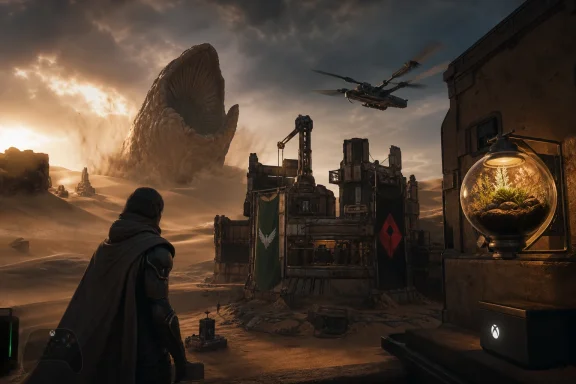 Funcom Is Selling Arrakis as a Console World, Not Just a PC Port
The Xbox listing for Dune: Awakening reads like a pitch aimed squarely at players who may have watched the PC launch from a distance but never wanted to live inside a server-first survival game. It promises an open-world Arrakis, base construction, crafting, ornithopters, factions, familiar characters, and a cinematic story built around an alternate-history premise: what if Paul Atreides was never born?That framing matters. The console version is not being marketed only as a multiplayer sandbox where the most dedicated players dominate the spice fields. It is being sold as a survival RPG with scale, spectacle, and player choice — the sort of phrasing that sounds much more palatable on Xbox than the harder-edged “survival MMO” label that followed the game through much of its pre-release cycle.
The Microsoft Store page also emphasizes that the full game is available whether the player chooses single-player, private multiplayer, or public servers. That is the key commercial pivot. Funcom is telling Xbox owners that Dune: Awakening is not asking them to surrender to the worst habits of the genre before they get to enjoy the best parts of the fiction.
The pre-order bonuses are modest but revealing. The Terrarium of Muad’Dib gives the desert mouse a decorative home inside the player’s base, while the Sunset Dye Global Swatch applies a unique color pattern across outfits, vehicles, and weapons. These are not power items, and they do not pretend to be. They are the kind of identity-layer cosmetics that fit a game where building a stronghold is as much about self-expression as resource logistics.
The Console Date Turns a Promise Into a Test
The September 22, 2026 release date gives Dune: Awakening a clear console landing zone after a long period in which Xbox and PlayStation versions were promised but not pinned down. That matters for a game whose PC life has already produced feedback, patches, and community arguments. Console players are not arriving on day one of the product’s existence; they are arriving after Funcom has had time to see where the sand got into the machinery.That can be an advantage. Survival games often improve after launch because their rough edges are unusually visible. Resource rates, PvP incentives, travel friction, server performance, crafting bottlenecks, and endgame loops all expose themselves quickly once real players start doing what designers did not expect them to do.
But it also raises the standard. A console release that follows a PC launch cannot hide behind the romance of early discovery. Xbox players will expect a more mature build, a cleaner onboarding curve, and a control scheme that feels designed rather than translated. The listing’s confidence around single-player and scalable difficulty suggests Funcom understands that console audiences will judge the game partly on whether it respects time, attention, and controller ergonomics.
This is where the Xbox version becomes interesting for more than Dune fans. The console market has room for survival games, but it is less forgiving of opaque systems than PC communities that enjoy learning a game through wikis, Discord servers, and attritional experimentation. If Dune: Awakening wants to be more than a niche import, its harshness has to feel authored rather than accidental.
Single-Player Is the Real Headline Hidden in the Store Copy
The Microsoft Store description repeatedly insists that Dune: Awakening can be played alone in full single-player, with the same content, story, and features available outside public servers. That is not a minor feature checkbox. It is a redefinition of what kind of product Funcom is offering to the console market.The survival genre has spent years wrestling with a basic problem: many players like gathering, building, crafting, and progression, but they do not necessarily want their enjoyment mediated by strangers. Public servers create memorable stories, but they also create griefing, imbalance, social pressure, and the creeping sense that the game is moving on without you. A single-player mode lets Funcom preserve the fantasy of Arrakis without forcing every player into the politics of server life.
That decision also fits the source material better than it might appear. Dune is full of systems — ecology, empire, religion, bloodlines, economics — but its power comes from individual perspective. A player alone in the desert, managing water, shelter, and movement, may actually feel closer to the fiction than a crowd of players turning the Deep Desert into a chaotic resource race.
The listing promises extensive customization options for single-player and private multiplayer servers. That is where the feature could become genuinely important. Scalable difficulty is not just an accessibility nicety here; it is the difference between Arrakis as an atmospheric RPG world and Arrakis as a second job.
The Sandworm Is a Design Problem Wearing a Movie Monster’s Face
The store copy leans on the line “the sandworm always comes,” and it should. The sandworm is Dune’s most famous threat, an image so powerful that it risks becoming a marketing shortcut. In a survival game, though, the worm is not only a monster. It is a constraint system.Arrakis works as a game world only if movement feels consequential. The player has to care about crossing dunes, timing expeditions, reading terrain, escaping storms, and earning the right to fly over danger in an ornithopter they built themselves. The worm is the mechanical enforcement of that fantasy. It is the thing that makes open space hostile instead of empty.
That is a difficult balance. If the worm is too predictable, it becomes scenery. If it is too punitive, it becomes irritation. If travel is too slow, the game becomes drudgery; if travel is too easy, the desert loses its authority. The Xbox listing’s emphasis on climbing mountains with the Shigawire hook and flying across worm-infested deserts in player-built ornithopters suggests Funcom wants traversal to become a progression arc rather than a background activity.
The best version of Dune: Awakening is one where the player gradually transforms Arrakis from an unknowable threat into a readable environment without ever making it safe. That is a narrow design path, but it is also the path that separates a licensed survival game from a true Dune adaptation.
The Alternate Timeline Gives Funcom Permission to Touch the Sacred Text
The most provocative piece of the premise is not crafting, factions, or multiplayer scale. It is the story question: what if Paul Atreides was never born? That is an audacious move for a licensed game based on one of science fiction’s most analyzed universes.It is also probably necessary. A game that simply retells the Atreides-Harkonnen conflict around Paul would trap the player at the edge of someone else’s destiny. Funcom needs room for players to matter, and the easiest way to create that room is to alter the central prophecy. By removing Paul from the equation, Dune: Awakening creates a version of Arrakis where the player can rise without constantly colliding with canon.
That does not mean the game is abandoning familiar touchstones. The listing mentions Duke Leto, Feyd-Rautha, the Atreides and Harkonnen power structures, the disappearance of the Fremen, and the player’s own hidden past. This is not a clean reboot. It is a controlled deviation.
For Xbox players coming from Denis Villeneuve’s films rather than Frank Herbert’s novels, that may be the right compromise. The world will look and sound recognizable, but the story has enough freedom to make player agency credible. A licensed game does not need to preserve every plot point; it needs to preserve the pressure system that made the original compelling.
The Faction Pitch Is Familiar, but the Survival Layer Changes the Stakes
The option to join Atreides or Harkonnen is unsurprising, almost unavoidable. Dune has always invited readers and viewers to think in houses, banners, loyalties, and betrayals. What makes Dune: Awakening different is that faction identity sits on top of a survival economy rather than a conventional RPG campaign.That means allegiance is not merely a dialogue choice. It can shape architecture, progression flavor, social alignment, and the way players imagine their place in the world. The listing’s promise of Atreides and Harkonnen building styles hints at how deeply the fiction can seep into ordinary systems. Even a wall panel or refinery layout becomes part of the role-play.
The danger is that faction identity becomes cosmetic theater rather than a meaningful structure. Players will forgive that if the base-building, crafting, and exploration are strong enough. They will not forgive it if the factions are sold as destiny and delivered as paint.
Funcom’s task is to make the houses feel like institutions rather than skins. That does not require every player to become a political mastermind, but it does require the world to react convincingly to power, reputation, and ambition. Dune without politics is just sand.
The Schools of the Imperium Are a Better Class System Than Classes
The Xbox listing describes abilities tied to the Schools of the Imperium: Trooper firepower, Bene Gesserit voice control, Mentat traps, and Swordmaster melee techniques. This is a smart way to translate Dune into game language without flattening it into generic fantasy classes.The appeal is obvious. The Bene Gesserit are not wizards, Mentats are not rogues, Swordmasters are not merely melee DPS, and Troopers are not just soldiers with bigger guns. Each school carries cultural baggage. Each implies training, worldview, discipline, and political utility.
That gives Funcom a richer palette than the usual survival game upgrade tree. A player who uses the Voice to control enemies is not simply pressing a crowd-control button; they are participating in one of the setting’s most recognizable power fantasies. A Mentat trap build can feel like calculation made physical. A Swordmaster build can turn close combat into ritual.
The risk, again, is genre gravity. Survival games tend to reduce everything to efficiency. Players optimize routes, builds, damage types, base layouts, and farming loops until the fiction becomes a spreadsheet. The challenge for Dune: Awakening is to make optimization feel like mastery of the Imperium rather than a betrayal of the atmosphere.
Base-Building Is Where the License Either Breathes or Breaks
The store page spends substantial space on stronghold construction, crafting machines, spice refineries, architectural styles, decorations, vehicles, and survival gadgets. That is not filler. In modern survival games, the base is the player’s biography.A base tells you what a player values. Some build factories. Some build fortresses. Some build shrines to symmetry. Some build practical ugliness and call it victory. In a Dune game, that instinct has unusually strong thematic support because power in the setting is always material: water, spice, shelter, machines, transport, and bodies.
Arrakis is a world where infrastructure is ideology. A spice refinery is not just a crafting station. It is a statement that the player has moved from victim of the desert to participant in its exploitation. An ornithopter is not just a vehicle. It is liberation from the tyranny of the sand.
That is why the Terrarium of Muad’Dib pre-order item is more clever than it first appears. It is small, decorative, and commercially harmless, but it gestures at the domestic side of survival. Even on Arrakis, players want a home, a trophy, a tiny symbol that says the base is not merely a warehouse with walls.
Xbox Players Will Judge the Controller Before the Lore
For all the richness of the setting, Dune: Awakening on Xbox will live or die partly on mundane console questions. Does inventory management work cleanly on a controller? Can players build without fighting radial menus? Does flying an ornithopter feel precise? Are combat inputs readable under pressure? Can the UI communicate complex survival systems from a couch distance?These details rarely dominate marketing copy, but they dominate player retention. A survival game asks players to repeat actions thousands of times. If those actions feel slightly clumsy on a controller, the irritation compounds. The difference between “deep” and “tedious” is often one menu too many.
Funcom has relevant experience here. Conan Exiles proved the studio can operate a survival game across console and PC ecosystems, even if it also demonstrated how messy long-running survival games can become. That history cuts both ways. It gives Funcom credibility, but it also gives players reason to scrutinize performance, server stability, and interface decisions.
The Xbox version will not be measured only against other licensed games. It will be measured against Grounded, Valheim, ARK, No Man’s Sky, Conan Exiles, and the broader console survival field. The Dune name opens the door; the feel of the first ten hours decides whether players stay.
Game Pass Changes the Psychology Even When Pre-Orders Exist
The Microsoft Store pre-order page sits in an ecosystem where subscription expectations shape buying behavior. If Dune: Awakening is available through Xbox Game Pass at launch, many players will approach it less like a $70 commitment and more like a test expedition. That can be enormously helpful for a complex survival game.Survival games benefit from sampling because their appeal is difficult to communicate in trailers. You do not know whether a loop works for you until you have gathered, crafted, died, rebuilt, and realized you are still thinking about your next run while away from the screen. Game Pass lowers the friction of that discovery.
But subscription access can also shorten patience. A player who paid full price may push through the awkward first hours because the purchase itself creates commitment. A Game Pass player can leave after a bad tutorial, an ugly menu, or a confusing death. The audience may be larger, but it is also more disposable.
That makes onboarding one of the most important parts of the console release. Funcom has to teach water discipline, sandworm avoidance, crafting logic, faction progression, combat, and base-building without turning the first evening into homework. The fantasy of Arrakis is harsh; the introduction cannot be.
Cross-Play Is Narrower Than the Dream, and That May Be Wise
Funcom has said cross-play will not span every platform, with Xbox and Windows PC Store players forming the notable bridge. That limitation will disappoint anyone hoping for a single unified Arrakis across PC, PlayStation, and Xbox. It may also be the sensible decision.Cross-play in survival games is not just a matchmaking switch. It affects server architecture, update certification, input balance, moderation, account systems, and community expectations. When building, PvP, long-term progression, and player economies are involved, a bad cross-play implementation can become a permanent source of resentment.
The Xbox-Windows Store connection is especially relevant for Microsoft’s ecosystem. It gives Xbox players a PC adjacency without promising universal parity. It also fits Microsoft’s broader strategy of treating Xbox less as a box under the television and more as a service layer spanning console and Windows.
Still, players will need clarity. If a friend owns the Steam version and another owns the Xbox version, assumptions can become frustration quickly. Store pages and launch messaging need to state the boundaries plainly, because survival games are social planning exercises as much as purchases.
The PC Launch Gives Console Players a Preview of the Fights Ahead
By the time Dune: Awakening reaches Xbox, its community history will already be part of the product. PC players have debated difficulty, multiplayer balance, server conditions, endgame incentives, PvP pressure, and the long-term appeal of the Deep Desert. Console players will inherit not just the game, but the arguments around it.That is not necessarily bad. A year of PC turbulence can make a console version better. It can reveal which systems were too punishing, which loops were too exploitable, and which features players actually used versus those that sounded good in previews. The important thing is whether Funcom treats the console launch as a relaunch moment rather than a late platform checkbox.
The single-player emphasis suggests the studio has absorbed at least one major lesson: not every player wants a public-server life. The broader promise of scalable private experiences suggests another: survival difficulty is more durable when players can tune it to their appetite rather than accept one official definition of pain.
The open question is endgame. Many survival games are strongest while the player is vulnerable and learning, then wobble once mastery arrives. Dune has a built-in answer — spice, politics, territory, and ecological danger — but translating that into sustainable gameplay is harder than writing it on a store page.
The Microsoft Store Copy Knows Exactly Which Fantasy It Is Selling
The Norwegian Microsoft Store page is packed with verbs: explore, build, craft, unravel, climb, fly, escape, witness, join, rise, investigate, discover, survive, study, wield, deploy, master. It is storefront language, yes, but it also tells us what Funcom believes the console fantasy is.This is not being pitched as a pure combat game. It is not being pitched as a pure MMO. It is not even being pitched primarily as a competitive survival sandbox. The dominant fantasy is progression through adaptation: start fragile, learn the planet, build tools, gain skills, claim space, enter politics, and become powerful enough to move through Arrakis with intention.
That is a good fit for Dune. Frank Herbert’s universe has always been obsessed with adaptation — biological, political, religious, ecological, and psychological. The desert does not merely threaten characters; it changes them. A survival game can express that better than many more linear genres.
The phrase “Those who do, awaken” is marketing copy, but it lands because it understands the underlying arc. Survival is not the endpoint. Survival is the initiation.
The Console Audience May Be the Best Argument for a Gentler Arrakis
PC survival communities often prize friction. They accept inconvenience as authenticity, grind as investment, and danger as proof that a world matters. Console audiences are not allergic to difficulty, but they tend to punish friction that feels like interface tax or time theft.That distinction should shape the Xbox version. Harsh weather, water scarcity, sandworms, and enemy raids can all be compelling if they produce stories. They become exhausting if they produce chores. The difference is whether the player feels they made a decision or merely forgot to satisfy a meter.
Single-player and private server customization are therefore not concessions. They are the feature set that could make Dune: Awakening viable for a broader audience. A player who wants a severe Arrakis can have it. A player who wants story, building, and exploration without endless punishment can tune toward that instead.
Purists may complain, but they should not. The survival genre has matured past the idea that one difficulty philosophy must rule everyone. If anything, Dune is the perfect setting for variable pressure: Arrakis should be terrifying, but not every player needs the same desert.
The Xbox Store Page Is Also a Windows Story
For WindowsForum readers, the Xbox listing has a second layer. This is not merely a console release; it is part of the continuing merge between Xbox, Windows Store distribution, Game Pass habits, and PC-console identity. When Funcom carves out cross-play between Xbox and Windows PC Store, it is acknowledging Microsoft’s platform logic.That logic is messy in practice. Steam remains the default PC storefront for many players, and Windows Store versions of PC games have historically faced skepticism around modding, file access, update behavior, and ecosystem lock-in. But Microsoft’s advantage is integration. If a player lives across Xbox, Windows, and Game Pass, the boundaries are increasingly commercial rather than conceptual.
Dune: Awakening becomes another test case for that strategy. Can a large online survival RPG feel coherent across Xbox hardware and Windows Store PC? Can friends coordinate without needing to parse platform fine print? Can Microsoft’s storefront make the purchasing and pre-order path feel less fragmented than the broader PC market?
For administrators and IT-minded readers, there is also the less glamorous angle: storage, bandwidth, patch cadence, and account management. Live survival games can be big, frequently updated, and socially sticky. In households and small offices where Xbox and Windows devices coexist, the platform plumbing matters.
The License Gives Funcom Attention, but It Also Raises the Floor
A generic desert survival game could get away with rough edges if its systems were novel enough. A Dune game has less room. The name brings attention, but it also brings expectations around tone, scale, ecology, architecture, politics, and menace.That is the burden of working with a famous universe. Players do not simply ask whether the crafting loop is satisfying. They ask whether the desert feels ancient, whether the factions feel dangerous, whether the machines look plausible, whether the world respects the novels and films, and whether the sandworm still inspires awe after repeated encounters.
The Microsoft Store listing leans heavily on recognizable imagery: Fremen caves, Arrakeen, ornithopters, sandstorms, Atreides and Harkonnen styles, Duke Leto, Feyd-Rautha, spice infrastructure, and the always-present worm. That is the right move. A licensed game should not hide its license.
But it also means Funcom cannot let the fiction become wallpaper. If the game’s systems do not reinforce the setting, the license will start to feel like a costume. The best survival games make the player’s behavior emerge from the world. Dune: Awakening has to make players conserve water not because a tutorial says so, but because Arrakis has taught them fear.
Console Survival Games Are Entering Their Second Act
The arrival of Dune: Awakening on Xbox comes at a moment when survival games are no longer a strange PC subculture. Console players understand base-building, co-op worlds, crafting progression, hostile environments, and open-ended goals. The genre has mainstream vocabulary now.That maturity changes the competitive landscape. Funcom cannot rely on novelty. Players already know what a crafting bench is. They know what resource tiers are. They know how server drama works. They know that “open world” can mean freedom or filler.
The opportunity is to use Dune to elevate familiar systems. Water scarcity can be more than a thirst meter. Spice can be more than a rare resource. Ornithopters can be more than mounts. Factions can be more than reputation bars. The genre gives Funcom a toolset, but the license gives it a chance to make those tools mean something.
That is why the console launch is not just another platform release. It is a second chance to define the game for an audience that may be less interested in survival purity and more interested in whether Arrakis feels like a place worth inhabiting.
The Small Print in the Sand
The Xbox pre-order listing tells players what they can expect at launch, but the practical reading is just as important as the promotional one. The most concrete details point to a game trying to widen its appeal without abandoning its survival identity.- Dune: Awakening is scheduled to launch on Xbox Series X|S on September 22, 2026, alongside the broader console release window.
- The Xbox pre-order rewards are cosmetic and decorative: the Terrarium of Muad’Dib base item and the Sunset Dye Global Swatch.
- The game is being presented as playable in full single-player, private multiplayer, or public-server multiplayer, with the same core content available across modes.
- Single-player and private multiplayer servers are expected to offer customization options that let players tune difficulty and gameplay variables.
- Cross-play is limited rather than universal, with Xbox and Windows PC Store compatibility standing out as the Microsoft ecosystem bridge.
- The console version’s success will depend less on the Dune license alone than on onboarding, controller feel, server stability, and whether Funcom’s post-PC-launch improvements are visible on day one.
Arrakis is supposed to be unforgiving, but a console release cannot be. If Funcom can make the desert dangerous while making the game legible, Dune: Awakening may arrive on Xbox as more than a delayed port; it may become the version that finally explains what this ambitious survival RPG was trying to be all along.
References
- Primary source: Microsoft
Published: 2026-06-03T06:12:14.030257
Kjøp Dune: Awakening | Xbox
Dune: Awakening is a single- and multiplayer Open World Survival game with immersive adventure and RPG gameplay. Explore, build, craft, and unravel a cinematic Dune story as you rise from survival to greatness on the most legendary planet in the universe. Just remember: the sandworm always comes.www.microsoft.com - Related coverage: gamesradar.com
Upcoming Xbox Series X games for 2026 and beyond | GamesRadar+
Here are all of the upcoming Xbox Series X games landing in 2026 and beyond, from Fable to Assassin's Creed Black Flag Resyncedwww.gamesradar.com - Related coverage: gematsu.com
Dune: Awakening for PS5, Xbox Series launches September 22 - Gematsu
The PlayStation 5 and Xbox Series versions of open-world survival game Dune: Awakening will launch on September 22, developer Funcom announced. It will also be…www.gematsu.com - Related coverage: gamespot.com
Dune: Awakening Is Coming To Console, Funcom Confirms As PC Game Puts Up Huge Numbers - GameSpot
The multiplayer survival game is headed to consoles, but not until 2026.www.gamespot.com - Related coverage: store.steampowered.com
Dune: Awakening - Terrarium of Muad'Dib on Steam
Decorate your base with the Terrarium of Muad’Dib base decoration. The resilient desert mouse is central to Fremen mythology.store.steampowered.com
- Related coverage: worthplaying.com
Worthplaying | 'Dune: Awakening' Comes To PS5 And Xbox Series X|S In September, Includes Full Single-player Mode And Other Features Across All Platforms - Trailer
Dune: Awakening is an open world survival MMO where you rise from survival to dominance in a vast and seamless Arrakis shared by thousands of players.www.worthplaying.com
- Related coverage: windowscentral.com
Is Dune: Awakening on Xbox Game Pass? | Windows Central
Dune: Awakening is one of 2025's most exciting new survival games, but will it be on Xbox Game Pass?www.windowscentral.com - Related coverage: keengamer.com
Dune: Awakening
Rise from survival to greatness and challenge the power of an Imperium in Dune: Awakening, a multiplayer survival game on a massive scale. Survive the sandworm, craft your ornithopter, build a fortress, and ascend to power on an open world Arrakis shared with hundreds of other players. www.keengamer.com
- Related coverage: techradar.com
Dune Awakening PS5 and Xbox Series X|S - everything we know so far | TechRadar
Here's what we know about Dune Awakening, an upcoming survival MMO on PS5 and Xbox Series X|S. New gameplay, the latest trailers and recent news updates.www.techradar.com - Related coverage: space.com
Dune: Awakening — Release date, plot, gameplay trailers, & everything else we know about this sci-fi survival MMO | Space
Experience Arrakis like never before in the upcoming sci-fi game Dune: Awakening.www.space.com - Related coverage: pcgamer.com
All the details on Dune: Awakening from release date to gameplay trailers | PC Gamer
Here's everything you need to know about survival MMO Dune: Awakening as its 2025 launch approacheswww.pcgamer.com - Related coverage: game8.co
How to Get Sunset Dye | Dune: Awakening|Game8
Sunset Dye is a Swatch cosmetic you can get after pre-ordering Dune: Awakening. See how to get Sunset Dye and its appearance in-game!game8.co - Related coverage: as.com
Dune: Awakening recibe un DLC para los amantes de la construcción y un Capítulo 3 que mejora enormemente su endgame
La mayor actualización gratuita de la historia de Dune: Awakening llega junto a un DLC en el que destaca la construcción.as.com
