

Microsoft put the Dynamics 365 Commerce MCP server into public preview on June 29, 2026, giving retailers a Microsoft-managed endpoint on Commerce Scale Unit 10.0.48 that lets compatible AI agents call product, inventory, cart, checkout, promotion, and order tools in real time. That sounds like another AI-era connector announcement, but it is more consequential than the usual integration pitch. Microsoft is trying to make the commerce engine itself agent-addressable, turning Dynamics 365 Commerce from a system behind websites and stores into a live transaction layer for Copilot, ChatGPT, custom agents, and whatever retail interface comes next. The wager is that agentic commerce will not be won by the chatbot with the best patter, but by the platform that can safely complete the purchase.
For the last two years, the retail AI conversation has been heavy on demos and light on durable plumbing. A shopping assistant that can recommend a jacket is easy to imagine; one that can check real inventory, apply the right promotion, respect a customer’s identity, build a cart, calculate tax and delivery options, and hand off payment without creating a parallel commerce universe is much harder.
That is the gap Microsoft is aiming at with the Dynamics 365 Commerce MCP server. The Model Context Protocol, or MCP, gives software systems a standardized way to expose tools to AI agents. In this case, Microsoft is exposing commerce capabilities from Dynamics 365 Commerce as callable tools rather than asking every retailer or partner to build another one-off connector.
The distinction matters. Retail systems are full of business logic that cannot be approximated by a language model: price books, trade agreements, coupon eligibility, channel-specific assortment, tax handling, store inventory, customer order history, and payment constraints. If an agent invents any of that, it is not an assistant; it is a liability.
Microsoft’s pitch is therefore less about conversational novelty than operational consistency. The same commerce engine that powers storefronts, point-of-sale, call center, and mobile channels can now be reached by an agent host through an MCP endpoint. If it works as advertised, the agent channel stops being a bespoke experiment and becomes another front door into the retailer’s existing transaction system.
That matters because retailers are not short of integration ideas. They are short of integrations that survive seasonality, security review, endpoint changes, staff turnover, and the painful reality of retail operations at scale. A retailer can build a flashy prototype in a week and still spend a year arguing over identity, auditability, payment boundaries, and whether a discount shown in the agent matches the discount shown at the register.
By embedding the MCP server into the Commerce Scale Unit, Microsoft is trying to remove one layer of infrastructure ownership from the retailer. Administrators can enable the endpoint from Lifecycle Services, and agent hosts can connect with Microsoft Entra ID authentication. The public preview requires Commerce Scale Unit version 10.0.48 or later, at least one active online channel, a configured Entra tenant, and an MCP-compatible host.
There is an important deployment caveat: Microsoft’s Learn documentation says Commerce MCP is available only on cloud-hosted Commerce Scale Units and is not supported on self-hosted, on-premises, or hybrid instances. That is not a footnote for some retailers. It is a line in the sand that reinforces Microsoft’s broader direction for Dynamics: the most interesting AI-era capabilities will increasingly land where Microsoft can operate the service, enforce the identity model, and update the evaluation pipeline.
The result is a preview that is both powerful and bounded. Retailers get a faster path to agentic commerce, but only if they are already aligned with Microsoft’s cloud-hosted Commerce architecture. That is a familiar trade in modern enterprise software: less plumbing in exchange for more platform gravity.
The hard part is state. A customer may start with a vague request, refine it by color and size, ask whether a nearby store has it, apply a coupon, change delivery to pickup, and then want to know whether an old order can be exchanged. A chatbot can maintain conversational context, but the business has to maintain commercial truth.
That is where Microsoft’s “tools around customer intent, not APIs” language becomes more than marketing. The server does not merely expose raw low-level APIs and leave every agent builder to reconstruct the shopping journey. It offers tools mapped to business tasks: search products, retrieve product details, check store inventory, create a cart, add products, update cart lines, retrieve cart totals, set addresses, get delivery options, apply or remove coupons, create a payment link, and look up orders.
This is a subtle but meaningful abstraction. AI agents are most useful when they can translate messy human requests into bounded actions. They are most dangerous when every action requires them to improvise against a sprawling API surface. By presenting intent-shaped tools, Microsoft is trying to narrow the gap between “what the shopper asked for” and “what the commerce platform can safely do.”
The current preview still centers on the shopper journey from discovery to checkout and order lookup. That is the right place to start because it is where conversational commerce has the clearest consumer-facing value. It is also where mistakes are most visible: wrong price, wrong availability, wrong delivery promise, wrong customer order.
A store associate should not need to remember which screen hides an order lookup, whether a return requires a particular sequence, or how to check inventory across nearby stores while a customer waits at the counter. A voice-driven agent layered over live Commerce data could reduce that friction, especially for seasonal staff or workers who split attention between customers, shelves, fulfillment, and point-of-sale tasks.
Microsoft highlights early partner work from AMICIS Solutions, which built a voice-driven commerce agent on top of Dynamics 365 Store Commerce so associates can search the catalog, manage carts, look up customers, and perform everyday POS tasks through natural language. That kind of use case is less glamorous than a consumer-facing AI stylist, but it is closer to where retailers feel operational pain.
There is also a training angle. Retailers often hire large waves of temporary workers for holiday peaks, promotions, or regional expansions. If an agent can guide an associate through returns, exchanges, order status, inventory receiving, or fulfillment tasks without requiring deep POS fluency, the payoff is not simply faster transactions. It is lower onboarding cost and fewer errors during the busiest periods of the year.
Still, the store is where Microsoft’s claims will face the harshest test. Voice interfaces must work amid noise. Identity and permissions must be airtight. The agent has to know when to ask for approval, when to defer to policy, and when not to turn a spoken request into an irreversible action. In retail, “hands-free” is useful only if it does not become “controls-free.”
Commerce handles the selling surface: product discovery, pricing display, discounts, cart, checkout, and order management. ERP handles the deeper machinery before and after the sale: merchandising, demand planning, procurement, inventory allocation, fulfillment, accounting, and financial reconciliation. If agents can safely operate across both, Microsoft gets to tell a bigger story than “AI can help shoppers buy things.”
The more ambitious story is an agent that sees the value chain rather than a single transaction. A pricing agent could incorporate margin targets and cost structures. An inventory agent could understand stock across warehouses and stores, not just one channel’s availability. A replenishment agent could recommend reorder actions based on demand signals and configured approval rules. A post-purchase agent could connect returns, fulfillment status, and ledger updates.
That is where the platform advantage emerges. Standalone AI tools can wrap a website or scrape a catalog, but they cannot reliably reason over the entire retail operation unless they are connected to the systems of record. Microsoft has spent years selling Dynamics as the connective tissue for business processes. MCP gives that argument a new AI-native interface.
The risk, of course, is that retailers may hear “autonomous agents across the value chain” and immediately picture runaway automation. Microsoft is careful to frame these agents as operating with configurable automation and approval workflows. That caveat is essential. Retailers may welcome agents that recommend a reorder, flag a pricing opportunity, or notify a team about a stock risk. They will be more cautious about agents that change prices, move inventory, or trigger procurement without human or policy-based control.
The winning pattern is likely to be graduated autonomy. Agents first observe and summarize, then recommend, then execute low-risk tasks, and only later take higher-impact actions under narrowly defined rules. Microsoft’s preview gives retailers the transaction plumbing, but governance will determine how far they actually let agents go.
That boundary matters. Payments are a compliance and trust minefield, and most retailers will not want sensitive payment details handled inside a general-purpose conversational interface. A payment link preserves the conversational convenience while keeping payment completion in a controlled surface.
This is also a reminder that “agentic commerce” does not mean the agent does everything. The agent can search, filter, explain, build, modify, and prepare the transaction. The final step can still be handed to a hardened payment workflow.
That pattern is likely to become common. The best agentic systems will not try to collapse every business process into a chat window. They will know when to invoke the right tool, when to ask for confirmation, when to surface a governed link, and when to stop.
For retailers, this is the difference between useful automation and reckless automation. The commercial system should be agent-accessible, not agent-subordinate.
Preview features can change. Tool schemas can evolve. Host support can vary. Evaluation systems can improve. Retailers should treat this as the beginning of an integration program, not the end of one.
The Learn documentation underscores the controlled nature of the preview. The endpoint is enabled on a Commerce Scale Unit through Lifecycle Services, and Microsoft says only one CSU per environment can have MCP enabled at a time. That constraint makes sense for preview governance, but it also shapes pilot design. Retailers will need to choose the right environment, channel, and use case before turning it on.
Authentication is another area where early planning matters. Commerce MCP supports authenticated user contexts for personalized data such as order history, saved addresses, customer-specific pricing, and discounts, while limited anonymous access supports guest discovery, guest cart, and Pay by Link checkout. That split is sensible, but it forces agent builders to design identity flows deliberately rather than treating authentication as an afterthought.
Public preview is also where evaluation claims should be read carefully. Microsoft says it evaluates tool selection accuracy, parameter precision, grounding fidelity, end-to-end completion, multi-turn task success, latency, error handling, edge-case robustness, and response helpfulness. That is exactly the right checklist. The real test is how those evaluations behave under retailer-specific catalogs, messy product data, promotions that overlap, partial inventory availability, and customers who do not ask clean questions.
The MCP endpoint is authenticated through Microsoft Entra ID, and Commerce handles authorization based on channel, role, and customer-scoped permissions. That is the right foundation, especially for Dynamics customers already standardized on Microsoft identity. But agentic access changes the operational model. A user no longer clicks through a familiar UI; an agent calls tools on that user’s behalf.
That makes auditability critical. Retailers will need to know which host called which tool, under whose identity, with what parameters, and what result came back. They will need to distinguish an agent hallucination from a bad tool response, a user error from a permission misconfiguration, and a legitimate discount from an unintended promotion path surfaced by the agent.
There is also the question of agent sprawl. Microsoft mentions Copilot Studio, ChatGPT, Azure AI Foundry, Visual Studio Code, Claude Desktop, and custom orchestrators in various connection contexts. That ecosystem breadth is the point of MCP, but it also means IT departments will need policies about which hosts are approved, which clients are allowed, and which environments can be reached.
The danger is not merely that an agent might say something wrong. The danger is that a retailer might accidentally create an uncontrolled shadow channel with access to real commerce operations. The preview gives IT a chance to define the guardrails before business units discover how easy it is to connect a new interface.
That partner mix hints at Microsoft’s go-to-market plan. Dynamics 365 Commerce customers rarely buy pure platform capability in isolation. They buy industry implementations, store workflows, integrations, localization, and partner expertise. MCP gives those partners a common technical substrate for building agent experiences without reinventing the Commerce connection each time.
It may also change the economics of retail AI projects. Instead of scoping a custom integration for every chatbot, store assistant, B2B portal, or sales associate tool, partners can build reusable agent patterns against the same MCP toolset. That should reduce integration drag, though it will not eliminate the hard work of experience design, policy mapping, data cleanup, and rollout.
The partner examples also show that the agent interface may vary widely. One retailer might deploy a voice associate assistant inside the store. Another might add a shopping agent to a website. A B2B distributor might use image recognition and conversational intake for products that are not yet in the catalog. The common denominator is not the user interface; it is the commerce transaction layer underneath.
This is where MCP’s open-standard posture helps Microsoft. The company can argue that retailers are not betting on a single chatbot surface. They are making Dynamics Commerce callable from multiple compliant clients. That is attractive in a market where nobody knows which agent host will dominate consumer shopping behavior.
A product search tool is only as useful as the catalog it searches. An inventory tool is only as trustworthy as the stock signals beneath it. A personalized offer is only as accurate as the customer identity, loyalty, consent, and pricing data feeding it. If the existing commerce implementation is inconsistent across channels, an MCP server will not magically harmonize it.
In fact, agentic interfaces can make inconsistency more damaging. A website may display filters, pages, and constraints that guide users toward valid choices. A conversational agent invites open-ended requests: “Find me something like the blue one I bought last year, but cheaper, available near me today, and eligible for my coupon.” That is a wonderful experience when the data is clean and the logic is consistent. It is a support ticket generator when they are not.
Retailers adopting Commerce MCP should therefore treat data readiness as part of the agent rollout. Product attributes, variants, media, pricing, promotions, tax settings, delivery modes, store inventory, and order lookup rules all become part of the AI experience. The agent does not merely sit on top of the commerce system; it becomes a new way of interrogating every weakness in that system.
This is why Microsoft’s “same engine, same data shape” argument is valuable but not sufficient. Consistency across channels is better than shadow logic, but it does not guarantee that the underlying truth is complete, current, or customer-friendly. The retailers that benefit fastest will be the ones that have already invested in disciplined commerce operations.
That is the strategic logic behind MCP adoption. If each enterprise system exposes its own agent-accessible capabilities, the agent host becomes less of a toy and more of an orchestration layer. For Microsoft, the prize is not only that Copilot can call Dynamics. It is that Dynamics becomes a trusted tool provider in a multi-agent, multi-host world.
There is an irony here. MCP is often presented as a way to avoid lock-in because it standardizes how agents connect to tools. Yet a first-party MCP server embedded in Dynamics also deepens the value of staying inside Microsoft’s managed stack. The protocol may be open, but the business logic, identity integration, and lifecycle management remain platform advantages.
That tension is not necessarily bad for customers. Open connection patterns and managed enterprise controls can coexist. But buyers should understand the distinction. MCP may reduce the cost of connecting agents to commerce; it does not make commerce systems interchangeable.
For WindowsForum readers who live in the Microsoft ecosystem, this is familiar terrain. The company often wins by turning infrastructure into a platform default. Here, the infrastructure is not Windows Update or Entra ID or Intune. It is the ability for an AI agent to safely ask, “Can this customer buy this product, at this price, from this location, right now?”
Microsoft’s Dynamics 365 Commerce MCP server is not the final form of retail AI, but it is a serious piece of the foundation: a managed bridge between agents and the commercial systems that decide what can actually be sold. If the next phase of AI is about action rather than answers, retailers will discover that the glamorous part is the conversation and the decisive part is the plumbing; Microsoft has just made a bid to own that plumbing before the agentic storefront becomes the new front door.
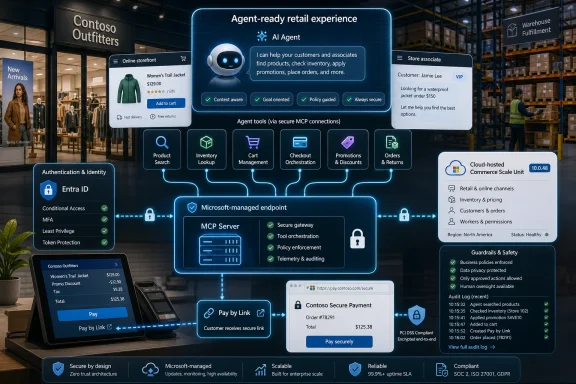 Microsoft Is Turning the Checkout Stack Into an Agent Surface
For the last two years, the retail AI conversation has been heavy on demos and light on durable plumbing. A shopping assistant that can recommend a jacket is easy to imagine; one that can check real inventory, apply the right promotion, respect a customer’s identity, build a cart, calculate tax and delivery options, and hand off payment without creating a parallel commerce universe is much harder.That is the gap Microsoft is aiming at with the Dynamics 365 Commerce MCP server. The Model Context Protocol, or MCP, gives software systems a standardized way to expose tools to AI agents. In this case, Microsoft is exposing commerce capabilities from Dynamics 365 Commerce as callable tools rather than asking every retailer or partner to build another one-off connector.
The distinction matters. Retail systems are full of business logic that cannot be approximated by a language model: price books, trade agreements, coupon eligibility, channel-specific assortment, tax handling, store inventory, customer order history, and payment constraints. If an agent invents any of that, it is not an assistant; it is a liability.
Microsoft’s pitch is therefore less about conversational novelty than operational consistency. The same commerce engine that powers storefronts, point-of-sale, call center, and mobile channels can now be reached by an agent host through an MCP endpoint. If it works as advertised, the agent channel stops being a bespoke experiment and becomes another front door into the retailer’s existing transaction system.
The Important Word Is “Managed”
The most practical part of the announcement is not that the server speaks MCP. It is that Microsoft is making it a first-party, managed endpoint on the Commerce Scale Unit, the headless commerce engine already used by Dynamics 365 Commerce customers.That matters because retailers are not short of integration ideas. They are short of integrations that survive seasonality, security review, endpoint changes, staff turnover, and the painful reality of retail operations at scale. A retailer can build a flashy prototype in a week and still spend a year arguing over identity, auditability, payment boundaries, and whether a discount shown in the agent matches the discount shown at the register.
By embedding the MCP server into the Commerce Scale Unit, Microsoft is trying to remove one layer of infrastructure ownership from the retailer. Administrators can enable the endpoint from Lifecycle Services, and agent hosts can connect with Microsoft Entra ID authentication. The public preview requires Commerce Scale Unit version 10.0.48 or later, at least one active online channel, a configured Entra tenant, and an MCP-compatible host.
There is an important deployment caveat: Microsoft’s Learn documentation says Commerce MCP is available only on cloud-hosted Commerce Scale Units and is not supported on self-hosted, on-premises, or hybrid instances. That is not a footnote for some retailers. It is a line in the sand that reinforces Microsoft’s broader direction for Dynamics: the most interesting AI-era capabilities will increasingly land where Microsoft can operate the service, enforce the identity model, and update the evaluation pipeline.
The result is a preview that is both powerful and bounded. Retailers get a faster path to agentic commerce, but only if they are already aligned with Microsoft’s cloud-hosted Commerce architecture. That is a familiar trade in modern enterprise software: less plumbing in exchange for more platform gravity.
Agentic Commerce Needs Fewer Demos and More State
The phrase agentic commerce risks sounding like another vendor coinage, but the underlying shift is real. Consumers are already moving between search, social feeds, messaging apps, voice assistants, marketplace experiences, and generative AI interfaces. Retailers want to meet them there, but every new surface threatens to fragment the buying experience.The hard part is state. A customer may start with a vague request, refine it by color and size, ask whether a nearby store has it, apply a coupon, change delivery to pickup, and then want to know whether an old order can be exchanged. A chatbot can maintain conversational context, but the business has to maintain commercial truth.
That is where Microsoft’s “tools around customer intent, not APIs” language becomes more than marketing. The server does not merely expose raw low-level APIs and leave every agent builder to reconstruct the shopping journey. It offers tools mapped to business tasks: search products, retrieve product details, check store inventory, create a cart, add products, update cart lines, retrieve cart totals, set addresses, get delivery options, apply or remove coupons, create a payment link, and look up orders.
This is a subtle but meaningful abstraction. AI agents are most useful when they can translate messy human requests into bounded actions. They are most dangerous when every action requires them to improvise against a sprawling API surface. By presenting intent-shaped tools, Microsoft is trying to narrow the gap between “what the shopper asked for” and “what the commerce platform can safely do.”
The current preview still centers on the shopper journey from discovery to checkout and order lookup. That is the right place to start because it is where conversational commerce has the clearest consumer-facing value. It is also where mistakes are most visible: wrong price, wrong availability, wrong delivery promise, wrong customer order.
The Retail Store Is the More Interesting Battlefield
The announcement spends plenty of time on consumer shopping assistants, but the store associate scenarios may prove more important for enterprise adoption. In-store retail remains operationally messy, labor-constrained, and full of software workflows that are technically correct but ergonomically punishing.A store associate should not need to remember which screen hides an order lookup, whether a return requires a particular sequence, or how to check inventory across nearby stores while a customer waits at the counter. A voice-driven agent layered over live Commerce data could reduce that friction, especially for seasonal staff or workers who split attention between customers, shelves, fulfillment, and point-of-sale tasks.
Microsoft highlights early partner work from AMICIS Solutions, which built a voice-driven commerce agent on top of Dynamics 365 Store Commerce so associates can search the catalog, manage carts, look up customers, and perform everyday POS tasks through natural language. That kind of use case is less glamorous than a consumer-facing AI stylist, but it is closer to where retailers feel operational pain.
There is also a training angle. Retailers often hire large waves of temporary workers for holiday peaks, promotions, or regional expansions. If an agent can guide an associate through returns, exchanges, order status, inventory receiving, or fulfillment tasks without requiring deep POS fluency, the payoff is not simply faster transactions. It is lower onboarding cost and fewer errors during the busiest periods of the year.
Still, the store is where Microsoft’s claims will face the harshest test. Voice interfaces must work amid noise. Identity and permissions must be airtight. The agent has to know when to ask for approval, when to defer to policy, and when not to turn a spoken request into an irreversible action. In retail, “hands-free” is useful only if it does not become “controls-free.”
The Commerce And ERP Pairing Is Microsoft’s Real Power Play
The Dynamics 365 Commerce MCP server is not arriving alone. Microsoft positions it as an extension of the MCP framework already established by the Dynamics 365 ERP MCP server, and that pairing is the strategic core of the announcement.Commerce handles the selling surface: product discovery, pricing display, discounts, cart, checkout, and order management. ERP handles the deeper machinery before and after the sale: merchandising, demand planning, procurement, inventory allocation, fulfillment, accounting, and financial reconciliation. If agents can safely operate across both, Microsoft gets to tell a bigger story than “AI can help shoppers buy things.”
The more ambitious story is an agent that sees the value chain rather than a single transaction. A pricing agent could incorporate margin targets and cost structures. An inventory agent could understand stock across warehouses and stores, not just one channel’s availability. A replenishment agent could recommend reorder actions based on demand signals and configured approval rules. A post-purchase agent could connect returns, fulfillment status, and ledger updates.
That is where the platform advantage emerges. Standalone AI tools can wrap a website or scrape a catalog, but they cannot reliably reason over the entire retail operation unless they are connected to the systems of record. Microsoft has spent years selling Dynamics as the connective tissue for business processes. MCP gives that argument a new AI-native interface.
The risk, of course, is that retailers may hear “autonomous agents across the value chain” and immediately picture runaway automation. Microsoft is careful to frame these agents as operating with configurable automation and approval workflows. That caveat is essential. Retailers may welcome agents that recommend a reorder, flag a pricing opportunity, or notify a team about a stock risk. They will be more cautious about agents that change prices, move inventory, or trigger procurement without human or policy-based control.
The winning pattern is likely to be graduated autonomy. Agents first observe and summarize, then recommend, then execute low-risk tasks, and only later take higher-impact actions under narrowly defined rules. Microsoft’s preview gives retailers the transaction plumbing, but governance will determine how far they actually let agents go.
Pay By Link Shows Where Microsoft Draws The Payment Boundary
One of the most revealing tools in the preview iscreate_payment_link, which generates a Pay by Link checkout URL using Adyen. That is a pragmatic design choice. Instead of asking the AI agent to become a payment surface, Microsoft has it create a link that moves the shopper into a secure checkout flow.That boundary matters. Payments are a compliance and trust minefield, and most retailers will not want sensitive payment details handled inside a general-purpose conversational interface. A payment link preserves the conversational convenience while keeping payment completion in a controlled surface.
This is also a reminder that “agentic commerce” does not mean the agent does everything. The agent can search, filter, explain, build, modify, and prepare the transaction. The final step can still be handed to a hardened payment workflow.
That pattern is likely to become common. The best agentic systems will not try to collapse every business process into a chat window. They will know when to invoke the right tool, when to ask for confirmation, when to surface a governed link, and when to stop.
For retailers, this is the difference between useful automation and reckless automation. The commercial system should be agent-accessible, not agent-subordinate.
Preview Status Is A Warning Label, Not A Footnote
Microsoft says the Commerce MCP server is in public preview. That is an invitation to experiment, not a signal that every retailer should route peak-season sales through a newly built agent next week.Preview features can change. Tool schemas can evolve. Host support can vary. Evaluation systems can improve. Retailers should treat this as the beginning of an integration program, not the end of one.
The Learn documentation underscores the controlled nature of the preview. The endpoint is enabled on a Commerce Scale Unit through Lifecycle Services, and Microsoft says only one CSU per environment can have MCP enabled at a time. That constraint makes sense for preview governance, but it also shapes pilot design. Retailers will need to choose the right environment, channel, and use case before turning it on.
Authentication is another area where early planning matters. Commerce MCP supports authenticated user contexts for personalized data such as order history, saved addresses, customer-specific pricing, and discounts, while limited anonymous access supports guest discovery, guest cart, and Pay by Link checkout. That split is sensible, but it forces agent builders to design identity flows deliberately rather than treating authentication as an afterthought.
Public preview is also where evaluation claims should be read carefully. Microsoft says it evaluates tool selection accuracy, parameter precision, grounding fidelity, end-to-end completion, multi-turn task success, latency, error handling, edge-case robustness, and response helpfulness. That is exactly the right checklist. The real test is how those evaluations behave under retailer-specific catalogs, messy product data, promotions that overlap, partial inventory availability, and customers who do not ask clean questions.
IT Will Care Less About Chat And More About Control
For sysadmins and IT pros, the headline is not that shoppers can talk to a store. It is that another production system is being opened to AI agents, and that means identity, authorization, observability, change management, and incident response move to the center of the story.The MCP endpoint is authenticated through Microsoft Entra ID, and Commerce handles authorization based on channel, role, and customer-scoped permissions. That is the right foundation, especially for Dynamics customers already standardized on Microsoft identity. But agentic access changes the operational model. A user no longer clicks through a familiar UI; an agent calls tools on that user’s behalf.
That makes auditability critical. Retailers will need to know which host called which tool, under whose identity, with what parameters, and what result came back. They will need to distinguish an agent hallucination from a bad tool response, a user error from a permission misconfiguration, and a legitimate discount from an unintended promotion path surfaced by the agent.
There is also the question of agent sprawl. Microsoft mentions Copilot Studio, ChatGPT, Azure AI Foundry, Visual Studio Code, Claude Desktop, and custom orchestrators in various connection contexts. That ecosystem breadth is the point of MCP, but it also means IT departments will need policies about which hosts are approved, which clients are allowed, and which environments can be reached.
The danger is not merely that an agent might say something wrong. The danger is that a retailer might accidentally create an uncontrolled shadow channel with access to real commerce operations. The preview gives IT a chance to define the guardrails before business units discover how easy it is to connect a new interface.
Microsoft’s Partner List Shows The Channel Strategy
The launch also leans heavily on partners, which is unsurprising for Dynamics but important for how this market will develop. Microsoft names AMICIS, Sunrise, Argano, Visionet, and Evenica as ecosystem participants building agents for store operations, clienteling, fashion shopping, B2B product requests, and related retail scenarios.That partner mix hints at Microsoft’s go-to-market plan. Dynamics 365 Commerce customers rarely buy pure platform capability in isolation. They buy industry implementations, store workflows, integrations, localization, and partner expertise. MCP gives those partners a common technical substrate for building agent experiences without reinventing the Commerce connection each time.
It may also change the economics of retail AI projects. Instead of scoping a custom integration for every chatbot, store assistant, B2B portal, or sales associate tool, partners can build reusable agent patterns against the same MCP toolset. That should reduce integration drag, though it will not eliminate the hard work of experience design, policy mapping, data cleanup, and rollout.
The partner examples also show that the agent interface may vary widely. One retailer might deploy a voice associate assistant inside the store. Another might add a shopping agent to a website. A B2B distributor might use image recognition and conversational intake for products that are not yet in the catalog. The common denominator is not the user interface; it is the commerce transaction layer underneath.
This is where MCP’s open-standard posture helps Microsoft. The company can argue that retailers are not betting on a single chatbot surface. They are making Dynamics Commerce callable from multiple compliant clients. That is attractive in a market where nobody knows which agent host will dominate consumer shopping behavior.
The Data Quality Bill Still Comes Due
There is one uncomfortable truth behind every agentic commerce announcement: AI does not fix bad product data. It exposes it faster.A product search tool is only as useful as the catalog it searches. An inventory tool is only as trustworthy as the stock signals beneath it. A personalized offer is only as accurate as the customer identity, loyalty, consent, and pricing data feeding it. If the existing commerce implementation is inconsistent across channels, an MCP server will not magically harmonize it.
In fact, agentic interfaces can make inconsistency more damaging. A website may display filters, pages, and constraints that guide users toward valid choices. A conversational agent invites open-ended requests: “Find me something like the blue one I bought last year, but cheaper, available near me today, and eligible for my coupon.” That is a wonderful experience when the data is clean and the logic is consistent. It is a support ticket generator when they are not.
Retailers adopting Commerce MCP should therefore treat data readiness as part of the agent rollout. Product attributes, variants, media, pricing, promotions, tax settings, delivery modes, store inventory, and order lookup rules all become part of the AI experience. The agent does not merely sit on top of the commerce system; it becomes a new way of interrogating every weakness in that system.
This is why Microsoft’s “same engine, same data shape” argument is valuable but not sufficient. Consistency across channels is better than shadow logic, but it does not guarantee that the underlying truth is complete, current, or customer-friendly. The retailers that benefit fastest will be the ones that have already invested in disciplined commerce operations.
The MCP Bet Is Bigger Than Retail
Although this announcement is specific to Dynamics 365 Commerce, it fits a broader Microsoft pattern. The company is trying to make its business applications legible to agents through standardized tools, authenticated access, and managed endpoints. Dynamics 365, Microsoft 365, Azure, Power Platform, and Copilot all become more valuable if agents can move across them without brittle custom bridges.That is the strategic logic behind MCP adoption. If each enterprise system exposes its own agent-accessible capabilities, the agent host becomes less of a toy and more of an orchestration layer. For Microsoft, the prize is not only that Copilot can call Dynamics. It is that Dynamics becomes a trusted tool provider in a multi-agent, multi-host world.
There is an irony here. MCP is often presented as a way to avoid lock-in because it standardizes how agents connect to tools. Yet a first-party MCP server embedded in Dynamics also deepens the value of staying inside Microsoft’s managed stack. The protocol may be open, but the business logic, identity integration, and lifecycle management remain platform advantages.
That tension is not necessarily bad for customers. Open connection patterns and managed enterprise controls can coexist. But buyers should understand the distinction. MCP may reduce the cost of connecting agents to commerce; it does not make commerce systems interchangeable.
For WindowsForum readers who live in the Microsoft ecosystem, this is familiar terrain. The company often wins by turning infrastructure into a platform default. Here, the infrastructure is not Windows Update or Entra ID or Intune. It is the ability for an AI agent to safely ask, “Can this customer buy this product, at this price, from this location, right now?”
The Retail Agent Era Starts With Guardrails, Not Magic
The most concrete message from Microsoft’s preview is that agentic commerce is becoming an implementation problem rather than a futurist slogan.- Retailers running cloud-hosted Dynamics 365 Commerce can begin testing a managed MCP endpoint on Commerce Scale Unit version 10.0.48 or later.
- The preview toolset focuses on product discovery, inventory lookup, cart management, coupons, Pay by Link checkout, order details, and order history.
- The architecture is designed to keep pricing, promotions, tax, inventory, and order behavior aligned with the existing Commerce engine rather than duplicating logic in an agent.
- Identity is central to the model, with Microsoft Entra ID supporting authenticated user contexts and limited anonymous flows.
- Store associate workflows may become one of the most practical early use cases because natural-language access can reduce POS complexity and training friction.
- Preview constraints, cloud-hosting requirements, data quality, auditability, and approved-agent governance will determine whether pilots become production channels.
Microsoft’s Dynamics 365 Commerce MCP server is not the final form of retail AI, but it is a serious piece of the foundation: a managed bridge between agents and the commercial systems that decide what can actually be sold. If the next phase of AI is about action rather than answers, retailers will discover that the glamorous part is the conversation and the decisive part is the plumbing; Microsoft has just made a bid to own that plumbing before the agentic storefront becomes the new front door.
References
- Primary source: Microsoft
Published: 2026-06-29T16:10:14.729361
Dynamics 365 Commerce MCP Server for AI Agents and Agentic Commerce
Discover how the Dynamics 365 Commerce MCP server enables AI agents to power product discovery, checkout, inventory, and retail operations.www.microsoft.com
