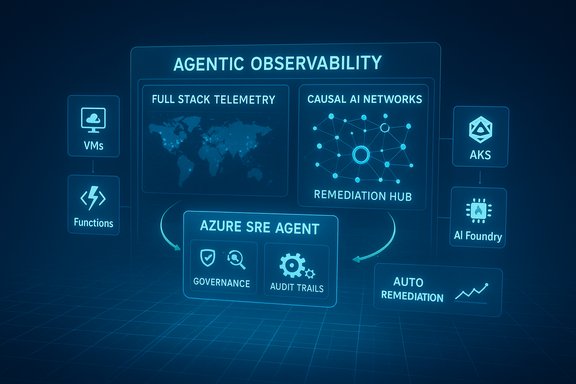
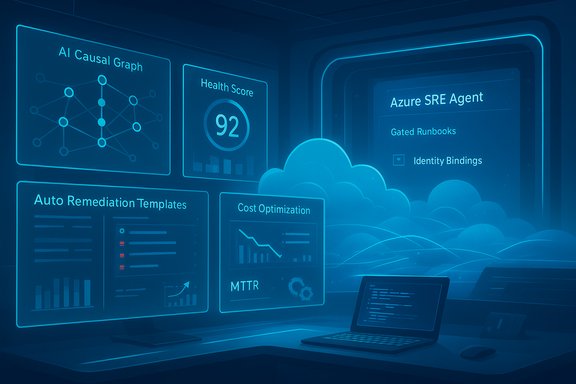
Dynatrace’s latest release expands its AI-driven observability playbook for Microsoft Azure, introducing a preview of a purpose-built cloud operations suite that promises deeper telemetry, automated remediation, continuous cost optimization, and a first-of-its-kind integration with Microsoft’s Azure SRE Agent — moves the vendor says will accelerate enterprise adoption of agentic and generative AI workloads on Azure.
Dynatrace has long positioned itself as an AI-first observability vendor, building on its Davis causal AI engine and the GRAIL data lakehouse to correlate traces, metrics, logs, and metadata into actionable intelligence. The company’s November announcement frames the new Azure-focused capabilities as an extension of that vision: richer Azure Monitor ingestion, expanded metadata and telemetry to boost causal analysis, automated workflows for remediation, and continuous cloud resource optimization to rein in rising Azure spend. The new cloud operations solution is available in preview with broader availability targeted for early 2026, according to vendor materials. The strategic narrative is twofold. First, Dynatrace aims to give platform and SRE teams a single pane of glass for cloud-native Azure services such as Azure Kubernetes Service (AKS), Azure Virtual Machines, Azure Functions, and Azure’s AI Foundry offerings. Second, the vendor explicitly couples its observability signals to action — surfacing remediation hints and automating runbook tasks — by integrating with Microsoft’s Azure SRE Agent to enable portal-native remediation workflows and closed‑loop incident handling. Dynatrace and Microsoft position the partnership as a way to reduce mean time to repair (MTTR) and operational toil while enabling faster, safer AI deployment on Azure.
The integration with Azure SRE Agent is particularly noteworthy: it signals a future where observability platforms don’t just inform SREs — they help execute and govern fixes within the cloud provider’s operational fabric. That future can deliver massive operational leverage, but it also raises fresh responsibilities for SRE teams to model costs, maintain runbooks as code, enforce RBAC, and preserve human oversight where it matters.
Organizations planning to test Dynatrace’s preview should approach with a practical pilot plan, explicitly modeled costs, and strict automation guardrails. Measured rollout — not overnight automation — will turn vendor promises into dependable operational improvements.
Source: Benzinga Dynatrace Introduces AI Cloud Upgrades For Microsoft Azure - Dynatrace (NYSE:DT), Microsoft (NASDAQ:MSFT)
 Background / Overview
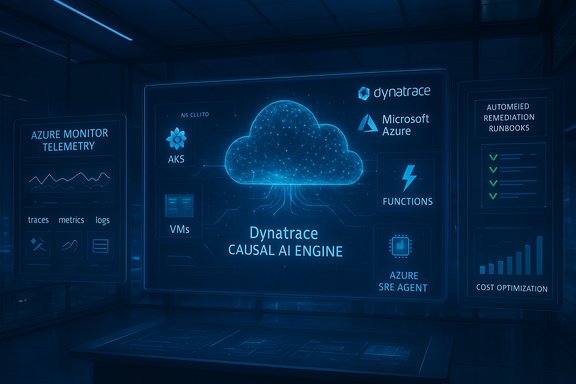
Dynatrace has long positioned itself as an AI-first observability vendor, building on its Davis causal AI engine and the GRAIL data lakehouse to correlate traces, metrics, logs, and metadata into actionable intelligence. The company’s November announcement frames the new Azure-focused capabilities as an extension of that vision: richer Azure Monitor ingestion, expanded metadata and telemetry to boost causal analysis, automated workflows for remediation, and continuous cloud resource optimization to rein in rising Azure spend. The new cloud operations solution is available in preview with broader availability targeted for early 2026, according to vendor materials. The strategic narrative is twofold. First, Dynatrace aims to give platform and SRE teams a single pane of glass for cloud-native Azure services such as Azure Kubernetes Service (AKS), Azure Virtual Machines, Azure Functions, and Azure’s AI Foundry offerings. Second, the vendor explicitly couples its observability signals to action — surfacing remediation hints and automating runbook tasks — by integrating with Microsoft’s Azure SRE Agent to enable portal-native remediation workflows and closed‑loop incident handling. Dynatrace and Microsoft position the partnership as a way to reduce mean time to repair (MTTR) and operational toil while enabling faster, safer AI deployment on Azure. What Dynatrace announced (what’s new)
Expanded Azure telemetry and metadata ingestion
- Dynatrace will ingest metrics from all Azure Monitor services, increasing the fidelity of its full-stack maps and causal models. This richer dataset feeds its continuous topology mapping, claimed to improve precision in identifying root causes and reducing false positives.
Automated risk identification and integrated health warnings
- The platform introduces automated risk scoring and integrated health warnings designed to detect emerging issues before they escalate into incidents. These are surfaced with customizable alert templates to align with platform team SLAs and SLOs.
Intelligent remediation workflows
- New automated workflows are available to remediate or suggest fixes across Azure VMs, Functions, AKS, and AI Foundry workloads. Dynatrace says these workflows use intelligent diagnostics to guide decision-making and can be wired into runbooks and automation pipelines, supporting both manual approval gates and automated low-risk actions.
Integration with Azure SRE Agent
- Dynatrace became the first observability platform to integrate with Microsoft’s Azure SRE Agent, bringing its causal AI-derived remediation hints into the SRE Agent’s portal-native incident workflows. The joint solution supports automated runbook steps, remediation hints, and faster root-cause analysis while preserving gate controls for human approval. Dynatrace and Microsoft emphasize that this integration is aimed at reducing outages and speeding recovery.
Cost and optimization features
- The updated solution continuously reviews Azure resource consumption and recommends rightsizing, idle resource removal, and other optimizations to reduce cloud spend — a notable priority for enterprises facing expanding AI workload costs. Dynatrace explicitly links these recommendations to showbacks and SRE cost-controls.
Why this matters for Azure customers and SRE teams
Azure environments have become more complex with the proliferation of containerized services, serverless functions, and specialized AI infrastructure. For operations teams, visibility gaps and noisy alerts remain the leading causes of slow incident resolution.- Deeper telemetry from Azure Monitor across all services provides higher signal fidelity for causal models, enabling more accurate root-cause determinations in multi-tier cloud-native failure scenarios.
- Agentic operations — the move from “alerting” to “acting” — reduces manual toil when done with guardrails. Integrations that place remediation within Azure’s control plane simplify workflows for Azure-first shops. Microsoft’s Azure SRE Agent itself is designed to act under human approval and leverages Azure Agent Units (AAUs) for billing; Dynatrace’s integration channels its causal context into that framework.
- Cost control is essential as AI workloads often carry large GPU/accelerator and inference costs; continuous optimization and rightsizing suggestions can yield measurable savings if teams operationalize them.
Verifying the key claims
When major vendors announce new cloud features, readers should ask which statements are demonstrable facts and which are vendor-positioned promises.- Dynatrace’s press releases and BusinessWire distribution confirm that a preview of the new Azure cloud operations solution is available now and that broader availability is expected in early 2026. These are verifiable product-stage claims in the vendor’s own materials.
- Dynatrace’s claim that it is the first observability platform to integrate with Azure SRE Agent is stated in the company announcement and echoed by Microsoft materials; the partnership materials assert this positioning. Readers should treat “first” as a vendor claim that could depend on how “integrate” is defined (e.g., marketplace listing, API-level integration, deployed joint runbooks). Independent verification suggests Dynatrace is the first major, announced observability vendor to publicize this specific integration as of the preview date. Nonetheless, customers should independently validate integration depth during procurement.
- Microsoft’s public documentation for Azure SRE Agent confirms agent behavior: continuous monitoring, a chat-style investigative interface, “approve before take action” controls, and a consumption model based on Azure Agent Units (AAUs) (a baseline hourly component plus usage-based AAUs for active mitigation work). This corroborates the operational model Dynatrace describes for combined workflows.
Strengths: What Dynatrace brings to the table
- Causal AI with richer Azure context. Dynatrace’s Davis engine benefits materially from higher-quality telemetry and metadata. Breadth of Azure Monitor ingestion can improve automated root-cause precision compared with narrower datasets.
- Portal-native remediation via Azure SRE Agent. Pushing remediation hints into a provider‑native agent reduces context switching and can make automated runbooks easier to audit and govern. This is particularly potent for Azure-first enterprises.
- Enterprise-grade integration footprint. Dynatrace’s existing integrations across tracing, logs, and security telemetry create a unified signal set that can make SRE Agent actions more confident and specific.
- Operational cost focus. Built-in continuous optimization recommendations directly address one of the top pain points for cloud-native AI: uncontrolled cost growth. This is a pragmatic complement to the observability story.
Risks, caveats, and where to watch closely
- Over-automation hazard. Agentic remediation is powerful but risky if runbooks are not exhaustively tested. Automated actions — particularly those that modify infrastructure or scale AI clusters — can produce cascading failures if they run on incorrect assumptions. Start conservative: read-only diagnostics → gated approvals → low-risk automations.
- Operational cost complexity. Azure SRE Agent introduces a new consumption unit (AAU) pricing model: a fixed baseline AAU per hour plus usage-based AAUs per task. Integrating third-party automation that triggers SRE Agent actions can therefore have opaque cost implications unless carefully modeled. Teams must forecast AAU consumption and map it to financial KPIs.
- Telemetry and data egress costs. Ingesting “all” Azure Monitor metrics and exporting to a third-party platform can raise telemetry ingestion and egress charges, particularly for high-cardinality metrics in AKS or GPU‑intensive AI workloads. Cost-benefit analysis must include telemetry overhead.
- Vendor lock‑in and multi-cloud parity. For organizations operating hybrid or multi-cloud estates, deep Azure SRE Agent + Dynatrace automation may not translate to AWS or GCP. Teams should assess whether the productivity gains are worth the potential lock‑in or plan for an abstraction layer that preserves multi-cloud flexibility.
- Security and data residency. Pushing actionability into a cloud provider’s control plane requires careful access, RBAC, and audit trail design. The SRE Agent requires specific permissions and may be region‑restricted during preview; customers must evaluate compliance implications for sensitive workloads. Microsoft’s docs list preview region restrictions and permission prerequisites that must be observed.
Practical guidance for IT and SRE teams (pilot plan)
- Define success metrics before you start.
- MTTR reduction targets, percentage of incidents fully diagnosed by AI, percentage of remediations automated, and cloud cost savings are typical KPIs. Track both technical and business outcomes.
- Start in read-only mode.
- Enable Dynatrace telemetry ingestion and feed diagnostics into the Azure SRE Agent in observational mode. Let the combined system generate remediation hints without executing actions. This builds trust and provides real usage data to refine runbooks.
- Pilot on low-risk workloads.
- Choose non-critical AKS namespaces, dev/test AI workloads, or sandboxed Function apps for initial gating of automated actions. Validate suggested runbook steps via dry runs and post‑mortems.
- Implement human-in-the-loop gating.
- Use approval gates for any remediation that impacts stateful resources or production traffic. Automate trivial, idempotent tasks (e.g., cache clears, targeted service restarts) under strict guardrails first.
- Model costs and telemetry budgets.
- Map expected Azure Agent Unit (AAU) usage and telemetry ingestion/egress volumes to running cost forecasts. Monitor telemetry cardinality and prune high-cardinality dimensions that create outsized storage costs.
- Institutionalize runbook maintenance.
- Automated remediation requires up-to-date runbooks. Treat runbooks as code: version them, test them in CI pipelines, and link them to incident post‑mortems so automation learns continuously.
Security, governance and compliance considerations
- Least privilege and RBAC: Ensure SRE Agent and Dynatrace connectors have narrowly scoped permissions. Microsoft docs outline required role assignments for agent creation; avoid over-permissive service principals.
- Auditability: All automated actions must produce immutable audit trails. Use Azure Activity Logs, resource provider logs, and third-party SIEM integration to capture an auditable chain of decision-making and actions.
- Data residency: Preview region availability and telemetry residency should be mapped to compliance postures. Microsoft’s preview notes indicate allowed regions for SRE Agent during the preview phase; larger enterprises must confirm regional availability for production rollouts.
- Model governance: If agentic suggestions leverage generative or agentic AI to craft remediation steps, teams should capture rationale, version model prompts, and include human review controls to prevent drift and unsafe automation.
Commercial and market context
The announcement follows broader go‑to‑market activity between Dynatrace and Microsoft that has been building for years, including marketplace availability and joint sales programs, reflecting an escalating strategic partnership to capture Azure-native observability workloads. The market response was modestly positive: Dynatrace stock saw incremental gains on the news, highlighting investor appetite for vendors that can tie observability to automation and, crucially, to cost control in cloud environments. For Microsoft, the integration deepens an ecosystem narrative: cloud providers increasingly want their native automation surfaces to be populated with partner data and trusted remediation flows rather than isolated vendor UIs. The Azure SRE Agent model — billed via Azure Agent Units and designed with approval gates — gives Microsoft a governance-centric control plane for agentic operations.How to evaluate claims during procurement
- Request proof-of-value metrics from vendor-led pilots: show historic MTTR, frequency of false-positive automated actions, and realized cost savings attributed to rightsizing recommendations. Treat vendor case studies as starting points; insist on controlled customer references.
- Validate integration depth: confirm whether integration is a telemetry export, API-level linking, or a managed, bi-directional context exchange that supports runbook execution and incident state reconciliation. Depth matters for reliability and automation safety.
- Test scale and high-cardinality scenarios: particularly in AKS and AI training clusters where metrics cardinality explodes. Ensure the solution’s telemetry pipeline remains performant and cost-predictable at scale.
Conclusion
Dynatrace’s Azure-focused cloud operations preview is a substantive step toward agentic observability — marrying high-fidelity telemetry with actionable automation inside the Azure control plane. For Azure-first enterprises, this combination promises faster diagnosis, safer remediation, and tangible cost controls for burgeoning AI workloads. The real value will depend on careful implementation: conservative pilots, strong governance, telemetry cost management, and rigorous runbook validation.The integration with Azure SRE Agent is particularly noteworthy: it signals a future where observability platforms don’t just inform SREs — they help execute and govern fixes within the cloud provider’s operational fabric. That future can deliver massive operational leverage, but it also raises fresh responsibilities for SRE teams to model costs, maintain runbooks as code, enforce RBAC, and preserve human oversight where it matters.
Organizations planning to test Dynatrace’s preview should approach with a practical pilot plan, explicitly modeled costs, and strict automation guardrails. Measured rollout — not overnight automation — will turn vendor promises into dependable operational improvements.
Source: Benzinga Dynatrace Introduces AI Cloud Upgrades For Microsoft Azure - Dynatrace (NYSE:DT), Microsoft (NASDAQ:MSFT)