

Microsoft’s latest campaign to steer Windows users away from Google Chrome and into Microsoft Edge has become more spectacle than strategy — a cascade of in‑browser prompts, “are you sure?” support pages, and persistent nudges that promise greater security, integrated AI, and a smoother Windows experience, but so far have failed to move the needle on the one metric that matters most: user adoption. The narrative is simple and stark: Microsoft says Edge is safer and better integrated; users keep choosing Chrome anyway, and the evidence shows the gap between the two browsers remains both wide and resilient.
Microsoft’s push is the latest chapter in a decade‑long browser rivalry where defaults, taskbar icons, and subtle UI design choices have been as important as code. Edge, rebuilt on Chromium, promised parity with Chrome while offering Windows‑specific integrations: system‑level protections, password monitoring, and in recent months, Copilot AI features baked into the browsing experience. Microsoft has increasingly leaned on those integrations as reasons to prefer Edge over Chrome. The company’s tactics range from explicit marketing — “browse securely, switch to Edge” prompts on newcomer flows and download pages — to more controversial UI nudges that appear within other browsers and Windows itself. Some of these UX experiments were rolled back after public outcry; others remain active as Microsoft refines when and how to surface persuasion in the OS. The effect has been heavy on visibility but, by most measures, light on results.
Regulators and rivals have noticed. Complaints and filings — including an antitrust complaint by Opera in Brazil — underscore the political risk of aggressive distribution tactics, especially where platform defaults and bundling can affect market competition. Those legal and regulatory pressures add another layer to Microsoft’s calculus when deciding how far to push.
For Windows users the pragmatic takeaway is straightforward: make a conscious browser choice and secure it properly. For Microsoft, the strategic lesson is equally clear: product improvements, transparent opt‑ins, and earned trust win far more sustainably than repeated in‑OS persuasion. The browser war is entering an AI phase where the winner will be determined less by who can push the hardest and more by who can make AI genuinely useful and frictionless inside the browser itself. Until then, Chrome’s incumbency and the stickiness of user ecosystems are likely to remain the defining reality of desktop browsing.
Source: Forbes https://www.forbes.com/sites/zakdof...-google-chrome-warning-for-all-windows-users/
 Background
Microsoft’s push is the latest chapter in a decade‑long browser rivalry where defaults, taskbar icons, and subtle UI design choices have been as important as code. Edge, rebuilt on Chromium, promised parity with Chrome while offering Windows‑specific integrations: system‑level protections, password monitoring, and in recent months, Copilot AI features baked into the browsing experience. Microsoft has increasingly leaned on those integrations as reasons to prefer Edge over Chrome. The company’s tactics range from explicit marketing — “browse securely, switch to Edge” prompts on newcomer flows and download pages — to more controversial UI nudges that appear within other browsers and Windows itself. Some of these UX experiments were rolled back after public outcry; others remain active as Microsoft refines when and how to surface persuasion in the OS. The effect has been heavy on visibility but, by most measures, light on results. Market reality: What the numbers actually say
Chrome’s dominance is durable, but numbers depend on measurement
Market share figures are slippery: global versus regional, desktop versus mobile, and dataset methodology all change the picture. Independent trackers show Chrome remains dominant on desktop, but the exact percentage varies. StatCounter’s global desktop snapshots show Chrome commanding a large majority through late 2025, while regional splits tell a more nuanced story: Chrome’s share in the United States sits noticeably lower than the global aggregate. Forbes’s recent coverage summarized the public debate by quoting StatCounter data and framed the last 12 months as one in which Chrome increased from roughly mid‑60s to very high levels — an assertion that captures a narrative truth (Chrome is dominant and persistent) but compresses the underlying variability across datasets and regions. StatCounter’s December 2025 global figure sits nearer to the low 70s percentage for Chrome, with Edge reported in the low single digits globally; U.S. desktop numbers show a smaller but still substantial lead for Chrome with Edge in the low‑ to mid‑teens. Different aggregators — and the distinction between desktop and all‑platform figures — explain why headline percentage swings can look larger or smaller depending on which lens you use.Why the disagreement matters
- Tracking methodology affects the headline number — panel samples, web traffic weighting, and device segmentation (desktop vs mobile) produce different outcomes.
- Regional dynamics: browser preference is shaped by local default installations, OEM bundling, and regulatory environments; what’s true for the U.S. or Europe may not hold worldwide.
- Time window: short‑term spikes (a viral install, a forced update, or a large OEM partnership) can move monthly statistics but may not indicate long‑term shifts.
What Microsoft is doing: tactics, nudges, and messaging
In‑browser banners, fake “uninstall” pages, and persistent prompts
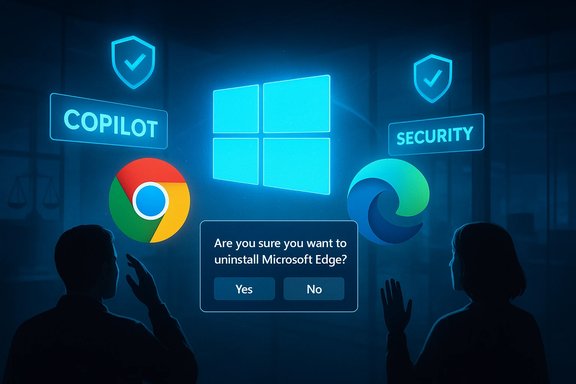
Microsoft’s toolkit includes overt banners on Chrome download pages inside Edge, specially worded support pages that begin “Are you sure you want to uninstall Microsoft Edge?” and system‑level prompts that encourage importing data from other browsers during first‑run experiences. These UX elements are intended to lower the friction of switching to Edge while framing the decision as security‑oriented. Critics argue some of these techniques qualify as dark patterns because they privilege confirmatory actions with large, colored buttons and make dismissal less obvious. Forum investigations and community testing have largely concluded these prompts are persuasive nudges, not OS‑level blocks that prevent Chrome from being downloaded or installed. When installers fail it is far more likely due to local security policies, Windows Defender/SmartScreen settings, or third‑party EDR/AV tools than a deliberate Microsoft blockade. Community guidance for troubleshooting — try a different browser, check Windows Security protection history, temporarily disable Controlled Folder Access for testing, or audit EDR policies — reflects practical steps that resolve most reported failures.The public backlash and perception problem
The very ubiquity and intensity of the push has produced backlash. Examples include a widely shared ad gaffe that showed Chrome pinned on a Windows desktop even as Microsoft was exhorting users to use Edge — a symbolic misstep that undercut Microsoft’s message and became a meme of corporate inconsistency. That ad error amplified the perception that Microsoft’s campaign is clumsy and heavy‑handed rather than persuasive.Regulators and rivals have noticed. Complaints and filings — including an antitrust complaint by Opera in Brazil — underscore the political risk of aggressive distribution tactics, especially where platform defaults and bundling can affect market competition. Those legal and regulatory pressures add another layer to Microsoft’s calculus when deciding how far to push.
Security claims: Is Edge measurably safer?
Shared foundations, different integrations
Technically, modern Edge and Chrome share a common foundation: Chromium. That shared codebase means both browsers inherit many of the same core security properties and vulnerabilities. Microsoft’s security argument therefore hinges less on engine superiority and more on what Edge adds through tighter integration with Windows security features, telemetry‑driven protections, and Microsoft’s security services. In enterprise contexts, those integrations can indeed be material: single‑vendor stacks often enable streamlined management, centralized telemetry, and additional protective controls.Browser vulnerabilities show the limits of platform claims
Chromium‑level vulnerabilities affect both Chrome and Edge; CVE disclosures that touch the Chromium codebase typically prompt patches across the browser ecosystem. Past examples show the same memory‑management or autofill vulnerabilities can be exploited in any Chromium‑based browser until patched. That shared exposure weakens blanket claims that one browser is categorically safer than another unless that vendor demonstrates faster patching or additional mitigations at the OS level. Microsoft and Google both operate rapid‑patch cycles; differences in response times are real but often measured in days rather than months.What users should do from a security perspective
- Keep your browser up to date — automatic updates are the first line of defense.
- Use built‑in protections (Safe Browsing, Microsoft Defender SmartScreen) and enable reputation‑based blocking.
- Reduce attack surface: limit extensions, prefer Passkeys/MFA for account security, and avoid installing updates or plugins from non‑trusted sources.
These are practical measures that matter regardless of whether you use Edge or Chrome.
The AI angle: why browsers are the next battlefield
Browsers as AI delivery vehicles
The next frontier in browser competition is AI integration. Microsoft is embedding Copilot features in Edge and Windows, while Google is integrating Gemini into Chrome and across its ecosystem. For platform owners, the browser is a primary vector to deliver AI assistants, generative search features, and monetized AI experiences — turning browser market share directly into an advantage for owning user attention and AI telemetry.Traffic shares and user behavior in AI services
Recent web traffic analytics from Similarweb show an evolving AI landscape: ChatGPT still leads web traffic to generative AI sites, but Gemini has made substantial gains; Microsoft’s Copilot web traffic remains comparatively small by this measure. Those web‑traffic percentages are an imperfect proxy for in‑app or embedded usage (for example, Copilot within an Edge session or Copilot in the Windows shell may not surface as separate web visits), but they do illuminate how public interest and discovery habits are currently oriented. The short takeaway: AI is increasing the stakes of browser competition, but current traffic figures show Google and OpenAI retaining a large lead in direct web engagement.Why Microsoft’s campaign appears to be failing
1. Network effects and habit
Browsers are sticky. Users build ecosystems — bookmarks, extensions, signed‑in profiles, saved passwords, sync — that make switching costly. Many users are reluctant to trade that convenience for promises of marginally better integration. That inertia strongly favors incumbents, especially one as entrenched as Chrome. Market inertia explains much of the resilience of Chrome’s share.2. Trust and the backfire effect
Heavy‑handed persuasion can erode trust. When the OS repeatedly nudges users to swap tools, people interpret that as manipulation rather than friendly advice. For some, the persistent prompts created a backlash that reinforced commitment to the incumbent browser — users react against perceived coercion. The ad gaffe and reports of Edge importing Chrome tabs without consent only reinforced the narrative that Microsoft’s campaign was invasive.3. Signal vs noise: security claims are necessary but not sufficient
Security rationales resonate most with enterprise admins who can mandate client transitions and reap the benefits of integration. For consumers, however, security is only one factor among speed, convenience, and extension ecosystem. A security pitch alone rarely overcomes the full cost of switching. Moreover, because Edge and Chrome share Chromium, everyday users perceive less functional difference than Microsoft implies.4. Measurement ambiguity and PR optics
Microsoft’s internal metrics and rollout choices may show local gains in engagement (for example, more first‑run imports), but public market share numbers are measured by independent third parties and reflect actual retention and usage patterns. Those independent trackers — StatCounter among them — are what analysts and journalists cite, and they’ve shown Chrome’s strength persists. Forbes’s narrative that Microsoft has “failed” is a media distillation of that disconnect between marketing activity and observable market shifts.Practical guidance for Windows users and admins
For everyday users
- Choose the browser that best matches your workflow and security comfort level; both modern Chrome and Edge are technically competent.
- If you prefer Chrome, don’t be alarmed by Microsoft’s prompts — treats them as recommendations rather than technical roadblocks.
- Harden security: enable strong browser protections, use a reputable password manager, enable MFA or Passkeys, and keep systems updated.
For IT administrators
- Audit policies and EDR rules to ensure legitimate installers aren’t being quarantined inadvertently.
- Document supported browsers and provide clear internal guidance to reduce helpdesk load.
- Monitor telemetry to spot unexpected behavior after Windows updates, and whitelist installer hashes where appropriate.
For Microsoft
- If persuasion remains the strategy, make it clearly opt‑in, transparent, and easier to dismiss — heavy‑handed tactics generate negative PR and regulatory scrutiny.
- Provide clear telemetry disclosures for any targeted nudges and add robust opt‑outs under Settings.
- Focus on product excellence and earned adoption: incremental product improvements, smoother migration tools, and demonstrable security differentials will win users more reliably than repeated in‑OS ads.
Legal and regulatory risks
Aggressive distribution tactics have already drawn scrutiny. Browser vendors and regulators pay attention when defaults or UI treatment appear to distort competition. Opera’s complaint in Brazil and other regulatory inquiries are reminders that what begins as product positioning can escalate into legal challenges if competitors successfully argue the behavior harms market fairness. Companies operating at the OS level must tread carefully: pushing a first‑party browser touches both antitrust and consumer‑protection norms.Where this goes next: scenarios and predictions
- AI features will intensify the battle: whichever browser successfully embeds a broadly useful, trustworthy AI assistant that users adopt as a habit — whether Edge/Copilot or Chrome/Gemini/OpenAI integrations — will capture significant long‑term value.
- Expect more experimentation and calibration: Microsoft will likely tone down the most controversial nudges, focus on enterprise conversion plays, and prioritize feature parity plus unique Windows integrations.
- Regulators will remain vigilant: if UI nudges are judged to materially suppress competition, legal remedies could follow, forcing clearer choice mechanisms.
- User choice will endure: despite platform pushes, switching costs and user preference will continue to favor incumbents unless a clear and compelling functional advantage emerges.
Conclusion
Microsoft’s recent campaign to persuade Windows users to abandon Google Chrome for Edge is a masterclass in visibility without commensurate conversion. The company has invested heavily in messaging that positions Edge as a safer, more integrated, AI‑ready browser. Yet independent traffic and market‑share measures show Chrome’s lead remains wide and resilient. The behavior that most unsettles users and regulators is the method of persuasion — persistent, sometimes ambiguous UX nudges that come across as coercive rather than helpful. Those tactics have not only failed to close the gap, they may have hardened user preferences.For Windows users the pragmatic takeaway is straightforward: make a conscious browser choice and secure it properly. For Microsoft, the strategic lesson is equally clear: product improvements, transparent opt‑ins, and earned trust win far more sustainably than repeated in‑OS persuasion. The browser war is entering an AI phase where the winner will be determined less by who can push the hardest and more by who can make AI genuinely useful and frictionless inside the browser itself. Until then, Chrome’s incumbency and the stickiness of user ecosystems are likely to remain the defining reality of desktop browsing.
Source: Forbes https://www.forbes.com/sites/zakdof...-google-chrome-warning-for-all-windows-users/
