

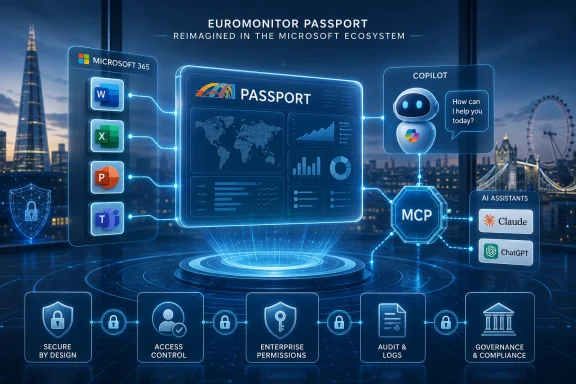
Euromonitor International announced on June 30, 2026, in London that it has rebuilt Passport, its flagship market-intelligence platform, with a Microsoft Copilot agent, MCP integration for AI assistants such as Claude and ChatGPT, AI chat, and expanded API access for clients. The headline is not simply that another data vendor has added an AI button. It is that one of the better-known subscription research platforms is trying to stop being a destination and start becoming infrastructure. For WindowsForum readers, that makes this less a market-research story than a Microsoft ecosystem story: the business database is now trying to live inside the productivity stack.
Euromonitor’s pitch is blunt: Passport has been “reimagined and redeveloped,” not merely refreshed. The company says this is its largest investment since its founding in 1972, which is exactly the kind of executive claim that should make enterprise buyers both interested and cautious. A ground-up rebuild can mean years of technical debt have finally been confronted; it can also mean the product you knew is about to change in ways that procurement, compliance, and power users must relearn.
Passport’s value has historically been bound to the credibility of its underlying market data: industries, countries, economies, consumers, and forecasts packaged for strategy teams, consultants, consumer-goods companies, banks, universities, and government-adjacent analysts. The new version reframes that value around access. The question becomes not “Can a user find the right chart?” but “Can an approved AI agent bring the right chart, context, or source-backed answer into the place where the decision is being made?”
That is the real significance of the Copilot agent. Microsoft 365 has become the enterprise workbench where documents, spreadsheets, presentations, email, and meetings converge. If Passport can surface Euromonitor intelligence inside that workbench, the platform moves from being another browser tab to being a context provider in Word, Excel, PowerPoint, Teams, and the broader Copilot experience.
This is the same shift that has been reshaping enterprise software since generative AI moved from novelty to budget line item. The old SaaS model asked users to visit systems of record. The new AI model asks systems of record to expose themselves to assistants, agents, and workflows. Euromonitor is betting that the interface layer is no longer the product’s moat; the trusted dataset is.
Euromonitor’s announcement fits that pattern almost too neatly. Passport’s data is valuable precisely because it is not generic web content. It is curated, paid, structured intelligence, the sort of material a strategy analyst might rely on when sizing a category, comparing markets, or building an investment thesis. If that material can be queried inside Microsoft applications, Copilot becomes less of a summarizer and more of a broker between proprietary knowledge stores.
For Microsoft, this is a distribution victory. Every credible vertical data provider that builds a Copilot agent reinforces Microsoft’s argument that enterprise AI should be anchored in the Microsoft 365 environment rather than scattered across standalone chat products. For Euromonitor, it is a defensive move against the same gravitational pull. If users increasingly ask questions in Copilot, ChatGPT, or Claude, Passport has to be present there or risk becoming invisible.
That does not mean the Passport interface stops mattering. In fact, Euromonitor says it has also rebuilt the user experience with clearer navigation and faster routes from business question to answer. But the center of gravity is shifting. The product’s future is less about forcing users into a single screen and more about enforcing permissions, sourcing, governance, and data quality across many screens.
This is where Windows and Microsoft 365 administrators should pay attention. Copilot agents are not just convenience features. They are new integration points between proprietary information and everyday productivity surfaces. Once an agent can answer business questions inside a user’s workflow, it becomes part of the organization’s information architecture.
Euromonitor says Passport will be “MCP ready,” allowing customers to connect global market data and insights into AI tools such as Claude and ChatGPT. That phrasing is important. The company is not only choosing Microsoft’s agent ecosystem; it is also acknowledging that enterprise AI is not going to be a single-vendor world.
This is a sensible hedge. Many organizations are standardizing on Microsoft 365 Copilot for everyday productivity while still experimenting with OpenAI, Anthropic, Google, or specialized agent frameworks for research, engineering, customer support, and internal automation. MCP gives Euromonitor a way to be available across that fragmented landscape without building a bespoke connector for every assistant.
But MCP also changes the risk model. A browser-based research platform can be locked down, audited, and trained around a relatively familiar user journey. An MCP-connected Passport becomes part of a broader agent chain, where prompts, tool calls, retrieved data, and downstream generated outputs may pass through multiple systems. That is powerful, but it places a premium on identity, access controls, logging, and data-loss prevention.
The phrase bring your data to the AI sounds simple until the data is expensive, licensed, regionally sensitive, and commercially consequential. Market-intelligence queries can reveal acquisition targets, launch plans, pricing strategies, supply-chain assumptions, and competitive priorities. If Passport is going to feed AI assistants, customers will want assurance that the assistant sees only what the user is entitled to see, and that generated outputs do not blur the line between licensed research and loose paraphrase.
APIs are where repeatable workflows live. A consultant can use chat to draft a quick market summary, but a retailer’s strategy team may want automated dashboards. A bank may want Passport data blended with internal models. A consumer goods company may want category, demographic, and economic indicators feeding planning tools, forecasting pipelines, or Power BI environments.
By expanding API access, Euromonitor is serving customers who do not want AI as a separate destination at all. They want Passport’s data to flow into existing systems under predictable governance. In that sense, the API and the AI layer are not separate product stories. They are two sides of the same move away from the classic subscription portal.
For IT teams, this is a familiar trade-off. The more useful a data platform becomes, the more deeply it integrates. The more deeply it integrates, the more it must be managed like critical infrastructure rather than a departmental research tool. Authentication, entitlement mapping, rate limits, usage monitoring, contract compliance, and audit trails stop being back-office details and become deployment blockers.
The expanded API also gives Euromonitor a stronger answer to customers who distrust generative interfaces for high-stakes work. Not every organization wants a chatbot summarizing market opportunity. Some want clean data feeds, reproducible queries, and controlled analytics. A successful Passport rebuild needs both: conversational access for human productivity and structured access for systems that cannot tolerate improvisation.
A good AI chat layer can compress that discovery process. Instead of navigating through categories and filters, a user can ask for market size, growth drivers, consumer segments, or regional comparisons in natural language. If the system returns sourced, traceable answers, that could save hours for analysts who otherwise spend their time stitching together reports and data tables.
The danger is that conversational interfaces make uncertainty feel smoother than it is. Market intelligence is full of estimates, forecasts, methodology choices, and scope definitions. An answer that sounds confident may still depend on whether “market size” means retail value, volume, constant prices, current prices, formal channels, informal channels, or a specific category taxonomy.
That is why the rebuilt Passport has to prove it can preserve context, not merely retrieve snippets. The product’s credibility depends on whether AI answers can point users back to underlying sources, definitions, and assumptions. If a platform built on expert verification becomes another black-box answer machine, it has sacrificed the thing that made it worth paying for.
The best version of this product is not an oracle. It is a research assistant that shortens the path from question to evidence while keeping the evidence visible. That distinction will matter to anyone using Passport outputs in board decks, market-entry plans, regulatory reviews, or investment memos.
That threat cuts across many information businesses. Legal research, financial terminals, developer documentation, competitive-intelligence tools, analyst reports, and internal knowledge bases are all being pushed toward the same question: if users ask an AI assistant first, what role does the original platform play? The answer increasingly depends on whether the platform can become an authenticated source inside that assistant’s workflow.
Passport’s Copilot and MCP integrations are therefore defensive as much as innovative. They help Euromonitor meet customers where work is happening, but they also protect the company from being abstracted away. If a generic AI tool can summarize market trends from public sources well enough for casual users, Passport must compete by making its proprietary intelligence easier to access, safer to use, and more deeply embedded.
This is not unique to Euromonitor. The entire enterprise software stack is being pressured by the rise of agentic interfaces. Systems that once differentiated themselves through dashboards and workflows now have to expose capabilities to agents that may sit above them. The user may never see the original UI, but the organization still needs the original system’s data, permissions, and reliability.
That is a subtle but profound shift. In the portal era, software vendors competed for attention. In the agent era, they compete for trust, authority, and interoperability. Passport’s rebuild is a sign that Euromonitor understands the terms of that contest.
Admins will want to know how the Copilot agent authenticates users, how Passport entitlements are enforced, what logs are available, and whether prompts or retrieved content are retained. They will also want clarity on how MCP connections are configured, which clients are supported, whether tenant-level controls exist, and how data is protected when routed through third-party AI tools.
Licensing will matter too. Market research subscriptions are often carefully scoped by seat, department, region, academic use, or commercial use. AI agents complicate that model because one prompt can generate an answer that is shared widely through a document, meeting, or chat thread. Vendors and customers will need to decide what counts as use, redistribution, derivative output, or automated access.
There is also the problem of provenance. If a Copilot-generated market summary includes Passport-derived figures, organizations need a way to identify the source and verify the numbers later. Without that, AI-assisted research becomes difficult to audit. A strategy deck built from untraceable generated text may look polished but create downstream risk when the assumptions are challenged.
For WindowsForum’s sysadmin audience, the lesson is familiar: the impressive part of enterprise AI is rarely the chat box. The hard part is plumbing identity, permissions, compliance, and observability through systems that were not originally designed to behave like autonomous assistants. Euromonitor’s rebuilt architecture may be designed for that world, but customers will still have to test it against their own rules.
That repositioning mirrors the broader evolution of enterprise computing. Databases became APIs. APIs became platforms. Platforms are now becoming tools that agents can call. Each step reduces friction for users while increasing the importance of governance behind the scenes.
For market intelligence, this could be genuinely useful. Business decisions rarely happen inside a research portal. They happen in Excel models, PowerPoint decks, Teams calls, procurement workflows, CRM systems, and executive memos. If Euromonitor can inject verified context into those environments without breaking licensing or auditability, Passport becomes more valuable precisely because it becomes less visible.
But invisibility has a cost. When data appears directly inside generated prose or spreadsheet logic, users may forget that it came from a specific provider with specific methodology and limitations. The interface disappears, and with it some of the cues that remind users to inspect definitions, dates, and assumptions. A serious AI-enabled research platform must design against that problem.
This is where Microsoft’s ecosystem could help or hurt. Microsoft 365 has the advantage of being where knowledge work already happens. It also has the disadvantage of making generated content extremely easy to copy, remix, and circulate. Passport inside Copilot will need strong provenance features if Euromonitor wants its intelligence to remain trusted after it leaves the source platform.
Power users will test whether AI chat can handle messy questions, not just canned prompts. They will ask for comparisons across countries, categories, and time periods. They will test whether the system understands Passport’s own taxonomy and whether it can distinguish between data, analysis, and forecast. They will look for hallucinations, stale figures, missing caveats, and overconfident prose.
IT teams will test the integrations differently. They will ask whether Copilot access respects existing Passport permissions, whether MCP connections can be limited, whether API expansion creates new exposure, and whether logs satisfy internal governance requirements. A feature that delights analysts but alarms security teams will not move smoothly into production.
Procurement teams will have their own questions. If Passport now appears inside Copilot, Claude, ChatGPT, APIs, and internal workflows, pricing models may need to evolve. Customers will ask whether they are paying for seats, queries, data volume, agent access, API calls, or some combination of all of the above.
That is why the “biggest investment since 1972” line is more than marketing. Euromonitor is not just shipping features; it is changing the operational model around a paid intelligence product. Early access will reveal whether the rebuild has made Passport more usable without making it harder to govern.
 Passport Is Being Rebuilt for the Age of Ambient Software
Euromonitor’s pitch is blunt: Passport has been “reimagined and redeveloped,” not merely refreshed. The company says this is its largest investment since its founding in 1972, which is exactly the kind of executive claim that should make enterprise buyers both interested and cautious. A ground-up rebuild can mean years of technical debt have finally been confronted; it can also mean the product you knew is about to change in ways that procurement, compliance, and power users must relearn.Passport’s value has historically been bound to the credibility of its underlying market data: industries, countries, economies, consumers, and forecasts packaged for strategy teams, consultants, consumer-goods companies, banks, universities, and government-adjacent analysts. The new version reframes that value around access. The question becomes not “Can a user find the right chart?” but “Can an approved AI agent bring the right chart, context, or source-backed answer into the place where the decision is being made?”
That is the real significance of the Copilot agent. Microsoft 365 has become the enterprise workbench where documents, spreadsheets, presentations, email, and meetings converge. If Passport can surface Euromonitor intelligence inside that workbench, the platform moves from being another browser tab to being a context provider in Word, Excel, PowerPoint, Teams, and the broader Copilot experience.
This is the same shift that has been reshaping enterprise software since generative AI moved from novelty to budget line item. The old SaaS model asked users to visit systems of record. The new AI model asks systems of record to expose themselves to assistants, agents, and workflows. Euromonitor is betting that the interface layer is no longer the product’s moat; the trusted dataset is.
Microsoft’s Real Win Is Becoming the Place Where Other People’s Data Shows Up
The Copilot angle matters because Microsoft is not merely selling a chatbot bolted onto Office. It is trying to make Copilot the orchestration layer for business knowledge. That strategy depends on third parties believing that Microsoft’s interface is where their own customers want to consume information.Euromonitor’s announcement fits that pattern almost too neatly. Passport’s data is valuable precisely because it is not generic web content. It is curated, paid, structured intelligence, the sort of material a strategy analyst might rely on when sizing a category, comparing markets, or building an investment thesis. If that material can be queried inside Microsoft applications, Copilot becomes less of a summarizer and more of a broker between proprietary knowledge stores.
For Microsoft, this is a distribution victory. Every credible vertical data provider that builds a Copilot agent reinforces Microsoft’s argument that enterprise AI should be anchored in the Microsoft 365 environment rather than scattered across standalone chat products. For Euromonitor, it is a defensive move against the same gravitational pull. If users increasingly ask questions in Copilot, ChatGPT, or Claude, Passport has to be present there or risk becoming invisible.
That does not mean the Passport interface stops mattering. In fact, Euromonitor says it has also rebuilt the user experience with clearer navigation and faster routes from business question to answer. But the center of gravity is shifting. The product’s future is less about forcing users into a single screen and more about enforcing permissions, sourcing, governance, and data quality across many screens.
This is where Windows and Microsoft 365 administrators should pay attention. Copilot agents are not just convenience features. They are new integration points between proprietary information and everyday productivity surfaces. Once an agent can answer business questions inside a user’s workflow, it becomes part of the organization’s information architecture.
MCP Turns Passport Into a Data Source for the AI Toolchain
The second major piece is Euromonitor’s adoption of the Model Context Protocol, or MCP. MCP has quickly become a favored method for connecting AI assistants to external tools and data sources. In practical terms, it gives an assistant a standardized way to ask an approved system for information rather than relying only on model memory or pasted documents.Euromonitor says Passport will be “MCP ready,” allowing customers to connect global market data and insights into AI tools such as Claude and ChatGPT. That phrasing is important. The company is not only choosing Microsoft’s agent ecosystem; it is also acknowledging that enterprise AI is not going to be a single-vendor world.
This is a sensible hedge. Many organizations are standardizing on Microsoft 365 Copilot for everyday productivity while still experimenting with OpenAI, Anthropic, Google, or specialized agent frameworks for research, engineering, customer support, and internal automation. MCP gives Euromonitor a way to be available across that fragmented landscape without building a bespoke connector for every assistant.
But MCP also changes the risk model. A browser-based research platform can be locked down, audited, and trained around a relatively familiar user journey. An MCP-connected Passport becomes part of a broader agent chain, where prompts, tool calls, retrieved data, and downstream generated outputs may pass through multiple systems. That is powerful, but it places a premium on identity, access controls, logging, and data-loss prevention.
The phrase bring your data to the AI sounds simple until the data is expensive, licensed, regionally sensitive, and commercially consequential. Market-intelligence queries can reveal acquisition targets, launch plans, pricing strategies, supply-chain assumptions, and competitive priorities. If Passport is going to feed AI assistants, customers will want assurance that the assistant sees only what the user is entitled to see, and that generated outputs do not blur the line between licensed research and loose paraphrase.
The API Expansion Is the Quiet Enterprise Feature
AI chat and Copilot agents will get the attention, but the expanded API may matter more to mature customers. Euromonitor says Passport’s API reach is being extended to include all Passport datasets for the first time. That is the sort of sentence that rarely makes mainstream headlines but often determines whether a platform becomes embedded in enterprise systems.APIs are where repeatable workflows live. A consultant can use chat to draft a quick market summary, but a retailer’s strategy team may want automated dashboards. A bank may want Passport data blended with internal models. A consumer goods company may want category, demographic, and economic indicators feeding planning tools, forecasting pipelines, or Power BI environments.
By expanding API access, Euromonitor is serving customers who do not want AI as a separate destination at all. They want Passport’s data to flow into existing systems under predictable governance. In that sense, the API and the AI layer are not separate product stories. They are two sides of the same move away from the classic subscription portal.
For IT teams, this is a familiar trade-off. The more useful a data platform becomes, the more deeply it integrates. The more deeply it integrates, the more it must be managed like critical infrastructure rather than a departmental research tool. Authentication, entitlement mapping, rate limits, usage monitoring, contract compliance, and audit trails stop being back-office details and become deployment blockers.
The expanded API also gives Euromonitor a stronger answer to customers who distrust generative interfaces for high-stakes work. Not every organization wants a chatbot summarizing market opportunity. Some want clean data feeds, reproducible queries, and controlled analytics. A successful Passport rebuild needs both: conversational access for human productivity and structured access for systems that cannot tolerate improvisation.
AI Chat Changes the Research Workflow, but Not the Burden of Proof
Euromonitor says Passport’s AI chat will let users find insight from reports and turn search into a conversation. That is the most obvious feature, and probably the one many users will try first. Anyone who has spent time inside market research databases understands the appeal: the hard part is often not reading the report but finding the relevant table, definition, geography, year, or methodological note in the first place.A good AI chat layer can compress that discovery process. Instead of navigating through categories and filters, a user can ask for market size, growth drivers, consumer segments, or regional comparisons in natural language. If the system returns sourced, traceable answers, that could save hours for analysts who otherwise spend their time stitching together reports and data tables.
The danger is that conversational interfaces make uncertainty feel smoother than it is. Market intelligence is full of estimates, forecasts, methodology choices, and scope definitions. An answer that sounds confident may still depend on whether “market size” means retail value, volume, constant prices, current prices, formal channels, informal channels, or a specific category taxonomy.
That is why the rebuilt Passport has to prove it can preserve context, not merely retrieve snippets. The product’s credibility depends on whether AI answers can point users back to underlying sources, definitions, and assumptions. If a platform built on expert verification becomes another black-box answer machine, it has sacrificed the thing that made it worth paying for.
The best version of this product is not an oracle. It is a research assistant that shortens the path from question to evidence while keeping the evidence visible. That distinction will matter to anyone using Passport outputs in board decks, market-entry plans, regulatory reviews, or investment memos.
The Competitive Pressure Is Coming From the Interface Layer
Euromonitor’s move also says something uncomfortable about the market-research business. The competitive threat is no longer just another data provider with better coverage or cheaper subscriptions. It is the possibility that users will stop visiting research platforms directly because AI assistants become the first point of inquiry.That threat cuts across many information businesses. Legal research, financial terminals, developer documentation, competitive-intelligence tools, analyst reports, and internal knowledge bases are all being pushed toward the same question: if users ask an AI assistant first, what role does the original platform play? The answer increasingly depends on whether the platform can become an authenticated source inside that assistant’s workflow.
Passport’s Copilot and MCP integrations are therefore defensive as much as innovative. They help Euromonitor meet customers where work is happening, but they also protect the company from being abstracted away. If a generic AI tool can summarize market trends from public sources well enough for casual users, Passport must compete by making its proprietary intelligence easier to access, safer to use, and more deeply embedded.
This is not unique to Euromonitor. The entire enterprise software stack is being pressured by the rise of agentic interfaces. Systems that once differentiated themselves through dashboards and workflows now have to expose capabilities to agents that may sit above them. The user may never see the original UI, but the organization still needs the original system’s data, permissions, and reliability.
That is a subtle but profound shift. In the portal era, software vendors competed for attention. In the agent era, they compete for trust, authority, and interoperability. Passport’s rebuild is a sign that Euromonitor understands the terms of that contest.
Where IT Will See the Work Hidden Behind the Demo
The demo version of this story is easy: ask Copilot a market question, receive a Euromonitor-grounded answer, drop it into a deck, and move on. The deployment version is harder. Every enterprise AI integration becomes a conversation between business enthusiasm and IT governance.Admins will want to know how the Copilot agent authenticates users, how Passport entitlements are enforced, what logs are available, and whether prompts or retrieved content are retained. They will also want clarity on how MCP connections are configured, which clients are supported, whether tenant-level controls exist, and how data is protected when routed through third-party AI tools.
Licensing will matter too. Market research subscriptions are often carefully scoped by seat, department, region, academic use, or commercial use. AI agents complicate that model because one prompt can generate an answer that is shared widely through a document, meeting, or chat thread. Vendors and customers will need to decide what counts as use, redistribution, derivative output, or automated access.
There is also the problem of provenance. If a Copilot-generated market summary includes Passport-derived figures, organizations need a way to identify the source and verify the numbers later. Without that, AI-assisted research becomes difficult to audit. A strategy deck built from untraceable generated text may look polished but create downstream risk when the assumptions are challenged.
For WindowsForum’s sysadmin audience, the lesson is familiar: the impressive part of enterprise AI is rarely the chat box. The hard part is plumbing identity, permissions, compliance, and observability through systems that were not originally designed to behave like autonomous assistants. Euromonitor’s rebuilt architecture may be designed for that world, but customers will still have to test it against their own rules.
The Market-Intelligence Portal Is Becoming a Service Layer
The most interesting phrase in Euromonitor’s announcement is not “AI chat” or “Copilot agent.” It is the idea of moving Passport “beyond a single screen.” That sentence captures the strategic pivot. Passport is no longer being positioned primarily as a place users go; it is being positioned as a service layer that follows users into their chosen tools.That repositioning mirrors the broader evolution of enterprise computing. Databases became APIs. APIs became platforms. Platforms are now becoming tools that agents can call. Each step reduces friction for users while increasing the importance of governance behind the scenes.
For market intelligence, this could be genuinely useful. Business decisions rarely happen inside a research portal. They happen in Excel models, PowerPoint decks, Teams calls, procurement workflows, CRM systems, and executive memos. If Euromonitor can inject verified context into those environments without breaking licensing or auditability, Passport becomes more valuable precisely because it becomes less visible.
But invisibility has a cost. When data appears directly inside generated prose or spreadsheet logic, users may forget that it came from a specific provider with specific methodology and limitations. The interface disappears, and with it some of the cues that remind users to inspect definitions, dates, and assumptions. A serious AI-enabled research platform must design against that problem.
This is where Microsoft’s ecosystem could help or hurt. Microsoft 365 has the advantage of being where knowledge work already happens. It also has the disadvantage of making generated content extremely easy to copy, remix, and circulate. Passport inside Copilot will need strong provenance features if Euromonitor wants its intelligence to remain trusted after it leaves the source platform.
The Early Access Window Will Decide Whether This Is Architecture or Announcement
Euromonitor says early access for selected clients opens next week, with wider availability planned later in 2026. That timing suggests the company is still moving from announcement to customer validation. The early access phase will matter because the success of this kind of rebuild depends less on feature checklists than on real-world workflow fit.Power users will test whether AI chat can handle messy questions, not just canned prompts. They will ask for comparisons across countries, categories, and time periods. They will test whether the system understands Passport’s own taxonomy and whether it can distinguish between data, analysis, and forecast. They will look for hallucinations, stale figures, missing caveats, and overconfident prose.
IT teams will test the integrations differently. They will ask whether Copilot access respects existing Passport permissions, whether MCP connections can be limited, whether API expansion creates new exposure, and whether logs satisfy internal governance requirements. A feature that delights analysts but alarms security teams will not move smoothly into production.
Procurement teams will have their own questions. If Passport now appears inside Copilot, Claude, ChatGPT, APIs, and internal workflows, pricing models may need to evolve. Customers will ask whether they are paying for seats, queries, data volume, agent access, API calls, or some combination of all of the above.
That is why the “biggest investment since 1972” line is more than marketing. Euromonitor is not just shipping features; it is changing the operational model around a paid intelligence product. Early access will reveal whether the rebuild has made Passport more usable without making it harder to govern.
The Rebuilt Passport Gives Enterprises a New Checklist
Euromonitor’s announcement is specific to one research platform, but the pattern is likely to repeat across premium data products. The winning services will not be the ones that shout “AI” the loudest. They will be the ones that combine trusted content, controlled access, useful interfaces, and clean integration into the tools where decisions already happen.- Euromonitor has rebuilt Passport around AI chat, a Microsoft Copilot agent, MCP integration, and expanded API access rather than treating AI as a cosmetic add-on.
- The Copilot agent makes Passport part of Microsoft’s broader push to turn Microsoft 365 into the front end for enterprise knowledge work.
- MCP support gives customers a way to use Passport intelligence in non-Microsoft AI tools, but it also raises governance questions around identity, permissions, and data flow.
- Expanded API coverage may prove more important than chat for enterprises that want reproducible data pipelines and controlled integrations.
- The early access program will test whether Euromonitor can preserve sourcing, methodology, and entitlement controls while making research feel conversational.
- The larger lesson for IT teams is that premium data platforms are becoming agent-accessible infrastructure, not just websites with search boxes.
References
- Primary source: Research Live
Published: 2026-07-02T15:50:11.775226
Euromonitor International adds Copilot to data tool | News | Research live
Market intelligence company Euromonitor International has released the latest version of its flagship market data and insights tool Passport, including a new Microsoft Copilot agent.www.research-live.com - Related coverage: euromonitor.com
Next-Generation AI-Powered Passport | Euromonitor International - Euromonitor.com
Euromonitor International unveils the next-generation Passport with AI-powered market intelligence, Microsoft Copilot integration, MCP support and expanded APIs. www.euromonitor.com
- Related coverage: agentmarketcap.ai
Microsoft Copilot Studio MCP Server GA: 16M Enterprise Seats Meet the Universal Agent Protocol | AgentMarketCap
Microsoft's GA of MCP in Copilot Studio and federated connectors creates the largest single MCP client deployment, reshaping enterprise agent infrastructure.agentmarketcap.ai - Related coverage: presenc.ai
A2A vs MCP: Agent Communication Standards 2026 | Presenc AI
Side-by-side comparison of Google's Agent-to-Agent (A2A) protocol and Anthropic's Model Context Protocol (MCP) as the two foundational standards...presenc.ai - Related coverage: go.euromonitor.com

Euromonitor
go.euromonitor.com
- Related coverage: aiagentindex.mit.edu
The 2025 AI Agent Index: Documenting Technical and Safety Features of Deployed Agentic AI Systems
PDF documentaiagentindex.mit.edu
