

StagwellMedia Platform became the first Stagwell global media business to integrate Microsoft Copilot, using Model Context Protocol in Assembly Global’s paid-search workflow to connect AI agents with live Microsoft Advertising campaigns for auditing, reporting, optimization, and opportunity discovery, MediaPost reported on July 7, 2026. The important part is not that a marketer can chat with an ad platform; it is that an AI system can now sit close enough to live campaign data to do useful work without being allowed to run the business. That distinction matters for Microsoft, for agencies, and for enterprise IT teams trying to decide where “agentic AI” stops being a demo and starts becoming operational infrastructure.
The Stagwell pilot is a useful corrective to one of the lazier assumptions about AI in advertising: that the breakthrough will be a conversational interface where a marketer types commands and the machine edits campaigns. According to Dan Roberts, global senior vice president of search for Stagwell Media Platform, the pilot showed something more prosaic and more valuable. Experienced marketers, he told MediaPost, are already efficient inside existing advertising interfaces; the bottleneck is not always execution, but the amount of live data a human team can review repeatedly, consistently, and quickly.
That is why this story belongs less in the “chatbot replaces worker” file than in the “software eats repetitive analysis” file. Stagwell’s Copilot integration points toward a near-term enterprise AI model in which agents are not autonomous executives but embedded analysts: close to the APIs, governed by known workflows, and useful precisely because the final decision still belongs to a human.
The most revealing line in MediaPost’s report is not the claim that StagwellMedia Platform became the first to integrate Microsoft Copilot through Model Context Protocol. It is Roberts’ answer when asked whether marketers entered the pilot with specific expectations. “Yes and no,” he said, before explaining that many people initially assumed AI’s advertising value would come from conversational campaign management.
That assumption was understandable. The public-facing image of generative AI has been dominated by chat: ask a question, get an answer; request a change, receive a draft; tell the system to act, watch it respond. In an advertising platform, the obvious extension is a chat window that creates, edits, or manages campaigns.
Stagwell’s pilot suggests that the obvious extension may not be the best one. Roberts told MediaPost that experienced marketers are already “highly efficient” at those campaign-management tasks through existing platform interfaces. In other words, replacing a seasoned paid-search practitioner’s muscle memory with a chat prompt is not automatically an upgrade.
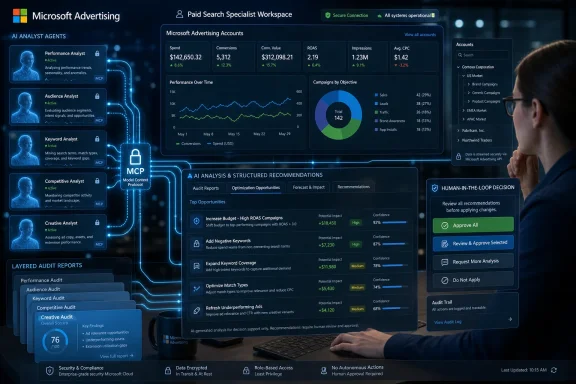
The real gain came from giving AI agents access to the repetitive analytical work around campaigns. Roberts said MCP enabled Stagwell to connect AI agents directly to live advertising data and workflows so they could analyze many campaigns at once, identify optimization opportunities, detect trends, surface insights, and automate audit and reporting processes. That is a different claim from “AI runs your campaigns.” It is closer to “AI does the first pass over the haystack so the expert can focus on the needles.”
This is the enterprise lesson buried inside the marketing story. In mature software categories, professionals often do not need a new interface as much as they need more leverage. A paid-search expert may not be slow because the buttons are hard to find. The expert is slow because the accounts, markets, campaigns, and reporting obligations multiply faster than human review cycles can keep up.
The pilot’s emphasis on auditing, reporting, optimization, and opportunity discovery is therefore significant. Those workflows are information-heavy, repetitive, and judgment-adjacent. They are exactly the kind of work where an agent can be useful without becoming the final authority.
The key shift is from conversational AI as a standalone destination to agentic AI as a connected layer in an existing workflow. Stagwell is not describing a practitioner logging into yet another dashboard to ask a general-purpose assistant what to do. The Copilot agent “sits alongside” the practitioner and can access live Microsoft Advertising data in real time.
For enterprise IT, that is the part that should draw attention. The practical challenge of AI adoption has never been merely whether a model can produce text. It is whether the model can be connected to business systems in a controlled enough way to deliver value without creating a governance nightmare.
In this pilot, the agent could translate natural-language requests into API calls, retrieve campaign data, analyze performance, and return structured recommendations. That is a concise description of what many companies now want from AI: not a clever paragraph generator, but a governed interface between human intent and operational data.
The risk is that every one of those verbs has enterprise implications. Translating a request into an API call requires permissions, context, and boundaries. Retrieving campaign data raises questions about access control and data scope. Analyzing performance requires rules, assumptions, and repeatability. Returning structured recommendations creates a record that clients and teams may treat as work product.
That is why the “secure connection layer” framing matters. If MCP becomes part of how agents connect to business APIs, then the architecture around the agent becomes as important as the model behind it. The question is no longer simply whether Copilot can understand a prompt. It is whether the organization can define what Copilot is allowed to see, what it is allowed to do, and how its recommendations flow back into human-controlled processes.
A demo can be impressive with curated examples. A live campaign environment is messier. Accounts vary, markets behave differently, reporting conventions accumulate, and campaign structures often reflect years of human decisions. An agent that can ingest live campaign data and apply Assembly’s audit frameworks across accounts, markets, and campaigns is not merely answering questions; it is being inserted into the agency’s operating rhythm.
The phrase “Assembly’s audit frameworks” is also important. The pilot did not ask a generic AI system to invent an advertising strategy from scratch. It applied an existing agency framework automatically. That is the difference between outsourcing judgment and scaling a defined practice.
This is likely where a great deal of enterprise AI value will appear first. Companies already have ways they want work done: audit checklists, review cadences, reporting templates, escalation patterns, client standards, risk controls, and optimization heuristics. The hard part is that applying those frameworks at scale is labor-intensive. An agent that can do that repeatably across a large body of live data becomes valuable without needing to become “creative” in the popular sense.
The pilot’s example instruction captures the point: “review all Microsoft Ads campaigns and identify the largest optimization opportunities.” In the article’s account, the agent accesses campaign data, runs the audit logic, determines where issues or opportunities exist, and produces an audit in minutes rather than requiring a manual review.
That is not magic. It is automation connected to context. But in a large agency environment, shaving manual review cycles from recurring campaign audits can be more valuable than a flashy chat interface that performs tasks humans already handle well.
That boundary is not rhetorical decoration. It is the difference between an AI agent as a specialist colleague and an AI agent as an unaccountable operator. Roberts used the colleague metaphor directly, saying the agent can review more data, more frequently, than any individual practitioner, while keeping humans fully in control of decision-making.
This is where the marketing-technology story turns into a broader enterprise-software story. The first durable wave of agentic AI may not be defined by systems that act entirely alone. It may be defined by systems that perform bounded, repeatable analysis inside human decision loops.
That is not a lesser ambition. It is probably the more realistic one. Most businesses do not lack decisions; they lack clean, timely, comprehensive preparation for those decisions. If the agent can surface trends, flag anomalies, identify missed opportunities, and assemble client-ready audit material, it changes the speed and texture of human work without erasing human accountability.
The human-in-the-loop language also answers a growing concern among IT and compliance teams. AI tools become dangerous when their authority is ambiguous. If a system recommends a budget shift, a bid change, a targeting adjustment, or a campaign restructuring, someone must know whether that recommendation is advisory or executable.
Stagwell’s reported implementation keeps that line visible. Outputs are returned as client audits and optimization recommendations. Marketers remain in control of all decisions. In practice, that means the system’s value depends not only on its analytical capability but on the workflow design that prevents recommendation from quietly becoming action.
Those claims are broad, and broad AI platform claims often blur into marketing language. The Microsoft Advertising pilot gives The Media Machine a more concrete proof point. Instead of saying that agents can transform media workflows in general, Stagwell can point to a specific paid-search use case: live Microsoft Advertising data, Assembly workflows, Copilot, MCP, audits, recommendations, and minutes-long turnaround.
That specificity matters because “agentic operating system” is an ambitious phrase. It implies orchestration across multiple tasks, platforms, and decision points. But the business value of such a system is not established by naming the category; it is established by showing where a workflow became faster, more consistent, or more scalable.
The Media Machine’s reported scope also reveals why Stagwell would care about a protocol-level connection to Microsoft Advertising APIs. Media planning, buying, and reporting do not live inside a single clean application. They span platforms, networks, client requirements, performance data, and internal agency methods. An AI layer that cannot connect to those systems is just a consultant with no files.
The Microsoft Copilot integration therefore becomes an early example of how agentic media systems may be assembled: not as one omniscient AI, but as multiple agents attached to specific operational domains. In this version, the paid-search agent does not need to be the universal marketer. It needs to be good at reading campaign data, applying audit frameworks, finding opportunities, and producing structured recommendations.
That is a much more believable architecture than the idea of one chat interface swallowing an entire media operation. It is also easier for IT teams to govern. Bounded agents can be scoped, monitored, tested, and improved against known workflows.
That may reflect overlapping internal initiatives, naming ambiguity, or imprecise phrasing in the source account. What can be stated safely is narrower: GALE led development of The Media Machine in collaboration with Assembly and Stagwell Media Platform; the article also says Code and Theory built the company’s first agentic operating system; and Stagwell is presented as having two agentic systems. The public naming and build-credit boundaries are less clean than the pilot workflow itself.
The ambiguity does not undercut the central finding of the pilot, but it does matter for readers trying to understand Stagwell’s platform strategy. “Agentic system” is still an emerging category, and companies are using the language before the market has settled on crisp distinctions. A holding-company-level operating system, a media-specific lifecycle platform, and a Copilot-connected paid-search workflow may be related layers rather than separate products.
For customers and IT buyers, the lesson is to ask architecture questions rather than accept category labels. Which system owns the workflow? Which agency built or maintains it? Which agent touches which data? Which APIs are involved? Where does human approval occur? The more agentic systems multiply, the more those questions become the difference between a governed deployment and a branding exercise.
The distinction is subtle but important. A user-facing Copilot that drafts text or answers questions is useful, but it is easy for customers to treat it as an optional productivity add-on. A Copilot agent that can retrieve live campaign data, run audit logic, and return structured recommendations starts to look more like operational middleware.
That is where Microsoft’s broader enterprise advantage tends to reside: identity, permissions, business applications, developer ecosystems, and APIs. The Stagwell example fits that pattern. The value does not come from Copilot being charming in conversation. It comes from Copilot being close enough to Microsoft Advertising data to do structured work and constrained enough that humans keep authority.
The Model Context Protocol detail is also notable because it frames the integration around an open standard rather than a one-off connector. In the source material, MCP is not presented as a consumer feature; it is the mechanism that lets the agent connect securely to advertising APIs. That is the sort of plumbing that decides whether agentic AI can move beyond isolated demos.
If Microsoft can make Copilot useful in specialized workflows without requiring users to abandon their existing tools, it changes the adoption pitch. The question shifts from “Will your employees use another AI interface?” to “Can AI be embedded into the workflow they already trust?” Stagwell’s answer, at least in this pilot, appears to be yes.
But speed alone undersells the change. Roberts’ “specialist colleague” framing emphasizes that the agent can review more data, more frequently, than any individual practitioner. Frequency may be the more important metric.
Manual audits are constrained by time, staffing, client priorities, and fatigue. Teams choose where to look because they cannot look everywhere all the time. That means some optimization opportunities are found late, some trends are noticed only after they become obvious, and some reporting work becomes backward-looking rather than operationally useful.
An agentic audit layer changes that cadence. If the system can repeatedly ingest live campaign data, apply the same audit frameworks, and surface structured recommendations, the agency can move from episodic review toward continuous review. The human team still decides what to do, but it receives a denser and more current stream of analysis.
That has consequences for client service. Client audits and optimization recommendations are not merely internal artifacts; they are part of how agencies prove value. A faster audit loop can make account teams more responsive, but a more frequent audit loop can make them more proactive.
The strategic advantage, then, is not just labor savings. It is the ability to detect patterns earlier and apply expert frameworks more consistently across fragmented campaign environments. In paid search, where performance shifts can be granular and fast-moving, that consistency can be a meaningful differentiator.
The pilot appears to have succeeded because it did not ask AI to define the job from scratch. It placed AI inside a known expert process. Assembly already had paid-search workflows and audit frameworks. Microsoft Advertising already had live campaign data exposed through APIs. Practitioners already knew how to evaluate recommendations and make decisions. Copilot and MCP were inserted into that structure.
That is a pattern IT leaders should recognize. The best candidates for agentic AI are often not the most glamorous tasks. They are recurring workflows where the organization already knows what good looks like, but the work is too voluminous, too repetitive, or too time-sensitive for humans to perform exhaustively.
This also explains why “chat to manage campaigns” may have disappointed as an initial idea. Conversational control can be useful, but it does not automatically add expertise. If a practitioner can already create or edit campaigns efficiently, chat may simply replace a familiar interface with a slower one. The deeper value appears when the agent does something the practitioner cannot practically do at scale: review large numbers of campaigns simultaneously and continuously.
For agencies, that means AI adoption should begin with workflow archaeology. Where do teams spend hours applying the same review logic? Which reports are necessary but repetitive? Which opportunity checks are valuable but performed too rarely? Which client deliverables depend on assembling facts from multiple accounts or markets? Those are the seams where agents can create leverage.
That makes identity and permissions central. The agent should not become a shared super-user with vague authority. Its access should map to the practitioner, team, account, market, and workflow boundaries the business already uses. If it can retrieve campaign data across accounts, leaders should know why, under whose authority, and with what logging.
Auditability matters as much as access. If the agent produces a client audit or optimization recommendation, the organization needs to understand the input data, the audit framework applied, the time of analysis, and the human decision that followed. Otherwise, the agent’s output becomes difficult to defend when a recommendation is questioned.
There is also a change-management issue. A tool that “sits alongside” practitioners can be adopted more naturally than a separate platform, but embedded tools can also become invisible. Teams may start to rely on generated audits without thinking carefully about edge cases, stale assumptions, or missing context.
The correct answer is not to block these systems. It is to govern them like serious operational software. The pilot’s human-control boundary is a good starting point, but enterprises will need policies that turn that boundary into daily practice.
That can be good news for senior practitioners and dangerous news for work that consists mainly of assembling reports or performing first-pass reviews. Stagwell’s public framing is deliberately augmentation-first, and Roberts’ comments emphasize humans remaining in control. But augmentation still changes what human work is worth.
In the old model, a team’s capacity was partly determined by how many accounts it could manually review and report on. In the emerging model, agents may expand the review surface dramatically. The limiting factor becomes not whether the team can generate an audit, but whether it can prioritize the recommendations, explain them to clients, and execute the right changes.
That should push agencies to become more explicit about their expertise. If the agent can apply an audit framework automatically, the competitive advantage moves into the quality of the framework, the speed of interpretation, and the credibility of human recommendations. The agency’s “secret sauce” cannot be merely that it has people who can look through platforms manually.
This also changes training. Junior practitioners have often learned by doing repetitive analysis. If agents absorb more of that work, agencies will need to ensure newer staff still learn how to evaluate the output, spot errors, and understand the mechanics beneath the recommendation. Otherwise, the industry risks producing operators who can accept AI-generated audits but cannot challenge them.
The best version of this future is not fewer skilled marketers. It is more marketers spending less time compiling evidence and more time exercising judgment. The worst version is a hollowed-out skills pipeline hidden under polished AI reports.
By keeping the pilot focused on audits, reports, optimization opportunities, and discovery, Stagwell and Microsoft are operating in a safer and more immediately useful zone. The agent can widen the field of view. It can reduce the time between data and insight. It can standardize first-pass review. But it does not become the signer of the check.
This is also where enterprise buyers should be skeptical of louder claims elsewhere in the market. “Autonomous” sounds powerful in a pitch deck, but many business workflows do not become better simply because a machine can act without asking. In complex professional environments, the valuable feature is often bounded initiative: the system goes looking, finds patterns, prepares options, and hands the decision back to a person.
That is the model Roberts described. The agent is a specialist colleague, not a replacement practitioner. It reviews more data, more frequently, than an individual can. The human remains responsible for deciding.
If this pattern holds, the next phase of enterprise AI will be less about replacing interfaces and more about surrounding existing interfaces with analytical agents. The professional still uses familiar platforms, but the background work changes. The agent prepares, flags, summarizes, and recommends. The expert decides, explains, and acts.
But the Microsoft Advertising pilot is still only one slice of that larger ambition. A controlled paid-search workflow connected to Microsoft Advertising APIs is a meaningful proof point, not proof that every platform and every workflow will behave the same way. Different networks have different data models, permissions, reporting structures, policy constraints, and optimization logic.
The more cross-platform an agentic system becomes, the more complicated the governance becomes. It must normalize data without flattening important platform differences. It must generate recommendations that make sense within each network’s rules. It must avoid presenting cross-platform certainty where the underlying data does not support it.
That is why Stagwell’s use of Assembly’s audit frameworks is so important. Cross-platform activation cannot depend only on the model’s general reasoning. It needs codified media expertise that can be applied appropriately in each environment. The agent may be the execution layer for analysis, but the quality of the system depends on the human-designed frameworks it applies.
The Microsoft pilot therefore should be read as a foundation, not a finish line. It demonstrates that agentic analysis can be connected to live campaign workflows in a bounded way. Scaling that across Google, Meta, TikTok, and other networks will require many more such bounded integrations, each with its own controls and assumptions.
In IT operations, the equivalent might be reviewing device compliance data, surfacing patch-risk patterns, summarizing endpoint health, or preparing change-management reports. In finance, it might be variance analysis. In support, it might be case triage. In security, it might be recurring control review. The common thread is not the domain; it is the workflow shape.
The Stagwell pilot shows the workflow shape clearly. A human asks for a review in natural language. The agent turns that request into API activity. It retrieves live data. It applies a known framework. It returns structured recommendations. Humans decide.
That is the version of agentic AI most likely to survive contact with enterprise reality. It does not require pretending that AI should independently run sensitive operations. It also does not reduce AI to a passive chatbot. It places the system in the middle: active enough to gather and analyze, constrained enough to remain governable.
For Microsoft customers, the Copilot angle is particularly relevant because it suggests how Microsoft may continue positioning Copilot across business processes. The winning argument will not be that every employee gets a smarter text box. It will be that Copilot can become an embedded agent layer across Microsoft-connected workflows, provided organizations can manage access, approvals, and audit trails.
The Stagwell pilot is a useful corrective to one of the lazier assumptions about AI in advertising: that the breakthrough will be a conversational interface where a marketer types commands and the machine edits campaigns. According to Dan Roberts, global senior vice president of search for Stagwell Media Platform, the pilot showed something more prosaic and more valuable. Experienced marketers, he told MediaPost, are already efficient inside existing advertising interfaces; the bottleneck is not always execution, but the amount of live data a human team can review repeatedly, consistently, and quickly.
That is why this story belongs less in the “chatbot replaces worker” file than in the “software eats repetitive analysis” file. Stagwell’s Copilot integration points toward a near-term enterprise AI model in which agents are not autonomous executives but embedded analysts: close to the APIs, governed by known workflows, and useful precisely because the final decision still belongs to a human.
 The Pilot Found Value Where the AI Hype Wasn’t Looking
The most revealing line in MediaPost’s report is not the claim that StagwellMedia Platform became the first to integrate Microsoft Copilot through Model Context Protocol. It is Roberts’ answer when asked whether marketers entered the pilot with specific expectations. “Yes and no,” he said, before explaining that many people initially assumed AI’s advertising value would come from conversational campaign management.That assumption was understandable. The public-facing image of generative AI has been dominated by chat: ask a question, get an answer; request a change, receive a draft; tell the system to act, watch it respond. In an advertising platform, the obvious extension is a chat window that creates, edits, or manages campaigns.
Stagwell’s pilot suggests that the obvious extension may not be the best one. Roberts told MediaPost that experienced marketers are already “highly efficient” at those campaign-management tasks through existing platform interfaces. In other words, replacing a seasoned paid-search practitioner’s muscle memory with a chat prompt is not automatically an upgrade.
The real gain came from giving AI agents access to the repetitive analytical work around campaigns. Roberts said MCP enabled Stagwell to connect AI agents directly to live advertising data and workflows so they could analyze many campaigns at once, identify optimization opportunities, detect trends, surface insights, and automate audit and reporting processes. That is a different claim from “AI runs your campaigns.” It is closer to “AI does the first pass over the haystack so the expert can focus on the needles.”
This is the enterprise lesson buried inside the marketing story. In mature software categories, professionals often do not need a new interface as much as they need more leverage. A paid-search expert may not be slow because the buttons are hard to find. The expert is slow because the accounts, markets, campaigns, and reporting obligations multiply faster than human review cycles can keep up.
The pilot’s emphasis on auditing, reporting, optimization, and opportunity discovery is therefore significant. Those workflows are information-heavy, repetitive, and judgment-adjacent. They are exactly the kind of work where an agent can be useful without becoming the final authority.
MCP Turns Copilot From a Chat Surface Into a Workflow Layer
MediaPost described Microsoft Copilot in this integration as powered by the open standard protocol Model Context Protocol, with MCP embedded into Assembly Global’s paid-search workflow. In the article’s formulation, MCP can act as a secure connection layer between Microsoft Advertising APIs and AI agents. That phrasing is doing a lot of work.The key shift is from conversational AI as a standalone destination to agentic AI as a connected layer in an existing workflow. Stagwell is not describing a practitioner logging into yet another dashboard to ask a general-purpose assistant what to do. The Copilot agent “sits alongside” the practitioner and can access live Microsoft Advertising data in real time.
For enterprise IT, that is the part that should draw attention. The practical challenge of AI adoption has never been merely whether a model can produce text. It is whether the model can be connected to business systems in a controlled enough way to deliver value without creating a governance nightmare.
In this pilot, the agent could translate natural-language requests into API calls, retrieve campaign data, analyze performance, and return structured recommendations. That is a concise description of what many companies now want from AI: not a clever paragraph generator, but a governed interface between human intent and operational data.
The risk is that every one of those verbs has enterprise implications. Translating a request into an API call requires permissions, context, and boundaries. Retrieving campaign data raises questions about access control and data scope. Analyzing performance requires rules, assumptions, and repeatability. Returning structured recommendations creates a record that clients and teams may treat as work product.
That is why the “secure connection layer” framing matters. If MCP becomes part of how agents connect to business APIs, then the architecture around the agent becomes as important as the model behind it. The question is no longer simply whether Copilot can understand a prompt. It is whether the organization can define what Copilot is allowed to see, what it is allowed to do, and how its recommendations flow back into human-controlled processes.
Assembly’s Paid-Search Workflow Is the Real Test Bed
The pilot was not described as a sandbox disconnected from business operations. MediaPost reported that it was connected to live Microsoft Advertising campaigns operated by Assembly, Stagwell’s multichannel media agency. That matters because live data is where AI systems either become useful or expose their limits.A demo can be impressive with curated examples. A live campaign environment is messier. Accounts vary, markets behave differently, reporting conventions accumulate, and campaign structures often reflect years of human decisions. An agent that can ingest live campaign data and apply Assembly’s audit frameworks across accounts, markets, and campaigns is not merely answering questions; it is being inserted into the agency’s operating rhythm.
The phrase “Assembly’s audit frameworks” is also important. The pilot did not ask a generic AI system to invent an advertising strategy from scratch. It applied an existing agency framework automatically. That is the difference between outsourcing judgment and scaling a defined practice.
This is likely where a great deal of enterprise AI value will appear first. Companies already have ways they want work done: audit checklists, review cadences, reporting templates, escalation patterns, client standards, risk controls, and optimization heuristics. The hard part is that applying those frameworks at scale is labor-intensive. An agent that can do that repeatably across a large body of live data becomes valuable without needing to become “creative” in the popular sense.
The pilot’s example instruction captures the point: “review all Microsoft Ads campaigns and identify the largest optimization opportunities.” In the article’s account, the agent accesses campaign data, runs the audit logic, determines where issues or opportunities exist, and produces an audit in minutes rather than requiring a manual review.
That is not magic. It is automation connected to context. But in a large agency environment, shaving manual review cycles from recurring campaign audits can be more valuable than a flashy chat interface that performs tasks humans already handle well.
Human Control Is Not a Footnote; It Is the Product Boundary
The strongest feature of Stagwell’s description is what the pilot did not do. Roberts told MediaPost that the pilot focused primarily on auditing, reporting, optimization, and opportunity discovery rather than autonomous campaign management. The article also states that The Media Machine requires human insight for every decision.That boundary is not rhetorical decoration. It is the difference between an AI agent as a specialist colleague and an AI agent as an unaccountable operator. Roberts used the colleague metaphor directly, saying the agent can review more data, more frequently, than any individual practitioner, while keeping humans fully in control of decision-making.
This is where the marketing-technology story turns into a broader enterprise-software story. The first durable wave of agentic AI may not be defined by systems that act entirely alone. It may be defined by systems that perform bounded, repeatable analysis inside human decision loops.
That is not a lesser ambition. It is probably the more realistic one. Most businesses do not lack decisions; they lack clean, timely, comprehensive preparation for those decisions. If the agent can surface trends, flag anomalies, identify missed opportunities, and assemble client-ready audit material, it changes the speed and texture of human work without erasing human accountability.
The human-in-the-loop language also answers a growing concern among IT and compliance teams. AI tools become dangerous when their authority is ambiguous. If a system recommends a budget shift, a bid change, a targeting adjustment, or a campaign restructuring, someone must know whether that recommendation is advisory or executable.
Stagwell’s reported implementation keeps that line visible. Outputs are returned as client audits and optimization recommendations. Marketers remain in control of all decisions. In practice, that means the system’s value depends not only on its analytical capability but on the workflow design that prevents recommendation from quietly becoming action.
The Media Machine Is Bigger Than Microsoft Ads, But the Microsoft Pilot Makes It Concrete
In June, Stagwell externally launched The Media Machine, described by MediaPost as the holding company’s AI-powered agentic operating system. The system automates and optimizes media planning, buying, and reporting using more than 20 intelligent agents. It is intended to manage cross-platform activation across major networks such as Google, Meta, and TikTok.Those claims are broad, and broad AI platform claims often blur into marketing language. The Microsoft Advertising pilot gives The Media Machine a more concrete proof point. Instead of saying that agents can transform media workflows in general, Stagwell can point to a specific paid-search use case: live Microsoft Advertising data, Assembly workflows, Copilot, MCP, audits, recommendations, and minutes-long turnaround.
That specificity matters because “agentic operating system” is an ambitious phrase. It implies orchestration across multiple tasks, platforms, and decision points. But the business value of such a system is not established by naming the category; it is established by showing where a workflow became faster, more consistent, or more scalable.
The Media Machine’s reported scope also reveals why Stagwell would care about a protocol-level connection to Microsoft Advertising APIs. Media planning, buying, and reporting do not live inside a single clean application. They span platforms, networks, client requirements, performance data, and internal agency methods. An AI layer that cannot connect to those systems is just a consultant with no files.
The Microsoft Copilot integration therefore becomes an early example of how agentic media systems may be assembled: not as one omniscient AI, but as multiple agents attached to specific operational domains. In this version, the paid-search agent does not need to be the universal marketer. It needs to be good at reading campaign data, applying audit frameworks, finding opportunities, and producing structured recommendations.
That is a much more believable architecture than the idea of one chat interface swallowing an entire media operation. It is also easier for IT teams to govern. Bounded agents can be scoped, monitored, tested, and improved against known workflows.
Stagwell’s Own Description Leaves a Naming Tangle
MediaPost’s report contains an awkward detail that should not be ignored. It says Stagwell has two agentic systems, then describes The Media Machine as the company’s first agentic operating system built by Code and Theory and also as a media-specific, full-lifecycle agentic operating system built by GALE. Earlier in the same article, GALE is described as leading development of The Media Machine in collaboration with Assembly and Stagwell Media Platform.That may reflect overlapping internal initiatives, naming ambiguity, or imprecise phrasing in the source account. What can be stated safely is narrower: GALE led development of The Media Machine in collaboration with Assembly and Stagwell Media Platform; the article also says Code and Theory built the company’s first agentic operating system; and Stagwell is presented as having two agentic systems. The public naming and build-credit boundaries are less clean than the pilot workflow itself.
| System or description in MediaPost account | Named builder or lead | Stated scope | Relationship to the Microsoft Copilot pilot |
|---|---|---|---|
| The Media Machine, described as Stagwell’s first agentic operating system | Code and Theory | Company agentic operating system | Presented as part of Stagwell’s broader agentic systems context |
| The Media Machine, described as a media-specific, full-lifecycle agentic operating system | GALE, in collaboration with Assembly and Stagwell Media Platform | Media planning, buying, reporting, and cross-platform activation | Provides the media workflow environment around the Assembly paid-search pilot |
For customers and IT buyers, the lesson is to ask architecture questions rather than accept category labels. Which system owns the workflow? Which agency built or maintains it? Which agent touches which data? Which APIs are involved? Where does human approval occur? The more agentic systems multiply, the more those questions become the difference between a governed deployment and a branding exercise.
Microsoft Gets a More Useful Copilot Story Than “Chat With Your Campaigns”
For Microsoft, the Stagwell pilot is a better Copilot story than another generic promise that users can ask software questions in natural language. The reported implementation connects Copilot to Microsoft Advertising APIs through MCP and places it inside a live agency workflow. That gives Microsoft something it badly needs in enterprise AI: a use case where Copilot is not just a user interface, but a working participant in a business process.The distinction is subtle but important. A user-facing Copilot that drafts text or answers questions is useful, but it is easy for customers to treat it as an optional productivity add-on. A Copilot agent that can retrieve live campaign data, run audit logic, and return structured recommendations starts to look more like operational middleware.
That is where Microsoft’s broader enterprise advantage tends to reside: identity, permissions, business applications, developer ecosystems, and APIs. The Stagwell example fits that pattern. The value does not come from Copilot being charming in conversation. It comes from Copilot being close enough to Microsoft Advertising data to do structured work and constrained enough that humans keep authority.
The Model Context Protocol detail is also notable because it frames the integration around an open standard rather than a one-off connector. In the source material, MCP is not presented as a consumer feature; it is the mechanism that lets the agent connect securely to advertising APIs. That is the sort of plumbing that decides whether agentic AI can move beyond isolated demos.
If Microsoft can make Copilot useful in specialized workflows without requiring users to abandon their existing tools, it changes the adoption pitch. The question shifts from “Will your employees use another AI interface?” to “Can AI be embedded into the workflow they already trust?” Stagwell’s answer, at least in this pilot, appears to be yes.
The Real Productivity Gain Is Frequency, Not Just Speed
The article’s “minutes rather than manual review” example naturally invites a speed narrative. That is partly right. If an audit that once required manual review can be produced in minutes, the operational impact is obvious.But speed alone undersells the change. Roberts’ “specialist colleague” framing emphasizes that the agent can review more data, more frequently, than any individual practitioner. Frequency may be the more important metric.
Manual audits are constrained by time, staffing, client priorities, and fatigue. Teams choose where to look because they cannot look everywhere all the time. That means some optimization opportunities are found late, some trends are noticed only after they become obvious, and some reporting work becomes backward-looking rather than operationally useful.
An agentic audit layer changes that cadence. If the system can repeatedly ingest live campaign data, apply the same audit frameworks, and surface structured recommendations, the agency can move from episodic review toward continuous review. The human team still decides what to do, but it receives a denser and more current stream of analysis.
That has consequences for client service. Client audits and optimization recommendations are not merely internal artifacts; they are part of how agencies prove value. A faster audit loop can make account teams more responsive, but a more frequent audit loop can make them more proactive.
The strategic advantage, then, is not just labor savings. It is the ability to detect patterns earlier and apply expert frameworks more consistently across fragmented campaign environments. In paid search, where performance shifts can be granular and fast-moving, that consistency can be a meaningful differentiator.
Agentic AI Works Best When It Amplifies a Known Expert Process
Roberts’ most important conclusion is that the future is not AI replacing marketers, but AI amplifying them by removing repetitive analysis and helping them focus on strategy, optimization, and client outcomes. That is the cleanest statement of the pilot’s thesis, and it is more grounded than most AI transformation rhetoric.The pilot appears to have succeeded because it did not ask AI to define the job from scratch. It placed AI inside a known expert process. Assembly already had paid-search workflows and audit frameworks. Microsoft Advertising already had live campaign data exposed through APIs. Practitioners already knew how to evaluate recommendations and make decisions. Copilot and MCP were inserted into that structure.
That is a pattern IT leaders should recognize. The best candidates for agentic AI are often not the most glamorous tasks. They are recurring workflows where the organization already knows what good looks like, but the work is too voluminous, too repetitive, or too time-sensitive for humans to perform exhaustively.
This also explains why “chat to manage campaigns” may have disappointed as an initial idea. Conversational control can be useful, but it does not automatically add expertise. If a practitioner can already create or edit campaigns efficiently, chat may simply replace a familiar interface with a slower one. The deeper value appears when the agent does something the practitioner cannot practically do at scale: review large numbers of campaigns simultaneously and continuously.
For agencies, that means AI adoption should begin with workflow archaeology. Where do teams spend hours applying the same review logic? Which reports are necessary but repetitive? Which opportunity checks are valuable but performed too rarely? Which client deliverables depend on assembling facts from multiple accounts or markets? Those are the seams where agents can create leverage.
Where Enterprise IT Should Draw the Governance Map
The Stagwell pilot is a marketing-technology story, but the governance questions are universal. Any enterprise system that lets an AI agent translate natural-language requests into API calls must be treated as a new class of access layer. It may not be autonomous campaign management, but it is still connected to live operational data.That makes identity and permissions central. The agent should not become a shared super-user with vague authority. Its access should map to the practitioner, team, account, market, and workflow boundaries the business already uses. If it can retrieve campaign data across accounts, leaders should know why, under whose authority, and with what logging.
Auditability matters as much as access. If the agent produces a client audit or optimization recommendation, the organization needs to understand the input data, the audit framework applied, the time of analysis, and the human decision that followed. Otherwise, the agent’s output becomes difficult to defend when a recommendation is questioned.
There is also a change-management issue. A tool that “sits alongside” practitioners can be adopted more naturally than a separate platform, but embedded tools can also become invisible. Teams may start to rely on generated audits without thinking carefully about edge cases, stale assumptions, or missing context.
The correct answer is not to block these systems. It is to govern them like serious operational software. The pilot’s human-control boundary is a good starting point, but enterprises will need policies that turn that boundary into daily practice.
Action checklist for admins
- Define which users, teams, accounts, markets, and campaigns an AI agent may access before connecting it to live advertising data.
- Require logging for natural-language requests, resulting API calls, retrieved data, generated audits, and human approval decisions.
- Keep agent outputs advisory unless a separate, approved workflow explicitly authorizes execution.
- Validate the audit frameworks the agent applies, especially when used across multiple accounts, markets, or clients.
- Review client-facing outputs for accuracy, context, and explainability before they become deliverables.
- Establish a periodic access and performance review so the agent’s permissions and recommendations do not drift from business intent.
The Agency Model Starts to Shift From Labor Capacity to Judgment Capacity
The uncomfortable implication for agencies is that AI does not need to replace marketers to change the economics of marketing work. If agents can automate time-consuming audit and reporting processes, the value of a team shifts toward judgment, client strategy, and the ability to interpret and act on a larger volume of machine-surfaced insight.That can be good news for senior practitioners and dangerous news for work that consists mainly of assembling reports or performing first-pass reviews. Stagwell’s public framing is deliberately augmentation-first, and Roberts’ comments emphasize humans remaining in control. But augmentation still changes what human work is worth.
In the old model, a team’s capacity was partly determined by how many accounts it could manually review and report on. In the emerging model, agents may expand the review surface dramatically. The limiting factor becomes not whether the team can generate an audit, but whether it can prioritize the recommendations, explain them to clients, and execute the right changes.
That should push agencies to become more explicit about their expertise. If the agent can apply an audit framework automatically, the competitive advantage moves into the quality of the framework, the speed of interpretation, and the credibility of human recommendations. The agency’s “secret sauce” cannot be merely that it has people who can look through platforms manually.
This also changes training. Junior practitioners have often learned by doing repetitive analysis. If agents absorb more of that work, agencies will need to ensure newer staff still learn how to evaluate the output, spot errors, and understand the mechanics beneath the recommendation. Otherwise, the industry risks producing operators who can accept AI-generated audits but cannot challenge them.
The best version of this future is not fewer skilled marketers. It is more marketers spending less time compiling evidence and more time exercising judgment. The worst version is a hollowed-out skills pipeline hidden under polished AI reports.
Why “No Autonomous Campaign Management” Is the Most Important Product Claim
It is tempting to treat the absence of autonomous campaign management as a limitation. In reality, it may be the feature that makes the system deployable. Paid media campaigns involve budgets, client commitments, brand risk, performance targets, and market-specific assumptions. Allowing an AI agent to directly manage campaigns without human control would raise a different class of operational and reputational risk.By keeping the pilot focused on audits, reports, optimization opportunities, and discovery, Stagwell and Microsoft are operating in a safer and more immediately useful zone. The agent can widen the field of view. It can reduce the time between data and insight. It can standardize first-pass review. But it does not become the signer of the check.
This is also where enterprise buyers should be skeptical of louder claims elsewhere in the market. “Autonomous” sounds powerful in a pitch deck, but many business workflows do not become better simply because a machine can act without asking. In complex professional environments, the valuable feature is often bounded initiative: the system goes looking, finds patterns, prepares options, and hands the decision back to a person.
That is the model Roberts described. The agent is a specialist colleague, not a replacement practitioner. It reviews more data, more frequently, than an individual can. The human remains responsible for deciding.
If this pattern holds, the next phase of enterprise AI will be less about replacing interfaces and more about surrounding existing interfaces with analytical agents. The professional still uses familiar platforms, but the background work changes. The agent prepares, flags, summarizes, and recommends. The expert decides, explains, and acts.
The Cross-Platform Ambition Will Be Harder Than the Microsoft Pilot
The Media Machine is described as managing cross-platform activation across major networks like Google, Meta, and TikTok. That ambition is strategically logical because media work is inherently cross-platform. Clients do not experience their budgets as isolated platform silos; they experience outcomes across channels.But the Microsoft Advertising pilot is still only one slice of that larger ambition. A controlled paid-search workflow connected to Microsoft Advertising APIs is a meaningful proof point, not proof that every platform and every workflow will behave the same way. Different networks have different data models, permissions, reporting structures, policy constraints, and optimization logic.
The more cross-platform an agentic system becomes, the more complicated the governance becomes. It must normalize data without flattening important platform differences. It must generate recommendations that make sense within each network’s rules. It must avoid presenting cross-platform certainty where the underlying data does not support it.
That is why Stagwell’s use of Assembly’s audit frameworks is so important. Cross-platform activation cannot depend only on the model’s general reasoning. It needs codified media expertise that can be applied appropriately in each environment. The agent may be the execution layer for analysis, but the quality of the system depends on the human-designed frameworks it applies.
The Microsoft pilot therefore should be read as a foundation, not a finish line. It demonstrates that agentic analysis can be connected to live campaign workflows in a bounded way. Scaling that across Google, Meta, TikTok, and other networks will require many more such bounded integrations, each with its own controls and assumptions.
The Lesson for Windows and Microsoft Shops Is Bigger Than Advertising
WindowsForum readers may not run paid-search campaigns, but the pattern should look familiar to anyone managing Microsoft-heavy environments. A Copilot-connected agent that uses a protocol layer to reach live business data, applies an established framework, and returns structured recommendations is not an advertising-only idea. It is a template.In IT operations, the equivalent might be reviewing device compliance data, surfacing patch-risk patterns, summarizing endpoint health, or preparing change-management reports. In finance, it might be variance analysis. In support, it might be case triage. In security, it might be recurring control review. The common thread is not the domain; it is the workflow shape.
The Stagwell pilot shows the workflow shape clearly. A human asks for a review in natural language. The agent turns that request into API activity. It retrieves live data. It applies a known framework. It returns structured recommendations. Humans decide.
That is the version of agentic AI most likely to survive contact with enterprise reality. It does not require pretending that AI should independently run sensitive operations. It also does not reduce AI to a passive chatbot. It places the system in the middle: active enough to gather and analyze, constrained enough to remain governable.
For Microsoft customers, the Copilot angle is particularly relevant because it suggests how Microsoft may continue positioning Copilot across business processes. The winning argument will not be that every employee gets a smarter text box. It will be that Copilot can become an embedded agent layer across Microsoft-connected workflows, provided organizations can manage access, approvals, and audit trails.
The Signal Inside Stagwell’s Pilot
The most concrete message from the Stagwell pilot is that agentic AI becomes useful when it is attached to live data, bounded by existing workflows, and kept inside human decision loops. The story is less dramatic than autonomous marketing and more consequential than chatbot convenience.- StagwellMedia Platform integrated Microsoft Copilot through Model Context Protocol into Assembly Global’s paid-search workflow.
- The pilot used live Microsoft Advertising campaigns operated by Assembly, not merely sample data.
- The focus was auditing, reporting, optimization, and opportunity discovery rather than autonomous campaign management.
- Copilot could translate natural-language requests into API calls, retrieve campaign data, analyze performance, and return structured recommendations.
- The agent applied Assembly’s audit frameworks across accounts, markets, and campaigns, producing client audits and optimization recommendations.
- Stagwell’s stated direction is augmentation: AI reviewing more data more often while humans retain control over decisions.
References
- Primary source: MediaPost
Published: 2026-07-07T20:50:14.594376
Stagwell Discovers Where Agent Performance Comes From 07/07/2026
Stagwell Discovers Where Agent Performance Comes From - 07/07/2026www.mediapost.com
