

Stagwell said on June 23, 2026, that its Assembly media agency has embedded Microsoft 365 Copilot into live Microsoft Advertising paid-search campaigns using Microsoft’s Model Context Protocol, moving AI assistance from experimental marketing workflows into active client campaign operations. That matters because the announcement is not really about a chatbot writing ad copy. It is about Microsoft, Stagwell, and Assembly trying to make AI an operating layer for campaign management itself. If it works, the pitch to advertisers changes from “we have AI tools” to “our media operation audits, optimizes, and reports differently because AI is wired into the machinery.”
The marketing industry has spent the past two years bathing in AI language. Every holding company has had a platform, every agency group has had a lab, and every earnings call has found a way to place “AI-enabled” near “margin expansion.” Stagwell’s announcement with Microsoft is notable because it is more specific than the usual agency-deck incantation.
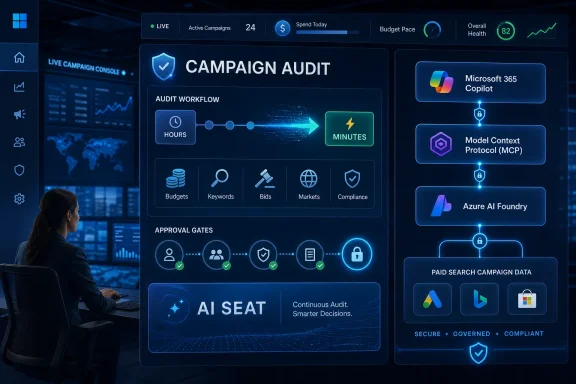
Assembly is using Microsoft 365 Copilot, Microsoft Advertising’s Model Context Protocol server, and Azure AI Foundry to connect an AI agent directly to paid-search campaign data and workflows. The claimed result is a campaign audit process that moves from hours to minutes, with broader market coverage and more continuous optimization. That is the kind of claim advertisers and procurement teams can interrogate.
The distinction matters. A creative brainstorm powered by generative AI is interesting, but it sits at the edge of the media business. A Copilot agent that can inspect live campaign structures, surface anomalies, standardize recommendations, and produce client-ready outputs sits closer to the revenue engine.
For WindowsForum readers, the story is not that Copilot has discovered advertising. It is that Microsoft is continuing to push Copilot out of the familiar productivity window and into domain-specific work systems. The same pattern Microsoft has sold to office workers, developers, sales teams, and support desks is now being applied to paid media: connect the agent to the data, constrain it through enterprise tooling, and let it operate where the work already happens.
Paid search is a good test case because it is operationally dense. Campaigns are split across geographies, product lines, budgets, audiences, keywords, bidding strategies, landing pages, and approval chains. The work is repetitive enough to invite automation but consequential enough that advertisers do not want a black box freelancing with their money.
That is why Microsoft’s Model Context Protocol is central to the announcement. MCP is being positioned as a way for AI systems to connect securely to external tools and live data. In practical terms, it gives the agent a governed path into the systems where campaign information lives, rather than forcing employees to copy data into a prompt window and hope the model understands the context.
This is also where Microsoft’s enterprise advantage shows up. Google may dominate search advertising in scale, and the broader ad-tech market has no shortage of automation. But Microsoft can bundle identity, compliance, productivity software, Azure infrastructure, and advertising data into one story. For enterprise clients already living in Microsoft 365, that is a more comfortable narrative than “paste your campaign exports into a third-party AI tool.”
Stagwell, for its part, gets to tell clients that AI is not an overlay. It is embedded in the operating model of the agency. That phrasing may sound like agency-speak, but the underlying business question is real: can AI reduce the labor drag of campaign stewardship without reducing the quality of human judgment?
The headline metric — audits moving from hours to minutes — is useful because audits are one of the less glamorous but more important parts of media execution. A paid-search account can look healthy at a high level while hiding issues in market-level structures, budget pacing, keyword coverage, bidding settings, tracking, or recommendation consistency. Human experts can catch those problems, but at global scale they are always rationing attention.
If Copilot can widen the audit surface, Assembly can plausibly tell clients that more markets are being checked more frequently. That does not automatically mean better performance, but it changes the cadence of management. Campaign governance shifts from periodic inspection to something closer to continuous surveillance.
That phrase will make some people uneasy, and it should. Continuous AI-enabled auditing raises questions about explainability, responsibility, and false confidence. A recommendation that arrives faster is not necessarily a better recommendation. But in agency operations, speed and consistency are not trivial advantages; they are the difference between a system that depends on heroic senior operators and one that scales across teams.
The strongest version of Stagwell’s case is not that AI replaces media strategists. It is that AI handles enough of the inspection and formatting work to let senior people spend more time on budget strategy, client interpretation, competitive context, and new briefs. The weakest version is that AI becomes another dashboard layer that junior staff must babysit while senior staff are told to produce more with less.
Instead of trying to win the AI advertising narrative only at the campaign surface, Microsoft is pushing agentic infrastructure. The Stagwell case study ties together Microsoft 365 Copilot, the Microsoft Advertising MCP server, and Azure AI Foundry. That is a stack argument, not merely a media argument.
The message to agencies is clear: Microsoft wants Copilot to be the interface through which marketers reason over campaign data, generate recommendations, and produce outputs. The message to advertisers is subtler: if your organization already trusts Microsoft for identity, productivity, and cloud governance, then Microsoft would like to be trusted with the AI layer that touches your advertising workflows too.
This is why the integration is more strategically interesting than a feature announcement inside Microsoft Advertising. It turns Copilot into a bridge between office productivity and media execution. The person reviewing campaign recommendations may still be in Microsoft 365, but the underlying agent is connected to advertising systems and live campaign data.
For Microsoft, that is exactly the kind of cross-product connective tissue Copilot needs. The company has spent heavily to make AI feel native across its product line. The risk has always been that Copilot becomes a button everyone sees and not enough people depend on. Integrations like this are meant to make Copilot less optional.
Media agencies are labor-intensive businesses under constant fee pressure. Clients want more markets, more platforms, more formats, faster reporting, and sharper optimization, often without commensurate increases in retainer budgets. AI promises a way to absorb complexity without adding headcount at the same rate.
That is why Stagwell’s focus on live workflow matters for investors. An AI demo does not change an agency’s cost structure. A repeatable system that compresses audit time, standardizes outputs, and helps teams manage more accounts per specialist might.
The difficult part is proving it beyond isolated case studies. Agency groups are federated organisms, often built through acquisitions, each with its own tools, habits, client relationships, and operational politics. A workflow that works inside Assembly for a particular global enterprise technology client may not immediately translate across every Stagwell agency, market, or media channel.
This is where the investor narrative can get ahead of the operational reality. “AI-enabled efficiency” sounds clean in a valuation model. In practice, the savings depend on adoption, training, governance, integration, client approval, and the willingness of teams to trust recommendations without becoming complacent.
In Stagwell’s case, MCP is the connective layer between Copilot and Microsoft Advertising systems. That allows the agent to operate with current campaign information rather than stale exports. For paid media, that distinction is essential; yesterday’s data can already be out of date when budgets are shifting, competitors are bidding, and campaigns are pacing unevenly.
The protocol framing also gives Microsoft a useful response to enterprise skepticism. Companies do not want employees improvising with sensitive marketing data inside consumer AI tools. They want access control, auditability, and predictable integration patterns. MCP lets Microsoft describe the work in the language of enterprise architecture rather than prompt engineering.
There is still a gap between “securely connects” and “is operationally safe.” A connected agent can misunderstand, overgeneralize, or recommend actions that make sense statistically but not commercially. Guardrails, approvals, human review, and logging will determine whether these systems earn trust in production.
Still, the direction is hard to miss. The AI race is moving from model capability to tool integration. In that world, the company that controls the workflow surface has leverage. Microsoft wants Copilot to be that surface.
For sysadmins, the lesson is that Copilot adoption will not always arrive as a neat application rollout. It may appear through a department’s SaaS platform, a vendor integration, a Teams workflow, a Microsoft 365 agent, an Azure-backed tool, or an industry-specific connector. The governance challenge is broader than deciding whether employees can use Copilot Chat.
Marketing departments are often early adopters of workflow AI because they sit at the intersection of data, content, performance pressure, and vendor abundance. But the same pattern applies elsewhere. Finance teams will want agents connected to planning systems. Legal teams will want document intelligence. Support teams will want ticket and knowledge-base automation. Security teams will want investigation copilots.
The Stagwell case is a useful preview because the stakes are concrete. Money is being spent in live campaigns. Recommendations affect performance. Client trust is on the line. That is a more revealing environment than a controlled productivity demo.
Windows administrators should read this as another signal that Microsoft’s AI layer will increasingly touch operational systems beyond the desktop. The question will not be whether Copilot exists in the tenant. The question will be which business processes it can reach, what data it can see, what actions it can trigger, and who is accountable when it is wrong.
The productivity story becomes credible when it survives contact with messy measurement. If Assembly can show reduced audit cycle times, fewer missed anomalies, faster client reporting, improved budget pacing, or better campaign outcomes, the integration becomes more than a Microsoft showcase. If the gains remain anecdotal, it risks joining the long list of AI announcements that sounded transformational until procurement asked for evidence.
There is also the problem of baseline inflation. Many agency tasks were already being automated before generative AI entered the frame. Scripts, rules, bulk editors, bidding algorithms, dashboards, and third-party optimization tools have been part of paid search for years. Copilot must be judged against that existing automation, not against a fictional world where every task was done manually from scratch.
The most credible interpretation is that Copilot may improve the coordination layer of media operations. It can summarize, inspect, standardize, reason across fragmented data, and generate outputs in a familiar work environment. That is valuable, but it is not magic.
For Stagwell, the opportunity is to turn those coordination gains into a repeatable operating advantage. For clients, the test is whether they see better stewardship rather than merely faster decks. For Microsoft, the test is whether Copilot becomes indispensable inside a revenue-generating workflow instead of remaining a helpful assistant at the edge.
Automation drift happens when teams gradually adapt their judgment to the system’s outputs. A recommendation engine becomes the default framing. A standardized audit becomes the definition of diligence. An AI-generated client summary becomes the version of reality everyone discusses. Over time, the organization may notice fewer things outside the tool’s field of view.
This is not unique to AI. Dashboards did it. Programmatic bidding systems did it. SEO tools did it. The difference is that generative AI is more persuasive because it explains itself in fluent language. A bad chart looks like a bad chart; a bad AI recommendation can sound like a competent analyst having a good day.
The antidote is not to keep AI out of live workflows. That is unrealistic and probably undesirable. The antidote is to design review processes that preserve dissent, sampling, and accountability. Agencies should know when the agent is uncertain, when data is incomplete, and when a recommendation conflicts with client strategy.
Clients should also resist the temptation to treat AI-supported operations as an excuse to squeeze fees without understanding what human expertise is being preserved. If the agency removes too much judgment from the system, the short-term efficiency gain may become a long-term performance tax.
That is a difficult transformation to pull off. Services firms often talk like software companies because software companies command better multiples. But the economics of agency work remain tied to clients, people, scopes, contracts, and execution quality. Technology can improve those economics, but it does not erase them.
The Assembly-Microsoft work gives Stagwell a tangible example to put in front of clients. It can say: here is a live campaign workflow, here is the Microsoft infrastructure, here is the audit-time reduction, here is how the work changes for practitioners. That is more persuasive than a generic AI manifesto.
The question is whether Stagwell can make this repeatable across agencies and clients. Assembly’s global paid-search operations are a logical starting point because the workflow is structured and data-rich. Creative development, brand strategy, influencer management, and integrated campaign planning may be harder to standardize.
Still, the direction is coherent. Stagwell does not need every part of the business to become software-like overnight. It needs enough operational proof points to convince clients that its agencies can deliver more speed and consistency without flattening strategic thinking. The Copilot integration is one such proof point.
In traditional agency work, responsibility is already distributed. Platforms supply tools, agencies manage campaigns, clients approve budgets, and algorithms optimize auctions. AI adds another layer of reasoning between data and action. That layer must be visible enough for people to challenge it.
The Stagwell announcement emphasizes audits, analysis, and client-ready outputs rather than autonomous budget changes. That is a sensible place to begin. AI can accelerate the diagnostic and reporting loop while humans remain responsible for decisions that materially affect spend.
But the industry’s direction is clearly toward more agentic execution. Once a system can analyze campaigns continuously, the next pressure will be to let it recommend more often, then implement low-risk changes, then manage defined optimization bands. Each step may look reasonable on its own. Together, they shift the operating model.
That shift will require new client language in contracts and scopes of work. Advertisers will want to know what AI tools are used, what data they access, how recommendations are reviewed, how errors are handled, and whether AI-enabled efficiency changes pricing. Agencies that answer those questions clearly will have an advantage over those that hide behind platform branding.
The timing also fits Microsoft’s broader push to make Copilot extensible. The company has been expanding connectors, agent-building tools, and Azure AI services so customers can adapt Copilot to their own workflows. A paid-search integration gives Microsoft a concrete example of that strategy outside the usual IT and office-productivity demos.
There is competitive logic here too. If Microsoft can make Copilot the place where marketers inspect and act on Microsoft Advertising data, it strengthens the platform relationship. If agencies build repeatable workflows around Microsoft’s MCP server and Azure AI Foundry, Microsoft gains stickiness beyond media spend.
The danger is overextension. Microsoft has attached the Copilot brand to so many surfaces that customers can struggle to understand what Copilot means in any given context. Is it a chat assistant, an agent platform, an embedded feature, a workflow automation layer, or a licensing bundle? The answer is increasingly “all of the above,” which is powerful but messy.
The Stagwell example helps because it is concrete. Copilot is connected to campaign data. It performs audits and analysis. It helps produce outputs. That is easier to understand than another abstract promise about AI transformation.
But the timing should not obscure the operational substance. The ad industry has a habit of turning every new technology into a festival talking point before the hard implementation work begins. The difference here is that the case study claims the system is already being used inside active client workflows.
That matters because clients are increasingly skeptical of AI theater. They have seen demos. They have heard promises. Many are now asking what changes in the operating model, what improves in measurable terms, and what risks are introduced. A live paid-search integration is at least closer to that conversation.
Still, the industry will need to separate “first” claims from durable advantage. Being first to integrate a particular protocol with a particular workflow is useful for publicity, but competitors can learn quickly. The longer-term advantage comes from data discipline, workflow design, client trust, and the ability to retrain teams around new operating habits.
Stagwell has bought itself a stronger story. It has not bought itself immunity from execution.
The company’s competitive set is not standing still. Publicis has leaned heavily into its own AI and data infrastructure. WPP has been rebuilding around AI-enabled marketing systems. Omnicom has its own precision marketing and data assets, and its pending industry consolidation story has kept attention on scale and integration. Stagwell’s challenge is to show that being smaller and more challenger-branded can translate into faster operational change.
This is where Stagwell’s acquisition history cuts both ways. A network of specialized agencies can be nimble, but it can also be fragmented. Integrating AI into one workflow is not the same as making AI a common operating system across a holding company.
Clients will not care whether the internal architecture is elegant if the service improves. Investors, however, will care whether the improvement is scalable. The Copilot integration is promising precisely because it targets repeatable work. The next test is whether Stagwell can repeat the repeatable.
A tenant-level Copilot policy may not be enough if departments are connecting agents to specialized systems through protocols, connectors, and vendor-managed platforms. Security teams need visibility into data access. Compliance teams need records of how outputs are generated and used. Business owners need to define where human approval is mandatory.
This is the same governance problem that accompanied SaaS sprawl, only faster and more persuasive. Departments will adopt tools that solve their immediate problems. Central IT will be asked to secure and rationalize them after the fact. Microsoft’s ecosystem advantage may make that easier in some ways, but it also increases the blast radius of a poorly understood integration.
The Stagwell case is a reminder that Copilot is becoming a platform conversation. It is no longer enough to ask whether a user can chat with corporate data. The better question is whether an AI agent is participating in a process that spends money, influences customers, or changes operational decisions.
The most concrete implications are already visible:
 Stagwell Moves Copilot From Presentation Slide to Production Console
The marketing industry has spent the past two years bathing in AI language. Every holding company has had a platform, every agency group has had a lab, and every earnings call has found a way to place “AI-enabled” near “margin expansion.” Stagwell’s announcement with Microsoft is notable because it is more specific than the usual agency-deck incantation.Assembly is using Microsoft 365 Copilot, Microsoft Advertising’s Model Context Protocol server, and Azure AI Foundry to connect an AI agent directly to paid-search campaign data and workflows. The claimed result is a campaign audit process that moves from hours to minutes, with broader market coverage and more continuous optimization. That is the kind of claim advertisers and procurement teams can interrogate.
The distinction matters. A creative brainstorm powered by generative AI is interesting, but it sits at the edge of the media business. A Copilot agent that can inspect live campaign structures, surface anomalies, standardize recommendations, and produce client-ready outputs sits closer to the revenue engine.
For WindowsForum readers, the story is not that Copilot has discovered advertising. It is that Microsoft is continuing to push Copilot out of the familiar productivity window and into domain-specific work systems. The same pattern Microsoft has sold to office workers, developers, sales teams, and support desks is now being applied to paid media: connect the agent to the data, constrain it through enterprise tooling, and let it operate where the work already happens.
The Real Product Is the Workflow, Not the Bot
Copilot has often been marketed as a conversational interface. Ask it to summarize a meeting, draft an email, or explain a spreadsheet, and the value proposition is easy to understand. But the Stagwell integration points toward a more important phase: Copilot as a workflow participant rather than an answer box.Paid search is a good test case because it is operationally dense. Campaigns are split across geographies, product lines, budgets, audiences, keywords, bidding strategies, landing pages, and approval chains. The work is repetitive enough to invite automation but consequential enough that advertisers do not want a black box freelancing with their money.
That is why Microsoft’s Model Context Protocol is central to the announcement. MCP is being positioned as a way for AI systems to connect securely to external tools and live data. In practical terms, it gives the agent a governed path into the systems where campaign information lives, rather than forcing employees to copy data into a prompt window and hope the model understands the context.
This is also where Microsoft’s enterprise advantage shows up. Google may dominate search advertising in scale, and the broader ad-tech market has no shortage of automation. But Microsoft can bundle identity, compliance, productivity software, Azure infrastructure, and advertising data into one story. For enterprise clients already living in Microsoft 365, that is a more comfortable narrative than “paste your campaign exports into a third-party AI tool.”
Stagwell, for its part, gets to tell clients that AI is not an overlay. It is embedded in the operating model of the agency. That phrasing may sound like agency-speak, but the underlying business question is real: can AI reduce the labor drag of campaign stewardship without reducing the quality of human judgment?
Assembly Is Testing the Part of Media Buying That Clients Actually Feel
Most advertisers do not care how elegant an agency’s internal platform is. They care whether budgets are monitored, problems are caught, recommendations arrive on time, and performance does not drift while everyone waits for the next reporting cycle. Assembly’s use case is pointed at those friction points.The headline metric — audits moving from hours to minutes — is useful because audits are one of the less glamorous but more important parts of media execution. A paid-search account can look healthy at a high level while hiding issues in market-level structures, budget pacing, keyword coverage, bidding settings, tracking, or recommendation consistency. Human experts can catch those problems, but at global scale they are always rationing attention.
If Copilot can widen the audit surface, Assembly can plausibly tell clients that more markets are being checked more frequently. That does not automatically mean better performance, but it changes the cadence of management. Campaign governance shifts from periodic inspection to something closer to continuous surveillance.
That phrase will make some people uneasy, and it should. Continuous AI-enabled auditing raises questions about explainability, responsibility, and false confidence. A recommendation that arrives faster is not necessarily a better recommendation. But in agency operations, speed and consistency are not trivial advantages; they are the difference between a system that depends on heroic senior operators and one that scales across teams.
The strongest version of Stagwell’s case is not that AI replaces media strategists. It is that AI handles enough of the inspection and formatting work to let senior people spend more time on budget strategy, client interpretation, competitive context, and new briefs. The weakest version is that AI becomes another dashboard layer that junior staff must babysit while senior staff are told to produce more with less.
Microsoft’s Advertising Ambition Now Runs Through Copilot
Microsoft Advertising has long lived in a strange position. It has valuable inventory, search intent, LinkedIn-connected targeting signals, commerce ambitions, and a foothold in enterprise accounts, but it does not occupy the cultural center of digital advertising the way Google does. Copilot gives Microsoft a different route into the conversation.Instead of trying to win the AI advertising narrative only at the campaign surface, Microsoft is pushing agentic infrastructure. The Stagwell case study ties together Microsoft 365 Copilot, the Microsoft Advertising MCP server, and Azure AI Foundry. That is a stack argument, not merely a media argument.
The message to agencies is clear: Microsoft wants Copilot to be the interface through which marketers reason over campaign data, generate recommendations, and produce outputs. The message to advertisers is subtler: if your organization already trusts Microsoft for identity, productivity, and cloud governance, then Microsoft would like to be trusted with the AI layer that touches your advertising workflows too.
This is why the integration is more strategically interesting than a feature announcement inside Microsoft Advertising. It turns Copilot into a bridge between office productivity and media execution. The person reviewing campaign recommendations may still be in Microsoft 365, but the underlying agent is connected to advertising systems and live campaign data.
For Microsoft, that is exactly the kind of cross-product connective tissue Copilot needs. The company has spent heavily to make AI feel native across its product line. The risk has always been that Copilot becomes a button everyone sees and not enough people depend on. Integrations like this are meant to make Copilot less optional.
The Agency Holding Companies Are Selling Automation Without Saying “Less Labor” Too Loudly
Stagwell is not alone in trying to turn AI into a margin story. WPP, Publicis, Omnicom, Interpublic, Accenture Song, and independent agencies have all been building, buying, or branding AI systems. The public language usually emphasizes creativity, speed, quality, and transformation. The financial logic is harder-edged.Media agencies are labor-intensive businesses under constant fee pressure. Clients want more markets, more platforms, more formats, faster reporting, and sharper optimization, often without commensurate increases in retainer budgets. AI promises a way to absorb complexity without adding headcount at the same rate.
That is why Stagwell’s focus on live workflow matters for investors. An AI demo does not change an agency’s cost structure. A repeatable system that compresses audit time, standardizes outputs, and helps teams manage more accounts per specialist might.
The difficult part is proving it beyond isolated case studies. Agency groups are federated organisms, often built through acquisitions, each with its own tools, habits, client relationships, and operational politics. A workflow that works inside Assembly for a particular global enterprise technology client may not immediately translate across every Stagwell agency, market, or media channel.
This is where the investor narrative can get ahead of the operational reality. “AI-enabled efficiency” sounds clean in a valuation model. In practice, the savings depend on adoption, training, governance, integration, client approval, and the willingness of teams to trust recommendations without becoming complacent.
Model Context Protocol Is the Quiet Infrastructure Bet
MCP is easy to overlook because protocols are not as exciting as agents. But protocols are how platforms become ecosystems. If an AI assistant can reliably and securely connect to tools, retrieve live data, invoke actions, and respect access controls, the assistant becomes more than a text generator.In Stagwell’s case, MCP is the connective layer between Copilot and Microsoft Advertising systems. That allows the agent to operate with current campaign information rather than stale exports. For paid media, that distinction is essential; yesterday’s data can already be out of date when budgets are shifting, competitors are bidding, and campaigns are pacing unevenly.
The protocol framing also gives Microsoft a useful response to enterprise skepticism. Companies do not want employees improvising with sensitive marketing data inside consumer AI tools. They want access control, auditability, and predictable integration patterns. MCP lets Microsoft describe the work in the language of enterprise architecture rather than prompt engineering.
There is still a gap between “securely connects” and “is operationally safe.” A connected agent can misunderstand, overgeneralize, or recommend actions that make sense statistically but not commercially. Guardrails, approvals, human review, and logging will determine whether these systems earn trust in production.
Still, the direction is hard to miss. The AI race is moving from model capability to tool integration. In that world, the company that controls the workflow surface has leverage. Microsoft wants Copilot to be that surface.
The Windows Angle Is Bigger Than Advertising
At first glance, a Stagwell media campaign announcement may seem remote from the everyday Windows ecosystem. But Copilot’s expansion into live business workflows is part of the same Microsoft strategy that Windows users and IT administrators are already seeing across the stack. The operating system, the productivity suite, the cloud control plane, the developer tools, and line-of-business applications are being pulled into one AI-forward architecture.For sysadmins, the lesson is that Copilot adoption will not always arrive as a neat application rollout. It may appear through a department’s SaaS platform, a vendor integration, a Teams workflow, a Microsoft 365 agent, an Azure-backed tool, or an industry-specific connector. The governance challenge is broader than deciding whether employees can use Copilot Chat.
Marketing departments are often early adopters of workflow AI because they sit at the intersection of data, content, performance pressure, and vendor abundance. But the same pattern applies elsewhere. Finance teams will want agents connected to planning systems. Legal teams will want document intelligence. Support teams will want ticket and knowledge-base automation. Security teams will want investigation copilots.
The Stagwell case is a useful preview because the stakes are concrete. Money is being spent in live campaigns. Recommendations affect performance. Client trust is on the line. That is a more revealing environment than a controlled productivity demo.
Windows administrators should read this as another signal that Microsoft’s AI layer will increasingly touch operational systems beyond the desktop. The question will not be whether Copilot exists in the tenant. The question will be which business processes it can reach, what data it can see, what actions it can trigger, and who is accountable when it is wrong.
The Productivity Claim Needs Harder Numbers
“Hours to minutes” is a strong claim, but it is not a complete business case. The missing details are the ones sophisticated clients and investors will want. How many audits are being run? Across how many markets? What percentage of recommendations are accepted by human experts? How often does the agent surface issues humans would have missed? How much time is actually reallocated to higher-value work?The productivity story becomes credible when it survives contact with messy measurement. If Assembly can show reduced audit cycle times, fewer missed anomalies, faster client reporting, improved budget pacing, or better campaign outcomes, the integration becomes more than a Microsoft showcase. If the gains remain anecdotal, it risks joining the long list of AI announcements that sounded transformational until procurement asked for evidence.
There is also the problem of baseline inflation. Many agency tasks were already being automated before generative AI entered the frame. Scripts, rules, bulk editors, bidding algorithms, dashboards, and third-party optimization tools have been part of paid search for years. Copilot must be judged against that existing automation, not against a fictional world where every task was done manually from scratch.
The most credible interpretation is that Copilot may improve the coordination layer of media operations. It can summarize, inspect, standardize, reason across fragmented data, and generate outputs in a familiar work environment. That is valuable, but it is not magic.
For Stagwell, the opportunity is to turn those coordination gains into a repeatable operating advantage. For clients, the test is whether they see better stewardship rather than merely faster decks. For Microsoft, the test is whether Copilot becomes indispensable inside a revenue-generating workflow instead of remaining a helpful assistant at the edge.
The Risk Is Not Just Hallucination — It Is Automation Drift
The obvious fear with AI in live campaign work is hallucination: the agent invents a reason, misreads a metric, or produces a polished but wrong recommendation. That risk is real, but it is not the only one. In operational environments, the more subtle danger is automation drift.Automation drift happens when teams gradually adapt their judgment to the system’s outputs. A recommendation engine becomes the default framing. A standardized audit becomes the definition of diligence. An AI-generated client summary becomes the version of reality everyone discusses. Over time, the organization may notice fewer things outside the tool’s field of view.
This is not unique to AI. Dashboards did it. Programmatic bidding systems did it. SEO tools did it. The difference is that generative AI is more persuasive because it explains itself in fluent language. A bad chart looks like a bad chart; a bad AI recommendation can sound like a competent analyst having a good day.
The antidote is not to keep AI out of live workflows. That is unrealistic and probably undesirable. The antidote is to design review processes that preserve dissent, sampling, and accountability. Agencies should know when the agent is uncertain, when data is incomplete, and when a recommendation conflicts with client strategy.
Clients should also resist the temptation to treat AI-supported operations as an excuse to squeeze fees without understanding what human expertise is being preserved. If the agency removes too much judgment from the system, the short-term efficiency gain may become a long-term performance tax.
Stagwell’s Bigger AI Story Is Becoming a Stack Story
Stagwell has been trying to position itself as a challenger network with a technology spine. The Copilot integration fits that story because it is not just a point solution; it sits alongside a broader push into AI-enabled media systems, automation, and agency operating platforms. The company wants to be seen less like a traditional services roll-up and more like a marketing network with software leverage.That is a difficult transformation to pull off. Services firms often talk like software companies because software companies command better multiples. But the economics of agency work remain tied to clients, people, scopes, contracts, and execution quality. Technology can improve those economics, but it does not erase them.
The Assembly-Microsoft work gives Stagwell a tangible example to put in front of clients. It can say: here is a live campaign workflow, here is the Microsoft infrastructure, here is the audit-time reduction, here is how the work changes for practitioners. That is more persuasive than a generic AI manifesto.
The question is whether Stagwell can make this repeatable across agencies and clients. Assembly’s global paid-search operations are a logical starting point because the workflow is structured and data-rich. Creative development, brand strategy, influencer management, and integrated campaign planning may be harder to standardize.
Still, the direction is coherent. Stagwell does not need every part of the business to become software-like overnight. It needs enough operational proof points to convince clients that its agencies can deliver more speed and consistency without flattening strategic thinking. The Copilot integration is one such proof point.
Clients Will Ask Who Owns the Recommendation
The most important governance question in AI-supported media buying is simple: who owns the recommendation? If Copilot flags an optimization and the agency accepts it, the agency owns the decision. If the client pressures the agency to automate more aggressively, the client shares responsibility. If Microsoft’s system behaves unpredictably, the platform becomes part of the accountability chain.In traditional agency work, responsibility is already distributed. Platforms supply tools, agencies manage campaigns, clients approve budgets, and algorithms optimize auctions. AI adds another layer of reasoning between data and action. That layer must be visible enough for people to challenge it.
The Stagwell announcement emphasizes audits, analysis, and client-ready outputs rather than autonomous budget changes. That is a sensible place to begin. AI can accelerate the diagnostic and reporting loop while humans remain responsible for decisions that materially affect spend.
But the industry’s direction is clearly toward more agentic execution. Once a system can analyze campaigns continuously, the next pressure will be to let it recommend more often, then implement low-risk changes, then manage defined optimization bands. Each step may look reasonable on its own. Together, they shift the operating model.
That shift will require new client language in contracts and scopes of work. Advertisers will want to know what AI tools are used, what data they access, how recommendations are reviewed, how errors are handled, and whether AI-enabled efficiency changes pricing. Agencies that answer those questions clearly will have an advantage over those that hide behind platform branding.
Microsoft Gains a Reference Customer in the Fight for Agentic Work
For Microsoft, Stagwell and Assembly provide something valuable: a production story in a commercially meaningful workflow. Copilot’s enterprise future depends on examples where AI is not merely summarizing documents but changing how departments operate. Advertising may not be Microsoft’s largest business, but it is a visible arena for proving that agents can connect to live systems.The timing also fits Microsoft’s broader push to make Copilot extensible. The company has been expanding connectors, agent-building tools, and Azure AI services so customers can adapt Copilot to their own workflows. A paid-search integration gives Microsoft a concrete example of that strategy outside the usual IT and office-productivity demos.
There is competitive logic here too. If Microsoft can make Copilot the place where marketers inspect and act on Microsoft Advertising data, it strengthens the platform relationship. If agencies build repeatable workflows around Microsoft’s MCP server and Azure AI Foundry, Microsoft gains stickiness beyond media spend.
The danger is overextension. Microsoft has attached the Copilot brand to so many surfaces that customers can struggle to understand what Copilot means in any given context. Is it a chat assistant, an agent platform, an embedded feature, a workflow automation layer, or a licensing bundle? The answer is increasingly “all of the above,” which is powerful but messy.
The Stagwell example helps because it is concrete. Copilot is connected to campaign data. It performs audits and analysis. It helps produce outputs. That is easier to understand than another abstract promise about AI transformation.
The Cannes Timing Was Not Accidental
The announcement landed during the industry’s annual season of polished decks, beachfront meetings, and AI positioning. Cannes Lions has become as much a technology marketplace as a creative festival, and agency groups use the moment to signal relevance to clients and investors. Stagwell’s Microsoft news fits that calendar perfectly.But the timing should not obscure the operational substance. The ad industry has a habit of turning every new technology into a festival talking point before the hard implementation work begins. The difference here is that the case study claims the system is already being used inside active client workflows.
That matters because clients are increasingly skeptical of AI theater. They have seen demos. They have heard promises. Many are now asking what changes in the operating model, what improves in measurable terms, and what risks are introduced. A live paid-search integration is at least closer to that conversation.
Still, the industry will need to separate “first” claims from durable advantage. Being first to integrate a particular protocol with a particular workflow is useful for publicity, but competitors can learn quickly. The longer-term advantage comes from data discipline, workflow design, client trust, and the ability to retrain teams around new operating habits.
Stagwell has bought itself a stronger story. It has not bought itself immunity from execution.
The Margin Story Will Be Won or Lost in Adoption
Investors watching Stagwell should focus less on the novelty of Copilot and more on adoption signals. Does Assembly expand the workflow beyond a single client? Do other Stagwell agencies use similar integrations? Do clients cite AI-enabled operations as a reason for renewals or new assignments? Does management connect these tools to margin improvement in a concrete way?The company’s competitive set is not standing still. Publicis has leaned heavily into its own AI and data infrastructure. WPP has been rebuilding around AI-enabled marketing systems. Omnicom has its own precision marketing and data assets, and its pending industry consolidation story has kept attention on scale and integration. Stagwell’s challenge is to show that being smaller and more challenger-branded can translate into faster operational change.
This is where Stagwell’s acquisition history cuts both ways. A network of specialized agencies can be nimble, but it can also be fragmented. Integrating AI into one workflow is not the same as making AI a common operating system across a holding company.
Clients will not care whether the internal architecture is elegant if the service improves. Investors, however, will care whether the improvement is scalable. The Copilot integration is promising precisely because it targets repeatable work. The next test is whether Stagwell can repeat the repeatable.
The WindowsForum Read Is Governance Before Glamour
For IT pros, the practical lesson is not to marvel at an advertising agency using Copilot. It is to watch how quickly AI integrations are moving from optional side tools to embedded business infrastructure. Once that happens, governance has to move with them.A tenant-level Copilot policy may not be enough if departments are connecting agents to specialized systems through protocols, connectors, and vendor-managed platforms. Security teams need visibility into data access. Compliance teams need records of how outputs are generated and used. Business owners need to define where human approval is mandatory.
This is the same governance problem that accompanied SaaS sprawl, only faster and more persuasive. Departments will adopt tools that solve their immediate problems. Central IT will be asked to secure and rationalize them after the fact. Microsoft’s ecosystem advantage may make that easier in some ways, but it also increases the blast radius of a poorly understood integration.
The Stagwell case is a reminder that Copilot is becoming a platform conversation. It is no longer enough to ask whether a user can chat with corporate data. The better question is whether an AI agent is participating in a process that spends money, influences customers, or changes operational decisions.
The Campaign Console Now Has an AI Seat at the Table
The Stagwell-Microsoft rollout is easiest to understand as a test of whether AI can become boring in the best possible way. Not spectacular, not magical, not autonomous in the science-fiction sense — just present in the daily mechanics of media work, shaving hours off audits and widening the scope of what teams can monitor.The most concrete implications are already visible:
- Stagwell and Assembly are using Microsoft 365 Copilot inside live Microsoft Advertising paid-search workflows, not merely in a sandbox or creative experiment.
- Microsoft’s Model Context Protocol is the technical hinge that lets Copilot connect to live campaign data and advertising systems in a governed way.
- The initial productivity claim centers on campaign audits moving from hours to minutes, with the potential for more continuous optimization across markets.
- The business case depends on whether time savings translate into better client outcomes, higher-value staff work, and repeatable operating leverage.
- The governance burden will rise as AI agents move closer to live systems that influence budget, performance, and client reporting.
- The competitive impact will depend less on who announces first and more on who can make AI-supported campaign operations reliable at scale.
References
- Primary source: simplywall.st
Published: Wed, 24 Jun 2026 17:56:45 GMT
Stagwell (STGW) Brings Microsoft Copilot Into Live Media Campaigns With Assembly - Simply Wall St News
Stagwell (NasdaqGS:STGW) has integrated Microsoft Copilot AI directly into live media campaigns in partnership with Microsoft. The rollout brings Copilot into paid search and marketing operations, moving AI support into day to day campaign execution. Assembly, a Stagwell agency, is using the...simplywall.st - Related coverage: marketscreener.com
- Official source: microsoft.com
Extend agents with Model Context Protocol (MCP) in Copilot Studio | Microsoft Copilot Blog
Discover how Model Context Protocol (MCP) extends Microsoft Copilot Studio, connecting agents to data, APIs, and external systems.www.microsoft.com - Related coverage: stocktitan.net
STAGWELL (STGW) Stock News & Updates
Stagwell (STGW) news covers AI-driven marketing services, Digital Transformation results, The Marketing Cloud, BERA.ai, polls, media assets and governance. Latest STGW news, June 2026.www.stocktitan.net - Official source: about.ads.microsoft.com
Stagwell customer success story | Microsoft Advertising
Stagwell cut campaign audit time from hours to minutes with Microsoft Advertising MCP and Copilot, enabling faster insights and continuous optimization.about.ads.microsoft.com - Official source: techcommunity.microsoft.com
Federated Copilot connectors - bringing real-time enterprise data within Microsoft 365 Copilot | Microsoft Community Hub
Announcing federated Copilot connectors. Bring real-time data within Copilot via connectors from partners like Moody's, HubSpot, LSEG (London Stock Exchange... techcommunity.microsoft.com
- Official source: blogs.microsoft.com
Microsoft Build 2026: Be yourself at work - The Official Microsoft Blog
Platforms shift when developers build. We explore, choose tools, dream, create. This platform shift comes with more information than ever, ready at your fingertips. This shift, it’s about building fast AND THEN: it’s about building, operating, optimizing and observing. Securing your...blogs.microsoft.com - Official source: help.ads.microsoft.com
- Official source: learn.microsoft.com
Set up custom federated connectors - Microsoft 365 Copilot connectors | Microsoft Learn
Learn how to build, authenticate, and deploy a custom federated connector that brings your organization's proprietary data into Microsoft 365 Copilot through the Model Context Protocol (MCP).learn.microsoft.com - Related coverage: stackmatix.com
Microsoft Advertising and Copilot Strategy in 2026: What Marketers Need to Know
Your Google Ads campaigns are getting more expensive every quarter, but your board still expects lower CPAs. Meanwhile, Microsoft has been quietly rebuilding its advertising platform around Copilot, a www.stackmatix.com
- Official source: news.microsoft.com
- Official source: cdn-dynmedia-1.microsoft.com
