

Microsoft defenders say intruders used exposed SolarWinds Web Help Desk (WHD) instances as a beachhead in December, then moved laterally to harvest high‑privilege credentials — but the exact bug that opened the door remains unresolved.
SolarWinds Web Help Desk is a widely deployed IT ticketing and asset‑management product that frequently sits on internet‑facing infrastructure to support remote IT operations. In late January 2026 SolarWinds published a set of critical and high‑severity WHD fixes (including CVE‑2025‑40551 and CVE‑2025‑40536), and federal authorities quickly flagged at least one of them as actively exploited.
The Microsoft Defender research team published an in‑depth analysis after observing multi‑stage intrusions tied to WHD‑exposed hosts. Their report describes initial unauthenticated remote code execution against WHD, followed by use of legitimate Windows services and third‑party RMM tools to persist, enumerate privileged accounts, and extract credential material — in one environment even culminating in DCSync activity against a domain controller.
Why this matters: a ticketing/help‑desk application commonly stores or can reach service accounts, LDAP/AD connectors, and other high‑value credentials. A simple RCE on such a box can rapidly turn into domain compromise if attackers are allowed to enumerate and abuse privileged accounts. The Microsoft advisory and subsequent reporting make that chain of escalation painfully clear.
What we can say with confidence is that the adversary prioritized credential acquisition and long‑term, low‑noise control over immediate disruptive outcomes. That pattern is consistent with either espionage‑style intrusions or financially motivated campaigns seeking durable access for follow‑on operations.
Key practical takeaways:
The Microsoft investigation remains active and will likely produce updated technical artifacts and IOCs; defenders should monitor vendor advisories and CISA’s KEV updates and incorporate any new detection content into their hunting playbooks as it becomes available.
Source: theregister.com Someone's attacking SolarWinds WHD - but which bug?
 Background
SolarWinds Web Help Desk is a widely deployed IT ticketing and asset‑management product that frequently sits on internet‑facing infrastructure to support remote IT operations. In late January 2026 SolarWinds published a set of critical and high‑severity WHD fixes (including CVE‑2025‑40551 and CVE‑2025‑40536), and federal authorities quickly flagged at least one of them as actively exploited. The Microsoft Defender research team published an in‑depth analysis after observing multi‑stage intrusions tied to WHD‑exposed hosts. Their report describes initial unauthenticated remote code execution against WHD, followed by use of legitimate Windows services and third‑party RMM tools to persist, enumerate privileged accounts, and extract credential material — in one environment even culminating in DCSync activity against a domain controller.
Why this matters: a ticketing/help‑desk application commonly stores or can reach service accounts, LDAP/AD connectors, and other high‑value credentials. A simple RCE on such a box can rapidly turn into domain compromise if attackers are allowed to enumerate and abuse privileged accounts. The Microsoft advisory and subsequent reporting make that chain of escalation painfully clear.
What we know — the observed attack chain
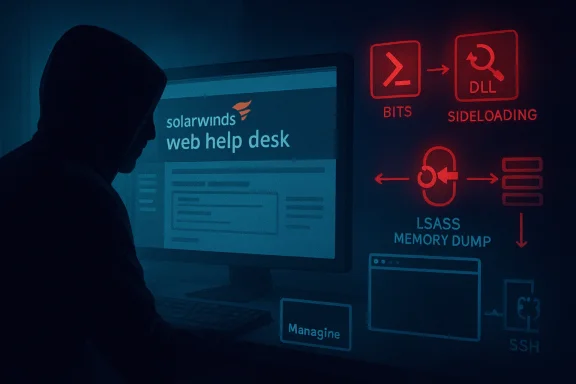
Below is a concise, evidence‑backed reconstruction of the campaign observed by Microsoft and corroborated by independent reporting.1) Initial compromise of internet‑facing WHD
- Microsoft saw unauthenticated RCE against exposed WHD instances that dated back to activity in December 2025. Researchers explicitly note they could not yet attribute the initial access to a single CVE because the affected hosts were vulnerable to multiple WHD CVEs (both older patch‑bypass flaws and the newly disclosed January 2026 bugs).
- The U.S. Cybersecurity and Infrastructure Security Agency added CVE‑2025‑40551 — an untrusted data deserialization RCE — to its Known Exploited Vulnerabilities (KEV) catalog, underscoring active exploitation and urgency for patching. That CVE was assigned a 9.8 CVSS score.
2) Living‑off‑the‑land execution and payload staging
- After initial code execution, the compromised WHD process spawned PowerShell that leveraged the Background Intelligent Transfer Service (BITS) to download and run payloads. Using BITS in this way is a classic living‑off‑the‑land technique: it abuses a trusted Windows transfer service to fetch files and reduces the visibility that custom downloader malware would create.
3) Installation of legitimate RMM for hands‑on control
- On several hosts the threat actors installed components of Zoho ManageEngine (a legitimate remote monitoring and management product). The RMM provided the adversary with interactive remote control and longer‑term access, effectively turning a legitimate administrative tool into a covert backdoor. Multiple independent reports reproduced Microsoft’s finding that attackers abused ManageEngine artifacts for persistence and remote access.
4) Lateral movement, persistence and concealment
- Attackers enumerated domain users and groups (including Domain Admins), deployed reverse SSH and RDP tunnels, and in some environments created a scheduled task that launched QEMU under the SYSTEM account on startup. That QEMU VM bitmask served two purposes: to hide noisy tooling inside a virtualized guest, and to expose SSH access via port‑forwarding — a stealthy persistence mechanism that can defeat simple process‑centric detections. Microsoft reproduced the exact scheduled task command used in at least one observed case.
5) Credential theft and domain abuse
- The intruders used DLL side‑loading techniques (abusing the legitimate wab.exe to load a malicious sspicli.dll) to access LSASS memory and extract credentials. In at least one environment the activity escalated to DCSync — a domain controller replication abuse that can directly harvest password material — indicating that the attackers obtained and then leveraged high‑privilege credentials.
The unresolved mystery: which WHD CVE was the entry vector?
Microsoft explicitly stated it could not conclusively identify the single CVE that yielded initial access. The build‑time and timeline details matter:- Newer CVEs disclosed on Jan 28, 2026 — notably CVE‑2025‑40551 (untrusted data deserialization, RCE, 9.8 CVSS) and CVE‑2025‑40536 (security control bypass, 8.1 CVSS) — were urgent fixes released by SolarWinds and quickly added to public trackers and advisories. CISA added CVE‑2025‑40551 to KEV within days.
- There is also a previously disclosed critical deserialization RCE, CVE‑2025‑26399 (itself described as a patch bypass of earlier CVEs from 2024). That flaw carried a 9.8 rating and required multiple hotfix attempts before SolarWinds’ remedial code was stable. Because the Microsoft investigators saw attacks in December 2025 on hosts that were vulnerable to both the older and the newer CVEs, Microsoft could not reliably trace which exact vulnerability was abused for the initial foothold.
Why the adversary tradecraft here is especially dangerous
- Untrusted deserialization RCEs have low complexity and high impact. Once an attacker can feed crafted serialized objects into an application that deserializes without strong validation, they can often get arbitrary code execution in the context of the application — typically with highly privileged local permissions. Multiple CVEs in WHD fall into this category.
- Living‑off‑the‑land reduces noisy signatures. The use of PowerShell + BITS, legitimate RMM tools, and virtualization (QEMU) shifts detection emphasis from static file signatures to behavior and telemetry. That forces defenders to rely on EDR, process lineage, and network indicators rather than simple AV matches.
- Legitimate admin tooling becomes an attacker’s ally. Installing ManageEngine components is a particularly worrisome move because many organizations implicitly trust RMM software: it runs with high privileges and is often exempt from strict controls for operational reasons. When attackers can persist with RMM, they gain reliable, noisy‑free control over multiple assets.
- Credential theft enables catastrophic follow‑on actions. LSASS memory access, DLL sideloading, and DCSync are not opportunistic. They are explicit, high‑value operations intended to turn a foothold into full domain access — after which containment becomes exponentially harder.
Indicators of compromise and what to hunt for now
Microsoft and multiple incident responders have published overlapping detection guidance. Below are prioritized observable behaviors defenders should hunt for, arranged from high to medium priority.- Search for WHD exploitation signals
- Web requests to known WHD admin endpoints followed by anomalous process spawning from the WHD service process. Look for unusual POST/GETs against Ajax proxy endpoints or serialized payloads.
- BITS abuse and PowerShell download‑and‑execute
- BITSAdmin or bitsjobs created by the WHD service process or by anomalous PowerShell commands that include encoded downloader payloads. Correlate BITS transfers to external hosting services (e.g., file‑hosting sites) or unexpected domains.
- Unauthorized RMM artifacts
- Presence of ManageEngine/ToolsIQ.exe and related installation artifacts appearing on systems that shouldn’t have them. Evict these installations immediately and triage their provenance.
- QEMU scheduled task creation
- Creation of scheduled tasks that launch qemu‑system‑x86_64 (or similar) under SYSTEM at startup, and tasks that forward local ports (e.g., hostfwd entries exposing SSH). Microsoft provided a sample SCHTASKS command observed in the wild; hunt for tasks named inconsistently with local naming conventions.
- DLL sideloading patterns targeting LSASS
- Look for wab.exe spawning with unusual DLL loads (such as sspicli.dll) or abnormal DLLs in system folders. Combine with detections of LSASS memory access or LSASS process handle activity.
- DCSync and AD replication anomalies
- Sudden calls to Directory Replication Service (DRS) APIs from non‑domain controller hosts, unexpected domain‑level replication requests, or replication requests issued by accounts that shouldn’t perform them. These are high‑priority signs of credential abuse.
- Network telemetry
- Outbound SSH tunnels, reverse SSH connections, and RDP sessions originating from WHD hosts or unexpected Windows endpoints. Monitor for unusual port‑forwards and connections to cloud hosts used for C2 or exfiltration.
- Log strings and serial payloads
- Serialized blobs, base64 payloads, or anomalous binary downloads recorded in web server logs (AjaxProxy, whd‑web logs). These artifacts can help confirm exploitation of deserialization flaws.
Immediate remediation checklist (operational playbook)
The following steps are distilled from Microsoft’s guidance, CISA KEV obligations, and practical incident response priorities. Treat the order below as a pragmatic triage sequence for teams who must act quickly.- Identify and inventory all WHD instances (including contractor and cloud instances). Prioritize internet‑facing and DMZ deployments. Use version.txt and WHD service metadata to determine versions.
- If you are running WHD versions prior to 2026.1, apply SolarWinds’ updates or hotfixes immediately. CVE‑2025‑40551 was added to CISA’s KEV catalog with tight remediation timelines for federal agencies; urgency applies to private sector too.
- Remove public exposure to WHD admin paths. Place admin interfaces behind VPNs, jump hosts, or network ACLs — don’t rely solely on application controls.
- If you cannot patch immediately, isolate WHD hosts from sensitive networks and apply network filtering (block outbound SSH/port‑forwarding destinations, restrict BITS traffic, and limit outbound HTTP to known curated hosts).
- Hunt for and evict unauthorized RMM installations (for example, ManageEngine artifacts such as ToolsIQ.exe). Document and preserve artifacts for forensic analysis.
- Rotate credentials for service and admin accounts reachable from WHD. Start with service principal and local admin/service accounts, then expand to higher privileged accounts if compromise is confirmed.
- Isolate suspected compromised hosts and perform volatile memory collection (LSASS, process lists, scheduled tasks, network connections). If DCSync or domain abuse is suspected, treat the identity store as potentially compromised and escalate to a full identity‑reconstitution plan if necessary.
- Monitor for QEMU scheduled tasks, DLL sideloading, BITS download jobs, and unusual SSH/RDP sessions. Create high‑fidelity alerts combining these behaviors.
- If you are a federal agency, adhere to BOD 22‑01 and KEV deadlines for mandatory remediation; document actions and notifications as required.
Longer‑term hardening and strategic recommendations
- Reduce the attack surface. Avoid exposing management consoles to the internet. Where remote operator access is required, use jump servers, bastion hosts, or strict per‑user VPN access with IP allowlisting.
- Zero trust for tooling. Treat RMM and monitoring agents like highly privileged software. Restrict their installation via allowlists, multi‑party approval for deployments, and continuous attestation checks.
- Credential hygiene and segmentation. Limit service account reach and forbid lateral logons where possible. Enforce MFA for management interfaces and restrict administrative sessions to dedicated admin workstations. Constrain delegation and use Group Managed Service Accounts (gMSA) where feasible.
- Behavioral detection over signature dependence. Invest in process lineage, network flow analysis, and identity telemetry so you can detect suspicious combinations (e.g., WHD→PowerShell→BITS→ManageEngine install). Signatures alone will miss living‑off‑the‑land pathways.
- Threat intelligence integration. Subscribe to vulnerability feeds (CISA KEV, NVD) and vendor advisories and integrate them into vulnerability management so critical WHD instances are triaged automatically.
Attribution, motive and uncertainty
At present Microsoft and other responders have not publicly attributed the activity to a named nation‑state or criminal group; reporting focuses on tradecraft and the observed sequence of actions rather than who ran them. The choice to use legitimate RMM, BITS, and QEMU suggests a mature operator comfortable with stealthy persistence. But absent reliable infrastructure or bespoke indicators tying activity to a known actor, attribution remains speculative.What we can say with confidence is that the adversary prioritized credential acquisition and long‑term, low‑noise control over immediate disruptive outcomes. That pattern is consistent with either espionage‑style intrusions or financially motivated campaigns seeking durable access for follow‑on operations.
Risks and potential downstream impacts
- Domain‑level compromise: Once DCSync or other AD replication abuses occur, the attacker may obtain domain‑wide credential material that enables lateral movement into cloud tenants and business‑critical systems. Recovery from such a compromise can require weeks to months and may necessitate full Active Directory reconstitution.
- Supply‑chain windows of opportunity: WHD is a central tool for many IT teams. If attackers persist in vendor‑management tooling or RMM, they can reach multiple customer environments through a single supplier compromise model. This is why hardening third‑party admin tooling is a strategic imperative.
- Data exfiltration and business disruption: Credential theft plus persistent remote access can be used for data theft, ransomware deployment, or the surreptitious manipulation of ticketing workflows (covering actions, causing purposeful delays, etc.). The downstream effects are broad and expensive.
Practical detection recipes (quick wins)
- Deploy EDR sensors for high‑value endpoints and enable behavioral rules to detect:
- WHD processes spawning PowerShell with encoded commands.
- BITSAdmin jobs created by unexpected parent processes.
- Scheduled tasks that execute qemu binaries at SYSTEM startup.
- wab.exe loading non‑standard DLLs from writable directories.
- New installations or services matching ManageEngine artifact names.
- Create a short SIEM rule set:
- If web server access to WHD admin endpoints AND subsequent process spawn by whd‑service → raise high severity.
- If ProcessCreate(wab.exe) AND LoadedDLL(sspicli.dll) → immediate investigation.
- If DirectoryReplicationService calls originate from non‑DC hosts → treat as suspected identity theft.
- Hunt on outbound connection patterns: look for SSH connections to unusual ports or host‑forwarded ports originating from workstations or WHD servers. Correlate with any known file‑hosting domains used for payloads.
Final analysis and takeaways
This incident is a textbook example of how unpatched administrative tooling paired with modern living‑off‑the‑land tactics yields outsized attacker ROI. The defenders’ burden is harder here: the payloads and persistence mechanisms aren’t always malware in the classic sense — they’re trusted OS services, virtualization, and legitimate admin software. Detection therefore requires cross‑layer telemetry (web, process, identity, and network), automated vulnerability triage, and operational discipline on credential exposure.Key practical takeaways:
- Patch WHD immediately and remove public admin exposure. CVE‑2025‑40551 and related fixes are high priority; CISA’s inclusion of CVE‑2025‑40551 in the KEV catalog underscores the real‑world exploitation risk.
- Hunt for the attack chain behaviors (WHD→PowerShell→BITS→RMM→QEMU/DLL sideloading→DCSync) rather than only looking for single artifacts.
- Treat RMM installations with suspicion if they were placed after suspicious web requests or process activity; evict unauthorized instances and rotate reachable credentials.
- Assume compromise if you detect DCSync or domain replication abuse; be prepared for identity reconstitution and a lengthy remediation cycle.
The Microsoft investigation remains active and will likely produce updated technical artifacts and IOCs; defenders should monitor vendor advisories and CISA’s KEV updates and incorporate any new detection content into their hunting playbooks as it becomes available.
Source: theregister.com Someone's attacking SolarWinds WHD - but which bug?
