

Nearly half of farmers and ranchers now use general artificial-intelligence tools such as ChatGPT or Gemini at least weekly, according to a June 2026 MorganMyers and Ag Access survey of 166 producers reported by AGDAILY and Kiowa County Press. The striking part is not adoption; it is the refusal to confuse experimentation with trust. Agriculture is becoming one of AI’s most revealing test beds because the users are practical, data-rich, and financially allergic to hype. If AI cannot earn confidence from people who already make probabilistic decisions for a living, the problem is not rural resistance — it is product maturity.
The headline number looks like a win for the AI industry: 48 percent of surveyed producers said they use AI tools weekly or more often, and MorganMyers’ own write-up says three-quarters have tried AI in some work-related capacity. In a sector often caricatured as slow-moving, that is a meaningful adoption curve. Farmers are not waiting for a futurist keynote to tell them that software might help draft a supplier email, compare seed options, summarize research, or model livestock nutrition.
But the trust numbers tell the more important story. Only about 24 percent of farmers said they fully or somewhat trust AI recommendations for farming-business decisions, while 45 percent said they were uncomfortable letting AI influence real operational choices. That gap — heavy trial, light trust — is the entire AI economy in miniature.
The distinction matters because agriculture is not a sandbox. A bad recommendation can mean wasted fertilizer, damaged soil, missed disease pressure, overfed animals, underfed animals, botched planting windows, or a five-figure equipment decision made on a false premise. The farmer who uses AI to draft a letter to a lender may be curious; the farmer who lets it set a nitrogen program is taking a business risk.
That is why the survey should not be read as a story about technophobia. It is a story about calibrated skepticism. Farmers are willing to test tools when the downside is bounded and the upside is convenience. They become wary when the tool moves from clerical assistant to operational adviser.
The top concern among surveyed farmers was accuracy of recommendations, cited by 72 percent. That outranked data privacy and ownership, which were still major worries at 57 percent, and concerns about biased or brand-influenced output at 51 percent. In other words, producers are not merely worried that AI will steal their data or favor a sponsor; they are worried that it will be wrong.
That is a more serious problem for vendors because it cannot be solved with branding alone. Accuracy in agriculture is contextual. A recommendation that makes sense on one Iowa cornfield may fail on another farm because of drainage, soil history, hybrid selection, pest pressure, weather volatility, labor constraints, or local equipment availability. The model does not merely need data; it needs domain accountability.
AI’s weakness here is familiar to anyone who has used large language models professionally. These systems are often fluent before they are reliable. They can sound confident while smoothing over uncertainty, and they can generate plausible explanations without owning the consequences. In an office workflow, that may mean a bad paragraph. In agriculture, plausibility is not enough.
That history makes the AI adoption curve more sophisticated than it first appears. Producers are not coming to technology cold. Many already run data-heavy operations, especially in dairy, large-scale row crops, and vertically managed livestock systems. They know the difference between a dashboard that saves time and one that creates chores.
This is where the phrase “digital farming” matters. Syngenta’s 2025 research reportedly found that farmers often found the term AI distant or alien, while digital farming felt more relatable because it described tools already embedded in daily operations. That language gap is not cosmetic. It tells us that agriculture does not object to computation; it objects to abstraction.
The more AI is packaged as a magical layer floating above the farm, the more suspicion it will invite. The more it is embedded into tools that solve known problems, surface evidence, and preserve operator control, the more likely it is to be treated as another instrument in the cab.
That makes sense because dairy has a different operational rhythm from row-crop farming. It is continuous, sensor-friendly, labor-intensive, and full of recurring biological signals. Cows eat, move, ruminate, produce milk, and show health patterns every day. When a tool flags mastitis risk earlier, optimizes feed, or identifies a reproductive-health issue, the feedback loop can be fast and economically visible.
Row-crop farming is less forgiving for AI validation. Planting, spraying, fertilizing, and harvesting decisions unfold over long seasons, and yield is influenced by weather, soil, disease, commodity prices, timing, machinery, seed genetics, and luck. If an AI-assisted nitrogen recommendation coincides with a good year, was the model smart or was the weather kind? If it fails, was the recommendation wrong or did a late dry spell erase the benefit?
Dairy’s advantage is not that dairy farmers are inherently more tech-friendly. It is that the business produces more frequent signals and clearer cause-and-effect moments. AI earns trust fastest where results can be observed, measured, and attributed.
That should be a warning to vendors trying to sell general-purpose models into all of agriculture at once. The farm is not one market. It is a collection of businesses with different data densities, risk cycles, capital structures, and tolerances for automation. AI will not arrive evenly.
That matters because retailers and advisers have traditionally helped translate new technology into farm decisions. Seed dealers, agronomists, nutritionists, equipment reps, veterinarians, and crop consultants often serve as the human middleware between vendor claims and field reality. If that layer is unconvinced, AI tools may struggle to move from experimentation to operational dependence.
The hesitation is understandable. Retailers have reputational skin in the game. If they recommend a platform that generates poor advice, the farmer may not blame the model; they may blame the trusted adviser who vouched for it. In a relationship-driven market, credibility is a balance sheet asset.
There is also a competitive tension. Some AI tools implicitly pitch themselves as adviser substitutes. They promise instant recommendations, always-on agronomy, automated business analysis, or livestock insights without another human visit. Retailers are unlikely to accelerate adoption of systems that seem designed to commoditize their judgment unless those systems clearly make them better at serving customers.
The result is a strange inversion of the usual technology story. Farmers may be more willing to try AI than some of the intermediaries who would normally validate it. That does not guarantee fast adoption. It may instead create a market where producers experiment alone with general-purpose tools while specialized platforms wait for the adviser class to become comfortable.
That should sting for agtech vendors. The most successful early farm AI tool may not be the specialized platform with years of agronomic positioning. It may be the general chatbot with a clean interface, low friction, and no required implementation cycle.
This does not mean generic models are better agronomists. It means they are easier to start using. A farmer can ask a chatbot to draft a lease letter, summarize a product label, create a checklist for calving season, compare financing options, or turn messy notes into a meeting agenda. These are low-risk uses that do not require deep integration with farm data.
Specialized platforms have the harder task. They must connect to real data, fit existing workflows, prove domain expertise, respect ownership boundaries, and produce recommendations that can be defended. That is the path to higher value, but it is also the path to higher scrutiny.
The lesson from consumer AI carries into agriculture: convenience drives trial, but trust drives dependence. Generic chatbots are winning attention. Farm-specific systems still have to win authority.
A model can ingest weather forecasts, soil maps, commodity prices, and product data. It may still miss the local fact that a certain low spot floods after three inches of rain, that a custom applicator is booked solid next week, that a landlord will not tolerate a visible mistake, or that a herd has a history that does not fit the textbook. Human experience is not sentimentality here. It is a compressed archive of edge cases.
That is why farmers in the survey reportedly said real-world farm results would boost trust. Sixty-two percent identified demonstrated outcomes as a confidence-builder. Thirty percent wanted the ability to override AI suggestions, and 27 percent wanted transparent data sources.
Those demands are modest and rational. Producers are not asking AI vendors to suspend physics. They are asking them to show their work, prove their claims, and leave the operator in charge. In a sector where margins can be thin and mistakes compound, that is the minimum price of admission.
The question is not simply whether a tool protects data from hackers. It is who benefits when farm data trains models, informs benchmarks, or powers recommendations sold back to the same producers who generated the raw material. Farmers have reason to ask whether AI turns their operational history into someone else’s proprietary advantage.
This concern is not new. Precision agriculture has wrestled with data ownership for years, especially as equipment manufacturers, seed companies, chemical firms, retailers, and software vendors built platforms around farm records. AI raises the stakes because model training can blur the line between using data to serve a customer and using data to build a market-wide intelligence asset.
The industry will be tempted to answer with privacy policies. That will not be enough. Trust will require plain-language controls, auditability, portability, deletion rights, and credible separation between advisory recommendations and commercial incentives. If a model recommends a seed, a chemical, a feed additive, or a piece of equipment, farmers will want to know whether the recommendation came from evidence or from a business relationship.
For WindowsForum readers, the parallel to enterprise IT is obvious. Shadow AI appears when official tools are cumbersome, and governance arrives after employees have already started pasting work into consumer systems. Agriculture is facing the same sequence, except the sensitive data is not a quarterly slide deck. It is the operating map of a farm.
That is not because farmers are uniquely stubborn. It is because farm decisions are accountable in ways models are not. A model does not face the banker, the landlord, the veterinarian, the family, the co-op, or the neighbor when a recommendation fails. The person making the decision does.
The right framing for AI in agriculture is therefore not replacement but instrumentation. A yield monitor does not harvest the field by itself. A weather model does not decide whether a sprayer rolls when the wind is marginal. A mastitis alert does not remove the need for stockmanship. The value comes from better signals in the hands of someone who understands the system.
Vendors that understand this will design for contestability. They will let users inspect assumptions, compare scenarios, trace data sources, and document why a recommendation was accepted or rejected. The best agricultural AI tools may look less like omniscient advisers and more like disciplined junior analysts.
This is also where Microsoft, Google, OpenAI, and the broader cloud ecosystem should pay attention. The winning interface for high-stakes AI may not be the conversational blank box. It may be structured decision support that makes uncertainty visible.
But the findings resonate because they align with patterns visible across other industries. Workers try AI before organizations govern it. Low-risk use cases spread faster than high-risk ones. Trust depends less on novelty than on observed reliability. Domain experts resist tools that ignore context while embracing tools that reduce drudgery.
That makes the survey useful even with its limits. It captures a moment when AI has crossed the curiosity threshold but not the authority threshold. The technology is already present on farms, but it is not yet trusted as a decision-maker.
That in-between state is where markets are made. Vendors can either listen to the discomfort and build systems that earn confidence, or they can keep telling users that hesitation is irrational. The first path is slower. The second path is how promising tools become expensive shelfware.
That is the real operating environment. Farms do not run on perfect datasets. They run on partial observations, practical constraints, family labor, seasonal deadlines, equipment failures, volatile input prices, and biological uncertainty. A tool that only performs well in a clean demo is not a farm tool.
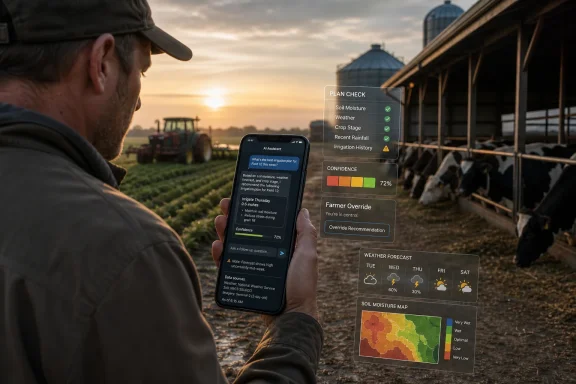
The market will therefore reward AI systems that are humble in the right ways. They should surface confidence levels, cite the underlying data in human-readable terms, and say when they do not know. They should adapt to local conditions without pretending that local knowledge is merely anecdotal. They should help the operator make a better decision, not pressure the operator to accept a mysterious one.
That is a different product philosophy from much of today’s AI marketing. The industry has spent years selling awe. Agriculture is asking for evidence.
The farm is a demanding place to sell vaporware, which is exactly why this moment matters. Producers are telling the AI industry that usefulness is welcome, but authority must be earned field by field, herd by herd, and season by season. If vendors respond with transparent tools that strengthen human expertise instead of trying to bypass it, agriculture could become one of AI’s most durable proving grounds. If they do not, farmers will keep using chatbots for the easy work — and keep the real decisions where they have always been, in the hands of people who live with the outcome.
 Farmers Are Trying AI, But They Are Not Handing It the Keys
The headline number looks like a win for the AI industry: 48 percent of surveyed producers said they use AI tools weekly or more often, and MorganMyers’ own write-up says three-quarters have tried AI in some work-related capacity. In a sector often caricatured as slow-moving, that is a meaningful adoption curve. Farmers are not waiting for a futurist keynote to tell them that software might help draft a supplier email, compare seed options, summarize research, or model livestock nutrition.But the trust numbers tell the more important story. Only about 24 percent of farmers said they fully or somewhat trust AI recommendations for farming-business decisions, while 45 percent said they were uncomfortable letting AI influence real operational choices. That gap — heavy trial, light trust — is the entire AI economy in miniature.
The distinction matters because agriculture is not a sandbox. A bad recommendation can mean wasted fertilizer, damaged soil, missed disease pressure, overfed animals, underfed animals, botched planting windows, or a five-figure equipment decision made on a false premise. The farmer who uses AI to draft a letter to a lender may be curious; the farmer who lets it set a nitrogen program is taking a business risk.
That is why the survey should not be read as a story about technophobia. It is a story about calibrated skepticism. Farmers are willing to test tools when the downside is bounded and the upside is convenience. They become wary when the tool moves from clerical assistant to operational adviser.
The Trust Gap Is a Product Problem, Not a Culture Problem
AI vendors often describe skepticism as an adoption barrier, as if users need more education before they will accept the inevitable. The MorganMyers numbers point in the opposite direction. Farmers have already educated themselves enough to know where the models are useful and where they are not yet accountable.The top concern among surveyed farmers was accuracy of recommendations, cited by 72 percent. That outranked data privacy and ownership, which were still major worries at 57 percent, and concerns about biased or brand-influenced output at 51 percent. In other words, producers are not merely worried that AI will steal their data or favor a sponsor; they are worried that it will be wrong.
That is a more serious problem for vendors because it cannot be solved with branding alone. Accuracy in agriculture is contextual. A recommendation that makes sense on one Iowa cornfield may fail on another farm because of drainage, soil history, hybrid selection, pest pressure, weather volatility, labor constraints, or local equipment availability. The model does not merely need data; it needs domain accountability.
AI’s weakness here is familiar to anyone who has used large language models professionally. These systems are often fluent before they are reliable. They can sound confident while smoothing over uncertainty, and they can generate plausible explanations without owning the consequences. In an office workflow, that may mean a bad paragraph. In agriculture, plausibility is not enough.
Rural Users Have Seen This Movie Before
Farmers have been sold decision-support technology for decades. GPS guidance, variable-rate application, yield monitors, satellite imagery, drones, livestock sensors, robotic milkers, weather apps, and cloud farm-management platforms all arrived with claims about efficiency and precision. Some stuck because they delivered measurable value. Others remained niche because the economics were muddy, the workflow burden was too high, or the promised insight did not survive contact with the field.That history makes the AI adoption curve more sophisticated than it first appears. Producers are not coming to technology cold. Many already run data-heavy operations, especially in dairy, large-scale row crops, and vertically managed livestock systems. They know the difference between a dashboard that saves time and one that creates chores.
This is where the phrase “digital farming” matters. Syngenta’s 2025 research reportedly found that farmers often found the term AI distant or alien, while digital farming felt more relatable because it described tools already embedded in daily operations. That language gap is not cosmetic. It tells us that agriculture does not object to computation; it objects to abstraction.
The more AI is packaged as a magical layer floating above the farm, the more suspicion it will invite. The more it is embedded into tools that solve known problems, surface evidence, and preserve operator control, the more likely it is to be treated as another instrument in the cab.
Dairy Shows What AI Looks Like When the Feedback Loop Is Short
The MorganMyers findings suggest that dairy producers are among the most active and trusting AI users in agriculture. The firm reported that 64 percent of dairy producers were active users of general AI tools and that 69 percent used AI features inside agricultural platforms at least weekly. It also found that nearly all dairy respondents saw at least some value from these tools.That makes sense because dairy has a different operational rhythm from row-crop farming. It is continuous, sensor-friendly, labor-intensive, and full of recurring biological signals. Cows eat, move, ruminate, produce milk, and show health patterns every day. When a tool flags mastitis risk earlier, optimizes feed, or identifies a reproductive-health issue, the feedback loop can be fast and economically visible.
Row-crop farming is less forgiving for AI validation. Planting, spraying, fertilizing, and harvesting decisions unfold over long seasons, and yield is influenced by weather, soil, disease, commodity prices, timing, machinery, seed genetics, and luck. If an AI-assisted nitrogen recommendation coincides with a good year, was the model smart or was the weather kind? If it fails, was the recommendation wrong or did a late dry spell erase the benefit?
Dairy’s advantage is not that dairy farmers are inherently more tech-friendly. It is that the business produces more frequent signals and clearer cause-and-effect moments. AI earns trust fastest where results can be observed, measured, and attributed.
That should be a warning to vendors trying to sell general-purpose models into all of agriculture at once. The farm is not one market. It is a collection of businesses with different data densities, risk cycles, capital structures, and tolerances for automation. AI will not arrive evenly.
The Retailer Bottleneck May Matter More Than the Farmer
One of the most interesting findings in MorganMyers’ own analysis is that agricultural retailers appear to lag farmers in AI use and trust. Fewer than 40 retailers were surveyed, so the sample is small and should be treated carefully. Still, the pattern is important enough to watch: 63 percent of ag retailers reportedly rarely or never use AI at work, and 60 percent gave AI low marks on trust.That matters because retailers and advisers have traditionally helped translate new technology into farm decisions. Seed dealers, agronomists, nutritionists, equipment reps, veterinarians, and crop consultants often serve as the human middleware between vendor claims and field reality. If that layer is unconvinced, AI tools may struggle to move from experimentation to operational dependence.
The hesitation is understandable. Retailers have reputational skin in the game. If they recommend a platform that generates poor advice, the farmer may not blame the model; they may blame the trusted adviser who vouched for it. In a relationship-driven market, credibility is a balance sheet asset.
There is also a competitive tension. Some AI tools implicitly pitch themselves as adviser substitutes. They promise instant recommendations, always-on agronomy, automated business analysis, or livestock insights without another human visit. Retailers are unlikely to accelerate adoption of systems that seem designed to commoditize their judgment unless those systems clearly make them better at serving customers.
The result is a strange inversion of the usual technology story. Farmers may be more willing to try AI than some of the intermediaries who would normally validate it. That does not guarantee fast adoption. It may instead create a market where producers experiment alone with general-purpose tools while specialized platforms wait for the adviser class to become comfortable.
Generic Chatbots Are Winning the First Round Because They Are Easy
The survey’s split between general AI tools and AI features built into agricultural platforms is revealing. Farmers reported using generic models such as ChatGPT, Gemini, or Claude more frequently than AI-enabled tools inside existing ag platforms. Thirty percent said they never use integrated AI features on ag platforms.That should sting for agtech vendors. The most successful early farm AI tool may not be the specialized platform with years of agronomic positioning. It may be the general chatbot with a clean interface, low friction, and no required implementation cycle.
This does not mean generic models are better agronomists. It means they are easier to start using. A farmer can ask a chatbot to draft a lease letter, summarize a product label, create a checklist for calving season, compare financing options, or turn messy notes into a meeting agenda. These are low-risk uses that do not require deep integration with farm data.
Specialized platforms have the harder task. They must connect to real data, fit existing workflows, prove domain expertise, respect ownership boundaries, and produce recommendations that can be defended. That is the path to higher value, but it is also the path to higher scrutiny.
The lesson from consumer AI carries into agriculture: convenience drives trial, but trust drives dependence. Generic chatbots are winning attention. Farm-specific systems still have to win authority.
Accuracy Is Harder in Agriculture Than in Office Work
AI’s boosters often talk about productivity as if all work can be reduced to information processing. Agriculture exposes the limits of that idea. Farming is information processing, but it is also biology, weather, machinery, labor, regulation, logistics, credit, land tenure, and inherited knowledge about particular fields and animals.A model can ingest weather forecasts, soil maps, commodity prices, and product data. It may still miss the local fact that a certain low spot floods after three inches of rain, that a custom applicator is booked solid next week, that a landlord will not tolerate a visible mistake, or that a herd has a history that does not fit the textbook. Human experience is not sentimentality here. It is a compressed archive of edge cases.
That is why farmers in the survey reportedly said real-world farm results would boost trust. Sixty-two percent identified demonstrated outcomes as a confidence-builder. Thirty percent wanted the ability to override AI suggestions, and 27 percent wanted transparent data sources.
Those demands are modest and rational. Producers are not asking AI vendors to suspend physics. They are asking them to show their work, prove their claims, and leave the operator in charge. In a sector where margins can be thin and mistakes compound, that is the minimum price of admission.
Data Ownership Is the Sleeping Political Issue
Accuracy may be the top concern, but data privacy and ownership are not far behind. This is where AI in agriculture becomes more than a product story. Farm data can reveal planting strategies, yields, input usage, herd performance, financial stress, land productivity, and operational weaknesses. Aggregated at scale, it becomes commercially powerful.The question is not simply whether a tool protects data from hackers. It is who benefits when farm data trains models, informs benchmarks, or powers recommendations sold back to the same producers who generated the raw material. Farmers have reason to ask whether AI turns their operational history into someone else’s proprietary advantage.
This concern is not new. Precision agriculture has wrestled with data ownership for years, especially as equipment manufacturers, seed companies, chemical firms, retailers, and software vendors built platforms around farm records. AI raises the stakes because model training can blur the line between using data to serve a customer and using data to build a market-wide intelligence asset.
The industry will be tempted to answer with privacy policies. That will not be enough. Trust will require plain-language controls, auditability, portability, deletion rights, and credible separation between advisory recommendations and commercial incentives. If a model recommends a seed, a chemical, a feed additive, or a piece of equipment, farmers will want to know whether the recommendation came from evidence or from a business relationship.
For WindowsForum readers, the parallel to enterprise IT is obvious. Shadow AI appears when official tools are cumbersome, and governance arrives after employees have already started pasting work into consumer systems. Agriculture is facing the same sequence, except the sensitive data is not a quarterly slide deck. It is the operating map of a farm.
The Human Override Is Not a Crutch; It Is the Product
One of the most revealing trust-builders in the survey was the desire to override AI suggestions. In some tech circles, human override is treated as a transitional feature — something users need until the machine becomes good enough. In agriculture, it is more likely to remain permanent.That is not because farmers are uniquely stubborn. It is because farm decisions are accountable in ways models are not. A model does not face the banker, the landlord, the veterinarian, the family, the co-op, or the neighbor when a recommendation fails. The person making the decision does.
The right framing for AI in agriculture is therefore not replacement but instrumentation. A yield monitor does not harvest the field by itself. A weather model does not decide whether a sprayer rolls when the wind is marginal. A mastitis alert does not remove the need for stockmanship. The value comes from better signals in the hands of someone who understands the system.
Vendors that understand this will design for contestability. They will let users inspect assumptions, compare scenarios, trace data sources, and document why a recommendation was accepted or rejected. The best agricultural AI tools may look less like omniscient advisers and more like disciplined junior analysts.
This is also where Microsoft, Google, OpenAI, and the broader cloud ecosystem should pay attention. The winning interface for high-stakes AI may not be the conversational blank box. It may be structured decision support that makes uncertainty visible.
Small Samples Still Tell a Large Story
The MorganMyers and Ag Access survey is not a census of American agriculture. A 166-producer sample can illuminate behavior, but it cannot carry every claim one might want to make about geography, farm size, commodity mix, income, broadband access, or generational differences. The retailer sample is smaller still.But the findings resonate because they align with patterns visible across other industries. Workers try AI before organizations govern it. Low-risk use cases spread faster than high-risk ones. Trust depends less on novelty than on observed reliability. Domain experts resist tools that ignore context while embracing tools that reduce drudgery.
That makes the survey useful even with its limits. It captures a moment when AI has crossed the curiosity threshold but not the authority threshold. The technology is already present on farms, but it is not yet trusted as a decision-maker.
That in-between state is where markets are made. Vendors can either listen to the discomfort and build systems that earn confidence, or they can keep telling users that hesitation is irrational. The first path is slower. The second path is how promising tools become expensive shelfware.
The Next Farm Platform Will Be Judged in Mud, Not Demos
AI’s agricultural future will not be decided by whether a chatbot can generate a polished answer about cover crops. It will be decided by whether a producer can use the tool during a bad week, under time pressure, with incomplete data, when the weather forecast has shifted and the ideal answer is no longer available.That is the real operating environment. Farms do not run on perfect datasets. They run on partial observations, practical constraints, family labor, seasonal deadlines, equipment failures, volatile input prices, and biological uncertainty. A tool that only performs well in a clean demo is not a farm tool.
The market will therefore reward AI systems that are humble in the right ways. They should surface confidence levels, cite the underlying data in human-readable terms, and say when they do not know. They should adapt to local conditions without pretending that local knowledge is merely anecdotal. They should help the operator make a better decision, not pressure the operator to accept a mysterious one.
That is a different product philosophy from much of today’s AI marketing. The industry has spent years selling awe. Agriculture is asking for evidence.
The Farm Test Is Really a Trust Test for Everyone
The lesson from this survey reaches beyond agriculture because farmers are behaving like the rational enterprise users many AI vendors claim to want. They are experimenting broadly, identifying practical use cases, resisting overreach, and demanding proof before delegating consequential decisions.- Farmers are not rejecting AI; many are already using it regularly for research, drafting, planning, livestock insights, and business support.
- Trust is lagging adoption because producers are worried most about whether AI recommendations are accurate enough for real operational decisions.
- Dairy appears more receptive because its data-rich, continuous operations create faster feedback loops and clearer returns.
- Agricultural retailers may slow adoption if they remain less trusting than the farmers who usually rely on them for technology validation.
- Generic AI tools are gaining early traction because they are easy to use, while specialized ag platforms still need to prove deeper value.
- The strongest path forward is AI that supports human judgment, explains its assumptions, protects farm data, and demonstrates results under real field conditions.
The farm is a demanding place to sell vaporware, which is exactly why this moment matters. Producers are telling the AI industry that usefulness is welcome, but authority must be earned field by field, herd by herd, and season by season. If vendors respond with transparent tools that strengthen human expertise instead of trying to bypass it, agriculture could become one of AI’s most durable proving grounds. If they do not, farmers will keep using chatbots for the easy work — and keep the real decisions where they have always been, in the hands of people who live with the outcome.
References
- Primary source: AGDAILY
Published: Fri, 26 Jun 2026 15:52:59 GMT
Nearly Half of U.S. Farmers Use AI, but Trust in it is Lagging
A new survey found nearly half of farmers use AI regularly, but concerns over accuracy and trust continue to limit its role in farm decision-making.www.agdaily.com - Independent coverage: Kiowa County Press
Published: Fri, 26 Jun 2026 15:47:38 GMT

Survey shows farmers split on AI use in the fields, majority skeptical of results | KiowaCountyPress.net
Nearly half of farmers use AI tools like ChatGPT weekly, but only a quarter trust the technology's farming recommendations, a new survey finds.
kiowacountypress.net
