

The Free SIEM Promise Lands Because Breach Economics Have Become Absurd
The appeal of Wazuh in 2026 is inseparable from the economics of breach response. IBM’s 2025 breach-cost figures put the average U.S. incident above $10 million, while the global average moved lower, a split that says as much about regulation, notification, legal exposure, and business interruption as it does about malware. The most important number in that picture is not the headline cost; it is the lifecycle. If organizations are still taking months to identify and contain incidents, then the tool that buys back time has become strategic infrastructure.
That is why the “free SIEM” framing works. Security monitoring used to be sold as an enterprise luxury, something for banks, hyperscalers, defense contractors, and regulated healthcare networks. Now even a 50-endpoint business has enough Windows event logs, Linux auth logs, cloud audit trails, VPN events, and firewall telemetry to need correlation rather than hope.
Commercial SIEMs solve that problem with impressive polish and punishing economics. Ingest-based pricing means the better you instrument your environment, the more you pay. That creates a perverse incentive: collect less, normalize less, retain less, and pray you did not discard the one event that matters.
Wazuh flips that model. The license cost is zero, the source is open, and the ceiling is set by the infrastructure you are willing to run. That does not make it automatically better than Splunk, Sentinel, QRadar, Elastic Security, or a managed MDR service. It makes it a serious option for teams whose biggest obstacle is not imagination but budget predictability.
A 40-Minute Install Is the Beginning, Not the Achievement
The submitted tutorial’s promise — a functioning Wazuh server in roughly 40 minutes — is plausible for a lab. The all-in-one installer does a great deal of heavy lifting: it deploys the Wazuh manager, indexer, and dashboard, generates certificates, wires services together, and leaves the administrator with a browser-accessible console. For anyone who remembers hand-building OSSEC-era stacks, that is real progress.
But the installer is not the SIEM. It is the foundation. A newly installed Wazuh dashboard with one enrolled Linux agent is a proof of life, not a security operation.
The distinction matters because SIEM projects often fail in the gap between installation and usefulness. Logs arrive, alerts fire, dashboards populate, and the team briefly feels safer. Then the false positives begin. The indexer slows under unexpected volume. The Windows estate produces authentication noise no one has time to interpret. Vulnerability findings pile up faster than patch windows. Eventually the dashboard becomes another tab nobody opens unless an auditor asks.
That is not a Wazuh-specific failure. It is the basic law of security monitoring: visibility without triage becomes noise. Wazuh’s strongest feature is that it gives small teams the same categories of telemetry that large teams expect. Its weakness is that it cannot supply the human process that turns those signals into decisions.
The Architecture Is Sensible Because It Is Boring
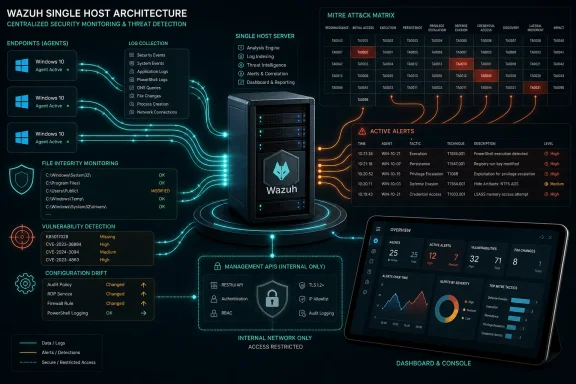
Wazuh’s architecture is not exotic, and that is a virtue. The manager receives endpoint telemetry, decodes events, applies rules, and triggers responses. The indexer stores and searches alerts. The dashboard provides the analyst interface. Agents live on endpoints and collect the messy local truth: logs, file changes, packages, configuration state, and security events.
That separation gives Wazuh a clear scaling path. A small deployment can run everything on one host. A larger one can split the manager, indexer, and dashboard. A still larger environment can cluster indexers and managers so ingestion and search stop fighting over the same resources.
The ports also tell the operational story. Agents need to reach the manager for enrollment and event forwarding. Analysts need the dashboard. The API and indexer are powerful internal services that should not be casually exposed. The minute a Wazuh server is treated like a generic web app on a public IP, the deployment has already drifted from defensive infrastructure into attack surface.
This is where the tutorial’s hardening advice earns its keep. A SIEM is not just another server. It is where adversaries expect defenders to look, and therefore where attackers would prefer defenders to be blind. Centralized logs are valuable because they survive endpoint tampering; they are dangerous because compromising the logging platform can rewrite the organization’s view of itself.
Wazuh’s OSSEC Inheritance Still Matters
Wazuh began as an OSSEC fork, and that lineage remains visible in the right ways. The agent-centric model is practical. Endpoint telemetry is still the best place to catch many real attacks: suspicious authentication, privilege escalation, unauthorized file changes, persistence mechanisms, and unexpected service creation.
Where Wazuh has moved beyond OSSEC is in packaging those capabilities into something closer to a full security platform. File integrity monitoring, vulnerability detection, security configuration assessment, MITRE ATT&CK tagging, compliance dashboards, cloud integrations, and active response now sit under one roof. That breadth is what makes it compelling for small and mid-sized teams.
The danger is assuming breadth equals maturity in every category. Wazuh can tell you that a package is vulnerable, but it is not a full replacement for a mature vulnerability management program with exploitability analysis, asset criticality, ownership, remediation SLAs, and exception tracking. It can assess configuration baselines, but it does not enforce organizational policy by itself. It can block an IP, but it does not know whether that IP belongs to a traveling executive, a monitoring service, or an attacker without context supplied by humans.
That is the right way to understand Wazuh: not as a magic SOC in a box, but as a credible telemetry and detection layer that makes a SOC possible.
The Version Choice Is Conservative for Good Reason
The tutorial correctly anchors on Wazuh 4.14.5 as the stable branch at publication time rather than steering production users toward the Wazuh 5.0 beta. That is the boring choice, and boring is what production security infrastructure should aspire to be.
Wazuh 5.0 is interesting because it points toward architectural cleanup. A native connector replacing Filebeat would simplify a long-standing dependency. Default clustering would better match how serious deployments actually scale. Expanded threat-intelligence handling and revamped access control could make the platform more coherent for larger teams.
But a SIEM upgrade is not a cosmetic update. It touches ingestion, storage, dashboards, authentication, alerting, retention, and analyst workflow. Indexer migrations in particular deserve caution because search infrastructure tends to be one-way in practice even when documentation provides a route forward. If your organization depends on Wazuh for evidence and detection, the upgrade path belongs in a lab before it goes anywhere near production.
The stable-versus-beta distinction also reveals a broader truth: defenders do not get points for running the newest security tool. They get points for running one that is patched, understood, monitored, backed up, and recoverable.
The CVE Lesson Is Not “Wazuh Is Unsafe”
The mention of CVE-2025-24016 is important, but it should not be read as a simple indictment of Wazuh. The vulnerability affected older versions and was fixed in Wazuh 4.9.1. The more useful lesson is architectural: management APIs should be treated like privileged control planes, not convenience endpoints.
That point applies to every SIEM. A security platform usually has elevated visibility, privileged integrations, stored credentials, automation hooks, and the authority to run response actions. If an attacker gets administrative API access, the question is no longer whether the product is “secure” in the abstract. The question is why that plane was reachable, how credentials were protected, and whether administrative activity was monitored.
The tutorial’s recommendation to keep the indexer and API off the public internet is therefore not optional hygiene. It is the baseline. Dashboard access belongs behind VPN, identity-aware proxy, trusted management networks, or equivalent controls. Administrative credentials should be rotated. Certificates should be replaced. Logs from the SIEM itself should be treated as high-value records.
Wazuh is free, but it is not exempt from the same operational security rules that govern every other management platform.
Windows Endpoints Are Where the Tutorial Becomes Real
A Linux-only lab is useful for learning Wazuh. A Windows agent is where most organizations start to see why they needed a SIEM in the first place.
Windows authentication events, PowerShell logs, service installation, account changes, scheduled task creation, endpoint protection events, and Sysmon telemetry produce the kind of signal that separates routine administration from compromise. A single Windows workstation can be noisy; a fleet can be overwhelming. But without that telemetry, defenders are left reconstructing incidents from fragments.
The tutorial’s Windows enrollment step is deceptively important because it moves Wazuh from server monitoring into enterprise reality. Most breaches do not unfold neatly on the one hardened Linux box the administrator watches closely. They move through identity, workstations, remote access, lateral movement, and legitimate tools abused for illegitimate purposes.
A Wazuh deployment that ignores Windows is a monitoring exercise. A Wazuh deployment that properly collects Windows endpoint telemetry becomes a candidate for real detection engineering.
File Integrity Monitoring Is the Old Control That Still Earns Its Keep
File integrity monitoring can sound quaint next to AI-driven detection and cloud-native analytics. It is not. Attackers still modify files, drop web shells, alter startup scripts, replace binaries, and tamper with configuration. The filesystem remains one of the most durable sources of evidence.
Wazuh’s FIM capability is especially useful because it is tied to the same alerting and compliance layer as the rest of the platform. A change to /etc/hosts, a modification under a web root, or an unexpected binary replacement can produce both an operational alert and audit evidence. That dual use matters for small teams that cannot afford separate tooling for detection and compliance.
The catch is tuning. Monitoring everything is a fast route to noise and storage pressure. Monitoring nothing but a few symbolic directories misses the point. The practical deployment sits in the middle: critical system paths, application directories, configuration files, identity-related files, and high-risk web locations.
The tutorial’s example paths are a reasonable start, but production teams should treat them as a template, not a doctrine. A Windows domain controller, a Linux web server, a Kubernetes node, and a finance workstation do not have the same sensitive files. Wazuh can watch all of them; administrators still have to decide what matters.
Vulnerability Detection Changes the Patch Conversation
Wazuh’s vulnerability detection module is one of the platform’s more consequential features because it connects endpoint inventory with known CVEs. That changes the conversation from “we think these systems are patched” to “here is the current exposure list by host and severity.”
For resource-constrained teams, that alone is powerful. Traditional vulnerability scanners can be expensive, intrusive, or politically difficult to run across every segment. Agent-based software inventory does not replace all forms of scanning, but it gives defenders a continuous view of installed packages and vulnerable versions.
The danger is treating CVSS severity as the whole prioritization model. A critical CVE on an isolated lab host may matter less than a high-severity bug on an internet-facing VPN appliance. Wazuh can surface the exposure, but prioritization still depends on asset value, exploit availability, network reachability, compensating controls, and business context.
Used well, Wazuh’s vulnerability module becomes a bridge between security and operations. It gives sysadmins a queue that is grounded in actual installed software rather than abstract advisories. Used poorly, it becomes another dashboard of red numbers everyone learns to ignore.
Configuration Assessment Turns Hardening Into Evidence
Security Configuration Assessment is one of those features that looks dull until an audit begins. Wazuh’s ability to assess systems against benchmark-style policies gives administrators a measurable baseline: what passed, what failed, and what changed over time.
That is useful even outside formal compliance. Configuration drift is one of the quiet causes of security decay. A server is hardened during deployment, then six months of troubleshooting, exceptions, emergency changes, and forgotten test settings turn it into something else. SCA gives teams a way to notice that drift before it becomes a finding after an incident.
The compliance appeal is obvious. PCI DSS, HIPAA, NIST mappings, SOC 2 evidence, and GDPR-adjacent controls all reward centralized logging, change monitoring, vulnerability management, and configuration governance. Wazuh does not make an organization compliant by existing, but it can reduce the amount of manual evidence gathering that makes audits painful.
That distinction should be stated plainly. Auditors do not certify dashboards; they assess controls. Wazuh can produce evidence that controls are operating. The organization still owns policy, review, remediation, exceptions, and accountability.
Active Response Is Powerful Enough to Hurt You
Active response is the feature that most clearly separates monitoring from action. Wazuh can run scripts when certain alerts fire, including blocking an offending IP for a defined period. For brute-force attempts and obvious malicious sources, that can turn detection into immediate containment.
It is also the feature most likely to punish overconfidence. Automatic blocking based on noisy rules can lock out legitimate users, disrupt monitoring systems, break integrations, or create self-inflicted denial of service. The right posture is incremental: narrow triggers, short timeouts, careful logging, and review before expansion.
This is not an argument against automation. It is an argument for humble automation. The best active-response rules handle high-confidence, reversible actions. Temporarily blocking a source that repeatedly fails SSH authentication is a different risk profile from disabling an account, killing a process, or quarantining a production host.
A mature Wazuh deployment should use active response, but it should do so with the same change-control mindset used for firewall rules and endpoint policy. Automation is not safer because it is fast. It is safer when it is predictable, bounded, and observable.
The Commercial SIEM Comparison Is Really a Labor Comparison
Wazuh’s strongest economic argument is that it does not charge for ingestion. That is a big deal. Log volume is not a side effect of security monitoring; it is the raw material. Pricing that raw material by the gigabyte forces organizations to ration visibility.
But the commercial SIEM comparison is incomplete if it stops at license cost. Paid platforms often bundle support, managed content, integrations, storage architecture, update pipelines, case management, user behavior analytics, SOAR hooks, and vendor accountability. Some of that is marketing. Some of it is genuinely valuable.
Wazuh shifts the cost from vendor invoice to operational ownership. Someone must patch the server, monitor the indexer, back up configuration, manage certificates, tune rules, control retention, onboard agents, maintain integrations, and investigate alerts. If that person does not exist, the fact that the software was free becomes less impressive.
This is where Wazuh fits best: organizations with capable sysadmins or security-minded infrastructure teams that need real telemetry but cannot justify enterprise SIEM spend. It is less ideal for teams that want to outsource both technology and judgment. For them, a managed service may be more expensive and still cheaper than pretending an untended dashboard is a SOC.
The 50-Endpoint Blueprint Is the Sweet Spot
The tutorial’s 50-endpoint blueprint is credible because it sits in Wazuh’s natural middle ground. One adequately sized all-in-one server, agents on servers and workstations, syslog from network devices, FIM on critical paths, vulnerability detection, SCA, compliance dashboards, email alerting, and a few carefully chosen active responses: that is enough to materially improve visibility for many organizations.
It is also small enough for one or two administrators to understand. That matters. Security systems fail when they become more complex than the team operating them. A modest Wazuh deployment that everyone understands is more useful than a sprawling toolchain nobody owns.
The 50-endpoint model also exposes the central trade-off. The infrastructure cost is modest, but the attention cost is real. Alerts need daily review. Vulnerabilities need owners. Configuration failures need remediation. Agent coverage needs monitoring. Storage needs retention policy. The SIEM’s health must become part of operational routine.
This is why Wazuh should be treated as a program, not a project. The install may take less than an hour. The deployment becomes valuable over weeks of tuning and months of disciplined use.
The Real Pitfalls Are Operational, Not Technical
Most failed Wazuh deployments will not fail because the installer could not run. They will fail because the organization made one of the classic SIEM mistakes: undersized hardware, unmanaged noise, exposed management interfaces, missing time synchronization, incomplete agent coverage, or no one assigned to act on alerts.
The indexer deserves special respect. Search infrastructure is hungry, and security logs grow faster than new administrators expect. A lab host with 4GB of RAM can teach the workflow, but production needs headroom. Once dashboards become slow, analysts stop using them. Once analysts stop using them, the SIEM becomes expensive wallpaper even if the license is free.
Time synchronization sounds mundane, but it is forensic bedrock. If servers and endpoints disagree about the clock, correlation becomes guesswork. An alert that appears five minutes before the login that caused it is not just confusing; it undermines trust in the platform.
Rule tuning is the long game. Out-of-the-box rulesets are necessarily broad because vendors and open-source projects cannot know which events are normal in your environment. The local work — suppressing expected noise, raising important signals, writing rules for crown-jewel applications, and mapping detections to business risk — is what makes Wazuh yours.
The Dashboard Is Not the Product; the Detections Are
It is easy to overvalue dashboards because they are visible. Wazuh’s interface gives users the reassuring shape of a security platform: agents, alerts, compliance views, vulnerability panels, MITRE mapping, and charts. That matters for adoption, but it is not the heart of the system.
The heart is detection content. Which behaviors are recognized? Which rules are too noisy? Which high-value systems deserve special logic? Which custom applications need decoders? Which alerts should page someone, and which should simply enrich a timeline?
This is where WindowsForum readers — the people who actually run mixed estates — have an advantage over security teams that live only in abstractions. They know which service accounts are supposed to log in where. They know which servers should never initiate outbound SSH. They know which legacy application writes strange logs at 2 a.m. every Sunday. That local knowledge is detection engineering fuel.
Wazuh’s open nature helps here. Local rules are not locked behind a professional services engagement. Administrators can inspect, change, test, and extend. The price of that freedom is responsibility for not making the ruleset worse.
The 5.0 Horizon Could Make Wazuh Easier to Operate
The coming Wazuh 5.0 line matters because it appears aimed at simplifying some of the platform’s rougher operational edges. Removing the Filebeat dependency in favor of a native connector would reduce moving parts. Default clustering would better align the product with real-world scale. RBAC improvements would help multi-user operations where analysts, administrators, auditors, and managers need different levels of access.
Those changes could make Wazuh more attractive to organizations that like the economics but worry about maintenance. Open-source security tools often reach an inflection point where the core capability is strong, but operational polish determines whether mainstream administrators adopt them. Wazuh is already past the hobbyist stage; the next challenge is reducing the amount of glue required to run it well.
Still, the upgrade advice remains conservative. Production SIEMs should not chase beta features. When 5.0 reaches general availability, the right move is a parallel test deployment, sample data migration, restored backups, agent compatibility checks, dashboard validation, and rollback planning where rollback is possible.
The organizations that benefit most from Wazuh will be the ones that treat version upgrades like infrastructure events, not package updates.
The Wazuh Build That Actually Deserves Trust
A useful Wazuh deployment is not defined by whether the installer completed. It is defined by whether the platform is restricted, monitored, tuned, and used. The tutorial gives administrators the build path; the real evaluation is whether the resulting system can survive contact with production.
- A production Wazuh server should expose only the services that agents and analysts actually need, while keeping the API and indexer on trusted internal networks.
- A stable deployment in mid-2026 should remain on Wazuh 4.14.5 unless Wazuh 5.0 has been tested against the organization’s own data, agents, rules, and dashboards.
- File integrity monitoring, vulnerability detection, and configuration assessment are most valuable when tuned to asset roles rather than enabled uniformly and forgotten.
- Active response should begin with narrow, reversible actions tied to high-confidence detections, not broad automation that can lock out legitimate users.
- The cost advantage over commercial SIEMs is real, but only if the organization budgets administrator time for patching, tuning, review, and retention management.
- Wazuh is strongest for small and mid-sized teams that need credible security telemetry without surrendering budget control to ingest-based licensing.
Wazuh’s best argument in 2026 is not that it makes SIEM easy, because serious monitoring is never easy. Its best argument is that it makes serious monitoring attainable for organizations that have been priced out of the market, provided they are willing to operate the platform with the care normally reserved for core infrastructure. The next phase, especially as Wazuh 5.0 matures, will determine whether the project can keep that bargain: enterprise-grade visibility without enterprise-grade licensing, and enough operational polish that “free SIEM” becomes not a shortcut, but a sustainable defensive strategy.
References
- Wazuh Tutorial: Free SIEM in 14 Steps, 40 Min (2026) tech-insider.org · 2026-06-29T20:16:12.473871