

Microsoft’s Copilot Studio team is arguing that AI agents should be judged not only by their answers, but by the reliability of the systems that grade those answers. That sounds like an inside-baseball data science problem until an agent ships into a help desk, HR portal, finance workflow, or customer-facing support channel. At that point, a bad evaluator is not a lab inconvenience. It is the quiet mechanism by which teams convince themselves a brittle system is improving.
The most important claim in Microsoft’s latest Copilot Studio post is not that agents need evaluation. That part is now table stakes. The sharper claim is that evaluation itself has become a product surface, and therefore needs its own quality system.
That is a meaningful shift. For years, AI vendors have sold “evals” as the antidote to vibe-based prompting: run the tests, compare the scores, deploy the winner. But once an organization starts using automated graders to decide whether an agent is good enough for production, the grader becomes part of the software supply chain.
Microsoft is effectively saying that Copilot Studio’s evaluators must be treated like models: tested before release, monitored after changes, and challenged with datasets designed to expose failure. That is the right instinct, especially for a low-code platform where many users will not have machine-learning teams to build their own test harnesses.
The uncomfortable implication is that an eval score is not truth. It is a measurement produced by another system, with its own assumptions, blind spots, and failure modes.
A Copilot Studio agent may handle a multi-turn conversation, call tools, retrieve knowledge, branch into predefined topics, and adapt to what a user says next. The answer is not just “right” or “wrong.” It may be correct but incomplete, grounded but poorly explained, polite but evasive, or coherent while quietly missing the point.
That is why Microsoft frames agent quality across dimensions such as correctness, completeness, clarity, coherence, tone, grounding, and conversational behavior. These are not merely aesthetic categories. In enterprise settings, each one can become a production risk.
A help-desk agent that gives a technically accurate answer in a confusing way still burns support time. An HR agent that sounds confident while omitting eligibility conditions can create compliance exposure. A customer-service agent that stays on tone while hallucinating policy is not “mostly good.” It is operationally dangerous.
That will annoy some purists, but it reflects how many organizations actually work. Production conversation data may be unavailable, restricted, sensitive, messy, or too narrow to cover the failure cases a team needs to test before launch. Waiting for real users to generate the test corpus is another way of saying users become the QA department.
Generated datasets let teams test earlier. They also let teams target scenarios that may be rare in production but costly when they occur. A synthetic user can ask awkward edge-case questions all day without violating privacy rules or waiting for an incident.
Microsoft describes several generation styles: single-turn prompts for isolated behaviors, multi-turn prompts for context tracking, knowledge-based queries for grounding, and topic- or instruction-based generation for broader exploration. The important point is not that one style is best. It is that different generation strategies stress different parts of the agent.
The risk, of course, is synthetic sameness. Generated prompts can look plausible while reflecting the generator’s habits more than the user population’s reality. Microsoft’s answer is to evaluate the generated queries themselves, looking at relevance, naturalness, human likeness, redundancy, intent diversity, and grounding where appropriate.
That recursive structure may sound absurd — using AI-like systems to evaluate AI-generated test data used to evaluate AI agents — but it is also where the industry is headed. The alternative is not some pure human-labeled paradise. The alternative is usually under-tested agents shipped with a handful of manually written happy-path prompts.
That means a bad grader can distort development. If it is too permissive, regressions slip through. If it is too strict, makers waste time “fixing” acceptable behavior. If it is inconsistent, teams stop trusting the evaluation dashboard entirely.
Microsoft says a high-quality grader should measure the intended dimension and only that dimension, distinguish meaningful differences, behave consistently across similar inputs, and produce interpretable signals. That “only that dimension” requirement matters more than it may appear. A tone grader that quietly penalizes length, or a correctness grader that overweights formatting, can push makers toward the wrong optimizations.
This is where evals become political inside organizations. Teams will optimize what the platform measures, especially when those measurements influence release decisions. A flawed score can become a management artifact, a compliance fig leaf, or a blocker in a deployment pipeline.
For WindowsForum readers who have lived through monitoring dashboards that went from helpful to tyrannical, the pattern is familiar. Once a number becomes the release gate, the integrity of that number becomes everyone’s problem.
That gives the grader something concrete to catch. If a response has been damaged in a known way, the system can measure whether the grader flags it. If an intact response is wrongly penalized, the team can see that too.
This is not glamorous data science, but it is exactly the kind of unglamorous engineering evals need. You cannot improve a grader by staring at a few explanations and deciding they feel reasonable. You need to know where it fails, what kind of failure it misses, and whether a change makes it more sensitive without making it noisy.
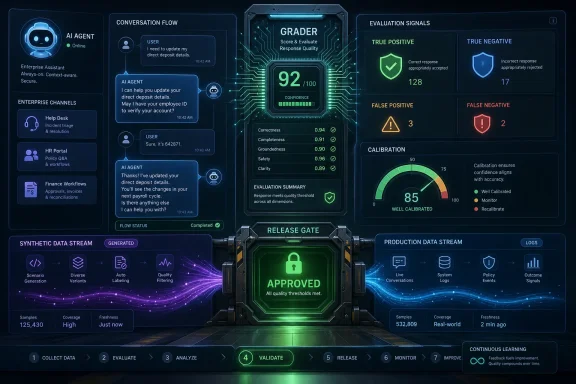
Microsoft says it tracks true positive rate and true negative rate. In plain English, that means asking two questions: how often does the grader catch bad responses, and how often does it leave good responses alone?
That tradeoff is central. A security-minded admin may prefer a grader that catches nearly every risky answer, even with false alarms. A customer-experience team may tolerate fewer false positives if excessive blocking would slow iteration. The correct threshold is not universal; it depends on what the agent does and what failure costs.
That matters because the Copilot Studio audience is not limited to machine-learning engineers. It includes business technologists, Power Platform makers, IT admins, and departments that want automation without constructing a full AI infrastructure stack. For those users, built-in evaluation is not a convenience feature. It is the difference between experimenting and operating.
The platform already supports test sets, AI-assisted generation, imported data, and evaluation results that compare actual responses with expected responses or quality standards. Microsoft’s broader documentation also emphasizes that agent evaluation is meant to measure response correctness and performance, rather than solve every AI safety or ethics problem.
That boundary is important. Evaluation can help determine whether an agent answered according to a rubric or reference response. It does not automatically prove that the organization has solved data leakage, prompt injection, policy compliance, or business process risk.
This is where administrators should resist vendor compression. “Evaluated” does not mean “safe.” “Grounded” does not mean “authorized.” “Passed the test set” does not mean “ready for every user.”
Still, the system ultimately depends on human choices. Someone defines the agent scope. Someone decides what counts as a high-quality response. Someone chooses the degradations. Someone interprets whether the true positive and true negative rates are acceptable for the use case.
That is not a weakness; it is reality. The danger comes when organizations pretend automated evaluation eliminates judgment rather than relocating it.
The best Copilot Studio teams will likely treat Microsoft’s eval machinery as a disciplined starting point, then layer in their own domain-specific tests. A legal intake agent, a payroll assistant, a device troubleshooting bot, and a customer refund agent should not be graded by the same generic sense of “quality.”
The more consequential the workflow, the more the test set needs to reflect actual policy, escalation paths, regional rules, and failure costs. In that sense, Microsoft can provide the scaffolding, but customers still own the risk.
 Microsoft Moves the AI Quality Argument Up One Level
The most important claim in Microsoft’s latest Copilot Studio post is not that agents need evaluation. That part is now table stakes. The sharper claim is that evaluation itself has become a product surface, and therefore needs its own quality system.That is a meaningful shift. For years, AI vendors have sold “evals” as the antidote to vibe-based prompting: run the tests, compare the scores, deploy the winner. But once an organization starts using automated graders to decide whether an agent is good enough for production, the grader becomes part of the software supply chain.
Microsoft is effectively saying that Copilot Studio’s evaluators must be treated like models: tested before release, monitored after changes, and challenged with datasets designed to expose failure. That is the right instinct, especially for a low-code platform where many users will not have machine-learning teams to build their own test harnesses.
The uncomfortable implication is that an eval score is not truth. It is a measurement produced by another system, with its own assumptions, blind spots, and failure modes.
Agent Testing Breaks the Old Machine-Learning Comfort Zone
Traditional machine-learning evaluation had a kind of procedural neatness. You had a dataset, labels, a task, and metrics that at least pretended to compress reality into a few numbers. Agents make that world messier.A Copilot Studio agent may handle a multi-turn conversation, call tools, retrieve knowledge, branch into predefined topics, and adapt to what a user says next. The answer is not just “right” or “wrong.” It may be correct but incomplete, grounded but poorly explained, polite but evasive, or coherent while quietly missing the point.
That is why Microsoft frames agent quality across dimensions such as correctness, completeness, clarity, coherence, tone, grounding, and conversational behavior. These are not merely aesthetic categories. In enterprise settings, each one can become a production risk.
A help-desk agent that gives a technically accurate answer in a confusing way still burns support time. An HR agent that sounds confident while omitting eligibility conditions can create compliance exposure. A customer-service agent that stays on tone while hallucinating policy is not “mostly good.” It is operationally dangerous.
Generated Data Is No Longer a Shortcut
The post’s most practical argument is that generated evaluation data is not a second-best substitute for production logs. Microsoft presents it as a deliberate design choice.That will annoy some purists, but it reflects how many organizations actually work. Production conversation data may be unavailable, restricted, sensitive, messy, or too narrow to cover the failure cases a team needs to test before launch. Waiting for real users to generate the test corpus is another way of saying users become the QA department.
Generated datasets let teams test earlier. They also let teams target scenarios that may be rare in production but costly when they occur. A synthetic user can ask awkward edge-case questions all day without violating privacy rules or waiting for an incident.
Microsoft describes several generation styles: single-turn prompts for isolated behaviors, multi-turn prompts for context tracking, knowledge-based queries for grounding, and topic- or instruction-based generation for broader exploration. The important point is not that one style is best. It is that different generation strategies stress different parts of the agent.
The risk, of course, is synthetic sameness. Generated prompts can look plausible while reflecting the generator’s habits more than the user population’s reality. Microsoft’s answer is to evaluate the generated queries themselves, looking at relevance, naturalness, human likeness, redundancy, intent diversity, and grounding where appropriate.
That recursive structure may sound absurd — using AI-like systems to evaluate AI-generated test data used to evaluate AI agents — but it is also where the industry is headed. The alternative is not some pure human-labeled paradise. The alternative is usually under-tested agents shipped with a handful of manually written happy-path prompts.
The Grader Becomes a Product Risk
Microsoft calls its evaluators “graders,” which is revealing language. A grader is not just a metric calculator. It makes judgments that users may interpret as objective.That means a bad grader can distort development. If it is too permissive, regressions slip through. If it is too strict, makers waste time “fixing” acceptable behavior. If it is inconsistent, teams stop trusting the evaluation dashboard entirely.
Microsoft says a high-quality grader should measure the intended dimension and only that dimension, distinguish meaningful differences, behave consistently across similar inputs, and produce interpretable signals. That “only that dimension” requirement matters more than it may appear. A tone grader that quietly penalizes length, or a correctness grader that overweights formatting, can push makers toward the wrong optimizations.
This is where evals become political inside organizations. Teams will optimize what the platform measures, especially when those measurements influence release decisions. A flawed score can become a management artifact, a compliance fig leaf, or a blocker in a deployment pipeline.
For WindowsForum readers who have lived through monitoring dashboards that went from helpful to tyrannical, the pattern is familiar. Once a number becomes the release gate, the integrity of that number becomes everyone’s problem.
Controlled Damage Is a Sensible Way to Find the Boundary
The most interesting methodological detail in Microsoft’s post is its use of controlled synthetic datasets with known ground truth. The team starts with a scoped test agent, generates realistic queries, creates high-quality responses, and then intentionally degrades some of those responses.That gives the grader something concrete to catch. If a response has been damaged in a known way, the system can measure whether the grader flags it. If an intact response is wrongly penalized, the team can see that too.
This is not glamorous data science, but it is exactly the kind of unglamorous engineering evals need. You cannot improve a grader by staring at a few explanations and deciding they feel reasonable. You need to know where it fails, what kind of failure it misses, and whether a change makes it more sensitive without making it noisy.
Microsoft says it tracks true positive rate and true negative rate. In plain English, that means asking two questions: how often does the grader catch bad responses, and how often does it leave good responses alone?
That tradeoff is central. A security-minded admin may prefer a grader that catches nearly every risky answer, even with false alarms. A customer-experience team may tolerate fewer false positives if excessive blocking would slow iteration. The correct threshold is not universal; it depends on what the agent does and what failure costs.
Copilot Studio Is Becoming an AI Test Bench, Not Just an Agent Builder
Copilot Studio began as a way to build agents, but Microsoft’s evaluation push shows the product moving deeper into lifecycle management. Building the agent is only the first phase. Testing, comparing, monitoring, and governing the agent are becoming part of the platform’s value proposition.That matters because the Copilot Studio audience is not limited to machine-learning engineers. It includes business technologists, Power Platform makers, IT admins, and departments that want automation without constructing a full AI infrastructure stack. For those users, built-in evaluation is not a convenience feature. It is the difference between experimenting and operating.
The platform already supports test sets, AI-assisted generation, imported data, and evaluation results that compare actual responses with expected responses or quality standards. Microsoft’s broader documentation also emphasizes that agent evaluation is meant to measure response correctness and performance, rather than solve every AI safety or ethics problem.
That boundary is important. Evaluation can help determine whether an agent answered according to a rubric or reference response. It does not automatically prove that the organization has solved data leakage, prompt injection, policy compliance, or business process risk.
This is where administrators should resist vendor compression. “Evaluated” does not mean “safe.” “Grounded” does not mean “authorized.” “Passed the test set” does not mean “ready for every user.”
The Missing Piece Is Still Human Accountability
Microsoft’s approach is stronger than the simplistic “LLM-as-a-judge” pitch that has spread across the AI tooling market. It acknowledges that graders need validation, that synthetic data needs quality checks, and that metrics must be interpreted through failure modes.Still, the system ultimately depends on human choices. Someone defines the agent scope. Someone decides what counts as a high-quality response. Someone chooses the degradations. Someone interprets whether the true positive and true negative rates are acceptable for the use case.
That is not a weakness; it is reality. The danger comes when organizations pretend automated evaluation eliminates judgment rather than relocating it.
The best Copilot Studio teams will likely treat Microsoft’s eval machinery as a disciplined starting point, then layer in their own domain-specific tests. A legal intake agent, a payroll assistant, a device troubleshooting bot, and a customer refund agent should not be graded by the same generic sense of “quality.”
The more consequential the workflow, the more the test set needs to reflect actual policy, escalation paths, regional rules, and failure costs. In that sense, Microsoft can provide the scaffolding, but customers still own the risk.
The Scorecard Microsoft Wants IT to Read Carefully
Microsoft’s post is ultimately less about a new feature than a new operating principle: agent quality depends on measurement quality. That should resonate with any admin who has watched a green dashboard hide a broken service.- Evaluation datasets need to be broad enough to test real behavior, not just the happy paths a maker remembered to write down.
- Generated test data is useful when it is targeted, diverse, and checked for redundancy, relevance, and grounding.
- Graders should be validated independently because their scores can shape release decisions and development priorities.
- Controlled degradations give teams a practical way to measure whether graders catch known failures without over-penalizing good answers.
- True positive and true negative rates are useful only when interpreted against the real cost of missed defects and false alarms.
- Passing an agent evaluation should be treated as evidence, not as a blanket guarantee of safety, compliance, or production readiness.
References
- Primary source: Microsoft
Published: Thu, 11 Jun 2026 16:00:00 GMT
Who evaluates the evaluators? The data science behind agent evals | Microsoft Copilot Blog
Learn how Copilot Studio approaches AI agent evaluation with generated data, grader validation, and scalable testing that improve agent quality.www.microsoft.com - Official source: learn.microsoft.com
About agent evaluation - Microsoft Copilot Studio | Microsoft Learn
Discover how agent evaluation helps automate testing, measure accuracy, and optimize your AI agent's behavior for better business outcomes.learn.microsoft.com - Official source: cdn-dynmedia-1.microsoft.com
