

Cloud architecture in 2026 has shifted from cataloguing services to making fast, defensible design choices under delivery pressure — and that change is why the five courses below matter for professionals who must design rather than merely deploy cloud systems.
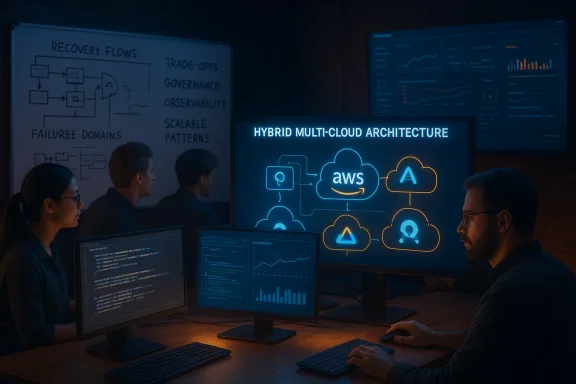
The market context is simple but decisive: worldwide public cloud end‑user spending is forecast to reach roughly $723.4 billion in 2025, and industry analysts expect hybrid and multi‑cloud strategies to dominate enterprise architecture discussions through 2027. These macro trends make practical skills in hybrid, multi‑cloud design, cost control, governance, and reliability central to anyone who wants to lead architecture discussions or own production outcomes.
Employers are less interested in rote exams and more in evidence of real‑world trade‑off thinking: can you design for availability while holding the line on cost? Can you specify an SLO, a recovery plan, and a cost forecast that are internally consistent? Training that emphasizes reference architectures, scenario‑based labs, and capstone projects produces those skills — which is the selection criterion applied to the five programs reviewed here.
Why this matters: AWS remains the largest public cloud by revenue and breadth of services. Practitioners who design on AWS must be able to balance availability zones, networking architectures, cost tiers (Spot vs On‑Demand vs Reserved), and service limits under production constraints.
Strengths
Recommended approach: Combine the Skill Builder modules with a small production‑grade lab (for example, build an autoscaled service with Canary deployments and a cost dashboard). Use the documentation produced during the lab as a portfolio artifact.
Why this matters: Many enterprises standardize on Azure for hybrid scenarios and Microsoft stacks. AZ‑305‑style training teaches architects to translate business constraints into mapped Azure services, identity models, and governance controls — critical for enterprise readiness.
Strengths
Recommended approach: Pair the course with a migration or continuity design exercise for your organization — e.g., design a migration plan for a 3‑tier monolith that preserves data residency and reduces mean time to recovery (MTTR) to a defined SLO.
Why this matters: If your work requires end‑to‑end delivery (architecture + CI/CD + observability + cost management), long‑form programs that build a portfolio of projects are more likely to convert into job‑ready outcomes than short vendor classes.
Strengths
Recommended approach: Treat the capstone as if it were a real procurement/architecture engagement: write a requirements doc, architecture diagrams, runbooks, a cost forecast, and a deployment plan — then include those artifacts in your portfolio.
Why this matters: Google Cloud’s strongest points are data, AI platforms, and containerized workloads. This course is effective when your primary risk profile is reliability under scale (SLOs, capacity planning, failure domains) and you want to translate those requirements into concrete GCP architecture choices.
Strengths
Recommended approach: Reserve the course for a small team and bring a live architecture case from your organization for workshop critique — that’s where the value compounds.
Why this matters: For busy professionals who want a structured, time‑boxed path with guided practice and simulated incidents, a blended provider program gives accountability and hands‑on rehearsal without the long calendar commitment of an 8‑month program.
Strengths
Recommended approach: After the course, do one additional project applying what you learned to a real workload — e.g., re‑architect a small service for cost, availability, and observability, and present your decisions to## Cross‑reference, verification and what I checked
I validated several market and course claims against multiple independent sources before recommending them:
I also noted community and forum discussion echoes about the practical value of these programs: practitioners often recommend AZ‑305 for architecture thinking and Skill Builder for repeated AWS lab practice, which aligns with the course strengths above.
Week 0 — Baseline & goals
Source: Analytics Insight 5 Cloud Computing Courses for Professionals Who Need Real-World Architecture Skills in 2026
 Background / Overview
The market context is simple but decisive: worldwide public cloud end‑user spending is forecast to reach roughly $723.4 billion in 2025, and industry analysts expect hybrid and multi‑cloud strategies to dominate enterprise architecture discussions through 2027. These macro trends make practical skills in hybrid, multi‑cloud design, cost control, governance, and reliability central to anyone who wants to lead architecture discussions or own production outcomes.Employers are less interested in rote exams and more in evidence of real‑world trade‑off thinking: can you design for availability while holding the line on cost? Can you specify an SLO, a recovery plan, and a cost forecast that are internally consistent? Training that emphasizes reference architectures, scenario‑based labs, and capstone projects produces those skills — which is the selection criterion applied to the five programs reviewed here.
What professionals really need in 2026
Before the course-by-course breakdown, here’s a checklist of capabilities a working architect must demonstrate in 2026:- Design for failure: define SLOs, error budgets, and recovery flows that scale.
- Cost-aware decisions: estimate and control spend across IaaS/PaaS while protecting performance.
- Hybrid/multi‑cloud fluency: map workloads to the right cloud(s) considering data gravity and regulatory constraints.
- Operational readiness: implement observability, runbooks, and deployment guardrails for fast, safe delivery.
- Security and governance: design identity, network segmentation, and data residency controls that auditors can validate.
- AI/ML considerations: prepare inference and training pipelines with cost and latency constraints in mind.
The five courses that focus on real-world architecture skills
Each entry below includes what the course is, who it’s for, the practical strengths, and verification notes where public claims required confirmation.1) Solutions Architect Learning Plan — AWS Skill Builder
Overview: AWS’s Solutions Architect learning path is a curated sequence of digital modules and hands‑on labs intended to push practitioners from service familiarity to architecture‑level thinking. The plan is oriented around AWS reference patterns and repeated lab practice to internalize tradeoffs.Why this matters: AWS remains the largest public cloud by revenue and breadth of services. Practitioners who design on AWS must be able to balance availability zones, networking architectures, cost tiers (Spot vs On‑Demand vs Reserved), and service limits under production constraints.
Strengths
- Lab-heavy learning: repeated practice with real products and patterns.
- Focus on architecture patterns rather than purely exam topics.
- Official vendor content, so the materials map to what engineering teams actually operate.
- Public-facing pages list the learning plan and module sets, but the total study hourss Builder plan can vary over time and by path; the specific “57 hours” figure that circulates in summaries is not consistently published on the official learning plan page and may change as content is added. Treat time estimates as planning guidance, not fixed contract hours.
Recommended approach: Combine the Skill Builder modules with a small production‑grade lab (for example, build an autoscaled service with Canary deployments and a cost dashboard). Use the documentation produced during the lab as a portfolio artifact.
2) Design Microsoft Azure Infrastructure Solutions (AZ‑305T00) — Microsoft Learn / Provider‑delivered
Overview: AZ‑305T00 is Microsoft’s role‑focused course for solution architects who must design end‑to‑end Azure infrastructure: governance, identity, networking, storage, migration strategy, and business continuity. The official course page lists a 4‑day provider‑delivered baseline, with scenario-driven labs to anchor design choices.Why this matters: Many enterprises standardize on Azure for hybrid scenarios and Microsoft stacks. AZ‑305‑style training teaches architects to translate business constraints into mapped Azure services, identity models, and governance controls — critical for enterprise readiness.
Strengths
- Emphasis on governance and architecture patterns rather thannario and case studies that require tradeoff analysis.
- Direct alignment with Azure Solutions Architect role expectations.
- Several provider calendars and partner pages sometimes list slightly different durations (some vendor offerings extend it to 5 days to accommodate deeper lab time). Always confirm the specific provider’s schedule and lab access before enrolling.
Recommended approach: Pair the course with a migration or continuity design exercise for your organization — e.g., design a migration plan for a 3‑tier monolith that preserves data residency and reduces mean time to recovery (MTTR) to a defined SLO.
3) PG Program in Cloud Computing and DevOps — Great Learning (Great Lakes Executive Learning partnership)
Overview: This is a long‑form, 8‑month program that promises multi‑cloud coverage (AWS, Azure, optional GCP), DevOps toolchains, hands‑on labs, and a multi‑week capstone. The provider lists 300+ hours of learning, with project work and live mentorship, making it the most comprehensive, portfolio‑forward option on this list.Why this matters: If your work requires end‑to‑end delivery (architecture + CI/CD + observability + cost management), long‑form programs that build a portfolio of projects are more likely to convert into job‑ready outcomes than short vendor classes.
Strengths
- Multi‑cloud coverage that forces you to compare design tradeoffs across providers.
- Large volume of structured exercises and a capstone that you can treat like a production task.
- Mentor and career support — helpful when juggling a full‑time job.
- Time commitment is substantial: eight months of sustained effort is required to get the advertised benefits.
- Employer recognition varies by region and hiring practice; treat the program as a portfolio builder rather than a single line on a resume.
Recommended approach: Treat the capstone as if it were a real procurement/architecture engagement: write a requirements doc, architecture diagrams, runbooks, a cost forecast, and a deployment plan — then include those artifacts in your portfolio.
4) Architecting with Google Cloud: Design and Process — Google Cloud curriculum (partner‑delivered)
Overview: This instructor‑led, 2‑day course focuses on applying reliability patterns, SRE‑style thinking, and clear design principles on Google Cloud. Delivered by authorized partners, the course is a compact, high‑impact workshop for experienced practitioners.Why this matters: Google Cloud’s strongest points are data, AI platforms, and containerized workloads. This course is effective when your primary risk profile is reliability under scale (SLOs, capacity planning, failure domains) and you want to translate those requirements into concrete GCP architecture choices.
Strengths
- SRE and reliability focus — useful for services expected to handle production spikes or complex failure modes.
- Instructor‑led, so you get facilitator feedback on tradeoffs and assumptions.
- Compact: two days of concentrated design work with guided activities.
- Short duration means you’ll need follow‑up labs to internalize patterns.
- The course assumes familiarity with core GCP services; it’s not an introduction.
Recommended approach: Reserve the course for a small team and bring a live architecture case from your organization for workshop critique — that’s where the value compounds.
5) AWS Solutions Architect Associate Certification Training — KnowledgeHut
Overview: KnowledgeHut’s Solutions Architect Associate program blends instructor‑led sessions with self‑paced learning, simulations, and capstone projects. Provider materials advertise 32 hours live plus 24 hours self‑paced content, along with numerous simulations and several capstones intended to mimic real delivery constraints.Why this matters: For busy professionals who want a structured, time‑boxed path with guided practice and simulated incidents, a blended provider program gives accountability and hands‑on rehearsal without the long calendar commitment of an 8‑month program.
Strengths
- Guided schedule and instructor accountability.
- Large volume of simulations and capstone projects (provider claims dozens of simulations and multiple capstones).
- Useful for engineers who need practical scenario experience quickly.
- This format mixes exam preparation and architecture practice; ensure you choose modules that emphasize scenario‑based architecture tasks rather than pure certification drill. Some provider pages emphasize exam readiness; read the syllabus carefully to confirm lab composition.
Recommended approach: After the course, do one additional project applying what you learned to a real workload — e.g., re‑architect a small service for cost, availability, and observability, and present your decisions to## Cross‑reference, verification and what I checked
I validated several market and course claims against multiple independent sources before recommending them:
- The public cloud spending and hybrid adoption figures are reported in Gartner’s public forecast and reflected across industry coverage; the $723.4B figure is from Gartner’s 2024–2025 forecast press release, which also highlights the shift toward hybrid and cross‑cloud frameworks. Secondary industry reporting repeats the hybrid adoption projection. Because Gartner content behind client paywalls can be summarized differently in various press items, treat the exact phrasing as Gartner’s research projection rather than an immutable policy.
- Microsoft’s AZ‑305T00 course and its 4‑day provider baseline are published on Microsoft Learn and mirrored by partner training calendars — note that partner schedules sometimes expand labs to a 5‑day format; always confirm with the vendor/partner you plan to attend.
- Great Learning’s PG program details (8 months, 300+ hours, multi‑cloud + capstone) are published on the program page and reflected in independent course roundups. This is a long‑form, portfolio‑oriented option.
- Google Cloud’s “Architecting with Google Cloud: Design and Process” course is listed as a 2‑day workshop in multiple partner course catalogs and curriculum roadmaps; these partner‑delivered workshops are the usual delivery model for this title.
- KnowledgeHut’s course claims (32 hours live + 24 self‑paced, many simulations) appear on the provider’s page and on course listings for the training. Those provider claims are consistent across their promotional materials.
I also noted community and forum discussion echoes about the practical value of these programs: practitioners often recommend AZ‑305 for architecture thinking and Skill Builder for repeated AWS lab practice, which aligns with the course strengths above.
How to choose between these five programs (practical decision matrix)
Pick based on how you spend most of your week at work. Below is a short decision flow you can follow.- Are you already tied to one cloud provider for production workloads?
- Yes, and it’s AWS: prioritize AWS Skill Builder or a structured AWS Solutions Architect training.
- Yes, and it’s Azure: AZ‑305 should be your first pick.
- Yes, and it’s GCP or AI‑centric: consider the Google Cloud design course and follow with hands‑on labs.
- Do you need multi‑cloud and delivery (DevOps) capability?
- Yes: the Great Learning PG Program’s multi‑cloud + DevOps focus is the best match if you can commit the time.
- Do you need a short, accountable, instructor‑guided sprint?
- Yes: a blended provider course like KnowledgeHut’s offers structure and practical simulations in a condensed window.
- Is your primary need reliability and SRE‑style decision making?
- Yes: the Google Cloud design and process workshop is optimized for SRE thinking and reliability patterns.
Tactical study plan to convert course time into career leverage
Courses are only valuable if you treat them like project time. Here’s a pragmatic 8‑week learning playbook you can apply no matter which course you pick:Week 0 — Baseline & goals
- Define 3 measurable outcomes (e.g., “design a multi‑AZ service with <1% monthly error budget”).
- Prepare a one‑page systems brief that will become your capstone input.
- Do every lab in the course. For each lab, write a one‑page decision log: requirement, constraint, chosen architecture, alternatives considered, cost estimate, and monitoring plan.
- Pair labs with short, timed design exercises (30–60 minutes) where you sketch architecture and justify tradeoffs.
- Build the capstone or a mini‑production pilot. Use IaC (Terraform/ARM/Bicep) and automated tests.
- Create realistic failure drills and incident runbooks.
- Package artifacts: architecture diagrams, cost reports, runbooks, and a short recorded walkthrough.
- Ask a peer or mentor to critique your design; iterate based on feedback.
Risks, tradeoffs, and blind spots
- Vendor bias: vendor‑authored courses (AWS, Microsoft, Google) emphasize platform‑native patterns. That’s valuable but must be balanced with multi‑cloud design thinking if your org spans providers. Combine vendor courses with multi‑cloud exercises or a neutral design course.
- Time vs depth tradeoff: short workshops (2–5 days) are great for concentrated pattern work but require follow‑up labs. Long programs (8 months) build depth but demand consistent time and motivation. Choose a format you can sustain.
- Claims variability: promotional pages may change hours, lab counts, or capstone descriptions. Always confirm the current syllabus and what actual lab access you’ll receive before paying. I flagged several of these variations in the verification section above.
- Hiring signal vs capability: certificates are weaker predictors of on‑the‑job competence than demonstrable artifacts. Hiring teams will ask how you made a decision, not what exam you passed. Build a portfolio.
Final recommendations — pick, plan, and prove
- If you need platform depth and repeated lab practice on AWS: start with the Solutions Architect Learning Plan and augment with targeted workshops or cert training for structured practice.
- If you operate in Microsoft‑centric enterprises and lead migrations or governance work: the AZ‑305T00 course (4‑day) plus a migration capstone will give you the right vocabulary and design patterns.
- If you need multi‑cloud architecture, delivery pipelines, and a job‑ready portfolio: invest the time in Great Learning’s PG Program and treat the capstone like a production engagement.
- If reliability, SRE, and scale are your priorities on Google Cloud: use the Architecting with Google Cloud: Design and Process 2‑day workshop as a catalyst, then follow with hands‑on labs.
- If you need a fast, instructor‑led, simulation‑heavy path to sharpen scenario practice: a blended provider program such as KnowledgeHut’s Solutions Architect Associate training fits that need.
Closing — how to make any course pay off
- Build artifacts: architecture diagrams, cost forecasts, SLOs, runbooks, and a recorded walkthrough.
- Publish a concise case study for each project you complete during a program.
- Run at least one incident drill with stakeholders and capture the post‑mortem.
- Seek peer review and iterate.
Source: Analytics Insight 5 Cloud Computing Courses for Professionals Who Need Real-World Architecture Skills in 2026
