

Spyglass MTG and FM have deployed a Microsoft Azure-based AI engineering knowledge platform, announced in early June 2026 and recently profiled by Microsoft, to give more than 1,500 FM field engineers faster access to the insurer’s technical standards and risk guidance. The headline is not that another enterprise has built a chatbot. It is that a large, risk-sensitive business has found a practical use for generative AI where speed matters, but unchecked creativity is a liability. In the current AI cycle, that distinction is everything.
The easiest way to misunderstand FM’s new system is to imagine a friendly corporate assistant answering questions over a pile of PDFs. That is the demo version of enterprise AI, the version that looks good in a conference keynote and falls apart the first time a professional user needs an answer that can influence real money, real property, and real safety decisions.
FM’s problem was more stubborn. The company, one of the world’s largest commercial property insurers, has built its business around engineering-led risk assessment. Its field engineers inspect complex environments such as manufacturing plants, mines, and industrial facilities, then translate technical observations into recommendations that can affect underwriting, client risk reduction, and loss prevention.
That work depends on institutional memory. FM’s engineering standards span tens of thousands of pages across more than 300 PDF documents, covering areas such as fire protection, equipment reliability, and other highly specialized industrial risks. The knowledge is valuable precisely because it is detailed, accumulated over nearly two centuries, and difficult to flatten into a handful of simple rules.
The result was a familiar enterprise bottleneck: the information existed, but the path to finding it was too slow. Engineers could search documents, but search often required knowing the exact terminology in advance. They could manually review standards, but that process consumed time during site visits and client preparation. In other words, FM did not have a knowledge problem so much as a retrieval problem.
Spyglass MTG’s role was to help turn that retrieval problem into an AI engineering platform built on Microsoft Azure, Azure OpenAI, and Azure AI Search. The important part is not the vendor logo stack. It is the design premise: the system had to behave less like a general-purpose conversational bot and more like a disciplined technical search-and-reasoning layer over approved engineering knowledge.
FM’s use case is different because it puts AI into the middle of a professional judgment process without pretending to replace the professional. The field engineer remains the accountable expert. The AI system narrows the distance between the expert and the relevant standard.
That is a more modest claim than much of the AI industry likes to make, but it is also a more credible one. The system is not being sold as an autonomous underwriter, a synthetic engineer, or a magic oracle for industrial risk. It is being positioned as a way to surface trusted guidance quickly, in context, and with enough governance to be useful in a high-stakes environment.
This is where the phrase AI-powered search undersells what is happening. Traditional enterprise search returns documents. A retrieval-augmented AI system attempts to assemble relevant passages, interpret the query, and produce a usable answer grounded in specific source material. That distinction matters when an engineer has five minutes before a client presentation and needs the right guidance, not a long list of potentially relevant PDFs.
But the distinction also introduces risk. The more an AI system synthesizes, the more opportunity it has to distort. The harder the user’s question, the more dangerous a confident but incomplete answer becomes. FM’s deployment is notable because its designers appear to have treated that danger as the central engineering problem rather than a public-relations inconvenience.
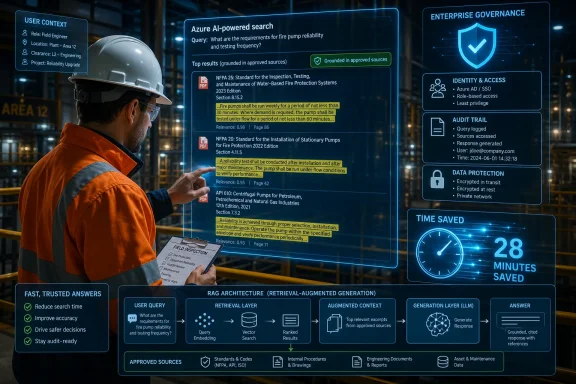
The architecture described by Microsoft and FM centers on retrieval discipline. The system uses Azure AI Search to retrieve relevant material from FM’s standards, while Azure OpenAI provides the natural-language interaction and response generation. Spyglass and FM reportedly structured and chunked the underlying content according to engineering logic rather than simply slicing documents into arbitrary blocks.
That detail is easy to skip over, but it may be the most important lesson of the project. Many enterprise AI pilots fail because they treat content preparation as clerical work. Dump a document repository into a vector database, add a prompt, give it a mascot, and call it transformation. FM’s example suggests the opposite: the quality of an AI knowledge system is limited by how well the organization understands its own knowledge.
Engineering standards are not ordinary prose. They include dependencies, exceptions, diagrams, tables, sequences, and domain-specific assumptions. If those relationships are broken during ingestion, the model may retrieve a technically related passage while missing the logic that gives it meaning. That is why FM’s emphasis on engineering logic, ground-truth validation, and continuous evaluation matters.
The system is also described as using known examples to validate outputs as standards evolve. That is another sign of maturity. A production AI platform is not finished when it works once in a demo; it has to remain reliable as documents change, users discover edge cases, and the organization’s own practices evolve. For enterprises, the maintenance burden is not a footnote. It is the product.
Those numbers are plausible in a way that many AI productivity claims are not. Saving a few minutes on a technical lookup does not sound like a revolution until it is multiplied across 1,500 field engineers who repeatedly need precise guidance under time pressure. The value is not in replacing an employee’s day; it is in shaving friction from the repeated tasks that make expert work slower than it needs to be.
The anecdote from the mining facility captures the point. An FM engineer reportedly needed to prepare client-facing material quickly during a site visit and used the platform to retrieve the necessary guidance within minutes. That is the sort of workflow where a general chatbot would be risky, but a well-grounded internal knowledge system can be useful.
The return on investment, then, is not merely time saved. It is confidence preserved. When a field engineer can find the relevant standard quickly, the client interaction improves, the engineer’s preparation improves, and the organization’s institutional knowledge becomes more portable. That is a quieter form of productivity than AI-generated spreadsheets or autonomous agents, but it may be more durable.
That message matters because Microsoft is trying to position Azure as the safe, governed substrate for enterprise AI. Foundry, Azure OpenAI, Azure AI Search, and the broader Azure AI portfolio are not just model access points. They are being sold as the scaffolding for production systems that connect models to private data, enforce access controls, and support auditable workflows.
FM’s deployment gives Microsoft a use case that avoids some of the fuzzier promises around AI agents. There is no need to claim that the system independently completes an entire business process. It helps a specific group of expert workers retrieve and apply specific institutional knowledge faster. For many CIOs, that is more attractive than a moonshot.
It is also a strong case for Microsoft’s partner ecosystem. Spyglass MTG, a consulting firm focused on data, AI, and security solutions on Microsoft platforms, appears to have supplied the implementation muscle and architectural judgment needed to turn Azure components into a production-grade system. That is the unglamorous truth of enterprise AI: platforms matter, but integration decides whether anything useful ships.
The case also reinforces why retrieval-augmented generation, or RAG, remains central to enterprise AI despite the industry’s obsession with ever-larger models. A more powerful model may reason better, but it still needs the right context. In FM’s case, the valuable intelligence lives in its standards, examples, and engineering history. The model is the interface and synthesis layer, not the source of truth.
The system reportedly runs within Azure using FM’s existing identity, security, and governance controls. That matters because access to knowledge inside a large company is rarely uniform. Different users may have different permissions, and sensitive internal standards may need to remain inside controlled environments. An enterprise AI platform that ignores those boundaries becomes a data leakage machine with a pleasant interface.
There is also the question of auditability. If AI-assisted answers influence engineering discussions, organizations will increasingly want to know what information was retrieved, how answers were generated, and whether users can trace responses back to approved sources. In regulated or risk-sensitive industries, the ability to explain the system’s behavior may matter nearly as much as the answer itself.
FM’s focus on ground-truth examples and continuous feedback suggests an awareness that AI reliability is not a static property. Models change, prompts change, documents change, and user behavior changes. The system has to be observed and tuned like other production software, with failure modes treated as engineering defects rather than philosophical debates.
That is the broader lesson for WindowsForum’s IT pro audience. AI governance is not a policy PDF written after deployment. It is embedded in identity, retrieval, logging, evaluation, content lifecycle management, and operational resilience. If those pieces are missing, the chatbot may still answer questions, but the organization should not trust it with important work.
A field engineer at an industrial site operates under different constraints. The environment is specific, the client context matters, the guidance may be technical, and time can be limited. The value of the AI system depends not on whether it sounds polished but on whether it helps the engineer act with more confidence.
That makes FM’s deployment a more meaningful test of enterprise AI than another generic assistant embedded in a productivity suite. Field engineers are expert users with specialized knowledge, and expert users are often unforgiving judges of bad software. If a system wastes their time, produces vague answers, or buries them in caveats, they will route around it.
The reported adoption — 17,000 queries in two months — suggests the platform cleared at least the first hurdle: engineers found it worth using. That does not prove perfection, and it does not eliminate the need for ongoing measurement. But adoption by busy technical professionals is more persuasive than an executive mandate or a vendor slide.
It also hints at a future in which AI adoption spreads through professional workflows rather than top-down digital transformation campaigns. The winners will be systems that meet users at the moment of friction. For FM, that moment was the search for precise standards in the field. For another company, it might be maintenance logs, legal clauses, medical protocols, incident histories, or software architecture decisions.
It also appears to have had the discipline to avoid the most common enterprise AI trap: building a general assistant before defining a specific job. “Ask our company anything” sounds attractive, but it tends to produce vague systems with vague accountability. FM’s platform was aimed at engineers, standards, risk guidance, and field use. Narrowness was a strength.
That narrowness also means the system’s success does not automatically generalize. A company with messy documents, inconsistent terminology, unclear ownership, weak identity controls, and no validation examples should not expect the same results by buying the same Azure services. The hard work is not in acquiring model access. It is in preparing the knowledge and governing the workflow.
There is also an unresolved human factor. When AI systems become useful, users may gradually trust them more than they should. The better the answers, the easier it is to forget that retrieval can miss context and generation can still misstate nuance. FM’s framing — AI as support for engineering judgment, not a substitute for it — will have to remain visible in training, interface design, and management expectations.
That may be the long-term test. The system should make experts faster without making them passive. If the AI becomes a shortcut around judgment, the value proposition flips. If it remains a tool that brings the right material to the right professional at the right time, it strengthens the very expertise that FM is built around.
The strongest takeaways are operational rather than promotional:
The next phase of enterprise AI will be judged less by how convincingly systems talk and more by how reliably they operate inside real constraints. FM’s engineering knowledge platform points in that direction. The companies that benefit most will be the ones that stop asking where they can “add AI” and start asking where their best people are losing time because the organization’s knowledge is trapped just out of reach.
 The Real Product Is Not the Chat Box
The easiest way to misunderstand FM’s new system is to imagine a friendly corporate assistant answering questions over a pile of PDFs. That is the demo version of enterprise AI, the version that looks good in a conference keynote and falls apart the first time a professional user needs an answer that can influence real money, real property, and real safety decisions.FM’s problem was more stubborn. The company, one of the world’s largest commercial property insurers, has built its business around engineering-led risk assessment. Its field engineers inspect complex environments such as manufacturing plants, mines, and industrial facilities, then translate technical observations into recommendations that can affect underwriting, client risk reduction, and loss prevention.
That work depends on institutional memory. FM’s engineering standards span tens of thousands of pages across more than 300 PDF documents, covering areas such as fire protection, equipment reliability, and other highly specialized industrial risks. The knowledge is valuable precisely because it is detailed, accumulated over nearly two centuries, and difficult to flatten into a handful of simple rules.
The result was a familiar enterprise bottleneck: the information existed, but the path to finding it was too slow. Engineers could search documents, but search often required knowing the exact terminology in advance. They could manually review standards, but that process consumed time during site visits and client preparation. In other words, FM did not have a knowledge problem so much as a retrieval problem.
Spyglass MTG’s role was to help turn that retrieval problem into an AI engineering platform built on Microsoft Azure, Azure OpenAI, and Azure AI Search. The important part is not the vendor logo stack. It is the design premise: the system had to behave less like a general-purpose conversational bot and more like a disciplined technical search-and-reasoning layer over approved engineering knowledge.
Enterprise AI Is Growing Up by Getting Boring
The FM deployment lands at a moment when corporate AI has begun to move from spectacle to plumbing. The first wave of generative AI inside enterprises was dominated by experimentation: summarize this meeting, draft that email, query this document, automate that help desk response. Useful, sometimes impressive, but often disconnected from core operational workflows.FM’s use case is different because it puts AI into the middle of a professional judgment process without pretending to replace the professional. The field engineer remains the accountable expert. The AI system narrows the distance between the expert and the relevant standard.
That is a more modest claim than much of the AI industry likes to make, but it is also a more credible one. The system is not being sold as an autonomous underwriter, a synthetic engineer, or a magic oracle for industrial risk. It is being positioned as a way to surface trusted guidance quickly, in context, and with enough governance to be useful in a high-stakes environment.
This is where the phrase AI-powered search undersells what is happening. Traditional enterprise search returns documents. A retrieval-augmented AI system attempts to assemble relevant passages, interpret the query, and produce a usable answer grounded in specific source material. That distinction matters when an engineer has five minutes before a client presentation and needs the right guidance, not a long list of potentially relevant PDFs.
But the distinction also introduces risk. The more an AI system synthesizes, the more opportunity it has to distort. The harder the user’s question, the more dangerous a confident but incomplete answer becomes. FM’s deployment is notable because its designers appear to have treated that danger as the central engineering problem rather than a public-relations inconvenience.
Accuracy Became the Architecture
FM’s executives and partners have been careful to frame accuracy as non-negotiable. That is not just a nice phrase for a case study. In commercial property insurance, engineering guidance can affect risk recommendations, loss prevention measures, and underwriting confidence. A vague answer is not merely unhelpful; it can be operationally dangerous.The architecture described by Microsoft and FM centers on retrieval discipline. The system uses Azure AI Search to retrieve relevant material from FM’s standards, while Azure OpenAI provides the natural-language interaction and response generation. Spyglass and FM reportedly structured and chunked the underlying content according to engineering logic rather than simply slicing documents into arbitrary blocks.
That detail is easy to skip over, but it may be the most important lesson of the project. Many enterprise AI pilots fail because they treat content preparation as clerical work. Dump a document repository into a vector database, add a prompt, give it a mascot, and call it transformation. FM’s example suggests the opposite: the quality of an AI knowledge system is limited by how well the organization understands its own knowledge.
Engineering standards are not ordinary prose. They include dependencies, exceptions, diagrams, tables, sequences, and domain-specific assumptions. If those relationships are broken during ingestion, the model may retrieve a technically related passage while missing the logic that gives it meaning. That is why FM’s emphasis on engineering logic, ground-truth validation, and continuous evaluation matters.
The system is also described as using known examples to validate outputs as standards evolve. That is another sign of maturity. A production AI platform is not finished when it works once in a demo; it has to remain reliable as documents change, users discover edge cases, and the organization’s own practices evolve. For enterprises, the maintenance burden is not a footnote. It is the product.
The Numbers Are Small Enough to Believe and Large Enough to Matter
The early usage figures are not astronomical, which is a point in their favor. FM says engineers submitted more than 17,000 queries in the first two months after launch. The company estimates that each search saves between six and ten minutes, freeing thousands of engineering hours annually for client-facing work.Those numbers are plausible in a way that many AI productivity claims are not. Saving a few minutes on a technical lookup does not sound like a revolution until it is multiplied across 1,500 field engineers who repeatedly need precise guidance under time pressure. The value is not in replacing an employee’s day; it is in shaving friction from the repeated tasks that make expert work slower than it needs to be.
The anecdote from the mining facility captures the point. An FM engineer reportedly needed to prepare client-facing material quickly during a site visit and used the platform to retrieve the necessary guidance within minutes. That is the sort of workflow where a general chatbot would be risky, but a well-grounded internal knowledge system can be useful.
The return on investment, then, is not merely time saved. It is confidence preserved. When a field engineer can find the relevant standard quickly, the client interaction improves, the engineer’s preparation improves, and the organization’s institutional knowledge becomes more portable. That is a quieter form of productivity than AI-generated spreadsheets or autonomous agents, but it may be more durable.
Microsoft’s AI Stack Finds a Sensible Enterprise Story
For Microsoft, the FM case study is almost too tidy. It combines Azure OpenAI, Azure AI Search, enterprise identity, governance, secure data handling, and partner-delivered implementation into exactly the story Microsoft wants CIOs to hear in 2026. The message is clear: you do not need to throw your proprietary knowledge into a consumer chatbot to get value from generative AI.That message matters because Microsoft is trying to position Azure as the safe, governed substrate for enterprise AI. Foundry, Azure OpenAI, Azure AI Search, and the broader Azure AI portfolio are not just model access points. They are being sold as the scaffolding for production systems that connect models to private data, enforce access controls, and support auditable workflows.
FM’s deployment gives Microsoft a use case that avoids some of the fuzzier promises around AI agents. There is no need to claim that the system independently completes an entire business process. It helps a specific group of expert workers retrieve and apply specific institutional knowledge faster. For many CIOs, that is more attractive than a moonshot.
It is also a strong case for Microsoft’s partner ecosystem. Spyglass MTG, a consulting firm focused on data, AI, and security solutions on Microsoft platforms, appears to have supplied the implementation muscle and architectural judgment needed to turn Azure components into a production-grade system. That is the unglamorous truth of enterprise AI: platforms matter, but integration decides whether anything useful ships.
The case also reinforces why retrieval-augmented generation, or RAG, remains central to enterprise AI despite the industry’s obsession with ever-larger models. A more powerful model may reason better, but it still needs the right context. In FM’s case, the valuable intelligence lives in its standards, examples, and engineering history. The model is the interface and synthesis layer, not the source of truth.
The Governance Story Is the Product Story
It is tempting to treat governance as the dull compliance appendix to an AI deployment. In FM’s case, governance is the difference between a toy and a tool. The platform handles proprietary engineering standards, supports field work, and operates in a context where inaccurate guidance can have downstream consequences.The system reportedly runs within Azure using FM’s existing identity, security, and governance controls. That matters because access to knowledge inside a large company is rarely uniform. Different users may have different permissions, and sensitive internal standards may need to remain inside controlled environments. An enterprise AI platform that ignores those boundaries becomes a data leakage machine with a pleasant interface.
There is also the question of auditability. If AI-assisted answers influence engineering discussions, organizations will increasingly want to know what information was retrieved, how answers were generated, and whether users can trace responses back to approved sources. In regulated or risk-sensitive industries, the ability to explain the system’s behavior may matter nearly as much as the answer itself.
FM’s focus on ground-truth examples and continuous feedback suggests an awareness that AI reliability is not a static property. Models change, prompts change, documents change, and user behavior changes. The system has to be observed and tuned like other production software, with failure modes treated as engineering defects rather than philosophical debates.
That is the broader lesson for WindowsForum’s IT pro audience. AI governance is not a policy PDF written after deployment. It is embedded in identity, retrieval, logging, evaluation, content lifecycle management, and operational resilience. If those pieces are missing, the chatbot may still answer questions, but the organization should not trust it with important work.
Field Engineers Are a Better AI Test Than Office Workers
Much of the enterprise AI conversation has centered on office productivity because that is where vendors can reach the broadest audience. Summarize a Teams meeting. Draft a Word document. Create a PowerPoint. Search an inbox. These are useful tasks, but they are also forgiving ones compared with field engineering.A field engineer at an industrial site operates under different constraints. The environment is specific, the client context matters, the guidance may be technical, and time can be limited. The value of the AI system depends not on whether it sounds polished but on whether it helps the engineer act with more confidence.
That makes FM’s deployment a more meaningful test of enterprise AI than another generic assistant embedded in a productivity suite. Field engineers are expert users with specialized knowledge, and expert users are often unforgiving judges of bad software. If a system wastes their time, produces vague answers, or buries them in caveats, they will route around it.
The reported adoption — 17,000 queries in two months — suggests the platform cleared at least the first hurdle: engineers found it worth using. That does not prove perfection, and it does not eliminate the need for ongoing measurement. But adoption by busy technical professionals is more persuasive than an executive mandate or a vendor slide.
It also hints at a future in which AI adoption spreads through professional workflows rather than top-down digital transformation campaigns. The winners will be systems that meet users at the moment of friction. For FM, that moment was the search for precise standards in the field. For another company, it might be maintenance logs, legal clauses, medical protocols, incident histories, or software architecture decisions.
The Limits Are Where the Lesson Lives
There is a danger in over-reading one successful deployment. FM had advantages that many organizations do not. It had a high-value knowledge base, a clearly defined user population, measurable time savings, executive sponsorship, and a business process where faster retrieval directly improves professional work.It also appears to have had the discipline to avoid the most common enterprise AI trap: building a general assistant before defining a specific job. “Ask our company anything” sounds attractive, but it tends to produce vague systems with vague accountability. FM’s platform was aimed at engineers, standards, risk guidance, and field use. Narrowness was a strength.
That narrowness also means the system’s success does not automatically generalize. A company with messy documents, inconsistent terminology, unclear ownership, weak identity controls, and no validation examples should not expect the same results by buying the same Azure services. The hard work is not in acquiring model access. It is in preparing the knowledge and governing the workflow.
There is also an unresolved human factor. When AI systems become useful, users may gradually trust them more than they should. The better the answers, the easier it is to forget that retrieval can miss context and generation can still misstate nuance. FM’s framing — AI as support for engineering judgment, not a substitute for it — will have to remain visible in training, interface design, and management expectations.
That may be the long-term test. The system should make experts faster without making them passive. If the AI becomes a shortcut around judgment, the value proposition flips. If it remains a tool that brings the right material to the right professional at the right time, it strengthens the very expertise that FM is built around.
The AI Deployment CIOs Should Study Before Buying Another Assistant
FM’s project offers a practical pattern for enterprise AI that is more useful than the average product announcement. It is not glamorous, but it is concrete. It starts with a painful retrieval problem, grounds answers in controlled knowledge, validates against known examples, and measures adoption through real work.The strongest takeaways are operational rather than promotional:
- The most credible enterprise AI systems begin with a specific workflow, a defined user group, and a measurable source of friction.
- Retrieval quality depends on how well the source material is structured, chunked, governed, and mapped to the way professionals actually reason.
- Generative AI is safer in high-stakes settings when it supports expert judgment rather than pretending to replace it.
- Time savings become meaningful when they occur repeatedly across large groups of skilled workers doing expensive, client-facing work.
- Governance, identity, evaluation, and feedback loops are not add-ons; they are the conditions that make enterprise AI deployable.
- The best AI case studies increasingly look less like science fiction and more like well-engineered internal software.
The next phase of enterprise AI will be judged less by how convincingly systems talk and more by how reliably they operate inside real constraints. FM’s engineering knowledge platform points in that direction. The companies that benefit most will be the ones that stop asking where they can “add AI” and start asking where their best people are losing time because the organization’s knowledge is trapped just out of reach.
References
- Primary source: Insurance Edge
Published: 2026-06-08T16:30:10.740436
Spyglass MTG Working With FM on AI Engineering Platform -
Discover the Spyglass partnership: unlocking 200 years of engineering knowledge for FM field engineers with AI solutions.insurance-edge.net - Official source: devblogs.microsoft.com
How we built "Ask Learn", the RAG-based knowledge service - Engineering@Microsoft
Learn how Microsoft Learn’s RAG-based generative AI chat system was engineered and their takeaways to help you design a RAG-based chat for your org.devblogs.microsoft.com - Related coverage: spyglassmtg.com
