

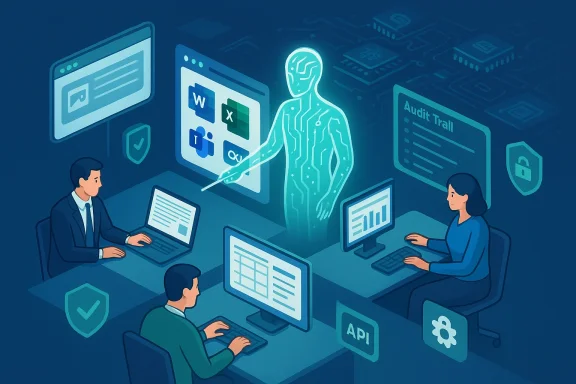
The AI industry’s public conversation has begun to pivot away from casual chat and toward a much more consequential promise: not conversational companions, but autonomous digital coworkers that can plan, act, and be managed inside the software ecosystems companies already use.
For three years the dominant story in AI was natural-language models that could answer questions, draft prose, and assist with coding. Those models unlocked astonishing new productivity at the task level, but industry leaders increasingly recognized a commercial ceiling: a chatbot answers a question and then waits. The newer generation of systems—AI agents—is architected to accept an objective, decompose work into subtasks, invoke external tools and APIs, execute actions in applications or browsers, and deliver completed results. That single shift—from reply to execution—changes product strategy, pricing, security posture, and organizational design.
Major vendors have made the change explicit. Enterprise offerings from multiple platform owners now promote agent creation, orchestration, and governance features: drag‑and‑drop agent design, agent catalogs or stores, background triggers that allow an agent to wake and act on specified events, and audit trails that record every action an agent takes. The technical building blocks that made this possible—large context windows, multi‑modal inputs, native tool use, and persistent memory—have matured in parallel. The result is an industry message that reads less like “talk to your assistant” and more like “hire and manage an AI employee.”
That pricing delta creates incentives for rapid enterprise adoption:
On the regulatory front, emerging frameworks treat agentic autonomy as a material factor in risk classification. The new European AI regulatory architecture and national guidance increasingly consider the degree of autonomy when allocating obligations and potential liability. That means organizations deploying agents in the EU must plan for conformity assessments, transparency, and human oversight obligations. Legal frameworks will likely move toward an autonomy‑based liability model: higher autonomy implies more upstream responsibility for developers and platform providers.
But risks are real and multifaceted:
The industry is asking organizations to stop chatting and start managing. The responsible answer is to do both: use agents to scale work, and build the systems and practices that make delegation safe, explainable, and ultimately sustainable.
Source: WebProNews From Chatbots to Coworkers: Inside the AI Industry’s Radical Pivot Toward Autonomous Agents
 Background: why “agents” replaced “chatbots” as the narrative
For three years the dominant story in AI was natural-language models that could answer questions, draft prose, and assist with coding. Those models unlocked astonishing new productivity at the task level, but industry leaders increasingly recognized a commercial ceiling: a chatbot answers a question and then waits. The newer generation of systems—AI agents—is architected to accept an objective, decompose work into subtasks, invoke external tools and APIs, execute actions in applications or browsers, and deliver completed results. That single shift—from reply to execution—changes product strategy, pricing, security posture, and organizational design.Major vendors have made the change explicit. Enterprise offerings from multiple platform owners now promote agent creation, orchestration, and governance features: drag‑and‑drop agent design, agent catalogs or stores, background triggers that allow an agent to wake and act on specified events, and audit trails that record every action an agent takes. The technical building blocks that made this possible—large context windows, multi‑modal inputs, native tool use, and persistent memory—have matured in parallel. The result is an industry message that reads less like “talk to your assistant” and more like “hire and manage an AI employee.”
Overview: what an AI agent is and what it isn’t
An AI agent, in current industry usage, is a compound system that combines a language model with:- access to tools and connectors (APIs, databases, apps, browser automation),
- statefulness or memory across sessions,
- a planning or orchestration layer that breaks objectives into actions,
- monitoring and traceability features that log decisions and external calls.
- Chatbot: reactive, single-turn or multi-turn textual interaction. Human asks; model answers.
- Agent: proactive, multi-step execution. Human delegates an objective; the agent plans, acts, and reports.
Who’s building the agent workforce — and how they differ
OpenAI: productizing co‑workers
OpenAI has pivoted beyond consumer chat to enterprise propositions that present agents as digital co‑workers. Their stacks emphasize integrations that let agents log in, call APIs, run browser actions, and persist memory and permissions. OpenAI’s enterprise platforms stress centralized control—roles, permissions, and monitoring dashboards—so organizations can deploy agents at scale while retaining oversight. The emphasis is on delivering outputs and workflows rather than single answers.Anthropic: safety‑centered agent teams
Anthropic has taken an explicitly safety-first posture as it moves into agentic workflows. Their recent model releases showcase multi-agent orchestration—multiple AI instances that split workloads and collaborate in parallel—while coupling those capabilities with constitutional AI techniques designed to make agents more controllable and explainable. Anthropic positions agents toward regulated industries that require explainability, traceability, and conservative default behavior.Microsoft: agents where you already work
Microsoft’s strategy is integration-first: agents are embedded into Word, Excel, Teams, and the Microsoft 365 surface through Copilot and Copilot Studio. That approach reduces friction—agents become features inside familiar apps rather than separate products. Copilot Studio also exposes a builder and a marketplace model so organizations can create, publish, and manage custom agents across the enterprise with governance controls layered in.Google: scale and multi‑modal orchestration
Google leverages Gemini models and its cloud infrastructure to make agentic capabilities available inside Workspace and Vertex AI. The focus is on multi‑modal reasoning and processing massive organizational context. Google’s approach emphasizes artifacts and logs that make agent activity auditable, and agent features appear as native extensions to search, email, and cloud tooling.The product and economic calculus: why agents matter to vendors and CFOs
The economics of agents differ profoundly from subscription chat. A chatbot is sold as per‑seat access to a powerful conversational model. An agent is pitched as a labor replacement or augmentation—a system that can execute tasks 24/7 with far lower marginal cost than a human employee when priced by usage (tokens, API calls, or per‑agent billing).That pricing delta creates incentives for rapid enterprise adoption:
- Vendors can monetize agents through enterprise contracts, platform fees, and agent marketplaces.
- Buyers compare agent costs to salary and overhead for junior roles: for many repetitive knowledge tasks the agent can be priced as a fraction of labor.
- The productivity story is compelling: in controlled deployments agents deliver measurable time savings on repetitive, well-specified workflows.
What managing an agent actually looks like inside an organization
The rise of agents is already creating new job families and processes:- Agent supervisors (or AI operations managers) configure objectives, specify boundaries, and tune monitoring.
- Security and identity teams must treat agents as first‑class identities—issuing credentials, setting least‑privilege access, and enabling instant revocation.
- Compliance teams demand audit trails, provenance records, and the ability to replay an agent’s decision sequence for regulatory review.
- Clear objectives: define outcomes and success criteria before deployment.
- Defined scope: limit which apps, files, and systems agents can access.
- Guardrails and policies: input sanitization, prompt injection protections, and safety filters.
- Monitoring: real‑time alerts and retrospective logs that record every tool invocation and state change.
- Human‑in‑the‑loop checkpoints: mandatory approvals for high‑risk actions.
Security, governance and legal risk—why agents raise the stakes
Agents change threat models. A chatbot that produces text is one class of risk; an agent that can log in to services, perform transactions, or manipulate data is another. New risks include:- Credential theft and misuse: agents with overbroad OAuth scopes can be a vector for unauthorized data access.
- Supply‑chain or social engineering attacks: attackers can craft prompts, topics, or agent configurations to trick agents into authorizing actions.
- Cascade failures: an agent acting on hallucinated output can propagate errors across systems (e.g., deleting data, placing orders, or creating contractual language).
- Identity and access confusion: without unique agent identities and fine‑grained access control, it’s difficult to attribute actions or apply least‑privilege principles.
On the regulatory front, emerging frameworks treat agentic autonomy as a material factor in risk classification. The new European AI regulatory architecture and national guidance increasingly consider the degree of autonomy when allocating obligations and potential liability. That means organizations deploying agents in the EU must plan for conformity assessments, transparency, and human oversight obligations. Legal frameworks will likely move toward an autonomy‑based liability model: higher autonomy implies more upstream responsibility for developers and platform providers.
Trust and explainability: the human limits of delegation
Trust is the single largest barrier to widespread agent adoption. For organizations to delegate work to an autonomous system they must be able to:- Verify what the agent did (audit trails, logs, screenshots, call traces).
- Understand why it made decisions (explainability summaries, reasoning traces).
- Correct or reverse actions reliably (rollback mechanisms and approvals).
Use cases where agents already add value — and where they fail
Agents are proving useful in several enterprise scenarios:- Developer tooling: autonomous code reviewers, test runners, and task orchestration inside IDEs and code-hosting platforms.
- Knowledge work augmentation: dossier preparation, compliance triage, and long‑document summarization when the document space can be fully ingested.
- Customer operations: scripted case resolution workflows with predictable branching.
- IT automation: provisioning, routine diagnostics, and change automation where actions are atomic and reversible.
- Deep interpersonal judgment: negotiation, conflict mediation, nuanced legal strategy.
- High‑stakes decisions without human oversight: medical diagnosis, legal filings, or financial market trades where errors cause material harm.
- Novel problem solving requiring intuition, tacit knowledge, or domain expertise not fully captured in training data.
The workforce question: augmentation, displacement, and reskilling
Agent adoption will reconfigure work, not overnight but steadily. Studies and industry analyses converge on these patterns:- A substantial share of knowledge‑work tasks are exposed to automation—especially repeatable, information‑processing activities.
- New roles will emerge: agent designers, AI operations managers, and agent auditors.
- Existing workers who can supervise, validate, and curate agent outputs will be in demand.
- Roles built on well‑defined procedures face the highest near‑term displacement risk.
Practical governance checklist for deploying agents responsibly
Organizations preparing to deploy agents should treat them as major infrastructure projects. A practical checklist:- Inventory and classification
- Identify candidate tasks and classify agent autonomy levels.
- Map which systems, data, and APIs any agent will touch.
- Identity and access
- Assign unique identities to agents; avoid shared human credentials.
- Implement least‑privilege access and time‑bound tokens.
- Testing and validation
- Run adversarial tests (prompt injection, social engineering).
- Validate in production‑like sandboxes before live deployment.
- Transparency and audit
- Enable detailed tracing: model calls, tool invocations, outputs, and handoffs.
- Preserve immutable logs for compliance and incident analysis.
- Human oversight
- Define mandatory approval gates for financial or legal actions.
- Maintain human‑readable rationales for key decisions.
- Incident response
- Create kill switches and disaster recovery procedures that can quickly revoke an agent’s permissions.
- Integrate agent incidents into existing security‑incident workflows.
- Continuous monitoring and metrics
- Track false‑positive/false‑negative rates, exception volumes, and operational costs.
- Use metrics to decide whether to expand, narrow, or retire agent roles.
- Employee training and change management
- Upskill workers in agent supervision and evaluation.
- Communicate role changes transparently to affected staff.
Strengths, risks, and the balanced case for adoption
The agent paradigm offers two indisputable strengths: automation at scale and new forms of productivity. When properly constrained and governed, agents can eliminate drudgery, accelerate time‑to‑decision, and free human workers for more creative or strategic work. Vendors are building increasingly robust guardrails, and enterprise features like catalogs, publish/subscribe triggers, and activity analytics reduce friction for large deployments.But risks are real and multifaceted:
- Security vectors expand when agents can act across apps and web sessions.
- Hallucinations are more dangerous when acted upon rather than merely written.
- Legal liability and regulatory obligations rise with autonomy and the potential for harm.
- Workforce disruption is uneven, threatening certain roles while creating others.
Where the industry may be headed next
Expect several converging trends:- Standardization: taxonomy and autonomy levels will mature, and regulators will adopt frameworks that allocate obligations based on autonomy and potential harm.
- Marketplaces: agent stores and vendor‑certified agent catalogs will proliferate, creating an economy of prebuilt workflows and verticalized agents.
- Observability platforms: tracing, replay, and artifact logging will become core enterprise infrastructure—required for compliance and trustworthy delegation.
- Security tooling: identity, secrets management, and behavioral anomaly detection specific to agents will become essential.
- Workforce transformation: educational and corporate reskilling programs will shift emphasis toward meta‑skills—agent design, governance, and strategic supervision.
Conclusion: delegate, don’t abdicate
The shift from chatbots to autonomous agents is the most consequential pivot in enterprise AI since the first scalable large language models. Agents promise a step change in what software can deliver: not only answers, but completed work. That promise comes with pronounced trade‑offs. The right path for organizations is not to blindly delegate but to delegate responsibly: pair conservative, auditable agent designs with strong identity governance, human oversight, and a commitment to reskilling the workforce. When those pieces are in place, agents can be powerful co‑workers; without them, the cost of mistaken delegation—security breaches, regulatory penalties, and broken trust—will outweigh the short‑term productivity gains.The industry is asking organizations to stop chatting and start managing. The responsible answer is to do both: use agents to scale work, and build the systems and practices that make delegation safe, explainable, and ultimately sustainable.
Source: WebProNews From Chatbots to Coworkers: Inside the AI Industry’s Radical Pivot Toward Autonomous Agents
