

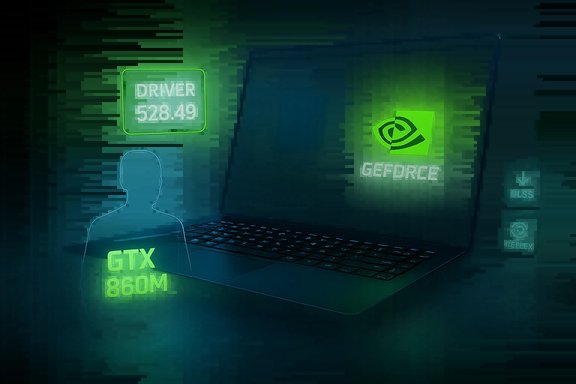
NVIDIA’s GeForce Game Ready Driver 528.49 is a confirmed, WHQL-signed release that supports Windows 10 (64‑bit) and Windows 11 and explicitly lists mobile GPUs in the GeForce 800M family — including the GeForce GTX 860M — in its supported-products table, making 528.49 a legitimate vendor-supplied driver option for GTX 860M systems when installing from NVIDIA’s official channels.
NVIDIA’s Game Ready drivers are distributed as packaged WHQL or DCH installers that deliver day‑0 game fixes, feature updates (DLSS, Reflex, etc., and a mix of stability and compatibility patches. The GeForce Game Ready Driver version 528.49 was published on February 8, 2023, and the official release notes and download record show a file size in the ~814 MB range for the Windows 10 (64‑bit) / Windows 11 package. The public release notes describe fixes for application stability and compatibility (for example, Adobe Bridge and a Discord-related GPU clocking issue) and add support for current mobile RTX laptop hardware at the time. For owners of older notebook GPUs like the GTX 860M, the question isn’t whage exists — it does — but whether a vendor-supplied universal driver is the best choice for a specific laptop. NVIDIA itself and the wider Windows community repeatedly recommend checking the laptop OEM first, because notebook drivers are often customized with vendor-signed INF entries and thermal/power tuning that generic installers may overwrite.
y and the “Technical storage” Clause You Quoted
The snippet you provided (about technical storage or access used exclusively for statistical or anonymous purposes) is a standard privacy/cookie disclosure text modelled after common web privacy language. It is relevant because GeForce Experience and the NVIDIA software suite can collect telemetry data (hardware profile, game list, driver version, crash logs) to power features like one‑click optimizations, cloud profiles, and crash reporting. If you are privacy‑sensitive:
Source: Born2Invest https://born2invest.com/?b=style-230720212/
 Background / Overview
NVIDIA’s Game Ready drivers are distributed as packaged WHQL or DCH installers that deliver day‑0 game fixes, feature updates (DLSS, Reflex, etc., and a mix of stability and compatibility patches. The GeForce Game Ready Driver version 528.49 was published on February 8, 2023, and the official release notes and download record show a file size in the ~814 MB range for the Windows 10 (64‑bit) / Windows 11 package. The public release notes describe fixes for application stability and compatibility (for example, Adobe Bridge and a Discord-related GPU clocking issue) and add support for current mobile RTX laptop hardware at the time. For owners of older notebook GPUs like the GTX 860M, the question isn’t whage exists — it does — but whether a vendor-supplied universal driver is the best choice for a specific laptop. NVIDIA itself and the wider Windows community repeatedly recommend checking the laptop OEM first, because notebook drivers are often customized with vendor-signed INF entries and thermal/power tuning that generic installers may overwrite. What 528.49 Actually Is — Quick Facts
- Version: GeForce Game Ready Driver 528.49 (WHQL).
- Release date: February 8, 2023.
- Supported OS: Windows 10 (64‑bit) and Windows 11.
- File size (approx.: 814.59 MB for the Windows bundle.
- Key highlights: DLSS support for recent releases, NVIDIA Reflex support for targeted titles, fixes for Adobe Bridge and an app‑driven GPU clock regression, and added support for RTX 40‑series mobile GPUs.
Is the GTX 860M Supported by 528.49?
Yes — the 528.49 release’s supported-products list explicitly includes the GeForce GTX 860M under the GeForce 800M Series (notebook) section on NVIDIA’s download page. That makes 528.49 a formal NVIDIA Game Ready build that recognizes and can install for the GTX 860M hardware, provided the installer is the correct notebook variant and your system does not block generic drivers via vendor-signed INF policies. Two practical cross‑checks that reinforce this compatibility:- NVIDIA’s official 528.49 release page lists the GeForce GTX 860M among the GeForce 800M Series notebook GPUs.
- Legacy GPU tool and archival notes from cw GTX 860M support in mainstream diagnostics tools (for example, GPU‑Z’s device support lists historically include GTX 860M), which confirms the GPU’s identification and the common driver-handling path for that model.
When to Use 528.49 for a GTX 860M Laptop — Practical Guidance
- Use 528.49 if:
- The OEM does not provide a newer certified driver for your laptop, and you need a vendor-signed universal driver.
- You are troubleshooting a driver-specific bug that NVIDIA’s release notes list as fixed in 528.49.
- You are prepared to test thermals and battery behavior after a driver updak plan.
- Prefer OEM drivers if:
- Your laptop maker publishes a tested driver for your exact model (always choose the OEM-supplied package first for notebooks).
- You rely on the laptop for battery-critical or thermally sensitive workloads (OEM firmware tuning matters).
- Your device has vendor-signed INF enforcement that may block or partially install a generic NVIDIA package.
Risks and Known Limitations
- OEM tuning and vendor-signed INF: Installing NVIDIA’s generic notebook driver can replace vendor-specific INFs or tuning. That may change fan curves, battery profiles, or thermal limits. For many users this is benign; for others it can produce higher temperatures or reduced battery life. If your laptop vendor offers an updated driver, prefer that first.
- Telemetry and GeForce Experience: The NVIDIA installer often bundles optional userland components such as GeForce Experience, which collects optional telemetry for game optimizations and crasconscious users should select the custom install and uncheck GeForce Experience if they want the core driver only. Community guides also document how to disable NVIDIA telemetry services post-install, though that is an advanced step.
- Third‑party mirrors and repackagers: Drisoftware. Downloading repackaged installers from third‑party sites can introduce tampering, altered INFs, or bundled software. Always download from NVIDIA or your OEM and verify digital signatures where possible.
- Edge‑case regressions: Large driver updates occasionally produce regressions in specific compute or graphics API paths (Vulkan, CUDA, TensorRT, etc.. If you run specialized compute or creative pipelines, stage the driver on a and test workloads before broad deployment. Community records of later driver branches show this is a recurring reality of complex graphics/compute driver stacks.
Step‑by‑Step: Safe Way to Download and Install 528.49 for GTX 860M
- Identify your exact GPU and OS:
- Open Device Manager → Display adapters and confirm the adapter string (e.g., GeForce GTX 860M).
- Confirm Windows build and architecture (Settings → System → About shows Windows 10/11 and 64‑bit status).
- C:
- Visit your laptop manufacturer’s support page for your exact model. If the OEM publishes a driver for your machine, prefer that package.
- Back up and prepare:
- Create a System Restore point or full disk imak straightforward if something goes wrong.
- Archive your current working driver installer.
- Download from NVIDIA:
- Use NVIDIA’s official driver download page and choose the notebook / notebook‑variant installer for Windows 10 (64‑bit) or Windows 11 that lists version 528.49. Confirm the file size and digital signature after download.
- (Optional but recommended for problem rigs) Clean uninstall with DDU:
- Boot into Safe Mode and run Display Driver Uninstaller (DDU) to remove all NVIDIA components and registry traces. This is the communityeanup when persistent issues exist. Keep a backup of DDU instructions and use the official sources for the tool.
- Install with custom options:
- Run NVIDIA’s installer, choose Custom (Advanced) and check Perform a clean installationerience if you want the driver-only install. Reboot after installation and verify via NVIDIA Control Panel → System Information.
- Validate:
- Run a quick workload or benchmark, check thermals and battery behavior for laptops, and verify the driver version is listed correctly in Device Manager and NVIDIA Control Panel.
- Rollback plan:
- If problems occur, use Device Manager → Driver tab → Roll Back Driver (if available) or re-install the archived previous installer. If the system is unstable or fails to boot, use Safe Mode or a System Restore to recover.
Common Installation Troubleshooting
- “No compatible hardware” message
- Confirm the hardware ID matches the driver’s supported products table on NVIDIA’s release notes. Some laptops have OEM‑locked INFs that block generic installers.
- Windows Update reverts driver
- Use Microsoft’s “Show or hide updates” troubleshooter to prevent automatic driver reinstalls while you test yourity guides include this tip for avoiding auto‑reversion.
- Black screen or boot failure after install
- Boot to Safe Mode, run DDU, and perform a clean reinstall. If Safe Mode is inaccessible, use a System Restore image.
- Unexpected thermals or battery regression (notebook)
- Reinstall OEM driver if available; otherwise monitor temps with a tool (GPU-Z, HWMonitor), and report anomalies to OEM support for guidance.
y and the “Technical storage” Clause You Quoted
The snippet you provided (about technical storage or access used exclusively for statistical or anonymous purposes) is a standard privacy/cookie disclosure text modelled after common web privacy language. It is relevant because GeForce Experience and the NVIDIA software suite can collect telemetry data (hardware profile, game list, driver version, crash logs) to power features like one‑click optimizations, cloud profiles, and crash reporting. If you are privacy‑sensitive:
- Choose the driver‑only install (Custom → uncheck GeForce Experience). This installs the kernel components and Control Panel without the optional app and its telemetry features.
- If GeForce installed, you can disable or remove telemetry services and scheduled tasks; community guides document how to remove telemetry components, though such steps move beyoconfiguration.
Cross‑Referenced Verification and Unverifiable Claims
- Verified claims:
- NVIDIA’s download/release page shows 528.49, WHQL, release date 2023‑02‑08, OS support Windows 10 (64‑bit) and Windows 11, and the GeForce GTX 860M listed under GeForce 800M Series. These are primary documents from NVIDIA and are authoritative for the release metadata.
- Independent coverage from hardware outlets documented the release highlights and fixes and corroborated the timing and intent of the driver; TechPowerUp covered the 528.49 release and noted the same headline features.
- Cross‑reference reinforcement:
- Community and archival tools record GTX 860M as a recognized notebook GPU (device lists and GPU detection tools) which aligns with NVIDIA’s product lists. This helps confirm the identification path used by installers and diagnostic utilities.
- Unverifiable or problematic claims:
- A Born2Invest URL supplied with the original query could not be reliably retrieved or validated by archived checks and community verification. Any unique assertions coming solely from that specific Born2Invest link should be treated as unverified until a working URL or a quoted excerpt is provided. Use NVIDIA’s own documents and trusted hardware outlets for authoritative facts instead.
Best Practices and a Conservative Recommendation
- Always prefer your laptop OEM’s driver if one is available for your exact model and OS. OEM packages are tuned and signed for your specific configuration.
- If no OEM package exists and you need an updated universal driver, download 528.49 directly from NVIDIA’s official driver page, confirm the digital signature, and perform a clean installation following the steps above.
- Create a System Restore point and archive your working driver before changing drivers. Test the new driver under the workloads that matter to you (gaming, video playback, productivity apps) and monitor thermals and battery life on laptops.
- Avoid third‑party repackaged installers. Drivers operate at the kernel level; the risk of altered INFs or bundled code is real. Download from NVIDIA or your OEM.
- For privacy, choose the driver‑only custom installation and avoid installing GeForce Experience; disable telemetry services if you require a minimal data footprint.
Conclusion
GeForce Game Ready Driver 528.49 is an official NVIDIA release for Windows 10 (64‑bit) and Windows 11 and includes support for the GeForce GTX 860M in its supported-products table, so it can be used to update GTX 860M systems when a universal NVIDIA notebook installer is appropriate. The release is confirmed by NVIDIA’s own download page and corroborated by independent hardware reporting. However, for notebook owners the safest path remains to check the laptop OEM first and to follow conservative installation best practices (backup, DDU where required, custom clean install) because OEM drivers retain important platform-specific tuning. Users who care about telemetry should opt out of GeForce Experience during installation and consider further telemetry hardening steps if required.Source: Born2Invest https://born2invest.com/?b=style-230720212/
