

Google began rolling out a Google Play connected app for Gemini on Android on June 26, 2026, letting eligible personal-account users ask the assistant to find Play Store apps, open listings, buy Play gift cards, and purchase select in-app digital items. The feature sounds small because app search sounds solved. It is not. Google is turning the Play Store from a catalog into a conversation, and that changes who gets discovered, who gets paid, and how much control users really have over the path between intent and installation.
The old mobile bargain was simple: users opened a store, typed a keyword, skimmed a ranked list, and made a choice. That model was never neutral, but at least it was legible. Search results, star ratings, screenshots, reviews, ads, editorial collections, and install counts all competed in a familiar marketplace.
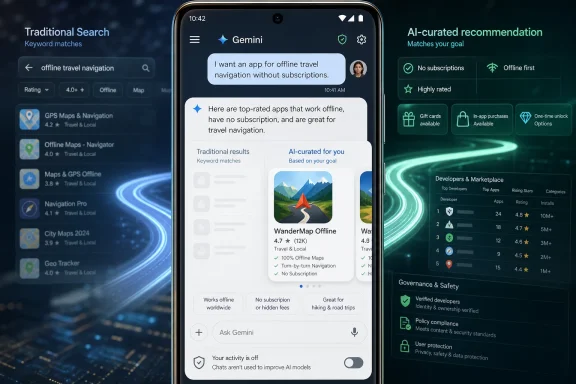
Gemini’s new Play integration compresses that marketplace into a prompt. Instead of searching for “travel maps,” a user can ask for an app that works well for international travel, offline navigation, or trip planning. Gemini can then surface suggestions and send the user directly to the relevant Play Store listing.
That is a much more natural interaction for normal people. Most users do not think in app-category taxonomies. They think in errands, anxieties, and half-formed intentions: “I need to plan meals,” “I need something for jet lag,” “I need a budgeting app my partner will actually use.” A conversational assistant is better suited to those fuzzy inputs than a keyword box.
But the convenience also shifts power. The store no longer begins with a page of options; it begins with an assistant’s interpretation of the user’s goal. That interpretation may be useful, but it is also a gatekeeping layer sitting between developers and demand.
The Play Store has long been a strange mix of software depot, ad marketplace, review system, recommendation engine, and payments platform. For popular categories, the result is often abundance without clarity. Search for a generic utility and the user is thrown into a thicket of sponsored placements, clones, abandoned apps, freemium traps, and legitimate tools that are hard to compare at a glance.
Gemini gives Google a chance to reframe that mess around user intent. A prompt like “find me a simple habit tracker that does not require a subscription” contains more signal than “habit tracker.” A prompt like “I need a map app for Japan that works offline and handles public transit” gives the assistant criteria that a search ranking page may not expose cleanly.
This is the strongest case for the feature. If Gemini can reliably translate intent into relevant app suggestions, Android users get a better front door to the ecosystem. Developers with genuinely useful products may also benefit if the assistant can match niche apps to specific needs instead of merely amplifying the already dominant names.
The risk is that the same mechanism can bury apps just as efficiently. In a list of search results, users can scroll. In a conversational answer, the assistant may present only a handful of recommendations. The difference between being third and thirtieth on a search page is painful; the difference between being mentioned and not mentioned at all is existential.
Google has been careful, at least at launch, to limit the scope. The integration is rolling out gradually, requires users to be 18 or older, needs a personal Google Account, requires the Play Store app on Android, and depends on Gemini Apps Activity being enabled. Workspace accounts are excluded for now, which is exactly the kind of boundary administrators will appreciate.
Still, the direction is unmistakable. Once an assistant can find an app, open a listing, and handle parts of the purchase flow, the app store becomes less of a destination and more of an API behind a chat interface. The user experiences this as reduced friction. The platform owner experiences it as a tighter funnel.
That matters because digital storefronts are not merely shelves. They are policy engines. They enforce age restrictions, payment rules, refunds, subscriptions, regional availability, malware scanning, identity requirements, developer ranking, and advertising models. When Gemini sits in front of that system, it inherits all the complexity of the store while adding a new layer of AI-driven interpretation.
The obvious question is not whether Gemini can buy a gift card. It is whether users will understand when they are receiving a neutral recommendation, a ranked search result, a sponsored suggestion, a policy-limited answer, or a commerce-optimized shortcut. Google will need to be far clearer about that distinction than AI assistants have generally been.
That is not the same as replacing apps. Apps remain the containers for features, data, permissions, subscriptions, and developer business models. But the way users reach those apps may change. Instead of tapping icons, browsing menus, and remembering which app does what, users increasingly ask Gemini to perform a task and let the assistant decide which service should be invoked.
For WindowsForum readers, the parallel is obvious. Microsoft has been trying to make Copilot a similar layer across Windows, Microsoft 365, Edge, and enterprise workflows. The strategic goal is not merely a smarter chatbot. It is a new command surface for computing.
Google has a structural advantage on Android because it controls the default assistant, the app store, the account system, the payment rail, and many of the most-used services. Microsoft can integrate Copilot deeply into Windows, but it does not own the equivalent of the dominant mobile app store. Apple has the store and the OS, but its AI rollout has been more cautious and, at times, visibly constrained.
The Play integration therefore shows where Google wants Android to go. Gemini is not just something that answers questions on top of Android. It is becoming one of Android’s primary navigation systems.
That does not automatically mean something nefarious is happening. AI assistants need context to function well, and connected services often depend on account-level activity to provide continuity, personalization, and safety auditing. A useful assistant that cannot remember anything is often just a more verbose search box.
But this is still a meaningful consent threshold. App discovery queries can be surprisingly revealing. Asking for a fertility tracker, a debt-management tool, a sobriety app, a dating app, a VPN, a mental-health journal, or a job-search app says something about a person’s circumstances. When those prompts are routed through an AI assistant tied to a Google Account, the privacy stakes are higher than ordinary keyword search inside a store.
Google’s challenge is not merely to provide settings. It is to make the tradeoff understandable at the moment users encounter it. If the feature is framed only as a helpful shortcut, many users will enable the required activity setting without understanding that they are moving sensitive app-discovery intent into a broader assistant history.
The enterprise exclusion is also telling. Workspace accounts are not supported at launch, which avoids an immediate collision with organizational data controls, audit requirements, and admin policy. That is sensible. It also highlights how unresolved the governance model remains for AI assistants that can reach across stores, apps, payments, and personal data.
The problem is opacity. Developers already spend enormous energy trying to understand Play Store ranking, policy enforcement, review moderation, subscription rules, and featuring opportunities. A Gemini recommendation layer adds another system to optimize for, but one whose criteria may be harder to observe.
If the assistant recommends apps based on descriptions, reviews, metadata, user behavior, developer reputation, install history, policy compliance, or some combination of those signals, developers will want to know. If sponsored results or commercial relationships influence recommendations, users and developers will both need disclosure. If Gemini avoids certain categories or makes conservative choices in sensitive areas, that too will shape the market.
There is also the matter of accuracy. App stores are full of apps that overpromise, degrade after acquisition, change business models, or hide key limitations behind subscriptions. Gemini may summarize an app’s usefulness in a clean conversational sentence, but the underlying product may be messier. A bad recommendation from a search page feels like a store problem; a bad recommendation from Gemini feels like an assistant failure.
The developer community should expect a new discipline to emerge around AI-era app discovery. Metadata will need to be clearer. Feature claims will need to be more machine-readable. Reviews, permissions, pricing, update cadence, and support history may become more important if assistants use them to infer trust. The storefront is becoming less visual and more semantic.
If Gemini becomes a major route into app discovery, questions about ranking and preference become sharper. Does the assistant favor Google services? Does it treat apps using Google Play Billing differently? Does it surface alternatives outside Play, or does the assistant’s helpfulness end at the boundary of Google’s own store? How does it handle categories where Google competes directly or indirectly?
Even if Google’s answers are reasonable, the optics are difficult. A company that owns the OS, the store, the assistant, the ads business, the payment infrastructure, and many competing apps is asking users to trust that a conversational intermediary will fairly represent the marketplace. That is a big ask in 2026.
The timing also matters. AI companies are racing to turn assistants into agents that can complete tasks, not merely answer questions. Once those agents steer commercial activity, every recommendation becomes economically meaningful. The assistant is no longer just a UI improvement; it is a distribution channel.
Regulators have spent years learning how search ranking, app-store rules, and default settings can shape markets. Gemini in Play collapses those categories into one product experience. It would be surprising if watchdogs did not eventually treat conversational app discovery as part of the same platform-power conversation.
The best version of this experience would be more like a knowledgeable store clerk than an ad slot. Gemini should ask clarifying questions when the user’s request is vague. It should distinguish between free, paid, ad-supported, subscription-based, and trial-based apps. It should warn when an app has not been updated recently or when reviews suggest a recent quality drop.
It should also be humble. In app discovery, confidence can be dangerous. A user asking for “the safest messaging app for my kid” or “the best app to track medical symptoms” is not merely shopping. They are making a decision with privacy, safety, or health implications. Gemini should not flatten those decisions into a cheery list of install buttons.
For many everyday searches, though, the assistant model could be genuinely better. If someone wants a meal-planning app that supports shared grocery lists, Android widgets, and vegetarian recipes, a conversational filter is exactly the right interface. If someone wants a game suitable for a long flight with offline play and no aggressive in-app purchases, Gemini could save time.
The line between helpful and manipulative will be thin. Google’s job is to make the assistant feel like it works for the user, not for the store.
Microsoft has its own version of this ambition. Copilot is spreading across Windows, Edge, Office, Teams, developer tools, and cloud services. The company clearly wants Copilot to become a general-purpose work interface. But the Microsoft Store has never had the same gravitational pull on Windows that Google Play has on Android.
That leaves Microsoft with a harder and potentially more interesting problem. If Copilot is to become a true software-discovery and task-completion layer on Windows, it cannot rely only on one store. Windows software lives across Microsoft Store listings, Win32 installers, winget packages, vendor portals, GitHub releases, enterprise catalogs, Intune Company Portal deployments, and managed app platforms.
In some ways, that fragmentation makes Windows more complicated. In others, it may protect users and developers from a single assistant-controlled funnel. Android’s strength is coherence; Windows’ strength is messy plurality. AI agents will test which model ages better.
Sysadmins should pay attention now because consumer assistant features often foreshadow enterprise expectations. Users who get used to asking Gemini for an app on their phone will eventually expect similar behavior on managed PCs. They will ask Copilot for a PDF editor, a VPN client, a project-management tool, or a Python environment. IT departments will need policies for what the assistant may recommend, install, purchase, or automate.
A Play Store connected app says Google believes AI’s next phase is not only content generation. It is orchestration. The assistant must understand intent, choose a service, invoke the right surface, and sometimes complete a transaction. That is the path from chatbot to operating layer.
The rollout is also deliberately constrained. It is gradual. It is Android-first. It excludes Workspace accounts. It requires personal accounts, adult users, the Play Store app, and activity retention. Those constraints reduce risk, but they also show how many policy seams appear when AI touches commerce.
The open question is how much agency users will retain as assistants become more capable. A good assistant reduces drudgery without narrowing choice. A bad one quietly converts user intent into platform-controlled routing. The difference may not be obvious at first, especially when the feature works well enough to feel magical.
That is why this update deserves more attention than a typical app integration. Google is not merely making it easier to find Android apps. It is testing whether users will let Gemini mediate the software marketplace itself.
 Google Moves the Storefront Into the Assistant
The old mobile bargain was simple: users opened a store, typed a keyword, skimmed a ranked list, and made a choice. That model was never neutral, but at least it was legible. Search results, star ratings, screenshots, reviews, ads, editorial collections, and install counts all competed in a familiar marketplace.Gemini’s new Play integration compresses that marketplace into a prompt. Instead of searching for “travel maps,” a user can ask for an app that works well for international travel, offline navigation, or trip planning. Gemini can then surface suggestions and send the user directly to the relevant Play Store listing.
That is a much more natural interaction for normal people. Most users do not think in app-category taxonomies. They think in errands, anxieties, and half-formed intentions: “I need to plan meals,” “I need something for jet lag,” “I need a budgeting app my partner will actually use.” A conversational assistant is better suited to those fuzzy inputs than a keyword box.
But the convenience also shifts power. The store no longer begins with a page of options; it begins with an assistant’s interpretation of the user’s goal. That interpretation may be useful, but it is also a gatekeeping layer sitting between developers and demand.
App Discovery Was Always the Broken Part
Digital Trends is right to frame the change around discovery rather than installation. Installing an Android app is already easy. Finding the right app inside a store with millions of listings is the part that routinely feels worse than it should.The Play Store has long been a strange mix of software depot, ad marketplace, review system, recommendation engine, and payments platform. For popular categories, the result is often abundance without clarity. Search for a generic utility and the user is thrown into a thicket of sponsored placements, clones, abandoned apps, freemium traps, and legitimate tools that are hard to compare at a glance.
Gemini gives Google a chance to reframe that mess around user intent. A prompt like “find me a simple habit tracker that does not require a subscription” contains more signal than “habit tracker.” A prompt like “I need a map app for Japan that works offline and handles public transit” gives the assistant criteria that a search ranking page may not expose cleanly.
This is the strongest case for the feature. If Gemini can reliably translate intent into relevant app suggestions, Android users get a better front door to the ecosystem. Developers with genuinely useful products may also benefit if the assistant can match niche apps to specific needs instead of merely amplifying the already dominant names.
The risk is that the same mechanism can bury apps just as efficiently. In a list of search results, users can scroll. In a conversational answer, the assistant may present only a handful of recommendations. The difference between being third and thirtieth on a search page is painful; the difference between being mentioned and not mentioned at all is existential.
The AI Assistant Becomes a Checkout Lane
The commerce piece is more revealing than the discovery piece. Gemini is not only recommending apps; it can also help users buy Google Play gift cards and purchase select in-app digital items for apps already installed on the device. That nudges the assistant from guide to transaction broker.Google has been careful, at least at launch, to limit the scope. The integration is rolling out gradually, requires users to be 18 or older, needs a personal Google Account, requires the Play Store app on Android, and depends on Gemini Apps Activity being enabled. Workspace accounts are excluded for now, which is exactly the kind of boundary administrators will appreciate.
Still, the direction is unmistakable. Once an assistant can find an app, open a listing, and handle parts of the purchase flow, the app store becomes less of a destination and more of an API behind a chat interface. The user experiences this as reduced friction. The platform owner experiences it as a tighter funnel.
That matters because digital storefronts are not merely shelves. They are policy engines. They enforce age restrictions, payment rules, refunds, subscriptions, regional availability, malware scanning, identity requirements, developer ranking, and advertising models. When Gemini sits in front of that system, it inherits all the complexity of the store while adding a new layer of AI-driven interpretation.
The obvious question is not whether Gemini can buy a gift card. It is whether users will understand when they are receiving a neutral recommendation, a ranked search result, a sponsored suggestion, a policy-limited answer, or a commerce-optimized shortcut. Google will need to be far clearer about that distinction than AI assistants have generally been.
Android’s Next Launcher Is a Conversation
This update is part of a larger Android story: Google is rebuilding the operating system’s user experience around Gemini as a cross-app action layer. The company has been connecting Gemini to more first-party services, including Chrome, Messages, Phone, Wallet, and now Play. Each integration looks modest in isolation. Together, they amount to a replacement strategy for the app-by-app workflow.That is not the same as replacing apps. Apps remain the containers for features, data, permissions, subscriptions, and developer business models. But the way users reach those apps may change. Instead of tapping icons, browsing menus, and remembering which app does what, users increasingly ask Gemini to perform a task and let the assistant decide which service should be invoked.
For WindowsForum readers, the parallel is obvious. Microsoft has been trying to make Copilot a similar layer across Windows, Microsoft 365, Edge, and enterprise workflows. The strategic goal is not merely a smarter chatbot. It is a new command surface for computing.
Google has a structural advantage on Android because it controls the default assistant, the app store, the account system, the payment rail, and many of the most-used services. Microsoft can integrate Copilot deeply into Windows, but it does not own the equivalent of the dominant mobile app store. Apple has the store and the OS, but its AI rollout has been more cautious and, at times, visibly constrained.
The Play integration therefore shows where Google wants Android to go. Gemini is not just something that answers questions on top of Android. It is becoming one of Android’s primary navigation systems.
The Price of Convenience Is More Behavioral Data
The launch requirement that Gemini Apps Activity, branded in settings as Keep Activity, must be enabled is not a footnote. It is central to the bargain. To use the Play connected app, users must allow Gemini to retain activity in the way Google requires for connected-app functionality.That does not automatically mean something nefarious is happening. AI assistants need context to function well, and connected services often depend on account-level activity to provide continuity, personalization, and safety auditing. A useful assistant that cannot remember anything is often just a more verbose search box.
But this is still a meaningful consent threshold. App discovery queries can be surprisingly revealing. Asking for a fertility tracker, a debt-management tool, a sobriety app, a dating app, a VPN, a mental-health journal, or a job-search app says something about a person’s circumstances. When those prompts are routed through an AI assistant tied to a Google Account, the privacy stakes are higher than ordinary keyword search inside a store.
Google’s challenge is not merely to provide settings. It is to make the tradeoff understandable at the moment users encounter it. If the feature is framed only as a helpful shortcut, many users will enable the required activity setting without understanding that they are moving sensitive app-discovery intent into a broader assistant history.
The enterprise exclusion is also telling. Workspace accounts are not supported at launch, which avoids an immediate collision with organizational data controls, audit requirements, and admin policy. That is sensible. It also highlights how unresolved the governance model remains for AI assistants that can reach across stores, apps, payments, and personal data.
Developers Get a New Gatekeeper With Fewer Visible Rules
For Android developers, the upside is tempting. A small app that solves a specific problem could be surfaced by Gemini in response to a highly targeted user request. That could be healthier than a store search economy dominated by brand recognition, install counts, and ad spend.The problem is opacity. Developers already spend enormous energy trying to understand Play Store ranking, policy enforcement, review moderation, subscription rules, and featuring opportunities. A Gemini recommendation layer adds another system to optimize for, but one whose criteria may be harder to observe.
If the assistant recommends apps based on descriptions, reviews, metadata, user behavior, developer reputation, install history, policy compliance, or some combination of those signals, developers will want to know. If sponsored results or commercial relationships influence recommendations, users and developers will both need disclosure. If Gemini avoids certain categories or makes conservative choices in sensitive areas, that too will shape the market.
There is also the matter of accuracy. App stores are full of apps that overpromise, degrade after acquisition, change business models, or hide key limitations behind subscriptions. Gemini may summarize an app’s usefulness in a clean conversational sentence, but the underlying product may be messier. A bad recommendation from a search page feels like a store problem; a bad recommendation from Gemini feels like an assistant failure.
The developer community should expect a new discipline to emerge around AI-era app discovery. Metadata will need to be clearer. Feature claims will need to be more machine-readable. Reviews, permissions, pricing, update cadence, and support history may become more important if assistants use them to infer trust. The storefront is becoming less visual and more semantic.
Google’s Antitrust Shadow Follows the Feature
No serious discussion of Play Store integration can ignore platform power. Google controls Android’s dominant app marketplace in much of the world, and it has spent years defending Play policies, billing rules, and distribution practices from regulators, developers, and competitors. Adding Gemini as a conversational front end does not erase those disputes; it gives them a new surface.If Gemini becomes a major route into app discovery, questions about ranking and preference become sharper. Does the assistant favor Google services? Does it treat apps using Google Play Billing differently? Does it surface alternatives outside Play, or does the assistant’s helpfulness end at the boundary of Google’s own store? How does it handle categories where Google competes directly or indirectly?
Even if Google’s answers are reasonable, the optics are difficult. A company that owns the OS, the store, the assistant, the ads business, the payment infrastructure, and many competing apps is asking users to trust that a conversational intermediary will fairly represent the marketplace. That is a big ask in 2026.
The timing also matters. AI companies are racing to turn assistants into agents that can complete tasks, not merely answer questions. Once those agents steer commercial activity, every recommendation becomes economically meaningful. The assistant is no longer just a UI improvement; it is a distribution channel.
Regulators have spent years learning how search ranking, app-store rules, and default settings can shape markets. Gemini in Play collapses those categories into one product experience. It would be surprising if watchdogs did not eventually treat conversational app discovery as part of the same platform-power conversation.
The User Experience Will Decide Whether This Is Useful or Creepy
The feature’s success will come down to execution. If Gemini recommends relevant apps, explains why, exposes pricing and privacy tradeoffs, and gets out of the way before checkout, users will likely embrace it. If it produces generic suggestions, hallucinates capabilities, hides subscriptions, or feels like a sales funnel, people will return to ordinary search.The best version of this experience would be more like a knowledgeable store clerk than an ad slot. Gemini should ask clarifying questions when the user’s request is vague. It should distinguish between free, paid, ad-supported, subscription-based, and trial-based apps. It should warn when an app has not been updated recently or when reviews suggest a recent quality drop.
It should also be humble. In app discovery, confidence can be dangerous. A user asking for “the safest messaging app for my kid” or “the best app to track medical symptoms” is not merely shopping. They are making a decision with privacy, safety, or health implications. Gemini should not flatten those decisions into a cheery list of install buttons.
For many everyday searches, though, the assistant model could be genuinely better. If someone wants a meal-planning app that supports shared grocery lists, Android widgets, and vegetarian recipes, a conversational filter is exactly the right interface. If someone wants a game suitable for a long flight with offline play and no aggressive in-app purchases, Gemini could save time.
The line between helpful and manipulative will be thin. Google’s job is to make the assistant feel like it works for the user, not for the store.
Microsoft Should Be Watching the Store, Not the Chatbot
Windows users may be tempted to view this as an Android-only story. That would be a mistake. The important development is not that Gemini can point to mobile apps. It is that a major platform owner is teaching users to treat an AI assistant as the front door to software.Microsoft has its own version of this ambition. Copilot is spreading across Windows, Edge, Office, Teams, developer tools, and cloud services. The company clearly wants Copilot to become a general-purpose work interface. But the Microsoft Store has never had the same gravitational pull on Windows that Google Play has on Android.
That leaves Microsoft with a harder and potentially more interesting problem. If Copilot is to become a true software-discovery and task-completion layer on Windows, it cannot rely only on one store. Windows software lives across Microsoft Store listings, Win32 installers, winget packages, vendor portals, GitHub releases, enterprise catalogs, Intune Company Portal deployments, and managed app platforms.
In some ways, that fragmentation makes Windows more complicated. In others, it may protect users and developers from a single assistant-controlled funnel. Android’s strength is coherence; Windows’ strength is messy plurality. AI agents will test which model ages better.
Sysadmins should pay attention now because consumer assistant features often foreshadow enterprise expectations. Users who get used to asking Gemini for an app on their phone will eventually expect similar behavior on managed PCs. They will ask Copilot for a PDF editor, a VPN client, a project-management tool, or a Python environment. IT departments will need policies for what the assistant may recommend, install, purchase, or automate.
The Small Rollout That Explains the Bigger Platform War
This is not the flashiest Gemini announcement Google has made. It does not have the spectacle of generative video, smart glasses, AI search, or autonomous research agents. But mundane integrations often reveal more about platform strategy than keynote demos do.A Play Store connected app says Google believes AI’s next phase is not only content generation. It is orchestration. The assistant must understand intent, choose a service, invoke the right surface, and sometimes complete a transaction. That is the path from chatbot to operating layer.
The rollout is also deliberately constrained. It is gradual. It is Android-first. It excludes Workspace accounts. It requires personal accounts, adult users, the Play Store app, and activity retention. Those constraints reduce risk, but they also show how many policy seams appear when AI touches commerce.
The open question is how much agency users will retain as assistants become more capable. A good assistant reduces drudgery without narrowing choice. A bad one quietly converts user intent into platform-controlled routing. The difference may not be obvious at first, especially when the feature works well enough to feel magical.
That is why this update deserves more attention than a typical app integration. Google is not merely making it easier to find Android apps. It is testing whether users will let Gemini mediate the software marketplace itself.
The Gemini Shortcut Comes With Strings Attached
The practical read is straightforward: this is a useful feature, but not a neutral one. Android users get a better way to describe what they want. Google gets a more powerful role in deciding what they see next.- Gemini’s Google Play connected app began rolling out on Android on June 26, 2026, after being previewed at Google I/O 2026.
- The feature lets eligible users find apps by describing goals, open Play Store listings, buy Google Play gift cards, and purchase select in-app digital items.
- Users need to be at least 18, signed in with a personal Google Account, using Android with the Play Store installed, and have Gemini Apps Activity enabled.
- Workspace accounts are not supported at launch, which keeps the first rollout away from enterprise governance headaches.
- The biggest impact is not faster installation, but the shift from searchable app lists to AI-mediated recommendations.
- Developers and regulators will need to watch how Gemini ranks, explains, and potentially monetizes app suggestions.
References
- Primary source: Digital Trends
Published: Sat, 27 Jun 2026 20:00:00 GMT
Finding Android apps on the Google Play Store just got a lot easier thanks to Gemini - Digital Trends
Google has launched the Google Play connected app for Gemini, allowing users to discover apps, make select purchases, and buy Play gift cards using AI.www.digitaltrends.com - Official source: play.google.com
- Official source: support.google.com

Use and manage Connected Apps in Gemini - Computer - Gemini Apps Help
Gemini Apps can connect to other apps to complete your request and give you more helpful responses. With your permission, Gemini can also help you with your info and content in other apps. Here are a
support.google.com
- Related coverage: megamobilecontent.com
- Official source: 9to5google.com
Gemini’s new Google Play integration lets you find Android apps
As previewed at I/O 2026 last month, the Gemini app on Android now integrates with the Google Play Store...9to5google.com - Related coverage: androidcentral.com
Google Play is getting a huge AI upgrade with Ask Play and Play Shorts | Android Central
Google Play is getting major AI upgrades focused on app discovery and developer growth.www.androidcentral.com
- Related coverage: techcrunch.com
Google updates its Gemini app to take on ChatGPT and Claude at IO 2026 | TechCrunch
The updates signal Google’s push to turn its Gemini app into an all-purpose AI hub rather than a stand-alone chatbot.techcrunch.com - Related coverage: cincodias.elpais.com
- Related coverage: tomsguide.com
Google denies report that ads are coming to Gemini following major ChatGPT backlash | Tom's Guide
Gemini is separating itself from ChatGPT, its biggest competitor, as it fends off accusations of planning to roll out ads.www.tomsguide.com - Related coverage: techradar.com
- Related coverage: axios.com
Google unveils broad new push to put AI everywhere
The search giant showcased a range of AI initiatives.www.axios.com
