

Google said on June 24, 2026, that it will begin rolling out expanded alternative billing options and lower Google Play fees on June 30 in the European Economic Area, the United Kingdom, and the United States. The change gives Android app developers more room to send customers to other payment systems, but it does not turn Google Play into a free storefront. The consumer-facing promise is choice; the business reality is a smaller, more complicated toll. Whether Android users actually pay less will depend less on Google’s announcement than on developers’ willingness to redraw their pricing, checkout flows, and customer-support obligations.
For years, the simplest story about app stores was also the most politically useful one: Apple and Google took up to 30 percent, developers complained, and regulators wondered whether the fee was rent, infrastructure cost, or monopoly tax. Google’s new Play Store model tries to retire that headline number without conceding the deeper premise that the platform deserves a cut of transactions that happen because an app reached users through Google Play.
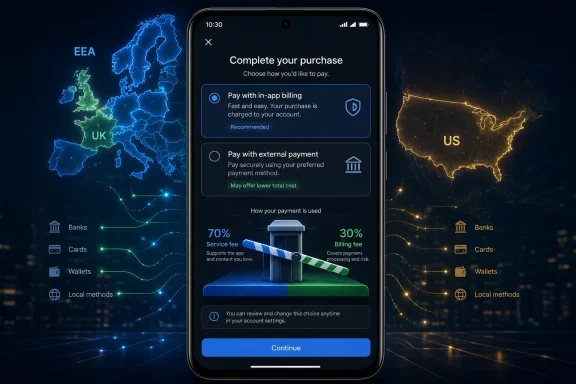
The new structure separates the service fee from the billing fee. In Google’s framing, the service fee pays for the store, discovery, distribution, security review, developer tools, and the broader Android commercial plumbing. The billing fee pays for Google Play Billing itself, including payment methods, tax handling, subscriptions, refunds, and compliance work.
That distinction matters because it lets Google say something it could not credibly say under the old model: developers may choose another payment processor without automatically paying for Google’s processor too. In the US, UK, and EEA rollout, Google says Play Billing carries an additional 5 percent fee where developers use it. Developers who send users elsewhere can avoid that billing fee, but not necessarily the underlying platform fee.
This is the heart of the change and the heart of the controversy. Google has moved from “you must use our payment rail” toward “you may use another rail, but the road still belongs to us.” That may satisfy some developers and regulators. It will infuriate others who believe the only meaningful alternative billing regime is one where Google stops charging on transactions it does not process.
What changed now is not simply the percentage. It is the architecture of the fee. A single commission is easier to attack; a layered model of service fees, billing fees, eligibility tiers, regional rollouts, and program-based discounts is harder to summarize and easier to defend.
That complexity is not accidental. Google is trying to solve several problems at once. It wants to answer antitrust pressure from Epic’s litigation, app-store enforcement in Europe, and similar scrutiny in other markets. It wants to give large developers enough financial incentive to stay inside the Play ecosystem. It also wants to avoid creating a clean precedent that app stores are mere download catalogs with no claim on downstream commerce.
So yes, the 30 percent number is losing its central role. But Android users should not confuse that with a world in which every subscription, game item, dating-app boost, cloud-storage plan, or language-learning upgrade becomes cheaper overnight. A reduced toll is still a toll, and a more flexible checkout is still a commercial funnel designed by the platform that controls the storefront.
Choice screens will likely become the public face of this compromise. Google can present them as user empowerment, developers can present them as a route to lower prices or more direct relationships, and regulators can point to them as proof that gatekeeping has loosened. But checkout choice also pushes more responsibility onto users.
Google Play Billing is not beloved because users enjoy paying Google. It is useful because it centralizes payment history, subscription management, refunds, family controls, and dispute expectations. A developer checkout may be cheaper, but it may also mean a different refund process, different cancellation path, different privacy policy, and a different merchant name on a bank statement.
This is where the “will you pay less?” question becomes more interesting than the “can you pay differently?” question. The existence of an external checkout does not guarantee a lower consumer price. Some developers will pocket the margin. Some will use it to fund customer acquisition. Some will offer discounts only on the web, where they can avoid app-store friction entirely. Others may decide that the operational burden of running billing, taxes, fraud handling, and support is not worth a few percentage points.
For them, the math can be compelling. If a developer can route a subscription through its own payment provider, reduce platform-related fees, and keep churn under control, even a modest percentage improvement can be meaningful at scale. That is especially true for recurring revenue, where small fee differences compound month after month.
Smaller developers face a harder decision. Google Play Billing may be expensive, but it is also a bundle of services that a two-person app shop may not want to rebuild. Payment processors charge their own fees. Tax compliance across borders is not a weekend project. Customer support for failed payments, refunds, chargebacks, and subscription confusion can consume the savings quickly.
That means the new regime may increase inequality among developers. Big developers get another lever. Mid-sized developers get a spreadsheet exercise. Small developers get a choice that may be too costly to use. App-store reform often sounds like a universal victory for “developers,” but developers are not a class with uniform needs.
Google’s position was always more complicated than Apple’s because Android has historically allowed sideloading and third-party stores, at least in theory. The problem, as critics argued, was that the practical path to users still ran overwhelmingly through Google Play, and alternative distribution carried enough warnings, friction, and commercial disadvantages to make “openness” feel conditional.
The Epic litigation exposed that tension. Android could be open at the operating-system layer and still commercially centralized at the store layer. Developers could technically distribute elsewhere and still find that payments, discovery, trust, and default behavior kept them tied to Google Play.
The new billing model is Google’s attempt to preserve the strategic center while retreating from the most vulnerable edge. It can say developers have payment choice. It can say fees are lower. It can say Play’s value is being priced separately from billing. But it is also defending the principle that distribution through Google Play has continuing monetary value even when Google does not process the payment.
Google’s move puts pressure on Apple because it makes the old 30 percent model look less inevitable. If Google can decouple billing from store services, allow alternative payment choices, and still defend Android security and platform investment, Apple’s tighter iOS model becomes harder to justify purely as a technical necessity. Apple will argue that iOS is different, that its integrated approach protects users, and that regulatory experiments have already created messy compliance regimes. But the comparison will be obvious.
At the same time, Google’s model may also give Apple a roadmap. A platform can permit external payments while preserving commissions. It can comply with the language of choice while attaching fees to the broader value of the ecosystem. It can turn a binary antitrust demand into a pricing table.
That is why regulators will study not just whether alternative billing exists, but whether it is commercially viable. A choice that no rational developer uses is theater. A choice that developers use but consumers do not trust is a partial reform. A choice that lowers developer costs without lowering consumer prices is a competition win for app makers, but not necessarily for the public.
Google has been moving in parallel toward stronger developer verification and more structured handling of third-party distribution. That is not necessarily sinister. Malware, fraud, impersonation, and predatory subscriptions are real problems on mobile platforms. Users do benefit from some trust infrastructure, and enterprises have every reason to care where apps come from and how payments are handled.
But the tradeoff is becoming clearer. The same company that loosens billing restrictions can tighten identity and distribution rules. The same platform that says developers have more choice can define the safe, compliant, registered, and economically acceptable versions of that choice.
For Windows veterans, this pattern should sound familiar. The PC ecosystem’s openness created enormous software freedom, but also decades of security headaches, installer abuse, bundled junk, and payment chaos. Mobile platforms reacted by centralizing distribution and billing. Now regulators are forcing them to decentralize selectively, and the result is not the old PC model. It is a hybrid: more doors, more signs, more rules, and more fees described with greater precision.
An employee who buys a business app subscription through Google Play leaves one kind of administrative trail. An employee who pays the developer directly creates another. If the app is tied to a personal account, a corporate email address, or a team workspace, the billing route can affect who controls renewal, cancellation, support, and records.
This is not just an accounting nuisance. Shadow IT often grows through small subscription purchases that seem harmless until teams depend on them. Alternative app billing could make that easier if developers aggressively promote direct discounts to end users. It could also make vendor management cleaner for companies that prefer direct contracts rather than app-store-mediated subscriptions.
Sysadmins should not panic, but they should update their assumptions. Mobile app governance has often focused on installation source and device permissions. Payment source is about to matter more. If an app can be installed from Google Play but paid for elsewhere, “approved app” no longer automatically means “approved purchasing path.”
But many apps will avoid direct price cuts. Developers may prefer to keep pricing consistent across platforms to avoid confusing users or angering Apple, where rules and fees may differ. They may use the savings to offset rising infrastructure, AI, moderation, licensing, or customer-support costs. They may also simply improve margins, because businesses are not charities and app-store fees were never the only reason digital subscriptions became expensive.
There is also a behavioral problem. Many users will choose Google Play Billing even if a developer option is cheaper, because familiarity has value. A $1 monthly discount may not persuade someone to trust a new checkout page, enter card details, and manage another subscription portal. A larger discount might, but then the developer gives up more revenue and takes on more support.
In other words, the new economics will not flow cleanly from Google to developers to users. They will be filtered through market power, brand trust, app category, customer inertia, and the quiet fact that most people do not want to think about payment infrastructure while buying a puzzle-game expansion or renewing a meditation app.
The bigger test is cultural. If Android users become comfortable seeing developer payment options inside apps, the app-store billing monopoly loses its inevitability. If they do not, Google will have conceded policy ground while retaining most consumer behavior. That outcome would still matter for developers, but it would be less transformative than the rhetoric suggests.
There is precedent for user inertia winning. Many web services already offer cheaper subscriptions outside mobile apps, yet plenty of users continue to subscribe through app stores because the path is easier. Convenience is a moat, and Google Play Billing remains convenient.
That is why the most important number may not be 10 percent, 15 percent, 20 percent, or 5 percent. It may be the conversion rate at the moment a user sees a payment choice. If users overwhelmingly pick Google, Google’s billing fee survives as a voluntary convenience charge. If users pick developers, the app economy begins to tilt toward direct relationships.
 Google Cuts the Toll Without Giving Up the Road
For years, the simplest story about app stores was also the most politically useful one: Apple and Google took up to 30 percent, developers complained, and regulators wondered whether the fee was rent, infrastructure cost, or monopoly tax. Google’s new Play Store model tries to retire that headline number without conceding the deeper premise that the platform deserves a cut of transactions that happen because an app reached users through Google Play.The new structure separates the service fee from the billing fee. In Google’s framing, the service fee pays for the store, discovery, distribution, security review, developer tools, and the broader Android commercial plumbing. The billing fee pays for Google Play Billing itself, including payment methods, tax handling, subscriptions, refunds, and compliance work.
That distinction matters because it lets Google say something it could not credibly say under the old model: developers may choose another payment processor without automatically paying for Google’s processor too. In the US, UK, and EEA rollout, Google says Play Billing carries an additional 5 percent fee where developers use it. Developers who send users elsewhere can avoid that billing fee, but not necessarily the underlying platform fee.
This is the heart of the change and the heart of the controversy. Google has moved from “you must use our payment rail” toward “you may use another rail, but the road still belongs to us.” That may satisfy some developers and regulators. It will infuriate others who believe the only meaningful alternative billing regime is one where Google stops charging on transactions it does not process.
The 30 Percent Era Ends as a Headline, Not as a Business Model
The familiar 30 percent app-store commission has been dying in stages for years. Google already reduced fees for subscriptions and the first $1 million in annual developer earnings, and Apple has made its own small-business and subscription adjustments. The platform owners learned that the headline rate was politically expensive even when many developers paid less than the maximum.What changed now is not simply the percentage. It is the architecture of the fee. A single commission is easier to attack; a layered model of service fees, billing fees, eligibility tiers, regional rollouts, and program-based discounts is harder to summarize and easier to defend.
That complexity is not accidental. Google is trying to solve several problems at once. It wants to answer antitrust pressure from Epic’s litigation, app-store enforcement in Europe, and similar scrutiny in other markets. It wants to give large developers enough financial incentive to stay inside the Play ecosystem. It also wants to avoid creating a clean precedent that app stores are mere download catalogs with no claim on downstream commerce.
So yes, the 30 percent number is losing its central role. But Android users should not confuse that with a world in which every subscription, game item, dating-app boost, cloud-storage plan, or language-learning upgrade becomes cheaper overnight. A reduced toll is still a toll, and a more flexible checkout is still a commercial funnel designed by the platform that controls the storefront.
The Consumer Choice Screen Is a Policy Compromise in Disguise
For users, the visible change will be mundane: an app may show a choice between Google Play Billing and a developer-provided payment option, or it may point users to an external website to complete a purchase. That sounds like ordinary e-commerce. In mobile apps, it is a major shift because the old app-store bargain treated in-app digital commerce as something the platform could tightly manage.Choice screens will likely become the public face of this compromise. Google can present them as user empowerment, developers can present them as a route to lower prices or more direct relationships, and regulators can point to them as proof that gatekeeping has loosened. But checkout choice also pushes more responsibility onto users.
Google Play Billing is not beloved because users enjoy paying Google. It is useful because it centralizes payment history, subscription management, refunds, family controls, and dispute expectations. A developer checkout may be cheaper, but it may also mean a different refund process, different cancellation path, different privacy policy, and a different merchant name on a bank statement.
This is where the “will you pay less?” question becomes more interesting than the “can you pay differently?” question. The existence of an external checkout does not guarantee a lower consumer price. Some developers will pocket the margin. Some will use it to fund customer acquisition. Some will offer discounts only on the web, where they can avoid app-store friction entirely. Others may decide that the operational burden of running billing, taxes, fraud handling, and support is not worth a few percentage points.
Developers Finally Get Leverage, but Not a Free Lunch
The developers most likely to benefit are those with direct customer relationships already: streaming services, productivity suites, cloud tools, dating platforms, fitness apps, education apps, and games with strong brand loyalty. These companies do not rely solely on a Play Store listing to persuade users to pay. They have email lists, web funnels, customer accounts, and payment infrastructure.For them, the math can be compelling. If a developer can route a subscription through its own payment provider, reduce platform-related fees, and keep churn under control, even a modest percentage improvement can be meaningful at scale. That is especially true for recurring revenue, where small fee differences compound month after month.
Smaller developers face a harder decision. Google Play Billing may be expensive, but it is also a bundle of services that a two-person app shop may not want to rebuild. Payment processors charge their own fees. Tax compliance across borders is not a weekend project. Customer support for failed payments, refunds, chargebacks, and subscription confusion can consume the savings quickly.
That means the new regime may increase inequality among developers. Big developers get another lever. Mid-sized developers get a spreadsheet exercise. Small developers get a choice that may be too costly to use. App-store reform often sounds like a universal victory for “developers,” but developers are not a class with uniform needs.
Epic’s Shadow Hangs Over Every Percentage Point
Google’s announcement cannot be separated from Epic Games’ long campaign against mobile app-store control. Epic’s fight with Apple and Google began as a dispute over Fortnite payments, but it became a wider challenge to the idea that mobile platforms could force digital commerce through their own checkout systems.Google’s position was always more complicated than Apple’s because Android has historically allowed sideloading and third-party stores, at least in theory. The problem, as critics argued, was that the practical path to users still ran overwhelmingly through Google Play, and alternative distribution carried enough warnings, friction, and commercial disadvantages to make “openness” feel conditional.
The Epic litigation exposed that tension. Android could be open at the operating-system layer and still commercially centralized at the store layer. Developers could technically distribute elsewhere and still find that payments, discovery, trust, and default behavior kept them tied to Google Play.
The new billing model is Google’s attempt to preserve the strategic center while retreating from the most vulnerable edge. It can say developers have payment choice. It can say fees are lower. It can say Play’s value is being priced separately from billing. But it is also defending the principle that distribution through Google Play has continuing monetary value even when Google does not process the payment.
Apple Is the Unnamed Audience
Although this is an Android story, Apple is never far from the frame. The app-store duopoly has always worked partly because each company could point to the other and say its policies were industry standard. When one platform changes the economics, the other inherits a political problem.Google’s move puts pressure on Apple because it makes the old 30 percent model look less inevitable. If Google can decouple billing from store services, allow alternative payment choices, and still defend Android security and platform investment, Apple’s tighter iOS model becomes harder to justify purely as a technical necessity. Apple will argue that iOS is different, that its integrated approach protects users, and that regulatory experiments have already created messy compliance regimes. But the comparison will be obvious.
At the same time, Google’s model may also give Apple a roadmap. A platform can permit external payments while preserving commissions. It can comply with the language of choice while attaching fees to the broader value of the ecosystem. It can turn a binary antitrust demand into a pricing table.
That is why regulators will study not just whether alternative billing exists, but whether it is commercially viable. A choice that no rational developer uses is theater. A choice that developers use but consumers do not trust is a partial reform. A choice that lowers developer costs without lowering consumer prices is a competition win for app makers, but not necessarily for the public.
Android’s Openness Becomes More Managed, Not More Simple
There is a temptation to treat this as Android returning to its open roots. That is too neat. Android’s future is not a free-for-all; it is a more managed marketplace with more approved paths through it.Google has been moving in parallel toward stronger developer verification and more structured handling of third-party distribution. That is not necessarily sinister. Malware, fraud, impersonation, and predatory subscriptions are real problems on mobile platforms. Users do benefit from some trust infrastructure, and enterprises have every reason to care where apps come from and how payments are handled.
But the tradeoff is becoming clearer. The same company that loosens billing restrictions can tighten identity and distribution rules. The same platform that says developers have more choice can define the safe, compliant, registered, and economically acceptable versions of that choice.
For Windows veterans, this pattern should sound familiar. The PC ecosystem’s openness created enormous software freedom, but also decades of security headaches, installer abuse, bundled junk, and payment chaos. Mobile platforms reacted by centralizing distribution and billing. Now regulators are forcing them to decentralize selectively, and the result is not the old PC model. It is a hybrid: more doors, more signs, more rules, and more fees described with greater precision.
Enterprise IT Will Care About the Billing Trail
For most consumers, alternative billing is about price and convenience. For businesses, it is about governance. Once apps can steer users through more payment routes, IT departments will have to pay closer attention to procurement, reimbursement, subscription ownership, and data exposure.An employee who buys a business app subscription through Google Play leaves one kind of administrative trail. An employee who pays the developer directly creates another. If the app is tied to a personal account, a corporate email address, or a team workspace, the billing route can affect who controls renewal, cancellation, support, and records.
This is not just an accounting nuisance. Shadow IT often grows through small subscription purchases that seem harmless until teams depend on them. Alternative app billing could make that easier if developers aggressively promote direct discounts to end users. It could also make vendor management cleaner for companies that prefer direct contracts rather than app-store-mediated subscriptions.
Sysadmins should not panic, but they should update their assumptions. Mobile app governance has often focused on installation source and device permissions. Payment source is about to matter more. If an app can be installed from Google Play but paid for elsewhere, “approved app” no longer automatically means “approved purchasing path.”
The Price Cut May Arrive as a Discount, a Perk, or Nothing at All
The fairest consumer expectation is cautious optimism. Some developers will use alternative billing to offer lower prices. They may advertise web-only discounts, annual plans, bundled subscriptions, loyalty credits, or lower in-app prices when users choose the developer’s payment option. Price-sensitive categories will move fastest, especially where consumers already compare subscription costs across web and mobile.But many apps will avoid direct price cuts. Developers may prefer to keep pricing consistent across platforms to avoid confusing users or angering Apple, where rules and fees may differ. They may use the savings to offset rising infrastructure, AI, moderation, licensing, or customer-support costs. They may also simply improve margins, because businesses are not charities and app-store fees were never the only reason digital subscriptions became expensive.
There is also a behavioral problem. Many users will choose Google Play Billing even if a developer option is cheaper, because familiarity has value. A $1 monthly discount may not persuade someone to trust a new checkout page, enter card details, and manage another subscription portal. A larger discount might, but then the developer gives up more revenue and takes on more support.
In other words, the new economics will not flow cleanly from Google to developers to users. They will be filtered through market power, brand trust, app category, customer inertia, and the quiet fact that most people do not want to think about payment infrastructure while buying a puzzle-game expansion or renewing a meditation app.
The Real Test Is Whether Choice Becomes Normal
The first few months of the rollout will be noisy but not decisive. Large developers will test messaging, discounts, and checkout placement. Google will tune policy enforcement. Consumer advocates will look for dark patterns. Regulators will watch whether the new regime produces meaningful competition or merely a more defensible version of the old toll booth.The bigger test is cultural. If Android users become comfortable seeing developer payment options inside apps, the app-store billing monopoly loses its inevitability. If they do not, Google will have conceded policy ground while retaining most consumer behavior. That outcome would still matter for developers, but it would be less transformative than the rhetoric suggests.
There is precedent for user inertia winning. Many web services already offer cheaper subscriptions outside mobile apps, yet plenty of users continue to subscribe through app stores because the path is easier. Convenience is a moat, and Google Play Billing remains convenient.
That is why the most important number may not be 10 percent, 15 percent, 20 percent, or 5 percent. It may be the conversion rate at the moment a user sees a payment choice. If users overwhelmingly pick Google, Google’s billing fee survives as a voluntary convenience charge. If users pick developers, the app economy begins to tilt toward direct relationships.
The New Android Checkout Bargain Comes With Fine Print
Google’s Play Store shift is real, but it is not the same as app-store liberation. It is a renegotiation of control, with developers gaining room to maneuver and Google preserving the commercial logic of the platform.- Google is beginning the expanded billing and lower-fee rollout on June 30, 2026, starting with the EEA, the UK, and the United States.
- Developers can gain more flexibility to offer alternative billing or external payment links, but Google still intends to collect service fees for Play Store distribution.
- Users may see more checkout choices inside Android apps, though Google Play Billing will remain the familiar and often simpler option.
- Lower developer fees do not automatically mean lower consumer prices, because developers may keep the savings or spend them elsewhere.
- Large developers with existing payment systems are best positioned to benefit quickly, while smaller developers may find the operational burden harder to justify.
- Enterprise IT teams should treat payment path, subscription ownership, and refund control as part of mobile app governance, not as afterthoughts.
References
- Primary source: How-To Geek
Published: Wed, 24 Jun 2026 21:56:46 GMT
You'll soon have more ways to pay in Android apps— but will you pay less?
You won't have to use Google Play, but you're not guaranteed to save money. www.howtogeek.com
- Independent coverage: TechRepublic
Published: Thu, 25 Jun 2026 13:31:45 GMT
Google Lowers Play Store Fees Under App Store Pressure
Google will cut Play Store fees, allow outside payment options, and roll out new developer programs across major markets starting June 30.www.techrepublic.com
- Related coverage: macrumors.com
Google Lowering Play Store Fees and Allowing Alternative Payments Worldwide
As a result of the lawsuit Epic Games filed against Google, Google is making major changes to its Play Store worldwide. Google today said it would soon lower fees and start accepting alternative payment options. App developers will be able to offer payment options other than Google's in-app...www.macrumors.com - Related coverage: phonearena.com
Google reduces its 30% Play Store "tax" - PhoneArena
Tim Sweeney, Epic CEO, thanks Google for making changes to its in-app payment program.www.phonearena.com - Related coverage: techspot.com
Google cuts Play Store fee to 20% and opens the door to third-party app stores | TechSpot
With these changes, Google is signaling that Android's future lies in greater openness – on its terms. Developers will soon see lower transaction fees, new options for...www.techspot.com - Related coverage: notebookcheck.net
Google cuts Play Store fees as Epic settlement reshapes Android app payments - Notebookcheck News
Google is lowering Play Store fees and allowing alternative billing and third-party Android app stores after its antitrust dispute with Epic Games. www.notebookcheck.net
- Related coverage: androidcentral.com
Google lowers Play Store fees for more apps amid scrutiny from regulators | Android Central
Google has announced that Play Store fees for more apps will be lowered to 15% from day one and may even reach as low as 10% for certain apps.www.androidcentral.com - Official source: support.google.com

Learn about Google Play & alternative billing systems - Google Play Help
Developers can now offer alternatives to Google Play’s billing system to their users that pay for digital content and services in the following countries: European Economic Area (EEA) countries
support.google.com
- Related coverage: techcrunch.com
Google lowers Play Store fees to 15% on subscription apps, as low as 10% for media apps | TechCrunch
Google is lowering commissions on all subscription-based businesses on the Google Play Store, the company announced today. Previously, the company hadtechcrunch.com - Related coverage: playstorewizard.pro
- Related coverage: androidnewswire.com
Google Announces Major Google Play Policy Changes: Billing Flexibility, Lower Fees & a New App Store Program | Android Newswire | Android Newswire
Google has unveiled one of the most significant overhauls to its Google Play ecosystem in years — giving developers more freedom over how they collect payments, introducing a formal pathway for third-party app stores to operate on Android, and cutting service fees in ways that could meaningfully...androidnewswire.com - Related coverage: techradar.com
Android could soon change in a big way thanks to the Google and Epic settlement – here’s what it means for you | TechRadar
A brave new world for Androidwww.techradar.com - Related coverage: axios.com
Google cuts app store fees, for some
There are a growing number of exceptions amid pressure from both competitors and regulators.www.axios.com
- Related coverage: tomsguide.com
Google's About to Ruin One of the Best Things About Android — and Make it More Like iOS | Tom's Guide
Google just announced changes to sideloading that could kill the very best thing about the Android platform, removing openness and freedom to choose.www.tomsguide.com - Related coverage: techxplore.com
- Related coverage: android-developers.googleblog.com
Android Developers Blog: Expanded billing choice and lower fees on Google Play
News and insights on the Android platform, developer tools, and events.android-developers.googleblog.com
- Related coverage: gadgets360.com
- Related coverage: techzine.eu
Play Store revamp for developers: lower fees, more choice - Techzine Global
Google is lowering Play Store fees to 15-20% for in-app purchases and introducing a program for alternative app stores. The conflict with Epic Games has also been resolved. www.techzine.eu
- Related coverage: revenuecat.com
