

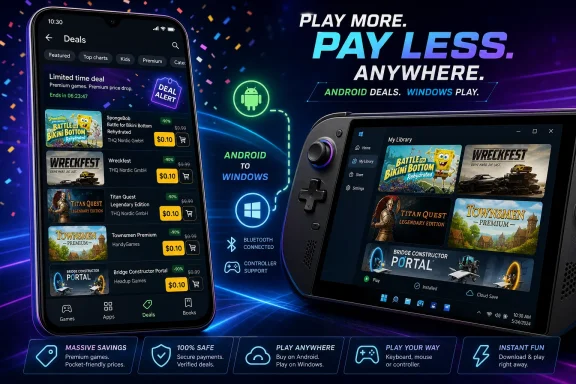
Several premium Android games, including SpongeBob SquarePants: Battle for Bikini Bottom, Wreckfest, Titan Quest, Townsmen Premium, and Bridge Constructor Portal, were discounted to $0.10 on the Google Play Store on June 22, 2026, according to Android Authority and live deal chatter. The sale is small in dollar terms but big in what it exposes: mobile gaming’s best value is often hiding underneath the free-to-play economy that dominates the storefront. For Windows users, it is also a reminder that Android games now sit awkwardly between phone, tablet, Chromebook, emulator, and Google’s own Windows gaming push.
The Google Play Store has trained users to be suspicious of the word free. Too often, free means timers, currencies, ads, starter packs, login rewards, battle passes, and a design vocabulary borrowed from casinos more than from traditional game design. Premium Android games, by contrast, have become a niche product: paid up front, usually quieter, often better suited to players who want a game rather than a retention machine.
That is why this discount wave is more interesting than a routine sale. A drop from $9.99 to $0.10 is not a modest promotion; it is a near-zero barrier to ownership. It turns games that many users might have ignored on principle into impulse purchases, especially for anyone with leftover Google Play credit or Google Opinion Rewards change.
The titles matter, too. This is not a bargain bin of anonymous shovelware. SpongeBob SquarePants: Battle for Bikini Bottom is a recognizable console-era platformer in mobile form, Wreckfest is a physics-heavy demolition racer with PC and console roots, and Titan Quest is a sprawling action RPG that predates the current mobile monetization template entirely. Even Bridge Constructor Portal, from a different publisher, carries the weight of a known puzzle series wrapped around Valve’s Portal universe.
A ten-cent sale does not fix mobile gaming. But it briefly reveals the alternate timeline that mobile gaming could have occupied more fully: a world where phones became a legitimate home for complete, self-contained games rather than the industry’s most efficient laboratory for extracting recurring payments.
This sale changes the calculation. At $9.99, Battle for Bikini Bottom has to compete not only with other mobile games but also with the user’s memory of Steam sales, Game Pass, and console backlogs. At $0.10, it competes with nothing. It becomes the sort of purchase people make just to avoid regretting it later.
That matters because premium Android ports have always had a discovery problem. The average Play Store user is far more likely to encounter free-to-play charts than a paid console port tucked into search results or recommendation rows. Discounts like this briefly push those games back into the social feed, where Reddit posts, deal trackers, and Android news sites do the merchandising that storefronts often fail to do.
There is an old-fashioned software-store pleasure here. You pay once, you get the thing, and the transaction ends. In 2026, that almost feels radical.
That does not mean the purchase is risk-free in every practical sense. Android compatibility can be messy, especially for older ports or games that target particular API levels, GPUs, or screen configurations. A game bought cheaply today may still be unavailable on a given device, awkward on a foldable, unsupported on Android TV, or missing from Google Play Games on PC.
Still, the psychology changes. Users who would never gamble $10 on a mobile port will gamble a dime. That is precisely why these sales can revive interest in games that already had their main commercial moment years ago.
For publishers, the strategy is obvious. A deep discount can harvest long-tail attention, push a game back up deal communities, and convert users who never would have paid full price. For players, it is one of the rare moments when the platform’s incentives line up with their own.
That is why Android’s best premium catalog often feels oddly invisible. There are excellent ports, indie releases, puzzle games, strategy titles, and role-playing games on the platform, but they rarely define the public image of Android gaming. The image is still dominated by free-to-play giants and ad-supported clones.
The result is a strange inversion. Android has the hardware to run serious games, the controllers to play them properly, and the storage to carry them around. What it lacks is a storefront culture that consistently rewards complete paid experiences.
This sale is a reminder that price is only one part of the problem. The deeper issue is trust. Users have learned that mobile games are often compromised by monetization first and design second, so even honest paid games must work harder to prove they are not traps.
Even so, there is a meaningful distinction between buying a complete game and entering a service economy. A premium game may still depend on platform infrastructure, but it is less likely to be designed around keeping the player in a monetized loop. There are no ad breaks every few minutes, no artificial energy walls, and no store page inside the game selling relief from inconvenience the game itself created.
That makes these discounted titles valuable in a way that goes beyond thrift. They are examples of a design model that respects the player’s time. They are also examples of why many users still prefer paid software when the price feels fair.
At $0.10, the fairness question almost becomes absurd. The bigger question becomes whether the mobile market can sustain these games at normal prices, or whether premium Android gaming only becomes visible when it is practically given away.
Google, meanwhile, has continued pushing Google Play Games on PC as a way to bring selected Android games to Windows. That offering is not the same thing as full Play Store access, and compatibility remains selective. Still, it signals where the industry is heading: Android games are no longer confined to phones, and Windows is no longer insulated from mobile-first software economics.
The awkward part is that these specific discounted games may or may not be part of a user’s Windows-accessible Android library through official means. Buying on Google Play does not guarantee a frictionless experience on a PC. Some titles remain phone-only, some work better with touch than keyboard and mouse, and some are better played through native PC versions when those exist.
But the broader direction is clear. Android’s game library is increasingly part of the Windows-adjacent ecosystem, whether through Google’s official client, third-party emulators, handheld PCs, cloud saves, or users simply expecting their purchases to follow them across screens.
The problem was execution and ecosystem alignment. The Amazon Appstore was not where most Android users had built their libraries. Google Play was. Without Google Play Services and the actual Play Store catalog, WSA was a technically interesting bridge to a neighborhood many users did not visit.
Google Play Games on PC attacks the problem from the other direction. Rather than making Windows a general Android app platform, Google is making Windows another endpoint for selected Android games. That is narrower than WSA, but it is also more aligned with where the commercial energy is.
For Windows enthusiasts, the lesson is blunt. Platform support is not just about kernels, subsystems, and virtualization. It is about catalogs, accounts, payment histories, cloud saves, input support, and whether the apps people want are actually there.
That is especially true for a game like Wreckfest. The appeal is physics, collisions, and spectacle, all of which demand more from the hardware than a static 2D interface. On a capable phone or tablet, the discount may feel like a steal. On a low-end device, it may feel like buying a ticket to a slideshow.
Titan Quest raises a different issue: scale. A large action RPG can be a superb mobile fit for some players and a poor fit for others, depending on control preferences and session length. The same game that feels wonderful with a controller on a tablet might feel cramped on a small phone screen.
That is why the smartest buyer treats this sale not as a random shopping spree but as a chance to build a small library of experiments. At $0.10, the user can afford to learn which kinds of premium Android games actually fit their devices and habits.
This is where Android’s hardware ecosystem has quietly improved. Devices are faster, screens are better, and controller accessories are no longer exotic. The software catalog has not always kept pace, but games like Battle for Bikini Bottom and Wreckfest make far more sense in that environment than they did in the era of touchscreen-only assumptions.
Windows handhelds complicate the picture further. A Steam Deck, ROG Ally, Legion Go, or similar machine is usually better served by native PC games, but users increasingly expect handheld libraries to be fluid. Android games, cloud games, PC games, and emulated older titles all compete for the same leisure time.
The winning platform may not be the one with the most technically elegant architecture. It may be the one that lets users buy cheaply, install easily, control comfortably, and resume play without thinking too hard.
The difference is that the market around it has changed. In the early Android years, a cheap paid app felt like a normal software bargain. In 2026, it feels almost countercultural because the dominant business model has shifted so far toward ongoing monetization.
That shift changed user expectations. Many players now assume mobile games will cost nothing up front and then attempt to monetize later. Others avoid mobile gaming entirely because they associate it with intrusive ads and manipulative design. Premium games sit between those groups, often admired but underbought.
A ten-cent sale temporarily resolves the contradiction. It gives free-to-play users no price objection and gives premium-game skeptics a reason to look again. But it also underscores the fragility of the category: if the best way to get attention is to charge almost nothing, premium mobile gaming remains in a precarious place.
Google has made progress in gaming infrastructure, especially around Play Games services and the PC client, but the storefront experience still often feels optimized for engagement rather than discernment. The difference matters. A store that promotes what monetizes best is not necessarily a store that promotes what users will value most.
Apple has wrestled with a similar problem through Apple Arcade, which carved out a subscription space for ad-free games. Google’s approach has been more diffuse, spanning Play Pass, individual purchases, and Play Games on PC. None of those fully solves premium discovery.
This sale is therefore both good news and an indictment. It proves the catalog has worthwhile games. It also proves many users need a shockingly low price to notice them.
The risk is that it trains users to wait. PC gamers know this pattern well from Steam. Once a game has been discounted deeply enough, full price becomes psychologically harder to justify later. Mobile users, already resistant to up-front pricing, may become even more reluctant to pay normal premium prices.
But the Android market may be different because many of these games are no longer in their launch window. The publisher is not necessarily sacrificing a full-price rush; it is extracting attention from an old catalog. The ten-cent sale is less a launch strategy than a reactivation strategy.
The healthier version of this would be a market where premium games sell steadily at fair prices and occasionally dip during events. The less healthy version is a market where paid mobile games only matter when discounted to novelty prices. This sale contains both possibilities.
But users should still check the basics before filling the cart. Compatibility warnings matter. Storage requirements matter. Controller support matters, especially for ports that were never designed around touchscreens in the first place.
There is also a platform-choice question. If you already own Titan Quest or Wreckfest on PC, the Android version may be a convenience purchase rather than a primary copy. If you prefer Windows handheld gaming, a native PC version may still be the better experience.
At $0.10, though, the calculation becomes forgiving. You are not buying the definitive version of every game. You are buying optionality.
 A Ten-Cent Sale Cuts Through Years of Mobile Store Cynicism
The Google Play Store has trained users to be suspicious of the word free. Too often, free means timers, currencies, ads, starter packs, login rewards, battle passes, and a design vocabulary borrowed from casinos more than from traditional game design. Premium Android games, by contrast, have become a niche product: paid up front, usually quieter, often better suited to players who want a game rather than a retention machine.That is why this discount wave is more interesting than a routine sale. A drop from $9.99 to $0.10 is not a modest promotion; it is a near-zero barrier to ownership. It turns games that many users might have ignored on principle into impulse purchases, especially for anyone with leftover Google Play credit or Google Opinion Rewards change.
The titles matter, too. This is not a bargain bin of anonymous shovelware. SpongeBob SquarePants: Battle for Bikini Bottom is a recognizable console-era platformer in mobile form, Wreckfest is a physics-heavy demolition racer with PC and console roots, and Titan Quest is a sprawling action RPG that predates the current mobile monetization template entirely. Even Bridge Constructor Portal, from a different publisher, carries the weight of a known puzzle series wrapped around Valve’s Portal universe.
A ten-cent sale does not fix mobile gaming. But it briefly reveals the alternate timeline that mobile gaming could have occupied more fully: a world where phones became a legitimate home for complete, self-contained games rather than the industry’s most efficient laboratory for extracting recurring payments.
HandyGames Turns Old Ports Into a New Argument
The common thread in the most eye-catching deals is HandyGames, a publisher that has long occupied an unusual lane in mobile gaming. Rather than treating Android merely as a place for lightweight distractions, the company has repeatedly brought console and PC-style games to phones and tablets. That strategy can look commercially awkward when users have been conditioned to expect mobile software for nothing.This sale changes the calculation. At $9.99, Battle for Bikini Bottom has to compete not only with other mobile games but also with the user’s memory of Steam sales, Game Pass, and console backlogs. At $0.10, it competes with nothing. It becomes the sort of purchase people make just to avoid regretting it later.
That matters because premium Android ports have always had a discovery problem. The average Play Store user is far more likely to encounter free-to-play charts than a paid console port tucked into search results or recommendation rows. Discounts like this briefly push those games back into the social feed, where Reddit posts, deal trackers, and Android news sites do the merchandising that storefronts often fail to do.
There is an old-fashioned software-store pleasure here. You pay once, you get the thing, and the transaction ends. In 2026, that almost feels radical.
The Real Discount Is on Friction
The headline price is $0.10, but the real discount is on hesitation. A $10 mobile game asks users to believe that the Android version is good, that it will work on their device, that the controls are tolerable, and that it will remain installable later. A ten-cent price mostly removes the burden of proof.That does not mean the purchase is risk-free in every practical sense. Android compatibility can be messy, especially for older ports or games that target particular API levels, GPUs, or screen configurations. A game bought cheaply today may still be unavailable on a given device, awkward on a foldable, unsupported on Android TV, or missing from Google Play Games on PC.
Still, the psychology changes. Users who would never gamble $10 on a mobile port will gamble a dime. That is precisely why these sales can revive interest in games that already had their main commercial moment years ago.
For publishers, the strategy is obvious. A deep discount can harvest long-tail attention, push a game back up deal communities, and convert users who never would have paid full price. For players, it is one of the rare moments when the platform’s incentives line up with their own.
Premium Mobile Games Are Still Fighting the Store They Live In
The Play Store is not hostile to premium games in policy, but it is structurally built around scale. Free downloads generate more installs, more reviews, more engagement signals, and more opportunities for in-app purchasing. Paid games start each race with a turnstile in front of them.That is why Android’s best premium catalog often feels oddly invisible. There are excellent ports, indie releases, puzzle games, strategy titles, and role-playing games on the platform, but they rarely define the public image of Android gaming. The image is still dominated by free-to-play giants and ad-supported clones.
The result is a strange inversion. Android has the hardware to run serious games, the controllers to play them properly, and the storage to carry them around. What it lacks is a storefront culture that consistently rewards complete paid experiences.
This sale is a reminder that price is only one part of the problem. The deeper issue is trust. Users have learned that mobile games are often compromised by monetization first and design second, so even honest paid games must work harder to prove they are not traps.
A Dime Can Buy a Better Kind of Ownership, But Not a Perfect One
It is tempting to say that paid mobile games restore ownership. That is only partly true. A Google Play purchase is still a license bound to an account, a storefront, device compatibility rules, and the ongoing willingness of a publisher and platform to keep the app available. Anyone who has watched mobile games disappear from stores knows that “bought” does not always mean “forever.”Even so, there is a meaningful distinction between buying a complete game and entering a service economy. A premium game may still depend on platform infrastructure, but it is less likely to be designed around keeping the player in a monetized loop. There are no ad breaks every few minutes, no artificial energy walls, and no store page inside the game selling relief from inconvenience the game itself created.
That makes these discounted titles valuable in a way that goes beyond thrift. They are examples of a design model that respects the player’s time. They are also examples of why many users still prefer paid software when the price feels fair.
At $0.10, the fairness question almost becomes absurd. The bigger question becomes whether the mobile market can sustain these games at normal prices, or whether premium Android gaming only becomes visible when it is practically given away.
Windows Users Have a Reason to Pay Attention
At first glance, an Android game sale might seem outside the usual WindowsForum beat. But the wall between Android gaming and Windows gaming has been crumbling for years, and not always in a coherent way. Microsoft tried to make Android apps part of Windows 11 through Windows Subsystem for Android, then deprecated that path and ended support in March 2025.Google, meanwhile, has continued pushing Google Play Games on PC as a way to bring selected Android games to Windows. That offering is not the same thing as full Play Store access, and compatibility remains selective. Still, it signals where the industry is heading: Android games are no longer confined to phones, and Windows is no longer insulated from mobile-first software economics.
The awkward part is that these specific discounted games may or may not be part of a user’s Windows-accessible Android library through official means. Buying on Google Play does not guarantee a frictionless experience on a PC. Some titles remain phone-only, some work better with touch than keyboard and mouse, and some are better played through native PC versions when those exist.
But the broader direction is clear. Android’s game library is increasingly part of the Windows-adjacent ecosystem, whether through Google’s official client, third-party emulators, handheld PCs, cloud saves, or users simply expecting their purchases to follow them across screens.
Microsoft Walked Away From the Wrong Layer
Microsoft’s retreat from Windows Subsystem for Android looks more consequential in this context. WSA was never perfect, and its Amazon Appstore integration limited its appeal from the start. But the idea was sound: Windows should be able to run the software users already own on adjacent platforms.The problem was execution and ecosystem alignment. The Amazon Appstore was not where most Android users had built their libraries. Google Play was. Without Google Play Services and the actual Play Store catalog, WSA was a technically interesting bridge to a neighborhood many users did not visit.
Google Play Games on PC attacks the problem from the other direction. Rather than making Windows a general Android app platform, Google is making Windows another endpoint for selected Android games. That is narrower than WSA, but it is also more aligned with where the commercial energy is.
For Windows enthusiasts, the lesson is blunt. Platform support is not just about kernels, subsystems, and virtualization. It is about catalogs, accounts, payment histories, cloud saves, input support, and whether the apps people want are actually there.
The Best Deal Is Still the Game That Runs Well
A ten-cent price can hide a lot of sins, but it cannot make a bad port good. Android is a brutally diverse platform, and premium games often sit closest to the edge of what devices can handle. Performance, thermals, controller support, touch controls, save syncing, and aspect-ratio behavior all matter more for a full console-style game than they do for a casual puzzle title.That is especially true for a game like Wreckfest. The appeal is physics, collisions, and spectacle, all of which demand more from the hardware than a static 2D interface. On a capable phone or tablet, the discount may feel like a steal. On a low-end device, it may feel like buying a ticket to a slideshow.
Titan Quest raises a different issue: scale. A large action RPG can be a superb mobile fit for some players and a poor fit for others, depending on control preferences and session length. The same game that feels wonderful with a controller on a tablet might feel cramped on a small phone screen.
That is why the smartest buyer treats this sale not as a random shopping spree but as a chance to build a small library of experiments. At $0.10, the user can afford to learn which kinds of premium Android games actually fit their devices and habits.
The Controller Is the Quiet Dividing Line
The mobile premium market becomes much more compelling once a controller enters the picture. A phone clipped to a Bluetooth controller, a small Android tablet, or a handheld Android gaming device changes the meaning of a console port. Suddenly, the platform is not a compromise but a portable console with a vast software store attached.This is where Android’s hardware ecosystem has quietly improved. Devices are faster, screens are better, and controller accessories are no longer exotic. The software catalog has not always kept pace, but games like Battle for Bikini Bottom and Wreckfest make far more sense in that environment than they did in the era of touchscreen-only assumptions.
Windows handhelds complicate the picture further. A Steam Deck, ROG Ally, Legion Go, or similar machine is usually better served by native PC games, but users increasingly expect handheld libraries to be fluid. Android games, cloud games, PC games, and emulated older titles all compete for the same leisure time.
The winning platform may not be the one with the most technically elegant architecture. It may be the one that lets users buy cheaply, install easily, control comfortably, and resume play without thinking too hard.
The Sale Revives an Old Google Play Memory
Longtime Android users will remember earlier eras when Google Play sales felt like events. Ten-cent promotions were once a way to fill a library with recognizable apps and games, and they helped establish the idea that Android was not just a free-app bazaar. This current wave taps into that nostalgia.The difference is that the market around it has changed. In the early Android years, a cheap paid app felt like a normal software bargain. In 2026, it feels almost countercultural because the dominant business model has shifted so far toward ongoing monetization.
That shift changed user expectations. Many players now assume mobile games will cost nothing up front and then attempt to monetize later. Others avoid mobile gaming entirely because they associate it with intrusive ads and manipulative design. Premium games sit between those groups, often admired but underbought.
A ten-cent sale temporarily resolves the contradiction. It gives free-to-play users no price objection and gives premium-game skeptics a reason to look again. But it also underscores the fragility of the category: if the best way to get attention is to charge almost nothing, premium mobile gaming remains in a precarious place.
Google’s Storefront Still Needs Better Curation Than Luck
Deal waves are useful, but they are a poor substitute for durable curation. If premium Android games only surface when an external site or Reddit thread points to them, the store is not doing enough editorial work. Users should not need to monitor deal communities to discover that their phone can run serious games.Google has made progress in gaming infrastructure, especially around Play Games services and the PC client, but the storefront experience still often feels optimized for engagement rather than discernment. The difference matters. A store that promotes what monetizes best is not necessarily a store that promotes what users will value most.
Apple has wrestled with a similar problem through Apple Arcade, which carved out a subscription space for ad-free games. Google’s approach has been more diffuse, spanning Play Pass, individual purchases, and Play Games on PC. None of those fully solves premium discovery.
This sale is therefore both good news and an indictment. It proves the catalog has worthwhile games. It also proves many users need a shockingly low price to notice them.
The Economics Are Weird, but Not Irrational
Selling a $9.99 game for $0.10 looks irrational only if each sale is judged in isolation. In the long tail, a near-free sale can serve several purposes. It can revive dormant listings, generate chart movement, gather new reviews, reintroduce a publisher’s brand, and monetize users who would otherwise never convert.The risk is that it trains users to wait. PC gamers know this pattern well from Steam. Once a game has been discounted deeply enough, full price becomes psychologically harder to justify later. Mobile users, already resistant to up-front pricing, may become even more reluctant to pay normal premium prices.
But the Android market may be different because many of these games are no longer in their launch window. The publisher is not necessarily sacrificing a full-price rush; it is extracting attention from an old catalog. The ten-cent sale is less a launch strategy than a reactivation strategy.
The healthier version of this would be a market where premium games sell steadily at fair prices and occasionally dip during events. The less healthy version is a market where paid mobile games only matter when discounted to novelty prices. This sale contains both possibilities.
Users Should Buy Fast, But Think Clearly
The practical advice is simple: if the games are available in your region and compatible with your devices, the downside is tiny. A few dimes can buy hours of ad-free play, especially for users who enjoy older console-style games. The sale may not last long, and Google Play pricing can vary by region and account.But users should still check the basics before filling the cart. Compatibility warnings matter. Storage requirements matter. Controller support matters, especially for ports that were never designed around touchscreens in the first place.
There is also a platform-choice question. If you already own Titan Quest or Wreckfest on PC, the Android version may be a convenience purchase rather than a primary copy. If you prefer Windows handheld gaming, a native PC version may still be the better experience.
At $0.10, though, the calculation becomes forgiving. You are not buying the definitive version of every game. You are buying optionality.
The Dime Store Moment Says More Than the Price Tag
This sale is easy to treat as a cute deal post and nothing more. But it points to several larger realities about Android gaming, Windows-adjacent play, and the uneasy survival of paid software on mobile.- Premium Android games still exist in meaningful numbers, but they often need external attention to break through the Play Store’s free-to-play noise.
- The deepest discounts are most compelling when they apply to complete games rather than monetized shells.
- Windows users should care because Google, Microsoft, and emulator vendors have all made Android gaming part of the broader PC conversation.
- A Google Play purchase does not automatically guarantee a good Windows experience, even as Google Play Games on PC continues to blur platform boundaries.
- The best buys in this sale are the games that match your actual device, input method, and tolerance for mobile-port quirks.
- The ten-cent price is a bargain for players, but it also reveals how difficult it remains to sell premium mobile games at sustainable full prices.
References
- Primary source: Android Authority
Published: Mon, 22 Jun 2026 15:01:28 GMT
You can grab some of the best Android games for literally pennies right now
Score premium Android games like Wreckfest and SpongeBob for just $0.10 on the Play Store in this fire sale! Check them out right now!www.androidauthority.com - Official source: play.google.com
SpongeBob SquarePants BfBB - Apps on Google Play
Play as SpongeBob, Patrick and Sandy and battle an army of wacky robots!play.google.com
- Related coverage: droidgamers.com
SpongeBob SquarePants: Battle for Bikini Bottom Arrives on Android for $9.99 - Droid Gamers
SpongeBob SquarePants: Battle for Bikini Bottom has landed on the Google Play Store courtesy of HandyGames. Originally released in 2003, SpongeBob SquarePants: Battle for Bikini Bottom sees you... Continue readingwww.droidgamers.com - Related coverage: spongebob-squarepants-battle-for-bikini-bottom.softonic.com
SpongeBob SquarePants: Battle for Bikini Bottom para Android - Descargar
SpongeBob SquarePants: Battle for Bikini Bottom para Android, descargar gratis. SpongeBob SquarePants: Battle for Bikini Bottom última versión: Un juespongebob-squarepants-battle-for-bikini-bottom.softonic.com
- Related coverage: androidout.com
Townsmen Premium Android - Free Download Townsmen Premium App - HandyGames
Download Townsmen Premium Android for US$ 0.99 by HandyGames, A voyage to the old dayswww.androidout.com
- Related coverage: droidpoin.com
SpongeBob SquarePants: Battle for Bikini Bottom Rehydrated Segera Tersedia di Android | DroidPoin
Tahun 2003, Purple Lamp Studios (bagian dari THQ) merilis game berjudul SpongeBob SquarePants: Battle for Bikini Bottom dan karena hingga saat ini masih banyak peminatnya, versi remake dari game tersebut akhirya diresmikan lagi tahun kemarin dengan judul SpongeBob SquarePants: Battle for Bikini... droidpoin.com
- Related coverage: img1.wsimg.com
Android action shooting games download
Joe Hindy / Android AuthorityAction games are among the most popular of any platform. They’re exciting, they keep you engaged, and the win conditions are generallyimg1.wsimg.com
- Related coverage: tomsguide.com
Windows 11 will stop supporting Android apps in 2025 - here's why | Tom's Guide
Microsoft's Windows 11 can support Android apps. But soon enough, that'll be going away.www.tomsguide.com - Official source: learn.microsoft.com
Will Windows Subsystem for Android (WSA) stay executable after 05 March 2025 if already installed at that time? - Microsoft Q&A
Quite recently I bought a PC running Windows 11 and was very glad about the option to also run Android apps in the Windows Subsystem for Android (WSA). In fact I have 3 Android apps that I'd like to run, which are not avaible in the Amazon Appstore but…learn.microsoft.com - Related coverage: drwindows.de
Windows 11: Microsoft stellt das Windows Subsystem for Android im März 2025 ein - Dr. Windows
Kleiner Rundumschlag aus Redmond: Microsoft hat in einem neuen Eintrag auf der entsprechenden Supportseite bei Microsoft Learn die Einstellung vom Windows Subsystem for Android angekündigt. Bis das Feature aus Windows 11 verschwunden ist, wird es aber noch ein bisschen dauern, erst im 5. März...www.drwindows.de
- Official source: support.google.com

Install & set up Google Play Games on your PC - Google Play Help
If your PC meets the minimum requirements, you can install Google Play Games on PC. Begin installation On your Windows computer, go to
support.google.com
- Related coverage: windowslatest.com
Windows 11's Subsystem for Android gets updated ahead of removal
Windows 11's Subsystem for Android gets updated ahead of removal and there's no hope for Android app emulation in future. www.windowslatest.com
- Related coverage: androidcentral.com
Google Play Games on PC finally gets an open beta so more people can try | Android Central
No more waitlists, but availability is still limited.www.androidcentral.com - Related coverage: techadvisor.com
Android App Support to be Removed From Windows on 5 March - Tech Advisor
The latest update of the Windows Subsystem for Android (WSA) has now been released but you have optionswww.techadvisor.com - Related coverage: developer.android.com
Google Play Games on PC | Android game development | Android Developers
 developer.android.com
- Related coverage: tomshardware.com
Google to kill Steam for Chromebook beta in 2026 — Installed games will 'no longer be available to play' | Tom's Hardware
Say goodbye to native Steam gaming on your ChromeOS device.www.tomshardware.com - Related coverage: techradar.com
- Related coverage: issuewire.com
