

Google Research unveiled Gemini-SQL2 in June 2026 as a Gemini 3.1 Pro-based text-to-SQL system that converts natural-language questions into executable database queries and, according to reported BIRD benchmark results, reached 80.04 percent execution accuracy. That score puts Google’s system well ahead of the cited OpenAI GPT-5.5-xhigh and Anthropic Claude Opus 4.6 results, but the larger story is not simply another leaderboard shuffle. It is that enterprise AI is moving from chatty copilots toward systems that can touch the data layer — and that is where impressive benchmarks start to look like operational risk.
Text-to-SQL has always been one of the cleaner promises in enterprise AI. Instead of asking a business analyst to learn joins, nested filters, date functions, and warehouse-specific syntax, a system can let the user ask, “Which regions had the highest renewal risk last quarter?” and return the query that answers it. In theory, that turns the database from a specialist tool into a conversational interface.
Gemini-SQL2 is Google’s latest argument that this is no longer a demo-class capability. The reported BIRD score of 80.04 percent matters because BIRD is designed to be harder than older academic benchmarks, with messier schemas, real-world domains, and questions that often require more than surface-level table matching. A model that performs well there is not merely stringing together plausible SQL; it is more often generating queries that actually run and return the expected result.
That distinction is central. SQL is unforgiving in a way ordinary chatbot prose is not. A sentence can be slightly wrong and still useful; a query can be syntactically valid, logically wrong, and expensive enough to ruin someone’s afternoon.
Google’s benchmark claim is therefore a shot at a very specific market: enterprise analytics, cloud data warehousing, BI copilots, and internal data assistants. If Gemini-SQL2’s performance translates into products, the prize is not just better answers in a chat window. It is a more powerful natural-language front end for BigQuery, Looker, Sheets-connected analytics, and whatever data-agent tooling Google decides to wrap around Gemini.
But the number should be read carefully. Execution accuracy means the generated query returns the same result as a reference query on the benchmark task. That is a better measure than exact text matching because SQL can be written many ways, but it still only proves success under the benchmark’s conditions.
A system can score well and still struggle when dropped into a corporate warehouse with half-documented columns, inherited naming conventions, materialized views that encode business policy, and metrics that mean different things to sales, finance, and operations. The hard part is often not SQL syntax. It is knowing that “active customer” excludes free trials in one dashboard, includes paused subscriptions in another, and changed definition after a pricing migration two fiscal years ago.
That is why 80 percent should excite data teams without seducing them. One in five failures on benchmark tasks is still a large error budget when the output could drive a revenue report, compliance search, executive dashboard, or production incident analysis. The remaining 20 percent is where governance, review, permissions, semantic layers, and query cost controls become the product rather than the afterthought.
That makes SQL generation an unusually useful test of whether large models can reason over structured systems. The model must interpret a user’s intent, inspect schema information, infer relationships between tables, choose the right filters, avoid invalid joins, and often handle domain-specific wording. It also has to know when the user’s question is under-specified.
The last point matters more than most demos admit. A natural-language interface that always tries to answer can be worse than one that occasionally refuses. If a user asks for “monthly revenue,” the safe response may be to ask which revenue definition, which currency conversion, whether refunds are netted out, and whether the month should be invoice date, payment date, or service period.
A strong text-to-SQL system is therefore not merely a translator. It is an interpreter of business semantics. The closer it gets to production, the more it resembles a junior analyst with database access — useful, fast, and dangerous if nobody checks its assumptions.
That is where Google has obvious strategic leverage. The company already owns major pieces of the data workflow through BigQuery, Looker, Workspace, and Vertex AI. If Gemini-SQL2 or its techniques are folded into those products, Google can surround the model with context most standalone chatbot vendors cannot easily access.
A BigQuery-native assistant could know table metadata, partitioning, permissions, query costs, lineage, and prior workload patterns. A Looker-connected assistant could lean on governed metrics instead of guessing at raw tables. A Workspace-facing assistant could bring SQL-derived answers into documents and spreadsheets while respecting enterprise access controls.
That integration story is more important than the leaderboard story. A model that is slightly weaker but deeply wired into the data platform can outperform a stronger model that sees only a pasted schema. Google’s announcement should be read as a move to make Gemini not just a general assistant, but a database-aware layer inside enterprise workflows.
Gemini-SQL2 lands directly in one of Microsoft’s most important enterprise battlegrounds. Power BI and Microsoft Fabric depend on trust in data models, semantic layers, and governed analytics. If Google can credibly claim that Gemini is better at translating business questions into executable SQL, it gives Google Cloud a sharper wedge into analytics-heavy organizations.
That does not mean Microsoft is suddenly behind across the board. Enterprise buying decisions rarely move on one benchmark, and Microsoft’s advantage remains distribution. Copilot is already present where many workers live: Outlook, Teams, Excel, Windows, PowerPoint, Power BI, and Azure.
But SQL is different from summarizing email. A better SQL assistant can become a productivity multiplier for analysts, DBAs, developers, and operations teams. If Google turns Gemini-SQL2 into a reliable BigQuery and Looker feature before rivals match it in Fabric and Power BI, it can convert a research result into a platform argument.
That opacity is not unusual in modern AI competition, but it matters here. Text-to-SQL benchmarks are sensitive to harness design. A system that gets multiple attempts, executes intermediate queries, observes errors, and repairs itself is not doing the same job as a single-pass model asked to emit SQL once. Both can be useful, but they should not be casually compared.
The lack of a public release also limits practical impact for now. Developers cannot test the model against their own schemas. Researchers cannot reproduce the score. Enterprise buyers cannot yet know whether this is a forthcoming product capability, an internal research prototype, or a benchmark-oriented system that may appear only indirectly inside Google services.
That uncertainty should temper the victory lap. The score is newsworthy, but the deployment story remains unwritten.
Most production data is not self-explanatory. Tables reflect product history, organizational politics, migrations, exceptions, and compromises. A column named
Even when the schema is clean, business logic can be scattered across BI dashboards, dbt models, stored procedures, spreadsheets, Jira tickets, and the memory of the person who built the reporting pipeline three jobs ago. A model cannot infer all of that reliably from table names.
This is where the next phase of text-to-SQL will be won. The winning systems will not simply generate more elegant queries. They will bind natural language to governed definitions, ask clarifying questions, surface assumptions, and explain which tables and metrics they used. They will become less like autocomplete and more like controlled analytical agents.
That is not a theoretical concern. A query assistant must respect row-level security, column masking, tenant boundaries, audit logging, data loss prevention rules, and approval workflows. It must also be resistant to prompt injection through metadata, documentation, comments, and stored content that the model may retrieve as context.
The nightmare version is not a malicious superintelligence. It is a well-meaning employee asking, “Show me all customers likely to churn,” and receiving more personally identifiable information than their role should expose. Or a model generating a cross-join that scans terabytes of data because the user phrased a question vaguely.
For sysadmins and data platform owners, Gemini-SQL2-style capability should trigger planning, not panic. The question is no longer whether natural-language query systems will arrive. It is whether they will arrive behind proper identity, permissions, cost controls, logs, and review mechanisms.
If natural-language SQL generation becomes reliable enough for common cases, analysts will spend less time writing boilerplate joins and more time validating definitions, investigating anomalies, and turning results into decisions. Junior analysts may become productive faster, but they will also need stronger judgment because they will be supervising a system that can produce confident wrong answers at speed.
Database administrators and data engineers will feel a different pressure. They will be asked to make warehouses more AI-readable: better descriptions, cleaner naming, richer metadata, documented lineage, and stricter access policies. The irony is that conversational analytics may force organizations to do the boring data hygiene work they postponed for years.
Developers, too, will use these tools differently from business users. For them, text-to-SQL can accelerate prototyping, migration analysis, test-data inspection, and operational debugging. But production changes will still require review, especially when generated queries are embedded into applications or automated workflows.
Still, benchmarks are not meaningless. They compress a messy research field into measurable signals. A large jump on a hard benchmark tells us something changed, even if it does not tell us everything. Gemini-SQL2’s reported BIRD result is meaningful because BIRD is closer to real-world database work than older, cleaner tasks.
The danger is treating the benchmark as a deployment certificate. An 80 percent score does not mean a CIO should let employees freely query production financial systems through a chatbot. It means the technology is crossing from novelty into serious pilot territory.
The best organizations will respond by building evaluation harnesses of their own. They will test models against internal schemas, known business questions, historical analyst queries, permission boundaries, and failure modes. Public benchmarks can identify candidates; private benchmarks decide whether a system belongs near the business.
The near-term deployments will probably be cautious. Expect copilots that draft SQL rather than run it automatically, assistants limited to governed datasets, and admin controls that determine whether users can execute, export, or merely preview results. The more sensitive the data, the more likely a human review step remains.
But the direction is clear. Users will increasingly expect to ask data questions in plain English and get answers without opening a SQL editor. Vendors will compete to make that feel magical. IT will be responsible for making sure the magic has logs, permissions, rollback plans, and spending limits.
Gemini-SQL2 is a reminder that the AI race is no longer just about who writes the best paragraph or solves the hardest puzzle. The next battleground is whether these systems can safely operate on the structured information businesses actually run on. Google appears to have made a serious advance, but the real test will come when the model leaves the leaderboard and meets the warehouse: messy, expensive, permissioned, political, and full of definitions no benchmark can fully capture.
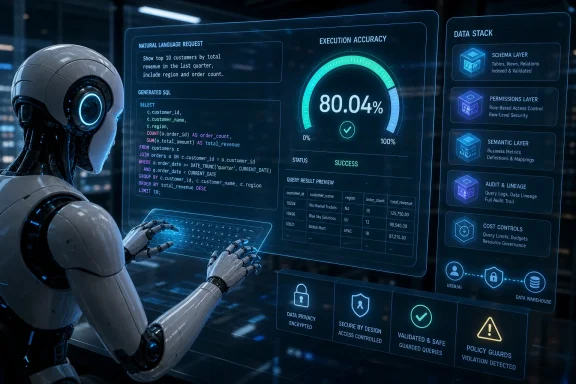 Google’s SQL Win Is Really a Claim on the Enterprise Data Stack
Text-to-SQL has always been one of the cleaner promises in enterprise AI. Instead of asking a business analyst to learn joins, nested filters, date functions, and warehouse-specific syntax, a system can let the user ask, “Which regions had the highest renewal risk last quarter?” and return the query that answers it. In theory, that turns the database from a specialist tool into a conversational interface.Gemini-SQL2 is Google’s latest argument that this is no longer a demo-class capability. The reported BIRD score of 80.04 percent matters because BIRD is designed to be harder than older academic benchmarks, with messier schemas, real-world domains, and questions that often require more than surface-level table matching. A model that performs well there is not merely stringing together plausible SQL; it is more often generating queries that actually run and return the expected result.
That distinction is central. SQL is unforgiving in a way ordinary chatbot prose is not. A sentence can be slightly wrong and still useful; a query can be syntactically valid, logically wrong, and expensive enough to ruin someone’s afternoon.
Google’s benchmark claim is therefore a shot at a very specific market: enterprise analytics, cloud data warehousing, BI copilots, and internal data assistants. If Gemini-SQL2’s performance translates into products, the prize is not just better answers in a chat window. It is a more powerful natural-language front end for BigQuery, Looker, Sheets-connected analytics, and whatever data-agent tooling Google decides to wrap around Gemini.
The Benchmark Lead Is Big Enough to Notice, but Not Big Enough to Trust Blindly
The reported gap is unusually wide for a frontier-model benchmark. Gemini-SQL2’s 80.04 percent execution accuracy is said to beat OpenAI’s GPT-5.5-xhigh at roughly 72.8 percent and Anthropic’s Claude Opus 4.6 at around 70.9 percent. In a field where vendors often trade tiny wins on highly tuned evaluations, a seven-point-plus lead is not noise.But the number should be read carefully. Execution accuracy means the generated query returns the same result as a reference query on the benchmark task. That is a better measure than exact text matching because SQL can be written many ways, but it still only proves success under the benchmark’s conditions.
A system can score well and still struggle when dropped into a corporate warehouse with half-documented columns, inherited naming conventions, materialized views that encode business policy, and metrics that mean different things to sales, finance, and operations. The hard part is often not SQL syntax. It is knowing that “active customer” excludes free trials in one dashboard, includes paused subscriptions in another, and changed definition after a pricing migration two fiscal years ago.
That is why 80 percent should excite data teams without seducing them. One in five failures on benchmark tasks is still a large error budget when the output could drive a revenue report, compliance search, executive dashboard, or production incident analysis. The remaining 20 percent is where governance, review, permissions, semantic layers, and query cost controls become the product rather than the afterthought.
Text-to-SQL Has Become the Place Where AI Meets Reality
General-purpose chatbots can hide uncertainty behind fluent language. Text-to-SQL cannot hide as easily. The query either executes or it does not; the result either matches the intended answer or it quietly lies.That makes SQL generation an unusually useful test of whether large models can reason over structured systems. The model must interpret a user’s intent, inspect schema information, infer relationships between tables, choose the right filters, avoid invalid joins, and often handle domain-specific wording. It also has to know when the user’s question is under-specified.
The last point matters more than most demos admit. A natural-language interface that always tries to answer can be worse than one that occasionally refuses. If a user asks for “monthly revenue,” the safe response may be to ask which revenue definition, which currency conversion, whether refunds are netted out, and whether the month should be invoice date, payment date, or service period.
A strong text-to-SQL system is therefore not merely a translator. It is an interpreter of business semantics. The closer it gets to production, the more it resembles a junior analyst with database access — useful, fast, and dangerous if nobody checks its assumptions.
Google’s Advantage Is Not Just the Model
Gemini-SQL2 is described as being built on Gemini 3.1 Pro, but the system’s real-world value would depend on far more than the base model. Text-to-SQL performance usually improves when the model is given schema descriptions, sample rows, data dictionaries, query history, business definitions, and feedback from execution attempts. In other words, the model is only one layer in a larger retrieval, planning, validation, and repair pipeline.That is where Google has obvious strategic leverage. The company already owns major pieces of the data workflow through BigQuery, Looker, Workspace, and Vertex AI. If Gemini-SQL2 or its techniques are folded into those products, Google can surround the model with context most standalone chatbot vendors cannot easily access.
A BigQuery-native assistant could know table metadata, partitioning, permissions, query costs, lineage, and prior workload patterns. A Looker-connected assistant could lean on governed metrics instead of guessing at raw tables. A Workspace-facing assistant could bring SQL-derived answers into documents and spreadsheets while respecting enterprise access controls.
That integration story is more important than the leaderboard story. A model that is slightly weaker but deeply wired into the data platform can outperform a stronger model that sees only a pasted schema. Google’s announcement should be read as a move to make Gemini not just a general assistant, but a database-aware layer inside enterprise workflows.
Microsoft and OpenAI Should Read This as a Data-Copilot Warning
For WindowsForum readers, the obvious comparison point is Microsoft’s Copilot strategy. Microsoft has spent the past few years pushing AI into Windows, Microsoft 365, Power BI, Fabric, Azure, GitHub, and security tooling. The broad ambition is similar: make natural language the control plane for work.Gemini-SQL2 lands directly in one of Microsoft’s most important enterprise battlegrounds. Power BI and Microsoft Fabric depend on trust in data models, semantic layers, and governed analytics. If Google can credibly claim that Gemini is better at translating business questions into executable SQL, it gives Google Cloud a sharper wedge into analytics-heavy organizations.
That does not mean Microsoft is suddenly behind across the board. Enterprise buying decisions rarely move on one benchmark, and Microsoft’s advantage remains distribution. Copilot is already present where many workers live: Outlook, Teams, Excel, Windows, PowerPoint, Power BI, and Azure.
But SQL is different from summarizing email. A better SQL assistant can become a productivity multiplier for analysts, DBAs, developers, and operations teams. If Google turns Gemini-SQL2 into a reliable BigQuery and Looker feature before rivals match it in Fabric and Power BI, it can convert a research result into a platform argument.
The Missing Paper Matters
The most important caveat is that Google Research has reportedly not yet released a paper or public model details. That leaves outsiders with the headline result but not the machinery behind it. We do not know how much of Gemini-SQL2’s score comes from model improvements, prompting strategy, schema retrieval, test-time scaling, query repair, benchmark-specific tuning, or a private evaluation setup.That opacity is not unusual in modern AI competition, but it matters here. Text-to-SQL benchmarks are sensitive to harness design. A system that gets multiple attempts, executes intermediate queries, observes errors, and repairs itself is not doing the same job as a single-pass model asked to emit SQL once. Both can be useful, but they should not be casually compared.
The lack of a public release also limits practical impact for now. Developers cannot test the model against their own schemas. Researchers cannot reproduce the score. Enterprise buyers cannot yet know whether this is a forthcoming product capability, an internal research prototype, or a benchmark-oriented system that may appear only indirectly inside Google services.
That uncertainty should temper the victory lap. The score is newsworthy, but the deployment story remains unwritten.
The Real Enemy Is Not SQL Syntax but Business Logic
Google’s own framing reportedly emphasizes that natural-language-to-SQL is hard because enterprise data is layered and queries often need complex business logic. That is exactly right, and it is why this category has repeatedly disappointed people who expected a database chatbot to replace analysts.Most production data is not self-explanatory. Tables reflect product history, organizational politics, migrations, exceptions, and compromises. A column named
status may not mean what a new analyst thinks it means. A row may represent an event, a snapshot, a transaction, a correction, or an artifact of an ETL process.Even when the schema is clean, business logic can be scattered across BI dashboards, dbt models, stored procedures, spreadsheets, Jira tickets, and the memory of the person who built the reporting pipeline three jobs ago. A model cannot infer all of that reliably from table names.
This is where the next phase of text-to-SQL will be won. The winning systems will not simply generate more elegant queries. They will bind natural language to governed definitions, ask clarifying questions, surface assumptions, and explain which tables and metrics they used. They will become less like autocomplete and more like controlled analytical agents.
The Security Model Becomes the Product
Once a natural-language system can generate SQL, security moves from the perimeter into the prompt. Users who cannot write SQL may still be able to ask for sensitive slices of data. If the assistant has broad database privileges, the natural-language interface becomes a new path to exfiltration, accidental overreach, and policy violations.That is not a theoretical concern. A query assistant must respect row-level security, column masking, tenant boundaries, audit logging, data loss prevention rules, and approval workflows. It must also be resistant to prompt injection through metadata, documentation, comments, and stored content that the model may retrieve as context.
The nightmare version is not a malicious superintelligence. It is a well-meaning employee asking, “Show me all customers likely to churn,” and receiving more personally identifiable information than their role should expose. Or a model generating a cross-join that scans terabytes of data because the user phrased a question vaguely.
For sysadmins and data platform owners, Gemini-SQL2-style capability should trigger planning, not panic. The question is no longer whether natural-language query systems will arrive. It is whether they will arrive behind proper identity, permissions, cost controls, logs, and review mechanisms.
The Analyst Job Changes Before It Disappears
Every leap in text-to-SQL revives the same prediction: analysts are doomed. That is the least interesting reading of the technology. The more plausible near-term outcome is that analysts become reviewers, modelers, and semantic-layer custodians rather than hand-coders of every query.If natural-language SQL generation becomes reliable enough for common cases, analysts will spend less time writing boilerplate joins and more time validating definitions, investigating anomalies, and turning results into decisions. Junior analysts may become productive faster, but they will also need stronger judgment because they will be supervising a system that can produce confident wrong answers at speed.
Database administrators and data engineers will feel a different pressure. They will be asked to make warehouses more AI-readable: better descriptions, cleaner naming, richer metadata, documented lineage, and stricter access policies. The irony is that conversational analytics may force organizations to do the boring data hygiene work they postponed for years.
Developers, too, will use these tools differently from business users. For them, text-to-SQL can accelerate prototyping, migration analysis, test-data inspection, and operational debugging. But production changes will still require review, especially when generated queries are embedded into applications or automated workflows.
Benchmarks Are Becoming Marketing, but They Still Matter
It is fashionable to dismiss AI benchmarks as vendor theater, and there is plenty of evidence for skepticism. Leaderboards can be gamed. Test sets can leak. Harnesses can favor particular interaction styles. A model can dominate one benchmark and underperform in the workflows customers actually care about.Still, benchmarks are not meaningless. They compress a messy research field into measurable signals. A large jump on a hard benchmark tells us something changed, even if it does not tell us everything. Gemini-SQL2’s reported BIRD result is meaningful because BIRD is closer to real-world database work than older, cleaner tasks.
The danger is treating the benchmark as a deployment certificate. An 80 percent score does not mean a CIO should let employees freely query production financial systems through a chatbot. It means the technology is crossing from novelty into serious pilot territory.
The best organizations will respond by building evaluation harnesses of their own. They will test models against internal schemas, known business questions, historical analyst queries, permission boundaries, and failure modes. Public benchmarks can identify candidates; private benchmarks decide whether a system belongs near the business.
The Practical Reading for Windows and Enterprise IT
The most useful way to read Gemini-SQL2 is not as a standalone Google victory, but as a preview of the next software interface. Natural language is moving down the stack from documents and meetings into databases, dashboards, shells, and administrative consoles. That shift has consequences for every IT department managing Windows clients, identity systems, cloud services, BI tools, and data warehouses.The near-term deployments will probably be cautious. Expect copilots that draft SQL rather than run it automatically, assistants limited to governed datasets, and admin controls that determine whether users can execute, export, or merely preview results. The more sensitive the data, the more likely a human review step remains.
But the direction is clear. Users will increasingly expect to ask data questions in plain English and get answers without opening a SQL editor. Vendors will compete to make that feel magical. IT will be responsible for making sure the magic has logs, permissions, rollback plans, and spending limits.
The Number That Should Make Data Teams Rewrite Their Playbooks
Gemini-SQL2’s reported result does not mean conversational databases are solved, but it does mean the excuses are getting weaker. Data leaders should assume that natural-language query tools will become good enough for mainstream internal pilots and prepare accordingly.- Organizations should build internal SQL evaluation sets using real business questions, known-good queries, and examples of ambiguous requests that should trigger clarification rather than execution.
- Data teams should treat semantic layers, metric definitions, lineage, and table documentation as AI infrastructure rather than optional reporting hygiene.
- Administrators should require natural-language query tools to inherit existing identity, row-level security, masking, auditing, and data-loss-prevention controls.
- Analysts should expect AI to remove some routine query-writing work while increasing the value of validation, business context, and statistical judgment.
- Buyers should avoid treating a public benchmark score as proof of production readiness until the system has been tested against their own schema, workload, permissions, and cost constraints.
Gemini-SQL2 is a reminder that the AI race is no longer just about who writes the best paragraph or solves the hardest puzzle. The next battleground is whether these systems can safely operate on the structured information businesses actually run on. Google appears to have made a serious advance, but the real test will come when the model leaves the leaderboard and meets the warehouse: messy, expensive, permissioned, political, and full of definitions no benchmark can fully capture.
References
- Primary source: the-decoder.com
Published: 2026-06-13T13:20:09.759438
Google Research's Gemini-SQL2 tops text-to-SQL benchmarks by a wide margin
Google Research's Gemini-SQL2 turns natural language into executable SQL queries. Built on Gemini 3.1 Pro, it tops the BIRD benchmark at 80.04 percent accuracy, well ahead of OpenAI and Anthropic. Google says the technology could improve natural language features across its data services.the-decoder.com - Related coverage: ai-navigate-news.com

Gemini-SQL2 tops BIRD text-to-SQL leaderboard at 80 accuracy | AI Navigate
- Gemini-SQL2(Gemini 3.1 Proベース)がBIRD text-to-SQLベンチマークで実行精度80.04%を達成し、シングルモデル部門の首位に到達した。 - これまでtext-to-SQLの精度が60〜70%帯に長く停滞しており、誤りが多いため人手でのSQLレビューが実運用上の必須条件になって
ai-navigate-news.com
- Related coverage: aiweekly.co
- Related coverage: dataforcee.us
- Related coverage: kucoin.com
Google's Gemini-SQL2 achieves 80.04% accuracy on the BIRD benchmark. | KuCoin
ME AI News: According to monitoring by Beating, Google Research released the text-to-SQL technology Gemini-SQL2 on June 12. The new system, built on the Geminiwww.kucoin.com - Related coverage: explainx.ai
Gemini-SQL2: Google Text-to-SQL Tops BIRD Benchmark | explainx.ai Blog | explainx.ai
Google Research announced Gemini-SQL2, a Gemini 3.1 Pro-powered text-to-SQL model with SOTA results on BIRD. What it is, why it matters, what's missing.www.explainx.ai

- Related coverage: layerlens.ai
Gemini 3.1 Pro Benchmarks: 14,549 Test Results | LayerLens
Gemini 3.1 Pro scored 32.5% to 97% across 14,549 tests. Where it wins (math), where it fails (agents, SQL), with per-benchmark data from Stratix. layerlens.ai
- Related coverage: sequel.sh
Text-to-SQL: The Complete Guide (2026) | Sequel | Sequel
Text-to-SQL turns a plain-English question into a database query. How it works, how accurate it really is, what Uber and Pinterest learned shipping it, and how to use it safely on real data.sequel.sh - Related coverage: datost.com
How Accurate Is Text-to-SQL, Really? Spider, BIRD, and the Enterprise Cliff — Datost Blog
Text-to-SQL hits ~85% on Spider but collapses to ~33% on ambiguous enterprise schemas. The benchmarks, the cliff, and the head-to-head numbers.datost.com
- Related coverage: awesomeagents.ai
Text-to-SQL LLM Leaderboard 2026: Spider and BIRD Ranked | Awesome Agents
Rankings of the best LLMs and agent pipelines on BIRD, Spider 2.0, CoSQL, and SParC text-to-SQL benchmarks, with execution accuracy scores and analysis.awesomeagents.ai - Related coverage: beancount.io
BIRD Benchmark: The Real-Database Gap in LLM Text-to-SQL
The BIRD benchmark (NeurIPS 2023) tests LLMs on 95 real databases — GPT-4 reaches only 54.89% execution accuracy with domain hints and 34.88% without, a 20-point gap that directly shapes what a natural-language BQL interface for Beancount would need to solve.beancount.io - Related coverage: wizwand.com
SOTA Text-to-SQL on BIRD (EX, VES) and PapersWithCode | Wizwand
Evaluation of Text-to-SQL performance on the BIRD dataset, reporting Execution Accuracy (EX) and Validation Efficiency Score (VES).www.wizwand.com
- Related coverage: llmdb.com
BIRD-SQL - LLM Benchmark
BIRD (BIg Bench for LaRge-scale Database Grounded Text-to-SQL Evaluation) is a cross-domain dataset that examines the impact of extensive database contents on text-to-SQL parsing. It contains over 12,751 unique question-SQL pairs, 95 big databases with a total size of 33.4 GB, and covers more...llmdb.com
