

Indy Data Partners, a veteran-owned IT consulting firm founded in 2014 and based in Indianapolis, announced on June 28, 2026, that it has expanded its Microsoft data services around SQL Server, Azure Databricks, Power BI, Power Platform, and Azure Data Factory. The news is not a moonshot product launch, and that is precisely why it matters. It captures a quieter enterprise reality: for many organizations, “AI readiness” still begins with the unglamorous work of fixing databases, pipelines, reporting models, and ownership boundaries. Microsoft’s modern data stack may be marketed as a cloud-era platform, but its success in the field still depends heavily on firms that can make yesterday’s SQL Server estate behave like tomorrow’s analytics backbone.
The fashionable version of enterprise modernization begins with dashboards, copilots, lakehouses, and generative AI pilots. The operational version begins with a slower and less photogenic inventory: SQL Server instances with unknown owners, long-running stored procedures nobody wants to touch, brittle reporting jobs, and Excel workbooks that have quietly become business-critical systems.
That is the environment Indy Data Partners is speaking to with its expanded service offering. The company’s announcement frames SQL Server management not as a legacy sideline but as the foundation for a broader Microsoft data architecture. That framing is important because most organizations do not get to choose between “old SQL” and “modern cloud” as cleanly as vendor diagrams imply.
SQL Server remains embedded in line-of-business applications, finance systems, logistics workflows, healthcare platforms, and custom applications built over many years. A company can adopt Power BI, Azure Data Factory, or Azure Databricks, but if the source systems are poorly indexed, inconsistently governed, or badly documented, the new analytics layer inherits the old dysfunction.
This is the part of digital transformation that rarely makes a keynote. Before an organization can build reliable intelligence from its data, it has to make the data estate observable, stable, and governable. Consulting firms that understand that sequence have a more realistic proposition than firms selling cloud migration as a single jump cut.
Indy Data Partners’ pitch therefore lands in a practical market niche. It is not promising to replace the database administrator with a wizardly abstraction layer. It is arguing that the database layer, the integration layer, and the reporting layer should be treated as one system of delivery.
But the customer side of that equation is messier. Many IT departments accumulated Microsoft data tooling in layers rather than as a single architecture. SQL Server may have arrived with an ERP deployment. Power BI may have entered through finance or operations teams. Power Platform may have grown through departmental automation. Azure Data Factory may have been adopted later to replace hand-built ETL jobs or file-based transfers.
The result is often a stack that is technically Microsoft end to end, but organizationally fragmented. Different teams own the databases, pipelines, semantic models, reports, automations, and applications. Each tool may be defensible in isolation, while the overall system becomes difficult to reason about.
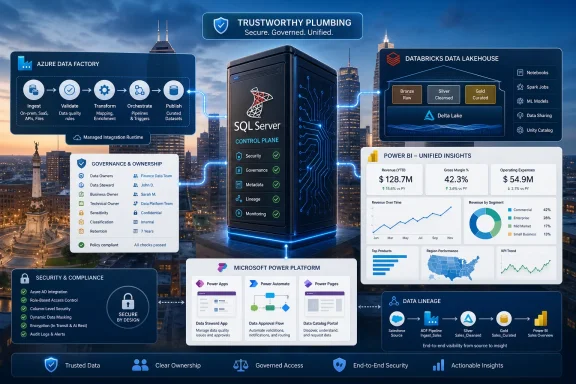
That is the opportunity Indy Data Partners is describing. The firm is positioning itself as a connective tissue provider across SQL Server database management, Azure Databricks processing, Azure Data Factory orchestration, Power BI reporting, and Power Platform workflow development. That is less flashy than launching a proprietary platform, but potentially more useful for mid-market and enterprise customers that already have Microsoft licenses and technical debt.
The key test for such a service model is not whether a consultant can deploy each tool. Many can. The test is whether the consultant can align data movement, transformation, governance, security, reporting, and support expectations so the environment behaves as a single operating model rather than a loose federation of Microsoft-branded projects.
SQL Server estates often contain the operational truth of the business. Orders, claims, invoices, inventory movements, customer records, scheduling data, and custom application state may all live in relational systems built long before the current analytics architecture was imagined. Treat those systems as disposable legacy plumbing, and modernization becomes fragile.
There is also a performance story here. Slow reports are often blamed on visualization tools, but the underlying causes may sit deeper: missing indexes, poor cardinality estimates, bloated tables, inefficient queries, parameter sniffing problems, outdated statistics, or under-provisioned storage. Pushing that data into a cloud analytics platform without fixing the source can simply move the bottleneck downstream.
A disciplined SQL Server practice can change the modernization conversation. Query tuning, migration planning, capacity management, backup validation, high-availability design, and proactive monitoring are not glamorous services, but they are the difference between a platform executives trust and one they quietly route around.
The same applies to migrations. Moving a database is not just a copy operation; it is a dependency exercise. Applications, linked servers, SQL Agent jobs, security models, reporting services, integrations, maintenance windows, and recovery objectives all have to be mapped. A botched migration can damage confidence in an entire cloud program.
By emphasizing “minimal disruption,” Indy Data Partners is acknowledging the real fear in the room. Organizations do not resist modernization only because they are conservative. They resist it because the systems being modernized are often the systems that keep revenue moving.
Azure Data Factory is commonly used to orchestrate data movement and transformation workflows. In practice, that means replacing or formalizing a world of scheduled scripts, manual exports, fragile file drops, and undocumented dependencies. ADF can bring order, but it also forces organizations to decide who owns pipelines, who approves schema changes, and who responds when a downstream report fails.
Azure Databricks brings a different set of tradeoffs. It is attractive for large-scale processing, advanced analytics, machine learning workloads, and lakehouse-style architectures. But it also introduces new design questions around cost control, cluster configuration, notebook governance, data lineage, and the boundary between data engineering and data science.
The press release presents these tools as part of a coordinated Microsoft data platform. That is the right ambition, but coordination is not automatic. Without careful architecture, companies can end up with SQL Server as the operational source, ADF as a scheduling layer, Databricks as a transformation layer, Power BI as a reporting layer, and no coherent answer to a simple executive question: which number is authoritative?
This is where consulting discipline matters. A modern data estate is not just a diagram of services; it is a chain of accountability. Every pipeline, model, and dashboard should have an owner, a refresh expectation, a failure path, and a defined relationship to source data. If those rules are absent, the platform becomes a faster way to distribute confusion.
For WindowsForum’s IT pro readership, this is the part worth watching closely. The Microsoft stack is powerful precisely because it spans so much territory, from the database engine to low-code workflow tools. But broad integration creates broad blast radius when design decisions are made casually.
That is why tying Power BI to database management and data pipeline work makes sense. Business intelligence is not simply the presentation layer at the end of the process. It is the place where choices made in schemas, transformations, definitions, access rules, and refresh schedules become tangible to users.
Many organizations underestimate this. They treat Power BI as a report-building tool rather than an operating discipline. The result is a proliferation of dashboards that answer similar questions differently, rely on undocumented transformations, or depend on a single analyst who knows which filters to apply.
Indy Data Partners’ broader service model implicitly recognizes that Power BI success depends on more than attractive visuals. It depends on trustworthy data models, consistent definitions, performant queries, and governance that does not crush self-service reporting under process overhead. That balance is difficult, and it is one of the central tensions in modern Microsoft data deployments.
Power Platform adds another wrinkle. Low-code apps and workflows can solve departmental problems quickly, but they can also create shadow integration paths if not governed properly. When Power Apps and Power Automate sit alongside SQL Server, Power BI, and Azure services, the architecture needs guardrails that let business teams move quickly without creating unsupportable systems.
The best version of this model gives users better tools without forcing every workflow through a traditional development queue. The worst version creates another layer of semi-official applications with unclear ownership. The difference is rarely the tool itself; it is the implementation discipline around it.
These are not necessarily cloud-native companies, but they are data-dependent companies. Many have significant Microsoft footprints, long-lived SQL Server deployments, and practical pressure to improve reporting, automation, forecasting, and compliance without tearing out core systems. They need modernization that respects operational continuity.
That creates an opening for regional consulting firms with deep platform specialization. National systems integrators can bring scale, but smaller firms can sometimes bring continuity, senior attention, and context. For organizations that cannot afford a sprawling transformation program, a focused Microsoft data partner may be a more realistic fit.
The veteran-owned element also gives the firm a distinct market identity, particularly in public-sector and supplier-diversity contexts. The announcement leans on discipline, accountability, and communication as cultural traits. Those claims are difficult to measure from the outside, but they map cleanly to the pain points of data modernization projects, where scope control and stakeholder coordination often determine outcomes.
Still, identity is not delivery. The market will judge Indy Data Partners less by its ownership status than by whether it can deliver measurable improvements: faster reports, more stable databases, fewer outages, cleaner migrations, better governed pipelines, and analytics users who trust the outputs.
That is the right standard. In data work, credibility compounds slowly and evaporates quickly.
For customers, that promise is attractive but complicated. Connecting SQL Server to Fabric or Azure services can reduce friction, but it also raises questions about licensing, network design, identity, monitoring, compliance, and operational ownership. The easier Microsoft makes cross-service integration, the more important architecture decisions become.
This is the paradox of platform maturity. As tools become more capable, the hard problems move up a layer. It is no longer enough to ask whether data can be copied, mirrored, transformed, or visualized. The real questions are whether the process is governed, cost-aware, secure, observable, and understandable by the people who must support it at 2 a.m.
Consulting firms that position themselves around the full Microsoft data stack are responding to that shift. Customers do not need a separate strategy for every service. They need a coherent operating model for how data enters, moves through, and leaves the Microsoft ecosystem.
There is also an AI subtext here, even though the announcement is not framed primarily as an AI story. Organizations chasing analytics modernization today are increasingly doing so because they want future AI capabilities to have something reliable to stand on. Poorly governed data pipelines and inconsistent reporting definitions do not become less dangerous when a copilot is placed on top of them.
If anything, AI raises the stakes for boring data work. A hallucinated answer is bad; a confidently generated answer based on broken enterprise data may be worse.
A performance issue may appear in a dashboard but originate in a query plan. A reporting inconsistency may appear in Power BI but originate in a transformation rule. A migration risk may appear in Azure planning but originate in undocumented SQL Agent jobs. A governance failure may appear in a low-code workflow but originate in unclear data ownership.
That is why “single coordinated delivery model” is the phrase doing the heavy lifting in the announcement. The value proposition is not that Indy Data Partners knows a list of Microsoft products. It is that the firm claims to connect those products into a managed data path from source systems to business decisions.
For administrators, that promise should be evaluated practically. Does the partner document dependencies? Does it define rollback plans? Does it leave behind monitoring that internal teams can understand? Does it rationalize security and identity rather than creating special-case access? Does it reduce operational burden, or merely relocate it?
For business leaders, the question is different but related. Does the work improve decision quality? Are reports faster and more trusted? Can teams answer questions without waiting weeks for manual data pulls? Are data definitions becoming more consistent across departments?
The strongest data consultancies bridge those worlds. They can talk about query plans and executive metrics in the same engagement without losing the plot.
Many organizations are too complex for pure DIY but too pragmatic for a massive transformation program. They need help with specific databases, migrations, reporting environments, and pipeline architectures. They may not want a five-year roadmap; they may want a three-month stabilization effort that makes the next phase possible.
That is a meaningful segment. It is also a demanding one. Mid-sized customers often expect consultants to be strategic and hands-on, to advise on architecture and write the scripts, to manage stakeholders and tune the queries. The margin for vague thought leadership is low.
This is where a SQL Server-centered background can be an advantage. Database professionals are trained to think in dependencies, recovery, performance, and correctness. Those instincts translate well into cloud data work when paired with modern platform knowledge.
They also provide a useful counterweight to tool-first modernization. A consultant who begins with the database is more likely to ask what the data means, how it changes, who owns it, and what failure looks like. Those questions are less exciting than a demo, but they are usually more important.
But it does require clear-eyed governance. Azure Data Factory, Azure Databricks, Power BI, Power Platform, Fabric-adjacent services, SQL Server, and Azure SQL all come with licensing, cost, and architectural implications. A unified stack can become a unified bill, and a poorly governed one can become expensive quickly.
Consulting partners should help customers understand those tradeoffs rather than smoothing them over. There are cases where Microsoft-native integration is the right answer. There are also cases where open formats, multi-cloud patterns, or vendor-neutral data modeling deserve serious consideration.
For many Windows-centric organizations, the practical path will still run through Microsoft. The installed base, skills availability, identity integration, and executive familiarity are powerful advantages. But the goal should be intentional standardization, not accidental dependency.
Indy Data Partners’ success in this expanded service line will depend partly on how honestly it navigates that tension. A trusted partner does not merely implement the stack a vendor wants to sell. It helps the customer understand where the stack fits, where it does not, and what operational commitments come with it.
That is especially important as data platforms become tied to AI initiatives. Once analytics, automation, and AI assistants depend on the same data architecture, mistakes in design and governance become harder to unwind.
The future of enterprise data is not arriving as a clean migration from old systems to new platforms. It is arriving as a long negotiation between SQL Server estates, cloud services, low-code tools, business intelligence demands, and governance requirements. Firms like Indy Data Partners are trying to commercialize that negotiation.
The strongest reading of the announcement is that the market is maturing. Customers are no longer satisfied with isolated report-building, one-off migrations, or tool deployments that leave the operating model untouched. They want partners that can connect the database foundation to the analytics surface and make the whole thing supportable.
The weaker reading is that every Microsoft data consultancy now has to claim full-stack integration because that is where the market language has moved. The difference between those two readings will show up in delivery. If projects reduce downtime, improve reporting trust, and make data movement more transparent, the model has substance. If they produce another layer of diagrams and disconnected workloads, it is just platform sprawl with better branding.
For IT pros, the practical lesson is to interrogate the seams. Ask how SQL Server performance work connects to pipeline design. Ask how Power BI semantic models are governed. Ask how Power Platform workflows are documented and secured. Ask who owns failures when a report, pipeline, or database job breaks.
Those seams are where modernization succeeds or fails.
 The Data Modernization Story Still Starts in the Server Room
The fashionable version of enterprise modernization begins with dashboards, copilots, lakehouses, and generative AI pilots. The operational version begins with a slower and less photogenic inventory: SQL Server instances with unknown owners, long-running stored procedures nobody wants to touch, brittle reporting jobs, and Excel workbooks that have quietly become business-critical systems.That is the environment Indy Data Partners is speaking to with its expanded service offering. The company’s announcement frames SQL Server management not as a legacy sideline but as the foundation for a broader Microsoft data architecture. That framing is important because most organizations do not get to choose between “old SQL” and “modern cloud” as cleanly as vendor diagrams imply.
SQL Server remains embedded in line-of-business applications, finance systems, logistics workflows, healthcare platforms, and custom applications built over many years. A company can adopt Power BI, Azure Data Factory, or Azure Databricks, but if the source systems are poorly indexed, inconsistently governed, or badly documented, the new analytics layer inherits the old dysfunction.
This is the part of digital transformation that rarely makes a keynote. Before an organization can build reliable intelligence from its data, it has to make the data estate observable, stable, and governable. Consulting firms that understand that sequence have a more realistic proposition than firms selling cloud migration as a single jump cut.
Indy Data Partners’ pitch therefore lands in a practical market niche. It is not promising to replace the database administrator with a wizardly abstraction layer. It is arguing that the database layer, the integration layer, and the reporting layer should be treated as one system of delivery.
Microsoft’s Stack Is Converging, but Customers Are Still Fragmented
Microsoft has spent the past several years pulling its data story toward a unified estate. SQL Server, Azure SQL, Microsoft Fabric, Power BI, Azure Databricks integrations, Azure Arc, and the Power Platform are increasingly presented as parts of a connected operational and analytical fabric. The company’s direction is clear: keep enterprise data inside the Microsoft gravitational field, whether it lives on-premises, in Azure, or in SaaS-native services.But the customer side of that equation is messier. Many IT departments accumulated Microsoft data tooling in layers rather than as a single architecture. SQL Server may have arrived with an ERP deployment. Power BI may have entered through finance or operations teams. Power Platform may have grown through departmental automation. Azure Data Factory may have been adopted later to replace hand-built ETL jobs or file-based transfers.
The result is often a stack that is technically Microsoft end to end, but organizationally fragmented. Different teams own the databases, pipelines, semantic models, reports, automations, and applications. Each tool may be defensible in isolation, while the overall system becomes difficult to reason about.
That is the opportunity Indy Data Partners is describing. The firm is positioning itself as a connective tissue provider across SQL Server database management, Azure Databricks processing, Azure Data Factory orchestration, Power BI reporting, and Power Platform workflow development. That is less flashy than launching a proprietary platform, but potentially more useful for mid-market and enterprise customers that already have Microsoft licenses and technical debt.
The key test for such a service model is not whether a consultant can deploy each tool. Many can. The test is whether the consultant can align data movement, transformation, governance, security, reporting, and support expectations so the environment behaves as a single operating model rather than a loose federation of Microsoft-branded projects.
SQL Server Is Not the Past; It Is the Control Plane for the Present
The most interesting part of the announcement is its refusal to treat SQL Server as merely a migration source. Indy Data Partners is putting SQL Server optimization and management at the center of the service expansion, which reflects how many organizations actually run.SQL Server estates often contain the operational truth of the business. Orders, claims, invoices, inventory movements, customer records, scheduling data, and custom application state may all live in relational systems built long before the current analytics architecture was imagined. Treat those systems as disposable legacy plumbing, and modernization becomes fragile.
There is also a performance story here. Slow reports are often blamed on visualization tools, but the underlying causes may sit deeper: missing indexes, poor cardinality estimates, bloated tables, inefficient queries, parameter sniffing problems, outdated statistics, or under-provisioned storage. Pushing that data into a cloud analytics platform without fixing the source can simply move the bottleneck downstream.
A disciplined SQL Server practice can change the modernization conversation. Query tuning, migration planning, capacity management, backup validation, high-availability design, and proactive monitoring are not glamorous services, but they are the difference between a platform executives trust and one they quietly route around.
The same applies to migrations. Moving a database is not just a copy operation; it is a dependency exercise. Applications, linked servers, SQL Agent jobs, security models, reporting services, integrations, maintenance windows, and recovery objectives all have to be mapped. A botched migration can damage confidence in an entire cloud program.
By emphasizing “minimal disruption,” Indy Data Partners is acknowledging the real fear in the room. Organizations do not resist modernization only because they are conservative. They resist it because the systems being modernized are often the systems that keep revenue moving.
Azure Data Factory and Databricks Are Where the Architecture Becomes Political
Once SQL Server is treated as a reliable source rather than a neglected archive, the next question is how data moves. This is where tools such as Azure Data Factory and Azure Databricks enter the story, and where many projects become as much about governance as engineering.Azure Data Factory is commonly used to orchestrate data movement and transformation workflows. In practice, that means replacing or formalizing a world of scheduled scripts, manual exports, fragile file drops, and undocumented dependencies. ADF can bring order, but it also forces organizations to decide who owns pipelines, who approves schema changes, and who responds when a downstream report fails.
Azure Databricks brings a different set of tradeoffs. It is attractive for large-scale processing, advanced analytics, machine learning workloads, and lakehouse-style architectures. But it also introduces new design questions around cost control, cluster configuration, notebook governance, data lineage, and the boundary between data engineering and data science.
The press release presents these tools as part of a coordinated Microsoft data platform. That is the right ambition, but coordination is not automatic. Without careful architecture, companies can end up with SQL Server as the operational source, ADF as a scheduling layer, Databricks as a transformation layer, Power BI as a reporting layer, and no coherent answer to a simple executive question: which number is authoritative?
This is where consulting discipline matters. A modern data estate is not just a diagram of services; it is a chain of accountability. Every pipeline, model, and dashboard should have an owner, a refresh expectation, a failure path, and a defined relationship to source data. If those rules are absent, the platform becomes a faster way to distribute confusion.
For WindowsForum’s IT pro readership, this is the part worth watching closely. The Microsoft stack is powerful precisely because it spans so much territory, from the database engine to low-code workflow tools. But broad integration creates broad blast radius when design decisions are made casually.
Power BI Turns Data Debt Into a Meeting-Room Problem
Power BI is often where technical debt becomes visible to business leadership. A slow database may be tolerated by IT. A broken pipeline may be understood by engineers. But a dashboard with conflicting revenue numbers becomes a boardroom problem.That is why tying Power BI to database management and data pipeline work makes sense. Business intelligence is not simply the presentation layer at the end of the process. It is the place where choices made in schemas, transformations, definitions, access rules, and refresh schedules become tangible to users.
Many organizations underestimate this. They treat Power BI as a report-building tool rather than an operating discipline. The result is a proliferation of dashboards that answer similar questions differently, rely on undocumented transformations, or depend on a single analyst who knows which filters to apply.
Indy Data Partners’ broader service model implicitly recognizes that Power BI success depends on more than attractive visuals. It depends on trustworthy data models, consistent definitions, performant queries, and governance that does not crush self-service reporting under process overhead. That balance is difficult, and it is one of the central tensions in modern Microsoft data deployments.
Power Platform adds another wrinkle. Low-code apps and workflows can solve departmental problems quickly, but they can also create shadow integration paths if not governed properly. When Power Apps and Power Automate sit alongside SQL Server, Power BI, and Azure services, the architecture needs guardrails that let business teams move quickly without creating unsupportable systems.
The best version of this model gives users better tools without forcing every workflow through a traditional development queue. The worst version creates another layer of semi-official applications with unclear ownership. The difference is rarely the tool itself; it is the implementation discipline around it.
The Midwest Angle Is Less Parochial Than It Looks
Indy Data Partners’ Indianapolis base is more than a biographical detail. The Midwest has a dense population of manufacturers, logistics firms, healthcare organizations, insurers, distributors, universities, public-sector agencies, and professional services companies with exactly the kind of mixed data estates this announcement targets.These are not necessarily cloud-native companies, but they are data-dependent companies. Many have significant Microsoft footprints, long-lived SQL Server deployments, and practical pressure to improve reporting, automation, forecasting, and compliance without tearing out core systems. They need modernization that respects operational continuity.
That creates an opening for regional consulting firms with deep platform specialization. National systems integrators can bring scale, but smaller firms can sometimes bring continuity, senior attention, and context. For organizations that cannot afford a sprawling transformation program, a focused Microsoft data partner may be a more realistic fit.
The veteran-owned element also gives the firm a distinct market identity, particularly in public-sector and supplier-diversity contexts. The announcement leans on discipline, accountability, and communication as cultural traits. Those claims are difficult to measure from the outside, but they map cleanly to the pain points of data modernization projects, where scope control and stakeholder coordination often determine outcomes.
Still, identity is not delivery. The market will judge Indy Data Partners less by its ownership status than by whether it can deliver measurable improvements: faster reports, more stable databases, fewer outages, cleaner migrations, better governed pipelines, and analytics users who trust the outputs.
That is the right standard. In data work, credibility compounds slowly and evaporates quickly.
The Timing Fits Microsoft’s Bigger Push Toward a Unified Data Estate
The announcement arrives as Microsoft’s own data strategy is becoming more integrated and more ambitious. SQL Server 2025, Azure Arc-enabled management, Fabric mirroring, Power BI, and the broader Fabric ecosystem all point toward a world in which Microsoft wants organizations to manage operational and analytical data as a connected estate.For customers, that promise is attractive but complicated. Connecting SQL Server to Fabric or Azure services can reduce friction, but it also raises questions about licensing, network design, identity, monitoring, compliance, and operational ownership. The easier Microsoft makes cross-service integration, the more important architecture decisions become.
This is the paradox of platform maturity. As tools become more capable, the hard problems move up a layer. It is no longer enough to ask whether data can be copied, mirrored, transformed, or visualized. The real questions are whether the process is governed, cost-aware, secure, observable, and understandable by the people who must support it at 2 a.m.
Consulting firms that position themselves around the full Microsoft data stack are responding to that shift. Customers do not need a separate strategy for every service. They need a coherent operating model for how data enters, moves through, and leaves the Microsoft ecosystem.
There is also an AI subtext here, even though the announcement is not framed primarily as an AI story. Organizations chasing analytics modernization today are increasingly doing so because they want future AI capabilities to have something reliable to stand on. Poorly governed data pipelines and inconsistent reporting definitions do not become less dangerous when a copilot is placed on top of them.
If anything, AI raises the stakes for boring data work. A hallucinated answer is bad; a confidently generated answer based on broken enterprise data may be worse.
The Real Product Is Trustworthy Plumbing
The danger in any services announcement is that it can sound like a catalog. SQL Server, Azure Databricks, Power BI, Power Platform, Azure Data Factory: the names are familiar enough that readers may skim past them. But the combination matters because enterprise data problems are rarely confined to one layer.A performance issue may appear in a dashboard but originate in a query plan. A reporting inconsistency may appear in Power BI but originate in a transformation rule. A migration risk may appear in Azure planning but originate in undocumented SQL Agent jobs. A governance failure may appear in a low-code workflow but originate in unclear data ownership.
That is why “single coordinated delivery model” is the phrase doing the heavy lifting in the announcement. The value proposition is not that Indy Data Partners knows a list of Microsoft products. It is that the firm claims to connect those products into a managed data path from source systems to business decisions.
For administrators, that promise should be evaluated practically. Does the partner document dependencies? Does it define rollback plans? Does it leave behind monitoring that internal teams can understand? Does it rationalize security and identity rather than creating special-case access? Does it reduce operational burden, or merely relocate it?
For business leaders, the question is different but related. Does the work improve decision quality? Are reports faster and more trusted? Can teams answer questions without waiting weeks for manual data pulls? Are data definitions becoming more consistent across departments?
The strongest data consultancies bridge those worlds. They can talk about query plans and executive metrics in the same engagement without losing the plot.
Smaller Specialists Are Filling the Gap Between DIY and Mega-Integrator
The market for data modernization is crowded. Global consultancies, cloud-native specialists, managed service providers, software vendors, and independent contractors all compete for pieces of the same budget. Indy Data Partners’ announcement highlights the role of a smaller specialist in that landscape.Many organizations are too complex for pure DIY but too pragmatic for a massive transformation program. They need help with specific databases, migrations, reporting environments, and pipeline architectures. They may not want a five-year roadmap; they may want a three-month stabilization effort that makes the next phase possible.
That is a meaningful segment. It is also a demanding one. Mid-sized customers often expect consultants to be strategic and hands-on, to advise on architecture and write the scripts, to manage stakeholders and tune the queries. The margin for vague thought leadership is low.
This is where a SQL Server-centered background can be an advantage. Database professionals are trained to think in dependencies, recovery, performance, and correctness. Those instincts translate well into cloud data work when paired with modern platform knowledge.
They also provide a useful counterweight to tool-first modernization. A consultant who begins with the database is more likely to ask what the data means, how it changes, who owns it, and what failure looks like. Those questions are less exciting than a demo, but they are usually more important.
The Catch Is That Integration Can Become Lock-In by Another Name
There is a strategic risk in the Microsoft data stack’s appeal: the more integrated it becomes, the more customers may find themselves optimized for one vendor’s worldview. That is not inherently bad. Standardizing on Microsoft can reduce training overhead, simplify identity integration, and align with existing enterprise agreements.But it does require clear-eyed governance. Azure Data Factory, Azure Databricks, Power BI, Power Platform, Fabric-adjacent services, SQL Server, and Azure SQL all come with licensing, cost, and architectural implications. A unified stack can become a unified bill, and a poorly governed one can become expensive quickly.
Consulting partners should help customers understand those tradeoffs rather than smoothing them over. There are cases where Microsoft-native integration is the right answer. There are also cases where open formats, multi-cloud patterns, or vendor-neutral data modeling deserve serious consideration.
For many Windows-centric organizations, the practical path will still run through Microsoft. The installed base, skills availability, identity integration, and executive familiarity are powerful advantages. But the goal should be intentional standardization, not accidental dependency.
Indy Data Partners’ success in this expanded service line will depend partly on how honestly it navigates that tension. A trusted partner does not merely implement the stack a vendor wants to sell. It helps the customer understand where the stack fits, where it does not, and what operational commitments come with it.
That is especially important as data platforms become tied to AI initiatives. Once analytics, automation, and AI assistants depend on the same data architecture, mistakes in design and governance become harder to unwind.
The Indianapolis Announcement Says More Than It Seems
This is not the sort of announcement that will dominate the enterprise software news cycle. There is no new database engine, no acquisition, no billion-dollar cloud commitment, and no AI model benchmark. But it is a useful signal of where the Windows and Microsoft ecosystem is heading in practice.The future of enterprise data is not arriving as a clean migration from old systems to new platforms. It is arriving as a long negotiation between SQL Server estates, cloud services, low-code tools, business intelligence demands, and governance requirements. Firms like Indy Data Partners are trying to commercialize that negotiation.
The strongest reading of the announcement is that the market is maturing. Customers are no longer satisfied with isolated report-building, one-off migrations, or tool deployments that leave the operating model untouched. They want partners that can connect the database foundation to the analytics surface and make the whole thing supportable.
The weaker reading is that every Microsoft data consultancy now has to claim full-stack integration because that is where the market language has moved. The difference between those two readings will show up in delivery. If projects reduce downtime, improve reporting trust, and make data movement more transparent, the model has substance. If they produce another layer of diagrams and disconnected workloads, it is just platform sprawl with better branding.
For IT pros, the practical lesson is to interrogate the seams. Ask how SQL Server performance work connects to pipeline design. Ask how Power BI semantic models are governed. Ask how Power Platform workflows are documented and secured. Ask who owns failures when a report, pipeline, or database job breaks.
Those seams are where modernization succeeds or fails.
What This Expansion Really Changes for Microsoft-Centric Shops
The immediate news is a service expansion by an Indianapolis consulting firm, but the useful lesson is broader: Microsoft data modernization is becoming a full-stack operations problem rather than a sequence of isolated technology projects. Organizations considering a similar path should read the announcement less as a vendor profile and more as a checklist of where their own data estate may be under-managed.- Indy Data Partners is expanding around SQL Server management, Azure Databricks, Power BI, Power Platform, and Azure Data Factory rather than presenting cloud analytics as a replacement for database fundamentals.
- The firm’s emphasis on SQL Server optimization reflects the reality that many modern analytics programs still depend on aging operational databases.
- The integrated service model targets a common enterprise failure mode in which databases, pipelines, reports, and automations are owned by different teams with inconsistent accountability.
- Microsoft’s broader platform direction makes this kind of consulting more relevant, because services such as Fabric, Azure Arc, Power BI, and Azure data tools increasingly assume a connected data estate.
- The main risk for customers is not adopting Microsoft’s stack; it is adopting it without clear governance, cost controls, ownership, and support models.
- The announcement is most significant for organizations that need pragmatic modernization of existing systems, not a greenfield reinvention of their data architecture.
References
- Primary source: mykxlg.com
Published: Sun, 28 Jun 2026 16:10:00 GMT
Veteran-Owned Firm Delivers SQL Server and Azure Data Services
Indianapolis IT Firm Offers SQL Server Management and Microsoft Data Stack Integration Indianapolis, United States -www.mykxlg.com - Related coverage: craft.co
Indy Data Partners Company Profile - Office Locations, Competitors, Revenue, Financials, Employees, Key People, Subsidiaries | Craft.co
Indy Data Partners has 5 employees at their 1 location. See insights on Indy Data Partners including office locations, competitors, revenue, financials, executives, subsidiaries and more at Craft.craft.co - Related coverage: govtribe.com
- Related coverage: vslive.com
SQL MCP Server: Bringing AI Agents to Your SQL Data -- Visual Studio Live!: Training Conferences and Events for Enterprise Microsoft .NET and Azure Developers
SQL MCP Server: Bringing AI Agents to Your SQL Datavslive.com - Official source: microsoft.com
Advancing agentic AI with Microsoft databases across a unified data estate - Microsoft SQL Server Blog
Find out how you can achieve better price performance, elastic scale, and resilience for all workloads with Azure SQL Database Hyperscale.www.microsoft.com - Related coverage: compworth.com

- Related coverage: signalhire.com
Indy Data Partners Information | SignalHire Company Profile
Indy Data Partners is a private company. The company currently specializes in the Information Technology and Services area. Its headquarters is located at Indianapolis, Indiana, USAwww.signalhire.com - Related coverage: bbb.org
Indy Data Partners, Inc. | BBB Business Profile | Better Business Bureau
Not BBB Accredited. Computer Consultants in Indianapolis, IN. See BBB rating, reviews, complaints, and more.www.bbb.org
- Related coverage: manta.com

Indy Data Partners Indianapolis IN, 46216 – Manta.com
Get information, directions, products, services, phone numbers, and reviews on Indy Data Partners in Indianapolis, IN. Discover more Computer Maintenance and Repair companies in Indianapolis on Manta.com
www.manta.com
