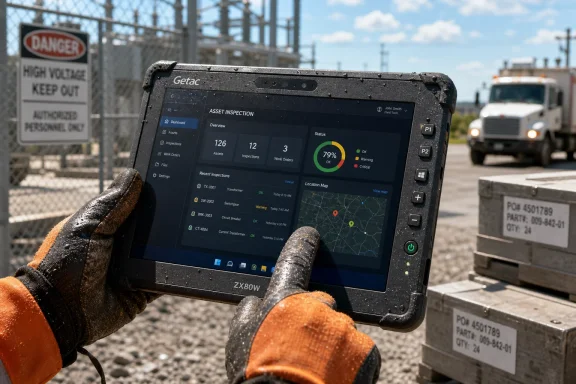
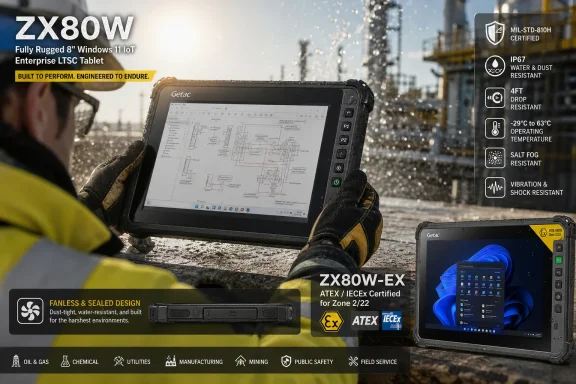
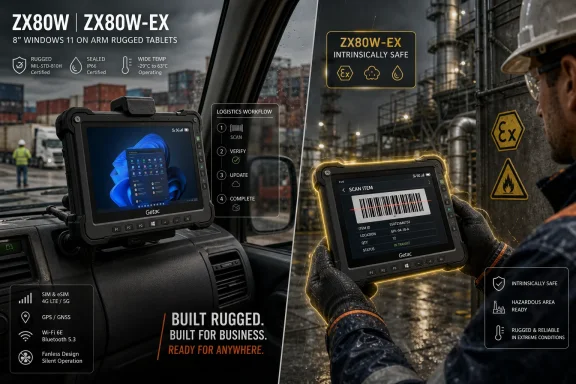
Getac announced on June 3, 2026, that its ZX80 family of 8-inch fully rugged tablets is expanding with the Windows 11-powered ZX80W and hazardous-location ZX80W-EX, both built around Qualcomm’s QCS6490 Arm platform and scheduled for availability in July 2026. The important part is not merely that another rugged tablet has arrived; it is that Windows on Arm is moving deeper into field computing, where battery life, thermals, certification, and fleet management matter more than benchmark theater. Getac is betting that enterprise Windows can finally live comfortably in the kind of compact, fanless hardware that used to push buyers toward Android. For sysadmins and operations teams, that makes this launch less a gadget story than a test of whether Arm-based Windows has become boring enough to deploy.
For years, Windows on Arm has been discussed mostly through the lens of consumer laptops, developer kits, and Microsoft’s long campaign to make thin-and-light PCs behave more like phones. That framing misses one of the more practical places where Arm can matter: field devices that must run all day, survive abuse, avoid fans, and still remain manageable inside a Microsoft-centric enterprise.
Getac’s ZX80W and ZX80W-EX land squarely in that category. They are not trying to replace a workstation or a high-end mobile CAD rig. They are designed for people who scan assets, inspect infrastructure, manage logistics, coordinate field crews, interact with industrial systems, and work in places where a dropped tablet is a routine event rather than a support ticket anomaly.
The choice of Windows 11 IoT Enterprise LTSC is the signal. This is not a retail Windows tablet chasing the iPad. It is a fixed-purpose, enterprise-oriented Windows endpoint meant to sit inside a managed fleet, run line-of-business applications, and remain stable over long service periods.
That matters because rugged computing has always been less glamorous and more consequential than the consumer PC market admits. A warehouse tablet that fails halfway through a shift can slow an operation. A utility tablet that overheats on a job site can delay maintenance. A hazardous-location device that lacks the right certification simply cannot be used where the work actually happens.
Both tablets are 8-inch devices, which is an increasingly important size in field computing. A 10- or 12-inch rugged tablet can be more comfortable for forms, maps, and dashboards, but it can also be too heavy or awkward for workers who are climbing, driving, checking equipment, or carrying other tools. An 8-inch unit is closer to the sweet spot for one-handed work, especially when it is paired with vehicle docks, straps, barcode scanners, or workflow-specific accessories.
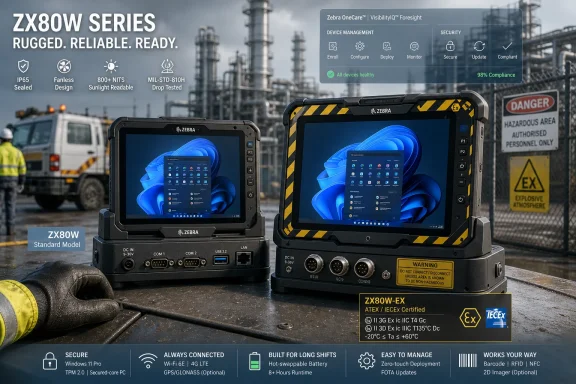
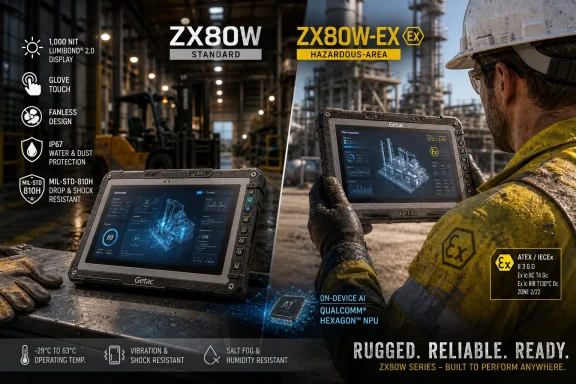
The headline specifications are practical rather than theatrical. Both devices use Qualcomm’s QCS6490 platform, include 12GB of LPDDR5 memory, and provide 256GB of UFS storage. The design is fanless, which is not just a comfort feature; fewer moving parts and fewer openings are useful in dusty, wet, dirty, or chemically sensitive environments.
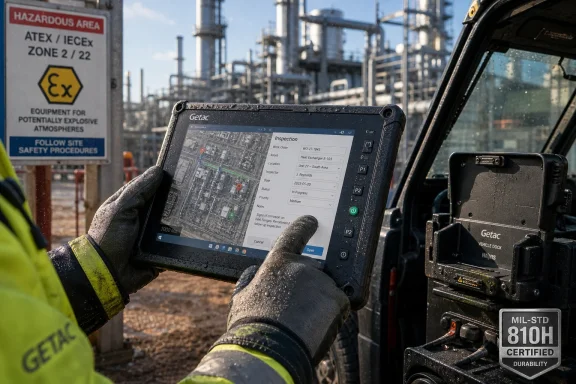
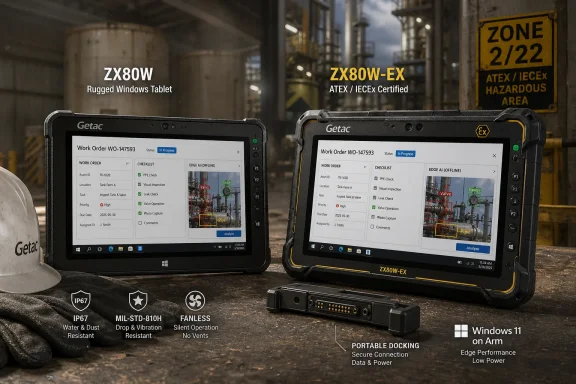
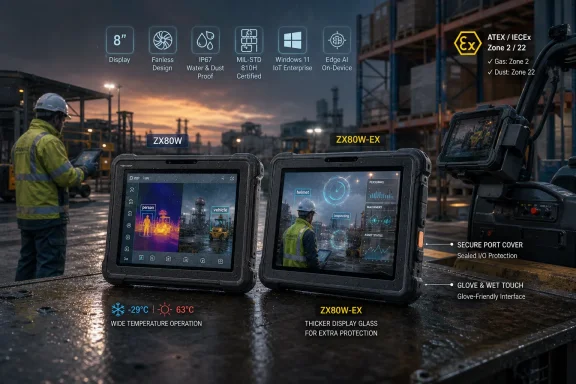
The ZX80W-EX is the more specialized model. Its ATEX and IECEx Zone 2/22 certification targets hazardous or potentially explosive environments, which is the difference between a device that looks rugged and one that can be approved for certain industrial sites. Getac also calls out thicker display glass, reinforced rear protection, a secure port cover for the main docking connector, and seals on exposed screw covers.
Windows has been the compatibility answer. Android has often been the battery-life and mobility answer. x86 chips have been the safer bet for application support. Arm chips have been the more attractive bet for thermals and efficiency. Rugged-device buyers have lived in the space between those poles.
Getac is now arguing that the old trade-off is weakening. If Windows 11 IoT Enterprise LTSC on Arm can run the needed software stack, then an 8-inch fanless Windows tablet becomes much easier to justify. It can slot into existing Microsoft management practices while behaving more like the mobile device field workers already expect.
That is the theory. The deployment reality will depend on application compatibility, driver support, peripheral support, and how much of an organization’s field software estate is still tied to x86 assumptions. Windows on Arm has improved considerably, but rugged deployments are often allergic to surprises. A niche USB peripheral, a decades-old inspection app, or an unsigned driver can matter more than the operating system’s marketing page.
This is why the ZX80W is interesting but not magical. It may be a better answer for many organizations, but it still asks IT departments to do the unglamorous work of validation. The hardware story is convincing only if the software story survives the pilot.
Windows 11 IoT Enterprise LTSC exists for a different rhythm. It is aimed at dedicated systems where stability and lifecycle predictability are more valuable than receiving every consumer-facing feature. For devices used in vehicles, plants, depots, utilities, emergency services, and manufacturing floors, that distinction is not academic.
Getac’s use of LTSC helps explain why this tablet is plausibly a Windows device rather than just a Windows-branded mobile experiment. Enterprise buyers want security updates, management consistency, and application support, but they do not necessarily want feature churn in the middle of a multi-year field deployment. A rugged tablet may remain in service long after a consumer laptop has been replaced twice.
The WindowsForum audience will recognize the tension here. Enthusiasts often talk about LTSC as a cleaner, calmer version of Windows. In the enterprise and IoT world, the point is narrower: LTSC is about keeping fixed-purpose systems fixed-purpose. The less often a field device changes behavior unexpectedly, the fewer times IT has to explain to operations why a familiar workflow now looks different.
The efficiency argument is straightforward. A fanless sealed tablet benefits from a chip that can deliver acceptable performance without dumping too much heat into a small chassis. In the field, performance-per-watt can matter more than peak performance, because a fast device that throttles, dies early, or gets too hot to hold is not actually faster in operational terms.
The platform’s support for Windows 11 IoT Enterprise also matters because this is no longer an exotic science project. Microsoft and Qualcomm have spent years broadening Windows on Arm beyond the early Surface Pro X era, and industrial hardware is one of the places where the payoff may be easier to see. The more standardized the silicon and OS support become, the less scary these deployments look to conservative IT teams.
That said, “AI-ready” should be treated carefully. The presence of a Qualcomm Hexagon NPU and a sixth-generation Qualcomm AI Engine means the hardware has local acceleration for certain workloads. It does not mean every field application will suddenly become intelligent, offline, and automated. The software has to be written, tested, secured, and integrated before the NPU becomes more than a line item.
Field workers often operate where connectivity is unreliable, expensive, congested, or restricted. A utility crew inspecting infrastructure, a logistics worker moving through a yard, or a technician operating near industrial equipment may not have a stable connection at the moment the software needs to make a decision. In that context, local inference is not a novelty; it is a way to keep the workflow moving.
The more credible use cases are narrow and operational. Image recognition for inspections, anomaly detection for assets, local processing for sensors, assisted data capture, and workflow automation are all plausible fits. Getac’s examples, including utility UAV control, predictive asset management, hazardous-environment work, and electronic logging in transport, fit the pattern.
The catch is that edge AI is only as useful as the process around it. A model running locally can reduce latency and cloud dependency, but it also introduces questions about model updates, auditability, data retention, false positives, and user training. For regulated or safety-sensitive work, the device’s AI capability must be treated as part of the system, not a decorative accelerator.
That changes the buying logic. A standard rugged tablet competes on durability, ergonomics, battery life, screen quality, accessories, and total cost of ownership. A hazardous-location device competes first on whether it is allowed onto the site. Certification can be the gating factor before anyone debates software performance.
Getac’s additional design details for the EX model are therefore not cosmetic. Thicker display glass, reinforced covers, secured connectors, and sealed screw areas all speak to the practical realities of intrinsically safer hardware. These are not features that excite consumers, but they are the kinds of details that safety officers, industrial buyers, and field operations teams care about.
The EX model also highlights why Windows remains sticky in industrial environments. Many hazardous-location workflows are tied to existing enterprise systems, reporting tools, inspection databases, identity infrastructure, and device-management policies. If a certified tablet can provide those Windows workflows in a smaller, lighter, more efficient design, that becomes a procurement argument with real force.
Android has been strong in rugged handhelds and compact tablets because it is efficient, touch-first, familiar to mobile users, and supported by a large ecosystem of scanning, logistics, and field-service applications. But Android can be awkward for organizations whose backend workflows, authentication, endpoint management, or legacy applications are Windows-first. Every Android deployment in a Windows-heavy enterprise can become an integration project.
Windows, by contrast, brings Group Policy heritage, Microsoft identity integration, familiar security tooling, and a vast legacy application base. It also brings baggage: resource expectations, update management, app compatibility complexity, and a user interface that was not born in a warehouse aisle. Windows on Arm is an attempt to preserve the former while reducing some of the latter.
The ZX80W therefore sits in an interesting middle ground. It is not trying to make Windows fashionable. It is trying to make Windows small, sealed, efficient, and manageable enough that organizations do not have to choose Android simply to get mobility.
For a device like the ZX80W, the question is not whether Windows on Arm can run Windows apps in general. The question is whether it can run your Windows apps, with your peripherals, inside your security stack, over your network, for your workers, in the conditions where your organization actually operates. That is the difference between a promising specification sheet and a successful deployment.
This is where IT departments should be both open-minded and stubborn. Open-minded because Arm-based Windows devices may now solve problems that x86 rugged tablets solved clumsily. Stubborn because every driver, agent, and workflow needs testing before procurement signs a large order.
The good news is that rugged deployments already tend to involve pilots, accessory validation, imaging decisions, device-management planning, and environmental testing. The bad news is that Arm adds another axis to the checklist. The organizations most likely to succeed with this class of device are the ones that treat architecture as a deployment variable, not an afterthought.
For Windows shops, the attraction is obvious. A Windows 11 IoT Enterprise LTSC tablet can fit into familiar management models more naturally than an Android alternative, depending on the organization’s tooling. Identity, policy, patching, application distribution, encryption, and remote assistance can all be aligned with existing Microsoft-oriented practices.
But fleets are unforgiving. A small driver problem multiplied across hundreds of devices becomes a major operational nuisance. A battery-runtime assumption that works in a lab but fails on a winter shift becomes a labor issue. A display that is readable in marketing photos but marginal in direct sunlight becomes a productivity problem.
Getac’s rugged credentials reduce some of that risk, but they do not remove it. Ruggedness is not a single property; it is a system of design choices tested against specific standards and real-world abuse. Buyers should still evaluate docks, gloves, wet touch behavior, stylus needs, charging logistics, cleaning procedures, and repair turnaround.
Getac is taking advantage of that shift. The ZX80W does not need to convince users that Arm is the future of all Windows computing. It only needs to convince field operations teams that Arm is good enough, efficient enough, and compatible enough for a specific class of rugged Windows endpoint.
That is a lower bar and a more useful one. The history of enterprise computing is full of technologies that failed as universal revolutions but succeeded as targeted tools. Windows on Arm may be most persuasive where the constraints are sharpest: battery life, thermals, sealing, weight, and long-term manageability.
The July 2026 availability window also gives buyers a near-term planning target. Organizations refreshing rugged fleets in the second half of 2026 will have another option to evaluate, particularly if they have been stuck between bulky x86 Windows tablets and Android devices that do not quite fit their enterprise stack.
The ZX80W is not a mass-market Windows moment. Most consumers will never see one. But platform health is not only measured by consumer excitement. It is also measured by whether hardware makers can take Windows into specialized markets without fighting the OS at every step.
For Microsoft, Windows 11 IoT Enterprise LTSC on Qualcomm silicon gives OEMs a way to build sealed, efficient, long-lived devices that still belong to the Windows family. That helps preserve Windows’ relevance in places where the operating system might otherwise be replaced by Android, Linux, or proprietary embedded platforms.
For Qualcomm, the launch is another proof point that its IoT silicon can move beyond development kits and reference designs into certified, operationally serious hardware. The company has spent years positioning its platforms for the intelligent edge. Rugged Windows tablets give that positioning a practical face.
A disciplined buyer will ask whether the target workflow is browser-based, UWP, native Arm64, emulated x86, peripheral-heavy, or driver-dependent. They will ask whether field workers need offline maps, barcode scanning, smart-card authentication, VPN access, serial connectivity, camera workflows, or real-time sensor processing. They will ask whether the same device image can serve multiple teams or whether the hardware will fragment the support model.
They will also ask whether the benefits are operationally measurable. Does the fanless design reduce failure points? Does the weight difference reduce fatigue? Does battery life cover a full shift with realistic screen brightness and radios active? Does local AI processing reduce manual work, or is it a feature waiting for a future software project?
That is the right kind of skepticism. Rugged hardware is expensive because failure is expensive. If Arm-based Windows reduces failure, runtime anxiety, and device weight without breaking compatibility, it earns its place. If it creates a new support burden, the efficiency story gets weaker fast.
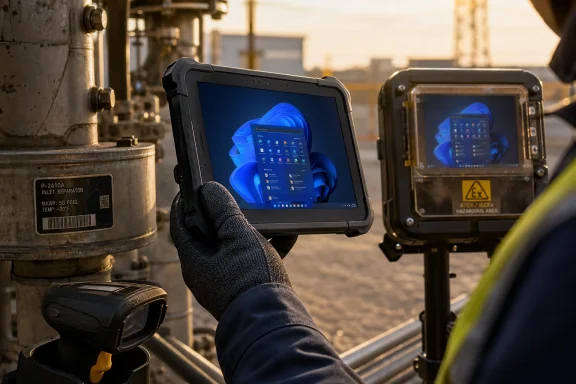 Windows on Arm Leaves the Conference Room and Heads for the Yard
For years, Windows on Arm has been discussed mostly through the lens of consumer laptops, developer kits, and Microsoft’s long campaign to make thin-and-light PCs behave more like phones. That framing misses one of the more practical places where Arm can matter: field devices that must run all day, survive abuse, avoid fans, and still remain manageable inside a Microsoft-centric enterprise.Getac’s ZX80W and ZX80W-EX land squarely in that category. They are not trying to replace a workstation or a high-end mobile CAD rig. They are designed for people who scan assets, inspect infrastructure, manage logistics, coordinate field crews, interact with industrial systems, and work in places where a dropped tablet is a routine event rather than a support ticket anomaly.
The choice of Windows 11 IoT Enterprise LTSC is the signal. This is not a retail Windows tablet chasing the iPad. It is a fixed-purpose, enterprise-oriented Windows endpoint meant to sit inside a managed fleet, run line-of-business applications, and remain stable over long service periods.
That matters because rugged computing has always been less glamorous and more consequential than the consumer PC market admits. A warehouse tablet that fails halfway through a shift can slow an operation. A utility tablet that overheats on a job site can delay maintenance. A hazardous-location device that lacks the right certification simply cannot be used where the work actually happens.
Getac Sells a Familiar Rugged Promise With a Different Engine
The ZX80W and ZX80W-EX follow Getac’s long-established rugged playbook: compact body, sealed design, sunlight-readable display, broad operating temperature range, resistance to drops and vibration, and certifications meant to reassure procurement teams that the hardware is not just “tough-looking.” The standard ZX80W weighs about 590 grams, while the ZX80W-EX comes in heavier at roughly 780 grams because it adds protection for hazardous environments.Both tablets are 8-inch devices, which is an increasingly important size in field computing. A 10- or 12-inch rugged tablet can be more comfortable for forms, maps, and dashboards, but it can also be too heavy or awkward for workers who are climbing, driving, checking equipment, or carrying other tools. An 8-inch unit is closer to the sweet spot for one-handed work, especially when it is paired with vehicle docks, straps, barcode scanners, or workflow-specific accessories.
The headline specifications are practical rather than theatrical. Both devices use Qualcomm’s QCS6490 platform, include 12GB of LPDDR5 memory, and provide 256GB of UFS storage. The design is fanless, which is not just a comfort feature; fewer moving parts and fewer openings are useful in dusty, wet, dirty, or chemically sensitive environments.
The ZX80W-EX is the more specialized model. Its ATEX and IECEx Zone 2/22 certification targets hazardous or potentially explosive environments, which is the difference between a device that looks rugged and one that can be approved for certain industrial sites. Getac also calls out thicker display glass, reinforced rear protection, a secure port cover for the main docking connector, and seals on exposed screw covers.
The Real Product Is Not the Tablet, It Is the Compromise
The rugged tablet market is built on compromise. Buyers want Windows compatibility, long runtime, sealed hardware, sunlight readability, survivability, light weight, and support for legacy workflows. Historically, they could usually get some of those things, but not all of them in a small package.Windows has been the compatibility answer. Android has often been the battery-life and mobility answer. x86 chips have been the safer bet for application support. Arm chips have been the more attractive bet for thermals and efficiency. Rugged-device buyers have lived in the space between those poles.
Getac is now arguing that the old trade-off is weakening. If Windows 11 IoT Enterprise LTSC on Arm can run the needed software stack, then an 8-inch fanless Windows tablet becomes much easier to justify. It can slot into existing Microsoft management practices while behaving more like the mobile device field workers already expect.
That is the theory. The deployment reality will depend on application compatibility, driver support, peripheral support, and how much of an organization’s field software estate is still tied to x86 assumptions. Windows on Arm has improved considerably, but rugged deployments are often allergic to surprises. A niche USB peripheral, a decades-old inspection app, or an unsigned driver can matter more than the operating system’s marketing page.
This is why the ZX80W is interesting but not magical. It may be a better answer for many organizations, but it still asks IT departments to do the unglamorous work of validation. The hardware story is convincing only if the software story survives the pilot.
Windows 11 IoT LTSC Is the Quiet Star of the Launch
Consumer Windows 11 is a moving target by design. It changes, accumulates features, experiments with interface nudges, and increasingly acts as a delivery vehicle for Microsoft’s AI and cloud priorities. That is not always what industrial customers want from a device bolted into a workflow.Windows 11 IoT Enterprise LTSC exists for a different rhythm. It is aimed at dedicated systems where stability and lifecycle predictability are more valuable than receiving every consumer-facing feature. For devices used in vehicles, plants, depots, utilities, emergency services, and manufacturing floors, that distinction is not academic.
Getac’s use of LTSC helps explain why this tablet is plausibly a Windows device rather than just a Windows-branded mobile experiment. Enterprise buyers want security updates, management consistency, and application support, but they do not necessarily want feature churn in the middle of a multi-year field deployment. A rugged tablet may remain in service long after a consumer laptop has been replaced twice.
The WindowsForum audience will recognize the tension here. Enthusiasts often talk about LTSC as a cleaner, calmer version of Windows. In the enterprise and IoT world, the point is narrower: LTSC is about keeping fixed-purpose systems fixed-purpose. The less often a field device changes behavior unexpectedly, the fewer times IT has to explain to operations why a familiar workflow now looks different.
Qualcomm’s QCS6490 Gives the Device Its Plausible Future
The QCS6490 is not being pitched here as a gaming chip or a laptop-class bruiser. It is an IoT-focused Qualcomm platform aimed at connected edge devices that need efficiency, camera and sensor handling, AI acceleration, and multi-OS support. That makes it a more logical fit for a rugged tablet than a repurposed consumer PC processor.The efficiency argument is straightforward. A fanless sealed tablet benefits from a chip that can deliver acceptable performance without dumping too much heat into a small chassis. In the field, performance-per-watt can matter more than peak performance, because a fast device that throttles, dies early, or gets too hot to hold is not actually faster in operational terms.
The platform’s support for Windows 11 IoT Enterprise also matters because this is no longer an exotic science project. Microsoft and Qualcomm have spent years broadening Windows on Arm beyond the early Surface Pro X era, and industrial hardware is one of the places where the payoff may be easier to see. The more standardized the silicon and OS support become, the less scary these deployments look to conservative IT teams.
That said, “AI-ready” should be treated carefully. The presence of a Qualcomm Hexagon NPU and a sixth-generation Qualcomm AI Engine means the hardware has local acceleration for certain workloads. It does not mean every field application will suddenly become intelligent, offline, and automated. The software has to be written, tested, secured, and integrated before the NPU becomes more than a line item.
Edge AI Sounds Like Hype Until the Network Drops
Getac’s pitch for edge AI is familiar: real-time recognition, analytics, on-device automation, and reduced dependency on the cloud. In a normal consumer launch, that language can blur into the general AI fog now surrounding nearly every device announcement. In rugged field computing, however, the argument is more concrete.Field workers often operate where connectivity is unreliable, expensive, congested, or restricted. A utility crew inspecting infrastructure, a logistics worker moving through a yard, or a technician operating near industrial equipment may not have a stable connection at the moment the software needs to make a decision. In that context, local inference is not a novelty; it is a way to keep the workflow moving.
The more credible use cases are narrow and operational. Image recognition for inspections, anomaly detection for assets, local processing for sensors, assisted data capture, and workflow automation are all plausible fits. Getac’s examples, including utility UAV control, predictive asset management, hazardous-environment work, and electronic logging in transport, fit the pattern.
The catch is that edge AI is only as useful as the process around it. A model running locally can reduce latency and cloud dependency, but it also introduces questions about model updates, auditability, data retention, false positives, and user training. For regulated or safety-sensitive work, the device’s AI capability must be treated as part of the system, not a decorative accelerator.
The Hazardous-Location Model Is More Than a Rugged Upsell
The ZX80W-EX is the more consequential of the two devices because it addresses environments where ordinary electronics are not merely fragile but potentially unsafe. ATEX and IECEx Zone 2/22 certification places the tablet into a category relevant to workplaces where explosive gases, vapors, dust, or similar hazards may be present under defined conditions.That changes the buying logic. A standard rugged tablet competes on durability, ergonomics, battery life, screen quality, accessories, and total cost of ownership. A hazardous-location device competes first on whether it is allowed onto the site. Certification can be the gating factor before anyone debates software performance.
Getac’s additional design details for the EX model are therefore not cosmetic. Thicker display glass, reinforced covers, secured connectors, and sealed screw areas all speak to the practical realities of intrinsically safer hardware. These are not features that excite consumers, but they are the kinds of details that safety officers, industrial buyers, and field operations teams care about.
The EX model also highlights why Windows remains sticky in industrial environments. Many hazardous-location workflows are tied to existing enterprise systems, reporting tools, inspection databases, identity infrastructure, and device-management policies. If a certified tablet can provide those Windows workflows in a smaller, lighter, more efficient design, that becomes a procurement argument with real force.
The Android Comparison Is the Subtext Getac Wants Buyers to Hear
Getac’s announcement is careful but unmistakable: Windows functionality in a compact, fanless, all-day form factor is being positioned against the kind of mobility historically associated with Android rugged devices. This is the central strategic claim. The company is not simply saying the ZX80W is a Windows tablet; it is saying Windows can now compete in a class where Android often had the ergonomic advantage.Android has been strong in rugged handhelds and compact tablets because it is efficient, touch-first, familiar to mobile users, and supported by a large ecosystem of scanning, logistics, and field-service applications. But Android can be awkward for organizations whose backend workflows, authentication, endpoint management, or legacy applications are Windows-first. Every Android deployment in a Windows-heavy enterprise can become an integration project.
Windows, by contrast, brings Group Policy heritage, Microsoft identity integration, familiar security tooling, and a vast legacy application base. It also brings baggage: resource expectations, update management, app compatibility complexity, and a user interface that was not born in a warehouse aisle. Windows on Arm is an attempt to preserve the former while reducing some of the latter.
The ZX80W therefore sits in an interesting middle ground. It is not trying to make Windows fashionable. It is trying to make Windows small, sealed, efficient, and manageable enough that organizations do not have to choose Android simply to get mobility.
App Compatibility Remains the Deployment Tax
No serious Windows on Arm story can ignore compatibility. Microsoft’s emulation work has improved, and native Arm64 software is more common than it used to be, but enterprise field deployments do not live in a clean app-store universe. They are full of custom utilities, old middleware, browser dependencies, device drivers, label printers, scanners, smart-card readers, VPN clients, and management agents.For a device like the ZX80W, the question is not whether Windows on Arm can run Windows apps in general. The question is whether it can run your Windows apps, with your peripherals, inside your security stack, over your network, for your workers, in the conditions where your organization actually operates. That is the difference between a promising specification sheet and a successful deployment.
This is where IT departments should be both open-minded and stubborn. Open-minded because Arm-based Windows devices may now solve problems that x86 rugged tablets solved clumsily. Stubborn because every driver, agent, and workflow needs testing before procurement signs a large order.
The good news is that rugged deployments already tend to involve pilots, accessory validation, imaging decisions, device-management planning, and environmental testing. The bad news is that Arm adds another axis to the checklist. The organizations most likely to succeed with this class of device are the ones that treat architecture as a deployment variable, not an afterthought.
Fleet Management Is Where the Sales Pitch Meets Reality
A rugged field tablet is rarely bought as a single device. It is bought as part of a fleet, with spares, docks, chargers, mounts, warranties, imaging processes, repair procedures, and help-desk scripts. The true product is the operational system around the hardware.For Windows shops, the attraction is obvious. A Windows 11 IoT Enterprise LTSC tablet can fit into familiar management models more naturally than an Android alternative, depending on the organization’s tooling. Identity, policy, patching, application distribution, encryption, and remote assistance can all be aligned with existing Microsoft-oriented practices.
But fleets are unforgiving. A small driver problem multiplied across hundreds of devices becomes a major operational nuisance. A battery-runtime assumption that works in a lab but fails on a winter shift becomes a labor issue. A display that is readable in marketing photos but marginal in direct sunlight becomes a productivity problem.
Getac’s rugged credentials reduce some of that risk, but they do not remove it. Ruggedness is not a single property; it is a system of design choices tested against specific standards and real-world abuse. Buyers should still evaluate docks, gloves, wet touch behavior, stylus needs, charging logistics, cleaning procedures, and repair turnaround.
The Timing Favors a More Serious Windows on Arm Conversation
This launch arrives after a period in which Windows on Arm has become more credible across the broader PC market. The attention has mostly gone to Copilot+ PCs and higher-profile Snapdragon-powered laptops, but the enterprise IoT implications may be just as significant. Once Windows on Arm is no longer treated as weird, industrial vendors can build around it with less market resistance.Getac is taking advantage of that shift. The ZX80W does not need to convince users that Arm is the future of all Windows computing. It only needs to convince field operations teams that Arm is good enough, efficient enough, and compatible enough for a specific class of rugged Windows endpoint.
That is a lower bar and a more useful one. The history of enterprise computing is full of technologies that failed as universal revolutions but succeeded as targeted tools. Windows on Arm may be most persuasive where the constraints are sharpest: battery life, thermals, sealing, weight, and long-term manageability.
The July 2026 availability window also gives buyers a near-term planning target. Organizations refreshing rugged fleets in the second half of 2026 will have another option to evaluate, particularly if they have been stuck between bulky x86 Windows tablets and Android devices that do not quite fit their enterprise stack.
Microsoft’s Platform Strategy Benefits Even If Getac Does the Selling
Microsoft has a platform problem that is also a platform opportunity. Windows remains deeply entrenched in enterprise workflows, but many frontline and industrial devices have drifted toward mobile operating systems because they were more efficient and better suited to compact hardware. Every Windows on Arm industrial device is a small attempt to reclaim that edge.The ZX80W is not a mass-market Windows moment. Most consumers will never see one. But platform health is not only measured by consumer excitement. It is also measured by whether hardware makers can take Windows into specialized markets without fighting the OS at every step.
For Microsoft, Windows 11 IoT Enterprise LTSC on Qualcomm silicon gives OEMs a way to build sealed, efficient, long-lived devices that still belong to the Windows family. That helps preserve Windows’ relevance in places where the operating system might otherwise be replaced by Android, Linux, or proprietary embedded platforms.
For Qualcomm, the launch is another proof point that its IoT silicon can move beyond development kits and reference designs into certified, operationally serious hardware. The company has spent years positioning its platforms for the intelligent edge. Rugged Windows tablets give that positioning a practical face.
The Price of Efficiency Is a More Disciplined Buyer
The ZX80W line should not be read as a blanket recommendation to move rugged Windows fleets to Arm. It should be read as evidence that the option is becoming mature enough to deserve serious evaluation. That is a meaningful distinction.A disciplined buyer will ask whether the target workflow is browser-based, UWP, native Arm64, emulated x86, peripheral-heavy, or driver-dependent. They will ask whether field workers need offline maps, barcode scanning, smart-card authentication, VPN access, serial connectivity, camera workflows, or real-time sensor processing. They will ask whether the same device image can serve multiple teams or whether the hardware will fragment the support model.
They will also ask whether the benefits are operationally measurable. Does the fanless design reduce failure points? Does the weight difference reduce fatigue? Does battery life cover a full shift with realistic screen brightness and radios active? Does local AI processing reduce manual work, or is it a feature waiting for a future software project?
That is the right kind of skepticism. Rugged hardware is expensive because failure is expensive. If Arm-based Windows reduces failure, runtime anxiety, and device weight without breaking compatibility, it earns its place. If it creates a new support burden, the efficiency story gets weaker fast.
The Field Tablet Fight Now Turns on Trust, Not Specs
The most concrete lesson from Getac’s announcement is that rugged Windows devices are becoming more mobile without surrendering their enterprise identity. The ZX80W and ZX80W-EX are not revolutionary because they have an 8-inch screen or an NPU. They are notable because they bring together Windows 11 IoT LTSC, Arm efficiency, rugged certification, and hazardous-location options in a form factor aimed at real field work.- Getac’s ZX80W and ZX80W-EX are 8-inch fully rugged Windows 11 tablets built on Qualcomm’s QCS6490 Arm platform and scheduled for July 2026 availability.
- The standard ZX80W targets compact, fanless field productivity, while the ZX80W-EX adds ATEX and IECEx Zone 2/22 certification for hazardous environments.
- Windows 11 IoT Enterprise LTSC is central to the product strategy because it gives enterprise buyers a more stable fixed-purpose Windows platform than consumer Windows releases.
- The Arm architecture promises better efficiency and thermals, but enterprise buyers still need to validate app, driver, peripheral, and management compatibility.
- The edge AI hardware is most credible when tied to specific offline or low-connectivity workflows such as inspection, asset management, and field automation.
- The real competition is not only other rugged tablets; it is the old assumption that compact all-day field devices must choose Android over Windows.
References
- Primary source: PR Newswire UK
Published: Wed, 03 Jun 2026 08:00:00 GMT
Getac's new 8-inch ZX80W and ZX80W-EX tablets blend Windows 11 functionality with energy-efficient fanless design, for all-day productivity in the field
Compact and lightweight form-factor meets powerful edge AI performance in Getac's versatile new offerings, built on ARM architecture News in brief: Getac is... www.prnewswire.co.uk
- Official source: learn.microsoft.com
Supported Qualcomm Processors for Windows 11 IoT Enterprise (2024 to present) | Microsoft Learn
Learn about Qualcomm Processors supported for Windows 11 IoT Enterprise (2024 to preent)learn.microsoft.com - Related coverage: getac.com
ZX80|Getac
ZX80 8インチ完全堅牢型Androidタブレットは、AI活用を前提に設計された強力なデバイスです。リアルタイム分析、設備管理、そしてUAV(無人航空機)の操縦といった機能を、お客様の手のひらの上で実現します。極めて高い耐久性と長時間のバッテリー駆動時間を、洗練された軽量のパッケージに搭載いたしました。www.getac.com - Official source: microsoft.com
Windows 11 IoT Enterprise LTSC
Windows 11 IoT Enterprise LTSC is intended for fixed-function, specialized, commercial devices that require a long support lifecycle of 10 years.www.microsoft.com
- Related coverage: forum.aim-linux.advantech.com
[How-to Article] Get Started with Windows 11 IoT Enterprise on Qualcomm Dragonwing QCS6490 Using the AOM-2721 Development Kit - Windows on Arm - Advantech AIM-Linux Community
1. Introduction Advantech has adopted Dragonwing™ QCS6490 technology across diverse hardware form factors and product lines for embedded modules, smart panels, and AI cameras. The QCS6490 platform supports a comprehe… forum.aim-linux.advantech.com
- Related coverage: ruggedtechla.com