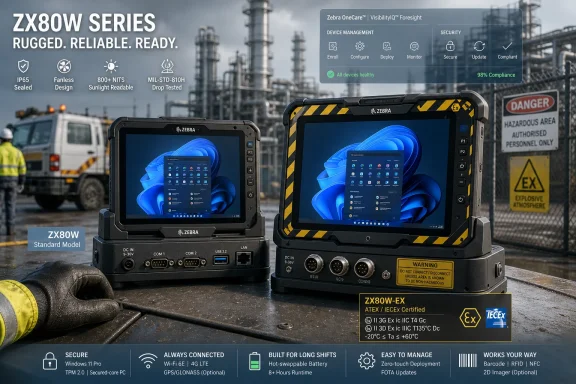
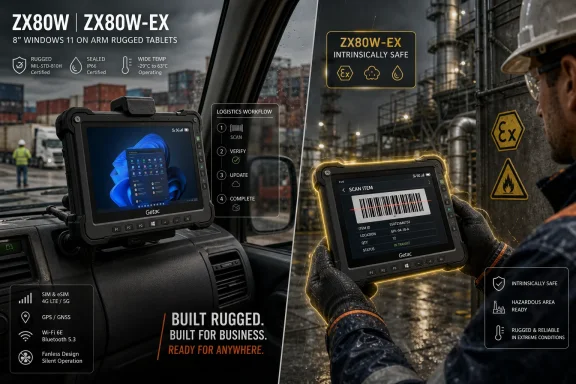
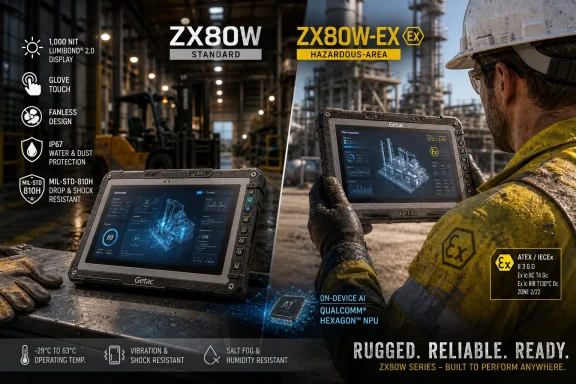
Getac announced on June 3, 2026, that its ZX80 family of 8-inch fully rugged tablets is expanding with the Windows 11-powered ZX80W and hazardous-location ZX80W-EX, both built around Qualcomm’s QCS6490 Arm platform and scheduled for availability in July 2026. The important part is not merely that another rugged tablet has arrived; it is that Windows on Arm is moving deeper into field computing, where battery life, thermals, certification, and fleet management matter more than benchmark theater. Getac is betting that enterprise Windows can finally live comfortably in the kind of compact, fanless hardware that used to push buyers toward Android. For sysadmins and operations teams, that makes this launch less a gadget story than a test of whether Arm-based Windows has become boring enough to deploy.

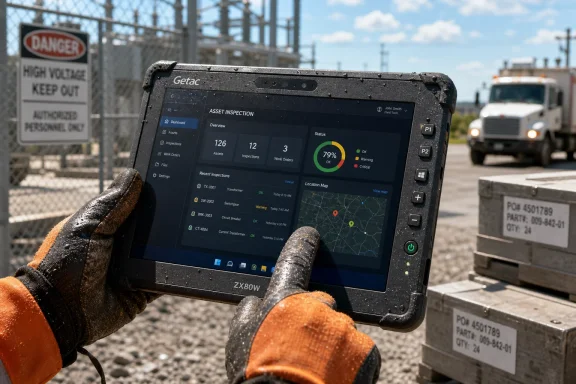
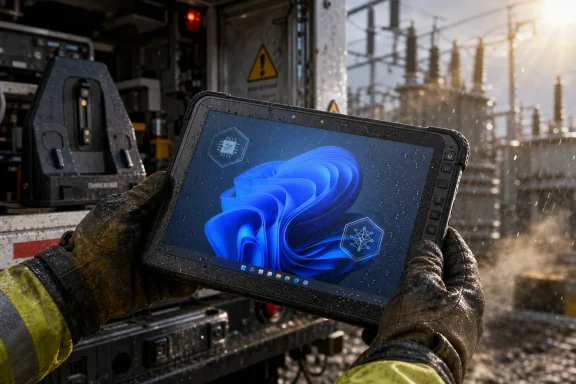
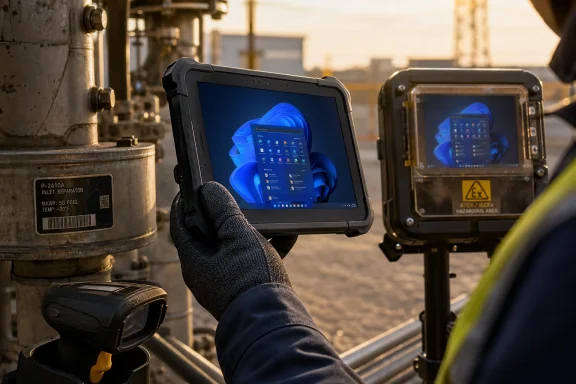
Gloved hand holds a rugged tablet displaying Windows, inspecting industrial equipment at sunset.Windows on Arm Leaves the Conference Room and Heads for the Yard​

For years, Windows on Arm has been discussed mostly through the lens of consumer laptops, developer kits, and Microsoft’s long campaign to make thin-and-light PCs behave more like phones. That framing misses one of the more practical places where Arm can matter: field devices that must run all day, survive abuse, avoid fans, and still remain manageable inside a Microsoft-centric enterprise.
Getac’s ZX80W and ZX80W-EX land squarely in that category. They are not trying to replace a workstation or a high-end mobile CAD rig. They are designed for people who scan assets, inspect infrastructure, manage logistics, coordinate field crews, interact with industrial systems, and work in places where a dropped tablet is a routine event rather than a support ticket anomaly.
The choice of Windows 11 IoT Enterprise LTSC is the signal. This is not a retail Windows tablet chasing the iPad. It is a fixed-purpose, enterprise-oriented Windows endpoint meant to sit inside a managed fleet, run line-of-business applications, and remain stable over long service periods.
That matters because rugged computing has always been less glamorous and more consequential than the consumer PC market admits. A warehouse tablet that fails halfway through a shift can slow an operation. A utility tablet that overheats on a job site can delay maintenance. A hazardous-location device that lacks the right certification simply cannot be used where the work actually happens.

Getac Sells a Familiar Rugged Promise With a Different Engine​

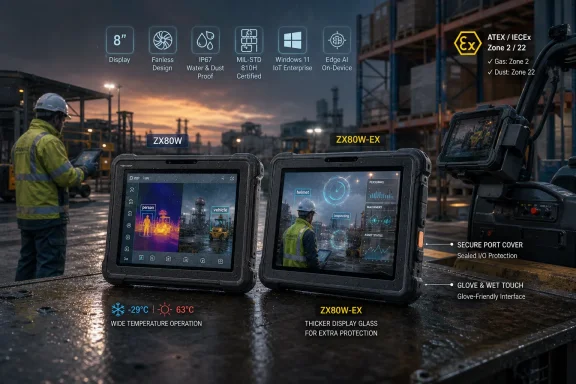
The ZX80W and ZX80W-EX follow Getac’s long-established rugged playbook: compact body, sealed design, sunlight-readable display, broad operating temperature range, resistance to drops and vibration, and certifications meant to reassure procurement teams that the hardware is not just “tough-looking.” The standard ZX80W weighs about 590 grams, while the ZX80W-EX comes in heavier at roughly 780 grams because it adds protection for hazardous environments.
Both tablets are 8-inch devices, which is an increasingly important size in field computing. A 10- or 12-inch rugged tablet can be more comfortable for forms, maps, and dashboards, but it can also be too heavy or awkward for workers who are climbing, driving, checking equipment, or carrying other tools. An 8-inch unit is closer to the sweet spot for one-handed work, especially when it is paired with vehicle docks, straps, barcode scanners, or workflow-specific accessories.
The headline specifications are practical rather than theatrical. Both devices use Qualcomm’s QCS6490 platform, include 12GB of LPDDR5 memory, and provide 256GB of UFS storage. The design is fanless, which is not just a comfort feature; fewer moving parts and fewer openings are useful in dusty, wet, dirty, or chemically sensitive environments.
The ZX80W-EX is the more specialized model. Its ATEX and IECEx Zone 2/22 certification targets hazardous or potentially explosive environments, which is the difference between a device that looks rugged and one that can be approved for certain industrial sites. Getac also calls out thicker display glass, reinforced rear protection, a secure port cover for the main docking connector, and seals on exposed screw covers.

The Real Product Is Not the Tablet, It Is the Compromise​

The rugged tablet market is built on compromise. Buyers want Windows compatibility, long runtime, sealed hardware, sunlight readability, survivability, light weight, and support for legacy workflows. Historically, they could usually get some of those things, but not all of them in a small package.
Windows has been the compatibility answer. Android has often been the battery-life and mobility answer. x86 chips have been the safer bet for application support. Arm chips have been the more attractive bet for thermals and efficiency. Rugged-device buyers have lived in the space between those poles.
Getac is now arguing that the old trade-off is weakening. If Windows 11 IoT Enterprise LTSC on Arm can run the needed software stack, then an 8-inch fanless Windows tablet becomes much easier to justify. It can slot into existing Microsoft management practices while behaving more like the mobile device field workers already expect.
That is the theory. The deployment reality will depend on application compatibility, driver support, peripheral support, and how much of an organization’s field software estate is still tied to x86 assumptions. Windows on Arm has improved considerably, but rugged deployments are often allergic to surprises. A niche USB peripheral, a decades-old inspection app, or an unsigned driver can matter more than the operating system’s marketing page.
This is why the ZX80W is interesting but not magical. It may be a better answer for many organizations, but it still asks IT departments to do the unglamorous work of validation. The hardware story is convincing only if the software story survives the pilot.

Windows 11 IoT LTSC Is the Quiet Star of the Launch​

Consumer Windows 11 is a moving target by design. It changes, accumulates features, experiments with interface nudges, and increasingly acts as a delivery vehicle for Microsoft’s AI and cloud priorities. That is not always what industrial customers want from a device bolted into a workflow.
Windows 11 IoT Enterprise LTSC exists for a different rhythm. It is aimed at dedicated systems where stability and lifecycle predictability are more valuable than receiving every consumer-facing feature. For devices used in vehicles, plants, depots, utilities, emergency services, and manufacturing floors, that distinction is not academic.
Getac’s use of LTSC helps explain why this tablet is plausibly a Windows device rather than just a Windows-branded mobile experiment. Enterprise buyers want security updates, management consistency, and application support, but they do not necessarily want feature churn in the middle of a multi-year field deployment. A rugged tablet may remain in service long after a consumer laptop has been replaced twice.
The WindowsForum audience will recognize the tension here. Enthusiasts often talk about LTSC as a cleaner, calmer version of Windows. In the enterprise and IoT world, the point is narrower: LTSC is about keeping fixed-purpose systems fixed-purpose. The less often a field device changes behavior unexpectedly, the fewer times IT has to explain to operations why a familiar workflow now looks different.

Qualcomm’s QCS6490 Gives the Device Its Plausible Future​

The QCS6490 is not being pitched here as a gaming chip or a laptop-class bruiser. It is an IoT-focused Qualcomm platform aimed at connected edge devices that need efficiency, camera and sensor handling, AI acceleration, and multi-OS support. That makes it a more logical fit for a rugged tablet than a repurposed consumer PC processor.
The efficiency argument is straightforward. A fanless sealed tablet benefits from a chip that can deliver acceptable performance without dumping too much heat into a small chassis. In the field, performance-per-watt can matter more than peak performance, because a fast device that throttles, dies early, or gets too hot to hold is not actually faster in operational terms.
The platform’s support for Windows 11 IoT Enterprise also matters because this is no longer an exotic science project. Microsoft and Qualcomm have spent years broadening Windows on Arm beyond the early Surface Pro X era, and industrial hardware is one of the places where the payoff may be easier to see. The more standardized the silicon and OS support become, the less scary these deployments look to conservative IT teams.
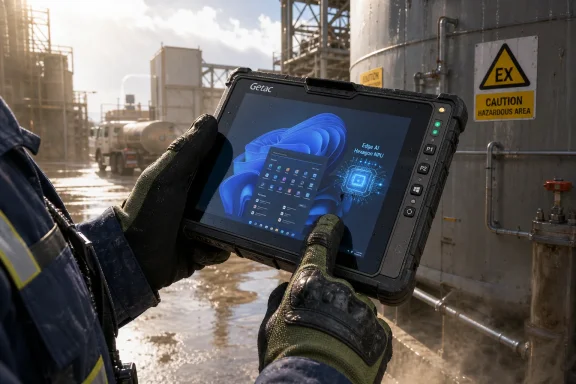
That said, “AI-ready” should be treated carefully. The presence of a Qualcomm Hexagon NPU and a sixth-generation Qualcomm AI Engine means the hardware has local acceleration for certain workloads. It does not mean every field application will suddenly become intelligent, offline, and automated. The software has to be written, tested, secured, and integrated before the NPU becomes more than a line item.

Edge AI Sounds Like Hype Until the Network Drops​

Getac’s pitch for edge AI is familiar: real-time recognition, analytics, on-device automation, and reduced dependency on the cloud. In a normal consumer launch, that language can blur into the general AI fog now surrounding nearly every device announcement. In rugged field computing, however, the argument is more concrete.
Field workers often operate where connectivity is unreliable, expensive, congested, or restricted. A utility crew inspecting infrastructure, a logistics worker moving through a yard, or a technician operating near industrial equipment may not have a stable connection at the moment the software needs to make a decision. In that context, local inference is not a novelty; it is a way to keep the workflow moving.
The more credible use cases are narrow and operational. Image recognition for inspections, anomaly detection for assets, local processing for sensors, assisted data capture, and workflow automation are all plausible fits. Getac’s examples, including utility UAV control, predictive asset management, hazardous-environment work, and electronic logging in transport, fit the pattern.
The catch is that edge AI is only as useful as the process around it. A model running locally can reduce latency and cloud dependency, but it also introduces questions about model updates, auditability, data retention, false positives, and user training. For regulated or safety-sensitive work, the device’s AI capability must be treated as part of the system, not a decorative accelerator.

The Hazardous-Location Model Is More Than a Rugged Upsell​

The ZX80W-EX is the more consequential of the two devices because it addresses environments where ordinary electronics are not merely fragile but potentially unsafe. ATEX and IECEx Zone 2/22 certification places the tablet into a category relevant to workplaces where explosive gases, vapors, dust, or similar hazards may be present under defined conditions.
That changes the buying logic. A standard rugged tablet competes on durability, ergonomics, battery life, screen quality, accessories, and total cost of ownership. A hazardous-location device competes first on whether it is allowed onto the site. Certification can be the gating factor before anyone debates software performance.
Getac’s additional design details for the EX model are therefore not cosmetic. Thicker display glass, reinforced covers, secured connectors, and sealed screw areas all speak to the practical realities of intrinsically safer hardware. These are not features that excite consumers, but they are the kinds of details that safety officers, industrial buyers, and field operations teams care about.
The EX model also highlights why Windows remains sticky in industrial environments. Many hazardous-location workflows are tied to existing enterprise systems, reporting tools, inspection databases, identity infrastructure, and device-management policies. If a certified tablet can provide those Windows workflows in a smaller, lighter, more efficient design, that becomes a procurement argument with real force.

The Android Comparison Is the Subtext Getac Wants Buyers to Hear​

Getac’s announcement is careful but unmistakable: Windows functionality in a compact, fanless, all-day form factor is being positioned against the kind of mobility historically associated with Android rugged devices. This is the central strategic claim. The company is not simply saying the ZX80W is a Windows tablet; it is saying Windows can now compete in a class where Android often had the ergonomic advantage.
Android has been strong in rugged handhelds and compact tablets because it is efficient, touch-first, familiar to mobile users, and supported by a large ecosystem of scanning, logistics, and field-service applications. But Android can be awkward for organizations whose backend workflows, authentication, endpoint management, or legacy applications are Windows-first. Every Android deployment in a Windows-heavy enterprise can become an integration project.
Windows, by contrast, brings Group Policy heritage, Microsoft identity integration, familiar security tooling, and a vast legacy application base. It also brings baggage: resource expectations, update management, app compatibility complexity, and a user interface that was not born in a warehouse aisle. Windows on Arm is an attempt to preserve the former while reducing some of the latter.
The ZX80W therefore sits in an interesting middle ground. It is not trying to make Windows fashionable. It is trying to make Windows small, sealed, efficient, and manageable enough that organizations do not have to choose Android simply to get mobility.

App Compatibility Remains the Deployment Tax​

No serious Windows on Arm story can ignore compatibility. Microsoft’s emulation work has improved, and native Arm64 software is more common than it used to be, but enterprise field deployments do not live in a clean app-store universe. They are full of custom utilities, old middleware, browser dependencies, device drivers, label printers, scanners, smart-card readers, VPN clients, and management agents.
For a device like the ZX80W, the question is not whether Windows on Arm can run Windows apps in general. The question is whether it can run your Windows apps, with your peripherals, inside your security stack, over your network, for your workers, in the conditions where your organization actually operates. That is the difference between a promising specification sheet and a successful deployment.
This is where IT departments should be both open-minded and stubborn. Open-minded because Arm-based Windows devices may now solve problems that x86 rugged tablets solved clumsily. Stubborn because every driver, agent, and workflow needs testing before procurement signs a large order.
The good news is that rugged deployments already tend to involve pilots, accessory validation, imaging decisions, device-management planning, and environmental testing. The bad news is that Arm adds another axis to the checklist. The organizations most likely to succeed with this class of device are the ones that treat architecture as a deployment variable, not an afterthought.

Fleet Management Is Where the Sales Pitch Meets Reality​

A rugged field tablet is rarely bought as a single device. It is bought as part of a fleet, with spares, docks, chargers, mounts, warranties, imaging processes, repair procedures, and help-desk scripts. The true product is the operational system around the hardware.
For Windows shops, the attraction is obvious. A Windows 11 IoT Enterprise LTSC tablet can fit into familiar management models more naturally than an Android alternative, depending on the organization’s tooling. Identity, policy, patching, application distribution, encryption, and remote assistance can all be aligned with existing Microsoft-oriented practices.
But fleets are unforgiving. A small driver problem multiplied across hundreds of devices becomes a major operational nuisance. A battery-runtime assumption that works in a lab but fails on a winter shift becomes a labor issue. A display that is readable in marketing photos but marginal in direct sunlight becomes a productivity problem.
Getac’s rugged credentials reduce some of that risk, but they do not remove it. Ruggedness is not a single property; it is a system of design choices tested against specific standards and real-world abuse. Buyers should still evaluate docks, gloves, wet touch behavior, stylus needs, charging logistics, cleaning procedures, and repair turnaround.

The Timing Favors a More Serious Windows on Arm Conversation​

This launch arrives after a period in which Windows on Arm has become more credible across the broader PC market. The attention has mostly gone to Copilot+ PCs and higher-profile Snapdragon-powered laptops, but the enterprise IoT implications may be just as significant. Once Windows on Arm is no longer treated as weird, industrial vendors can build around it with less market resistance.
Getac is taking advantage of that shift. The ZX80W does not need to convince users that Arm is the future of all Windows computing. It only needs to convince field operations teams that Arm is good enough, efficient enough, and compatible enough for a specific class of rugged Windows endpoint.
That is a lower bar and a more useful one. The history of enterprise computing is full of technologies that failed as universal revolutions but succeeded as targeted tools. Windows on Arm may be most persuasive where the constraints are sharpest: battery life, thermals, sealing, weight, and long-term manageability.
The July 2026 availability window also gives buyers a near-term planning target. Organizations refreshing rugged fleets in the second half of 2026 will have another option to evaluate, particularly if they have been stuck between bulky x86 Windows tablets and Android devices that do not quite fit their enterprise stack.

Microsoft’s Platform Strategy Benefits Even If Getac Does the Selling​

Microsoft has a platform problem that is also a platform opportunity. Windows remains deeply entrenched in enterprise workflows, but many frontline and industrial devices have drifted toward mobile operating systems because they were more efficient and better suited to compact hardware. Every Windows on Arm industrial device is a small attempt to reclaim that edge.
The ZX80W is not a mass-market Windows moment. Most consumers will never see one. But platform health is not only measured by consumer excitement. It is also measured by whether hardware makers can take Windows into specialized markets without fighting the OS at every step.
For Microsoft, Windows 11 IoT Enterprise LTSC on Qualcomm silicon gives OEMs a way to build sealed, efficient, long-lived devices that still belong to the Windows family. That helps preserve Windows’ relevance in places where the operating system might otherwise be replaced by Android, Linux, or proprietary embedded platforms.
For Qualcomm, the launch is another proof point that its IoT silicon can move beyond development kits and reference designs into certified, operationally serious hardware. The company has spent years positioning its platforms for the intelligent edge. Rugged Windows tablets give that positioning a practical face.

The Price of Efficiency Is a More Disciplined Buyer​

The ZX80W line should not be read as a blanket recommendation to move rugged Windows fleets to Arm. It should be read as evidence that the option is becoming mature enough to deserve serious evaluation. That is a meaningful distinction.
A disciplined buyer will ask whether the target workflow is browser-based, UWP, native Arm64, emulated x86, peripheral-heavy, or driver-dependent. They will ask whether field workers need offline maps, barcode scanning, smart-card authentication, VPN access, serial connectivity, camera workflows, or real-time sensor processing. They will ask whether the same device image can serve multiple teams or whether the hardware will fragment the support model.
They will also ask whether the benefits are operationally measurable. Does the fanless design reduce failure points? Does the weight difference reduce fatigue? Does battery life cover a full shift with realistic screen brightness and radios active? Does local AI processing reduce manual work, or is it a feature waiting for a future software project?
That is the right kind of skepticism. Rugged hardware is expensive because failure is expensive. If Arm-based Windows reduces failure, runtime anxiety, and device weight without breaking compatibility, it earns its place. If it creates a new support burden, the efficiency story gets weaker fast.
The Field Tablet Fight Now Turns on Trust, Not Specs​

The most concrete lesson from Getac’s announcement is that rugged Windows devices are becoming more mobile without surrendering their enterprise identity. The ZX80W and ZX80W-EX are not revolutionary because they have an 8-inch screen or an NPU. They are notable because they bring together Windows 11 IoT LTSC, Arm efficiency, rugged certification, and hazardous-location options in a form factor aimed at real field work.
  • Getac’s ZX80W and ZX80W-EX are 8-inch fully rugged Windows 11 tablets built on Qualcomm’s QCS6490 Arm platform and scheduled for July 2026 availability.
  • The standard ZX80W targets compact, fanless field productivity, while the ZX80W-EX adds ATEX and IECEx Zone 2/22 certification for hazardous environments.
  • Windows 11 IoT Enterprise LTSC is central to the product strategy because it gives enterprise buyers a more stable fixed-purpose Windows platform than consumer Windows releases.
  • The Arm architecture promises better efficiency and thermals, but enterprise buyers still need to validate app, driver, peripheral, and management compatibility.
  • The edge AI hardware is most credible when tied to specific offline or low-connectivity workflows such as inspection, asset management, and field automation.
  • The real competition is not only other rugged tablets; it is the old assumption that compact all-day field devices must choose Android over Windows.
Getac’s new tablets do not settle the Windows-on-Arm debate, but they move it into a more useful arena. The question is no longer whether Arm can make a stylish Windows laptop with good battery life; it is whether Arm can make Windows disappear into the background of hard, repetitive, safety-sensitive work. If the ZX80W family performs as promised, the future of rugged Windows may be less about carrying a PC into the field and more about giving field workers a device that finally behaves as if it was built for them from the start.

References​

  1. Primary source: PR Newswire UK
    Published: Wed, 03 Jun 2026 08:00:00 GMT
  2. Official source: learn.microsoft.com
  3. Related coverage: getac.com
  4. Official source: microsoft.com
  5. Related coverage: forum.aim-linux.advantech.com
  6. Related coverage: ruggedtechla.com
 

Getac announced the ZX80W on June 3, 2026, as an 8-inch fully rugged Windows 11 IoT Enterprise LTSC tablet using Qualcomm’s ARM-based QCS6490 platform, with availability planned for July 2026 in field-heavy markets including defense, utilities, transportation, and logistics. The interesting part is not that another rugged tablet exists. It is that Getac is trying to make Windows on ARM feel less like a consumer-laptop experiment and more like a practical answer to a very old field-computing problem. For IT buyers, the ZX80W is a small device with a larger argument inside it: Windows can move closer to the worker without dragging the old thermal, battery, and form-factor compromises along for the ride.

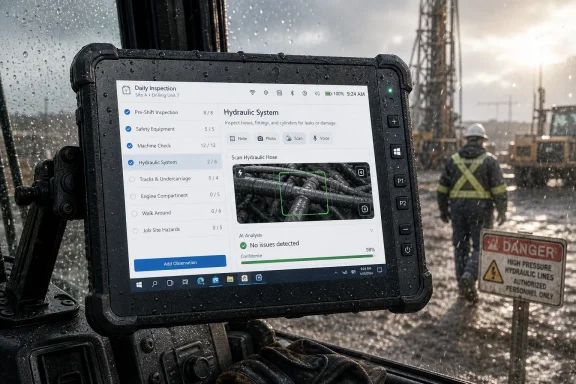
Technician holds a rugged Getac tablet showing asset inspection stats and a map near industrial construction warning signs.Getac Shrinks the Windows Field Kit Without Shrinking the Windows Pitch​

The rugged tablet market has always lived in a compromise zone. Field teams want something light enough to carry all day, bright enough to read outdoors, tough enough to survive drops and weather, and familiar enough that IT does not have to rebuild workflows from scratch. Historically, Windows has won the familiarity argument while Android has often won the mobility argument.
The ZX80W is Getac’s attempt to collapse that divide. It takes the 8-inch rugged-tablet shape usually associated with Android devices and puts Windows 11 IoT Enterprise LTSC on ARM inside it. That matters because it changes the sales conversation from “which platform do we standardize on?” to “can we finally deploy Windows where Android used to be the practical default?”
This is not a normal Windows tablet dressed in rubber armor. Getac is pitching a fanless, ARM-based device built around Qualcomm’s QCS6490, with 12GB of LPDDR5 memory and 256GB of UFS storage. The spec sheet says edge AI, rugged certification, sunlight readability, and long-duration use; the subtext says that a Windows endpoint no longer has to be a laptop-adjacent object.
That distinction matters in the sectors Getac names. A utility worker flying a drone near a substation, a logistics operator using an electronic logging device, or a defense user operating in a dusty, wet, cold, or hot environment does not want a delicate productivity slab. They want an appliance that happens to run the organization’s software stack.

Windows on ARM Finds a Less Glamorous, More Convincing Home​

Windows on ARM has spent years chasing the laptop mainstream, often with mixed results. The promise has been familiar: better battery life, instant-on responsiveness, thinner designs, and integrated connectivity. The difficulty has been equally familiar: app compatibility, driver support, peripheral expectations, and the inertia of decades of x86 Windows deployment.
The rugged market is different. It does not need Windows on ARM to win over every gamer, developer, creative professional, and office worker at once. It needs it to run a controlled set of applications reliably, securely, and efficiently on hardware that can stay in the field.
That is why the ZX80W is more strategically interesting than its size suggests. A rugged tablet running Windows 11 IoT Enterprise LTSC does not live in the same software chaos as a consumer PC. Its job is usually bounded: inventory, dispatch, inspection, asset management, mapping, scanning, telemetry, logging, forms, video, or remote control. If the required applications are native, web-based, emulated acceptably, or packaged for the platform, the usual Windows on ARM caveats become manageable procurement questions rather than existential blockers.
There is also a timing advantage. Enterprises have spent the past decade pushing more workflows into browser-based, cloud-connected, API-driven systems. That does not erase the need for local apps or hardware integrations, but it gives Windows on ARM a better opening than it had when every specialized workflow assumed an x86 executable and a thick-client desktop.
Getac’s choice of Windows 11 IoT Enterprise LTSC reinforces that reading. LTSC is not about chasing the newest consumer feature or feeding the Windows feature-update treadmill. It is about predictable function over a long service life, with Microsoft positioning Windows IoT Enterprise LTSC for fixed-purpose devices that need stability and long-term servicing rather than frequent feature churn.

The Fanless Design Is the Product Strategy​

It is easy to reduce fanless design to a line item, but in a rugged tablet it is closer to a design philosophy. Fans are moving parts. Moving parts dislike dust, vibration, moisture, and impact. In the field, every vent is a liability, every noise source is a tell, and every thermal constraint eventually becomes a user-experience problem.
ARM architecture gives Getac a way to make fanless Windows plausible in a smaller envelope. The Qualcomm QCS6490 is not being presented as a workstation-class chip; it is being presented as a performance-per-watt engine for edge use. That is the right frame. The ZX80W does not need to replace a CAD workstation or a developer laptop. It needs to run field applications without becoming hot, heavy, loud, or dead before the shift ends.
This is where the “all-day productivity” phrase, usually a marketing cliché, earns a little more scrutiny. In field work, battery life is not just convenience. It determines whether a worker carries fewer chargers, whether a vehicle dock becomes mandatory, whether cold-weather operation is practical, and whether a device can be trusted during emergency operations.
A fanless tablet also changes maintenance assumptions. Sealed rugged devices are not just built to survive dramatic drops; they are built to reduce the slow accumulation of failure. Dust ingress, fan degradation, thermal throttling, and blocked vents are boring problems until they happen at scale across a fleet.
The ZX80W’s rugged credentials sit in that context. Getac says the device is MIL-STD-810H and IP67 certified, vibration resistant, resistant to a 6-foot drop, and rated for operation from -20°F to 145°F. Those claims belong to the rugged-computing checklist, but the fanless ARM design is what ties them to the Windows platform story.

LTSC Turns Windows From a Moving Target Into an Appliance Platform​

The Windows detail that deserves the most attention is not simply “Windows 11.” It is Windows 11 IoT Enterprise LTSC. For normal PC users, LTSC is often misunderstood as a cleaner or quieter version of Windows. For device makers and enterprise fleets, it is something more specific: a long-term servicing channel for fixed-purpose systems where stability matters more than feature novelty.
That distinction is crucial for a rugged tablet. A field device is not a personal computer in the cultural sense, even when it runs Windows. It is an instrument. It may need to survive certification, training cycles, application validation, vehicle mounts, accessories, and replacement planning. The cost of change is not just a reboot; it is a support ticket, a broken workflow, or a failed deployment in a place where IT staff are not physically present.
Microsoft’s IoT Enterprise LTSC model gives OEMs and enterprise customers a Windows base with a long support horizon and a more static feature set than the general Windows channel. That aligns naturally with rugged hardware, where fleets are expected to last for years and where the operational cost of disruption can exceed the hardware purchase price.
It also helps explain why Getac is not pitching the ZX80W as a Copilot+ PC or a general AI laptop in miniature. The device has an NPU and Qualcomm’s AI engine, but the operating system choice points toward controlled industrial use, not consumer feature spectacle. In this context, AI is less about generating meeting notes and more about local recognition, automation, analytics, and decision support when connectivity is weak or unavailable.
That is a healthier version of the AI PC narrative than much of what the broader market has been served. Edge AI in a rugged tablet has obvious use cases: image recognition during inspection, anomaly detection near assets, data capture in vehicles, barcode or object recognition, and assisted workflows in remote environments. The challenge is not imagining use cases; it is integrating them into workflows that justify the cost and survive procurement scrutiny.

The NPU Is Useful Only If the Workflow Leaves the Cloud​

Getac says the ZX80W uses a 6th-generation Qualcomm AI Engine and a Hexagon NPU for real-time analytics and on-device automation. On the product page, the NPU is described as delivering up to 13 TOPS. That number is smaller than the headline figures attached to high-end Copilot+ PCs, but that comparison is not especially useful.
A rugged 8-inch field tablet is not trying to win a synthetic AI benchmark race. Its value depends on whether the NPU can reduce latency, conserve battery, preserve bandwidth, and keep core functions available when networks degrade. In a warehouse, truck cab, utility right-of-way, emergency scene, or industrial site, a “smart” feature that fails without a clean cloud connection is not very smart.
That is why Getac’s examples matter even if they are promotional. UAV flight control, predictive asset management, and electronic logging devices are not abstract AI demos. They are field operations where latency, reliability, and local processing can matter more than raw compute spectacle.
Still, enterprise buyers should treat the AI language as a starting point, not a conclusion. The hardware may be AI-ready, but the deployment is only as useful as the software stack. Models must be available for ARM. Applications must know how to use the NPU. Data pipelines must be governed. Offline behavior must be tested. Security teams must understand what data is being processed locally and what is transmitted later.
The lesson from the PC industry’s first wave of AI branding is that silicon capability often arrives before software maturity. The rugged sector may avoid some of that hype because its use cases are more concrete, but it will not escape the integration work.

Android’s Mobility Advantage Is Under Direct Attack​

Getac’s own framing makes the competitive target clear. The company says the ZX80W combines Windows security and compatibility with the lightweight mobility and long battery life traditionally associated with Android devices. That is a direct challenge to the usual platform split in field mobility.
Android has been attractive in rugged handhelds and small tablets because it scales down well. It is touch-native, power-efficient, familiar to users, and supported by a large mobile-device-management ecosystem. For scanning, forms, dispatch, mapping, and communications, it is often good enough or better.
Windows, however, remains deeply embedded in enterprise identity, management, legacy applications, peripheral support, and operational tooling. Many organizations already know how to secure, provision, update, and audit Windows endpoints. The appeal of a small Windows rugged tablet is that it may let IT extend existing practices farther into frontline work without maintaining a separate mobile platform for certain roles.
That does not mean Android disappears. It means the Windows option becomes less awkward in form factors where it used to look like a compromise. If a Windows tablet can be 8 inches, 1.3 pounds, fanless, rugged, and all-day viable, then the choice becomes less about operating-system stereotypes and more about application fit.
For some organizations, Android will still be the better answer. Its app ecosystem, mobile-first workflows, and device-management patterns are mature. But for environments where Windows applications, Windows authentication, or Windows security controls remain central, the ZX80W’s existence weakens the argument that mobility automatically means Android.

The Compatibility Story Still Needs Careful Testing​

The biggest risk in any Windows on ARM deployment remains compatibility. Microsoft’s emulation layer and native ARM64 ecosystem have improved significantly, but rugged deployments often depend on odd software and older assumptions. Serial adapters, scanner integrations, VPN clients, custom drivers, smart-card readers, vehicle docks, mapping packages, and line-of-business applications can expose weak links.
The ZX80W’s promise is not that every Windows workload becomes magically portable. It is that a defined set of Windows workflows may now fit into a smaller, cooler, longer-running rugged device. That is a meaningful promise, but it demands pilot testing rather than belief.
IT teams should validate the boring things first. Does the VPN client work on ARM? Does the endpoint security agent support the platform? Do required peripherals have ARM-compatible drivers? Does the barcode scanner integration behave under suspend and resume? Do management policies apply as expected? Does the application run natively, under emulation, or in a browser, and what does that do to battery life?
Those questions are not reasons to dismiss the device. They are reasons to treat it like infrastructure, not a gadget. Rugged tablets are bought for workflows, not spec-sheet admiration.
The use of Windows 11 IoT Enterprise LTSC also changes the software calculus. LTSC’s static nature is a strength for fixed-purpose systems, but it can be a constraint if an organization expects rapid access to new Windows features, changing app dependencies, or consumer-channel capabilities. The best fit is a stable, validated workflow that values long servicing more than novelty.

Rugged Specs Are Table Stakes, but Weight Is the Quiet Win​

Getac’s rugged claims are impressive but not surprising for the brand. MIL-STD-810H, IP67, vibration resistance, drop resistance, sunlight readability, and extreme temperature tolerance are part of the category’s grammar. A rugged tablet that cannot survive rough handling is not a rugged tablet; it is just an expensive apology waiting to happen.
The more revealing number is weight. At 1.3 pounds, the ZX80W is light enough to make continuous handheld use more credible. That matters because rugged computing often fails not at the technical level but at the human level. A device can be certified, secure, and powerful, but if workers hate carrying it, they will avoid it, leave it in the truck, or develop unofficial workarounds.
An 8-inch screen also sits in a practical middle ground. It is large enough for forms, maps, dashboards, inspection images, and control interfaces, but small enough for one-handed or vehicle-mounted use. The WUXGA display and 1,000-nit brightness give it a reasonable claim to outdoor usability, which is not optional in the markets Getac is chasing.
The industrial design is part of the platform argument. Windows has often been associated with bigger screens, keyboards, docks, and office-adjacent workflows. The ZX80W says Windows can be a clipboard, a controller, a scanner companion, a dashboard, or a mounted device. That is a more interesting Windows story than another thin laptop promising another hour of battery life.

The July Launch Gives Buyers a Pilot Window, Not a Reason to Rush​

Getac says the ZX80W will be available in July 2026. For most enterprise buyers, that should mark the start of evaluation rather than immediate fleet replacement. The value of a rugged Windows on ARM tablet depends heavily on workload validation, accessory availability, support commitments, and total cost of ownership.
The obvious pilot groups are those already split between Windows back-end workflows and mobile field devices. Utilities, transportation operators, logistics fleets, public-safety-adjacent teams, defense contractors, and industrial maintenance groups all face versions of the same problem: field workers need smaller devices, but IT wants manageable, secure, durable endpoints that fit existing systems.
The ZX80W could be especially attractive where Android rugged tablets have been deployed mainly because Windows hardware was too bulky or power-hungry. If a Windows device can now meet the ergonomic and battery expectations, organizations may consolidate around Windows for certain workflows. That consolidation can reduce training complexity, simplify endpoint management, and preserve compatibility with existing applications.
But buyers should also consider the platform horizon. ARM-based Windows devices require confidence in vendor support, Microsoft’s continued investment, Qualcomm’s driver ecosystem, and the availability of compatible management and security tools. A rugged tablet bought in 2026 may still be expected to operate well into the 2030s. Long servicing is only useful if the whole stack remains viable.
That is the advantage of an OEM like Getac entering this space with a purpose-built device rather than a generic consumer tablet adapted after the fact. Rugged buyers are not just buying a processor and a screen. They are buying support, accessories, warranties, docking, replacement planning, and confidence that the device was designed for abuse rather than photographed near it.

The Real Test Will Happen in the Messy Middle of Enterprise IT​

The ZX80W is easy to admire as a piece of positioning: Windows, ARM, rugged, fanless, AI-ready, compact. The harder question is whether it can survive the messy middle of enterprise IT, where good ideas meet procurement rules, legacy software, security mandates, and workers who just need the thing to work.
That middle is where Windows on ARM has often struggled. Not because the architecture is doomed, but because Windows carries an enormous ecosystem of assumptions. Every organization has a strange peripheral, a forgotten driver, a custom app maintained by one vendor, or a workflow that nobody wants to touch because it still works.
The rugged market may be more forgiving in one way and less forgiving in another. It is more forgiving because devices are often task-specific and easier to validate against a defined workload. It is less forgiving because failure happens in the field, not at a desk with a help menu open.
Getac’s best argument is therefore operational, not ideological. The company does not need to convince every Windows user that ARM is the future. It needs to convince a utilities manager, a logistics IT lead, or a defense systems integrator that this particular Windows-on-ARM device reduces friction in a particular job.
That is a narrower claim, and a stronger one.

A Small Windows Tablet Carries a Large Procurement Lesson​

The ZX80W should not be read as just another rugged SKU. It is a sign that the Windows ecosystem is becoming more willing to specialize by workload, architecture, and form factor. That is healthy. The old assumption that serious Windows computing required x86 hardware, active cooling, and laptop-like dimensions has been weakening for years; devices like this make the erosion visible.
For administrators, the most important consequence may be the return of choice. If Windows on ARM can occupy field roles that were drifting toward Android, IT departments gain another way to standardize without forcing workers into bad hardware. If it cannot, the market will expose that quickly through failed pilots and cautious purchasing.
Either way, the ZX80W lands at a useful moment. Windows 10’s mainstream end-of-support date has already forced many organizations to rethink aging field hardware. Windows 11 IoT Enterprise LTSC gives device makers a stable base for fixed-purpose systems. Qualcomm’s industrial and edge-focused silicon gives OEMs another route to fanless rugged devices. Getac is combining those currents into a product that feels less like a bet on novelty and more like an attempt to resolve a long-standing category tension.
That does not make the ZX80W universally important. It makes it strategically specific. In enterprise hardware, that is often more valuable.

The Field Tablet Checklist Has Changed​

The ZX80W’s headline specs are useful, but the real story is how they shift the evaluation criteria for rugged Windows endpoints. Buyers should look past the novelty of Windows on ARM and ask whether this architecture solves a field problem that older Windows tablets could not solve cleanly.
  • The ZX80W is an 8-inch fully rugged Windows 11 IoT Enterprise LTSC tablet built on Qualcomm’s ARM-based QCS6490 platform, with Getac planning availability in July 2026.
  • Its fanless design is not just an engineering flourish; it supports the durability, sealing, battery, and maintenance assumptions that matter in field deployments.
  • Windows 11 IoT Enterprise LTSC makes the device more suitable for fixed-purpose industrial workflows than for general-purpose consumer-style computing.
  • The device’s AI claims are most credible where local processing reduces latency, bandwidth use, or cloud dependency in defined field applications.
  • Compatibility testing remains essential because Windows on ARM success depends on applications, drivers, security agents, peripherals, and management tools working in the real deployment environment.
  • The larger competitive move is against Android’s traditional advantage in lightweight rugged mobility, not against high-performance Windows laptops.
The ZX80W will not decide the fate of Windows on ARM by itself, and it should not be treated as proof that every field workflow is ready to leave x86 behind. But it does show a more convincing path for the platform: not as a universal PC revolution, but as a practical architecture for sealed, power-efficient, task-focused Windows devices. If Getac and its customers can prove that path in the field, the next generation of rugged Windows hardware may look less like a shrunken laptop and more like the purpose-built tools frontline workers should have had all along.

References​

  1. Primary source: bastillepost.com
    Published: Wed, 03 Jun 2026 13:00:00 GMT
  2. Related coverage: getac.com
  3. Related coverage: ruggedplus.com
  4. Related coverage: advfn.com
  5. Related coverage: ruggedordie.com
  6. Related coverage: affinityenterprises.net
  1. Related coverage: mobileruggedcomputers.com
  2. Related coverage: lttpartners.com
  3. Related coverage: techradar.com
  4. Related coverage: jarltech.com
  5. Related coverage: ruggedmobiledevices.decisionpt.com
 

Getac announced the ZX80W and hazardous-area ZX80W-EX on June 3, 2026, as 8-inch fully rugged Windows 11 tablets built on Qualcomm’s ARM-based QCS6490 platform, with availability expected in July 2026 through Getac’s enterprise channel. The headline is not simply that another rugged tablet exists. It is that Windows on Arm has moved from executive travel laptops into places where fans clog, ports corrode, and downtime has a physical cost. For field IT, the ZX80W is a test of whether Microsoft’s ARM story can survive outside the conference room.

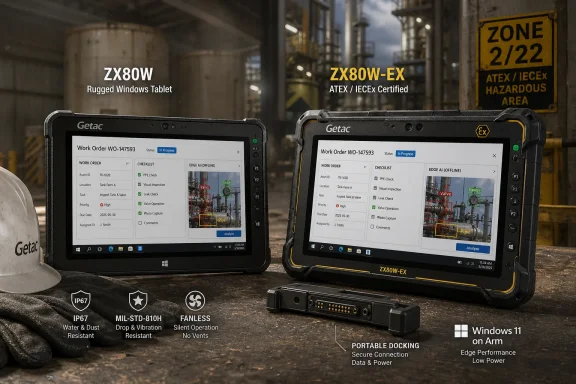
Gloved worker uses a rugged Getac ZX80W industrial tablet in a factory, with durability and certification badges overlayed.Getac Pushes Windows on Arm Into the Dirt​

The rugged tablet market is not where platform shifts usually begin. It is conservative by design, because the buyers are conservative by necessity: utilities, defense contractors, oil and gas operators, transport fleets, warehouses, field-service organizations, and public safety agencies do not replace hardware because a benchmark chart looks good. They replace it when the old machine is too heavy, too hot, too fragile, too power-hungry, or too expensive to support.
That is why Getac’s ZX80W matters more than its modest 8-inch footprint suggests. This is not a consumer tablet with a rubber case and a procurement SKU. It is a Windows device meant for the ugly edge of computing, where a tablet may be mounted in a vehicle one day, carried across a wet worksite the next, and used near combustible dust or flammable gas in its EX variant.
Windows on Arm has spent years being judged by the wrong audience. Enthusiasts asked whether it could replace a gaming laptop. Reviewers asked whether every niche desktop app ran perfectly. Enterprise buyers asked a harsher and more useful question: can it do the assigned job reliably, quietly, and for a full shift?
The ZX80W is built around that third question. Its Qualcomm QCS6490 is not a Snapdragon X Elite chasing laptop glory; it is an IoT-oriented ARM platform paired with 12GB of LPDDR5 memory and 256GB of UFS storage. The pitch is efficiency, thermals, local AI acceleration, and a sealed design that does not need a fan to survive the day.

The Fanless Design Is the Real Spec Sheet​

The absence of a cooling fan sounds like a minor mechanical detail until the device is used where rugged tablets are actually used. Fans move air, and air carries dust, moisture, fibers, metal particles, chemical residue, and every other environmental irritant that enterprise buyers spend money trying to keep out of electronics. A sealed fanless chassis is not just quieter; it is simpler to maintain and harder to contaminate.
For a warehouse supervisor, that may mean fewer failures after months of exposure to cardboard dust and temperature swings. For a flight-line technician, it means one less mechanical part vulnerable to grit, vibration, and impact. For a refinery or chemical plant, it pairs with hazardous-environment certification to support a more controlled approach to electronics in sensitive zones.
The ZX80W’s rugged credentials are the sort buyers expect from Getac: MIL-STD-810H testing, IP67 dust and water resistance, a quoted 1.8-meter drop tolerance, and an operating range from -29°C to +63°C. Those numbers are easy to skim past, but they define the difference between a tablet that can be carried into a storm and one that lives in a supervisor’s office because nobody trusts it outside.
The display also matters. Getac lists an 8-inch WUXGA panel with 1,000 nits of brightness and its sunlight-readable LumiBond treatment. That is not a luxury feature in the field; it is the difference between a worker reading a maintenance workflow outdoors and angling the device under a truck shadow to see a form.

Windows 11 IoT LTSC Changes the ARM Argument​

The operating system choice is just as important as the chip. Getac is not pitching the ZX80W as a general-purpose Windows 11 Home or Pro tablet. It uses Windows 11 IoT Enterprise LTSC, the long-term servicing branch aimed at fixed-function and specialized commercial devices.
That is the correct Windows for this job. Rugged deployments do not want surprise feature churn, consumer integrations, or a UI experiment arriving mid-contract. They want a stable baseline, predictable patching, and a support window long enough to justify hardware qualification, accessory investment, imaging work, and field training.
This also softens one of the classic Windows on Arm objections. On a consumer laptop, broad compatibility is the product. On an industrial tablet, compatibility is scoped. A fleet may need one electronic logging application, one barcode workflow, one VPN client, one device-management agent, one remote-support tool, and one browser-based dashboard. If those work, the rest of the Windows ecosystem is largely theoretical.
That does not make ARM compatibility irrelevant. Drivers, peripherals, VPNs, security agents, smart-card middleware, diagnostic utilities, and legacy Win32 applications still need validation. But the ZX80W’s most likely buyers already validate hardware images before deployment; they are not handing these tablets to users and hoping the app store fills the gaps.
Microsoft’s modern Windows on Arm stack is also better than the version that damaged the category’s reputation years ago. Windows 11 supports x86 and x64 app emulation on Arm, and Microsoft has continued improving the emulation layer. But emulation is a bridge, not a deployment strategy, especially in field operations where performance predictability and peripheral support can matter more than whether an app merely launches.

Qualcomm’s QCS6490 Is Not Trying to Be a Laptop Chip​

The QCS6490 is the most interesting part of the ZX80W precisely because it is not the flashiest Qualcomm part available. It is an octa-core ARM platform designed for embedded and IoT use cases, not a high-end laptop SoC marketed around creator workloads. Getac lists it at up to 2.7GHz with Qualcomm Adreno graphics and a Hexagon processor capable of up to 13 TOPS through Qualcomm’s sixth-generation AI Engine.
That 13 TOPS figure will not impress anyone comparing it with the 40-plus TOPS NPUs in Copilot+ PCs. But rugged tablets live in a different performance economy. A compact field device does not need to generate marketing art in a coffee shop; it needs to process images, sensor inputs, forms, routes, telemetry, and inspection data without burning through its battery or waiting for a cloud connection that may not exist.
This is where ARM’s strengths become less abstract. Lower heat output makes sealed designs easier. Better performance per watt stretches runtime. Integrated connectivity options matter for mobile fleets. And local acceleration can support edge workloads that would be clumsy or insecure if every inference had to leave the device.
Getac’s use-case list includes drone management, infrastructure monitoring, predictive maintenance, and electronic logging. These are sensible examples because they are not sci-fi. A tablet that can classify visual inspection data, assist with asset checks, process barcode or camera input, or support maintenance prompts locally is more useful than one that merely opens a cloud dashboard faster.

Edge AI Is Practical Only When It Is Boring​

The industry has spent the past two years attaching “AI” to everything with a processor, so skepticism is justified. The ZX80W is not an AI workstation, and Getac should not be judged as if it were. The meaningful question is whether local inference makes existing field work less dependent on connectivity and less likely to expose sensitive data.
In defense and critical infrastructure, that matters. A tablet used around substations, depots, pipelines, ports, or military logistics may collect images, locations, asset identifiers, personnel notes, and operational status. Sending all of that to a cloud service by default is not always acceptable, and in some places it is not even possible.
Local processing also reduces latency. A technician inspecting equipment does not want to wait for a remote model to process an image over a weak cellular connection. A driver logging compliance data does not want an app to stall because coverage dropped between depots. A maintenance worker using guided workflows wants the device to respond like a tool, not like a web page trapped behind a spinning icon.
The ZX80W’s NPU is best understood as a way to make small, repetitive, targeted tasks more reliable at the edge. That is less glamorous than generative AI demos, but it is closer to how enterprise AI will actually show up in rugged computing. The field does not need a chatbot in a hard hat; it needs software that can keep working when the network disappears.

The EX Model Is Where Rugged Becomes Regulated​

The ZX80W-EX adds ATEX and IECEx Zone 2/22 certification for hazardous environments where flammable gases or combustible dust may be present. That makes it a different kind of product, even if the core platform remains the same. Ruggedness keeps a device alive; hazardous-location certification helps determine whether it is allowed through the gate.
This distinction matters because industrial buyers do not treat certifications as brochure decorations. A device used in a chemical plant, refinery, mine, pharmaceutical facility, or fuel logistics site may need to satisfy internal safety requirements before it can be deployed. A consumer tablet in a rugged case is not a substitute for equipment certified for the relevant zone.
The EX version is heavier at 780g, compared with the ZX80W’s listed 590g. That is a real increase, but still compact by the standards of rugged Windows hardware. Many field workers have grown accustomed to carrying larger Intel-based rugged tablets that behave more like small laptops with handles than mobile tablets.
The ZX80W-EX also illustrates why the ARM shift is not merely about battery life. Removing fans, reducing heat, and minimizing mechanical complexity all align with the requirements of hazardous and punishing environments. In that context, the processor architecture becomes part of the safety and reliability story, not just the performance story.

The Weight Reduction Is an IT Issue, Not a Comfort Perk​

A 590g fully rugged Windows tablet sounds like a spec-sheet win, but weight is also a deployment variable. The heavier a device is, the more likely workers are to leave it in a vehicle, mount it permanently, swap it for a phone, or avoid using it until paperwork is unavoidable. Mobility hardware fails not only when it breaks, but when it is inconvenient enough to be bypassed.
That is especially true in workflows where the user already carries tools, protective equipment, radios, scanners, test instruments, or safety gear. A lighter Windows tablet can be the difference between digitizing a workflow at the point of work and digitizing it later, after the worker returns to a desk. The first changes operations; the second merely changes the form.
This is one reason the 8-inch size is important. The ZX80W is not trying to replace a 14-inch rugged laptop used for complex diagnostics or report writing. It is aimed at quick interaction: viewing work orders, scanning assets, capturing photos, checking procedures, logging readings, managing routes, or controlling field equipment.
Windows has historically struggled in this size class because small tablets expose the limits of desktop UI assumptions. But in controlled enterprise deployments, that problem can be managed with custom applications, kiosk modes, task-specific shells, and touch-first workflows. Again, the narrower the job, the more sense Windows on Arm makes.

Intel Is Not Being Replaced Everywhere​

It would be easy to frame the ZX80W as another sign of Intel losing ground in Windows devices. That is partly true, but too simplistic. Intel and AMD remain essential in rugged computing where high sustained performance, specialized x86 software, complex peripheral stacks, and mature driver support are non-negotiable.
Getac itself sells larger rugged Windows machines built around x86 processors, and those are not going away because an 8-inch ARM tablet exists. A technician running heavy diagnostics, CAD viewers, legacy service tools, or multi-monitor docked workflows may still be better served by an Intel or AMD device. ARM’s opportunity is not to erase x86 from the field; it is to claim the jobs where x86 has been tolerated rather than required.
That distinction is important for IT buyers. A rugged fleet does not have to be architecturally pure. It can include x86 laptops for complex work, ARM tablets for lightweight field capture, Android handhelds for narrow scanning roles, and phones where appropriate. The winning architecture is the one that fits the task and can be supported without multiplying headaches.
The ZX80W therefore lands in a middle zone. It offers Windows manageability and application continuity in a form factor and thermal envelope more often associated with Android rugged tablets. That is its pitch: not the most powerful Windows field device, but perhaps a more deployable one for frontline workflows that never needed a hot little PC in the first place.

The Price Will Keep This Out of Consumer Fantasyland​

Getac has not announced pricing, and that omission is normal for rugged enterprise hardware. These devices typically move through B2B channels, configured with options, accessories, service plans, docks, mounts, scanners, cellular modules, warranties, and support contracts. A single street price would be less useful than it looks.
Still, nobody should expect bargain-table pricing. The previous Android ZX80 family started around the low four figures in European enterprise channels, and a Windows model with industrial support, rugged certification, and optional hazardous-environment configuration will almost certainly sit above ordinary consumer tablets. The ZX80W is not competing with an iPad or a Surface Go at retail.
That price context matters because rugged hardware often looks overpriced until total cost is considered. A cheap tablet that fails in the field, cannot be read in sunlight, lacks replaceable or shift-friendly power options, breaks after drops, or cannot pass safety review may be cheaper only on the purchase order. The expensive part is dispatching workers with tools they cannot rely on.
The tougher question is whether Windows on Arm introduces hidden costs: application remediation, driver validation, security tooling gaps, or user training. For some organizations, those costs will erase the efficiency advantage. For others, especially those with modern web apps or custom ARM-ready software, the trade may be favorable.

Microsoft Gets a More Credible Windows on Arm Story​

Microsoft has wanted Windows on Arm to be a real platform for a long time. The consumer version of that story has been uneven, even as recent Snapdragon laptops have improved the case substantially. But rugged and embedded devices may be where the platform’s logic becomes harder to dismiss.
Windows on Arm is most persuasive when efficiency, standby behavior, integrated connectivity, low heat, and sealed designs matter more than peak compatibility with decades of desktop software. That description fits field tablets better than it fits gaming rigs or developer workstations. The ZX80W plays directly to those strengths.
The use of Windows 11 IoT Enterprise LTSC also gives Microsoft a cleaner enterprise narrative. Instead of asking users to accept the full consumer Windows experience on unfamiliar silicon, it offers a stable, managed, specialized Windows environment on hardware designed for a defined job. That is a more disciplined proposition.
There is also a strategic angle. If Windows on Arm can move into rugged tablets, industrial handhelds, point-of-service devices, medical equipment, logistics terminals, and edge-AI appliances, Microsoft gains a broader hardware base without needing every traditional PC user to switch. ARM adoption may grow first where the user does not care what the CPU is, as long as the device works.

The Compatibility Trap Has Not Disappeared​

The danger for buyers is assuming that “Windows 11” means “drop-in replacement.” It may not. Windows on Arm can run many x86 and x64 applications through emulation, but specialized environments are full of awkward exceptions: kernel drivers, old VPN clients, USB accessories, smart-card readers, serial adapters, label printers, proprietary diagnostics, and security agents with deep system hooks.
Rugged deployments often rely on accessories as much as the tablet itself. Vehicle docks, hand straps, hot-swap batteries, barcode readers, NFC workflows, GPS, cellular modules, external antennas, and charging bays all need to work in the real configuration, not just in a spec table. The more specialized the environment, the less useful generic compatibility claims become.
This is why pilot deployments will matter. A ZX80W evaluation should include the actual image, actual MDM policies, actual line-of-business applications, actual gloves, actual mounts, actual wireless dead zones, and actual workers. A lab test that proves the tablet boots and joins management is not enough.
The same applies to AI features. Buyers should ask what models run locally, what software exposes the NPU, how updates are handled, what happens offline, and whether data stays on the device by default. “AI-ready” is a starting point, not a solution architecture.

The Rugged Tablet Becomes a Platform Decision​

For years, rugged tablets were often purchased as physical tools first and computing platforms second. The key questions were durability, battery life, screen brightness, warranty, and accessory ecosystem. Those still matter, but the ZX80W shows how platform decisions are becoming entangled with edge computing strategy.
Choosing this device is not just choosing Getac. It is choosing Windows on Arm, Windows 11 IoT Enterprise LTSC, Qualcomm’s embedded roadmap, Getac’s accessory and support ecosystem, and whatever software stack can take advantage of the NPU. That makes procurement more complex, but also more consequential.
The upside is a more coherent field architecture. A fanless ARM Windows tablet can sit between Android handhelds and x86 rugged PCs, giving organizations a Windows-managed endpoint for tasks that do not justify a heavier machine. If the software estate supports it, that could simplify workflows that currently bounce between phones, paper, and laptops.
The downside is fragmentation. IT teams may end up supporting Windows x86, Windows Arm, Android, iOS, and browser-based workflows in the same operational environment. Without discipline, the “right tool for every job” becomes five platforms, six management models, and a support desk that hates everyone.

The July Launch Will Test the Channel, Not the Hype​

Availability in July 2026 gives Getac a short runway between announcement and market entry. That is appropriate for enterprise hardware, where early conversations likely began long before the press release. The important action will happen in reseller demos, proof-of-concept deployments, and procurement reviews rather than in public preorders.
The device’s success will depend on how well Getac and its partners answer practical questions. How long does the battery last in real field use? Which accessories are available at launch? Which cellular options are supported in each region? How does the EX model’s certification map to customer safety requirements? Which Windows management and security tools have been validated on the ARM image?
The answers will vary by customer, and that is normal. Rugged computing is not a mass-market category hiding behind enterprise language. It is a project business, full of site-specific constraints and workflows that outsiders find oddly particular because they are oddly particular.
That is also why the ZX80W deserves attention. Products in this category are not built for vibes. If Getac is putting Windows on Arm into an 8-inch fully rugged tablet, it is because the company believes enough customers see a practical advantage in fanless, efficient, locally intelligent Windows endpoints.

The Field Test Will Be Whether Workers Stop Leaving Windows Behind​

The most concrete lesson from the ZX80W is that Windows on Arm is no longer confined to thin laptops and platform demonstrations. Getac is betting that the architecture can solve physical problems that x86 Windows tablets have often worked around with bulk, heat, and larger batteries.
  • The ZX80W is an 8-inch fully rugged Windows 11 IoT Enterprise LTSC tablet built on Qualcomm’s ARM-based QCS6490 platform.
  • Getac says the standard model weighs 590g, while the hazardous-area ZX80W-EX weighs 780g.
  • The fanless design is central to the product because sealed rugged devices benefit directly from lower heat and fewer moving parts.
  • The ZX80W-EX adds ATEX and IECEx Zone 2/22 certification for certain explosive-atmosphere environments.
  • The device’s edge-AI value will depend less on headline TOPS and more on validated local workflows that work offline.
  • Enterprise buyers should treat Windows on Arm compatibility as a pilot requirement, especially for drivers, accessories, VPNs, security tools, and legacy line-of-business applications.
The ZX80W will not make every rugged Windows tablet suddenly ARM-based, and it does not need to. Its importance is narrower and more believable: it shows Windows on Arm finding a job where efficiency, silence, sealed hardware, long support, and edge processing are not marketing flourishes but operational requirements. If the July launch proves that the software and accessory ecosystem can keep up, the next phase of Windows on Arm may be measured less by laptop reviews and more by how many field workers stop leaving their Windows device in the truck.

References​

  1. Primary source: gagadget.com
    Published: 2026-06-03T15:10:15.832548
  2. Related coverage: getac.com
  3. Related coverage: prnewswire.com
  4. Related coverage: belsatex.com
  5. Related coverage: qualcomm.com
  6. Related coverage: atexdepot.nl
  1. Related coverage: ecom-ex.com
  2. Related coverage: windowscentral.com
  3. Official source: learn.microsoft.com
  4. Official source: microsoft.com
  5. Official source: developer.microsoft.com
  6. Official source: support.microsoft.com
  7. Official source: blogs.windows.com
  8. Related coverage: windowslatest.com
  9. Related coverage: computerworld.com
  10. Related coverage: tomshardware.com
  11. Related coverage: techradar.com
  12. Related coverage: arrow.com
 

Getac announced on June 3, 2026, that its new ZX80W and ZX80W-EX rugged 8-inch Windows tablets will ship in July 2026 with Qualcomm QCS6490 ARM processors, fanless designs, Windows 11 IoT Enterprise LTSC, and optional hazardous-location certification for explosive environments. The headline is not that another rugged tablet exists; Getac already knows that market well. The real story is that Windows on ARM is moving into places where failure is not annoying but operationally expensive, physically dangerous, or both. If the ZX80W works as advertised, it is a small device with a large implication: the old trade-off between Windows compatibility and field-friendly hardware is starting to weaken.

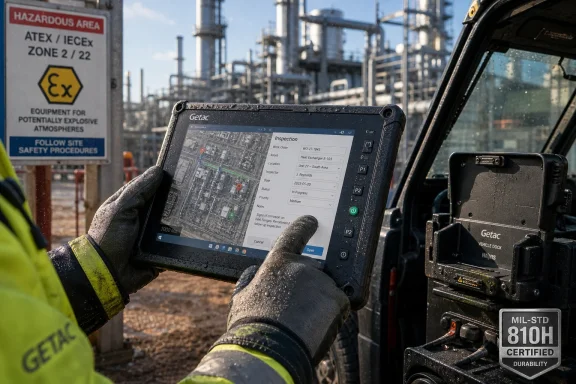
Worker scans an inspection tablet at an industrial plant marked hazardous area with ATEX/IECEx Zone signage.Windows on ARM Leaves the Coffee Shop​

For years, Windows on ARM has been discussed as if its natural habitat were the thin-and-light laptop: a machine for executives, students, and battery-life obsessives who spend their days in browsers, Teams calls, and Microsoft 365. That framing was always too narrow. ARM’s deeper advantage is not glamour; it is the ability to put useful compute into constrained thermal and power envelopes.
The Getac ZX80W is a good example of why that matters. A rugged field tablet has different priorities from a Surface-style ultraportable. It must survive dust, vibration, rain, shock, sunlight, gloves, vehicle docks, long shifts, and users who are not paid to baby hardware. In that world, a fan is not just a cooling component. It is an opening, a moving part, a maintenance concern, and a liability.
Getac’s move also arrives at a moment when Microsoft’s ARM strategy is more credible than it used to be. The Copilot+ PC push put Qualcomm-powered Windows machines back into the mainstream conversation, but enterprise buyers do not care much about platform narratives unless the software stack behaves. Rugged deployments are even less forgiving. If an oil-and-gas operator, defense contractor, utility crew, or logistics fleet standardizes on a Windows device, it is because there are existing Windows applications, management policies, security baselines, and workflows that would be painful to abandon.
That is why the ZX80W is more interesting than its screen size suggests. It is not a consumer tablet trying to be tough. It is a Windows endpoint built around the assumption that the edge of the network is increasingly where the work happens.

The Fanless Chassis Is the Product Strategy​

The most important specification in the ZX80W may be the absence of a specification: no cooling fan. In consumer electronics, fanless design is usually sold as elegance. In industrial computing, it is closer to risk management.
Fans pull air through systems, and air in the field often carries dust, salt, moisture, metal particles, chemicals, or combustible material. The less a device needs to breathe, the easier it is to seal. That is why a fanless rugged Windows tablet is more than a comfort upgrade for workers who do not want noise. It changes where the device can plausibly be used and how often IT teams need to think about failure modes that have nothing to do with software.
Getac says the ZX80W is MIL-STD-810H certified, IP67 rated, vibration resistant, and drop resistant up to 6 feet, or 1.8 meters. The operating range for the standard model stretches from -29°C to +63°C, a range that comfortably exceeds the normal ambitions of consumer tablets. This is hardware intended for cold mornings, hot yards, wet inspections, greasy gloves, and long periods away from a desk.
The weight matters too. At 590 grams, the ZX80W is light for a fully rugged Windows device. The rugged category has long asked workers to accept heft as the price of reliability. That bargain may still be reasonable for a 12-inch tablet mounted in a vehicle, but it becomes harder to justify for users who carry a device all shift, climb ladders, scan assets, inspect lines, or work in constrained spaces.
Getac’s bet is that ARM efficiency lets Windows move into a more mobile industrial shape without becoming an underpowered curiosity. That is the right bet to test. The field does not need another delicate tablet in a rubber case. It needs Windows devices that behave less like small laptops and more like purpose-built instruments.

The Specs Are Modest Until You Read Them Like an IT Buyer​

The Qualcomm QCS6490 inside the ZX80W is not a Snapdragon X Elite laptop chip, and that is the point. It is an embedded and industrially oriented platform, not a prestige processor for benchmark charts. Getac pairs it with 12GB of LPDDR5 memory and 256GB of UFS storage, which sounds ordinary until you remember that this device is aimed at data capture, forms, diagnostics, mapping, asset management, communications, and edge automation rather than video editing.
The display is an 8-inch WUXGA panel rated at 1,000 nits with Getac’s sunlight-readable technology. That number is more operationally significant than a processor turbo frequency. A tablet that cannot be read outdoors is a failure in a utility yard, on a flight line, beside a road, or in a logistics depot. Field workers do not experience specs in a lab sequence; they experience them as friction or relief.
The device also includes the usual rugged-tablet ingredients that make it fit into enterprise workflows: programmable buttons, front and rear cameras, USB-C with DisplayPort and power delivery, microSD or SIM options, Wi-Fi 6E, Bluetooth 5.2, dedicated GPS, and optional cellular connectivity including 5G Sub-6. These are not glamorous features, but they are the connective tissue of real deployments. A tablet that cannot dock, scan, locate, authenticate, and communicate reliably is not a platform. It is a screen with a warranty problem.
Security is similarly pragmatic. The use of Windows 11 IoT Enterprise LTSC matters because rugged devices often have longer service lives and slower change cycles than ordinary PCs. Feature churn is not a virtue when a device is validating maintenance steps in a plant or supporting regulated work. A stable Windows image with a long support runway is precisely what many industrial buyers want.
That does not mean the ZX80W will be effortless to deploy. Windows on ARM still requires careful application testing, especially around legacy drivers, older utilities, VPN clients, endpoint agents, browser plug-ins, and peripherals. But enterprise IT knows how to test Windows images. The more important question is whether the ARM transition buys enough battery life, thermals, sealing, and weight reduction to justify that validation work.

Edge AI Becomes Less Abstract When the Network Disappears​

Getac is leaning into edge AI with the ZX80W and ZX80W-EX, and for once the phrase is not entirely marketing vapor. The QCS6490 includes a Qualcomm Hexagon NPU rated by Getac at up to 13 TOPS with the sixth-generation Qualcomm AI Engine. That is not a Copilot+ PC-class number, but industrial AI is not always about running giant models locally. Often it is about recognition, inference, anomaly detection, barcode and image workflows, sensor interpretation, and real-time decision support.
The edge matters because the field is full of bad networks. Mines, refineries, ships, depots, rural infrastructure, disaster zones, basements, substations, and military sites all have places where cloud assumptions fall apart. A workflow that depends on a round trip to a data center may be fine in an office and useless in a steel structure or remote site.
Local processing also has a security argument. Defense and critical-infrastructure buyers are not eager to stream every image, inspection result, location point, or equipment reading off-site if they can avoid it. A tablet that can perform useful processing locally reduces latency and limits exposure. It does not eliminate the need for cloud systems, but it changes the balance between centralization and autonomy.
The examples Getac cites — UAV control, infrastructure monitoring, predictive asset management, electronic logging, and hazardous-environment workflows — all fit this logic. None requires us to imagine a rugged tablet as a science-fiction brain. They require a device that can do enough at the edge to keep workers productive when connectivity, time, and safety margins are thin.
That is where Windows on ARM could find a more defensible identity than “MacBook battery life, but Windows.” In rugged computing, the goal is not to win a lifestyle comparison. The goal is to put a manageable Windows endpoint into environments where x86 thermals and device bulk have historically made that difficult.

The EX Model Shows Where the Money Is​

The ZX80W-EX is the more specialized sibling, and it may be the more revealing product. It adds ATEX and IECEx Zone 2/22 certification for environments where flammable gases or combustible dust may be present. In plain English, this is the version for places where a normal device is not merely fragile but potentially unsafe.
That certification changes the audience. Chemical plants, oil refineries, pharmaceutical facilities, petrochemical sites, mining operations, and certain manufacturing environments do not buy equipment on the same logic as consumers. They buy around risk, compliance, uptime, and auditability. A cheaper tablet that cannot enter the work area is not cheaper in any meaningful operational sense.
The EX model weighs 780 grams, heavier than the standard ZX80W but still compact given its purpose. Getac lists additional safety-oriented design changes, including thicker display glass, an enhanced back cover, secure port covering, and sealed exposed screw areas. This is the unglamorous engineering that tends to determine whether a device can be used where the work actually happens.
There is a useful reminder here for anyone watching Windows hardware primarily through the lens of laptops. The PC market is not just notebooks, desktops, and gaming rigs. It is also vehicle-mounted systems, medical carts, warehouse scanners, police tablets, diagnostic tools, industrial panels, and intrinsically safe devices. Those categories move slowly, but when they move, they can anchor platform decisions for years.
If Windows on ARM can earn trust in the EX version of a rugged tablet, it will have done something more difficult than impress a reviewer with standby time. It will have passed into a procurement category where conservatism is rational.

The Compatibility Story Is Better, Not Finished​

No serious discussion of an ARM-based Windows field device can skip compatibility. Microsoft and Qualcomm have made real progress, especially with native ARM64 applications and x86/x64 emulation, but industrial deployments live in the long tail. That long tail contains ancient configuration tools, obscure USB adapters, scanner utilities, serial-device bridges, custom line-of-business apps, security agents, print drivers, and VPN clients with unpleasant assumptions about architecture.
This is where Getac’s choice of Windows 11 IoT Enterprise LTSC is important but not magical. LTSC can reduce platform churn and keep a fleet stable, but it does not make every driver appear or every vendor recompile. Buyers will need pilot programs, peripheral inventories, application validation, and a sober view of what must run locally versus what can be modernized.
The good news is that rugged tablets are often deployed for bounded workflows. A field crew may need a defined set of apps, authentication tools, maps, camera functions, forms, scanning, messaging, and device-management hooks. That is easier to validate than the chaotic software universe of a general-purpose employee laptop.
The bad news is that a single missing driver can still sink a deployment. An ARM tablet that cannot talk to a required diagnostic cable, label printer, smart-card reader, gas sensor, or proprietary dock is not 95 percent successful. It is unsuccessful at the point of work.
That is why the ZX80W should be seen less as proof that Windows on ARM has solved everything and more as evidence that the platform has matured enough to be tested in harsher, more specialized places. The burden shifts from “does this idea make sense?” to “does this fleet’s exact software and peripheral stack work?”

Pricing Silence Says This Is Not a Gadget Launch​

Getac has not announced pricing, and that silence is normal for this category. Rugged tablets are typically sold through enterprise channels, configured with options, warranties, docks, accessories, service agreements, and certifications. The sticker price is only part of the acquisition cost, and in many deployments it is not even the most important part.
That said, nobody should expect the ZX80W to compete with consumer tablets. The earlier Android-based ZX80 started around the low four figures in some enterprise channels, and a Windows ARM model with rugged certification, IoT Enterprise licensing, and optional hazardous-environment credentials is likely to sit comfortably above mainstream consumer pricing. For the EX model, certification alone pushes the device into a different economic category.
The more meaningful comparison is not with an iPad, a Surface Go, or a cheap Android slab in a case. It is with existing rugged Windows tablets, older x86 field devices, and dedicated industrial handhelds. If the ZX80W reduces weight, heat, downtime, and charging dependency while preserving Windows manageability, the business case will not need to look like a consumer bargain.
Enterprise buyers tend to think in fleet math. How long does the device last? How often does it fail? How many accessories must be stocked? How quickly can a worker complete a task? How many hours are lost to charging, unreadable screens, broken ports, or devices that cannot be used in restricted areas? In that frame, a fanless ARM Windows tablet could justify a premium even if its raw performance looks unremarkable on paper.
This is also why Getac’s warranty and service story matters. Rugged hardware is bought as an ecosystem: docks, batteries, mounts, chargers, hand straps, vehicle power, repair turnaround, imaging support, and lifecycle availability. A clever processor choice gets attention, but support logistics win renewals.

Microsoft Gets a New Kind of ARM Proof Point​

For Microsoft, devices like the ZX80W are strategically useful because they broaden the Windows on ARM story beyond consumer enthusiasm cycles. The company does not need every rugged tablet to become ARM overnight. It needs credible examples showing that ARM Windows can serve serious enterprise roles where power efficiency and manageability intersect.
That helps counter one of the platform’s oldest problems: the perception that Windows on ARM is always waiting for a future that never quite arrives. In the consumer market, each new generation is judged against MacBooks, Intel ultrabooks, AMD laptops, game compatibility, Adobe performance, and battery tests. In industrial computing, the comparison can be more favorable. The question is not whether the device is the fastest Windows machine. The question is whether it is the best Windows machine for that environment.
There is also a quiet licensing and lifecycle angle. Windows 11 IoT Enterprise LTSC gives Microsoft a path into dedicated-purpose devices that should not be treated like ordinary PCs. These machines need security updates and management compatibility, but they do not necessarily need constant feature additions. That distinction fits rugged deployments better than the consumer Windows update cadence ever did.
Qualcomm benefits too. The QCS6490 is positioned for IoT and embedded use, and the ZX80W gives it a Windows-facing industrial win rather than another Android handheld. The more Qualcomm can show ARM silicon running real enterprise Windows workloads outside premium laptops, the less the platform looks like a one-segment experiment.
The risk is that expectations outrun the reality. A 13 TOPS NPU, an efficient processor, and a rugged chassis do not automatically create a transformed field operation. Enterprises still need software integration, data governance, device management, training, and support. The ZX80W is enabling infrastructure, not a digital transformation wand.

The Rugged PC Market Rewards Boring Success​

The most encouraging thing about the ZX80W is that its ambitions are fundamentally boring. It wants to be carried all day. It wants to survive rain, dust, vibration, drops, and heat. It wants to run Windows line-of-business software. It wants to process enough locally to be useful when the network is unreliable. It wants to avoid a fan.
That is exactly the kind of boring that matters in enterprise hardware. The flashy parts of the PC industry tend to revolve around peak performance, thin bezels, OLED panels, and AI demos. Rugged buyers care about whether the device can be read in sun, held with gloves, cleaned, dropped, docked, tracked, locked down, and repaired.
There is a broader lesson here for Windows hardware makers. ARM does not need to win everywhere at once. It can win first in places where x86’s disadvantages are most obvious: thermally constrained designs, sealed devices, always-mobile workflows, and long shifts away from power. Rugged tablets check all of those boxes.
The ZX80W will not settle the Windows on ARM debate. But it may move the debate into a more practical register. Instead of asking whether ARM Windows can replace every Intel or AMD laptop, the better question is where ARM makes the Windows device possible, lighter, safer, or easier to seal.
That is a more interesting question because it has specific answers. Field tablets are one of them.

The Small Tablet That Makes the Platform Argument Concrete​

Getac’s ZX80W launch leaves several practical points for WindowsForum readers who track enterprise hardware, deployment risk, and Microsoft’s ARM roadmap:
  • The ZX80W is scheduled for July 2026 availability and brings Windows 11 IoT Enterprise LTSC to an 8-inch fully rugged ARM tablet.
  • The standard model weighs 590 grams, while the hazardous-location ZX80W-EX weighs 780 grams and adds ATEX and IECEx Zone 2/22 certification.
  • The Qualcomm QCS6490 platform gives Getac a fanless Windows design with 12GB of LPDDR5 memory, 256GB of UFS storage, and an NPU rated at up to 13 TOPS.
  • The rugged credentials include MIL-STD-810H certification, IP67 protection, vibration resistance, and 6-foot drop resistance.
  • Enterprise buyers should treat application, driver, dock, scanner, VPN, and peripheral validation as the central deployment question, not as a footnote.
  • Pricing has not been announced, but this is plainly a B2B rugged computing product rather than a consumer tablet with a tough shell.
The ZX80W is not the device that makes Windows on ARM universal, and it does not need to be. Its significance is narrower and stronger: it shows ARM Windows moving into the kind of field hardware where efficiency, sealing, weight, and lifecycle stability matter more than benchmark theater. If Getac and Microsoft can make that equation work in the dust, rain, heat, cold, and regulatory complexity of rugged deployments, Windows on ARM will have earned something more valuable than hype — it will have earned a job.

References​

  1. Primary source: gagadget.com
    Published: 2026-06-03T15:10:17.304547
  2. Related coverage: getac.com
  3. Related coverage: belsatex.com
  4. Related coverage: qualcomm.com
  5. Related coverage: atexdepot.nl
  6. Related coverage: ruggedtechla.com
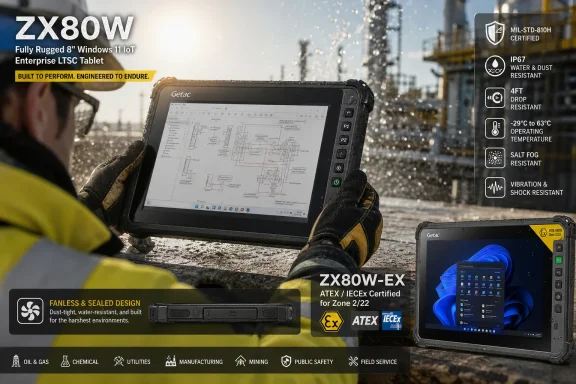
 

Getac announced on June 4, 2026, that its 8-inch ZX80 rugged tablet family is expanding with two Windows 11 on Arm models, the ZX80W and ATEX/IECEx-certified ZX80W-EX, both scheduled for July 2026 availability. The headline is not simply that another rugged tablet is getting a spec refresh. It is that Windows on Arm is moving from the conference-stage laptop story into the grittier world of utilities, logistics, defense, and hazardous industrial sites. That is where the platform’s promises of lower heat, longer runtime, and local AI processing will either prove useful—or be exposed as another neat architecture idea that enterprise software stacks are not ready to absorb.

Two rugged Getac tablets display inspection checklists in an industrial facility with an ATEX “Zone 2/22” sign.Getac Takes Windows on Arm Somewhere Less Polished Than the Laptop Aisle​

The consumer PC industry has spent the past few years trying to make Windows on Arm feel normal. Qualcomm and Microsoft have talked up battery life, AI acceleration, and a widening app ecosystem, while laptop makers have tried to frame Arm as the inevitable next phase of Windows mobility. Getac’s ZX80W and ZX80W-EX are a more interesting test because rugged tablets do not get to live on vibes.
A field tablet is not bought because it looks good in a coffee shop. It is bought because a worker can drop it, read it in sunlight, use it in rain or dust, and keep it alive through a shift that may not include a wall outlet. For that market, Arm’s usual pitch—performance per watt—lands with much less abstraction.
Getac is positioning the ZX80W line around exactly that: a compact 8-inch Windows device that can run fanlessly, avoid the thermal compromises of more power-hungry chips, and still give organizations a familiar Windows management and application environment. The move matters because rugged mobility has often forced an uncomfortable choice between Android’s mobility strengths and Windows’ enterprise gravity. Getac is betting that Arm narrows that gap.
The company’s existing ZX80 family already leaned into Qualcomm silicon and compact rugged design. The “W” suffix is the tell. These are Windows devices, not Android tablets trying to approximate enterprise compatibility through mobile apps and browser front ends. In industrial IT, that distinction can be the difference between a smooth rollout and a year of workaround tickets.

The Real Product Is Not the Tablet, It Is the Compromise It Avoids​

The ZX80W and ZX80W-EX use Qualcomm’s QCS6490 platform, an octa-core Arm-based chip aimed at industrial and IoT-class devices rather than premium consumer laptops. Getac lists 12GB of LPDDR5 memory and 256GB of UFS storage, which places the tablets above the bare-minimum embedded Windows appliance tier without pretending to be workstation replacements. That is probably the correct target.
The more important design choice is fanless operation. Fans are a minor nuisance on a desk and a major liability in industrial hardware. They draw in dust, moisture, and contaminants; they add moving parts; and they complicate sealed-device design. In a rugged tablet, removing the fan is not just a comfort feature. It is part of the durability story.
That also explains why Getac is not chasing spec-sheet theatrics. The point is not to beat an x86 tablet in a benchmark sprint. The point is to keep a device usable in the field without cooking itself, draining its battery too quickly, or forcing the chassis to grow beyond the point where an 8-inch rugged tablet still makes sense.
For years, Windows tablets in harsh environments have tended to skew larger, heavier, or more thermally constrained than their Android counterparts. Getac’s argument is that Windows on Arm changes the physical equation. If the OS and applications cooperate, the same class of device that used to feel like an Android-only form factor can now host a Windows workload.

Windows 11 IoT Enterprise LTSC Is the Quietly Important Detail​

Getac says the ZX80W runs Windows 11 IoT Enterprise LTSC, and that is more significant than the Windows 11 branding alone. LTSC is not meant for the feature-churn rhythm of consumer Windows. It is meant for fixed-purpose and specialized devices where stability, security servicing, and predictable behavior matter more than having the newest shell experiment.
That maps cleanly to rugged tablets. A utility crew, warehouse operator, or defense contractor does not want a device’s interface or application assumptions shifting underfoot because a semiannual feature wave landed at the wrong time. In field operations, change control is not bureaucracy for its own sake; it is how organizations avoid breaking the job.
The IoT LTSC angle also helps explain why a Windows tablet can still make sense in a world where Android is strong in handhelds. Many organizations already have Windows identity, endpoint management, VPN, certificate, logging, and application practices. If the rugged tablet can slot into that world with fewer exceptions, the hardware premium can be easier to justify.
But there is a catch. Windows on Arm may emulate x86 and x64 applications, but the strongest deployments will be the ones that validate workloads carefully and, where possible, run native Arm64 software. Rugged buyers tend to care about the last 10 percent of compatibility because that last 10 percent often includes a scanner driver, a proprietary inspection tool, a VPN client, or a legacy line-of-business application that no one has touched since the Obama administration.

Edge AI Sounds Like Marketing Until the Network Disappears​

Getac is also leaning into AI at the edge. The ZX80W models include Qualcomm’s Hexagon NPU through the QCS6490 platform, with Getac describing use cases such as real-time recognition, analytics, automation, UAV flight control, predictive asset management, and electronic logging in transport and logistics. This is the part of the announcement most likely to be dismissed as obligatory 2026 AI language, but field computing is one of the places where local inference has a practical argument.
Cloud AI assumes connectivity. Field work often does not. A tablet used around substations, pipelines, ports, depots, industrial yards, and disaster zones may face patchy service or deliberate network restrictions. In those conditions, a device that can perform recognition, triage, or automation locally is not just saving latency. It is preserving workflow continuity.
The harder question is whether customers will actually deploy meaningful edge AI workloads on an 8-inch rugged Windows tablet. An NPU is potential energy. It becomes operational value only when paired with trained models, validated workflows, software that can use the accelerator, and an IT/security process that permits local processing of operational data.
That makes Getac’s AI claim credible but not self-fulfilling. The hardware is pointed in the right direction, especially for visual inspection, asset identification, sensor-adjacent workflows, and offline decision support. The implementation burden will sit with customers, integrators, and software vendors. In rugged computing, that is not a footnote; it is often the main event.

The EX Model Is Where Rugged Stops Being a Lifestyle Word​

The ZX80W-EX adds ATEX/IECEx Zone 2/22 certification for hazardous and potentially explosive environments. That moves the product from “tough tablet” into a more specialized category where device design can affect worker safety and regulatory compliance. Oil and gas, chemical processing, pharmaceuticals, utilities, and certain manufacturing environments do not treat battery-powered electronics casually.
Getac says the EX variant includes intrinsically safe design features such as thicker display glass, an enhanced back cover, a secured port cover for the main docking connector, and mylar seals on exposed screw covers. Those are not glamorous additions, but they are the sorts of details that separate a device designed for an industrial brochure from one intended to pass through a safety review.
The trade-off is visible in the weight. Getac lists the standard ZX80W at 590 grams and the ZX80W-EX at 780 grams. Both are light by fully rugged standards, but the EX model’s extra protection and certification add mass. In this category, that is less a flaw than a reminder that “rugged” is not a single attribute. A tablet built for a dusty warehouse and a tablet cleared for hazardous zones are solving overlapping but different problems.
The operating temperature ranges tell a similar story. Getac lists the ZX80W at -29°C to 63°C, while the ZX80W-EX is rated from -21°C to 55°C. The EX version is more specialized, not universally more extreme. Certification and intrinsically safe construction often impose their own boundaries.

Microsoft’s Arm Problem Has Shifted From “Can It Run Apps?” to “Will IT Trust It?”​

A few years ago, the obvious objection to Windows on Arm was application compatibility. That concern has not vanished, but it has changed shape. Windows 11 on Arm supports x86 and x64 emulation, and Microsoft has continued improving the Prism emulator in recent Windows releases. For many mainstream apps, the experience is no longer the immediate dealbreaker it once was.
Enterprise field deployments, however, are not mainstream consumer scenarios. The annoying cases matter more: kernel drivers, old middleware, niche peripherals, custom browser controls, serial adapters, smart-card readers, inspection accessories, and VPN or endpoint security agents that assume x86. A single unsupported component can turn an elegant Arm deployment into a pilot-program museum piece.
That is why Getac’s choice of Windows 11 IoT Enterprise LTSC cuts both ways. It is the right Windows edition for stability-minded devices, but it also raises the standard for validation. Organizations choosing these tablets will not be casual buyers installing whatever app they fancy. They will be fleet operators expecting consistent images, support windows, accessory compatibility, and known-good update behavior.
Microsoft’s broader Windows on Arm progress helps Getac. Native Arm versions of more applications reduce friction, and emulation gives IT a fallback for many legacy binaries. But rugged deployments will still reward conservatism. The winning sales motion is not “Windows apps just work.” It is “your specific Windows workload, peripherals, security stack, and management model have been tested on this hardware.”

Android Is the Rival Getac Is Really Arguing Against​

The ZX80W announcement is framed as Windows 11 functionality in a compact form factor, but the implied competitor is Android rugged hardware. Android has been a natural fit for small field tablets because it is power-efficient, touch-first, mobile-friendly, and well supported by scanning, logistics, and handheld ecosystems. It is often the easier answer when the job is data capture rather than desktop-style computing.
Windows retains its pull where organizations need legacy applications, Win32 tooling, domain practices, or a closer match with existing endpoint governance. The tension is that Windows devices have historically been heavier, hotter, or shorter-lived on battery in small rugged designs. Getac’s pitch is that Arm lets Windows compete on the physical qualities that made Android attractive.
That does not mean Windows will displace Android across rugged mobility. Many frontline workflows are already mobile-native, cloud-managed, and deeply integrated with Android device management. For those, a Windows tablet may be unnecessary overhead. The strongest case for ZX80W is the mixed environment: organizations that want field mobility without surrendering Windows-native software, security assumptions, or operational tooling.
This is why the 8-inch size matters. A 12-inch rugged Windows tablet is a known thing: capable, heavy, and often used as a laptop alternative. An 8-inch Windows rugged tablet is more assertive. It says Windows wants to be present not just in vehicles, control rooms, and carts, but in the hand.

Rugged Hardware Turns Spec Sheets Into Operational Math​

Getac lists MIL-STD-810H and IP67 certifications, vibration resistance, a 6-foot drop rating, and a daylight-readable display. These are familiar rugged-computing phrases, but their value depends on work patterns rather than marketing. A bright display matters if the tablet is used outdoors all day. IP67 matters if exposure to dust or water is routine. Drop resistance matters if the user is wearing gloves, climbing, loading, inspecting, or working near machinery.
The ZX80W’s compact size gives it a plausible role in jobs where a laptop is absurd and a phone is too constrained. Electronic logging, inspection forms, asset lookup, work orders, mapping, guided procedures, and field communications all fit naturally on a small tablet. Add local AI and the device could become more than a digital clipboard, at least in deployments where software vendors build for it.
The all-day productivity claim should be treated as a direction, not a universal measurement. Battery life in rugged devices depends heavily on screen brightness, radios, peripherals, temperature, workload, and whether the device is constantly capturing data or merely displaying forms. Still, the fanless Arm design gives Getac a stronger foundation for that claim than a conventional small Windows tablet running a hotter x86 chip.
The deeper operational math is total fleet downtime. If a tablet runs longer, gets less hot, survives more abuse, and needs fewer accessory compromises, the savings show up in fewer swaps, fewer depot tickets, and less worker improvisation. That is the economic case rugged vendors sell, and Arm may make it easier to defend.

The July Launch Will Test a Very Specific Kind of Windows Momentum​

The ZX80W and ZX80W-EX are scheduled for July 2026 availability, which places them in a Windows on Arm market that is more mature than it was during the early Surface Pro X era but still not invisible to IT planners. Consumer attention has largely followed Snapdragon X laptops and AI PCs. Getac is operating in a narrower lane, where the question is not whether Arm can make Windows feel modern, but whether it can make Windows field hardware feel practical.
That distinction matters for Microsoft as much as for Getac. Windows has long dominated desks, laptops, and many specialized embedded environments, but the frontline device market has been more fragmented. If Windows on Arm can make smaller, sealed, durable, long-running devices viable, Microsoft gets another route into work that might otherwise standardize around Android.
For Qualcomm, the win is similarly strategic. The QCS6490 is not being sold here as a consumer laptop brain. It is industrial silicon for devices that need longevity, efficiency, and local intelligence. That is a better story for Arm in Windows than simply asking users to compare app launch times against an Intel or AMD laptop.
For buyers, though, the burden remains practical. Rugged fleets are conservative because failures are expensive and visible. The ZX80W line will need more than good architecture. It will need predictable accessories, stable images, driver readiness, security-agent support, and proof that emulated apps do not become battery or performance traps in daily use.

The Small Tablet Is Now a Referendum on Windows in the Field​

The most concrete lesson from Getac’s announcement is that Windows on Arm is no longer confined to premium thin-and-light PCs. It is being asked to serve workers who care less about platform ideology than about whether the device survives the shift. That is a healthier test than another laptop launch because it strips the story down to utility.
  • The ZX80W and ZX80W-EX bring Windows 11 on Arm into Getac’s 8-inch fully rugged tablet line, with availability planned for July 2026.
  • Both tablets use Qualcomm’s QCS6490 platform with 12GB of LPDDR5 memory and 256GB of UFS storage.
  • The standard ZX80W emphasizes compact, fanless Windows field computing, while the ZX80W-EX adds ATEX/IECEx Zone 2/22 certification for hazardous environments.
  • The Arm architecture is central to the product argument because it enables lower heat, sealed fanless design, and longer operation in a small rugged chassis.
  • The edge AI claims are plausible for offline recognition, inspection, and automation workloads, but their value will depend on software support and deployment discipline.
  • The biggest adoption risk is not raw performance; it is compatibility across legacy apps, drivers, peripherals, VPNs, security tools, and management stacks.
Getac’s new tablets are not likely to make Windows on Arm fashionable, and that may be precisely why they matter. Fashionable platforms win headlines; boring platforms win fleets. If the ZX80W and ZX80W-EX can give field organizations the manageability of Windows, the endurance of Arm, and the physical resilience expected from rugged hardware, they will mark a small but meaningful expansion of where Windows belongs. The next phase will be less about announcing Arm-based Windows devices and more about proving, one messy deployment at a time, that the old Windows ecosystem can fit into smaller, tougher, more power-conscious machines.

References​

  1. Primary source: acrofan.com
    Published: 2026-06-04T00:10:27.642380
  2. Related coverage: getac.com
  3. Official source: learn.microsoft.com
  4. Related coverage: ruggedtechla.com
  5. Related coverage: einpresswire.com
  6. Related coverage: windowscentral.com
  1. Official source: developer.microsoft.com
  2. Official source: answers.microsoft.com
  3. Related coverage: howtogeek.com
  4. Official source: blogs.windows.com
  5. Related coverage: tweakers.net
  6. Related coverage: tomshardware.com
  7. Related coverage: techradar.com
 

Back
Top