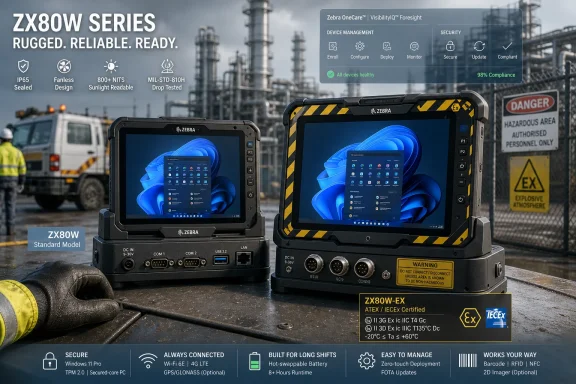
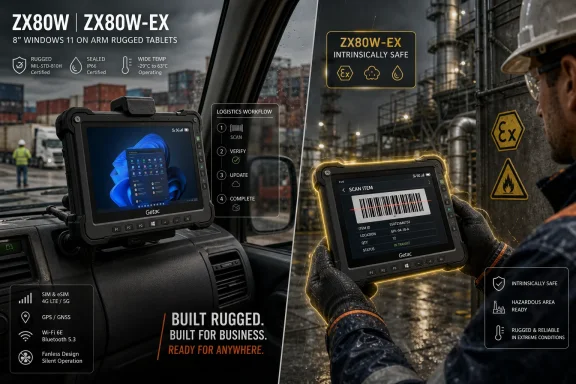
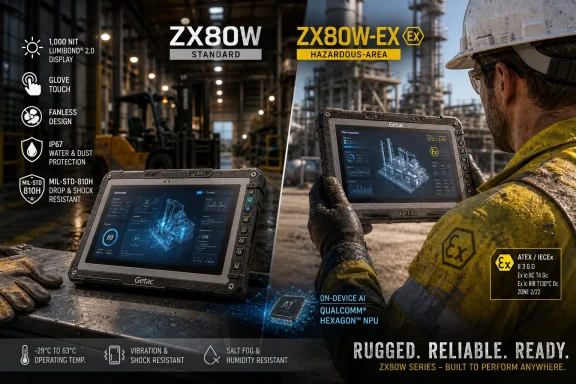
Getac announced on June 3, 2026, that its ZX80 family of 8-inch fully rugged tablets is expanding with the Windows 11-powered ZX80W and hazardous-location ZX80W-EX, both built around Qualcomm’s QCS6490 Arm platform and scheduled for availability in July 2026. The important part is not merely that another rugged tablet has arrived; it is that Windows on Arm is moving deeper into field computing, where battery life, thermals, certification, and fleet management matter more than benchmark theater. Getac is betting that enterprise Windows can finally live comfortably in the kind of compact, fanless hardware that used to push buyers toward Android. For sysadmins and operations teams, that makes this launch less a gadget story than a test of whether Arm-based Windows has become boring enough to deploy.

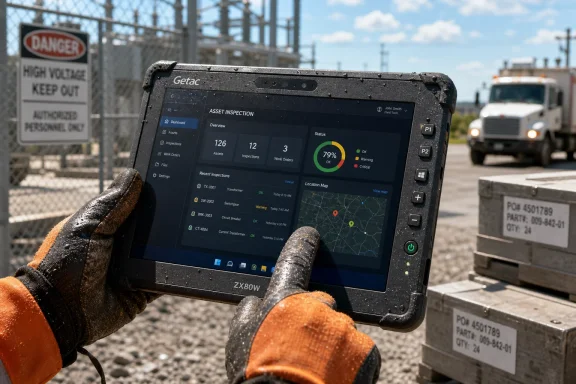
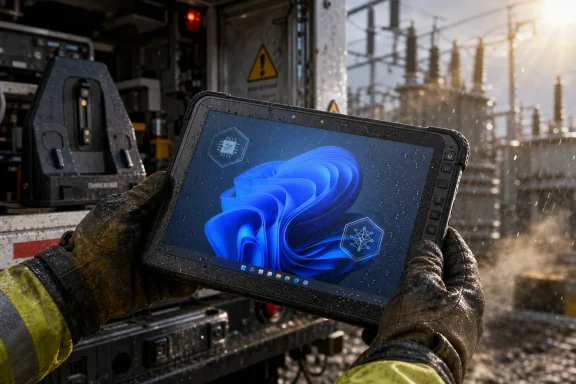
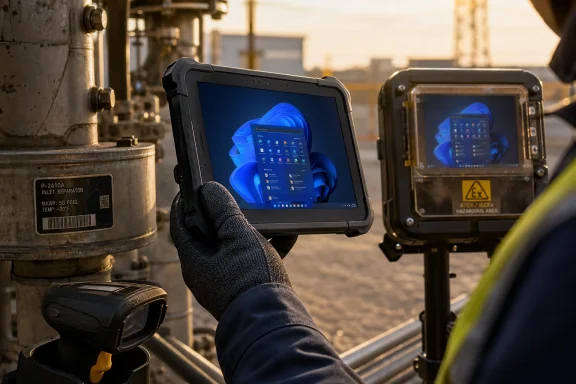
Gloved hand holds a rugged tablet displaying Windows, inspecting industrial equipment at sunset.Windows on Arm Leaves the Conference Room and Heads for the Yard​

For years, Windows on Arm has been discussed mostly through the lens of consumer laptops, developer kits, and Microsoft’s long campaign to make thin-and-light PCs behave more like phones. That framing misses one of the more practical places where Arm can matter: field devices that must run all day, survive abuse, avoid fans, and still remain manageable inside a Microsoft-centric enterprise.
Getac’s ZX80W and ZX80W-EX land squarely in that category. They are not trying to replace a workstation or a high-end mobile CAD rig. They are designed for people who scan assets, inspect infrastructure, manage logistics, coordinate field crews, interact with industrial systems, and work in places where a dropped tablet is a routine event rather than a support ticket anomaly.
The choice of Windows 11 IoT Enterprise LTSC is the signal. This is not a retail Windows tablet chasing the iPad. It is a fixed-purpose, enterprise-oriented Windows endpoint meant to sit inside a managed fleet, run line-of-business applications, and remain stable over long service periods.
That matters because rugged computing has always been less glamorous and more consequential than the consumer PC market admits. A warehouse tablet that fails halfway through a shift can slow an operation. A utility tablet that overheats on a job site can delay maintenance. A hazardous-location device that lacks the right certification simply cannot be used where the work actually happens.

Getac Sells a Familiar Rugged Promise With a Different Engine​

The ZX80W and ZX80W-EX follow Getac’s long-established rugged playbook: compact body, sealed design, sunlight-readable display, broad operating temperature range, resistance to drops and vibration, and certifications meant to reassure procurement teams that the hardware is not just “tough-looking.” The standard ZX80W weighs about 590 grams, while the ZX80W-EX comes in heavier at roughly 780 grams because it adds protection for hazardous environments.
Both tablets are 8-inch devices, which is an increasingly important size in field computing. A 10- or 12-inch rugged tablet can be more comfortable for forms, maps, and dashboards, but it can also be too heavy or awkward for workers who are climbing, driving, checking equipment, or carrying other tools. An 8-inch unit is closer to the sweet spot for one-handed work, especially when it is paired with vehicle docks, straps, barcode scanners, or workflow-specific accessories.
The headline specifications are practical rather than theatrical. Both devices use Qualcomm’s QCS6490 platform, include 12GB of LPDDR5 memory, and provide 256GB of UFS storage. The design is fanless, which is not just a comfort feature; fewer moving parts and fewer openings are useful in dusty, wet, dirty, or chemically sensitive environments.
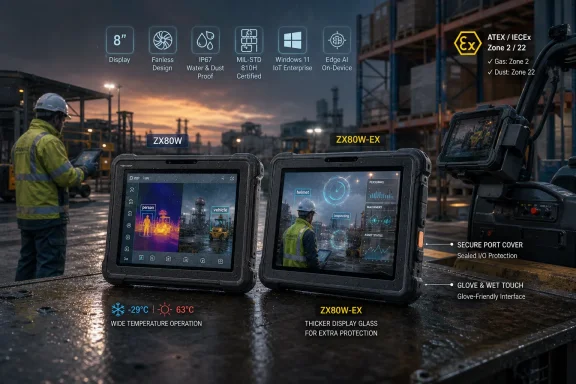
The ZX80W-EX is the more specialized model. Its ATEX and IECEx Zone 2/22 certification targets hazardous or potentially explosive environments, which is the difference between a device that looks rugged and one that can be approved for certain industrial sites. Getac also calls out thicker display glass, reinforced rear protection, a secure port cover for the main docking connector, and seals on exposed screw covers.

The Real Product Is Not the Tablet, It Is the Compromise​

The rugged tablet market is built on compromise. Buyers want Windows compatibility, long runtime, sealed hardware, sunlight readability, survivability, light weight, and support for legacy workflows. Historically, they could usually get some of those things, but not all of them in a small package.
Windows has been the compatibility answer. Android has often been the battery-life and mobility answer. x86 chips have been the safer bet for application support. Arm chips have been the more attractive bet for thermals and efficiency. Rugged-device buyers have lived in the space between those poles.
Getac is now arguing that the old trade-off is weakening. If Windows 11 IoT Enterprise LTSC on Arm can run the needed software stack, then an 8-inch fanless Windows tablet becomes much easier to justify. It can slot into existing Microsoft management practices while behaving more like the mobile device field workers already expect.
That is the theory. The deployment reality will depend on application compatibility, driver support, peripheral support, and how much of an organization’s field software estate is still tied to x86 assumptions. Windows on Arm has improved considerably, but rugged deployments are often allergic to surprises. A niche USB peripheral, a decades-old inspection app, or an unsigned driver can matter more than the operating system’s marketing page.
This is why the ZX80W is interesting but not magical. It may be a better answer for many organizations, but it still asks IT departments to do the unglamorous work of validation. The hardware story is convincing only if the software story survives the pilot.

Windows 11 IoT LTSC Is the Quiet Star of the Launch​

Consumer Windows 11 is a moving target by design. It changes, accumulates features, experiments with interface nudges, and increasingly acts as a delivery vehicle for Microsoft’s AI and cloud priorities. That is not always what industrial customers want from a device bolted into a workflow.
Windows 11 IoT Enterprise LTSC exists for a different rhythm. It is aimed at dedicated systems where stability and lifecycle predictability are more valuable than receiving every consumer-facing feature. For devices used in vehicles, plants, depots, utilities, emergency services, and manufacturing floors, that distinction is not academic.
Getac’s use of LTSC helps explain why this tablet is plausibly a Windows device rather than just a Windows-branded mobile experiment. Enterprise buyers want security updates, management consistency, and application support, but they do not necessarily want feature churn in the middle of a multi-year field deployment. A rugged tablet may remain in service long after a consumer laptop has been replaced twice.
The WindowsForum audience will recognize the tension here. Enthusiasts often talk about LTSC as a cleaner, calmer version of Windows. In the enterprise and IoT world, the point is narrower: LTSC is about keeping fixed-purpose systems fixed-purpose. The less often a field device changes behavior unexpectedly, the fewer times IT has to explain to operations why a familiar workflow now looks different.

Qualcomm’s QCS6490 Gives the Device Its Plausible Future​

The QCS6490 is not being pitched here as a gaming chip or a laptop-class bruiser. It is an IoT-focused Qualcomm platform aimed at connected edge devices that need efficiency, camera and sensor handling, AI acceleration, and multi-OS support. That makes it a more logical fit for a rugged tablet than a repurposed consumer PC processor.
The efficiency argument is straightforward. A fanless sealed tablet benefits from a chip that can deliver acceptable performance without dumping too much heat into a small chassis. In the field, performance-per-watt can matter more than peak performance, because a fast device that throttles, dies early, or gets too hot to hold is not actually faster in operational terms.
The platform’s support for Windows 11 IoT Enterprise also matters because this is no longer an exotic science project. Microsoft and Qualcomm have spent years broadening Windows on Arm beyond the early Surface Pro X era, and industrial hardware is one of the places where the payoff may be easier to see. The more standardized the silicon and OS support become, the less scary these deployments look to conservative IT teams.
That said, “AI-ready” should be treated carefully. The presence of a Qualcomm Hexagon NPU and a sixth-generation Qualcomm AI Engine means the hardware has local acceleration for certain workloads. It does not mean every field application will suddenly become intelligent, offline, and automated. The software has to be written, tested, secured, and integrated before the NPU becomes more than a line item.

Edge AI Sounds Like Hype Until the Network Drops​

Getac’s pitch for edge AI is familiar: real-time recognition, analytics, on-device automation, and reduced dependency on the cloud. In a normal consumer launch, that language can blur into the general AI fog now surrounding nearly every device announcement. In rugged field computing, however, the argument is more concrete.
Field workers often operate where connectivity is unreliable, expensive, congested, or restricted. A utility crew inspecting infrastructure, a logistics worker moving through a yard, or a technician operating near industrial equipment may not have a stable connection at the moment the software needs to make a decision. In that context, local inference is not a novelty; it is a way to keep the workflow moving.
The more credible use cases are narrow and operational. Image recognition for inspections, anomaly detection for assets, local processing for sensors, assisted data capture, and workflow automation are all plausible fits. Getac’s examples, including utility UAV control, predictive asset management, hazardous-environment work, and electronic logging in transport, fit the pattern.
The catch is that edge AI is only as useful as the process around it. A model running locally can reduce latency and cloud dependency, but it also introduces questions about model updates, auditability, data retention, false positives, and user training. For regulated or safety-sensitive work, the device’s AI capability must be treated as part of the system, not a decorative accelerator.

The Hazardous-Location Model Is More Than a Rugged Upsell​

The ZX80W-EX is the more consequential of the two devices because it addresses environments where ordinary electronics are not merely fragile but potentially unsafe. ATEX and IECEx Zone 2/22 certification places the tablet into a category relevant to workplaces where explosive gases, vapors, dust, or similar hazards may be present under defined conditions.
That changes the buying logic. A standard rugged tablet competes on durability, ergonomics, battery life, screen quality, accessories, and total cost of ownership. A hazardous-location device competes first on whether it is allowed onto the site. Certification can be the gating factor before anyone debates software performance.
Getac’s additional design details for the EX model are therefore not cosmetic. Thicker display glass, reinforced covers, secured connectors, and sealed screw areas all speak to the practical realities of intrinsically safer hardware. These are not features that excite consumers, but they are the kinds of details that safety officers, industrial buyers, and field operations teams care about.
The EX model also highlights why Windows remains sticky in industrial environments. Many hazardous-location workflows are tied to existing enterprise systems, reporting tools, inspection databases, identity infrastructure, and device-management policies. If a certified tablet can provide those Windows workflows in a smaller, lighter, more efficient design, that becomes a procurement argument with real force.

The Android Comparison Is the Subtext Getac Wants Buyers to Hear​

Getac’s announcement is careful but unmistakable: Windows functionality in a compact, fanless, all-day form factor is being positioned against the kind of mobility historically associated with Android rugged devices. This is the central strategic claim. The company is not simply saying the ZX80W is a Windows tablet; it is saying Windows can now compete in a class where Android often had the ergonomic advantage.
Android has been strong in rugged handhelds and compact tablets because it is efficient, touch-first, familiar to mobile users, and supported by a large ecosystem of scanning, logistics, and field-service applications. But Android can be awkward for organizations whose backend workflows, authentication, endpoint management, or legacy applications are Windows-first. Every Android deployment in a Windows-heavy enterprise can become an integration project.
Windows, by contrast, brings Group Policy heritage, Microsoft identity integration, familiar security tooling, and a vast legacy application base. It also brings baggage: resource expectations, update management, app compatibility complexity, and a user interface that was not born in a warehouse aisle. Windows on Arm is an attempt to preserve the former while reducing some of the latter.
The ZX80W therefore sits in an interesting middle ground. It is not trying to make Windows fashionable. It is trying to make Windows small, sealed, efficient, and manageable enough that organizations do not have to choose Android simply to get mobility.

App Compatibility Remains the Deployment Tax​

No serious Windows on Arm story can ignore compatibility. Microsoft’s emulation work has improved, and native Arm64 software is more common than it used to be, but enterprise field deployments do not live in a clean app-store universe. They are full of custom utilities, old middleware, browser dependencies, device drivers, label printers, scanners, smart-card readers, VPN clients, and management agents.
For a device like the ZX80W, the question is not whether Windows on Arm can run Windows apps in general. The question is whether it can run your Windows apps, with your peripherals, inside your security stack, over your network, for your workers, in the conditions where your organization actually operates. That is the difference between a promising specification sheet and a successful deployment.
This is where IT departments should be both open-minded and stubborn. Open-minded because Arm-based Windows devices may now solve problems that x86 rugged tablets solved clumsily. Stubborn because every driver, agent, and workflow needs testing before procurement signs a large order.
The good news is that rugged deployments already tend to involve pilots, accessory validation, imaging decisions, device-management planning, and environmental testing. The bad news is that Arm adds another axis to the checklist. The organizations most likely to succeed with this class of device are the ones that treat architecture as a deployment variable, not an afterthought.

Fleet Management Is Where the Sales Pitch Meets Reality​

A rugged field tablet is rarely bought as a single device. It is bought as part of a fleet, with spares, docks, chargers, mounts, warranties, imaging processes, repair procedures, and help-desk scripts. The true product is the operational system around the hardware.
For Windows shops, the attraction is obvious. A Windows 11 IoT Enterprise LTSC tablet can fit into familiar management models more naturally than an Android alternative, depending on the organization’s tooling. Identity, policy, patching, application distribution, encryption, and remote assistance can all be aligned with existing Microsoft-oriented practices.
But fleets are unforgiving. A small driver problem multiplied across hundreds of devices becomes a major operational nuisance. A battery-runtime assumption that works in a lab but fails on a winter shift becomes a labor issue. A display that is readable in marketing photos but marginal in direct sunlight becomes a productivity problem.
Getac’s rugged credentials reduce some of that risk, but they do not remove it. Ruggedness is not a single property; it is a system of design choices tested against specific standards and real-world abuse. Buyers should still evaluate docks, gloves, wet touch behavior, stylus needs, charging logistics, cleaning procedures, and repair turnaround.

The Timing Favors a More Serious Windows on Arm Conversation​

This launch arrives after a period in which Windows on Arm has become more credible across the broader PC market. The attention has mostly gone to Copilot+ PCs and higher-profile Snapdragon-powered laptops, but the enterprise IoT implications may be just as significant. Once Windows on Arm is no longer treated as weird, industrial vendors can build around it with less market resistance.
Getac is taking advantage of that shift. The ZX80W does not need to convince users that Arm is the future of all Windows computing. It only needs to convince field operations teams that Arm is good enough, efficient enough, and compatible enough for a specific class of rugged Windows endpoint.
That is a lower bar and a more useful one. The history of enterprise computing is full of technologies that failed as universal revolutions but succeeded as targeted tools. Windows on Arm may be most persuasive where the constraints are sharpest: battery life, thermals, sealing, weight, and long-term manageability.
The July 2026 availability window also gives buyers a near-term planning target. Organizations refreshing rugged fleets in the second half of 2026 will have another option to evaluate, particularly if they have been stuck between bulky x86 Windows tablets and Android devices that do not quite fit their enterprise stack.

Microsoft’s Platform Strategy Benefits Even If Getac Does the Selling​

Microsoft has a platform problem that is also a platform opportunity. Windows remains deeply entrenched in enterprise workflows, but many frontline and industrial devices have drifted toward mobile operating systems because they were more efficient and better suited to compact hardware. Every Windows on Arm industrial device is a small attempt to reclaim that edge.
The ZX80W is not a mass-market Windows moment. Most consumers will never see one. But platform health is not only measured by consumer excitement. It is also measured by whether hardware makers can take Windows into specialized markets without fighting the OS at every step.
For Microsoft, Windows 11 IoT Enterprise LTSC on Qualcomm silicon gives OEMs a way to build sealed, efficient, long-lived devices that still belong to the Windows family. That helps preserve Windows’ relevance in places where the operating system might otherwise be replaced by Android, Linux, or proprietary embedded platforms.
For Qualcomm, the launch is another proof point that its IoT silicon can move beyond development kits and reference designs into certified, operationally serious hardware. The company has spent years positioning its platforms for the intelligent edge. Rugged Windows tablets give that positioning a practical face.

The Price of Efficiency Is a More Disciplined Buyer​

The ZX80W line should not be read as a blanket recommendation to move rugged Windows fleets to Arm. It should be read as evidence that the option is becoming mature enough to deserve serious evaluation. That is a meaningful distinction.
A disciplined buyer will ask whether the target workflow is browser-based, UWP, native Arm64, emulated x86, peripheral-heavy, or driver-dependent. They will ask whether field workers need offline maps, barcode scanning, smart-card authentication, VPN access, serial connectivity, camera workflows, or real-time sensor processing. They will ask whether the same device image can serve multiple teams or whether the hardware will fragment the support model.
They will also ask whether the benefits are operationally measurable. Does the fanless design reduce failure points? Does the weight difference reduce fatigue? Does battery life cover a full shift with realistic screen brightness and radios active? Does local AI processing reduce manual work, or is it a feature waiting for a future software project?
That is the right kind of skepticism. Rugged hardware is expensive because failure is expensive. If Arm-based Windows reduces failure, runtime anxiety, and device weight without breaking compatibility, it earns its place. If it creates a new support burden, the efficiency story gets weaker fast.
The Field Tablet Fight Now Turns on Trust, Not Specs​

The most concrete lesson from Getac’s announcement is that rugged Windows devices are becoming more mobile without surrendering their enterprise identity. The ZX80W and ZX80W-EX are not revolutionary because they have an 8-inch screen or an NPU. They are notable because they bring together Windows 11 IoT LTSC, Arm efficiency, rugged certification, and hazardous-location options in a form factor aimed at real field work.
  • Getac’s ZX80W and ZX80W-EX are 8-inch fully rugged Windows 11 tablets built on Qualcomm’s QCS6490 Arm platform and scheduled for July 2026 availability.
  • The standard ZX80W targets compact, fanless field productivity, while the ZX80W-EX adds ATEX and IECEx Zone 2/22 certification for hazardous environments.
  • Windows 11 IoT Enterprise LTSC is central to the product strategy because it gives enterprise buyers a more stable fixed-purpose Windows platform than consumer Windows releases.
  • The Arm architecture promises better efficiency and thermals, but enterprise buyers still need to validate app, driver, peripheral, and management compatibility.
  • The edge AI hardware is most credible when tied to specific offline or low-connectivity workflows such as inspection, asset management, and field automation.
  • The real competition is not only other rugged tablets; it is the old assumption that compact all-day field devices must choose Android over Windows.
Getac’s new tablets do not settle the Windows-on-Arm debate, but they move it into a more useful arena. The question is no longer whether Arm can make a stylish Windows laptop with good battery life; it is whether Arm can make Windows disappear into the background of hard, repetitive, safety-sensitive work. If the ZX80W family performs as promised, the future of rugged Windows may be less about carrying a PC into the field and more about giving field workers a device that finally behaves as if it was built for them from the start.

References​

  1. Primary source: PR Newswire UK
    Published: Wed, 03 Jun 2026 08:00:00 GMT
  2. Official source: learn.microsoft.com
  3. Related coverage: getac.com
  4. Official source: microsoft.com
  5. Related coverage: forum.aim-linux.advantech.com
  6. Related coverage: ruggedtechla.com
 

Getac announced the ZX80W on June 3, 2026, as an 8-inch fully rugged Windows 11 IoT Enterprise LTSC tablet using Qualcomm’s ARM-based QCS6490 platform, with availability planned for July 2026 in field-heavy markets including defense, utilities, transportation, and logistics. The interesting part is not that another rugged tablet exists. It is that Getac is trying to make Windows on ARM feel less like a consumer-laptop experiment and more like a practical answer to a very old field-computing problem. For IT buyers, the ZX80W is a small device with a larger argument inside it: Windows can move closer to the worker without dragging the old thermal, battery, and form-factor compromises along for the ride.

Technician holds a rugged Getac tablet showing asset inspection stats and a map near industrial construction warning signs.Getac Shrinks the Windows Field Kit Without Shrinking the Windows Pitch​

The rugged tablet market has always lived in a compromise zone. Field teams want something light enough to carry all day, bright enough to read outdoors, tough enough to survive drops and weather, and familiar enough that IT does not have to rebuild workflows from scratch. Historically, Windows has won the familiarity argument while Android has often won the mobility argument.
The ZX80W is Getac’s attempt to collapse that divide. It takes the 8-inch rugged-tablet shape usually associated with Android devices and puts Windows 11 IoT Enterprise LTSC on ARM inside it. That matters because it changes the sales conversation from “which platform do we standardize on?” to “can we finally deploy Windows where Android used to be the practical default?”
This is not a normal Windows tablet dressed in rubber armor. Getac is pitching a fanless, ARM-based device built around Qualcomm’s QCS6490, with 12GB of LPDDR5 memory and 256GB of UFS storage. The spec sheet says edge AI, rugged certification, sunlight readability, and long-duration use; the subtext says that a Windows endpoint no longer has to be a laptop-adjacent object.
That distinction matters in the sectors Getac names. A utility worker flying a drone near a substation, a logistics operator using an electronic logging device, or a defense user operating in a dusty, wet, cold, or hot environment does not want a delicate productivity slab. They want an appliance that happens to run the organization’s software stack.

Windows on ARM Finds a Less Glamorous, More Convincing Home​

Windows on ARM has spent years chasing the laptop mainstream, often with mixed results. The promise has been familiar: better battery life, instant-on responsiveness, thinner designs, and integrated connectivity. The difficulty has been equally familiar: app compatibility, driver support, peripheral expectations, and the inertia of decades of x86 Windows deployment.
The rugged market is different. It does not need Windows on ARM to win over every gamer, developer, creative professional, and office worker at once. It needs it to run a controlled set of applications reliably, securely, and efficiently on hardware that can stay in the field.
That is why the ZX80W is more strategically interesting than its size suggests. A rugged tablet running Windows 11 IoT Enterprise LTSC does not live in the same software chaos as a consumer PC. Its job is usually bounded: inventory, dispatch, inspection, asset management, mapping, scanning, telemetry, logging, forms, video, or remote control. If the required applications are native, web-based, emulated acceptably, or packaged for the platform, the usual Windows on ARM caveats become manageable procurement questions rather than existential blockers.
There is also a timing advantage. Enterprises have spent the past decade pushing more workflows into browser-based, cloud-connected, API-driven systems. That does not erase the need for local apps or hardware integrations, but it gives Windows on ARM a better opening than it had when every specialized workflow assumed an x86 executable and a thick-client desktop.
Getac’s choice of Windows 11 IoT Enterprise LTSC reinforces that reading. LTSC is not about chasing the newest consumer feature or feeding the Windows feature-update treadmill. It is about predictable function over a long service life, with Microsoft positioning Windows IoT Enterprise LTSC for fixed-purpose devices that need stability and long-term servicing rather than frequent feature churn.

The Fanless Design Is the Product Strategy​

It is easy to reduce fanless design to a line item, but in a rugged tablet it is closer to a design philosophy. Fans are moving parts. Moving parts dislike dust, vibration, moisture, and impact. In the field, every vent is a liability, every noise source is a tell, and every thermal constraint eventually becomes a user-experience problem.
ARM architecture gives Getac a way to make fanless Windows plausible in a smaller envelope. The Qualcomm QCS6490 is not being presented as a workstation-class chip; it is being presented as a performance-per-watt engine for edge use. That is the right frame. The ZX80W does not need to replace a CAD workstation or a developer laptop. It needs to run field applications without becoming hot, heavy, loud, or dead before the shift ends.
This is where the “all-day productivity” phrase, usually a marketing cliché, earns a little more scrutiny. In field work, battery life is not just convenience. It determines whether a worker carries fewer chargers, whether a vehicle dock becomes mandatory, whether cold-weather operation is practical, and whether a device can be trusted during emergency operations.
A fanless tablet also changes maintenance assumptions. Sealed rugged devices are not just built to survive dramatic drops; they are built to reduce the slow accumulation of failure. Dust ingress, fan degradation, thermal throttling, and blocked vents are boring problems until they happen at scale across a fleet.
The ZX80W’s rugged credentials sit in that context. Getac says the device is MIL-STD-810H and IP67 certified, vibration resistant, resistant to a 6-foot drop, and rated for operation from -20°F to 145°F. Those claims belong to the rugged-computing checklist, but the fanless ARM design is what ties them to the Windows platform story.

LTSC Turns Windows From a Moving Target Into an Appliance Platform​

The Windows detail that deserves the most attention is not simply “Windows 11.” It is Windows 11 IoT Enterprise LTSC. For normal PC users, LTSC is often misunderstood as a cleaner or quieter version of Windows. For device makers and enterprise fleets, it is something more specific: a long-term servicing channel for fixed-purpose systems where stability matters more than feature novelty.
That distinction is crucial for a rugged tablet. A field device is not a personal computer in the cultural sense, even when it runs Windows. It is an instrument. It may need to survive certification, training cycles, application validation, vehicle mounts, accessories, and replacement planning. The cost of change is not just a reboot; it is a support ticket, a broken workflow, or a failed deployment in a place where IT staff are not physically present.
Microsoft’s IoT Enterprise LTSC model gives OEMs and enterprise customers a Windows base with a long support horizon and a more static feature set than the general Windows channel. That aligns naturally with rugged hardware, where fleets are expected to last for years and where the operational cost of disruption can exceed the hardware purchase price.
It also helps explain why Getac is not pitching the ZX80W as a Copilot+ PC or a general AI laptop in miniature. The device has an NPU and Qualcomm’s AI engine, but the operating system choice points toward controlled industrial use, not consumer feature spectacle. In this context, AI is less about generating meeting notes and more about local recognition, automation, analytics, and decision support when connectivity is weak or unavailable.
That is a healthier version of the AI PC narrative than much of what the broader market has been served. Edge AI in a rugged tablet has obvious use cases: image recognition during inspection, anomaly detection near assets, data capture in vehicles, barcode or object recognition, and assisted workflows in remote environments. The challenge is not imagining use cases; it is integrating them into workflows that justify the cost and survive procurement scrutiny.

The NPU Is Useful Only If the Workflow Leaves the Cloud​

Getac says the ZX80W uses a 6th-generation Qualcomm AI Engine and a Hexagon NPU for real-time analytics and on-device automation. On the product page, the NPU is described as delivering up to 13 TOPS. That number is smaller than the headline figures attached to high-end Copilot+ PCs, but that comparison is not especially useful.
A rugged 8-inch field tablet is not trying to win a synthetic AI benchmark race. Its value depends on whether the NPU can reduce latency, conserve battery, preserve bandwidth, and keep core functions available when networks degrade. In a warehouse, truck cab, utility right-of-way, emergency scene, or industrial site, a “smart” feature that fails without a clean cloud connection is not very smart.
That is why Getac’s examples matter even if they are promotional. UAV flight control, predictive asset management, and electronic logging devices are not abstract AI demos. They are field operations where latency, reliability, and local processing can matter more than raw compute spectacle.
Still, enterprise buyers should treat the AI language as a starting point, not a conclusion. The hardware may be AI-ready, but the deployment is only as useful as the software stack. Models must be available for ARM. Applications must know how to use the NPU. Data pipelines must be governed. Offline behavior must be tested. Security teams must understand what data is being processed locally and what is transmitted later.
The lesson from the PC industry’s first wave of AI branding is that silicon capability often arrives before software maturity. The rugged sector may avoid some of that hype because its use cases are more concrete, but it will not escape the integration work.

Android’s Mobility Advantage Is Under Direct Attack​

Getac’s own framing makes the competitive target clear. The company says the ZX80W combines Windows security and compatibility with the lightweight mobility and long battery life traditionally associated with Android devices. That is a direct challenge to the usual platform split in field mobility.
Android has been attractive in rugged handhelds and small tablets because it scales down well. It is touch-native, power-efficient, familiar to users, and supported by a large mobile-device-management ecosystem. For scanning, forms, dispatch, mapping, and communications, it is often good enough or better.
Windows, however, remains deeply embedded in enterprise identity, management, legacy applications, peripheral support, and operational tooling. Many organizations already know how to secure, provision, update, and audit Windows endpoints. The appeal of a small Windows rugged tablet is that it may let IT extend existing practices farther into frontline work without maintaining a separate mobile platform for certain roles.
That does not mean Android disappears. It means the Windows option becomes less awkward in form factors where it used to look like a compromise. If a Windows tablet can be 8 inches, 1.3 pounds, fanless, rugged, and all-day viable, then the choice becomes less about operating-system stereotypes and more about application fit.
For some organizations, Android will still be the better answer. Its app ecosystem, mobile-first workflows, and device-management patterns are mature. But for environments where Windows applications, Windows authentication, or Windows security controls remain central, the ZX80W’s existence weakens the argument that mobility automatically means Android.

The Compatibility Story Still Needs Careful Testing​

The biggest risk in any Windows on ARM deployment remains compatibility. Microsoft’s emulation layer and native ARM64 ecosystem have improved significantly, but rugged deployments often depend on odd software and older assumptions. Serial adapters, scanner integrations, VPN clients, custom drivers, smart-card readers, vehicle docks, mapping packages, and line-of-business applications can expose weak links.
The ZX80W’s promise is not that every Windows workload becomes magically portable. It is that a defined set of Windows workflows may now fit into a smaller, cooler, longer-running rugged device. That is a meaningful promise, but it demands pilot testing rather than belief.
IT teams should validate the boring things first. Does the VPN client work on ARM? Does the endpoint security agent support the platform? Do required peripherals have ARM-compatible drivers? Does the barcode scanner integration behave under suspend and resume? Do management policies apply as expected? Does the application run natively, under emulation, or in a browser, and what does that do to battery life?
Those questions are not reasons to dismiss the device. They are reasons to treat it like infrastructure, not a gadget. Rugged tablets are bought for workflows, not spec-sheet admiration.
The use of Windows 11 IoT Enterprise LTSC also changes the software calculus. LTSC’s static nature is a strength for fixed-purpose systems, but it can be a constraint if an organization expects rapid access to new Windows features, changing app dependencies, or consumer-channel capabilities. The best fit is a stable, validated workflow that values long servicing more than novelty.

Rugged Specs Are Table Stakes, but Weight Is the Quiet Win​

Getac’s rugged claims are impressive but not surprising for the brand. MIL-STD-810H, IP67, vibration resistance, drop resistance, sunlight readability, and extreme temperature tolerance are part of the category’s grammar. A rugged tablet that cannot survive rough handling is not a rugged tablet; it is just an expensive apology waiting to happen.
The more revealing number is weight. At 1.3 pounds, the ZX80W is light enough to make continuous handheld use more credible. That matters because rugged computing often fails not at the technical level but at the human level. A device can be certified, secure, and powerful, but if workers hate carrying it, they will avoid it, leave it in the truck, or develop unofficial workarounds.
An 8-inch screen also sits in a practical middle ground. It is large enough for forms, maps, dashboards, inspection images, and control interfaces, but small enough for one-handed or vehicle-mounted use. The WUXGA display and 1,000-nit brightness give it a reasonable claim to outdoor usability, which is not optional in the markets Getac is chasing.
The industrial design is part of the platform argument. Windows has often been associated with bigger screens, keyboards, docks, and office-adjacent workflows. The ZX80W says Windows can be a clipboard, a controller, a scanner companion, a dashboard, or a mounted device. That is a more interesting Windows story than another thin laptop promising another hour of battery life.

The July Launch Gives Buyers a Pilot Window, Not a Reason to Rush​

Getac says the ZX80W will be available in July 2026. For most enterprise buyers, that should mark the start of evaluation rather than immediate fleet replacement. The value of a rugged Windows on ARM tablet depends heavily on workload validation, accessory availability, support commitments, and total cost of ownership.
The obvious pilot groups are those already split between Windows back-end workflows and mobile field devices. Utilities, transportation operators, logistics fleets, public-safety-adjacent teams, defense contractors, and industrial maintenance groups all face versions of the same problem: field workers need smaller devices, but IT wants manageable, secure, durable endpoints that fit existing systems.
The ZX80W could be especially attractive where Android rugged tablets have been deployed mainly because Windows hardware was too bulky or power-hungry. If a Windows device can now meet the ergonomic and battery expectations, organizations may consolidate around Windows for certain workflows. That consolidation can reduce training complexity, simplify endpoint management, and preserve compatibility with existing applications.
But buyers should also consider the platform horizon. ARM-based Windows devices require confidence in vendor support, Microsoft’s continued investment, Qualcomm’s driver ecosystem, and the availability of compatible management and security tools. A rugged tablet bought in 2026 may still be expected to operate well into the 2030s. Long servicing is only useful if the whole stack remains viable.
That is the advantage of an OEM like Getac entering this space with a purpose-built device rather than a generic consumer tablet adapted after the fact. Rugged buyers are not just buying a processor and a screen. They are buying support, accessories, warranties, docking, replacement planning, and confidence that the device was designed for abuse rather than photographed near it.

The Real Test Will Happen in the Messy Middle of Enterprise IT​

The ZX80W is easy to admire as a piece of positioning: Windows, ARM, rugged, fanless, AI-ready, compact. The harder question is whether it can survive the messy middle of enterprise IT, where good ideas meet procurement rules, legacy software, security mandates, and workers who just need the thing to work.
That middle is where Windows on ARM has often struggled. Not because the architecture is doomed, but because Windows carries an enormous ecosystem of assumptions. Every organization has a strange peripheral, a forgotten driver, a custom app maintained by one vendor, or a workflow that nobody wants to touch because it still works.
The rugged market may be more forgiving in one way and less forgiving in another. It is more forgiving because devices are often task-specific and easier to validate against a defined workload. It is less forgiving because failure happens in the field, not at a desk with a help menu open.
Getac’s best argument is therefore operational, not ideological. The company does not need to convince every Windows user that ARM is the future. It needs to convince a utilities manager, a logistics IT lead, or a defense systems integrator that this particular Windows-on-ARM device reduces friction in a particular job.
That is a narrower claim, and a stronger one.

A Small Windows Tablet Carries a Large Procurement Lesson​

The ZX80W should not be read as just another rugged SKU. It is a sign that the Windows ecosystem is becoming more willing to specialize by workload, architecture, and form factor. That is healthy. The old assumption that serious Windows computing required x86 hardware, active cooling, and laptop-like dimensions has been weakening for years; devices like this make the erosion visible.
For administrators, the most important consequence may be the return of choice. If Windows on ARM can occupy field roles that were drifting toward Android, IT departments gain another way to standardize without forcing workers into bad hardware. If it cannot, the market will expose that quickly through failed pilots and cautious purchasing.
Either way, the ZX80W lands at a useful moment. Windows 10’s mainstream end-of-support date has already forced many organizations to rethink aging field hardware. Windows 11 IoT Enterprise LTSC gives device makers a stable base for fixed-purpose systems. Qualcomm’s industrial and edge-focused silicon gives OEMs another route to fanless rugged devices. Getac is combining those currents into a product that feels less like a bet on novelty and more like an attempt to resolve a long-standing category tension.
That does not make the ZX80W universally important. It makes it strategically specific. In enterprise hardware, that is often more valuable.

The Field Tablet Checklist Has Changed​

The ZX80W’s headline specs are useful, but the real story is how they shift the evaluation criteria for rugged Windows endpoints. Buyers should look past the novelty of Windows on ARM and ask whether this architecture solves a field problem that older Windows tablets could not solve cleanly.
  • The ZX80W is an 8-inch fully rugged Windows 11 IoT Enterprise LTSC tablet built on Qualcomm’s ARM-based QCS6490 platform, with Getac planning availability in July 2026.
  • Its fanless design is not just an engineering flourish; it supports the durability, sealing, battery, and maintenance assumptions that matter in field deployments.
  • Windows 11 IoT Enterprise LTSC makes the device more suitable for fixed-purpose industrial workflows than for general-purpose consumer-style computing.
  • The device’s AI claims are most credible where local processing reduces latency, bandwidth use, or cloud dependency in defined field applications.
  • Compatibility testing remains essential because Windows on ARM success depends on applications, drivers, security agents, peripherals, and management tools working in the real deployment environment.
  • The larger competitive move is against Android’s traditional advantage in lightweight rugged mobility, not against high-performance Windows laptops.
The ZX80W will not decide the fate of Windows on ARM by itself, and it should not be treated as proof that every field workflow is ready to leave x86 behind. But it does show a more convincing path for the platform: not as a universal PC revolution, but as a practical architecture for sealed, power-efficient, task-focused Windows devices. If Getac and its customers can prove that path in the field, the next generation of rugged Windows hardware may look less like a shrunken laptop and more like the purpose-built tools frontline workers should have had all along.

References​

  1. Primary source: bastillepost.com
    Published: Wed, 03 Jun 2026 13:00:00 GMT
  2. Related coverage: getac.com
  3. Related coverage: ruggedplus.com
  4. Related coverage: advfn.com
  5. Related coverage: ruggedordie.com
  6. Related coverage: affinityenterprises.net
  1. Related coverage: mobileruggedcomputers.com
  2. Related coverage: lttpartners.com
  3. Related coverage: techradar.com
  4. Related coverage: jarltech.com
  5. Related coverage: ruggedmobiledevices.decisionpt.com
 

Getac announced the ZX80W and hazardous-area ZX80W-EX on June 3, 2026, as 8-inch fully rugged Windows 11 tablets built on Qualcomm’s ARM-based QCS6490 platform, with availability expected in July 2026 through Getac’s enterprise channel. The headline is not simply that another rugged tablet exists. It is that Windows on Arm has moved from executive travel laptops into places where fans clog, ports corrode, and downtime has a physical cost. For field IT, the ZX80W is a test of whether Microsoft’s ARM story can survive outside the conference room.

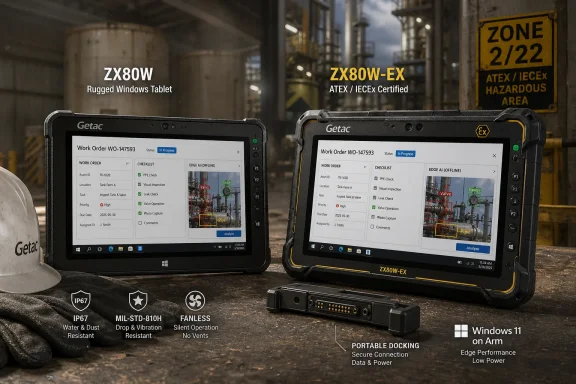
Gloved worker uses a rugged Getac ZX80W industrial tablet in a factory, with durability and certification badges overlayed.Getac Pushes Windows on Arm Into the Dirt​

The rugged tablet market is not where platform shifts usually begin. It is conservative by design, because the buyers are conservative by necessity: utilities, defense contractors, oil and gas operators, transport fleets, warehouses, field-service organizations, and public safety agencies do not replace hardware because a benchmark chart looks good. They replace it when the old machine is too heavy, too hot, too fragile, too power-hungry, or too expensive to support.
That is why Getac’s ZX80W matters more than its modest 8-inch footprint suggests. This is not a consumer tablet with a rubber case and a procurement SKU. It is a Windows device meant for the ugly edge of computing, where a tablet may be mounted in a vehicle one day, carried across a wet worksite the next, and used near combustible dust or flammable gas in its EX variant.
Windows on Arm has spent years being judged by the wrong audience. Enthusiasts asked whether it could replace a gaming laptop. Reviewers asked whether every niche desktop app ran perfectly. Enterprise buyers asked a harsher and more useful question: can it do the assigned job reliably, quietly, and for a full shift?
The ZX80W is built around that third question. Its Qualcomm QCS6490 is not a Snapdragon X Elite chasing laptop glory; it is an IoT-oriented ARM platform paired with 12GB of LPDDR5 memory and 256GB of UFS storage. The pitch is efficiency, thermals, local AI acceleration, and a sealed design that does not need a fan to survive the day.

The Fanless Design Is the Real Spec Sheet​

The absence of a cooling fan sounds like a minor mechanical detail until the device is used where rugged tablets are actually used. Fans move air, and air carries dust, moisture, fibers, metal particles, chemical residue, and every other environmental irritant that enterprise buyers spend money trying to keep out of electronics. A sealed fanless chassis is not just quieter; it is simpler to maintain and harder to contaminate.
For a warehouse supervisor, that may mean fewer failures after months of exposure to cardboard dust and temperature swings. For a flight-line technician, it means one less mechanical part vulnerable to grit, vibration, and impact. For a refinery or chemical plant, it pairs with hazardous-environment certification to support a more controlled approach to electronics in sensitive zones.
The ZX80W’s rugged credentials are the sort buyers expect from Getac: MIL-STD-810H testing, IP67 dust and water resistance, a quoted 1.8-meter drop tolerance, and an operating range from -29°C to +63°C. Those numbers are easy to skim past, but they define the difference between a tablet that can be carried into a storm and one that lives in a supervisor’s office because nobody trusts it outside.
The display also matters. Getac lists an 8-inch WUXGA panel with 1,000 nits of brightness and its sunlight-readable LumiBond treatment. That is not a luxury feature in the field; it is the difference between a worker reading a maintenance workflow outdoors and angling the device under a truck shadow to see a form.

Windows 11 IoT LTSC Changes the ARM Argument​

The operating system choice is just as important as the chip. Getac is not pitching the ZX80W as a general-purpose Windows 11 Home or Pro tablet. It uses Windows 11 IoT Enterprise LTSC, the long-term servicing branch aimed at fixed-function and specialized commercial devices.
That is the correct Windows for this job. Rugged deployments do not want surprise feature churn, consumer integrations, or a UI experiment arriving mid-contract. They want a stable baseline, predictable patching, and a support window long enough to justify hardware qualification, accessory investment, imaging work, and field training.
This also softens one of the classic Windows on Arm objections. On a consumer laptop, broad compatibility is the product. On an industrial tablet, compatibility is scoped. A fleet may need one electronic logging application, one barcode workflow, one VPN client, one device-management agent, one remote-support tool, and one browser-based dashboard. If those work, the rest of the Windows ecosystem is largely theoretical.
That does not make ARM compatibility irrelevant. Drivers, peripherals, VPNs, security agents, smart-card middleware, diagnostic utilities, and legacy Win32 applications still need validation. But the ZX80W’s most likely buyers already validate hardware images before deployment; they are not handing these tablets to users and hoping the app store fills the gaps.
Microsoft’s modern Windows on Arm stack is also better than the version that damaged the category’s reputation years ago. Windows 11 supports x86 and x64 app emulation on Arm, and Microsoft has continued improving the emulation layer. But emulation is a bridge, not a deployment strategy, especially in field operations where performance predictability and peripheral support can matter more than whether an app merely launches.

Qualcomm’s QCS6490 Is Not Trying to Be a Laptop Chip​

The QCS6490 is the most interesting part of the ZX80W precisely because it is not the flashiest Qualcomm part available. It is an octa-core ARM platform designed for embedded and IoT use cases, not a high-end laptop SoC marketed around creator workloads. Getac lists it at up to 2.7GHz with Qualcomm Adreno graphics and a Hexagon processor capable of up to 13 TOPS through Qualcomm’s sixth-generation AI Engine.
That 13 TOPS figure will not impress anyone comparing it with the 40-plus TOPS NPUs in Copilot+ PCs. But rugged tablets live in a different performance economy. A compact field device does not need to generate marketing art in a coffee shop; it needs to process images, sensor inputs, forms, routes, telemetry, and inspection data without burning through its battery or waiting for a cloud connection that may not exist.
This is where ARM’s strengths become less abstract. Lower heat output makes sealed designs easier. Better performance per watt stretches runtime. Integrated connectivity options matter for mobile fleets. And local acceleration can support edge workloads that would be clumsy or insecure if every inference had to leave the device.
Getac’s use-case list includes drone management, infrastructure monitoring, predictive maintenance, and electronic logging. These are sensible examples because they are not sci-fi. A tablet that can classify visual inspection data, assist with asset checks, process barcode or camera input, or support maintenance prompts locally is more useful than one that merely opens a cloud dashboard faster.

Edge AI Is Practical Only When It Is Boring​

The industry has spent the past two years attaching “AI” to everything with a processor, so skepticism is justified. The ZX80W is not an AI workstation, and Getac should not be judged as if it were. The meaningful question is whether local inference makes existing field work less dependent on connectivity and less likely to expose sensitive data.
In defense and critical infrastructure, that matters. A tablet used around substations, depots, pipelines, ports, or military logistics may collect images, locations, asset identifiers, personnel notes, and operational status. Sending all of that to a cloud service by default is not always acceptable, and in some places it is not even possible.
Local processing also reduces latency. A technician inspecting equipment does not want to wait for a remote model to process an image over a weak cellular connection. A driver logging compliance data does not want an app to stall because coverage dropped between depots. A maintenance worker using guided workflows wants the device to respond like a tool, not like a web page trapped behind a spinning icon.
The ZX80W’s NPU is best understood as a way to make small, repetitive, targeted tasks more reliable at the edge. That is less glamorous than generative AI demos, but it is closer to how enterprise AI will actually show up in rugged computing. The field does not need a chatbot in a hard hat; it needs software that can keep working when the network disappears.

The EX Model Is Where Rugged Becomes Regulated​

The ZX80W-EX adds ATEX and IECEx Zone 2/22 certification for hazardous environments where flammable gases or combustible dust may be present. That makes it a different kind of product, even if the core platform remains the same. Ruggedness keeps a device alive; hazardous-location certification helps determine whether it is allowed through the gate.
This distinction matters because industrial buyers do not treat certifications as brochure decorations. A device used in a chemical plant, refinery, mine, pharmaceutical facility, or fuel logistics site may need to satisfy internal safety requirements before it can be deployed. A consumer tablet in a rugged case is not a substitute for equipment certified for the relevant zone.
The EX version is heavier at 780g, compared with the ZX80W’s listed 590g. That is a real increase, but still compact by the standards of rugged Windows hardware. Many field workers have grown accustomed to carrying larger Intel-based rugged tablets that behave more like small laptops with handles than mobile tablets.
The ZX80W-EX also illustrates why the ARM shift is not merely about battery life. Removing fans, reducing heat, and minimizing mechanical complexity all align with the requirements of hazardous and punishing environments. In that context, the processor architecture becomes part of the safety and reliability story, not just the performance story.

The Weight Reduction Is an IT Issue, Not a Comfort Perk​

A 590g fully rugged Windows tablet sounds like a spec-sheet win, but weight is also a deployment variable. The heavier a device is, the more likely workers are to leave it in a vehicle, mount it permanently, swap it for a phone, or avoid using it until paperwork is unavoidable. Mobility hardware fails not only when it breaks, but when it is inconvenient enough to be bypassed.
That is especially true in workflows where the user already carries tools, protective equipment, radios, scanners, test instruments, or safety gear. A lighter Windows tablet can be the difference between digitizing a workflow at the point of work and digitizing it later, after the worker returns to a desk. The first changes operations; the second merely changes the form.
This is one reason the 8-inch size is important. The ZX80W is not trying to replace a 14-inch rugged laptop used for complex diagnostics or report writing. It is aimed at quick interaction: viewing work orders, scanning assets, capturing photos, checking procedures, logging readings, managing routes, or controlling field equipment.
Windows has historically struggled in this size class because small tablets expose the limits of desktop UI assumptions. But in controlled enterprise deployments, that problem can be managed with custom applications, kiosk modes, task-specific shells, and touch-first workflows. Again, the narrower the job, the more sense Windows on Arm makes.

Intel Is Not Being Replaced Everywhere​

It would be easy to frame the ZX80W as another sign of Intel losing ground in Windows devices. That is partly true, but too simplistic. Intel and AMD remain essential in rugged computing where high sustained performance, specialized x86 software, complex peripheral stacks, and mature driver support are non-negotiable.
Getac itself sells larger rugged Windows machines built around x86 processors, and those are not going away because an 8-inch ARM tablet exists. A technician running heavy diagnostics, CAD viewers, legacy service tools, or multi-monitor docked workflows may still be better served by an Intel or AMD device. ARM’s opportunity is not to erase x86 from the field; it is to claim the jobs where x86 has been tolerated rather than required.
That distinction is important for IT buyers. A rugged fleet does not have to be architecturally pure. It can include x86 laptops for complex work, ARM tablets for lightweight field capture, Android handhelds for narrow scanning roles, and phones where appropriate. The winning architecture is the one that fits the task and can be supported without multiplying headaches.
The ZX80W therefore lands in a middle zone. It offers Windows manageability and application continuity in a form factor and thermal envelope more often associated with Android rugged tablets. That is its pitch: not the most powerful Windows field device, but perhaps a more deployable one for frontline workflows that never needed a hot little PC in the first place.

The Price Will Keep This Out of Consumer Fantasyland​

Getac has not announced pricing, and that omission is normal for rugged enterprise hardware. These devices typically move through B2B channels, configured with options, accessories, service plans, docks, mounts, scanners, cellular modules, warranties, and support contracts. A single street price would be less useful than it looks.
Still, nobody should expect bargain-table pricing. The previous Android ZX80 family started around the low four figures in European enterprise channels, and a Windows model with industrial support, rugged certification, and optional hazardous-environment configuration will almost certainly sit above ordinary consumer tablets. The ZX80W is not competing with an iPad or a Surface Go at retail.
That price context matters because rugged hardware often looks overpriced until total cost is considered. A cheap tablet that fails in the field, cannot be read in sunlight, lacks replaceable or shift-friendly power options, breaks after drops, or cannot pass safety review may be cheaper only on the purchase order. The expensive part is dispatching workers with tools they cannot rely on.
The tougher question is whether Windows on Arm introduces hidden costs: application remediation, driver validation, security tooling gaps, or user training. For some organizations, those costs will erase the efficiency advantage. For others, especially those with modern web apps or custom ARM-ready software, the trade may be favorable.

Microsoft Gets a More Credible Windows on Arm Story​

Microsoft has wanted Windows on Arm to be a real platform for a long time. The consumer version of that story has been uneven, even as recent Snapdragon laptops have improved the case substantially. But rugged and embedded devices may be where the platform’s logic becomes harder to dismiss.
Windows on Arm is most persuasive when efficiency, standby behavior, integrated connectivity, low heat, and sealed designs matter more than peak compatibility with decades of desktop software. That description fits field tablets better than it fits gaming rigs or developer workstations. The ZX80W plays directly to those strengths.
The use of Windows 11 IoT Enterprise LTSC also gives Microsoft a cleaner enterprise narrative. Instead of asking users to accept the full consumer Windows experience on unfamiliar silicon, it offers a stable, managed, specialized Windows environment on hardware designed for a defined job. That is a more disciplined proposition.
There is also a strategic angle. If Windows on Arm can move into rugged tablets, industrial handhelds, point-of-service devices, medical equipment, logistics terminals, and edge-AI appliances, Microsoft gains a broader hardware base without needing every traditional PC user to switch. ARM adoption may grow first where the user does not care what the CPU is, as long as the device works.

The Compatibility Trap Has Not Disappeared​

The danger for buyers is assuming that “Windows 11” means “drop-in replacement.” It may not. Windows on Arm can run many x86 and x64 applications through emulation, but specialized environments are full of awkward exceptions: kernel drivers, old VPN clients, USB accessories, smart-card readers, serial adapters, label printers, proprietary diagnostics, and security agents with deep system hooks.
Rugged deployments often rely on accessories as much as the tablet itself. Vehicle docks, hand straps, hot-swap batteries, barcode readers, NFC workflows, GPS, cellular modules, external antennas, and charging bays all need to work in the real configuration, not just in a spec table. The more specialized the environment, the less useful generic compatibility claims become.
This is why pilot deployments will matter. A ZX80W evaluation should include the actual image, actual MDM policies, actual line-of-business applications, actual gloves, actual mounts, actual wireless dead zones, and actual workers. A lab test that proves the tablet boots and joins management is not enough.
The same applies to AI features. Buyers should ask what models run locally, what software exposes the NPU, how updates are handled, what happens offline, and whether data stays on the device by default. “AI-ready” is a starting point, not a solution architecture.

The Rugged Tablet Becomes a Platform Decision​

For years, rugged tablets were often purchased as physical tools first and computing platforms second. The key questions were durability, battery life, screen brightness, warranty, and accessory ecosystem. Those still matter, but the ZX80W shows how platform decisions are becoming entangled with edge computing strategy.
Choosing this device is not just choosing Getac. It is choosing Windows on Arm, Windows 11 IoT Enterprise LTSC, Qualcomm’s embedded roadmap, Getac’s accessory and support ecosystem, and whatever software stack can take advantage of the NPU. That makes procurement more complex, but also more consequential.
The upside is a more coherent field architecture. A fanless ARM Windows tablet can sit between Android handhelds and x86 rugged PCs, giving organizations a Windows-managed endpoint for tasks that do not justify a heavier machine. If the software estate supports it, that could simplify workflows that currently bounce between phones, paper, and laptops.
The downside is fragmentation. IT teams may end up supporting Windows x86, Windows Arm, Android, iOS, and browser-based workflows in the same operational environment. Without discipline, the “right tool for every job” becomes five platforms, six management models, and a support desk that hates everyone.

The July Launch Will Test the Channel, Not the Hype​

Availability in July 2026 gives Getac a short runway between announcement and market entry. That is appropriate for enterprise hardware, where early conversations likely began long before the press release. The important action will happen in reseller demos, proof-of-concept deployments, and procurement reviews rather than in public preorders.
The device’s success will depend on how well Getac and its partners answer practical questions. How long does the battery last in real field use? Which accessories are available at launch? Which cellular options are supported in each region? How does the EX model’s certification map to customer safety requirements? Which Windows management and security tools have been validated on the ARM image?
The answers will vary by customer, and that is normal. Rugged computing is not a mass-market category hiding behind enterprise language. It is a project business, full of site-specific constraints and workflows that outsiders find oddly particular because they are oddly particular.
That is also why the ZX80W deserves attention. Products in this category are not built for vibes. If Getac is putting Windows on Arm into an 8-inch fully rugged tablet, it is because the company believes enough customers see a practical advantage in fanless, efficient, locally intelligent Windows endpoints.

The Field Test Will Be Whether Workers Stop Leaving Windows Behind​

The most concrete lesson from the ZX80W is that Windows on Arm is no longer confined to thin laptops and platform demonstrations. Getac is betting that the architecture can solve physical problems that x86 Windows tablets have often worked around with bulk, heat, and larger batteries.
  • The ZX80W is an 8-inch fully rugged Windows 11 IoT Enterprise LTSC tablet built on Qualcomm’s ARM-based QCS6490 platform.
  • Getac says the standard model weighs 590g, while the hazardous-area ZX80W-EX weighs 780g.
  • The fanless design is central to the product because sealed rugged devices benefit directly from lower heat and fewer moving parts.
  • The ZX80W-EX adds ATEX and IECEx Zone 2/22 certification for certain explosive-atmosphere environments.
  • The device’s edge-AI value will depend less on headline TOPS and more on validated local workflows that work offline.
  • Enterprise buyers should treat Windows on Arm compatibility as a pilot requirement, especially for drivers, accessories, VPNs, security tools, and legacy line-of-business applications.
The ZX80W will not make every rugged Windows tablet suddenly ARM-based, and it does not need to. Its importance is narrower and more believable: it shows Windows on Arm finding a job where efficiency, silence, sealed hardware, long support, and edge processing are not marketing flourishes but operational requirements. If the July launch proves that the software and accessory ecosystem can keep up, the next phase of Windows on Arm may be measured less by laptop reviews and more by how many field workers stop leaving their Windows device in the truck.

References​

  1. Primary source: gagadget.com
    Published: 2026-06-03T15:10:15.832548
  2. Related coverage: getac.com
  3. Related coverage: prnewswire.com
  4. Related coverage: belsatex.com
  5. Related coverage: qualcomm.com
  6. Related coverage: atexdepot.nl
  1. Related coverage: ecom-ex.com
  2. Related coverage: windowscentral.com
  3. Official source: learn.microsoft.com
  4. Official source: microsoft.com
  5. Official source: developer.microsoft.com
  6. Official source: support.microsoft.com
  7. Official source: blogs.windows.com
  8. Related coverage: windowslatest.com
  9. Related coverage: computerworld.com
  10. Related coverage: tomshardware.com
  11. Related coverage: techradar.com
  12. Related coverage: arrow.com
 

Getac announced on June 3, 2026, that its new ZX80W and ZX80W-EX rugged 8-inch Windows tablets will ship in July 2026 with Qualcomm QCS6490 ARM processors, fanless designs, Windows 11 IoT Enterprise LTSC, and optional hazardous-location certification for explosive environments. The headline is not that another rugged tablet exists; Getac already knows that market well. The real story is that Windows on ARM is moving into places where failure is not annoying but operationally expensive, physically dangerous, or both. If the ZX80W works as advertised, it is a small device with a large implication: the old trade-off between Windows compatibility and field-friendly hardware is starting to weaken.

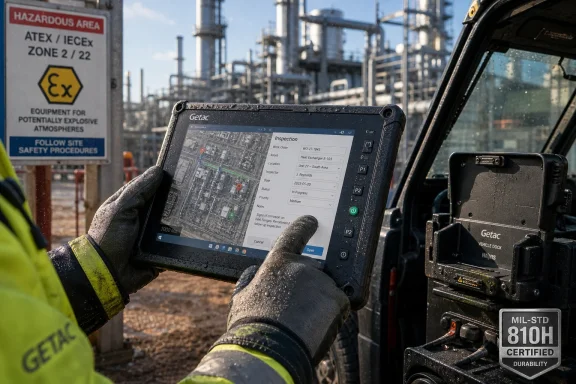
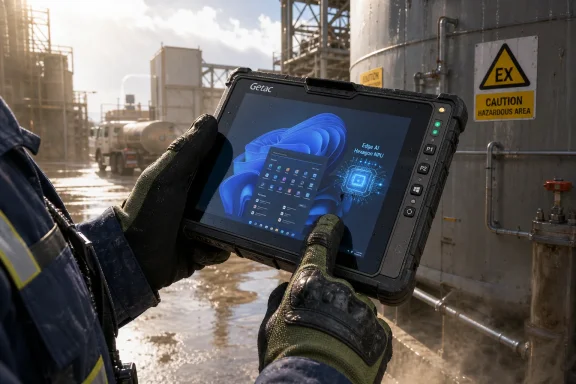
Worker scans an inspection tablet at an industrial plant marked hazardous area with ATEX/IECEx Zone signage.Windows on ARM Leaves the Coffee Shop​

For years, Windows on ARM has been discussed as if its natural habitat were the thin-and-light laptop: a machine for executives, students, and battery-life obsessives who spend their days in browsers, Teams calls, and Microsoft 365. That framing was always too narrow. ARM’s deeper advantage is not glamour; it is the ability to put useful compute into constrained thermal and power envelopes.
The Getac ZX80W is a good example of why that matters. A rugged field tablet has different priorities from a Surface-style ultraportable. It must survive dust, vibration, rain, shock, sunlight, gloves, vehicle docks, long shifts, and users who are not paid to baby hardware. In that world, a fan is not just a cooling component. It is an opening, a moving part, a maintenance concern, and a liability.
Getac’s move also arrives at a moment when Microsoft’s ARM strategy is more credible than it used to be. The Copilot+ PC push put Qualcomm-powered Windows machines back into the mainstream conversation, but enterprise buyers do not care much about platform narratives unless the software stack behaves. Rugged deployments are even less forgiving. If an oil-and-gas operator, defense contractor, utility crew, or logistics fleet standardizes on a Windows device, it is because there are existing Windows applications, management policies, security baselines, and workflows that would be painful to abandon.
That is why the ZX80W is more interesting than its screen size suggests. It is not a consumer tablet trying to be tough. It is a Windows endpoint built around the assumption that the edge of the network is increasingly where the work happens.

The Fanless Chassis Is the Product Strategy​

The most important specification in the ZX80W may be the absence of a specification: no cooling fan. In consumer electronics, fanless design is usually sold as elegance. In industrial computing, it is closer to risk management.
Fans pull air through systems, and air in the field often carries dust, salt, moisture, metal particles, chemicals, or combustible material. The less a device needs to breathe, the easier it is to seal. That is why a fanless rugged Windows tablet is more than a comfort upgrade for workers who do not want noise. It changes where the device can plausibly be used and how often IT teams need to think about failure modes that have nothing to do with software.
Getac says the ZX80W is MIL-STD-810H certified, IP67 rated, vibration resistant, and drop resistant up to 6 feet, or 1.8 meters. The operating range for the standard model stretches from -29°C to +63°C, a range that comfortably exceeds the normal ambitions of consumer tablets. This is hardware intended for cold mornings, hot yards, wet inspections, greasy gloves, and long periods away from a desk.
The weight matters too. At 590 grams, the ZX80W is light for a fully rugged Windows device. The rugged category has long asked workers to accept heft as the price of reliability. That bargain may still be reasonable for a 12-inch tablet mounted in a vehicle, but it becomes harder to justify for users who carry a device all shift, climb ladders, scan assets, inspect lines, or work in constrained spaces.
Getac’s bet is that ARM efficiency lets Windows move into a more mobile industrial shape without becoming an underpowered curiosity. That is the right bet to test. The field does not need another delicate tablet in a rubber case. It needs Windows devices that behave less like small laptops and more like purpose-built instruments.

The Specs Are Modest Until You Read Them Like an IT Buyer​

The Qualcomm QCS6490 inside the ZX80W is not a Snapdragon X Elite laptop chip, and that is the point. It is an embedded and industrially oriented platform, not a prestige processor for benchmark charts. Getac pairs it with 12GB of LPDDR5 memory and 256GB of UFS storage, which sounds ordinary until you remember that this device is aimed at data capture, forms, diagnostics, mapping, asset management, communications, and edge automation rather than video editing.
The display is an 8-inch WUXGA panel rated at 1,000 nits with Getac’s sunlight-readable technology. That number is more operationally significant than a processor turbo frequency. A tablet that cannot be read outdoors is a failure in a utility yard, on a flight line, beside a road, or in a logistics depot. Field workers do not experience specs in a lab sequence; they experience them as friction or relief.
The device also includes the usual rugged-tablet ingredients that make it fit into enterprise workflows: programmable buttons, front and rear cameras, USB-C with DisplayPort and power delivery, microSD or SIM options, Wi-Fi 6E, Bluetooth 5.2, dedicated GPS, and optional cellular connectivity including 5G Sub-6. These are not glamorous features, but they are the connective tissue of real deployments. A tablet that cannot dock, scan, locate, authenticate, and communicate reliably is not a platform. It is a screen with a warranty problem.
Security is similarly pragmatic. The use of Windows 11 IoT Enterprise LTSC matters because rugged devices often have longer service lives and slower change cycles than ordinary PCs. Feature churn is not a virtue when a device is validating maintenance steps in a plant or supporting regulated work. A stable Windows image with a long support runway is precisely what many industrial buyers want.
That does not mean the ZX80W will be effortless to deploy. Windows on ARM still requires careful application testing, especially around legacy drivers, older utilities, VPN clients, endpoint agents, browser plug-ins, and peripherals. But enterprise IT knows how to test Windows images. The more important question is whether the ARM transition buys enough battery life, thermals, sealing, and weight reduction to justify that validation work.

Edge AI Becomes Less Abstract When the Network Disappears​

Getac is leaning into edge AI with the ZX80W and ZX80W-EX, and for once the phrase is not entirely marketing vapor. The QCS6490 includes a Qualcomm Hexagon NPU rated by Getac at up to 13 TOPS with the sixth-generation Qualcomm AI Engine. That is not a Copilot+ PC-class number, but industrial AI is not always about running giant models locally. Often it is about recognition, inference, anomaly detection, barcode and image workflows, sensor interpretation, and real-time decision support.
The edge matters because the field is full of bad networks. Mines, refineries, ships, depots, rural infrastructure, disaster zones, basements, substations, and military sites all have places where cloud assumptions fall apart. A workflow that depends on a round trip to a data center may be fine in an office and useless in a steel structure or remote site.
Local processing also has a security argument. Defense and critical-infrastructure buyers are not eager to stream every image, inspection result, location point, or equipment reading off-site if they can avoid it. A tablet that can perform useful processing locally reduces latency and limits exposure. It does not eliminate the need for cloud systems, but it changes the balance between centralization and autonomy.
The examples Getac cites — UAV control, infrastructure monitoring, predictive asset management, electronic logging, and hazardous-environment workflows — all fit this logic. None requires us to imagine a rugged tablet as a science-fiction brain. They require a device that can do enough at the edge to keep workers productive when connectivity, time, and safety margins are thin.
That is where Windows on ARM could find a more defensible identity than “MacBook battery life, but Windows.” In rugged computing, the goal is not to win a lifestyle comparison. The goal is to put a manageable Windows endpoint into environments where x86 thermals and device bulk have historically made that difficult.

The EX Model Shows Where the Money Is​

The ZX80W-EX is the more specialized sibling, and it may be the more revealing product. It adds ATEX and IECEx Zone 2/22 certification for environments where flammable gases or combustible dust may be present. In plain English, this is the version for places where a normal device is not merely fragile but potentially unsafe.
That certification changes the audience. Chemical plants, oil refineries, pharmaceutical facilities, petrochemical sites, mining operations, and certain manufacturing environments do not buy equipment on the same logic as consumers. They buy around risk, compliance, uptime, and auditability. A cheaper tablet that cannot enter the work area is not cheaper in any meaningful operational sense.
The EX model weighs 780 grams, heavier than the standard ZX80W but still compact given its purpose. Getac lists additional safety-oriented design changes, including thicker display glass, an enhanced back cover, secure port covering, and sealed exposed screw areas. This is the unglamorous engineering that tends to determine whether a device can be used where the work actually happens.
There is a useful reminder here for anyone watching Windows hardware primarily through the lens of laptops. The PC market is not just notebooks, desktops, and gaming rigs. It is also vehicle-mounted systems, medical carts, warehouse scanners, police tablets, diagnostic tools, industrial panels, and intrinsically safe devices. Those categories move slowly, but when they move, they can anchor platform decisions for years.
If Windows on ARM can earn trust in the EX version of a rugged tablet, it will have done something more difficult than impress a reviewer with standby time. It will have passed into a procurement category where conservatism is rational.

The Compatibility Story Is Better, Not Finished​

No serious discussion of an ARM-based Windows field device can skip compatibility. Microsoft and Qualcomm have made real progress, especially with native ARM64 applications and x86/x64 emulation, but industrial deployments live in the long tail. That long tail contains ancient configuration tools, obscure USB adapters, scanner utilities, serial-device bridges, custom line-of-business apps, security agents, print drivers, and VPN clients with unpleasant assumptions about architecture.
This is where Getac’s choice of Windows 11 IoT Enterprise LTSC is important but not magical. LTSC can reduce platform churn and keep a fleet stable, but it does not make every driver appear or every vendor recompile. Buyers will need pilot programs, peripheral inventories, application validation, and a sober view of what must run locally versus what can be modernized.
The good news is that rugged tablets are often deployed for bounded workflows. A field crew may need a defined set of apps, authentication tools, maps, camera functions, forms, scanning, messaging, and device-management hooks. That is easier to validate than the chaotic software universe of a general-purpose employee laptop.
The bad news is that a single missing driver can still sink a deployment. An ARM tablet that cannot talk to a required diagnostic cable, label printer, smart-card reader, gas sensor, or proprietary dock is not 95 percent successful. It is unsuccessful at the point of work.
That is why the ZX80W should be seen less as proof that Windows on ARM has solved everything and more as evidence that the platform has matured enough to be tested in harsher, more specialized places. The burden shifts from “does this idea make sense?” to “does this fleet’s exact software and peripheral stack work?”

Pricing Silence Says This Is Not a Gadget Launch​

Getac has not announced pricing, and that silence is normal for this category. Rugged tablets are typically sold through enterprise channels, configured with options, warranties, docks, accessories, service agreements, and certifications. The sticker price is only part of the acquisition cost, and in many deployments it is not even the most important part.
That said, nobody should expect the ZX80W to compete with consumer tablets. The earlier Android-based ZX80 started around the low four figures in some enterprise channels, and a Windows ARM model with rugged certification, IoT Enterprise licensing, and optional hazardous-environment credentials is likely to sit comfortably above mainstream consumer pricing. For the EX model, certification alone pushes the device into a different economic category.
The more meaningful comparison is not with an iPad, a Surface Go, or a cheap Android slab in a case. It is with existing rugged Windows tablets, older x86 field devices, and dedicated industrial handhelds. If the ZX80W reduces weight, heat, downtime, and charging dependency while preserving Windows manageability, the business case will not need to look like a consumer bargain.
Enterprise buyers tend to think in fleet math. How long does the device last? How often does it fail? How many accessories must be stocked? How quickly can a worker complete a task? How many hours are lost to charging, unreadable screens, broken ports, or devices that cannot be used in restricted areas? In that frame, a fanless ARM Windows tablet could justify a premium even if its raw performance looks unremarkable on paper.
This is also why Getac’s warranty and service story matters. Rugged hardware is bought as an ecosystem: docks, batteries, mounts, chargers, hand straps, vehicle power, repair turnaround, imaging support, and lifecycle availability. A clever processor choice gets attention, but support logistics win renewals.

Microsoft Gets a New Kind of ARM Proof Point​

For Microsoft, devices like the ZX80W are strategically useful because they broaden the Windows on ARM story beyond consumer enthusiasm cycles. The company does not need every rugged tablet to become ARM overnight. It needs credible examples showing that ARM Windows can serve serious enterprise roles where power efficiency and manageability intersect.
That helps counter one of the platform’s oldest problems: the perception that Windows on ARM is always waiting for a future that never quite arrives. In the consumer market, each new generation is judged against MacBooks, Intel ultrabooks, AMD laptops, game compatibility, Adobe performance, and battery tests. In industrial computing, the comparison can be more favorable. The question is not whether the device is the fastest Windows machine. The question is whether it is the best Windows machine for that environment.
There is also a quiet licensing and lifecycle angle. Windows 11 IoT Enterprise LTSC gives Microsoft a path into dedicated-purpose devices that should not be treated like ordinary PCs. These machines need security updates and management compatibility, but they do not necessarily need constant feature additions. That distinction fits rugged deployments better than the consumer Windows update cadence ever did.
Qualcomm benefits too. The QCS6490 is positioned for IoT and embedded use, and the ZX80W gives it a Windows-facing industrial win rather than another Android handheld. The more Qualcomm can show ARM silicon running real enterprise Windows workloads outside premium laptops, the less the platform looks like a one-segment experiment.
The risk is that expectations outrun the reality. A 13 TOPS NPU, an efficient processor, and a rugged chassis do not automatically create a transformed field operation. Enterprises still need software integration, data governance, device management, training, and support. The ZX80W is enabling infrastructure, not a digital transformation wand.

The Rugged PC Market Rewards Boring Success​

The most encouraging thing about the ZX80W is that its ambitions are fundamentally boring. It wants to be carried all day. It wants to survive rain, dust, vibration, drops, and heat. It wants to run Windows line-of-business software. It wants to process enough locally to be useful when the network is unreliable. It wants to avoid a fan.
That is exactly the kind of boring that matters in enterprise hardware. The flashy parts of the PC industry tend to revolve around peak performance, thin bezels, OLED panels, and AI demos. Rugged buyers care about whether the device can be read in sun, held with gloves, cleaned, dropped, docked, tracked, locked down, and repaired.
There is a broader lesson here for Windows hardware makers. ARM does not need to win everywhere at once. It can win first in places where x86’s disadvantages are most obvious: thermally constrained designs, sealed devices, always-mobile workflows, and long shifts away from power. Rugged tablets check all of those boxes.
The ZX80W will not settle the Windows on ARM debate. But it may move the debate into a more practical register. Instead of asking whether ARM Windows can replace every Intel or AMD laptop, the better question is where ARM makes the Windows device possible, lighter, safer, or easier to seal.
That is a more interesting question because it has specific answers. Field tablets are one of them.

The Small Tablet That Makes the Platform Argument Concrete​

Getac’s ZX80W launch leaves several practical points for WindowsForum readers who track enterprise hardware, deployment risk, and Microsoft’s ARM roadmap:
  • The ZX80W is scheduled for July 2026 availability and brings Windows 11 IoT Enterprise LTSC to an 8-inch fully rugged ARM tablet.
  • The standard model weighs 590 grams, while the hazardous-location ZX80W-EX weighs 780 grams and adds ATEX and IECEx Zone 2/22 certification.
  • The Qualcomm QCS6490 platform gives Getac a fanless Windows design with 12GB of LPDDR5 memory, 256GB of UFS storage, and an NPU rated at up to 13 TOPS.
  • The rugged credentials include MIL-STD-810H certification, IP67 protection, vibration resistance, and 6-foot drop resistance.
  • Enterprise buyers should treat application, driver, dock, scanner, VPN, and peripheral validation as the central deployment question, not as a footnote.
  • Pricing has not been announced, but this is plainly a B2B rugged computing product rather than a consumer tablet with a tough shell.
The ZX80W is not the device that makes Windows on ARM universal, and it does not need to be. Its significance is narrower and stronger: it shows ARM Windows moving into the kind of field hardware where efficiency, sealing, weight, and lifecycle stability matter more than benchmark theater. If Getac and Microsoft can make that equation work in the dust, rain, heat, cold, and regulatory complexity of rugged deployments, Windows on ARM will have earned something more valuable than hype — it will have earned a job.

References​

  1. Primary source: gagadget.com
    Published: 2026-06-03T15:10:17.304547
  2. Related coverage: getac.com
  3. Related coverage: belsatex.com
  4. Related coverage: qualcomm.com
  5. Related coverage: atexdepot.nl
  6. Related coverage: ruggedtechla.com
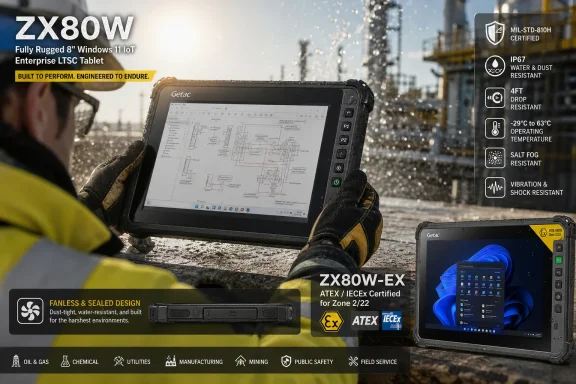
 

Getac announced on June 4, 2026, that its 8-inch ZX80 rugged tablet family is expanding with two Windows 11 on Arm models, the ZX80W and ATEX/IECEx-certified ZX80W-EX, both scheduled for July 2026 availability. The headline is not simply that another rugged tablet is getting a spec refresh. It is that Windows on Arm is moving from the conference-stage laptop story into the grittier world of utilities, logistics, defense, and hazardous industrial sites. That is where the platform’s promises of lower heat, longer runtime, and local AI processing will either prove useful—or be exposed as another neat architecture idea that enterprise software stacks are not ready to absorb.

Two rugged Getac tablets display inspection checklists in an industrial facility with an ATEX “Zone 2/22” sign.Getac Takes Windows on Arm Somewhere Less Polished Than the Laptop Aisle​

The consumer PC industry has spent the past few years trying to make Windows on Arm feel normal. Qualcomm and Microsoft have talked up battery life, AI acceleration, and a widening app ecosystem, while laptop makers have tried to frame Arm as the inevitable next phase of Windows mobility. Getac’s ZX80W and ZX80W-EX are a more interesting test because rugged tablets do not get to live on vibes.
A field tablet is not bought because it looks good in a coffee shop. It is bought because a worker can drop it, read it in sunlight, use it in rain or dust, and keep it alive through a shift that may not include a wall outlet. For that market, Arm’s usual pitch—performance per watt—lands with much less abstraction.
Getac is positioning the ZX80W line around exactly that: a compact 8-inch Windows device that can run fanlessly, avoid the thermal compromises of more power-hungry chips, and still give organizations a familiar Windows management and application environment. The move matters because rugged mobility has often forced an uncomfortable choice between Android’s mobility strengths and Windows’ enterprise gravity. Getac is betting that Arm narrows that gap.
The company’s existing ZX80 family already leaned into Qualcomm silicon and compact rugged design. The “W” suffix is the tell. These are Windows devices, not Android tablets trying to approximate enterprise compatibility through mobile apps and browser front ends. In industrial IT, that distinction can be the difference between a smooth rollout and a year of workaround tickets.

The Real Product Is Not the Tablet, It Is the Compromise It Avoids​

The ZX80W and ZX80W-EX use Qualcomm’s QCS6490 platform, an octa-core Arm-based chip aimed at industrial and IoT-class devices rather than premium consumer laptops. Getac lists 12GB of LPDDR5 memory and 256GB of UFS storage, which places the tablets above the bare-minimum embedded Windows appliance tier without pretending to be workstation replacements. That is probably the correct target.
The more important design choice is fanless operation. Fans are a minor nuisance on a desk and a major liability in industrial hardware. They draw in dust, moisture, and contaminants; they add moving parts; and they complicate sealed-device design. In a rugged tablet, removing the fan is not just a comfort feature. It is part of the durability story.
That also explains why Getac is not chasing spec-sheet theatrics. The point is not to beat an x86 tablet in a benchmark sprint. The point is to keep a device usable in the field without cooking itself, draining its battery too quickly, or forcing the chassis to grow beyond the point where an 8-inch rugged tablet still makes sense.
For years, Windows tablets in harsh environments have tended to skew larger, heavier, or more thermally constrained than their Android counterparts. Getac’s argument is that Windows on Arm changes the physical equation. If the OS and applications cooperate, the same class of device that used to feel like an Android-only form factor can now host a Windows workload.

Windows 11 IoT Enterprise LTSC Is the Quietly Important Detail​

Getac says the ZX80W runs Windows 11 IoT Enterprise LTSC, and that is more significant than the Windows 11 branding alone. LTSC is not meant for the feature-churn rhythm of consumer Windows. It is meant for fixed-purpose and specialized devices where stability, security servicing, and predictable behavior matter more than having the newest shell experiment.
That maps cleanly to rugged tablets. A utility crew, warehouse operator, or defense contractor does not want a device’s interface or application assumptions shifting underfoot because a semiannual feature wave landed at the wrong time. In field operations, change control is not bureaucracy for its own sake; it is how organizations avoid breaking the job.
The IoT LTSC angle also helps explain why a Windows tablet can still make sense in a world where Android is strong in handhelds. Many organizations already have Windows identity, endpoint management, VPN, certificate, logging, and application practices. If the rugged tablet can slot into that world with fewer exceptions, the hardware premium can be easier to justify.
But there is a catch. Windows on Arm may emulate x86 and x64 applications, but the strongest deployments will be the ones that validate workloads carefully and, where possible, run native Arm64 software. Rugged buyers tend to care about the last 10 percent of compatibility because that last 10 percent often includes a scanner driver, a proprietary inspection tool, a VPN client, or a legacy line-of-business application that no one has touched since the Obama administration.

Edge AI Sounds Like Marketing Until the Network Disappears​

Getac is also leaning into AI at the edge. The ZX80W models include Qualcomm’s Hexagon NPU through the QCS6490 platform, with Getac describing use cases such as real-time recognition, analytics, automation, UAV flight control, predictive asset management, and electronic logging in transport and logistics. This is the part of the announcement most likely to be dismissed as obligatory 2026 AI language, but field computing is one of the places where local inference has a practical argument.
Cloud AI assumes connectivity. Field work often does not. A tablet used around substations, pipelines, ports, depots, industrial yards, and disaster zones may face patchy service or deliberate network restrictions. In those conditions, a device that can perform recognition, triage, or automation locally is not just saving latency. It is preserving workflow continuity.
The harder question is whether customers will actually deploy meaningful edge AI workloads on an 8-inch rugged Windows tablet. An NPU is potential energy. It becomes operational value only when paired with trained models, validated workflows, software that can use the accelerator, and an IT/security process that permits local processing of operational data.
That makes Getac’s AI claim credible but not self-fulfilling. The hardware is pointed in the right direction, especially for visual inspection, asset identification, sensor-adjacent workflows, and offline decision support. The implementation burden will sit with customers, integrators, and software vendors. In rugged computing, that is not a footnote; it is often the main event.

The EX Model Is Where Rugged Stops Being a Lifestyle Word​

The ZX80W-EX adds ATEX/IECEx Zone 2/22 certification for hazardous and potentially explosive environments. That moves the product from “tough tablet” into a more specialized category where device design can affect worker safety and regulatory compliance. Oil and gas, chemical processing, pharmaceuticals, utilities, and certain manufacturing environments do not treat battery-powered electronics casually.
Getac says the EX variant includes intrinsically safe design features such as thicker display glass, an enhanced back cover, a secured port cover for the main docking connector, and mylar seals on exposed screw covers. Those are not glamorous additions, but they are the sorts of details that separate a device designed for an industrial brochure from one intended to pass through a safety review.
The trade-off is visible in the weight. Getac lists the standard ZX80W at 590 grams and the ZX80W-EX at 780 grams. Both are light by fully rugged standards, but the EX model’s extra protection and certification add mass. In this category, that is less a flaw than a reminder that “rugged” is not a single attribute. A tablet built for a dusty warehouse and a tablet cleared for hazardous zones are solving overlapping but different problems.
The operating temperature ranges tell a similar story. Getac lists the ZX80W at -29°C to 63°C, while the ZX80W-EX is rated from -21°C to 55°C. The EX version is more specialized, not universally more extreme. Certification and intrinsically safe construction often impose their own boundaries.

Microsoft’s Arm Problem Has Shifted From “Can It Run Apps?” to “Will IT Trust It?”​

A few years ago, the obvious objection to Windows on Arm was application compatibility. That concern has not vanished, but it has changed shape. Windows 11 on Arm supports x86 and x64 emulation, and Microsoft has continued improving the Prism emulator in recent Windows releases. For many mainstream apps, the experience is no longer the immediate dealbreaker it once was.
Enterprise field deployments, however, are not mainstream consumer scenarios. The annoying cases matter more: kernel drivers, old middleware, niche peripherals, custom browser controls, serial adapters, smart-card readers, inspection accessories, and VPN or endpoint security agents that assume x86. A single unsupported component can turn an elegant Arm deployment into a pilot-program museum piece.
That is why Getac’s choice of Windows 11 IoT Enterprise LTSC cuts both ways. It is the right Windows edition for stability-minded devices, but it also raises the standard for validation. Organizations choosing these tablets will not be casual buyers installing whatever app they fancy. They will be fleet operators expecting consistent images, support windows, accessory compatibility, and known-good update behavior.
Microsoft’s broader Windows on Arm progress helps Getac. Native Arm versions of more applications reduce friction, and emulation gives IT a fallback for many legacy binaries. But rugged deployments will still reward conservatism. The winning sales motion is not “Windows apps just work.” It is “your specific Windows workload, peripherals, security stack, and management model have been tested on this hardware.”

Android Is the Rival Getac Is Really Arguing Against​

The ZX80W announcement is framed as Windows 11 functionality in a compact form factor, but the implied competitor is Android rugged hardware. Android has been a natural fit for small field tablets because it is power-efficient, touch-first, mobile-friendly, and well supported by scanning, logistics, and handheld ecosystems. It is often the easier answer when the job is data capture rather than desktop-style computing.
Windows retains its pull where organizations need legacy applications, Win32 tooling, domain practices, or a closer match with existing endpoint governance. The tension is that Windows devices have historically been heavier, hotter, or shorter-lived on battery in small rugged designs. Getac’s pitch is that Arm lets Windows compete on the physical qualities that made Android attractive.
That does not mean Windows will displace Android across rugged mobility. Many frontline workflows are already mobile-native, cloud-managed, and deeply integrated with Android device management. For those, a Windows tablet may be unnecessary overhead. The strongest case for ZX80W is the mixed environment: organizations that want field mobility without surrendering Windows-native software, security assumptions, or operational tooling.
This is why the 8-inch size matters. A 12-inch rugged Windows tablet is a known thing: capable, heavy, and often used as a laptop alternative. An 8-inch Windows rugged tablet is more assertive. It says Windows wants to be present not just in vehicles, control rooms, and carts, but in the hand.

Rugged Hardware Turns Spec Sheets Into Operational Math​

Getac lists MIL-STD-810H and IP67 certifications, vibration resistance, a 6-foot drop rating, and a daylight-readable display. These are familiar rugged-computing phrases, but their value depends on work patterns rather than marketing. A bright display matters if the tablet is used outdoors all day. IP67 matters if exposure to dust or water is routine. Drop resistance matters if the user is wearing gloves, climbing, loading, inspecting, or working near machinery.
The ZX80W’s compact size gives it a plausible role in jobs where a laptop is absurd and a phone is too constrained. Electronic logging, inspection forms, asset lookup, work orders, mapping, guided procedures, and field communications all fit naturally on a small tablet. Add local AI and the device could become more than a digital clipboard, at least in deployments where software vendors build for it.
The all-day productivity claim should be treated as a direction, not a universal measurement. Battery life in rugged devices depends heavily on screen brightness, radios, peripherals, temperature, workload, and whether the device is constantly capturing data or merely displaying forms. Still, the fanless Arm design gives Getac a stronger foundation for that claim than a conventional small Windows tablet running a hotter x86 chip.
The deeper operational math is total fleet downtime. If a tablet runs longer, gets less hot, survives more abuse, and needs fewer accessory compromises, the savings show up in fewer swaps, fewer depot tickets, and less worker improvisation. That is the economic case rugged vendors sell, and Arm may make it easier to defend.

The July Launch Will Test a Very Specific Kind of Windows Momentum​

The ZX80W and ZX80W-EX are scheduled for July 2026 availability, which places them in a Windows on Arm market that is more mature than it was during the early Surface Pro X era but still not invisible to IT planners. Consumer attention has largely followed Snapdragon X laptops and AI PCs. Getac is operating in a narrower lane, where the question is not whether Arm can make Windows feel modern, but whether it can make Windows field hardware feel practical.
That distinction matters for Microsoft as much as for Getac. Windows has long dominated desks, laptops, and many specialized embedded environments, but the frontline device market has been more fragmented. If Windows on Arm can make smaller, sealed, durable, long-running devices viable, Microsoft gets another route into work that might otherwise standardize around Android.
For Qualcomm, the win is similarly strategic. The QCS6490 is not being sold here as a consumer laptop brain. It is industrial silicon for devices that need longevity, efficiency, and local intelligence. That is a better story for Arm in Windows than simply asking users to compare app launch times against an Intel or AMD laptop.
For buyers, though, the burden remains practical. Rugged fleets are conservative because failures are expensive and visible. The ZX80W line will need more than good architecture. It will need predictable accessories, stable images, driver readiness, security-agent support, and proof that emulated apps do not become battery or performance traps in daily use.

The Small Tablet Is Now a Referendum on Windows in the Field​

The most concrete lesson from Getac’s announcement is that Windows on Arm is no longer confined to premium thin-and-light PCs. It is being asked to serve workers who care less about platform ideology than about whether the device survives the shift. That is a healthier test than another laptop launch because it strips the story down to utility.
  • The ZX80W and ZX80W-EX bring Windows 11 on Arm into Getac’s 8-inch fully rugged tablet line, with availability planned for July 2026.
  • Both tablets use Qualcomm’s QCS6490 platform with 12GB of LPDDR5 memory and 256GB of UFS storage.
  • The standard ZX80W emphasizes compact, fanless Windows field computing, while the ZX80W-EX adds ATEX/IECEx Zone 2/22 certification for hazardous environments.
  • The Arm architecture is central to the product argument because it enables lower heat, sealed fanless design, and longer operation in a small rugged chassis.
  • The edge AI claims are plausible for offline recognition, inspection, and automation workloads, but their value will depend on software support and deployment discipline.
  • The biggest adoption risk is not raw performance; it is compatibility across legacy apps, drivers, peripherals, VPNs, security tools, and management stacks.
Getac’s new tablets are not likely to make Windows on Arm fashionable, and that may be precisely why they matter. Fashionable platforms win headlines; boring platforms win fleets. If the ZX80W and ZX80W-EX can give field organizations the manageability of Windows, the endurance of Arm, and the physical resilience expected from rugged hardware, they will mark a small but meaningful expansion of where Windows belongs. The next phase will be less about announcing Arm-based Windows devices and more about proving, one messy deployment at a time, that the old Windows ecosystem can fit into smaller, tougher, more power-conscious machines.

References​

  1. Primary source: acrofan.com
    Published: 2026-06-04T00:10:27.642380
  2. Related coverage: getac.com
  3. Official source: learn.microsoft.com
  4. Related coverage: ruggedtechla.com
  5. Related coverage: einpresswire.com
  6. Related coverage: windowscentral.com
  1. Official source: developer.microsoft.com
  2. Official source: answers.microsoft.com
  3. Related coverage: howtogeek.com
  4. Official source: blogs.windows.com
  5. Related coverage: tweakers.net
  6. Related coverage: tomshardware.com
  7. Related coverage: techradar.com
 

Getac announced on June 3, 2026, that its new ZX80W is an 8-inch fully rugged Windows 11 IoT Enterprise LTSC tablet built on Qualcomm’s ARM-based QCS6490 platform, with availability planned for July 2026 and pricing not yet disclosed. The headline spec is not any one component but the combination: Windows, ARM, ruggedization, and long-term servicing in a device small enough to be carried all day. That mix says something important about where field computing is going. The Windows tablet is no longer just a shrunken office PC; in Getac’s telling, it is becoming a sealed, low-power, edge-AI endpoint for work that happens in rain, dust, heat, cold, and moving vehicles.

Waterproof tablet displays a hydraulic system inspection checklist on a construction site during rain.Getac Shrinks the Windows Field PC Without Making It a Consumer Tablet​

The ZX80W is not trying to compete with an iPad mini, a Surface Go, or the average Android handheld used for warehouse scanning. It belongs to the less glamorous but more demanding world of utilities, transportation, defense, emergency services, industrial inspection, and logistics. These are environments where a glossy consumer tablet becomes a liability the moment gloves, sunlight, vibration, water, or regulatory paperwork enter the conversation.
That explains the bluntness of the design. The ZX80W has an 8-inch 1920 x 1200 display rated at 1,000 nits, a chassis weighing about 590 grams, and a body roughly 17.6 mm thick. Those numbers would be unimpressive in a consumer spec race, but rugged devices are judged by a different arithmetic: how much visibility, connectivity, battery life, and physical abuse tolerance can be packed into something a worker will actually keep on them.
Getac says the tablet is MIL-STD-810H certified, IP67 rated, resistant to 1.8-meter drops, and able to operate across a -29°C to 63°C temperature range. IP67 matters because it is not just about splashes; it implies dust-tight sealing and temporary immersion in water. For a field technician, that is the difference between a device that survives the day and a device that becomes a procurement incident.
The more interesting choice is that Getac did not simply ship another rugged Android slab. The company already has an Android ZX80 family, and rugged Android devices are common in logistics and industrial scanning. The ZX80W brings the same size class into the Windows estate, which matters for organizations whose software, identity, device management, VPN clients, smart-card workflows, or compliance assumptions still orbit Microsoft’s platform.

Windows on ARM Moves From Curiosity to Worksite Tool​

The ZX80W runs on Qualcomm’s Dragonwing QCS6490, an eight-core ARM chip with an Adreno 643 GPU and a Hexagon NPU rated at up to 13 TOPS. In 2026, that AI number will not impress anyone comparing it with premium Copilot+ PCs, but this is the wrong comparison. The tablet is not being sold as a workstation for generative AI demos; it is being positioned as a device that can do useful on-device recognition, analytics, scanning, and automation while sipping power and staying cool in a sealed chassis.
For years, Windows on ARM carried the baggage of being almost there. It could run familiar Windows applications, but compatibility caveats, driver limitations, and inconsistent native app availability made it feel like a platform you had to explain before you could recommend it. That stigma has softened as Microsoft, Qualcomm, and OEMs have pushed ARM harder across laptops and edge devices, but the ZX80W shows a different path for the architecture.
Rugged tablets are a logical home for ARM because their constraints are physical before they are aesthetic. Fanless operation is easier to justify when the device is sealed against water and dust. Lower heat output matters when the tablet is strapped into a vehicle mount under sunlight. Longer runtime matters more than peak benchmark performance when a worker is six hours into a shift and nowhere near a charger.
The old Windows tablet formula was often a compromise: x86 compatibility in exchange for heat, thickness, short battery life, or a more expensive thermal design. ARM changes that negotiation. The price is that some x86 and x64 assumptions still need testing, especially for drivers, old line-of-business software, and peripherals with obscure middleware. The reward is that Windows can plausibly live in smaller, quieter, more sealed devices without behaving like a laptop motherboard trapped in a lunchbox.

LTSC Is the Real Enterprise Feature, Not the Nits​

The 1,000-nit display will attract attention because it is easy to understand. Anyone who has tried to read a dim screen outdoors knows why brightness matters. But the more consequential specification for enterprise buyers is Windows 11 IoT Enterprise LTSC.
LTSC is Microsoft’s long-term servicing channel for fixed-purpose and special-purpose devices, and the IoT Enterprise version is intended for systems where the feature set should remain stable for years. Microsoft positions Windows 11 IoT Enterprise LTSC 2024 as a platform with a 10-year servicing lifecycle, monthly quality updates, and no routine feature-update churn through Windows Update. That is a profoundly different proposition from standard Windows 11, where annual feature updates and interface changes are part of the bargain.
For a rugged field tablet, stability is not a sentimental preference. A tablet mounted in a forklift, issued to a utility crew, used beside an aircraft, or deployed for public-safety workflows is part of an operational system. If an update changes a UI flow, breaks a scanner integration, alters a driver behavior, or prompts the wrong person at the wrong time, the failure is not just annoying. It can interrupt work, create safety risks, or trigger expensive validation cycles.
This is why Windows 11 IoT Enterprise LTSC gives the ZX80W a sharper identity than “small Windows tablet.” It tells IT departments that Getac is thinking less about general-purpose personal computing and more about managed fleets. The buyer is not a consumer choosing a tablet; the buyer is an organization trying to keep hundreds or thousands of devices boring, predictable, and supportable.
There is a licensing and suitability caveat here. IoT Enterprise LTSC is not a backdoor way to buy a cleaner Windows build for every office PC. Microsoft frames it around fixed-purpose devices and OEM or volume-licensing channels. That fits Getac’s market neatly, but it also means the ZX80W’s Windows story is an enterprise deployment story, not a hobbyist upgrade story.

Rugged Specs Are Easy to List and Hard to Deliver​

Rugged computing is full of numbers that look definitive until you remember how messy real work is. MIL-STD-810H, IP67, drop resistance, operating-temperature ranges, and sunlight-readable panels all sound reassuring. They are also only as useful as the design choices surrounding them.
Getac’s pitch is that the ZX80W is built for abuse without becoming too heavy to carry. At 590 grams, it is heavier than a consumer mini tablet but light for a fully rugged Windows device. The company is threading a narrow needle: the tablet has to feel substantial enough to survive, but not so bulky that workers leave it in the truck.
The battery system reflects the same trade-off. Getac lists configurations including a fixed 4,060 mAh battery and swappable battery options, with standard and high-capacity choices. The company’s LifeSupport hot-swappable battery branding is more than marketing if the implementation is solid, because field devices often fail in practice not when they break, but when they run out of power during the part of the shift nobody planned for.
The port selection is similarly pragmatic rather than extravagant. USB 3.2 Gen 1 Type-C with DisplayPort and Power Delivery, microSD, a headphone jack, cameras, Wi-Fi 6E, Bluetooth 5.2, GPS, and optional 4G/5G dual SIM or eSIM support cover the expected field checklist. The absence of a sprawling port array is not surprising on a sealed 8-inch device. In rugged environments, every opening is a design liability.
The screen may be the most visible example of real-world prioritization. An 8-inch WUXGA panel is not luxurious by consumer standards, but 1,000 nits and touch usability matter more than pixel-count theatrics when the user is standing outside in direct sun. A rugged tablet display is not there to make movies look cinematic. It is there so someone can read a work order, map, checklist, telemetry feed, or dispatch message while weather and glare are working against them.

The ARM Compatibility Question Has Not Disappeared​

The ZX80W’s biggest technical risk is also the thing that makes it interesting: Windows on ARM. Microsoft’s emulation story has improved substantially over the years, and many mainstream Windows applications now work acceptably on ARM systems. But field deployments are not built only from mainstream applications.
Industrial Windows environments often contain a mess of old utilities, proprietary drivers, scanner tools, VPN clients, serial adapters, certificate middleware, printer components, and vendor applications whose development histories are not pretty. Some are 32-bit. Some are unsigned. Some assume x86. Some were written for a version of Windows that the vendor still technically “supports” but has not meaningfully modernized in a decade.
That is where Getac’s Windows choice becomes both attractive and dangerous. The ZX80W may let an organization keep Windows-based workflows while gaining ARM efficiency and rugged mobility. But it will also force that organization to audit which parts of the workflow are truly Windows applications and which parts are x86-era dependencies masquerading as simple software requirements.
For new deployments, this may be manageable. If a company is building browser-based apps, modern UWP or WinUI applications, cloud-connected dashboards, or ARM-native components, the ZX80W can be treated as a clean break from the old rugged PC model. For legacy-heavy environments, testing will decide everything.
This does not make the tablet a bad idea. It makes it a serious enterprise device. Serious enterprise devices are not bought because a spec sheet looks plausible; they are bought after pilot programs, image validation, peripheral testing, MDM enrollment, security review, and a long argument about accessories.

Edge AI Gets a Practical, Unshowy Home​

The ZX80W’s 13 TOPS NPU rating is modest compared with the numbers now attached to flagship AI PCs, but it may be more useful in this class of device than in many laptops. Field work generates visual, spatial, and sensor-heavy tasks that benefit from low-latency local processing. A tablet used for inspection, barcode recognition, remote assistance, fleet operations, or UAV control does not need to write a sonnet; it needs to identify things, process inputs, and avoid sending every decision to the cloud.
That is the quiet promise of edge AI in rugged hardware. It is not the theatrical AI of chatbots and image generators. It is the kind that can help classify damage, assist with object recognition, accelerate camera workflows, improve noise handling, process telemetry, or support real-time analytics when connectivity is expensive, weak, or restricted.
The catch is that the software stack has to exist. Hardware vendors love to put “AI-ready” on devices because the phrase is flexible enough to mean almost anything. Buyers should read it as potential, not as a guarantee. The value will come from Getac’s partners, customer applications, Microsoft’s Windows on ARM tooling, Qualcomm’s edge ecosystem, and whatever custom software an organization is willing to deploy.
Still, rugged devices may be one of the more honest places for AI hardware. A field tablet does not need to pretend to replace a person. It can simply make a workflow faster, more resilient, or less dependent on a round trip to a server.

The ZX80W-EX Shows Where Rugged Windows Still Commands a Premium​

Getac also announced the ZX80W-EX, a related model aimed at hazardous environments with ATEX and IECEx Zone 2/22 certification. That variant weighs more, at around 780 grams, and operates across a narrower temperature range than the standard ZX80W. The trade-off is certification for use in potentially explosive atmospheres, which matters in oil and gas, chemical processing, utilities, and other regulated industries.
This is the part of the market consumer hardware never really touches. A warehouse may be able to ruggedize a consumer tablet with a case and a service contract. A refinery cannot simply improvise its way around hazardous-location requirements. Certification, materials, sealing, port protection, and documentation become part of the product.
The EX model also clarifies Getac’s broader strategy. The company is not merely releasing a small Windows tablet; it is extending a platform across adjacent field scenarios. One version targets general rugged mobility. Another targets environments where device failure is not just costly but potentially dangerous.
That modularity matters for IT procurement. Organizations prefer device families because they simplify accessories, mounts, training, support, spare parts, and software images. If Getac can give buyers a Windows-on-ARM rugged family rather than a one-off oddity, the ZX80W becomes easier to justify.

Microsoft’s Platform Strategy Reaches the Mud​

For Windows enthusiasts, the ZX80W is a reminder that Windows is not only a desktop operating system fighting for relevance against macOS, ChromeOS, iPadOS, and Linux. It is also a platform embedded in strange, durable, task-specific machines that most consumers will never see. Those machines are often where Windows’ backward compatibility, management tooling, identity integration, and enterprise habits still matter most.
Windows 11 IoT Enterprise LTSC is central to that story because it strips away some of the consumer platform drama. No one buying a rugged tablet for a field crew wants surprise UI experiments, gaming features, or a constant stream of feature changes. They want security updates, device control, app compatibility, and predictable servicing.
The ZX80W therefore lands at an interesting moment for Microsoft. The company is trying to make Windows on ARM feel mainstream in laptops while also pushing AI PCs as a new category. Getac’s device suggests a parallel path: ARM and AI silicon may succeed not only because they make premium laptops thinner, but because they make specialized Windows devices more practical.
That is arguably the more durable opportunity. Consumer enthusiasm rises and falls with marketing cycles. Enterprise field deployments are slower, more skeptical, and more expensive to win, but once a device family is validated, it can remain in service for years.

The Price Will Decide Whether This Is a Fleet Device or a Niche Trophy​

Getac has not disclosed pricing, and that omission matters. Rugged tablets are not cheap, and they are not supposed to be. Buyers pay for durability, certifications, support, accessories, long availability windows, and a vendor that understands fleet deployment.
But price will still define the ZX80W’s addressable market. If it lands too high, organizations may reserve it for specialized teams and continue using Android handhelds, older x86 tablets, or semi-rugged devices elsewhere. If Getac prices it aggressively enough for broader fleet use, the ZX80W could become a persuasive argument for Windows on ARM in places where laptop-style ARM PCs have struggled to make a case.
The accessory ecosystem will be almost as important. Vehicle docks, hand straps, chargers, multi-bay battery systems, barcode modules, mounts, and protective peripherals can determine whether a rugged tablet works in the field. A device like this is never just a device. It is the center of a small operational universe.
Support commitments will matter too. Enterprises buying LTSC devices are implicitly betting on long timelines. They will want stable availability, replacement parts, imaging tools, firmware updates, and clear guidance on Windows on ARM compatibility. The operating system may be serviced for a decade, but the hardware vendor still has to make the deployment feel durable in practice.

The Small Windows Tablet Finally Finds a Serious Reason to Exist​

The small Windows tablet has had an awkward history. Consumer models often felt compromised, squeezed between phones that were more convenient and laptops that were more capable. Eight-inch Windows devices were once curiosities for people who wanted a Start menu in a coat pocket, but the category never became a mainstream consumer phenomenon.
The ZX80W shows why the form factor still makes sense when the audience changes. In the field, an 8-inch screen is large enough for real work but small enough for one-handed carry, vehicle mounting, and quick reference. Windows is not there because someone wants a desktop on a tiny panel; it is there because the organization’s software and management stack already depend on Windows.
That distinction is crucial. Consumer mini tablets live or die by entertainment, app ecosystems, and price. Rugged enterprise tablets live or die by workflow fit. If the ZX80W lets a technician complete a job without returning to a truck, lets a dispatcher stay connected in a harsh environment, or lets a regulated operation keep a stable Windows image for years, the category has a purpose.
This is also why the device’s limitations may be acceptable. Nobody should buy it expecting a universal replacement for every x64 Windows tablet. Nobody should assume all legacy peripherals will behave. But if the workload is known, tested, and managed, Windows on ARM can become less of a compromise and more of an engineering choice.

The Field-Test Checklist Is the Story Buyers Should Remember​

The ZX80W is one of those devices whose significance will be proven less by launch-day excitement than by procurement spreadsheets and pilot deployments. Its spec sheet is coherent, but rugged computing punishes assumptions. The organizations most likely to benefit are the ones that test the whole workflow rather than the tablet in isolation.
  • The ZX80W brings Windows 11 IoT Enterprise LTSC to an 8-inch rugged tablet built around Qualcomm’s ARM-based QCS6490 platform.
  • The device is designed for field work, with a 1,000-nit WUXGA display, IP67 sealing, MIL-STD-810H ruggedization, and a 590-gram chassis.
  • Windows on ARM is the opportunity and the risk, because efficiency and fanless design are attractive but legacy x86 software and drivers still require validation.
  • The LTSC operating system is central to the enterprise pitch because it favors long-term stability over routine feature churn.
  • The optional connectivity, battery configurations, and hazardous-location ZX80W-EX variant make the product family more relevant to fleet buyers than a one-off rugged tablet would be.
  • Pricing, accessories, support terms, and real-world compatibility testing will determine whether the ZX80W becomes a widely deployed field device or a specialized tool for narrow deployments.
Getac’s ZX80W is not the tablet that will make Windows on ARM fashionable, and that may be exactly why it matters. Fashionable devices chase attention; rugged devices chase uptime. If Getac can deliver the compatibility, accessories, and support that field buyers need, this little Windows tablet could become a practical signpost for the next phase of enterprise computing: quieter, tougher, more specialized, and increasingly powered by ARM silicon in places where failure is measured not in benchmark points, but in missed work.

References​

  1. Primary source: Notebookcheck
    Published: Thu, 04 Jun 2026 06:38:00 GMT
  2. Related coverage: getac.com
  3. Related coverage: prnewswire.com
  4. Related coverage: qualcomm.com
  5. Related coverage: getac.com.cn
  6. Related coverage: ceskenoviny.cz
 

Getac announced the ZX80W and ZX80W-EX on June 4, 2026, expanding its eight-inch fully rugged tablet line with Windows 11 IoT Enterprise LTSC devices built on Qualcomm’s ARM-based QCS6490 platform for field, industrial, defense, utilities, and transport use. The launch is not just another rugged-tablet refresh. It is a small but telling marker of where Windows on ARM is trying to go next: out of the consumer laptop comparison trap and into jobs where battery life, thermals, certification, and manageability matter more than benchmark theater. For WindowsForum readers, the interesting question is not whether this is an iPad rival in a rubber suit, but whether ARM Windows has become credible enough for frontline enterprise work.

Industrial rugged Zebra ZX80W tablets with cybersecurity UI and “ZX80W-EX” ATEX certification in a factory setting.Getac Moves Windows on ARM Out of the Coffee Shop​

Windows on ARM has spent years being judged by the wrong courtroom. Reviewers compared it against thin Intel laptops, developers worried about plug-ins, and consumers reasonably wondered why they should accept compatibility caveats when x86 machines were sitting on the next shelf. That debate was real, but it was also narrow.
Getac’s ZX80W and ZX80W-EX point at a different market, one where a fanless sealed chassis is not a lifestyle flourish but an operational requirement. A rugged tablet used in a vehicle yard, refinery perimeter, inspection route, warehouse, or utility deployment is not rewarded for feeling like a premium notebook. It is rewarded for being readable in sunlight, surviving drops, working through a shift, and fitting into device-management routines that IT already understands.
That is why Windows 11 IoT Enterprise LTSC is central to the pitch. Getac is not selling a general-purpose Windows tablet that happens to be rugged. It is selling an appliance-like Windows endpoint with a long support horizon, a controlled feature cadence, and the software familiarity that industrial fleets often prefer over mobile-only operating systems.
The eight-inch form factor matters because rugged Windows devices have traditionally paid for compatibility with bulk. Smaller tablets in the field have often meant Android, while Windows carried the baggage of larger boards, active cooling, heavier batteries, and shorter runtime. Getac is arguing that ARM lets Windows enter spaces where it previously looked overbuilt.

The Fanless Chassis Is the Product Strategy​

A fanless design is easy to underestimate if you buy laptops by spec sheet. In industrial environments, moving air is a liability. Fans pull in dust, complicate sealing, add noise, consume power, and introduce another failure point in hardware that may be mounted, dropped, cleaned, gloved, or used around contaminants.
The ZX80W and ZX80W-EX use Qualcomm’s QCS6490, an octa-core ARM platform with an Adreno 643 GPU and a Hexagon NPU rated by Getac at up to 13 TOPS. The number will not impress anyone tracking Copilot+ PC marketing, where AI performance figures have become much larger. But for this class of device, the point is not to run flashy generative demos on a showroom table.
The more plausible uses are narrower and more practical: recognition, inspection assistance, local inference, analytics at the edge, and automation that does not collapse when a connection is intermittent. Getac’s examples — UAV control, predictive asset management, electronic logging, and hazardous-environment workflows — are exactly the kind of jobs where shaving seconds from a field process matters more than producing a synthetic benchmark victory.
The 12GB of LPDDR5 memory and 256GB of UFS storage also speak to a device designed around sufficiency rather than excess. This is not a workstation in miniature. It is a rugged endpoint with enough headroom to multitask, run Windows workloads, keep local data, and avoid the sluggishness that has historically made low-power Windows tablets feel like punishment.

Windows 11 IoT LTSC Is the Quiet Star​

The consumer Windows conversation is dominated by feature updates, AI branding, and whichever Start menu argument is burning this month. Field computing has a different hierarchy of needs. Stability, servicing predictability, lockdown, peripheral compatibility, and support timelines matter more than getting the newest shell refinements.
Windows 11 IoT Enterprise LTSC gives Getac a way to position these tablets as stable fleet devices rather than general-purpose PCs with rugged marketing. LTSC’s appeal is not that it is exciting. Its appeal is that it is deliberately boring: fewer moving parts, a longer servicing model, and a better fit for devices expected to perform a defined role for years.
That matters in sectors such as utilities, transport, logistics, emergency response, natural resources, and defense-adjacent work. These organizations do not replace endpoint fleets because a UI widget changed. They replace them when a battery strategy fails, a certification expires, a docking ecosystem ages out, or security teams can no longer justify the platform.
The Windows part of the announcement is therefore less about giving field workers access to the full desktop experience and more about giving IT a known management and application model. If an organization already has Windows identity, policy, security tooling, and line-of-business software, the argument for a rugged Windows tablet remains strong — provided the hardware no longer imposes the old penalties.

ARM Solves Some Windows Problems and Exposes Others​

The ARM pitch is straightforward: better performance per watt, less heat, thinner sealed designs, and longer operation away from chargers. Those advantages become especially attractive in rugged devices because the enclosure itself is part of the engineering constraint. You cannot simply vent your way out of heat when IP ratings and hazardous-environment design are on the table.
But Windows on ARM still carries a compatibility story that IT departments must treat seriously. Windows 11 can emulate x86 and x64 applications, and Microsoft has significantly improved that layer with Prism in Windows 11 24H2 and newer. Many user-mode apps will run without modification, and the native ARM64 software ecosystem is much healthier than it was in the Windows 10 on ARM era.
The hard boundary remains drivers and low-level components. Kernel-mode drivers must be compiled for ARM64; emulation does not rescue them. That is not an academic footnote in industrial computing, where barcode readers, docks, serial adapters, vehicle mounts, diagnostic equipment, security modules, and specialized sensors can be as important as the tablet itself.
Getac’s advantage is that rugged vendors tend to sell systems, accessories, support, and lifecycle assurance rather than bare slates. The company can validate the tablet, its optional modules, and its docking ecosystem in ways that reduce deployment risk. Still, any buyer considering the ZX80W should test the entire workflow, not just the operating system.

The EX Model Is Where Rugged Becomes Regulated​

The ZX80W-EX is not merely a heavier version of the same tablet. Its ATEX and IECEx Zone 2/22 certification puts it into a more demanding category: environments where explosive gases, vapors, dust, or other hazardous conditions may be present under defined circumstances. In that world, a computing device is not just a productivity tool; it is a safety-controlled object.
Getac says the EX model includes design changes such as thicker display glass, an enhanced back cover, a secured port cover for the main docking connector, and mylar seals on exposed screw covers. Those details sound mundane until you remember that hazardous-environment hardware is judged by what can go wrong at the edges: impact, sparks, ingress, exposed contacts, cracked surfaces, and maintenance mistakes.
The trade-off is visible in weight and temperature range. The standard ZX80W weighs 590 grams, while the ZX80W-EX weighs 780 grams. The ZX80W is listed for operation from -29°C to 63°C, while the EX model is rated from -21°C to 55°C. That is still rugged by ordinary tablet standards, but it shows how certification and intrinsic-safety requirements reshape the engineering envelope.
This is also where Windows has a durable advantage. Many industrial customers have years of custom Windows applications, compliance workflows, device-management policies, and security processes built around Microsoft platforms. A hazardous-location tablet that can participate in that environment without requiring a wholesale mobile-app rewrite has obvious appeal.

The Eight-Inch Bet Is Really a Workflow Bet​

An eight-inch tablet is small enough to be carried constantly and large enough to show forms, maps, checklists, equipment data, camera feeds, or diagnostic views without becoming a phone. That middle ground is valuable in field work because the device is often used while standing, walking, wearing gloves, entering vehicles, or interacting with equipment.
Getac lists a WUXGA 1920 x 1200 display with 1,000-nit brightness and its sunlight-readable LumiBond technology. That is not spec-sheet decoration. Outdoor readability is one of the practical features that separates a field device from a tablet that merely survives being taken outside.
The cameras — an 8MP front camera and 16MP rear autofocus camera on the ZX80W specification page — also fit the workflow story. Field tablets increasingly serve as evidence capture devices, inspection tools, video-call endpoints, and identity or asset-verification terminals. The value is not the camera alone, but its integration into a device that can be managed, secured, docked, and used in poor conditions.
Optional cellular, including 4G LTE and 5G Sub-6 depending on configuration and region, rounds out the operational argument. A rugged endpoint that depends on Wi-Fi is only partly mobile. A rugged endpoint that can stay connected to fleet systems, cloud dashboards, dispatch platforms, and enterprise identity from a remote worksite is much closer to what frontline digitization actually requires.

Edge AI Is Useful Only If It Survives the Edge​

Every hardware announcement in 2026 seems required to say “AI-ready,” and many of those claims deserve skepticism. Getac’s use of the phrase is more defensible than most because the field-computing case for local inference is concrete. Connectivity can be spotty, latency can matter, and sending every image, sensor reading, or recognition task to the cloud is not always practical or secure.
A 13 TOPS NPU will not turn the ZX80W into a mobile AI workstation. But it can support targeted models, recognition workloads, and automated classification tasks that reduce manual steps. The difference between useful and useless AI in this setting will come down to software integration, model size, workflow design, and whether the NPU is actually used by the applications a customer deploys.
That caveat is important. Hardware vendors can provide NPUs, but operational value arrives only when ISVs, integrators, or internal development teams build around them. A logistics company that uses the NPU for document capture or asset recognition may see a real benefit. A fleet that mostly runs legacy x86 form-entry software may simply be buying efficiency and ruggedness, not AI transformation.
Still, the direction is clear. Field devices are becoming collection points and decision points, not merely terminals. The ZX80W line is part of that shift: push more processing to the worker’s hand, reduce dependency on perfect networks, and let the endpoint handle tasks that previously required cloud round-trips or manual review.

The Competition Is Not Just Other Rugged Tablets​

Getac is competing with Panasonic Toughbook devices, Zebra and Honeywell enterprise handhelds, rugged Android tablets, iPads in protective cases, and ordinary Windows tablets pressed into jobs they were never built to do. The ZX80W’s value proposition sits in the overlap: smaller than many rugged Windows devices, more Windows-native than Android, and more industrially hardened than consumer hardware.
That overlap is attractive, but it is also narrow. Buyers in this market are conservative for good reasons. A tablet is not a disposable gadget when it is tied to vehicle mounts, chargers, asset tags, provisioning images, repair contracts, spare batteries, training, and safety documentation.
The Windows on ARM element may therefore be both a selling point and a procurement hurdle. It gives Getac the battery and thermal characteristics needed for the form factor. It also requires buyers to validate software, peripherals, drivers, VPN clients, endpoint protection agents, and any aging line-of-business applications that might behave badly under emulation or require native components.
Microsoft’s improving ARM compatibility changes the conversation, but it does not eliminate due diligence. The most successful deployments will be the ones where the workload is well understood: browser-based systems, modern Windows apps, remote desktop, native ARM64 tools, validated peripherals, and carefully tested legacy software. The riskiest deployments will be the ones that assume “Windows” means “every old Windows dependency works exactly as before.”

Getac Is Selling Fleet Confidence, Not Silicon Fashion​

The rugged-device market is slower and more deliberate than the consumer PC market, which makes this launch more meaningful than it might first appear. Getac is not chasing ARM because it wants to join a trend cycle. It is using ARM to solve a physical-product problem: how to deliver Windows in a smaller, cooler, lighter, longer-running rugged device.
That is the part Microsoft should care about. Windows on ARM does not need to win every laptop comparison to matter. It needs credible niches where ARM’s strengths outweigh the compatibility anxiety, and rugged field computing is a good candidate.
The ZX80W’s arrival also hints at a broader segmentation of Windows devices. High-end Copilot+ PCs can push ARM into premium laptops, while IoT and rugged devices can normalize it in managed fleets. Those are different buyers, but they reinforce the same ecosystem: more ARM64 software, more validated drivers, more enterprise confidence, and more reasons for developers to stop treating ARM Windows as a curiosity.
For Getac, the bet is more immediate. If the company can deliver all-day operation, reliable thermals, strong accessory support, and validated Windows workflows in a compact rugged frame, the processor architecture becomes less of a headline and more of a means to an end. That is exactly where ARM needs to be if it is going to mature in Windows.

The Real Test Comes After the Press Release​

The ZX80W and ZX80W-EX look most compelling when judged as fleet tools rather than gadget launches. Their success will depend less on peak performance claims and more on how well they survive integration into messy, regulated, weather-exposed, peripheral-heavy work.
  • Getac plans to make the ZX80W and ZX80W-EX available in July 2026.
  • Both tablets use Qualcomm’s QCS6490 ARM platform, 12GB of LPDDR5 memory, and 256GB of UFS storage.
  • The standard ZX80W weighs 590 grams, while the hazardous-location ZX80W-EX weighs 780 grams.
  • The ZX80W-EX adds ATEX and IECEx Zone 2/22 certification for certain hazardous and potentially explosive environments.
  • Windows 11 IoT Enterprise LTSC is the strategic choice because it favors stability, servicing predictability, and managed deployment over consumer feature churn.
  • The biggest deployment question is not whether Windows on ARM can run apps, but whether each customer’s drivers, peripherals, security tools, and line-of-business stack are validated end to end.
Getac’s new tablets do not prove that Windows on ARM has conquered the enterprise, but they do show a more convincing path than another thin-and-light laptop launch: put ARM where efficiency, sealed design, and manageability solve an actual operational problem. If the ZX80W line performs as advertised in July and beyond, it may become one of those quiet industrial products that says more about the future of Windows than a louder consumer flagship ever could.

References​

  1. Primary source: Plataforma Media
    Published: 2026-06-04T01:10:34.380117
  2. Related coverage: getac.com
  3. Related coverage: getac.com.cn
 

Getac announced the ZX80W on June 3, 2026, as an 8-inch fully rugged Windows 11 tablet built on Qualcomm’s ARM-based QCS6490 platform, with July 2026 availability aimed at defense, utilities, transportation, logistics, and other field operations needing compact, fanless Windows devices. The headline is not simply that another rugged tablet has arrived. It is that Windows on Arm is being pushed into the kind of dirty, hot, wet, disconnected environments where Windows has often been useful but physically awkward.
That makes the ZX80W more interesting than its spec sheet first suggests. Rugged computing is rarely about glamour; it is about whether a device survives a shift, runs the required software, stays readable in sunlight, and does not become an IT exception factory. Getac’s bet is that Windows 11 IoT Enterprise LTSC on Arm can finally make an 8-inch Windows field tablet feel less like a compromise between a laptop and a handheld Android terminal.

Gloved hands hold a rugged tablet showing a blue Windows logo inside a train maintenance workshop.Getac Shrinks the Windows Field Kit​

The rugged tablet market has long been split between two instincts. One side wants the full Windows stack because field teams still depend on Windows applications, domain management practices, device security tooling, and workflows built over years of enterprise investment. The other side wants the portability, thermals, battery behavior, and appliance-like simplicity associated with Android handhelds.
The ZX80W is Getac’s attempt to collapse that divide. It keeps the 8-inch form factor of the existing ZX80 family but changes the software proposition by putting Windows 11 IoT Enterprise LTSC on a Qualcomm QCS6490 platform. That is a very specific kind of Windows pitch: not a general-purpose consumer tablet, but a managed, stable, long-service device for organizations that treat operating systems as infrastructure.
At 590 grams, or about 1.3 pounds, the ZX80W is light enough to be carried all day without drifting into the “small laptop with a handle” category. The chassis measures 234 x 149.8 x 17.6 mm, which puts it closer to a field instrument than to the 10- and 12-inch rugged tablets often seen mounted in vehicles. That matters because the job site does not care how elegant a management console looks if the device is too bulky to use at the top of a pole, beside a truck, or inside a cramped service bay.
The device is also fanless, and that is more than a comfort feature. Fans are failure points in dust, vibration, and moisture; they also complicate sealing and add another vector for maintenance. By leaning on Arm’s thermal profile, Getac is making a claim that Windows can now fit into the small-rugged category without importing the heat and weight penalties historically associated with x86 Windows tablets.

Arm Is No Longer Just the Battery-Life Story​

For years, Windows on Arm was discussed as a battery-life bet with a compatibility asterisk. That framing made sense in the consumer PC market, where users compare browsers, Office workloads, native apps, and emulated desktop software. In rugged computing, the calculus is different: power efficiency is not a luxury, and compatibility is measured against a narrower but more mission-critical application set.
The Qualcomm QCS6490 is not being sold here as a laptop-class Snapdragon X Elite rival. It is an industrial edge platform, and Getac is using it for exactly that role. The ZX80W’s eight-core processor runs up to 2.7GHz, paired with 12GB of LPDDR5 memory and 256GB of UFS storage. Those numbers are not workstation figures, but they are serious for an 8-inch sealed field tablet that is expected to spend long periods away from a charger.
The more important point is performance per watt. A tablet used for inspection, data capture, fleet operations, utility mapping, drone control, or asset management often spends its day bouncing between moderate compute bursts and long stretches of connectivity, sensor, display, and standby demands. In that world, a cooler chip can mean a smaller device, fewer thermal throttling surprises, and a battery strategy that works for an entire shift rather than for a demo loop.
Getac’s language around “all-day” operation should still be read carefully, because real endurance depends on screen brightness, cellular use, GPS, camera activity, temperature, and workload. But the company is not relying only on silicon efficiency. The ZX80W includes an internal battery, a LifeSupport hot-swappable battery system, and optional standard or high-capacity swappable packs. That is the kind of detail that separates rugged design from marketing copy.

Windows 11 IoT Enterprise LTSC Is the Quiet Center of the Product​

The operating system choice may be the most consequential part of the ZX80W. Windows 11 IoT Enterprise LTSC is not the mainstream Windows channel that most consumers and office workers know. It is a long-term servicing release intended for specialized devices, where feature churn is less attractive than stability, security updates, and a known application environment.
That fits the rugged market neatly. Field fleets are not upgraded for fun. They are procured, imaged, certified, mounted, accessorized, and integrated into back-end systems; then IT departments try very hard not to touch them unless a security update, regulatory change, or business requirement forces the issue. A stable LTSC platform lets Getac pitch the ZX80W as something closer to industrial infrastructure than a gadget.
The Windows angle also changes the buying conversation for organizations that already manage endpoints through Microsoft tooling. A Windows device can slide into familiar identity, policy, security, and application deployment models more easily than a mixed fleet of Android handhelds and Windows laptops. That does not automatically make Windows better for every job, but it lowers the organizational friction for customers whose operational software estate already assumes Windows.
The catch is the Arm transition. Windows on Arm has improved, but enterprises will still need to validate drivers, peripherals, VPN clients, security agents, line-of-business applications, and any legacy x86 dependencies before treating the ZX80W as a drop-in replacement. In a rugged deployment, a compatibility problem is not an inconvenience; it can strand a field workflow. Getac’s target customers will likely pilot this device carefully before ordering it by the pallet.

Edge AI Moves From Keynote Slide to Inspection Route​

The ZX80W’s AI story is intentionally local. Getac says the tablet uses the 6th Generation Qualcomm AI Engine and a Hexagon NPU rated up to 13 TOPS for recognition, real-time analytics, and on-device automation. That is modest compared with the highest-end Copilot+ PC class, but it is relevant for edge tasks where cloud round-trips are unreliable, expensive, or undesirable.
This is where rugged computing and AI have a more grounded intersection than the consumer PC market often provides. A utility worker may need image recognition at a substation where connectivity is weak. A transportation operator may need local analysis for logging or asset checks. A defense or public-sector user may want automation without sending data off-device. In those cases, the NPU is not about generating pictures or rewriting emails; it is about making a tablet more useful when the network is absent or untrusted.
Still, “AI-ready” should not be mistaken for a universal guarantee. The NPU is only valuable if the relevant applications can use it, and Windows on Arm adds another layer of software qualification. Getac can provide the hardware platform, but the success of edge AI in this device will depend on ISVs, systems integrators, and customers building or adapting workflows that actually run locally.
That distinction matters because rugged devices often live in narrow verticals. A single successful predictive maintenance application can justify an NPU in one fleet, while another customer may never touch it. The ZX80W is therefore less an AI tablet than a Windows field tablet that leaves room for AI workloads where they make operational sense.

Rugged Specs Are the Price of Admission, Not the Differentiator​

Getac knows this market, and the ZX80W arrives with the expected durability credentials. It is MIL-STD-810H certified, IP67 rated, vibration resistant, and drop resistant from 6 feet, or 1.8 meters. It is rated to operate from -20°F to 145°F, or -29°C to 63°C, which puts it in the range demanded by outdoor and vehicle-adjacent work.
The 8-inch WUXGA display runs at 1920 x 1200 with 1,000 nits of brightness and Getac’s sunlight-readable LumiBond technology. That is not a vanity spec. A field tablet that cannot be read in direct sunlight becomes an expensive pocket weight, especially in utilities, transport yards, road work, public safety, and defense scenarios.
Connectivity is similarly practical rather than flashy. The ZX80W supports Wi-Fi 6E and Bluetooth 5.2, with optional 4G LTE or 5G Sub-6 mobile broadband. Dual-SIM support combines a physical Nano-SIM with eSIM, and the tablet includes dedicated L1/L5 GPS with support for major satellite systems. In field computing, location and connectivity are not accessories; they are part of the workflow.
The I/O list reflects the tension of an 8-inch sealed device. There is a USB 3.2 Gen 1 Type-C port with DisplayPort and Power Delivery, a docking connector, audio combo jack, cameras, and options for barcode scanning, RF antenna pass-through, SIM, and microSD configurations. Nobody should confuse this with a port-rich rugged laptop. The point is to dock, mount, scan, navigate, and sync without making the tablet too large to carry.

The EX Variant Reveals the Real Ambition​

The broader June 4 announcement also introduced the ZX80W-EX, an intrinsically safer sibling aimed at hazardous environments. It shares the same core Windows-on-Arm idea but adds ATEX/IECEx Zone 2/22 certification and design changes for potentially explosive atmospheres. That version weighs more, at 780 grams, and has a narrower operating temperature range, but it points to Getac’s bigger plan.
The company is not merely testing Windows on Arm in a single rugged SKU. It is trying to create a Windows variant across the same kind of segmented rugged portfolio that already exists in Android and x86 lines. Standard fieldwork, vehicle use, hazardous zones, defense applications, and utility operations all have different certification and accessory needs. If Windows on Arm is going to matter here, it has to be productized across those niches.
The EX version also shows how conservative these markets are. Hazardous-location certification is not a decorative badge; it is a procurement gate. Oil and gas, chemical processing, mining-adjacent operations, and certain industrial facilities cannot simply buy the “nice tablet” and hope for the best. They need certified configurations, controlled accessories, documented safety claims, and predictable support.
That is why the ZX80W family matters more than a single device launch normally would. It suggests that Getac sees Windows on Arm as mature enough to support not just a product experiment, but a rugged platform strategy. Whether customers agree will depend on software validation and lifecycle support more than on benchmark charts.

Microsoft’s Arm Moment Reaches the Mud​

Microsoft has spent years trying to make Windows on Arm feel normal. The consumer narrative has recently centered on Copilot+ PCs, native Arm apps, and emulation improvements. Getac’s ZX80W moves that conversation into a more revealing environment: enterprise field work, where devices are judged by uptime, fleet manageability, and whether they reduce exceptions for IT.
In many ways, rugged computing is a harsher test of Windows on Arm than premium laptops. A consumer can tolerate a missing app, a workaround, or a return window. A logistics company, utility, or defense contractor needs confidence before committing to a device that may be mounted in vehicles, assigned to shifts, and supported for years. The software stack has to be boring in the best possible sense.
That is where Windows 11 IoT Enterprise LTSC helps Microsoft’s case. It strips away some of the anxiety around consumer Windows’ constant feature cadence and reframes the operating system as a stable endpoint base. For IT administrators, the promise is not novelty but continuity: a Windows device that behaves more like a mobile appliance.
The risk is that Arm still creates a second compatibility track inside the Windows world. Admins already struggle with driver packages, firmware, imaging, update rings, security baselines, and app dependencies across hardware generations. Adding architecture differences requires discipline. Getac and its channel partners will need to make the validation path clear, especially for customers replacing older x86 tablets.

Android’s Advantage Is Being Challenged, Not Erased​

Getac’s own messaging nods to an important truth: Android has owned much of the lightweight rugged handheld and tablet experience because it fits mobile field workflows well. Android devices tend to boot quickly, sip power, integrate scanners and cellular connectivity naturally, and feel familiar to workers trained on smartphones. They are also commonly used in logistics, warehousing, retail-adjacent operations, and field data capture.
The ZX80W does not make Android irrelevant. Instead, it targets organizations that wanted Android-like mobility but could not give up Windows. That is a narrower but valuable audience. Think of customers with legacy Windows applications, Windows-based security requirements, or back-end workflows that make a pure Android fleet awkward.
There is also a cultural divide inside many organizations. Operations teams often favor the lightest and simplest tool that gets the job done; IT teams favor platforms they can secure, patch, inventory, and govern. The ZX80W is designed to make those groups argue less. If it works as promised, field teams get a small tablet and IT gets a Windows endpoint.
But Android retains advantages in app ecosystems built specifically for mobile-first workflows. A rugged Windows tablet is not automatically better for barcode-heavy warehouse work, quick forms, or smartphone-style task management. Getac’s strongest case is where Windows compatibility, enterprise security alignment, and rugged portability intersect.

The Spec Sheet Hints at Real Deployment Trade-Offs​

The ZX80W’s 12GB of memory is generous for its class, especially given the device’s role as a multitasking field endpoint. The 256GB of UFS storage is sufficient for many field applications, cached data, maps, logs, images, and offline work packages. But storage-heavy workflows, video capture, or large AI models may need careful planning, especially if local retention policies are strict.
The cameras — 8MP front and 16MP rear autofocus — are practical for documentation, remote assistance, inspection evidence, and video calls. The integrated speakers and dual-array microphones point to field collaboration as much as data collection. Rugged tablets increasingly serve as remote expert terminals, not just form-entry devices.
The screen is one of the most important everyday features. A 1,000-nit 8-inch display with 16:10 aspect ratio gives enough room for Windows UI, maps, dashboards, and forms without turning the unit into a tray. But Windows on an 8-inch screen still raises UI questions. Applications designed for desktop monitors can become fiddly in gloves, rain, sun, or vehicle vibration unless they are adapted for touch-first workflows.
That is the old rugged computing lesson: hardware ruggedness does not fix software ergonomics. A durable tablet running a cramped legacy app can still slow workers down. Customers considering the ZX80W should test real workflows, with real gloves, mounts, barcode tasks, network dead zones, and sunlight, before assuming that “Windows compatibility” equals field usability.

The Accessory Ecosystem Will Decide Fleet Success​

Rugged devices are rarely bought alone. They are bought with docks, cradles, vehicle adapters, chargers, hand straps, shoulder straps, pens, batteries, screen films, and service plans. Getac’s accessory list for the ZX80W is therefore not an afterthought; it is part of the value proposition.
The hot-swappable battery options are particularly important. Field operations often fail at the margins — a truck that missed a charging cycle, a shift extension, a cold day that drains cells faster, a device left at full brightness. Swappable packs and multi-bay chargers turn battery management into an operational routine rather than a scramble.
Vehicle docking support also matters for transportation, public safety, utilities, and defense. A tablet that works in the hand but not in a vehicle mount leaves gaps in the day. Conversely, a device that transitions cleanly from dashboard to field walkaround can replace multiple endpoints.
Getac’s three-year bumper-to-bumper warranty is another part of the procurement argument. Rugged devices cost more upfront because downtime, repairs, and replacements cost more later. A warranty that covers accidental damage is not a kindness; it is a way to make fleet costs more predictable for administrators who have learned that “rugged” does not mean “indestructible.”

The July Window Gives IT a Short Runway​

The ZX80W is slated for availability in July 2026, which gives prospective buyers little time between announcement and ordering. For small pilots, that is manageable. For larger deployments, especially in regulated or safety-critical environments, the real timeline will stretch through application validation, accessory qualification, imaging, security review, and worker training.
The device’s launch timing is also interesting because Windows 10’s end-of-support aftermath is still shaping endpoint decisions. Many organizations have spent the last few years rationalizing old fleets, replacing unsupported hardware, or deciding whether specialized systems should move to Windows 11, Windows 11 IoT, Android, or something more locked down. The ZX80W arrives as that decision pressure continues.
For customers with aging rugged Windows tablets, the ZX80W offers a tempting path: keep Windows, reduce weight, improve battery behavior, and gain an NPU for future edge workloads. For customers already standardized on Android, the case is more selective. Getac will need to prove that Windows on Arm solves a real operational problem rather than simply satisfying a platform preference.
Pricing was not included in the submitted announcement, and that absence is meaningful. Rugged hardware is never judged on sticker price alone, but price still determines whether the ZX80W is a specialized tool for premium workflows or a broader fleet replacement candidate. Total cost of ownership will hinge on accessories, support, replacement cycles, application migration, and downtime reduction.

The Field Tablet Is Becoming an Edge Computer​

The ZX80W reflects a broader shift in rugged hardware: the tablet is no longer just a screen for forms. It is becoming a sensor hub, collaboration endpoint, navigation device, AI inference platform, identity-managed Windows client, and vehicle-connected node. That convergence is useful, but it also raises the stakes.
When a tablet does more, its failure hurts more. A dead device can interrupt inspection, communications, documentation, routing, compliance logging, and local analytics at once. That is why Getac’s emphasis on ruggedness, battery strategy, connectivity, and LTSC stability is not just defensive marketing. It is a recognition that field devices are becoming operational infrastructure.
The AI component accelerates that transition. Today, many edge AI workloads will be narrow: image classification, anomaly detection, local recognition, automated data capture, or assisted inspection. Over time, those tasks may become embedded into standard field applications. When that happens, having a local NPU may feel less like a speculative feature and more like a baseline requirement.
But the rugged market will adopt that future unevenly. Defense, utilities, and industrial maintenance may move faster where connectivity, security, or latency make local inference valuable. Other sectors may stay with simpler data-capture workflows. Getac is placing the ZX80W in the middle of that uncertainty, giving buyers enough AI hardware to experiment without making AI the sole reason to buy.

Getac’s Small Windows Tablet Leaves IT With Big Homework​

The ZX80W is not a device to evaluate by headline alone. Its promise sits at the intersection of Windows compatibility, Arm efficiency, rugged design, and edge AI, and each of those claims needs to survive contact with an organization’s actual software and field conditions.
  • Getac’s ZX80W is an 8-inch fully rugged Windows 11 IoT Enterprise LTSC tablet built on Qualcomm’s Arm-based QCS6490 platform.
  • The device is scheduled for July 2026 availability and is aimed at field sectors including defense, utilities, transportation, and logistics.
  • Its fanless design, 590-gram weight, hot-swappable battery options, and rugged certifications make mobility and durability the central pitch.
  • The Hexagon NPU and 6th Generation Qualcomm AI Engine give the tablet a plausible edge AI role, but only where applications are built or adapted to use local acceleration.
  • Windows on Arm reduces the size and power penalty of field Windows devices, but enterprises still need to validate applications, drivers, security agents, and peripherals before deployment.
  • The ZX80W-EX variant broadens the platform into hazardous environments, suggesting Getac sees Windows on Arm as a rugged portfolio strategy rather than a one-off experiment.
The ZX80W is ultimately a test of whether Windows on Arm can become ordinary in the least ordinary places PCs are used. If Getac and its software partners can make the compatibility story boring, the device could give IT departments a new answer to an old problem: how to put Windows in a worker’s hand without sending a laptop’s compromises along for the ride. If not, it will remain a clever niche machine in a market that rewards reliability over cleverness — but the direction of travel is clear, and the next generation of rugged Windows devices is likely to look a lot more like this than like the heavy tablets they are trying to replace.

References​

  1. Primary source: digitalmore.co
    Published: 2026-06-03T14:10:33.886064
 

Getac announced on June 4, 2026, in Taipei that its new ZX80W and ZX80W-EX rugged 8-inch tablets will ship in July with Windows 11 IoT Enterprise LTSC, Qualcomm QCS6490 Arm silicon, and on-device AI acceleration for industrial field work. The launch is not simply another spec bump in a hardened chassis. It is a bet that Windows on Arm has matured enough to leave the conference room and survive the utility truck, the warehouse dock, the flight line, and the hazardous worksite. For WindowsForum readers, the interesting part is not that Getac made another rugged tablet; it is that the rugged Windows tablet is starting to look less like a shrunken laptop and more like a purpose-built edge device.

Technician uses rugged tablets to view QR and networked analytics at an industrial facility with IoT overlay.Getac Takes Windows on Arm Where Laptops Could Not Prove It Alone​

Windows on Arm has spent years being judged by consumer laptop expectations: browser performance, battery life, app compatibility, and whether the machine feels like a normal PC when a user installs old x86 software. That was always a difficult courtroom for the platform. The PC market rewards broad compatibility above almost everything else, and even small gaps in drivers, VPN clients, plug-ins, or peripheral utilities can become evidence against the whole architecture.
Getac’s ZX80W line moves the argument into a different arena. A rugged tablet used for inspection routes, vehicle logging, field service, asset management, or hazardous-zone data capture is not trying to be a general-purpose developer workstation. It is expected to run a defined set of applications, connect to known peripherals, survive weather and abuse, and keep working long after a consumer tablet would be dead, dim, overheated, or out of warranty.
That makes Arm more persuasive. The Qualcomm QCS6490 platform gives Getac a fanless thermal envelope, low power draw, integrated AI acceleration, and enough compute for field workflows that are increasingly camera-heavy and sensor-heavy. The ZX80W is still a Windows device, but it is not Windows chasing the laptop benchmark leaderboard. It is Windows being used as an enterprise compatibility layer on top of hardware designed for mobility first.
This distinction matters because rugged computing is often conservative by necessity. Procurement teams do not buy tablets for soldiers, linemen, port workers, drivers, inspectors, or refinery operators because a platform is fashionable. They buy them because downtime is expensive, because failure can be dangerous, and because the device has to slot into management, security, and application ecosystems that already exist.

The Real Product Is the Compromise Getac No Longer Has to Make​

The classic rugged Windows tablet compromise has been brutally simple: if you want Windows, you usually accept more heat, more weight, more battery anxiety, and a larger chassis than an Android-first design. If you want a lighter field tablet with long endurance, Android has often looked more natural, but at the cost of Windows application compatibility and familiar enterprise control.
The ZX80W is Getac’s attempt to collapse that trade-off. The standard model weighs 590 grams, while the hazardous-environment ZX80W-EX comes in at 780 grams. Both are 8-inch fully rugged tablets, not semi-rugged office devices in a rubber case, and both run Windows 11 IoT Enterprise LTSC rather than a mobile operating system or a consumer Windows build.
That combination is the story. Getac is telling customers they can have a small, fanless, power-efficient field tablet without leaving the Windows estate. For enterprises with existing Windows applications, identity policies, device management tools, security baselines, and support playbooks, that message is stronger than any single benchmark number.
The use of Windows 11 IoT Enterprise LTSC is also deliberate. LTSC is not the right Windows channel for normal knowledge-worker PCs, and Microsoft has repeatedly positioned it for fixed-function and special-purpose devices. In rugged field hardware, though, a stable feature set and long servicing horizon are virtues rather than limitations. Nobody wants a tablet mounted in a vehicle or certified for hazardous operations to be treated like a consumer laptop receiving a steady drip of feature churn.

A Rugged Tablet Is a Different Kind of Windows PC​

The ZX80W’s published specifications read like a checklist for a field device rather than a consumer tablet. It has an 8-inch WUXGA display at 1920 by 1200, Getac’s sunlight-readable LumiBond display technology, capacitive multi-touch, programmable buttons, front and rear cameras, USB-C with DisplayPort and Power Delivery, and optional data-capture accessories such as a barcode reader. It is rated to MIL-STD-810H and IP67, resists vibration, and is specified for six-foot drops.
The temperature numbers are equally telling. The standard ZX80W is listed for operation from -29°C to 63°C, while the ZX80W-EX is listed from -21°C to 55°C. Those are not lifestyle-tablet claims. They are intended for workflows where a device may be used outdoors in heat, cold, rain, dust, vehicle vibration, and gloved conditions.
The EX model adds the second half of Getac’s argument: operator safety in places where ordinary electronics are not welcome. ATEX and IECEx Zone 2/22 certification places the ZX80W-EX in a different procurement category from a normal rugged tablet. Getac says the EX variant also includes thicker display glass, a reinforced rear cover, a secure port cover for the main docking connector, and seals over exposed screw covers.
That matters because hazardous-environment hardware is not merely “tougher.” It is constrained. Materials, ports, covers, seals, battery behavior, and docking mechanisms become part of the safety story. The tablet has to be useful without becoming a new ignition risk, and the Windows device inside has to behave like a controlled industrial endpoint rather than a gadget.

Edge AI Is Less Glamorous Here, and More Useful​

The phrase “edge AI” has become so overused that it can make serious products sound unserious. In the ZX80W and ZX80W-EX, however, the AI claim is relatively grounded. The tablets use Qualcomm’s 6th-generation AI Engine and Hexagon NPU, with Getac listing up to 13 TOPS of NPU performance for the ZX80W.
That does not turn an 8-inch rugged tablet into a mobile data center. It does make local inference plausible for tasks that fit the device’s real world: image recognition, inspection assistance, barcode or label workflows, anomaly detection, voice and audio processing, and automation that should not wait on a round trip to the cloud. In many industrial environments, the network is not merely slow; it is intermittent, congested, restricted, or intentionally unavailable.
This is where the rugged AI story becomes more believable than the consumer AI PC story. A field worker inspecting a substation, managing a UAV-related task, checking a vehicle log, or documenting an asset may need a fast local decision more than a generative assistant. The value is not a chatbot in a hard hat. The value is reducing the number of times a worker has to stop, rescan, re-enter, reconnect, or radio someone else because the device could not process information locally.
Getac’s examples point in that direction: UAV flight control in utilities, predictive asset management, electronic logging devices in transport and logistics, and hazardous-environment workflows with the EX model. Some of those use cases will depend heavily on the customer’s software stack, and buyers should treat vendor AI claims as a starting point rather than a delivered outcome. But the hardware direction is rational: rugged devices are becoming sensor terminals, and sensor terminals need local compute.

Windows 11 IoT LTSC Is the Quiet Center of the Pitch​

The most important word in the product description may not be Arm, Qualcomm, NPU, or rugged. It may be LTSC. Windows 11 IoT Enterprise LTSC is built for devices whose operators do not want the operating system experience to keep changing underneath them. Microsoft’s current IoT LTSC release carries a 10-year support lifecycle, with quality updates rather than regular feature-update churn.
That is the right fit for a field tablet that may be deployed into a controlled workflow and left there for years. An enterprise can qualify an application image, validate drivers, test docking stations, configure security policy, and avoid the constant anxiety that a new consumer feature will alter behavior on a device that is not being used like a consumer PC. For many Windows administrators, that stability is not boring; it is the whole point.
There is also a security argument. Getac’s president, James Hwang, framed the ZX80W series as a way to extend the enterprise core into the field while preserving enterprise security and performance standards. That is vendor language, but it maps onto a real IT problem. The more work moves to the edge, the more organizations need field endpoints that can be managed, patched, locked down, audited, and integrated with identity systems.
The catch is that LTSC does not magically solve application compatibility. Windows on Arm supports native Arm64 applications and can run many x86 and x64 Windows applications through emulation, but drivers and low-level utilities remain a harder boundary. A rugged tablet deployment is therefore only as strong as the validation work done around its line-of-business apps, peripherals, VPN stack, security tooling, and device management agents.

Arm Compatibility Is Better, But Field IT Still Has Homework​

The consumer Windows on Arm conversation has improved significantly since the early Surface Pro X era, but “better” is not the same as “invisible.” Microsoft has invested in emulation, developer tooling, Arm64EC, and broader native Arm application support. Qualcomm’s more recent Windows push has also helped change expectations around performance and battery life.
Industrial buyers should still be colder-eyed than laptop shoppers. A rugged device often relies on specialized accessories, vehicle docks, serial or USB adapters, barcode scanners, smart card readers, GNSS modules, radio equipment, camera software, and proprietary enterprise applications that may have been written years ago. If any one of those components depends on an x86-only driver or a kernel-level component without Arm support, emulation will not save the deployment.
That does not make the ZX80W a risky product by default. It means the purchasing process has to look like industrial IT, not retail IT. The right evaluation is a pilot with the actual image, the actual peripherals, the actual management stack, and the actual workday. If the apps are web-based, UWP, Arm-native, or already validated under Windows on Arm, the platform may be a strong fit. If the deployment depends on obscure legacy drivers, the conversation gets more complicated.
The upside is that rugged tablets are usually deployed in controlled fleets. Unlike a consumer laptop that might run anything a user downloads, a field tablet often runs a narrow set of sanctioned applications. That gives Windows on Arm a practical path to success: it does not need to run every possible Windows workload beautifully; it needs to run the customer’s workload reliably.

The Fanless Chassis Is a Maintenance Feature, Not Just a Comfort Feature​

Fanless computing is easy to undersell because it sounds like a matter of noise. In rugged hardware, it is more than that. A fan is an opening, a moving part, a dust path, a thermal dependency, and a failure point. Removing it helps simplify sealing, improves reliability, and makes the device easier to trust in dirty, wet, or explosive-adjacent environments.
This is where the QCS6490 platform’s performance-per-watt matters. The ZX80W is not chasing workstation-class compute. It is trying to keep a Windows field workflow responsive while minimizing heat and preserving battery life in a small enclosure. A fanless design also makes the product more credible for mounted and mobile scenarios, where airflow is inconsistent and environmental exposure is a given.
For administrators, fanless also changes the support profile. Fewer moving parts means fewer mechanical failures, and lower heat can mean less throttling, less battery stress, and fewer mystery lockups in the field. That does not eliminate the need for spare devices, warranty planning, or depot repair logistics, but it strengthens the case for Arm in places where the device’s physical survivability is as important as its software compatibility.
The weight figures reinforce the same point. A 590-gram Windows rugged tablet is easier to carry, mount, scan with, and use one-handed than the older mental image of a thick Windows slab. In industrial settings, ergonomics is not a luxury feature. A device that is too heavy, too hot, or too awkward gets left in the vehicle, and a device left in the vehicle is not transforming any workflow.

The EX Variant Shows Where Rugged Computing Still Defies Consumer Logic​

The ZX80W-EX is the more specialized product, and that makes it the more revealing one. Its extra weight, thicker glass, reinforced protection, port-cover changes, and hazardous-zone certifications are not spec-sheet decoration. They are reminders that industrial computing obeys rules consumer electronics rarely encounter.
ATEX and IECEx Zone 2/22 certification targets environments where explosive gas or dust atmospheres may occur under abnormal conditions. That does not mean every EX customer is walking into a refinery every day, but it does mean the device is intended for procurement scenarios where safety certification can determine whether a product is even eligible. In those markets, Apple-versus-Android-versus-Windows preferences are secondary to compliance.
This is also where Windows can remain unusually sticky. Many hazardous-environment workflows are tied to enterprise systems that have been built, validated, and audited over long periods. Replacing the endpoint OS may sound attractive in a slide deck, but rewriting or recertifying the workflow can be expensive and risky. A small Windows on Arm rugged tablet offers a middle path: modern mobile hardware characteristics without abandoning the Windows application estate.
The EX model’s existence suggests Getac is not just testing Arm with a low-stakes device. It is bringing the architecture into one of the most demanding branches of its product line. That does not guarantee market success, but it signals confidence that Windows on Arm can be more than a premium laptop experiment.

Qualcomm’s IoT Play Is Hiding in Plain Sight​

For Qualcomm, devices like the ZX80W are strategically useful because they move Arm Windows beyond the consumer PC cycle. The QCS6490 is positioned for IoT and embedded use cases, not merely thin laptops. It combines CPU, GPU, AI acceleration, connectivity capabilities, and long-life platform considerations that are attractive to industrial OEMs.
That platform framing matters. Rugged computing buyers care about availability windows, accessory ecosystems, fleet consistency, and support commitments. They do not want a device family that changes silicon unpredictably every year because the consumer market moved on. Industrial hardware often needs a longer runway for qualification, deployment, and maintenance.
The ZX80W therefore sits at the intersection of two Qualcomm stories. One is the visible Windows on Arm story driven by laptop silicon and consumer AI PCs. The other is the quieter IoT story, where Arm chips power fixed-function devices, cameras, kiosks, handhelds, industrial terminals, and edge systems. Getac’s tablet pulls those narratives together under the Windows banner.
For Microsoft, that is useful too. Windows on Arm does not need to win only by converting laptop skeptics. It can win in categories where power efficiency, battery life, thermals, and integrated AI are more important than maximum backward compatibility with decades of arbitrary PC software. Rugged Windows tablets are one of those categories.

The Battery Story Is Really an Operations Story​

Getac’s announcement emphasizes uninterrupted work in remote locations where charging may be limited. That sounds obvious, but battery life is often the hinge between a successful field deployment and a failed one. If workers have to ration screen time, carry extra chargers, rotate devices midday, or return to a vehicle to recharge, the workflow has already lost much of its efficiency.
Arm helps because it changes the power budget. LPDDR5 memory, UFS storage, fanless operation, and a mobile-first SoC all point toward a device designed for long shifts rather than short bursts. Getac describes the ZX80W as having class-leading battery capacity, though real endurance will depend on brightness, radios, camera use, AI workloads, temperature, and application behavior.
The daylight-readable display is a reminder that battery claims must be read in context. A 1,000-nit outdoor screen is a field necessity, but it is also a power draw. The more often the device is used in direct sunlight, with cameras active and radios searching for signal, the more theoretical battery advantages meet operational reality.
Still, the platform direction is sensible. A rugged Windows tablet that can stay cooler, run longer, and remain sealed without a fan is not just nicer to use. It reduces logistical drag. In fleet deployments, fewer charging interruptions can mean fewer spare units, fewer battery swaps, fewer vehicle adapters, and fewer support calls from workers who are trying to finish a route before the device dies.

The Rugged Market Is a Test Bed for Sensible AI PCs​

The mainstream AI PC conversation has often been backwards. Vendors lead with TOPS, assistant branding, and speculative productivity features, then ask users to imagine the killer app. Rugged industrial devices start from the other end: the work already exists, the environment is hostile, the network may be unreliable, and the device has to make specific tasks faster or safer.
That makes the ZX80W a better example of what on-device AI can actually mean. Local recognition can help with asset tags, components, forms, faces where permitted, damage patterns, inventory, gauges, or safety checks. Local analytics can reduce dependence on the cloud in places where connectivity is weak or data should remain near the point of capture. Local automation can remove repetitive steps from workflows that are already constrained by gloves, weather, vehicles, and time pressure.
None of this requires pretending the tablet is a general artificial intelligence machine. It requires software that uses the NPU for targeted tasks and a deployment model that measures whether those tasks reduce errors, speed completion, or improve safety. In enterprise terms, that is a healthier conversation than asking whether an AI feature can produce a clever demo.
The risk is that “AI-ready” remains a promise until customer applications use the hardware well. Getac can provide the platform, but system integrators and software vendors will determine much of the outcome. The edge AI hardware is the enabler, not the deployment.

Windows Administrators Should See Both Opportunity and Friction​

For WindowsForum’s administrator audience, the ZX80W family is interesting because it expands the Windows endpoint map. A Windows device is no longer necessarily an x86 laptop, desktop, or thick tablet. It can be an Arm-based, fanless, rugged, AI-capable field unit running an LTSC branch and operating inside a highly specialized workflow.
That creates opportunity. Existing Windows management skills remain relevant. Security baselines, identity integration, application packaging, update control, and device lockdown practices can carry over more naturally than they would with an Android-only fleet. Organizations that have resisted mobile OS fragmentation may find this sort of hardware easier to justify.
It also creates friction. Admins will need better Arm readiness testing. They will need inventories of agents, drivers, and peripheral dependencies. They will need to know which apps run native, which run under emulation, and which cannot run at all. They will need vendor commitments in writing, not just compatibility optimism.
The right mental model is not “Can this replace every rugged x86 tablet?” It is “Which field workflows are constrained by battery, heat, weight, and connectivity more than by raw x86 compatibility?” In those workflows, the ZX80W class of device may be exactly where Windows on Arm makes the most sense.

Getac’s Small Tablet Carries a Bigger Windows Signal​

The concrete details are easy to summarize, but their implications are larger than the product page. Getac is bringing Windows on Arm, LTSC servicing, rugged certification, hazardous-environment options, and local AI acceleration into an 8-inch tablet family aimed at serious field operations.
  • The ZX80W and ZX80W-EX are scheduled for availability in July 2026, with both models built around Qualcomm’s QCS6490 Arm platform.
  • The standard ZX80W weighs 590 grams, while the ZX80W-EX weighs 780 grams and adds hazardous-environment certification and additional protective design changes.
  • Both devices run Windows 11 IoT Enterprise LTSC, which fits controlled industrial deployments better than consumer Windows feature-update cycles.
  • The tablets combine 12GB of LPDDR5 memory, 256GB of UFS storage, an 8-inch 1920-by-1200 sunlight-readable display, and Qualcomm Hexagon NPU acceleration.
  • The strongest early use cases are likely to be controlled line-of-business deployments where the app stack and peripherals can be validated on Windows on Arm before fleet rollout.
  • The biggest practical risk is not the rugged hardware claim but compatibility with legacy drivers, specialized accessories, and low-level enterprise software that may not yet support Arm.
This is the kind of launch that looks narrow until you follow the thread. Getac is not trying to convince gamers, creators, or office workers that Arm has finally conquered the Windows PC. It is arguing something more specific and, perhaps, more durable: that Windows on Arm can be the basis for lighter, cooler, longer-running industrial endpoints where the software estate still matters and the cloud cannot always be assumed. If that argument holds up in the field, the future of Windows devices will be less tied to the old laptop template and more defined by the work each endpoint is built to survive.

References​

  1. Primary source: Vietnam Investment Review - VIR
    Published: 2026-06-04T04:10:34.504211
  2. Related coverage: getac.com
  3. Related coverage: prnewswire.com
  4. Related coverage: getac.com.cn
  5. Related coverage: einpresswire.com
 

Getac announced on June 4, 2026, in Taipei that it is adding the ZX80W and ZX80W-EX to its 8-inch rugged tablet line, bringing Windows 11 IoT Enterprise LTSC, Qualcomm ARM silicon, fanless operation, and an explosion-safe option to field workers. The announcement is not just another rugged-device refresh. It is a small but revealing bet that Windows on Arm is ready to leave the conference-room demo circuit and survive in trucks, depots, substations, flight lines, and industrial zones. For Windows users, the story is less about an 8-inch screen than about Microsoft’s operating system inching into places where Android handhelds and older x86 tablets have long looked more natural.

Technician checks an equipment maintenance checklist on rugged tablet in an industrial refinery.Getac Shrinks the Windows Field Computer Without Shrinking the Ambition​

Rugged tablets have always lived in a different universe from consumer tablets. They are not judged by how thin they look on a coffee shop table, but by whether they can keep working after a drop, a rainstorm, a freezing morning, a blast of dust, or a twelve-hour shift with no charger in sight. Getac’s ZX80W and ZX80W-EX are aimed squarely at that world.
The basic proposition is straightforward: an 8-inch fully rugged Windows tablet, light enough to carry all day, but still tied into the Windows software and management stack that enterprise IT already understands. The ZX80W weighs 590 grams, while the ZX80W-EX comes in at 780 grams because of its additional hazardous-environment protections. Both are positioned as compact field devices rather than laptop replacements.
That matters because the rugged market has often forced a compromise. If an organization wanted Windows compatibility, it typically accepted a larger, heavier, hotter, and more power-hungry device. If it wanted something closer to a handheld form factor with long battery life, Android often became the easier answer. Getac is trying to collapse that distinction.
The company’s choice of Windows 11 IoT Enterprise LTSC is not incidental. This is the version of Windows that makes sense for industrial fleets because it favors stability, long servicing horizons, and predictable behavior over consumer feature churn. For sysadmins, that is the part of the spec sheet that may matter more than the display resolution.

Windows on Arm Moves From Lifestyle Pitch to Worksite Tool​

For years, Windows on Arm has been sold with a familiar promise: thinner machines, longer battery life, instant-on behavior, and cellular-friendly mobility. That pitch made sense for premium laptops, but it always carried a whiff of consumer aspiration. The rugged field market is a harsher test because performance-per-watt is not a lifestyle perk; it is operational infrastructure.
The ZX80W line uses Qualcomm’s QCS6490 platform, an eight-core ARM system-on-chip with Adreno graphics and a Hexagon processor for AI workloads. Getac lists 12GB of LPDDR5 memory and 256GB of UFS storage, which places the devices well above the bare-minimum configuration many industrial handhelds still tolerate. The goal is not workstation horsepower, but enough headroom for line-of-business apps, mapping, inspection forms, telemetry, video capture, barcode scanning options, and local inference tasks.
The fanless design is the tell. Fans are inconvenient in thin consumer devices; in rugged machines, they are liabilities. They draw in dust, complicate sealing, add moving parts, and become another point of failure in places where repair logistics are expensive. By leaning on ARM efficiency, Getac can make the thermal design part of the reliability story rather than a constraint to be hidden.
This is where the announcement intersects with a larger Windows trend. Microsoft and Qualcomm have spent years trying to make Windows on Arm feel less like a special case. Getac’s tablets suggest a different route to relevance: do not merely ask whether Arm Windows can mimic x86 laptops; ask where x86’s heat and power profile made Windows awkward in the first place.

The Rugged Tablet Market Has Been Waiting for a Better Compromise​

The industrial tablet is a compromise machine by nature. It must be readable outdoors, usable with gloves or wet hands, manageable by IT, secure enough for enterprise networks, repairable through fleet logistics, and tough enough to absorb abuse that would end the life of a normal tablet. Every gram, port, seal, and chipset choice has consequences.
Getac says the ZX80W and ZX80W-EX are MIL-STD-810H and IP67 certified, vibration resistant, and capable of surviving a 6-foot drop. The displays are 8-inch WUXGA panels with sunlight-readable technology and a quoted 1,000-nit brightness. Those specifications are not glamorous, but they are the language of workers who need to read a maintenance checklist at noon, not stream a movie indoors.
The operating temperature ranges also show the intended audience. The standard ZX80W is listed for -29°C to 63°C operation, while the ZX80W-EX is rated from -21°C to 55°C. Those figures are more meaningful than the usual “all-day productivity” phrase because field hardware often fails at the edges: the cold morning, the hot cab, the wet dock, the dusty yard.
The compact size may be equally important. An 8-inch rugged tablet can be mounted, carried, handed between workers, used in a vehicle cradle, or attached to workflows where a full-size laptop would be a nuisance. The market has not lacked rugged Windows devices; it has lacked enough small Windows devices that do not feel like they are fighting their own operating system.

The EX Model Is the Real Signal to Heavy Industry​

The ZX80W-EX is not just a heavier version with a different badge. Its ATEX and IECEx Zone 2/22 certifications place it in a more specialized category: environments where explosive gas, vapor, mist, or dust may be present under abnormal conditions. That moves the product from general rugged computing into the territory of oil and gas, chemical processing, utilities, mining-adjacent workflows, and other industrial operations where ordinary electronics can become safety concerns.
Getac also lists intrinsically safe design changes, including thicker display glass, an enhanced back cover, a secure port cover for the main docking connector, and mylar seals on exposed screw covers. These are not features a general business buyer would notice. They are features designed to pass audits, satisfy safety officers, and reduce the number of exceptions IT has to explain.
This is where Windows compatibility becomes more than a convenience. Hazardous-environment industries often run legacy line-of-business applications, inspection systems, asset databases, and compliance tools that were built around Windows assumptions. Replacing the hardware is hard enough; rewriting the workflow around a different operating system can be harder.
The ZX80W-EX therefore points to the most interesting part of the launch. Getac is not merely saying that Windows on Arm can be efficient. It is saying that Windows on Arm can be packaged into regulated, safety-conscious environments where procurement cycles are conservative and failure modes are expensive.

Edge AI Arrives Wearing a Hard Hat​

Getac’s announcement leans into AI, as nearly every hardware announcement now must, but the rugged-device version of the AI pitch is more practical than the laptop-marketing version. The ZX80W and ZX80W-EX use Qualcomm’s Hexagon processor and 6th-generation Qualcomm AI Engine to support on-device analytics, recognition, and automation. Getac points to use cases such as UAV flight control, predictive asset management, and electronic logging devices.
The phrase AI-ready deserves some skepticism. A 12 or 13 TOPS-class NPU is useful for specific optimized inference tasks, but it is not a magic box that turns every field app into a local Copilot. Real deployments will depend on Qualcomm’s software stack, Windows on Arm compatibility, model optimization, and whether industrial software vendors actually target the hardware.
Still, the direction is credible. Field operations often have unreliable connectivity, limited bandwidth, and strict latency requirements. If a device can inspect imagery, classify assets, detect anomalies, process voice commands, or automate routine checks locally, it can reduce dependence on cloud round trips at exactly the moments when cloud access is least dependable.
The more important point is that AI at the edge changes the value of rugged devices. A tablet is no longer just a screen for forms and dispatch instructions. It becomes a sensor hub, a local decision point, and a managed endpoint that can participate in automation without sending every raw input back to a data center.

Windows Compatibility Remains Both the Selling Point and the Caveat​

The strongest argument for these devices is obvious: they run Windows. For organizations already built around Active Directory, Intune, Microsoft Defender, Windows-based apps, PowerShell automation, and familiar endpoint policies, the ZX80W line slots into an existing management culture. That reduces the organizational friction that often accompanies Android or custom embedded deployments.
But the hardest question is also obvious: they run Windows on Arm. Compatibility has improved significantly, and Windows 11’s Arm story is stronger than it was in the Windows 10 era. Even so, industrial buyers do not get to assume every legacy driver, peripheral, scanner, VPN client, serial adapter, diagnostic utility, or custom executable will behave exactly as it does on x86.
That does not make the ZX80W a bad idea. It makes pilot testing non-negotiable. The most successful deployments will be the ones where IT validates not just the headline application, but the entire field workflow: docks, printers, barcode readers, authentication tools, offline sync, remote support, device imaging, VPN behavior, and update policy.
Windows 11 IoT Enterprise LTSC helps by reducing the churn that can turn device fleets into moving targets. But LTSC is not a substitute for application certification. In rugged computing, the pain rarely comes from the operating system alone; it comes from the one old utility that only one department uses and absolutely cannot lose.

The Battery-Life Story Is Really a Maintenance Story​

Getac’s release emphasizes uninterrupted operation in the field, and that is where ARM architecture earns its keep. Battery life in rugged deployments is not just about worker convenience. It determines shift planning, vehicle charging needs, spare battery logistics, depot routines, downtime, and the hidden cost of keeping fleets alive.
A fanless ARM tablet with efficient memory and UFS storage should be easier to keep running than an older x86 design built around higher thermal envelopes. That is not a guarantee of real-world endurance, because screen brightness, wireless radios, GPS use, camera workloads, AI inference, and peripheral attachments can all reshape battery life. But the architectural bet is sensible.
The interesting part is how this changes procurement math. A device that costs more upfront can still win if it reduces spares, chargers, vehicle adapters, battery swaps, failures, and worker downtime. Rugged hardware buyers are used to thinking in total cost of ownership, not retail price.
That is why Getac’s “all-day” language should be read as an operations claim, not a consumer-style battery brag. If these tablets can reliably make it through long shifts in high-brightness outdoor use, the payoff is not that workers feel impressed. The payoff is that IT receives fewer tickets and supervisors build fewer workarounds around dead hardware.

The Small Screen Forces Discipline​

An 8-inch Windows tablet is not a natural canvas for every Windows application. That is both a limitation and a useful filter. Applications designed for desktop monitors can become awkward on compact touchscreens, especially when used with gloves, in vehicles, or under time pressure.
This means the ZX80W is best understood as a workflow endpoint, not a tiny general-purpose PC. It is suited for focused tasks: inspection, inventory, dispatch, mapping, maintenance, logging, authentication, image capture, and operational dashboards. It is less suited to sprawling desktop software that assumes a keyboard, mouse, and a 24-inch monitor.
For developers and internal IT teams, the device is a reminder that Windows compatibility is not the same as Windows usability. A field app may technically run, yet still fail the worker if buttons are too small, offline states are unclear, or text entry takes too long. Rugged hardware cannot rescue bad interface design.
The upside is that Windows gives organizations a bridge. They can modernize field workflows without abandoning every existing tool at once. But the best deployments will treat the 8-inch form factor as a design constraint from the beginning, not as an afterthought after procurement has already signed the purchase order.

Getac Is Selling Continuity, Not Disruption​

Getac’s framing is careful. The company is not presenting the ZX80W line as a consumer tablet killer, a Copilot PC, or a radical new computing category. It is selling continuity: Windows where Windows already matters, ruggedness where ruggedness already matters, and better efficiency where old Windows field devices have been weak.
That is smart because rugged computing buyers are not usually chasing novelty. They want fewer broken devices, fewer compatibility surprises, fewer field failures, and fewer reasons to retrain an entire workforce. The ZX80W line fits into that procurement psychology by promising a familiar software base in a more practical physical package.
The launch also shows how Windows on Arm may gain ground in niches before it wins every mainstream argument. In consumer laptops, Arm has to compete with excellent x86 machines that already deliver strong battery life and performance. In rugged tablets, the trade-offs are sharper, and Arm’s efficiency can solve more visible problems.
That does not guarantee success. Getac will still need to prove availability, support, accessory depth, docking options, peripheral compatibility, and long-term servicing. But the product thesis is coherent in a way that many Windows on Arm pitches have not always been.

The Procurement Conversation Starts Before July​

The ZX80W and ZX80W-EX are scheduled for availability in July 2026, which gives enterprise buyers a short runway to begin evaluation. For IT departments, the right response is not to ask whether Windows on Arm is “ready” in the abstract. The right response is to test whether this specific device is ready for this specific workflow.
That testing should include the boring parts. Can the device enroll cleanly into the organization’s management platform? Do security agents support Arm properly? Does the VPN client behave? Are required Windows applications native, emulated, or blocked? Do barcode scanners, docks, vehicle mounts, and charging accessories work under real conditions?
The EX version adds another layer. Hazardous-location deployments require safety review, certification documentation, and operational controls that go beyond normal endpoint management. A device can be rugged and still be unsuitable for a particular classified zone if the paperwork, accessories, or use procedures do not align.
The July date also matters because field fleets are rarely swapped overnight. A rugged tablet launch is the beginning of a long sales and validation cycle. Getac has announced the hardware; now the burden shifts to pilots, integrators, software vendors, and IT teams to determine whether the Windows-on-Arm promise survives contact with the job site.

The ZX80W’s Bet Comes Down to Five Practical Tests​

The launch is best read as a practical checkpoint for Windows on Arm in rugged computing. The hardware looks credible on paper, but this market rewards devices that disappear into the workflow rather than devices that win specification arguments.
  • The ZX80W and ZX80W-EX bring Windows 11 IoT Enterprise LTSC to an 8-inch rugged form factor built around Qualcomm’s QCS6490 ARM platform.
  • The fanless design is more than a comfort feature because it supports sealing, durability, lower heat, and fewer moving parts in harsh environments.
  • The ZX80W-EX’s ATEX and IECEx Zone 2/22 certifications make it the more specialized and strategically interesting model for hazardous industrial settings.
  • The AI hardware is useful only if field applications are optimized for local inference and if organizations have real offline or low-latency workloads.
  • The biggest deployment risk is not the tablet’s ruggedness, but the compatibility of legacy Windows applications, drivers, peripherals, and security tools on Arm.
  • The July 2026 availability window should be treated as the start of pilot testing, not as a signal for blind fleet replacement.
Getac’s new tablets do not prove that Windows on Arm has conquered rugged computing, but they do show why the architecture may find its most persuasive early victories far from the polished laptop aisle. If the ZX80W and ZX80W-EX can deliver stable Windows management, credible battery life, and field-tested compatibility in places where heat, dust, water, and safety rules punish ordinary hardware, they will make a quiet but important argument: the future of Windows mobility may be built less around thinner notebooks than around tougher endpoints doing real work at the edge.

References​

  1. Primary source: The Manila Times
    Published: 2026-06-04T02:10:27.254976
  2. Related coverage: getac.com
  3. Related coverage: prnewswire.com
  4. Related coverage: pv-magazine.es
  5. Related coverage: briefglance.com
 

Getac announced on June 4, 2026, in Taipei that its ZX80 rugged 8-inch tablet family is expanding with the Windows 11-powered ZX80W and hazardous-location ZX80W-EX, both ARM-based, fanless field devices scheduled for availability in July 2026. The important word there is not “rugged,” because Getac has been doing rugged for years. The important word is Windows, because the company is trying to make a small, sealed, all-day field tablet behave like part of the enterprise PC estate rather than a tolerated exception at the edge. That makes the ZX80W less a simple product launch than another sign that Windows on ARM is moving from showcase laptops into the grittier devices that actually test whether the platform is useful.

Industrial workers use rugged tablets with on-screen sensor dashboards at a construction yard during dusk.Windows on ARM Leaves the Conference Room​

Windows on ARM has spent much of its public life being judged by thin laptops, battery-life slides, and arguments about app compatibility. That framing always made sense for consumers and knowledge workers, but it also narrowed the story too much. The places where ARM’s efficiency can matter most are not necessarily cafés and airport lounges; they are depots, substations, vehicle cabs, utility yards, military posts, oil facilities, and warehouses where a dead battery is not an inconvenience but a workflow failure.
Getac’s pitch for the ZX80W and ZX80W-EX lands squarely in that world. These are 8-inch fully rugged tablets running Windows 11 IoT Enterprise LTSC on Qualcomm’s QCS6490 platform, with 12GB of LPDDR5 memory and 256GB of UFS storage. They are not meant to be glamorous general-purpose PCs. They are meant to be always-carried, often-dropped, rarely-babied endpoints that can stay in the field longer without fans, vents, or frequent charging.
That matters because the rugged tablet market has long lived with a trade-off that enterprise IT departments know well. Android devices could be compact, efficient, and easy to carry, but they often sat outside the Windows management and application assumptions that many organizations had built over decades. Windows devices brought the familiar security model, line-of-business application compatibility, and device-management tooling, but they tended to need more thermal headroom, more battery, and more physical space.
The ZX80W is Getac’s argument that this split is narrowing. ARM is not being sold here as an exotic alternative to Windows. It is being sold as the mechanism that lets Windows fit into a sealed, lightweight 8-inch form factor without compromising the field-worker ergonomics that Android previously owned.

The Rugged Tablet Has Become an Edge Computer​

The most telling part of Getac’s announcement is the language around edge AI. The company says the ZX80W and ZX80W-EX use Qualcomm’s sixth-generation AI Engine and Hexagon NPU to support real-time recognition, analytics, and on-device automation. Those phrases are easy to dismiss as 2026 product-marketing boilerplate, but in rugged computing they point to a real shift.
A rugged tablet used to be primarily a screen, a barcode reader companion, a form-entry device, or a dispatch terminal. Increasingly, it is becoming a local decision engine. A field technician may need image recognition for asset inspection, a drone operator may need low-latency control and telemetry, and a logistics operator may need local automation when the connection to a cloud service is slow, congested, or unavailable.
That is where on-device AI stops being a keynote flourish. In consumer PCs, the NPU is often pitched through convenience features. In the field, the case is more practical: process data where it is captured, reduce dependency on connectivity, preserve responsiveness, and avoid shipping every inference request back to a remote service.
Getac names utilities, predictive asset management, hazardous environments, UAV flight control, and electronic logging devices as target scenarios. Some of those workloads will still depend on specialized software, sensor integrations, and industry-specific validation. But the direction is clear: the rugged endpoint is no longer just a durable window into back-office systems. It is expected to perform more computation locally, and that makes performance-per-watt a central design constraint rather than a nice-to-have.

Fanless Is a Feature, Not an Aesthetic Choice​

In consumer electronics, fanless design is often treated as a comfort issue. No fan means no whine, no dust-clogged vent, no hot exhaust, and a cleaner industrial design. In rugged computing, fanless design has a more consequential meaning: fewer openings, fewer moving parts, less ingress risk, and a better chance of surviving environments where dust, moisture, vibration, and accidental abuse are routine.
The ZX80W’s fanless design is therefore not just a byproduct of ARM efficiency. It is part of the ruggedization story. If a device is expected to operate in rain, on job sites, near industrial equipment, or inside vehicles, every vent and mechanical component becomes a potential liability. ARM lets Getac talk about Windows functionality without asking users to carry something that looks and behaves like a shrunken laptop.
The published rugged specifications reinforce the point. Both models are MIL-STD-810H and IP67 certified, rated for vibration resistance and 6-foot drops, and equipped with daylight-readable displays. The standard ZX80W is listed at 590 grams, while the ZX80W-EX weighs 780 grams. Those are not trivial numbers for someone carrying the device for an entire shift, but they are light in the context of fully rugged Windows equipment.
The operating temperature ranges also show how the two models diverge. Getac lists the ZX80W for -29°C to 63°C, while the ZX80W-EX is rated for -21°C to 55°C. The EX model trades some range and adds weight because hazardous-location certification and intrinsically safe design impose their own constraints. That is the kind of engineering compromise enterprise buyers understand better than spec-sheet maximalism.

The EX Model Is the Real Enterprise Tell​

The ZX80W-EX is not merely a more expensive sibling with a suffix. It is ATEX/IECEx Zone 2/22 certified, which positions it for hazardous or potentially explosive environments where ordinary mobile devices may be prohibited or heavily restricted. That includes settings where gases, vapors, dust, or other combustible materials create safety and compliance obligations.
This is where the Windows story becomes more interesting. In hazardous environments, organizations do not buy devices casually. They buy certified equipment, validate workflows, document procedures, and live with hardware decisions for years. A Windows 11 IoT Enterprise LTSC rugged tablet in that setting is not chasing the annual upgrade cycle. It is designed to become a stable, managed tool inside a regulated operational environment.
Getac says the ZX80W-EX includes thicker display glass, an enhanced back cover, a secure port cover for the main docking connector, and mylar seals on exposed screw covers. Those details may not excite a mainstream audience, but they are the substance behind the certification story. Ruggedness is not just drop height and water resistance; it is the accumulation of small design choices that reduce failure modes in predictable ways.
For Windows administrators, the EX model also highlights why LTSC remains relevant. Microsoft’s long-term servicing channel for Windows IoT Enterprise is aimed at special-purpose devices where feature stability matters more than continual UI and platform change. That fits industrial deployments better than the normal Windows consumer cadence. The device is supposed to perform the same job consistently, not surprise a field crew with a shifted interface or altered feature set halfway through a certification cycle.

Microsoft’s Industrial Opening Is Not the Same as the Consumer ARM Story​

It is tempting to view every Windows on ARM device through the lens of Snapdragon laptops and the broader Copilot+ PC push. That would be a mistake here. The ZX80W is not trying to prove that ARM can replace x86 for every desktop workload. It is trying to prove that Windows can hold onto edge and field workflows that might otherwise migrate to Android, Linux, or custom embedded systems.
That is a subtler but potentially more durable opportunity for Microsoft. Enterprise IT often prefers Windows not because it is elegant, but because it is known. Identity, endpoint security, policy, update tooling, remote management, application packaging, and audit practices already exist. The more Windows can appear in smaller, cooler, longer-lasting devices, the less reason organizations have to carve out exceptions for field hardware.
But Microsoft’s advantage is not automatic. Windows on ARM still raises questions around driver availability, peripheral support, legacy application compatibility, and vendor-specific integrations. Rugged deployments often depend on docking stations, vehicle mounts, barcode scanners, smart-card readers, GNSS modules, custom sensors, and old line-of-business software. The operating system may be Windows, but the deployment succeeds or fails on the surrounding ecosystem.
Getac’s use of Windows 11 IoT Enterprise LTSC helps answer some of those concerns by anchoring the device in a stable Windows branch. It does not eliminate compatibility questions. It shifts the burden to Getac, Qualcomm, Microsoft, and software vendors to prove that the ARM version of the stack is not a curiosity but a dependable production platform.

Qualcomm’s QCS6490 Is a Different Kind of Windows Chip​

The Qualcomm QCS6490 is not the same kind of silicon that powers headline-grabbing premium Windows laptops. It is an IoT and edge platform, built for embedded, industrial, and connected-device use cases. That distinction matters because the rugged market values long availability, thermals, connectivity options, and platform stability as much as burst performance.
Getac says the ZX80W runs an eight-core QCS6490 up to 2.7GHz, while the ZX80W-EX product details list the same platform in a configuration described at 1.9GHz. The distinction may reflect model-specific tuning, certification constraints, or published configuration differences. Either way, the point is not to win a benchmark table. The point is to deliver enough local compute inside a sealed device that can survive a shift.
The QCS6490’s AI and imaging capabilities are important because many field workflows are visual. Inspection, identification, anomaly detection, meter reading, component recognition, and documentation all begin with sensor data. If some of that processing can happen locally, the tablet becomes more useful in areas where network service is unreliable or expensive.
This is also where the term “AI-ready” deserves scrutiny. A capable NPU does not automatically create useful automation. Customers still need software that knows the asset, the procedure, the safety requirement, and the decision boundary. Getac is supplying the rugged Windows endpoint; the real productivity gains will depend on whether industry applications can exploit the hardware without adding complexity to frontline work.

The 8-Inch Size Is a Strategy​

An 8-inch rugged Windows tablet sounds almost paradoxical if your mental image of Windows remains tied to taskbars, desktop apps, and a keyboard. But in field operations, smaller can be more valuable than larger. A device that is always carried beats a device that is left in the truck because it is too heavy, too hot, or too awkward.
Getac is explicitly targeting the gap between smartphone portability and laptop-class manageability. The ZX80W is meant to be held, mounted, scanned with, carried through a shift, and used outdoors. The daylight-readable display and low weight are therefore not secondary features. They are the front line of adoption.
This is where Windows has historically struggled. A small Windows device can feel like a compromise if the software is not designed for touch, gloves, vehicle motion, or quick glanceable tasks. The hardware may be rugged, but the workflow can still be fragile if users must jab at tiny controls or fight desktop UI assumptions in bad weather.
The success of the ZX80W will depend partly on whether customers use it for applications designed for this class of device, rather than merely shrinking old desktop workflows onto an 8-inch panel. Windows gives organizations continuity, but continuity can become baggage. The best field deployments will use Windows as the management and compatibility foundation while delivering interfaces that respect the realities of one-handed, outdoor, interrupted work.

LTSC Is the Quiet Selling Point​

For enthusiasts, the phrase Windows 11 IoT Enterprise LTSC may sound dry. For enterprise buyers, it may be one of the most important facts in the announcement. LTSC exists for devices that need a stable feature set, long servicing, and predictable behavior over time. That is exactly the world rugged tablets inhabit.
The regular Windows cadence is built around change. New features arrive, support windows move, hardware requirements evolve, and the operating system keeps adapting to consumer and enterprise priorities. That model makes sense for many PCs, but it is less comfortable for a device bolted into a vehicle mount, certified for a hazardous worksite, or deployed as part of a fixed operational process.
Windows 11 IoT Enterprise LTSC 2024 carries a 10-year support lifecycle, which aligns better with industrial equipment planning than consumer PC refresh assumptions. That does not mean every ZX80W will remain in service for a decade. Batteries age, accessories change, and business needs evolve. But the existence of a long servicing runway changes the procurement conversation.
It also sharpens the hardware question. Long-life Windows IoT deployments require confidence not only in Microsoft’s update policy, but in component availability, driver support, and vendor commitment. Getac’s rugged customers are not just buying a tablet; they are buying into a platform relationship that needs to survive beyond the first purchase order.

Android Still Has the Ergonomic High Ground​

Getac’s announcement implicitly acknowledges the strength of Android in field devices. The company says the ZX80W offers the lightweight agility and all-day battery life previously associated with Android devices, while retaining Windows security and application compatibility. That is a revealing comparison because Android has earned its place in rugged mobility through simplicity, battery life, and touch-first software.
Windows can match some of that with efficient ARM hardware, but it does not automatically inherit Android’s ergonomic advantages. Android’s mobile-first application model, notification system, touch assumptions, and device-management ecosystem are mature in frontline scenarios. Windows brings different strengths, particularly for organizations with legacy applications, Microsoft-centric identity, and existing endpoint controls.
The ZX80W’s market will therefore not be every field organization. It will appeal most strongly to buyers who want Windows in the field but have been constrained by weight, heat, battery life, or device size. For organizations already satisfied with Android-native workflows, Getac’s Windows-on-ARM pitch will need to show more than familiarity. It will need to show measurable operational benefit.
This is the practical test for Windows on ARM outside the laptop market. Can it create devices that are not simply Windows versions of Android tablets, but better answers for Windows-dependent organizations? If Getac can make that case, the ZX80W may become part of a broader rebalancing in rugged mobility.

The Hazardous-Location Niche Could Validate the Whole Platform​

The ZX80W-EX may sell into a narrower market than the standard ZX80W, but it could carry outsized symbolic weight. Hazardous-location devices are conservative by necessity. Certification requirements, safety rules, and operational risk all slow down adoption of new platforms. If Windows on ARM earns trust there, it sends a signal beyond the niche.
That does not mean rapid mass adoption is coming. Industrial buyers move deliberately, and they should. They will test the device with their applications, accessories, gloves, mounts, charging routines, mobile-device-management tools, VPNs, authentication systems, and safety procedures. A rugged tablet that looks good on paper still has to survive procurement pilots and field trials.
Still, the EX model demonstrates that ARM-based Windows is not being confined to lightweight office devices. It is being packaged for regulated, physically demanding, safety-sensitive settings. That is a meaningful milestone for a platform whose early reputation was shaped by compromises.
The rugged market is also less obsessed with raw CPU dominance than the consumer PC market. If the device is fast enough, reliable enough, cool enough, and manageable enough, efficiency can win. That creates a friendlier environment for ARM’s strengths than a desktop benchmark race against x86 workstations.

The Device Is Only as Good as the Workflow Around It​

There is a danger in treating rugged hardware announcements as self-contained events. The truth is that field productivity rarely changes because a tablet is a few hundred grams lighter or a processor is more efficient. It changes when those improvements remove friction from a workflow that was previously compromised.
A utility inspection crew may gain value if the tablet lasts an entire route without a battery swap and can perform image analysis locally. A logistics operator may gain value if electronic logs remain responsive through poor connectivity. A hazardous-site worker may gain value if one certified Windows device replaces a patchwork of paper forms, radios, and non-compliant phones.
But each of those gains depends on integration. Software has to be adapted. Data has to flow back to systems of record. IT has to manage updates without disrupting operations. Security teams have to decide what local AI processing means for data handling, audit trails, and model governance.
Getac’s announcement gives customers the hardware premise. The real projects will be messier, and that is where the WindowsForum audience should pay attention. The arrival of a compact ARM-based Windows rugged tablet is interesting. Its ability to simplify real deployments will determine whether it is important.

Security Is a Selling Point, But Also a Burden​

Getac’s president, James Hwang, frames the ZX80W series as a way to extend the enterprise core into the field while maintaining enterprise security and performance standards. That is the right executive sound bite, but it also points to the central burden of Windows field devices. Once a rugged tablet becomes part of the Windows estate, it inherits the expectations of that estate.
That means identity integration, encryption, patch compliance, endpoint detection and response, certificate management, remote wipe, application control, and auditability. For IT departments, this is a feature because it avoids creating a shadow fleet of less-governed devices. For field operations, it can become friction if controls are imposed without understanding intermittent connectivity, shift patterns, shared-device use, and emergency workflows.
The promise of on-device AI adds another layer. Local inference can reduce cloud dependency, but it also raises questions about where data is stored, how models are updated, how outputs are validated, and whether sensitive operational images or telemetry are retained. In industrial settings, the security conversation is never only about malware. It is about safety, compliance, uptime, and evidence.
This is why Windows 11 IoT Enterprise LTSC is a sensible choice. It gives administrators a stable foundation and reduces the churn of feature updates. But stability is not the same as simplicity. Enterprises will still need to decide how aggressively to patch, how to validate updates, and how to manage application compatibility on ARM.

Procurement Will Notice the Missing Consumer Drama​

One underappreciated advantage of devices like the ZX80W is that they can avoid much of the drama that surrounds mainstream Windows PCs. Rugged tablets are not sold on ultra-thin bezels, AI assistant branding, or annual design refreshes. They are sold on fitness for purpose. That makes the conversation more concrete.
Can the device survive the environment? Can it run the required software? Can it be managed with existing tools? Can it last a shift? Can it be mounted, charged, scanned with, secured, and serviced? Can it be purchased, deployed, and supported over the expected operational life?
Those questions are less glamorous than whether Windows on ARM finally wins over consumers, but they may be more commercially meaningful. Enterprise mobility has always been full of specific niches with specific requirements. A product that solves a narrow problem well can have more staying power than a general-purpose device that wins a week of headlines.
Getac’s July 2026 availability date also matters. This is not a vague concept device or a platform preview. It is a commercial product announcement with defined positioning. Buyers may still need regional pricing, configuration details, accessory matrices, and software validation, but the product is close enough to procurement reality to take seriously.

Getac’s Small Tablet Carries a Bigger Windows Bet​

The ZX80W and ZX80W-EX should not be mistaken for mass-market Windows devices. Their importance lies precisely in their specificity. They show how Windows on ARM can move into vertical markets where battery life, thermals, sealed design, and manageability intersect.
The most concrete takeaways are straightforward:
  • Getac is launching two 8-inch fully rugged Windows 11 tablets, the ZX80W and ZX80W-EX, with commercial availability planned for July 2026.
  • Both models use Qualcomm’s QCS6490 ARM-based platform, 12GB of LPDDR5 memory, 256GB of UFS storage, and a fanless design aimed at long field operation.
  • The ZX80W-EX adds ATEX/IECEx Zone 2/22 certification and physical design changes for hazardous or potentially explosive environments.
  • Windows 11 IoT Enterprise LTSC gives the devices a long-term servicing model better suited to fixed-purpose industrial deployments than ordinary consumer Windows releases.
  • The real test will be application compatibility, accessory support, and workflow integration, not whether the hardware specification looks modern on paper.
  • The launch strengthens the case that Windows on ARM’s most practical early wins may come from edge and industrial devices rather than mainstream laptops.
The ZX80W series is not proof that Windows on ARM has solved every old problem, and it is not a guarantee that rugged buyers will abandon Android or x86 designs. It is something more interesting: a deliberately unglamorous example of ARM letting Windows fit where Windows used to be too heavy, too hot, or too power-hungry. If the next phase of enterprise computing is partly about pushing intelligence outward from the cloud and back office to the places where work actually happens, then devices like Getac’s new 8-inch tablets are where that argument will be tested — not in a demo room, but in rain, dust, vibration, weak signal, long shifts, and the unforgiving arithmetic of field operations.

References​

  1. Primary source: KIPOST
    Published: 2026-06-04T08:10:14.901293
  2. Related coverage: getac.com
  3. Related coverage: prnewswire.com
  4. Related coverage: pv-magazine.es
  5. Related coverage: notebookcheck-cn.com
 

Getac announced on June 4, 2026, that it will expand its 8-inch ZX80 rugged tablet line in July with the Windows 11-based ZX80W and hazardous-location ZX80W-EX, both using Qualcomm’s ARM-based QCS6490 platform. The launch is small in screen size but large in implication: Windows on ARM is moving deeper into the places where Windows has historically been tolerated rather than loved. Rugged tablets are not fashion devices, and that is exactly why this one matters. If Windows can become lighter, cooler, and more battery-friendly without abandoning enterprise manageability, the field device market starts to look less like a compromise between Android mobility and Windows compatibility.

Gloved workers use a rugged tablet with AI chip graphics inside an industrial plant marked “caution hazardous area.”Getac Pushes Windows on ARM Into the Mud​

The rugged PC market has always been a brutally practical corner of computing. Devices are judged less by benchmark charts than by whether they survive rain, gloves, drops, vibration, docking stations, shift changes, and the occasional fall from the back of a truck. In that world, “thin and light” is not a lifestyle slogan; it is a worker-safety and productivity issue.
Getac’s ZX80W and ZX80W-EX are 8-inch tablets, which puts them closer to a field notebook than a laptop replacement. The standard ZX80W weighs 590 grams, while the EX variant weighs 780 grams, and both are built around a fanless design. That combination is the crux of the announcement: Getac is promising Windows 11 in a form factor that traditionally leaned Android when battery life, thermals, and handheld use mattered most.
The company is not positioning these tablets as consumer PCs with rubber bumpers. They are aimed at defense, utilities, transport, logistics, and other field-heavy sectors where the device is part of a workflow rather than a general-purpose gadget. That distinction matters because enterprises do not buy rugged tablets simply to browse dashboards. They buy them to extend business systems into environments where normal hardware fails.
The ZX80W line therefore sits at the intersection of three long-running enterprise tensions: Windows compatibility, mobile endurance, and device ruggedness. Historically, getting two of those three was easy. Getting all three in an 8-inch handheld was harder.

The Processor Choice Is the Product Strategy​

The headline specification is Qualcomm’s QCS6490, an ARM-based platform with an eight-core Kryo CPU and a Hexagon NPU for on-device AI workloads. Getac pairs it with 12GB of LPDDR5 memory and 256GB of UFS storage. Those numbers are not workstation-class, but they are serious for a compact field tablet designed to spend its life away from a desk.
The more interesting detail is not raw performance. It is performance per watt. Rugged devices have always had to fight heat, dust ingress, sealing, and battery size. A fanless chassis is simpler to seal and less vulnerable to airborne contaminants, but it also forces the system to live within a tighter thermal envelope. ARM is attractive here because it gives Getac a way to reduce heat and power draw without giving up Windows outright.
That is the pitch Microsoft and Qualcomm have been making for years in the PC market, with mixed results. Consumers have been asked to care about instant-on behavior, battery life, and app compatibility trade-offs. In the rugged market, the argument is sharper. A technician may not care whether a tablet is elegant, but they will care if it lasts a shift, runs the right enterprise app, and does not throttle itself into uselessness in direct sunlight.
Getac’s decision also signals a broader maturity point for Windows on ARM. The platform is no longer only about premium ultrabooks or developer curiosity. It is becoming plausible in specialist enterprise hardware, where buyers are less sentimental about x86 and more willing to standardize on whatever solves the field problem.

Windows 11 IoT Enterprise LTSC Is Doing Quiet Work Here​

The ZX80W runs Windows 11 IoT Enterprise LTSC, a choice that says more about the intended buyer than the marketing copy does. LTSC is not the Windows edition for people who want every new consumer-facing feature the moment Microsoft ships it. It is the Windows edition for fixed-purpose devices, controlled fleets, and organizations that value stability over novelty.
That makes sense for rugged tablets. A utility worker, logistics driver, or defense operator does not need the operating system to reinvent itself mid-deployment. They need predictable patching, long-term support planning, compatibility with management tools, and the ability to run line-of-business applications without turning the device into an experiment.
This is where Windows on ARM gets a more forgiving venue than the consumer PC shelf. In consumer laptops, every unsupported driver, game, VPN client, or old utility becomes a reputational wound. In managed field deployments, IT can validate a narrower application set, lock down the device image, and control peripherals. The compatibility question does not disappear, but it becomes manageable.
That is why Getac’s claim of “Windows functionality” is not merely branding. For many enterprises, Windows is not just a user interface; it is a management model, an identity stack, a security baseline, and a procurement habit. The ZX80W is trying to preserve that ecosystem while borrowing the battery and thermal advantages that made Android tablets attractive in the first place.

Rugged Hardware Makes the AI Pitch Less Gimmicky​

Every hardware launch in 2026 seems contractually obligated to mention AI, and Getac’s announcement is no exception. The ZX80W and ZX80W-EX include a sixth-generation Qualcomm AI Engine, with the Hexagon NPU intended for real-time analytics, recognition, and on-device automation. In a consumer PC announcement, that might read like another vague promise waiting for software to catch up.
In field computing, the case is more concrete. Connectivity is often intermittent, expensive, or unavailable. If a device can process sensor data, images, asset conditions, or workflow triggers locally, it can reduce round trips to the cloud and keep a worker moving. Edge AI is not magic, but in the right industrial context it is a practical latency and reliability tool.
Getac mentions use cases such as UAV flight control for utilities, predictive asset management, hazardous-environment work with the EX model, and electronic logging devices in transport and logistics. Some of those examples will depend heavily on customer software, integration work, and regulatory constraints. But the underlying direction is credible: rugged tablets are becoming local decision devices, not just screens for remote systems.
The question is whether the software stack will make good use of the hardware. NPUs are only valuable when applications can target them reliably and when IT teams understand what workloads actually benefit. For now, the AI story should be treated as a capability rather than a guaranteed transformation. The more immediate win is still the same old field-computing demand: more work per charge, less heat, and fewer reasons to return to the truck.

The EX Model Shows Where Rugged Still Means Something Specific​

The ZX80W-EX is not merely a heavier SKU. Its ATEX and IECEx Zone 2/22 certification is the part of the announcement that separates ordinary rugged marketing from industrial reality. Hazardous-location certification is about reducing ignition risk in environments where gas, vapor, dust, or other explosive atmospheres may be present.
That shifts the device into a different procurement conversation. Oil and gas sites, chemical facilities, utilities, mining-adjacent operations, and certain manufacturing floors do not simply ask whether a tablet can survive a drop. They ask whether it is safe to use at all. A consumer tablet in a rugged case is not a substitute for a device designed and certified for those environments.
Getac says the EX model includes intrinsically safe design changes such as thicker display glass, an enhanced back cover, a secure port cover for the main docking connector, and mylar seals over exposed screw covers. These are not glamorous features, but they are exactly the kind of engineering that determines whether a device can be approved for use in sensitive operational areas.
The trade-off is weight and operating range. The ZX80W-EX weighs 780 grams compared with the ZX80W’s 590 grams, and its operating temperature range is narrower. That is not a defect so much as a reminder that industrial safety certification is a design constraint. The EX model exists because some customers need a Windows tablet that can go where ordinary Windows tablets cannot.

The 8-Inch Screen Is a Bet Against Laptop Thinking​

There is a reason Getac did not make this announcement around a 13-inch detachable or a conventional rugged notebook. The 8-inch form factor is the statement. It assumes the user is standing, walking, scanning, inspecting, logging, navigating, or controlling equipment rather than sitting with a keyboard and a coffee.
That changes everything about the device’s priorities. Weight matters because the tablet may be carried for hours. Sunlight readability matters because field work does not happen under office lighting. Drop resistance matters because devices are used with gloves, in bad weather, and around vehicles. Battery life matters because the nearest outlet may be irrelevant to the day’s route.
The ZX80W’s display is described as daylight-readable, and both models are MIL-STD-810H and IP67 certified, vibration resistant, and rated for 6-foot drops. The standard model operates from -29°C to 63°C, while the EX model operates from -21°C to 55°C. These are the kinds of specifications that do not excite mainstream PC buyers but decide contracts in industrial computing.
The 8-inch category also underlines why Windows on ARM could matter more here than in the laptop aisle. In a handheld rugged tablet, a power-hungry processor is not just inefficient; it can force compromises in battery size, surface temperature, sealing, and weight. ARM gives Getac a route to keep Windows while designing for the hand rather than the desk.

Microsoft’s Compatibility Problem Becomes a Fleet-Management Problem​

The old objection to Windows on ARM is simple: Windows users expect Windows software to run. That objection has not vanished. Native ARM applications, emulation performance, driver support, and peripheral compatibility remain practical concerns, especially in industrial environments full of specialized scanners, docks, serial adapters, security agents, and legacy software.
But rugged deployments are different from consumer purchases. A company buying hundreds or thousands of field tablets typically validates a controlled software image before rollout. It knows which apps matter, which peripherals are approved, and which workflows the device must support. That does not make compatibility easy, but it turns a chaotic ecosystem problem into a testable deployment problem.
This is why the ZX80W may be a better ambassador for Windows on ARM than many consumer laptops. The target buyer is not expecting Steam libraries, obscure desktop utilities, or every printer driver from the last two decades. The buyer wants a known set of enterprise applications, identity integration, security controls, and lifecycle support.
If Getac and its customers can prove those workflows on ARM, the platform gains credibility in one of the most conservative corners of computing. Rugged IT departments do not change platforms for novelty. They change when the operational math is obvious.

The Real Rival Is Not Another Rugged Windows Tablet​

Getac’s most important competition may not be another Windows tablet at all. It may be Android. For years, Android has been the natural choice for small, battery-efficient, handheld field devices, especially when tasks revolve around data capture, mobile apps, and cloud-connected workflows.
Windows, meanwhile, has remained sticky where enterprises need existing desktop applications, domain integration, specific management tools, or long-lived software investments. The problem has been that Windows hardware often arrived with more bulk, more heat, and more power demand than frontline workflows wanted. Getac is trying to narrow that gap.
The ZX80W’s pitch is therefore not “Windows beats Android” in the abstract. It is that some organizations want Android-like mobility without leaving the Windows estate. That is a subtler and more commercially useful argument, especially for companies that have spent decades building internal processes around Microsoft infrastructure.
This also explains the importance of Windows 11 IoT Enterprise LTSC. Getac is not chasing the broadest possible PC audience. It is giving enterprises a way to deploy a controlled Windows endpoint in places where Android previously looked like the only ergonomic answer.

The Battery-Life Claim Needs Real-World Proof​

Getac talks about all-day productivity and long periods of uninterrupted operation, but rugged devices live or die by field results rather than press-release phrasing. Battery life in industrial settings is notoriously workload-dependent. Screen brightness, cellular connectivity, GNSS use, camera work, scanning, AI inference, cold weather, and background security tools can all change the outcome.
The fanless ARM design gives Getac a credible foundation for better endurance. Qualcomm’s QCS6490 platform is designed for embedded and IoT use cases where efficient compute matters. But the difference between “energy efficient” and “lasts my shift” is measured in real deployments, not architecture diagrams.
For IT buyers, the right question is not whether the ZX80W can reach an impressive runtime under ideal conditions. The right question is whether it can sustain a representative workflow with the radios, brightness, applications, device management agents, and security controls actually enabled. Rugged vendors know this, and serious customers will test it.
Still, the direction of travel is clear. The field tablet category has been waiting for Windows devices that feel less like shrunken PCs and more like purpose-built mobile endpoints. ARM does not guarantee that result, but it makes it more achievable.

Security Is the Quiet Enterprise Hook​

The announcement leans on mobility, ruggedness, and AI, but the security story may be just as important. Windows remains deeply embedded in enterprise security operations. Device identity, endpoint management, application control, update policy, encryption, and compliance reporting are often built around Microsoft-centered environments.
A rugged Windows tablet that can run longer and cooler allows IT departments to extend those controls further into the field. That matters because frontline devices are no longer peripheral to the business. They capture operational data, access work orders, control assets, verify deliveries, document inspections, and increasingly participate in real-time decision-making.
The more capable those devices become, the more damaging it is when they are unmanaged, under-secured, or treated as disposable mobile accessories. A Windows 11 IoT Enterprise device gives administrators familiar policy levers, though the exact implementation will depend on each organization’s management stack and application model.
This is the less glamorous side of Getac’s launch, but it may be the one that closes deals. Field mobility has often been sold to operations teams. Windows rugged devices give IT and security teams a stronger reason to say yes.

Availability in July Turns the Announcement Into a Deployment Clock​

Getac says the ZX80W and ZX80W-EX will be available in July 2026. That timing matters because rugged hardware deployments tend to move slowly. Customers need evaluation units, accessory validation, app testing, security reviews, procurement approvals, and training plans.
The July window also means these tablets will arrive as Windows on ARM is under sharper scrutiny across the PC ecosystem. Microsoft, Qualcomm, and OEMs have spent the last few years trying to convince buyers that ARM-based Windows machines are no longer science projects. Rugged tablets create a different test: not whether the platform impresses reviewers, but whether it survives enterprise operations.
For Getac, the challenge is to make the ARM transition invisible where it should be invisible and valuable where it should be valuable. Users should notice lower weight, less heat, and longer endurance. They should not notice app incompatibility, missing drivers, or weird behavior from mission-critical tools.
That is the narrow path all Windows on ARM vendors must walk. In rugged computing, it may be even narrower, but the reward is higher. A successful deployment becomes proof that ARM Windows can work where failure is expensive.

Getac’s Small Tablet Carries a Bigger Windows Argument​

The ZX80W launch is not just a product refresh. It is a statement about where Windows may need to go to stay relevant outside the office. The traditional PC model assumed a desk, a charger, generous cooling, and a user sitting still. Field work assumes none of those things.
That shift has been underway for years, but AI and edge computing make it more urgent. If more decision-making happens near assets, vehicles, infrastructure, and crews, then the endpoints doing that work need to be more capable. They also need to remain manageable, secure, and durable. That is a hard combination, and it explains why rugged computing remains its own discipline rather than a simple accessory market.
Getac is arguing that Windows can participate in that future without dragging old PC compromises behind it. The ARM platform is central to that argument because it changes the thermal and battery equation. The NPU adds a forward-looking edge-AI layer. The rugged chassis and EX certification keep the device grounded in real industrial requirements.
Whether the ZX80W line becomes a landmark product will depend on field adoption, pricing, software compatibility, and the quality of Getac’s ecosystem around docks, accessories, service, and support. But the strategic direction is unmistakable. Windows is trying to become more mobile without becoming less enterprise.

The Field-Tested Meaning of This Launch​

Getac’s announcement is most useful when read less as a spec-sheet contest and more as a signal about enterprise mobility. The ZX80W and ZX80W-EX show how Windows on ARM can make sense when the buyer has a controlled workload, a harsh environment, and a strong reason to avoid Android fragmentation or x86 thermals.
  • The ZX80W and ZX80W-EX are 8-inch fully rugged Windows 11 tablets built around Qualcomm’s ARM-based QCS6490 platform.
  • The standard ZX80W targets lightweight field mobility, while the ZX80W-EX adds ATEX and IECEx Zone 2/22 certification for hazardous environments.
  • The fanless design is not just about silence; it helps with sealing, reliability, and operation in dusty or harsh industrial settings.
  • The real-world value of the onboard NPU will depend on customer software, but local AI processing is a credible advantage in low-connectivity field work.
  • Windows 11 IoT Enterprise LTSC makes the devices more relevant to managed fleets than to general consumer-style PC use.
  • The July 2026 availability window gives IT teams a near-term opportunity to test whether Windows on ARM is ready for their field workflows.
The most interesting thing about Getac’s ZX80W and ZX80W-EX is not that they are rugged tablets, or that they run Windows, or that they include an AI-capable Qualcomm processor. It is that all three ideas are finally converging in a form factor designed for the worker who cannot assume a desk, a charger, or a clean environment. If Windows on ARM is going to prove itself beyond the premium laptop aisle, it may do so first in the hands of technicians, inspectors, drivers, and operators who care less about architecture debates than whether the device survives the day.

References​

  1. Primary source: Macau Business
    Published: 2026-06-05T05:10:32.395346
  2. Related coverage: prnewswire.com
  3. Related coverage: getac.com
  4. Related coverage: pv-magazine.es
  5. Related coverage: notebookcheck-cn.com
 

Back
Top