

GitHub changed Copilot Free and Copilot Student on June 24, 2026, making Copilot Auto the default and only model-selection experience for those users across supported Copilot Chat surfaces. The immediate effect is simple: free and student users lose the model picker. The larger story is that GitHub is turning model choice from a user-facing feature into an infrastructure decision. That may make Copilot cheaper and more reliable to operate, but it also makes the product less transparent at exactly the moment developers are learning that model behavior matters.
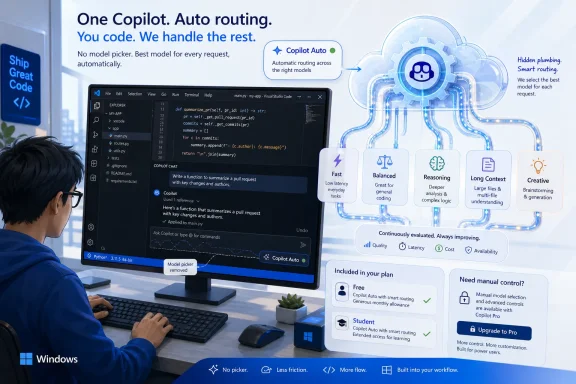
GitHub’s stated pitch is tidy: Copilot Auto evaluates a request and routes it to an appropriate AI model, drawing from multiple model families according to task complexity, service health, availability, and plan restrictions. In theory, the developer asks for help and GitHub worries about the machinery.
That is not a trivial engineering promise. A coding assistant is not a normal chatbot with a novelty skin; it sits inside the editor, reads local context, proposes changes, explains stack traces, and increasingly acts through tools. If the routing layer can reliably distinguish between a throwaway syntax question and a multi-file reasoning task, users may get faster responses with fewer failed requests.
But GitHub is also changing the social contract. For Free and Student users, model selection was a visible control that helped explain why Copilot behaved differently from one session to another. Removing that control does not merely simplify the interface; it shifts authority from the developer to the platform.
That distinction matters because developers have learned to treat models like tools, not interchangeable engines. A fast model might be fine for boilerplate. A stronger reasoning model might be necessary for refactoring a brittle Windows service, diagnosing a race condition, or understanding a tangled build failure. GitHub’s bet is that most users do not want to make that call. Many power users will hear something else: GitHub no longer wants them to.
Free tiers are useful for adoption, education, and ecosystem lock-in. They are much harder to justify when a student can repeatedly invoke high-cost models for exploratory coding, debugging, and agentic workflows that consume large context windows and many tokens. The more Copilot becomes an autonomous coding environment rather than autocomplete with a chat box, the more every “free” interaction starts to look like a metered cloud workload.
GitHub’s public language emphasizes reliability and latency. That is plausible. If too many free-tier users pile onto a premium model, requests slow down, fail, or hit limits. Auto routing gives GitHub a way to flatten demand, steer simple work to cheaper capacity, and reserve more capable models for tasks the system believes need them.
Yet the business logic is impossible to miss. Manual model selection lets users express preference. Auto routing lets GitHub express budget.
That does not make the decision cynical. It makes it infrastructural. GitHub is trying to preserve the appearance of broad model access while reducing the operational damage caused by unconstrained model choice. For a paid Pro, Business, or Enterprise customer, the model picker remains part of the value proposition. For Free and Student users, GitHub is now saying the free lunch comes with a chef’s choice menu.
When a student can compare how two models explain a recursion bug or scaffold a React component, they are learning something practical about AI-assisted development. They learn which model hallucinates APIs, which one over-engineers, which one follows constraints, and which one needs more explicit context. That is not trivia. It is the emerging literacy of software work.
Auto mode hides some of that. GitHub says users can still see which model generated a response, but seeing the label after the fact is not the same as choosing the tool before the work begins. The former is an audit trail. The latter is agency.
There is also a trust problem. If Copilot produces a poor answer under Auto, the user has to wonder whether the prompt was bad, the routing decision was bad, the chosen model was weak, or the plan quietly constrained access. That ambiguity is tolerable for casual experimentation. It is frustrating when the assistant is being used to learn, debug, or ship.
GitHub may argue that most students should not have to understand model menus. That is fair for beginners. But the best educational tools reveal complexity gradually rather than removing it entirely. A beginner-friendly default and an advanced override could have coexisted. GitHub has instead made the override a paid-plan distinction.
The model market is volatile. Providers release new versions, deprecate older ones, shift pricing, impose rate limits, and tune performance. A static model picker exposes that churn to end users. Auto mode absorbs it behind an abstraction.
That abstraction has benefits. GitHub can add a new model family without forcing users to read release notes. It can route around outages. It can reduce failed requests. It can tune performance for different clients, such as GitHub.com, VS Code, mobile, and the Copilot CLI. It can also make plan entitlements easier to enforce without maintaining a sprawling user-visible matrix.
But abstractions always have politics. When a platform hides complexity, it also decides which parts of complexity users are allowed to care about. For Copilot Free and Student, GitHub has decided that model identity is no longer a first-class choice.
That may become the norm across AI products. Consumers already accept “best available” routing in search, recommendations, voice assistants, and cloud services. Developers, however, tend to resist invisible decisions that affect correctness. They like compiler flags, runtime versions, package locks, and reproducible builds for a reason. Software work punishes mystery.
Preview labels gave users a hint that a model might change, behave unpredictably, or carry different support expectations. Removing the label makes sense if the user is no longer being asked to choose between models. If Auto is the product, the distinction between preview and production becomes an internal quality-management issue.
The problem is that developers use labels to calibrate risk. A preview compiler, SDK, driver, or API carries an implied warning. A preview AI model may be fine for brainstorming but questionable for critical code paths. If that distinction disappears from the interface, GitHub is asking users to trust the routing layer’s judgment instead.
For enterprises, this is less alarming because administrative controls, procurement terms, and policy settings tend to matter more than the individual model menu. For students and free users, the interface is the policy. If the product no longer exposes meaningful state, users are left to infer it through behavior.
That creates a familiar platform problem: simplification for the majority can look like opacity to the minority that cares most.
A sysadmin using Copilot to draft PowerShell remediation scripts may care less about model branding than response reliability. If Auto mode reduces failed requests and picks a competent model for routine scripting, the change may be welcome. Fewer knobs can mean fewer support headaches.
A developer debugging a COM interop issue, packaging an MSIX installer, or modernizing a .NET Framework application may feel differently. These are tasks where model depth and domain knowledge matter. If Auto routes too aggressively toward cheaper or faster models, the answer may be superficially fluent and technically wrong.
That is the danger zone for AI coding tools: not failure, but plausible mediocrity. A slow error is easier to distrust than a confident near-miss. The model picker gave advanced users one way to reduce that risk. Auto mode asks them to accept that GitHub’s classifier knows when the stakes are high.
There is a practical workaround, of course: pay for a plan that preserves more control. That is the quiet upsell embedded in the change. Free and Student users still get Copilot, but the more deterministic version of Copilot increasingly belongs to paid tiers.
The company also says it generally avoids switching models in the middle of an active chat session. That is important. Model hopping can make a conversation feel incoherent, especially when the assistant is carrying assumptions about a codebase. Keeping a session on the same model can preserve continuity while still allowing GitHub to make a routing decision up front.
But reliability is not only uptime. For developer tools, reliability also means predictable behavior. If Auto mode changes model choices over time, and if the available pool is subject to plan restrictions and backend updates, then the same prompt may produce materially different outcomes week to week. That may be acceptable for casual chat. It is awkward for teams trying to standardize workflows.
This is where GitHub has to be careful. If Auto mode is excellent, the missing picker becomes a footnote. If Auto mode is inconsistent, users will treat it as a black box that took away their escape hatch.
The product therefore needs more than clever routing. It needs honest observability. Showing which model answered is a start. Explaining why Auto chose that model, what alternatives were unavailable, and whether plan restrictions affected the decision would go much further.
That is not unique to GitHub. Every AI vendor is wrestling with the same squeeze between user expectations and inference costs. The early era of “try the magic model for free” is giving way to a more cloud-like economy of metering, routing, throttling, and tiering.
Developers should recognize the pattern. This is what happens when a capability moves from demo to utility. The first version dazzles. The mature version bills, limits, routes, and governs.
GitHub’s challenge is that Copilot became popular partly because it felt immediate and personal. The assistant lived in the editor and responded as if it were your pair programmer. Plan restrictions make it feel more like a shared service.
That shift may be unavoidable. But it changes how users evaluate the product. A pair programmer earns trust through skill. A shared service earns trust through transparency, predictable rules, and graceful degradation. GitHub’s latest move improves its control over the service. It remains to be seen whether it improves users’ trust in it.
That understates the issue. The model picker represented a visible boundary between the user’s judgment and the platform’s judgment. Removing it is a signal that GitHub considers routing too important to leave to free-tier users.
There are good reasons for that. Users often pick the biggest model because it sounds best, not because the task requires it. That wastes capacity and can make the service worse for everyone. Students, in particular, may have used premium models in ways that were economically hard to sustain.
Still, the best developer platforms do not simply take controls away when they become expensive. They redesign them. GitHub could have kept manual selection with clearer quotas, added “recommended” defaults, exposed model classes rather than brand names, or limited premium selections without eliminating choice entirely.
Instead, it has chosen a cleaner dividing line. Free and Student users get Auto. Paying users get more explicit control. That is simpler to message, easier to enforce, and more aligned with usage-based billing. It is also a reminder that in AI tooling, product design and cost containment are now inseparable.
GitHub’s decision is less a retreat from free Copilot than a preview of where AI developer tools are headed: fewer visible model knobs for the mass market, more routing intelligence in the platform, and sharper differences between free access and paid control. The company may be right that most users should not have to choose a model before asking for help, but developers will judge the bargain by results, not by simplification rhetoric. If Auto consistently picks well, this will look like housekeeping. If it does not, June 2026 will be remembered as the moment GitHub made Copilot feel less like a programmable assistant and more like a managed service with a missing control panel.
 GitHub Turns Choice Into Plumbing
GitHub’s stated pitch is tidy: Copilot Auto evaluates a request and routes it to an appropriate AI model, drawing from multiple model families according to task complexity, service health, availability, and plan restrictions. In theory, the developer asks for help and GitHub worries about the machinery.That is not a trivial engineering promise. A coding assistant is not a normal chatbot with a novelty skin; it sits inside the editor, reads local context, proposes changes, explains stack traces, and increasingly acts through tools. If the routing layer can reliably distinguish between a throwaway syntax question and a multi-file reasoning task, users may get faster responses with fewer failed requests.
But GitHub is also changing the social contract. For Free and Student users, model selection was a visible control that helped explain why Copilot behaved differently from one session to another. Removing that control does not merely simplify the interface; it shifts authority from the developer to the platform.
That distinction matters because developers have learned to treat models like tools, not interchangeable engines. A fast model might be fine for boilerplate. A stronger reasoning model might be necessary for refactoring a brittle Windows service, diagnosing a race condition, or understanding a tangled build failure. GitHub’s bet is that most users do not want to make that call. Many power users will hear something else: GitHub no longer wants them to.
Free Copilot Was Always a Cost Problem Waiting to Surface
The change lands after months of Copilot plan reshuffling, usage controls, and a broader move toward usage-based economics. That context is essential. AI coding assistants are expensive to run, especially when users can steer requests toward premium models from OpenAI, Anthropic, Google, or Microsoft-backed model families.Free tiers are useful for adoption, education, and ecosystem lock-in. They are much harder to justify when a student can repeatedly invoke high-cost models for exploratory coding, debugging, and agentic workflows that consume large context windows and many tokens. The more Copilot becomes an autonomous coding environment rather than autocomplete with a chat box, the more every “free” interaction starts to look like a metered cloud workload.
GitHub’s public language emphasizes reliability and latency. That is plausible. If too many free-tier users pile onto a premium model, requests slow down, fail, or hit limits. Auto routing gives GitHub a way to flatten demand, steer simple work to cheaper capacity, and reserve more capable models for tasks the system believes need them.
Yet the business logic is impossible to miss. Manual model selection lets users express preference. Auto routing lets GitHub express budget.
That does not make the decision cynical. It makes it infrastructural. GitHub is trying to preserve the appearance of broad model access while reducing the operational damage caused by unconstrained model choice. For a paid Pro, Business, or Enterprise customer, the model picker remains part of the value proposition. For Free and Student users, GitHub is now saying the free lunch comes with a chef’s choice menu.
Students Lose the Most Legible Version of Copilot
The Student plan is where this change will feel sharpest. Students are not just light users who need occasional help with syntax. Many are learning the differences between model behavior, prompt design, code review discipline, and the limits of generated code. For them, the model picker was not only a convenience; it was a teaching surface.When a student can compare how two models explain a recursion bug or scaffold a React component, they are learning something practical about AI-assisted development. They learn which model hallucinates APIs, which one over-engineers, which one follows constraints, and which one needs more explicit context. That is not trivia. It is the emerging literacy of software work.
Auto mode hides some of that. GitHub says users can still see which model generated a response, but seeing the label after the fact is not the same as choosing the tool before the work begins. The former is an audit trail. The latter is agency.
There is also a trust problem. If Copilot produces a poor answer under Auto, the user has to wonder whether the prompt was bad, the routing decision was bad, the chosen model was weak, or the plan quietly constrained access. That ambiguity is tolerable for casual experimentation. It is frustrating when the assistant is being used to learn, debug, or ship.
GitHub may argue that most students should not have to understand model menus. That is fair for beginners. But the best educational tools reveal complexity gradually rather than removing it entirely. A beginner-friendly default and an advanced override could have coexisted. GitHub has instead made the override a paid-plan distinction.
Auto Mode Is a Product Feature and a Governance Layer
Copilot Auto sounds like a convenience feature, but it is better understood as a governance layer. It governs cost, capacity, latency, access, and probably model availability across a fast-changing supplier landscape. That makes it strategically valuable for GitHub even if users experience it as a missing dropdown.The model market is volatile. Providers release new versions, deprecate older ones, shift pricing, impose rate limits, and tune performance. A static model picker exposes that churn to end users. Auto mode absorbs it behind an abstraction.
That abstraction has benefits. GitHub can add a new model family without forcing users to read release notes. It can route around outages. It can reduce failed requests. It can tune performance for different clients, such as GitHub.com, VS Code, mobile, and the Copilot CLI. It can also make plan entitlements easier to enforce without maintaining a sprawling user-visible matrix.
But abstractions always have politics. When a platform hides complexity, it also decides which parts of complexity users are allowed to care about. For Copilot Free and Student, GitHub has decided that model identity is no longer a first-class choice.
That may become the norm across AI products. Consumers already accept “best available” routing in search, recommendations, voice assistants, and cloud services. Developers, however, tend to resist invisible decisions that affect correctness. They like compiler flags, runtime versions, package locks, and reproducible builds for a reason. Software work punishes mystery.
The Preview Label Disappears Along With the Picker
GitHub is also retiring the “Preview” label from Microsoft-released models as part of this simplification. On paper, that is a minor UI cleanup. In practice, it reinforces the same direction of travel: less model-specific signaling, more platform-managed routing.Preview labels gave users a hint that a model might change, behave unpredictably, or carry different support expectations. Removing the label makes sense if the user is no longer being asked to choose between models. If Auto is the product, the distinction between preview and production becomes an internal quality-management issue.
The problem is that developers use labels to calibrate risk. A preview compiler, SDK, driver, or API carries an implied warning. A preview AI model may be fine for brainstorming but questionable for critical code paths. If that distinction disappears from the interface, GitHub is asking users to trust the routing layer’s judgment instead.
For enterprises, this is less alarming because administrative controls, procurement terms, and policy settings tend to matter more than the individual model menu. For students and free users, the interface is the policy. If the product no longer exposes meaningful state, users are left to infer it through behavior.
That creates a familiar platform problem: simplification for the majority can look like opacity to the minority that cares most.
The Windows Developer Angle Is Bigger Than GitHub
For WindowsForum readers, this change is not just about GitHub’s plan matrix. Copilot has become part of the daily toolchain for many Windows developers, sysadmins, and IT pros using VS Code, Visual Studio, PowerShell, GitHub repositories, and Microsoft’s broader developer ecosystem. When GitHub changes Copilot, it changes the texture of Windows development.A sysadmin using Copilot to draft PowerShell remediation scripts may care less about model branding than response reliability. If Auto mode reduces failed requests and picks a competent model for routine scripting, the change may be welcome. Fewer knobs can mean fewer support headaches.
A developer debugging a COM interop issue, packaging an MSIX installer, or modernizing a .NET Framework application may feel differently. These are tasks where model depth and domain knowledge matter. If Auto routes too aggressively toward cheaper or faster models, the answer may be superficially fluent and technically wrong.
That is the danger zone for AI coding tools: not failure, but plausible mediocrity. A slow error is easier to distrust than a confident near-miss. The model picker gave advanced users one way to reduce that risk. Auto mode asks them to accept that GitHub’s classifier knows when the stakes are high.
There is a practical workaround, of course: pay for a plan that preserves more control. That is the quiet upsell embedded in the change. Free and Student users still get Copilot, but the more deterministic version of Copilot increasingly belongs to paid tiers.
Reliability Is the Winning Argument, Until It Is Not
GitHub’s strongest argument is reliability. If Auto mode reduces latency, avoids overloaded models, and keeps chat sessions stable, many users will not mourn the picker. Most people do not want to benchmark AI models before asking why their TypeScript build failed.The company also says it generally avoids switching models in the middle of an active chat session. That is important. Model hopping can make a conversation feel incoherent, especially when the assistant is carrying assumptions about a codebase. Keeping a session on the same model can preserve continuity while still allowing GitHub to make a routing decision up front.
But reliability is not only uptime. For developer tools, reliability also means predictable behavior. If Auto mode changes model choices over time, and if the available pool is subject to plan restrictions and backend updates, then the same prompt may produce materially different outcomes week to week. That may be acceptable for casual chat. It is awkward for teams trying to standardize workflows.
This is where GitHub has to be careful. If Auto mode is excellent, the missing picker becomes a footnote. If Auto mode is inconsistent, users will treat it as a black box that took away their escape hatch.
The product therefore needs more than clever routing. It needs honest observability. Showing which model answered is a start. Explaining why Auto chose that model, what alternatives were unavailable, and whether plan restrictions affected the decision would go much further.
GitHub Is Teaching Users to Think in Plans, Not Models
The old Copilot story was about AI capability: better models, broader context, smarter coding help. The new story is increasingly about entitlement. Which plan are you on? How many credits do you have? Which models can you select? Which models can Auto reach? Which features are reserved for Pro, Pro+, Business, or Enterprise?That is not unique to GitHub. Every AI vendor is wrestling with the same squeeze between user expectations and inference costs. The early era of “try the magic model for free” is giving way to a more cloud-like economy of metering, routing, throttling, and tiering.
Developers should recognize the pattern. This is what happens when a capability moves from demo to utility. The first version dazzles. The mature version bills, limits, routes, and governs.
GitHub’s challenge is that Copilot became popular partly because it felt immediate and personal. The assistant lived in the editor and responded as if it were your pair programmer. Plan restrictions make it feel more like a shared service.
That shift may be unavoidable. But it changes how users evaluate the product. A pair programmer earns trust through skill. A shared service earns trust through transparency, predictable rules, and graceful degradation. GitHub’s latest move improves its control over the service. It remains to be seen whether it improves users’ trust in it.
The Real Cost Is Not the Dropdown
It is tempting to frame this as a small UI change. Free users lose a dropdown. Student users lose a dropdown. Copilot continues to work. Life goes on.That understates the issue. The model picker represented a visible boundary between the user’s judgment and the platform’s judgment. Removing it is a signal that GitHub considers routing too important to leave to free-tier users.
There are good reasons for that. Users often pick the biggest model because it sounds best, not because the task requires it. That wastes capacity and can make the service worse for everyone. Students, in particular, may have used premium models in ways that were economically hard to sustain.
Still, the best developer platforms do not simply take controls away when they become expensive. They redesign them. GitHub could have kept manual selection with clearer quotas, added “recommended” defaults, exposed model classes rather than brand names, or limited premium selections without eliminating choice entirely.
Instead, it has chosen a cleaner dividing line. Free and Student users get Auto. Paying users get more explicit control. That is simpler to message, easier to enforce, and more aligned with usage-based billing. It is also a reminder that in AI tooling, product design and cost containment are now inseparable.
The Copilot Free Ride Now Comes With a Driver
The concrete consequences are not hard to summarize, even if the long-term implications are still forming.- Copilot Free and Copilot Student users now use Copilot Auto as the only model-selection experience rather than manually choosing individual models.
- Copilot Auto can route requests across multiple model families, but the available pool remains subject to plan restrictions and may change over time.
- GitHub says Auto is meant to improve reliability, reduce latency, and lower the odds of failed or unavailable model requests.
- Active chat sessions generally stay on the same selected model, which should reduce conversational inconsistency during a single task.
- Users may still see which model generated a response, but they no longer control that choice on Free and Student plans.
- The removal of Microsoft model “Preview” labels fits the same strategy of moving model-specific decisions behind GitHub’s routing layer.
GitHub’s decision is less a retreat from free Copilot than a preview of where AI developer tools are headed: fewer visible model knobs for the mass market, more routing intelligence in the platform, and sharper differences between free access and paid control. The company may be right that most users should not have to choose a model before asking for help, but developers will judge the bargain by results, not by simplification rhetoric. If Auto consistently picks well, this will look like housekeeping. If it does not, June 2026 will be remembered as the moment GitHub made Copilot feel less like a programmable assistant and more like a managed service with a missing control panel.
References
- Primary source: Techzine Global
Published: Thu, 25 Jun 2026 08:00:59 GMT
GitHub removes model selection in free Copilot - Techzine Global
Following changes made by GitHub, users of Copilot Free and Copilot Student will no longer be able to select an AI model themselves. www.techzine.eu
- Independent coverage: Windows Report
Published: 2026-06-25T06:02:51.650794
GitHub Copilot Auto Becomes Default for Free and Student Users
GitHub is removing manual AI model selection from Copilot Free and Student plans, replacing it with Copilot Auto for smarter model routing. windowsreport.com
- Related coverage: github.blog
Changes to model selection for Free and Student plans - GitHub Changelog
Copilot Free and Student plans will now use Copilot auto model selection as the default and only model selection experience. Auto dynamically selects the best model for each task, removing…github.blog
- Related coverage: roboin.io
GitHub Copilot student discount no longer allows selecting GPT-5.4 or Claude, with some models limited to Auto mode only amid plan reorganization - Roboin Blog
On March 12, 2026, GitHub announced that, in conjunction with a reorganization of GitHub Copilot's free plan for students, some premium models such as Claude Opus, Claude Sonnet, and GPT-5.4 will no longer be available for selection. This became clear through an official GitHub community... roboin.io
- Related coverage: agent-wars.com

GitHub Copilot Restricts Self-Selection of Premium Models for Students, Including Claude Opus, Sonnet, and GPT-5.4
Agent Wars — Tracking the rise of AI agents. The definitive directory of AI agent platforms, tools, and frameworks.
agent-wars.com
- Official source: github.com
GitHub Copilot · Your AI pair programmer · GitHub
GitHub is where people build software. More than 150 million people use GitHub to discover, fork, and contribute to over 420 million projects. github.com
- Related coverage: techzine.nl
GitHub schrapt modelkeuze in gratis Copilot - Techzine.nl
Gebruikers van Copilot Free en Copilot Student verliezen de mogelijkheid om zelf een AI-model te selecteren na aanpassingen door GitHub. www.techzine.nl
- Official source: docs.github.com
About individual GitHub Copilot plans and benefits - GitHub Docs
GitHub offers several Copilot plans for individual developers, each with different features, model access, and usage limits to support a wide range of coding needs. docs.github.com
- Related coverage: startdebugging.net
GPT-5.3-Codex Becomes the Copilot Business and Enterprise Base Model - Start Debugging
On May 17, 2026 GitHub flipped the default Copilot model on Business and Enterprise plans from GPT-4.1 to GPT-5.3-Codex. GPT-4.1 stays free until June 1, then it falls under usage-based billing. Here is what changes for pinned models in your repo and CI.startdebugging.net
- Related coverage: heise.de
GitHub removes free models from Copilot plans | heise online
New plans for Copilot: Instead of flat-rate premium requests, GitHub now charges for actual token consumption. Free models will be discontinued. www.heise.de
- Related coverage: theoncetimes.com
GitHub Copilot Pulls Premium Models from Free Student Plan | The Once Times
Students lose manual access to top AI models. GitHub says it's about sustainability. Not everyone is buying it.theoncetimes.com - Related coverage: botbeat.news
GitHub Removes Frontier AI Models from Copilot Student Plan to Ensure Long-Term Accessibility | BotBeat
# GitHub Removes Frontier AI Models from Copilot Student Plan to Ensure Long-Term Accessibility **Source**: [Hacker News](https://github.com/orgs/community/disbotbeat.news - Official source: devblogs.microsoft.com
Introducing Copilot auto model selection (preview) - Visual Studio Blog
Learn how auto model selection (preview) streamlines your experience by automatically choosing the best model for each request.devblogs.microsoft.com
