

Switzerland’s Competition Commission has opened a preliminary investigation into Google’s removal of the Android Choice Screen, a setup-stage prompt that allowed buyers of new phones and tablets to select a default search engine. Without it, Google Search is automatically configured for Swiss users, while Android devices in the European Economic Area continue to present a choice.
The investigation was announced by the Secretariat of the Competition Commission, known as COMCO, on July 14. As reported by CNBC-TV18 and detailed in the regulator’s statement, COMCO will examine whether Google’s change shows signs of an unlawful restriction of competition under Switzerland’s Cartel Act.
Google acknowledged the proceeding and said it would cooperate with the authority. The company has not publicly explained why the choice screen was removed specifically in Switzerland.
For Microsoft, the dispute is directly relevant to Bing: setup screens give rival search providers one of their few opportunities to reach users before Google becomes an established default. COMCO warned that removing this point of choice could also affect competition among digital services beyond conventional web search.
Google introduced Android search-engine choice screens in Europe following the European Commission’s 2018 Android antitrust decision. Switzerland was not initially covered by that European Economic Area remedy, but Google expanded the program to the country on November 1, 2021.
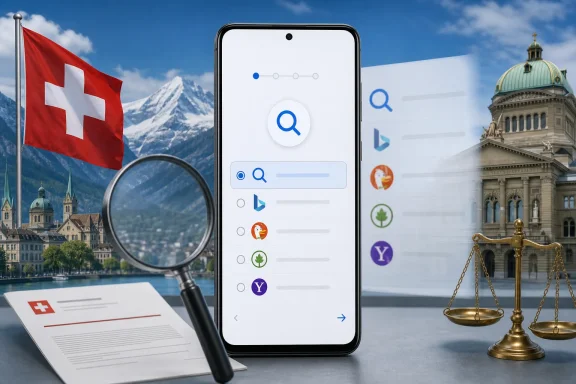
The screen appeared during the initial setup of eligible new Android phones and tablets on which the Google Search app was preinstalled. It presented alternative general-purpose search services alongside Google, allowing the user’s selection to determine the default search provider and associated search application.
Google’s published documentation previously listed providers such as Microsoft Bing, DuckDuckGo, Ecosia and Yahoo among the available Swiss choices. Eligibility depended on requirements including local-language support, a free application distributed through Google Play and the ability to operate as a general search engine rather than a specialist search service.
COMCO now says Google has “recently” removed that screen in Switzerland. The regulator did not provide an exact date for the change, identify the affected Android builds or say whether it was delivered through Google Play services, a setup application update or revised regional configuration.
That distinction matters operationally because Android’s setup experience is assembled from several components controlled by Google, device manufacturers and mobile carriers. A region-specific server-side policy can alter what users see without requiring a conventional Android operating-system upgrade.
Existing users can still change search providers manually through their browser or Android settings, depending on the applications installed. COMCO’s concern is that a buried configuration option is not equivalent to an explicit decision presented when a device is first activated.
The immediate beneficiary of the Swiss change is Google Search. Statcounter estimated Google’s share of the Swiss search market at 81.6% in June 2026, compared with 10.17% for Microsoft Bing, 2.31% for DuckDuckGo and 1.39% for Ecosia. Statcounter figures are usage estimates rather than regulatory market findings, but they illustrate the steep imbalance facing alternatives.
A choice screen does not guarantee that users will select a rival. Google remains one of the options, enjoys enormous brand recognition and can win the selection on merit or familiarity. The screen’s competitive value is that it creates a visible, neutral moment in which alternatives can be considered at all.
Removing that moment shifts the burden. A Swiss Android buyer who wants Bing, DuckDuckGo, Ecosia or another provider must recognize that Google has been selected automatically, know that the setting can be changed, locate the relevant controls and potentially install another application.
Each step introduces friction, and many users simply retain the default. That behavior is why operating-system prompts have become such a contested antitrust issue across Android, iOS and Windows.
Microsoft has faced comparable scrutiny over Edge and Bing promotion inside Windows 11, including default-app workflows, search links opened from Windows components and prompts encouraging users to retain Microsoft services. The companies and legal mechanisms differ, but the underlying regulatory question is the same: when a platform owner controls the first-run experience, a default can function as distribution power.
The EEA’s current protections are reinforced by the European Union’s Digital Markets Act, which imposes obligations on designated technology gatekeepers. Switzerland is not an EU member or part of the EEA, so those rules do not automatically extend across the Swiss border.
That legal boundary appears to have produced a visible product difference. Two users buying comparable Android devices in neighboring European markets can encounter different setup flows, even though COMCO argues that the underlying competition concerns are comparable.
Google voluntarily extended its earlier European choice-screen framework to Switzerland in 2021. Its later withdrawal could therefore test whether Swiss competition law can preserve a product safeguard that is mandatory or otherwise maintained elsewhere in Europe.
The timing also places the investigation against Google’s broader Android antitrust history. On July 2, the Court of Justice of the European Union rejected Google’s final appeal against the European Commission’s Android competition decision and upheld a penalty of approximately €4.1 billion. That case concerned contractual restrictions, preinstallation and other practices used to promote Google Search and Chrome on Android devices, rather than the specific removal now under examination in Switzerland.
Still, the cases share a central concern: Google controls Android’s commercially important distribution terms while also competing through services placed prominently on Android devices.
The inquiry could be closed without further action. Google could also change the Swiss setup flow during discussions, or COMCO could determine that a deeper investigation is warranted under the Cartel Act.
The regulator signaled that the proceeding may reach beyond one search prompt. It said its findings could help assess practices involving default settings on other mobile devices, potentially making the case relevant to Apple, browser developers and any platform operator that gives its own service privileged placement.
For enterprises, schools and managed-device fleets, the immediate effect is limited because administrators can deploy browsers, applications and search policies through mobile-device management systems. The users most exposed are consumers and small organizations activating unmanaged Android hardware through the standard out-of-box experience.
No restoration date has been announced, and Google has not committed to bringing the Choice Screen back while the probe proceeds. Until either the company or COMCO intervenes, new Swiss Android users will start with Google Search selected for them, while alternatives including Microsoft Bing lose the most valuable opportunity to appear before the first query is entered.
The investigation was announced by the Secretariat of the Competition Commission, known as COMCO, on July 14. As reported by CNBC-TV18 and detailed in the regulator’s statement, COMCO will examine whether Google’s change shows signs of an unlawful restriction of competition under Switzerland’s Cartel Act.
Google acknowledged the proceeding and said it would cooperate with the authority. The company has not publicly explained why the choice screen was removed specifically in Switzerland.
For Microsoft, the dispute is directly relevant to Bing: setup screens give rival search providers one of their few opportunities to reach users before Google becomes an established default. COMCO warned that removing this point of choice could also affect competition among digital services beyond conventional web search.
 Google Quietly Reversed a Five-Year-Old Concession
Google introduced Android search-engine choice screens in Europe following the European Commission’s 2018 Android antitrust decision. Switzerland was not initially covered by that European Economic Area remedy, but Google expanded the program to the country on November 1, 2021.The screen appeared during the initial setup of eligible new Android phones and tablets on which the Google Search app was preinstalled. It presented alternative general-purpose search services alongside Google, allowing the user’s selection to determine the default search provider and associated search application.
Google’s published documentation previously listed providers such as Microsoft Bing, DuckDuckGo, Ecosia and Yahoo among the available Swiss choices. Eligibility depended on requirements including local-language support, a free application distributed through Google Play and the ability to operate as a general search engine rather than a specialist search service.
COMCO now says Google has “recently” removed that screen in Switzerland. The regulator did not provide an exact date for the change, identify the affected Android builds or say whether it was delivered through Google Play services, a setup application update or revised regional configuration.
That distinction matters operationally because Android’s setup experience is assembled from several components controlled by Google, device manufacturers and mobile carriers. A region-specific server-side policy can alter what users see without requiring a conventional Android operating-system upgrade.
Existing users can still change search providers manually through their browser or Android settings, depending on the applications installed. COMCO’s concern is that a buried configuration option is not equivalent to an explicit decision presented when a device is first activated.
The Default Is the Product
Search defaults determine where queries go from browser address bars, home-screen widgets and other entry points that users may never reconfigure. COMCO described these settings as decisive in digital markets because they can create lock-in effects around preconfigured services.The immediate beneficiary of the Swiss change is Google Search. Statcounter estimated Google’s share of the Swiss search market at 81.6% in June 2026, compared with 10.17% for Microsoft Bing, 2.31% for DuckDuckGo and 1.39% for Ecosia. Statcounter figures are usage estimates rather than regulatory market findings, but they illustrate the steep imbalance facing alternatives.
A choice screen does not guarantee that users will select a rival. Google remains one of the options, enjoys enormous brand recognition and can win the selection on merit or familiarity. The screen’s competitive value is that it creates a visible, neutral moment in which alternatives can be considered at all.
Removing that moment shifts the burden. A Swiss Android buyer who wants Bing, DuckDuckGo, Ecosia or another provider must recognize that Google has been selected automatically, know that the setting can be changed, locate the relevant controls and potentially install another application.
Each step introduces friction, and many users simply retain the default. That behavior is why operating-system prompts have become such a contested antitrust issue across Android, iOS and Windows.
Microsoft has faced comparable scrutiny over Edge and Bing promotion inside Windows 11, including default-app workflows, search links opened from Windows components and prompts encouraging users to retain Microsoft services. The companies and legal mechanisms differ, but the underlying regulatory question is the same: when a platform owner controls the first-run experience, a default can function as distribution power.
Switzerland Now Gets Less Choice Than Its Neighbors
COMCO highlighted an unusual geographic split in Google’s policy. Swiss users no longer receive the Android search screen, while users in the European Economic Area continue to see a choice mechanism.The EEA’s current protections are reinforced by the European Union’s Digital Markets Act, which imposes obligations on designated technology gatekeepers. Switzerland is not an EU member or part of the EEA, so those rules do not automatically extend across the Swiss border.
That legal boundary appears to have produced a visible product difference. Two users buying comparable Android devices in neighboring European markets can encounter different setup flows, even though COMCO argues that the underlying competition concerns are comparable.
Google voluntarily extended its earlier European choice-screen framework to Switzerland in 2021. Its later withdrawal could therefore test whether Swiss competition law can preserve a product safeguard that is mandatory or otherwise maintained elsewhere in Europe.
The timing also places the investigation against Google’s broader Android antitrust history. On July 2, the Court of Justice of the European Union rejected Google’s final appeal against the European Commission’s Android competition decision and upheld a penalty of approximately €4.1 billion. That case concerned contractual restrictions, preinstallation and other practices used to promote Google Search and Chrome on Android devices, rather than the specific removal now under examination in Switzerland.
Still, the cases share a central concern: Google controls Android’s commercially important distribution terms while also competing through services placed prominently on Android devices.
A Preliminary Probe Is Not a Finding Against Google
COMCO has not concluded that Google broke Swiss law. A preliminary investigation is an initial process used by the Secretariat to determine whether sufficient indications of an unlawful restriction exist to justify formal proceedings.The inquiry could be closed without further action. Google could also change the Swiss setup flow during discussions, or COMCO could determine that a deeper investigation is warranted under the Cartel Act.
The regulator signaled that the proceeding may reach beyond one search prompt. It said its findings could help assess practices involving default settings on other mobile devices, potentially making the case relevant to Apple, browser developers and any platform operator that gives its own service privileged placement.
For enterprises, schools and managed-device fleets, the immediate effect is limited because administrators can deploy browsers, applications and search policies through mobile-device management systems. The users most exposed are consumers and small organizations activating unmanaged Android hardware through the standard out-of-box experience.
No restoration date has been announced, and Google has not committed to bringing the Choice Screen back while the probe proceeds. Until either the company or COMCO intervenes, new Swiss Android users will start with Google Search selected for them, while alternatives including Microsoft Bing lose the most valuable opportunity to appear before the first query is entered.
References
- Primary source: CNBC TV18
Published: 2026-07-14T07:55:35+00:00
Google probed by Swiss regulator over Android default search feature - CNBC TV18
COMCO investigates Google for removing Android's "Choice Screen" in Switzerland, potentially violating competition law and impacting user choice.www.cnbctv18.com - Related coverage: se.marketscreener.com
