

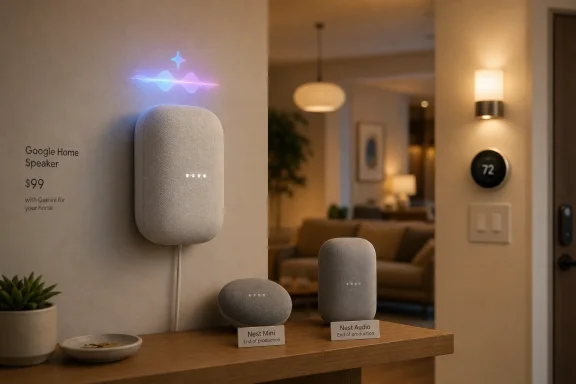
Google has confirmed in June 2026 that it has ended production of the Nest Mini and Nest Audio smart speakers, leaving the new $99 Google Home Speaker as its lone current first-party speaker for the Gemini-era Google Home lineup. The discontinuation is not a surprise; both devices belonged to a pre-generative-AI smart home strategy that Google has been trying to outrun for years. What matters is not that two aging speakers are disappearing, but that Google is collapsing a once-tiered hardware family into a single bet on AI as the reason to buy back into the home.
For most people, the Nest Mini was never really a speaker in the audiophile sense. It was a $35 to $49 puck that made Google Assistant ambient, inexpensive, and easy to scatter around a house. It was the thing you bought on sale, received in a bundle, stuck in a kitchen, or mounted near a light switch so the smart home felt less like an app and more like an appliance.
The Nest Audio played a different role. Released as the more serious $99 option, it was the speaker for people who wanted Google’s voice assistant without pretending a tiny puck could fill a room. It was not a Sonos killer, but it gave Google a defensible middle tier: better sound, still approachable, still clearly part of the same ecosystem.
Now both have been put on the same shelf as so many Google hardware experiments before them. Google says it will keep supporting existing Nest Mini and Nest Audio units with software patches, security updates, and customer care. That reassurance matters, but it does not change the signal the company is sending: the old Google Assistant speaker lineup is over, and the replacement strategy starts with one device.
That is a bold simplification, and maybe a necessary one. It is also a risk. Google’s smart home business has always depended on low-friction adoption, and retiring the cheapest entry point makes the future of Google Home look less like a mass-market utility and more like a premium AI accessory.
Google’s advantage was obvious. It had search, speech recognition, maps, YouTube, Android, and an enormous services graph. If any company should have made the home assistant feel inevitable, it was Google. The Nest Mini embodied that strategy because it was small, cheap, and good enough.
The problem was that “good enough” became the ceiling. Smart speakers did not evolve into the general-purpose household computers once imagined. They became voice remotes with microphones, excellent for a few recurring tasks and maddening for everything else. Users learned the phrases that worked, avoided the ones that did not, and slowly internalized the limits of the assistant.
That stagnation hit Google especially hard because Google Assistant was supposed to be smarter than the competition. When it misunderstood a command, lost context, or failed at a simple smart home routine, the disappointment felt larger than the device. The hardware was cheap; the promise was not.
By discontinuing the Nest Mini and Nest Audio, Google is not merely refreshing a product line. It is acknowledging that the old bargain — inexpensive hardware plus a command-based assistant — has run out of narrative energy.
That is the right ambition. A useful home AI should not require users to remember exact incantations. It should understand that “make it cozy in here” might mean dimming lights, adjusting the thermostat, and starting music depending on the room, time, and user. It should summarize what happened while you were out without forcing you to inspect camera events one by one. It should handle follow-up questions without forgetting the previous sentence.
But the smart home is a harsher test for generative AI than a browser tab or chatbot window. In a chat interface, a wrong answer is irritating. In a home, a wrong action can unlock a door, disable a routine, wake a child, turn on a camera, or change a thermostat at the worst possible time. Domestic computing has a low tolerance for whimsical interpretation.
That is why the retirement of the older speakers feels bigger than a hardware cleanup. Google is asking users to believe that Gemini will improve the home experience enough to justify a new device, even as many existing smart speaker owners still mostly want speed, reliability, and predictable command execution. The company’s AI story is compelling, but the home is where AI has to become boringly dependable.
That kind of simplification can be useful. Apple has often benefited from fewer, clearer choices. Amazon’s Echo lineup, by contrast, can feel like a retail aisle designed by a spreadsheet. Google may have decided that if Gemini is the main event, it needs a clean stage rather than a pile of legacy devices with different acoustic profiles and different expectations attached.
Still, the funnel matters. The Nest Mini was not just a low-end SKU; it was a recruitment tool. It let Google enter bedrooms, apartments, dorms, kitchens, and offices at impulse-buy prices. It was a stocking stuffer, a bundle sweetener, and a “why not?” device. Removing it changes the psychology of buying into Google Home.
A $99 speaker is not outrageous. It is, however, a different purchase category from a discounted Mini. At $35 or $49, a user might experiment. At $99, they compare. They look at Echo devices, HomePod mini, Bluetooth speakers, soundbars, phones, and tablets. They ask whether they need another stationary voice box at all.
That is the danger in collapsing the lineup. Google may gain clarity while losing the cheap ubiquity that made smart speakers useful in the first place.
The company’s broader smart home record, however, gives users reason to read the fine print emotionally even when the technical facts are reassuring. Google has a long reputation for pruning products, rebranding services, and altering roadmaps after users have already bought in. Some of that reputation is exaggerated by internet lore, but enough of it is earned that every discontinuation lands with baggage.
Support also means different things to different people. To Google, it may mean updates, compatibility, and security maintenance. To users, it means the device should keep working the way it did, with routines intact, voice recognition stable, music services responsive, and smart home commands no more flaky than before. Those are not always the same promise.
The Gemini transition sharpens that tension. If older speakers receive Gemini for Home features over time, users may benefit from the new software without buying new hardware. If those features arrive unevenly, slowly, or with limitations, the discontinued devices could become second-class citizens while still technically being “supported.”
For WindowsForum readers, the analogy is familiar. A PC can be supported by updates and still feel left behind by a platform shift. Hardware rarely becomes obsolete all at once. It becomes obsolete when the center of gravity moves elsewhere.
That matters because Gemini is not merely a better assistant voice. It is Google’s attempt to make the smart home legible through AI. Cameras, doorbells, speakers, displays, sensors, routines, and subscriptions can all be woven into a story where the home reports, summarizes, recommends, and acts.
The business logic is obvious. A user who buys one cheap speaker may generate little long-term revenue. A user who buys into an AI-powered home platform may pay for storage, premium features, device upgrades, and future services. The speaker becomes less of a product margin play and more of a gateway to an ongoing relationship.
That is also where user skepticism should intensify. The more the smart home depends on cloud AI, the more users need to understand what is processed where, what is retained, what requires a subscription, what works offline, and what happens when services change. A light switch lasts decades. A cloud-connected AI speaker lasts as long as the vendor’s roadmap says it does.
Google is not alone here. Amazon is pushing Alexa into a more AI-heavy future, and Apple continues to treat the home as an extension of its device ecosystem. The difference is that Google’s home strategy has been visibly reset several times. This new speaker has to prove not only that Gemini is useful, but that Google will stay the course.
A smart home platform benefits from density. One speaker in the living room is a gadget. A speaker in the kitchen, bedroom, office, and hallway is infrastructure. The more rooms a voice assistant inhabits, the more natural it becomes to use. That was the Mini’s superpower.
Without a low-cost replacement, Google risks ceding the impulse-buy layer of the market. Amazon has historically been aggressive with inexpensive Echo hardware, especially during sales events. Apple does not chase the bottom of the market, but Apple’s home strategy is tied to iPhones, Apple TVs, HomePods, and an affluent installed base. Google’s advantage should be reach.
There may be a future Google Home Mini with Gemini, and the current simplification may be temporary. But as of this shift, Google is asking the market to accept one speaker where two distinct roles used to exist. That is cleaner on a product page and less persuasive in a real house.
The smart home is not a one-device category. It is a coverage problem. Google has solved the branding problem; it has not yet solved the coverage problem created by retiring the Mini.
That is probably correct as a matter of strategy. The smart speaker market is not short of things that play music. It is short of assistants that feel meaningfully smarter than they did five years ago. If Gemini can make the device more conversational, more context-aware, and more useful across household tasks, users may forgive modest audio compromises.
But there is a trap here. Many smart speaker owners use these devices as music endpoints more often than they use advanced assistant features. In that daily reality, microphone accuracy, latency, volume, bass, casting reliability, stereo pairing, and multi-room playback matter enormously. AI demos do not compensate for a speaker that feels worse at the basics.
Google has to avoid turning the home speaker into another AI showcase that impresses in launch videos and annoys in kitchens. The device must be a good speaker, a reliable smart home controller, and a trustworthy AI endpoint. Any one of those can sink the experience if neglected.
That is the burden of replacing two products with one. The new speaker has to be cheap enough to replace the Mini psychologically, good enough to replace the Nest Audio sonically, and smart enough to justify its Gemini branding. That is a lot of work for a single fabric-covered object.
That makes lifecycle transparency important. Users should know how long a device will receive security updates, what features require cloud processing, and how functionality changes when the assistant layer is replaced. Google’s statement that support continues is welcome, but the industry still lacks the kind of plain lifecycle commitments that PC and phone buyers have gradually learned to demand.
The Gemini shift also raises practical questions for mixed-device homes. Many households contain older Google Home speakers, Nest Minis, Nest Audios, Nest Hubs, Chromecast devices, Android phones, iPhones, Matter devices, and third-party accessories. The user does not experience those as separate product teams. They experience them as “the house.”
If Gemini features land inconsistently across that mix, the result could be confusion. A command that works in one room but not another is worse than a feature that does not exist at all, because it undermines trust. In home automation, predictability is a feature.
Security-minded users should also keep a close eye on data handling. AI-powered summaries and contextual automation can be genuinely useful, but they depend on interpreting more signals from the home. The industry needs clearer controls, clearer logs, and clearer explanations of what the assistant knows and why it acted.
The Nest brand itself has lived through acquisition, integration, rebranding, product retirements, app transitions, and subscription changes. That history does not mean the new Google Home Speaker is doomed. It does mean Google has less room for ambiguity than a company with a steadier smart home record.
The discontinuation of Nest Mini and Nest Audio may be perfectly normal lifecycle management. Products from 2019 and 2020 do not need to remain in production forever. But when the replacement is tied to a major AI platform transition, the move feels less like a refresh and more like a line in the sand.
Google’s challenge is to make that line feel like progress rather than churn. It needs to show that existing devices remain useful, that Gemini improves the experience in ways users can feel, and that the new hardware is the beginning of a coherent roadmap rather than another isolated swing.
That is especially important because smart home purchases are cumulative. A bad phone upgrade can be corrected in two years. A bad home platform bet leaves devices attached to walls, routines embedded in family habits, and accessories chosen around compatibility assumptions. Trust compounds slowly and evaporates quickly.
That gives users fewer choices, and fewer choices can be good when the remaining product is excellent. It can also be a warning sign when a company is optimizing for its platform story more than household reality. A single $99 Gemini speaker may be the right flagship and the wrong complete lineup.
The discontinued speakers also remind us that the smart home is entering a more demanding phase. The novelty period is over. Users are no longer impressed that a cylinder can answer a weather query or turn on a lamp. They expect reliability, interoperability, privacy controls, and a clear upgrade path.
Google is betting that Gemini can restart the category by making the assistant feel less mechanical and more useful. That is a reasonable bet, perhaps even the only one worth making. But it will not be won by killing old SKUs. It will be won in the boring daily moments where a user asks for something and the house simply does it correctly.
 Google Retires the Cheap Doorway Into Its Smart Home
For most people, the Nest Mini was never really a speaker in the audiophile sense. It was a $35 to $49 puck that made Google Assistant ambient, inexpensive, and easy to scatter around a house. It was the thing you bought on sale, received in a bundle, stuck in a kitchen, or mounted near a light switch so the smart home felt less like an app and more like an appliance.The Nest Audio played a different role. Released as the more serious $99 option, it was the speaker for people who wanted Google’s voice assistant without pretending a tiny puck could fill a room. It was not a Sonos killer, but it gave Google a defensible middle tier: better sound, still approachable, still clearly part of the same ecosystem.
Now both have been put on the same shelf as so many Google hardware experiments before them. Google says it will keep supporting existing Nest Mini and Nest Audio units with software patches, security updates, and customer care. That reassurance matters, but it does not change the signal the company is sending: the old Google Assistant speaker lineup is over, and the replacement strategy starts with one device.
That is a bold simplification, and maybe a necessary one. It is also a risk. Google’s smart home business has always depended on low-friction adoption, and retiring the cheapest entry point makes the future of Google Home look less like a mass-market utility and more like a premium AI accessory.
The Old Assistant Era Was Built on Ubiquity, Not Loyalty
The first wave of smart speakers was a land grab disguised as a convenience revolution. Amazon, Google, and Apple all understood that the device mattered less than the room it occupied. A smart speaker on the counter meant a company had placed its assistant at the edge of daily behavior: timers, music, lights, weather, reminders, shopping lists, thermostat changes, and the small domestic rituals that turn platforms into habits.Google’s advantage was obvious. It had search, speech recognition, maps, YouTube, Android, and an enormous services graph. If any company should have made the home assistant feel inevitable, it was Google. The Nest Mini embodied that strategy because it was small, cheap, and good enough.
The problem was that “good enough” became the ceiling. Smart speakers did not evolve into the general-purpose household computers once imagined. They became voice remotes with microphones, excellent for a few recurring tasks and maddening for everything else. Users learned the phrases that worked, avoided the ones that did not, and slowly internalized the limits of the assistant.
That stagnation hit Google especially hard because Google Assistant was supposed to be smarter than the competition. When it misunderstood a command, lost context, or failed at a simple smart home routine, the disappointment felt larger than the device. The hardware was cheap; the promise was not.
By discontinuing the Nest Mini and Nest Audio, Google is not merely refreshing a product line. It is acknowledging that the old bargain — inexpensive hardware plus a command-based assistant — has run out of narrative energy.
Gemini Gives Google a Better Story, but Not Yet a Proven Product
The new Google Home Speaker is being positioned around Gemini rather than Google Assistant, and that distinction is more than branding. Assistant was built around commands, intents, and integrations. Gemini is being sold as conversational, context-aware, and capable of stitching together the messy state of a modern connected home.That is the right ambition. A useful home AI should not require users to remember exact incantations. It should understand that “make it cozy in here” might mean dimming lights, adjusting the thermostat, and starting music depending on the room, time, and user. It should summarize what happened while you were out without forcing you to inspect camera events one by one. It should handle follow-up questions without forgetting the previous sentence.
But the smart home is a harsher test for generative AI than a browser tab or chatbot window. In a chat interface, a wrong answer is irritating. In a home, a wrong action can unlock a door, disable a routine, wake a child, turn on a camera, or change a thermostat at the worst possible time. Domestic computing has a low tolerance for whimsical interpretation.
That is why the retirement of the older speakers feels bigger than a hardware cleanup. Google is asking users to believe that Gemini will improve the home experience enough to justify a new device, even as many existing smart speaker owners still mostly want speed, reliability, and predictable command execution. The company’s AI story is compelling, but the home is where AI has to become boringly dependable.
One Speaker Means a Cleaner Lineup and a Narrower Funnel
There is a clean product-management argument for killing the Nest Mini and Nest Audio. Google’s speaker lineup had grown old, uneven, and confusingly branded. The Nest name itself has stretched across cameras, thermostats, displays, doorbells, speakers, Wi-Fi routers, and subscription services. A single Google Home Speaker gives the company one message, one price point, one industrial design language, and one flagship for Gemini in the home.That kind of simplification can be useful. Apple has often benefited from fewer, clearer choices. Amazon’s Echo lineup, by contrast, can feel like a retail aisle designed by a spreadsheet. Google may have decided that if Gemini is the main event, it needs a clean stage rather than a pile of legacy devices with different acoustic profiles and different expectations attached.
Still, the funnel matters. The Nest Mini was not just a low-end SKU; it was a recruitment tool. It let Google enter bedrooms, apartments, dorms, kitchens, and offices at impulse-buy prices. It was a stocking stuffer, a bundle sweetener, and a “why not?” device. Removing it changes the psychology of buying into Google Home.
A $99 speaker is not outrageous. It is, however, a different purchase category from a discounted Mini. At $35 or $49, a user might experiment. At $99, they compare. They look at Echo devices, HomePod mini, Bluetooth speakers, soundbars, phones, and tablets. They ask whether they need another stationary voice box at all.
That is the danger in collapsing the lineup. Google may gain clarity while losing the cheap ubiquity that made smart speakers useful in the first place.
Existing Owners Are Safe, but the Word “Supported” Carries History
Google says existing Nest Mini and Nest Audio units will continue to receive patches, security updates, and customer service. That is the right message, and it is important for anyone who already has these devices scattered around the house. Discontinued does not mean bricked, and there is no immediate reason to rip working speakers off the wall or out of a stereo pair.The company’s broader smart home record, however, gives users reason to read the fine print emotionally even when the technical facts are reassuring. Google has a long reputation for pruning products, rebranding services, and altering roadmaps after users have already bought in. Some of that reputation is exaggerated by internet lore, but enough of it is earned that every discontinuation lands with baggage.
Support also means different things to different people. To Google, it may mean updates, compatibility, and security maintenance. To users, it means the device should keep working the way it did, with routines intact, voice recognition stable, music services responsive, and smart home commands no more flaky than before. Those are not always the same promise.
The Gemini transition sharpens that tension. If older speakers receive Gemini for Home features over time, users may benefit from the new software without buying new hardware. If those features arrive unevenly, slowly, or with limitations, the discontinued devices could become second-class citizens while still technically being “supported.”
For WindowsForum readers, the analogy is familiar. A PC can be supported by updates and still feel left behind by a platform shift. Hardware rarely becomes obsolete all at once. It becomes obsolete when the center of gravity moves elsewhere.
The Smart Home Is Becoming a Subscription and AI Platform Fight
The discontinuation also fits a broader shift in smart home economics. The first era was about selling devices. The second era is increasingly about recurring services, cloud intelligence, security features, storage, automation, and AI-enhanced convenience. Speakers are no longer just speakers; they are endpoints for a service layer.That matters because Gemini is not merely a better assistant voice. It is Google’s attempt to make the smart home legible through AI. Cameras, doorbells, speakers, displays, sensors, routines, and subscriptions can all be woven into a story where the home reports, summarizes, recommends, and acts.
The business logic is obvious. A user who buys one cheap speaker may generate little long-term revenue. A user who buys into an AI-powered home platform may pay for storage, premium features, device upgrades, and future services. The speaker becomes less of a product margin play and more of a gateway to an ongoing relationship.
That is also where user skepticism should intensify. The more the smart home depends on cloud AI, the more users need to understand what is processed where, what is retained, what requires a subscription, what works offline, and what happens when services change. A light switch lasts decades. A cloud-connected AI speaker lasts as long as the vendor’s roadmap says it does.
Google is not alone here. Amazon is pushing Alexa into a more AI-heavy future, and Apple continues to treat the home as an extension of its device ecosystem. The difference is that Google’s home strategy has been visibly reset several times. This new speaker has to prove not only that Gemini is useful, but that Google will stay the course.
The Missing Mini Leaves a Strategic Hole
The most conspicuous absence in Google’s new lineup is not the Nest Audio. It is the Mini. Google can credibly argue that the new Home Speaker replaces the Nest Audio at roughly the same price and with a more modern AI foundation. It is much harder to argue that a $99 device replaces the cheapest and most casual way into the ecosystem.A smart home platform benefits from density. One speaker in the living room is a gadget. A speaker in the kitchen, bedroom, office, and hallway is infrastructure. The more rooms a voice assistant inhabits, the more natural it becomes to use. That was the Mini’s superpower.
Without a low-cost replacement, Google risks ceding the impulse-buy layer of the market. Amazon has historically been aggressive with inexpensive Echo hardware, especially during sales events. Apple does not chase the bottom of the market, but Apple’s home strategy is tied to iPhones, Apple TVs, HomePods, and an affluent installed base. Google’s advantage should be reach.
There may be a future Google Home Mini with Gemini, and the current simplification may be temporary. But as of this shift, Google is asking the market to accept one speaker where two distinct roles used to exist. That is cleaner on a product page and less persuasive in a real house.
The smart home is not a one-device category. It is a coverage problem. Google has solved the branding problem; it has not yet solved the coverage problem created by retiring the Mini.
Audio Quality Is Now Secondary to Intelligence
The Nest Audio’s departure also clarifies something about where Google thinks the market has gone. The new Home Speaker’s selling proposition is not primarily that it will outclass the old Nest Audio as a music device. The headline is Gemini. Sound matters, but intelligence is the differentiator Google wants users to notice.That is probably correct as a matter of strategy. The smart speaker market is not short of things that play music. It is short of assistants that feel meaningfully smarter than they did five years ago. If Gemini can make the device more conversational, more context-aware, and more useful across household tasks, users may forgive modest audio compromises.
But there is a trap here. Many smart speaker owners use these devices as music endpoints more often than they use advanced assistant features. In that daily reality, microphone accuracy, latency, volume, bass, casting reliability, stereo pairing, and multi-room playback matter enormously. AI demos do not compensate for a speaker that feels worse at the basics.
Google has to avoid turning the home speaker into another AI showcase that impresses in launch videos and annoys in kitchens. The device must be a good speaker, a reliable smart home controller, and a trustworthy AI endpoint. Any one of those can sink the experience if neglected.
That is the burden of replacing two products with one. The new speaker has to be cheap enough to replace the Mini psychologically, good enough to replace the Nest Audio sonically, and smart enough to justify its Gemini branding. That is a lot of work for a single fabric-covered object.
Admins and Power Users Should Watch the Platform, Not the Plastic
For IT pros and technically minded households, the hardware discontinuation is less interesting than the platform direction behind it. Smart speakers are not managed like enterprise endpoints, but they increasingly behave like networked clients in an identity, automation, and cloud-service mesh. They sit on Wi-Fi, listen for commands, integrate with accounts, control devices, and depend on vendor update pipelines.That makes lifecycle transparency important. Users should know how long a device will receive security updates, what features require cloud processing, and how functionality changes when the assistant layer is replaced. Google’s statement that support continues is welcome, but the industry still lacks the kind of plain lifecycle commitments that PC and phone buyers have gradually learned to demand.
The Gemini shift also raises practical questions for mixed-device homes. Many households contain older Google Home speakers, Nest Minis, Nest Audios, Nest Hubs, Chromecast devices, Android phones, iPhones, Matter devices, and third-party accessories. The user does not experience those as separate product teams. They experience them as “the house.”
If Gemini features land inconsistently across that mix, the result could be confusion. A command that works in one room but not another is worse than a feature that does not exist at all, because it undermines trust. In home automation, predictability is a feature.
Security-minded users should also keep a close eye on data handling. AI-powered summaries and contextual automation can be genuinely useful, but they depend on interpreting more signals from the home. The industry needs clearer controls, clearer logs, and clearer explanations of what the assistant knows and why it acted.
Google’s Hardware Graveyard Makes This Launch Harder Than It Should Be
Every Google hardware story eventually drags the company’s reputation into the room. Sometimes unfairly, sometimes not. Google has made excellent devices and abandoned plenty of ideas. Consumers remember both, but they remember abandonment more vividly.The Nest brand itself has lived through acquisition, integration, rebranding, product retirements, app transitions, and subscription changes. That history does not mean the new Google Home Speaker is doomed. It does mean Google has less room for ambiguity than a company with a steadier smart home record.
The discontinuation of Nest Mini and Nest Audio may be perfectly normal lifecycle management. Products from 2019 and 2020 do not need to remain in production forever. But when the replacement is tied to a major AI platform transition, the move feels less like a refresh and more like a line in the sand.
Google’s challenge is to make that line feel like progress rather than churn. It needs to show that existing devices remain useful, that Gemini improves the experience in ways users can feel, and that the new hardware is the beginning of a coherent roadmap rather than another isolated swing.
That is especially important because smart home purchases are cumulative. A bad phone upgrade can be corrected in two years. A bad home platform bet leaves devices attached to walls, routines embedded in family habits, and accessories chosen around compatibility assumptions. Trust compounds slowly and evaporates quickly.
The New Google Home Bet Narrows the Choices Users Actually Have
The immediate buying advice is simple, but the strategic implications are not. If you already own a Nest Mini or Nest Audio and it works, there is no urgent need to replace it. If you want a new Google-made smart speaker, the new Google Home Speaker is now the path Google wants you to take.That gives users fewer choices, and fewer choices can be good when the remaining product is excellent. It can also be a warning sign when a company is optimizing for its platform story more than household reality. A single $99 Gemini speaker may be the right flagship and the wrong complete lineup.
The discontinued speakers also remind us that the smart home is entering a more demanding phase. The novelty period is over. Users are no longer impressed that a cylinder can answer a weather query or turn on a lamp. They expect reliability, interoperability, privacy controls, and a clear upgrade path.
Google is betting that Gemini can restart the category by making the assistant feel less mechanical and more useful. That is a reasonable bet, perhaps even the only one worth making. But it will not be won by killing old SKUs. It will be won in the boring daily moments where a user asks for something and the house simply does it correctly.
The Nest Era Ends With a Smaller Shelf and a Bigger Test
Google’s move leaves a handful of concrete realities for buyers and existing owners to keep in mind.- The Nest Mini and Nest Audio are no longer in production, so remaining retail stock should be treated as finite rather than part of an ongoing lineup.
- Google says existing Nest Mini and Nest Audio devices will continue to receive software support, security updates, and customer care.
- The new $99 Google Home Speaker is now Google’s main first-party smart speaker and is designed around Gemini-era interactions.
- The loss of the Nest Mini removes Google’s cheapest speaker entry point, which may make whole-home voice coverage more expensive.
- Existing owners should wait to see how Gemini features behave on older devices before replacing working speakers purely out of lifecycle anxiety.
- Google’s long-term smart home credibility now depends less on hardware design than on reliable AI behavior, transparent support windows, and consistent feature delivery.
References
- Primary source: Mashable
Published: 2026-06-26T15:36:08.274754
Google confirms death of Nest Mini and Nest Audio | Mashable
Google has discontinued some of its previous Nest smart home products, now that the new Google Home Speaker is here.mashable.com - Related coverage: t3.com
It’s official – Google’s Nest Mini and Nest Audio have been discontinued | T3
Google has discontinued its Nest Mini and Audio speakers – what this means for youwww.t3.com - Related coverage: techradar.com
‘A nightmare for repairability’: Early Google Home Speaker unboxing reveals design choice that many users won't be happy with | TechRadar
See if you can guess what it iswww.techradar.com - Related coverage: phonearena.com
The all-new Google Home Speaker with Gemini is finally up for grabs, replacing two old Nest devices - PhoneArena
Both the Nest Audio and Nest Mini have been officially discontinued to make room for a new $99.99 Google Home Speaker.www.phonearena.com - Official source: 9to5google.com
Google discontinues Nest Mini and Nest Audio after new speaker
Google has confirmed that it has ended production of the Nest Mini and Nest Audio, its 5+ year old smart...9to5google.com - Related coverage: techtimes.com
Google Home Speaker Launches June 25: Gemini Replaces Assistant After Six Years
Google Home Speaker pre-orders are live at $99.99 ahead of the June 25 launch, with Gemini for Home replacing Google Assistant on the first new Google smart speaker in six years. Nest Mini and Nestwww.techtimes.com
- Related coverage: soundguys.com
Google's new Home Speaker quietly replaces two Nest favorites
Google's $99.99 Home Speaker adds Gemini and 360° sound, replacing the Nest Mini and Nest Audio. Pre-orders June 17, ships June 25.www.soundguys.com - Related coverage: androidcentral.com
New Google Home speaker incoming? The Nest Mini and Nest Audio are suddenly hard to find | Android Central
Google's Nest Audio and Nest Mini are disappearing from stock as a new Home speaker nears launch.www.androidcentral.com - Related coverage: helentech.jp
Nest Mini と Nest Audio の製造終了が正式に確認。Google Home スピーカー発売に合わせて | HelenTech
Google が「Google Home スピーカー」の販売を開始したことに合わせて、後継製品にあたる「Nest Mini」および「Nest Audio」の製造を終了したことが正式に明らかになりました。 一方で、すでに所有しているユーザーへhelentech.jp - Related coverage: smartworld.it
Google Nest Mini e Nest Audio fuori produzione | SmartWorld
Google conferma ufficialmente: Nest Mini e Nest Audio sono fuori produzione. Arrivano i pre-ordini del nuovo Google Home Speaker.www.smartworld.it - Related coverage: techadvisor.com
Google Home Speaker: Release Date, Price and Features - Tech Advisor
Google's new £99/$99 Gemini-powered smart speaker arrives just in time for its 'Spring 2026' launchwww.techadvisor.com - Related coverage: infobae.com
- Related coverage: tomsguide.com
Google Home Speaker review: modest upgrades, but Gemini is the star | Tom's Guide
Aside from its design, the Google Home Speaker isn't a huge upgrade over the Nest Audio, and you can get all the same Gemini features on both devices.www.tomsguide.com - Related coverage: que.es
Google Nest descontinuado: Nest Audio y Nest Mini dejan de fabricarse
Google dice adiós a los altavoces Nest Audio y Nest Mini. La gama económica desaparece y solo queda el nuevo Home Speaker de 119 euros. ¿Qué significa para los usuarios actuales? Te lo contamos. www.que.es
- Related coverage: cincodias.elpais.com
- Related coverage: techrounder.com
