

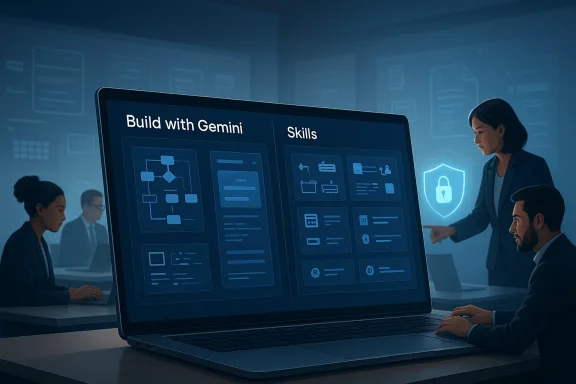
Google is quietly testing two features that could make Gemini Enterprise feel less like a chat box and more like a genuine workplace platform: Build with Gemini for app prototyping and a new Skills area for configuring custom workflows. If TestingCatalog’s code findings hold up, the two additions would deepen Google’s enterprise AI stack just as the company is pushing harder on agentic tools, no-code creation, and tightly integrated business automation. The timing also makes sense: Google has repeatedly signaled that Gemini for Workspace is meant to move beyond simple prompting and into more durable, production-ready work patterns for teams.
Google’s enterprise AI strategy has been evolving in clear stages. The first phase was about placing Gemini inside familiar productivity apps and giving companies the reassurance of enterprise-grade privacy, admin controls, and data boundaries. Google has long emphasized that business data in Gemini for Workspace is not used to train models outside a customer’s domain without permission, and that the platform is designed with confidentiality and compliance in mind.
The second phase was about making Gemini more useful for knowledge work, not just text generation. Over the past year, Google has added and expanded features across Workspace, the Gemini app, and developer surfaces so that users can do more than draft emails or summarize docs. The company has also leaned into customization, from Gems to no-code app building in AppSheet and tool-oriented features in Gemini Code Assist and AI Studio.
That is what makes these hidden Gemini Enterprise features notable. A product like Build with Gemini would not merely help users talk about software ideas; it would move them closer to creating prototypes from inside the same interface where they already collaborate. In parallel, a Skills section suggests Google wants a structured way to define repeatable behaviors, which is a more scalable approach than asking users to re-prompt the model every time.
The competitive context matters too. OpenAI, Anthropic, Microsoft, and Google are all converging on a similar end state: AI systems that remember context, execute actions, and support custom workflows. Google’s recent Gemini Enterprise launch and Workspace Studio announcements show a company trying to convert its distribution advantage into a serious automation platform, not just an assistant.
The hidden Skills section is equally important, but for a different reason. “Skills” implies modular capability blocks: a place to define what Gemini should know, do, or automate in specific scenarios. That is a more mature design than a generic prompt library because it suggests a UI for behavior management, not just conversation history.
That distinction is critical in enterprise software. A chat assistant that answers questions is useful; a system that can be configured to reliably carry out a business process is far more valuable. For Google, this could be a way to move Gemini from a support role into a core workflow role.
Google already has precedent here. The company has shown in AI Studio and related documentation that it wants users to build interactive web apps from prompts, and it has public guidance around “build” workflows that turn natural language into functioning prototypes. Bringing that idea into Enterprise would make the feature feel less experimental and more like a sanctioned internal productivity tool.
A finance manager, operations lead, or sales enablement specialist could sketch a workflow in plain English and iterate on it immediately. That is not the same as shipping production software, but it is enough to validate ideas, reduce ambiguity, and improve collaboration with technical teams.
A well-designed Skills system could let teams encode standard operating procedures, preferred tone, approved sources, or task-specific actions. That would align strongly with Google’s recent enterprise emphasis on customization, including custom agents, Gems, and workflow automation in Workspace Studio.
The shift also mirrors a broader market trend. The winning enterprise AI products are increasingly the ones that give admins and power users controls, not just conversational convenience. In that sense, Skills would be Google’s answer to the custom assistants, project-specific setups, and agent frameworks competitors have been pushing.
That convergence is visible in Google’s recent product messaging. Gemini for Workspace has been framed as secure, private, and ready for business use, while Gemini 2.5 Pro and AI Studio have emphasized faster building and richer app creation. The overlap is deliberate: Google wants users to move from idea to execution without leaving its ecosystem.
But distribution alone is not enough. The features have to feel coherent and useful, or they will be dismissed as another AI layer stapled onto familiar products. Build with Gemini and Skills look promising precisely because they appear to extend familiar behaviors: creating, organizing, and automating work.
If Build with Gemini becomes a polished internal prototyping tool, it could appeal directly to teams that have been using ChatGPT, Claude, or low-code tools for rapid ideation. If Skills becomes a robust workflow layer, it could compete with custom GPT-style assistants, project workspaces, and agent frameworks. The overlap is obvious, and so is the stakes.
This matters because enterprise buyers do not usually want a dozen disconnected AI tools. They want one environment that is secure, governable, and already close to the documents and data where work happens. Google is positioning Gemini to be that environment.
For consumers, the story is more nuanced. A Skills feature in the consumer Gemini app could make the assistant more personalized and more powerful, but it also raises questions about complexity. Regular users often prefer a simple interface, so Google will need to balance depth with clarity if it brings enterprise-style customization downmarket.
If Skills is too complicated, it risks becoming a power-user feature that most people ignore. If it is too simple, it may not justify its place in an enterprise product. Google’s job is to design a layer that feels approachable while still supporting real operational value. That is harder than it sounds.
There is also a risk that Google creates too many overlapping surfaces. Gems, Workspace Studio, AI Studio, Gemini Enterprise, and now Skills could all blur together unless the company defines them very carefully. When users cannot easily tell which tool to use, adoption slows and support costs rise. Clarity will be as important as capability.
The most interesting part of this story is that the features are hidden, not announced. That means Google is still shaping the product, and the final version could be broader, narrower, or simply renamed before launch. Still, the direction is unmistakable: Gemini is moving toward a world where users do not just chat with AI, they configure it, build with it, and deploy it into real work.
Source: TestingCatalog Google tests Skills and "Build with Gemini" for Gemini
 Background
Google’s enterprise AI strategy has been evolving in clear stages. The first phase was about placing Gemini inside familiar productivity apps and giving companies the reassurance of enterprise-grade privacy, admin controls, and data boundaries. Google has long emphasized that business data in Gemini for Workspace is not used to train models outside a customer’s domain without permission, and that the platform is designed with confidentiality and compliance in mind.The second phase was about making Gemini more useful for knowledge work, not just text generation. Over the past year, Google has added and expanded features across Workspace, the Gemini app, and developer surfaces so that users can do more than draft emails or summarize docs. The company has also leaned into customization, from Gems to no-code app building in AppSheet and tool-oriented features in Gemini Code Assist and AI Studio.
That is what makes these hidden Gemini Enterprise features notable. A product like Build with Gemini would not merely help users talk about software ideas; it would move them closer to creating prototypes from inside the same interface where they already collaborate. In parallel, a Skills section suggests Google wants a structured way to define repeatable behaviors, which is a more scalable approach than asking users to re-prompt the model every time.
The competitive context matters too. OpenAI, Anthropic, Microsoft, and Google are all converging on a similar end state: AI systems that remember context, execute actions, and support custom workflows. Google’s recent Gemini Enterprise launch and Workspace Studio announcements show a company trying to convert its distribution advantage into a serious automation platform, not just an assistant.
What Google Appears to Be Testing
The biggest signal in TestingCatalog’s reporting is the naming itself. Build with Gemini sounds like a direct bridge between conversational AI and product creation, especially because Google already has a separate developer-oriented building story in AI Studio and the Gemini API. If that logic holds, the feature may be an enterprise-facing front end for ideation, quick prototyping, and internal tool creation.The hidden Skills section is equally important, but for a different reason. “Skills” implies modular capability blocks: a place to define what Gemini should know, do, or automate in specific scenarios. That is a more mature design than a generic prompt library because it suggests a UI for behavior management, not just conversation history.
Why the wording matters
Google has been increasingly careful with product names that map to user intent. “Build” implies creation, while “Skills” implies repeatable competence. Together, they point toward a product that is not merely reactive but operational.That distinction is critical in enterprise software. A chat assistant that answers questions is useful; a system that can be configured to reliably carry out a business process is far more valuable. For Google, this could be a way to move Gemini from a support role into a core workflow role.
- Build with Gemini likely targets prototyping and quick app creation.
- Skills likely targets reusable behaviors and workflow configuration.
- Both names suggest a more structured enterprise interface.
- The features fit Google’s broader move toward agentic productivity.
How Build with Gemini Could Change Enterprise Prototyping
If Build with Gemini does what the code hints at, the practical impact could be substantial. Businesses often have ideas for internal dashboards, lightweight approval tools, reporting interfaces, or customer-facing prototypes, but those concepts stall because engineering queues are long and business teams lack coding expertise. A conversational builder inside Gemini Enterprise could reduce that friction dramatically.Google already has precedent here. The company has shown in AI Studio and related documentation that it wants users to build interactive web apps from prompts, and it has public guidance around “build” workflows that turn natural language into functioning prototypes. Bringing that idea into Enterprise would make the feature feel less experimental and more like a sanctioned internal productivity tool.
From prompt to prototype
The real value is not that Gemini will replace software teams. It is that it can shorten the gap between an idea and a testable artifact. For many organizations, that gap is where momentum dies.A finance manager, operations lead, or sales enablement specialist could sketch a workflow in plain English and iterate on it immediately. That is not the same as shipping production software, but it is enough to validate ideas, reduce ambiguity, and improve collaboration with technical teams.
- Faster internal proofs of concept.
- Lower barrier for non-developers.
- More productive handoff to engineering teams.
- Better alignment between business requirements and technical execution.
Why Skills Could Be the More Important Feature
At first glance, Skills sounds less flashy than app building. In reality, it may prove more consequential because reusable skills are how enterprise AI becomes dependable. Businesses do not just want creativity; they want repeatability, consistency, and governance.A well-designed Skills system could let teams encode standard operating procedures, preferred tone, approved sources, or task-specific actions. That would align strongly with Google’s recent enterprise emphasis on customization, including custom agents, Gems, and workflow automation in Workspace Studio.
Skills versus plain prompts
Plain prompts are fragile because they depend on the user remembering to restate the same instructions every time. A Skills layer would be more like a controlled configuration surface. That matters because businesses need behavior that survives across users, sessions, and departments.The shift also mirrors a broader market trend. The winning enterprise AI products are increasingly the ones that give admins and power users controls, not just conversational convenience. In that sense, Skills would be Google’s answer to the custom assistants, project-specific setups, and agent frameworks competitors have been pushing.
- Standardized workflows become easier to enforce.
- Teams can tailor Gemini to specific functions.
- Admins may gain better control over how AI behaves.
- Users spend less time repeating context.
- The platform becomes more scalable across departments.
Google’s Enterprise AI Strategy in Context
Google’s current posture is more coherent than it sometimes appears from the outside. The company is building along three parallel tracks: consumer AI, Workspace productivity, and developer/enterprise tooling. Hidden features like Build with Gemini and Skills suggest those tracks are starting to converge into one broader platform story.That convergence is visible in Google’s recent product messaging. Gemini for Workspace has been framed as secure, private, and ready for business use, while Gemini 2.5 Pro and AI Studio have emphasized faster building and richer app creation. The overlap is deliberate: Google wants users to move from idea to execution without leaving its ecosystem.
The distribution advantage
Google has a huge advantage in enterprise distribution because Workspace already sits inside a large number of organizations. When the company adds AI capabilities, it can ship them into a trusted environment with existing admin controls, identity, and collaboration habits. That makes adoption easier than for a standalone AI startup.But distribution alone is not enough. The features have to feel coherent and useful, or they will be dismissed as another AI layer stapled onto familiar products. Build with Gemini and Skills look promising precisely because they appear to extend familiar behaviors: creating, organizing, and automating work.
- Google can ship AI into a pre-existing enterprise footprint.
- Workspace provides admin and security scaffolding.
- AI Studio and API tooling provide technical depth.
- Gemini Enterprise can become the user-facing orchestration layer.
Competitive Implications
The competitive implications are straightforward: Google is trying to close the gap between chat, workflow automation, and app creation. That puts pressure on OpenAI, Anthropic, and Microsoft, all of whom are racing to make AI assistants useful beyond generic conversation. Google’s advantage is that it can frame this as a productivity extension, not a separate AI destination.If Build with Gemini becomes a polished internal prototyping tool, it could appeal directly to teams that have been using ChatGPT, Claude, or low-code tools for rapid ideation. If Skills becomes a robust workflow layer, it could compete with custom GPT-style assistants, project workspaces, and agent frameworks. The overlap is obvious, and so is the stakes.
Why rivals should care
The enterprise AI market is increasingly a battle over default behavior. Whoever becomes the easiest place to draft, organize, prototype, and automate inside an existing workflow may win a disproportionate amount of daily usage. Google is betting that Workspace and Gemini together can do that.This matters because enterprise buyers do not usually want a dozen disconnected AI tools. They want one environment that is secure, governable, and already close to the documents and data where work happens. Google is positioning Gemini to be that environment.
- OpenAI may need stronger enterprise workflow depth.
- Anthropic will need to keep emphasizing structured project use.
- Microsoft will continue leaning on Copilot’s native Office integration.
- Google is trying to unify AI creation and automation inside Workspace.
Enterprise Versus Consumer Impact
For enterprise users, Build with Gemini and Skills could be especially meaningful because the value proposition is tied to real work output. Businesses care about repeatable workflows, secure data handling, and the ability to prototype internal tools without long procurement cycles. Google already positions Gemini Enterprise as a secure, business-ready environment, so these additions would feel like a logical expansion.For consumers, the story is more nuanced. A Skills feature in the consumer Gemini app could make the assistant more personalized and more powerful, but it also raises questions about complexity. Regular users often prefer a simple interface, so Google will need to balance depth with clarity if it brings enterprise-style customization downmarket.
Different expectations, different design
Enterprise buyers want controls; consumers want simplicity. That tension is not unique to Google, but it becomes more pronounced when the same product family serves both audiences. Features like Gems already hint at this split, offering custom behavior without demanding technical expertise.If Skills is too complicated, it risks becoming a power-user feature that most people ignore. If it is too simple, it may not justify its place in an enterprise product. Google’s job is to design a layer that feels approachable while still supporting real operational value. That is harder than it sounds.
- Enterprises want governance and consistency.
- Consumers want ease of use and speed.
- Shared features must scale across both without confusion.
- Customization should feel optional, not mandatory.
Strengths and Opportunities
Google’s advantage is that it can connect AI creation, enterprise security, and workspace-native distribution in one stack. That combination is unusually powerful if the company can keep the experience coherent. It also gives Google a way to capture value at multiple points in the workflow instead of only at the chat interface.- Strong enterprise distribution through Workspace.
- Existing trust posture around privacy and data handling.
- Clear alignment with no-code and low-code demand.
- Strong fit with Google’s AI Studio and API ecosystem.
- Potential to speed up prototyping across departments.
- Better workflow automation than plain chat-based assistants.
- Opportunity to make Gemini more sticky inside daily work.
Risks and Concerns
The main risk is overpromising. Features like Build with Gemini can sound transformative, but if they are limited, buggy, or difficult to govern, enterprise customers will quickly downgrade their expectations. In business software, a flashy demo is never enough; reliability and accountability matter more.There is also a risk that Google creates too many overlapping surfaces. Gems, Workspace Studio, AI Studio, Gemini Enterprise, and now Skills could all blur together unless the company defines them very carefully. When users cannot easily tell which tool to use, adoption slows and support costs rise. Clarity will be as important as capability.
- Hidden features may not survive intact to launch.
- Enterprise buyers may demand stronger governance than the prototype provides.
- Too many overlapping tools could confuse users.
- Security and prompt-injection concerns will remain central.
- App-building promises may exceed what non-technical users can safely do.
- Consumer rollout could be too complex for mainstream audiences.
- Rival platforms may move faster on simpler custom-assistant experiences.
Looking Ahead
If TestingCatalog’s findings are accurate, Google appears to be lining up a more ambitious Gemini story for the next major product cycle, likely around Google I/O 2026. That would give the company a high-profile stage to show how conversational AI becomes a building platform, a workflow engine, and a customizable enterprise assistant all at once. The question is not whether Google wants that future; it clearly does. The question is whether the execution will feel polished enough to match the ambition.The most interesting part of this story is that the features are hidden, not announced. That means Google is still shaping the product, and the final version could be broader, narrower, or simply renamed before launch. Still, the direction is unmistakable: Gemini is moving toward a world where users do not just chat with AI, they configure it, build with it, and deploy it into real work.
- Watch for official Google I/O 2026 teasers.
- Look for Gemini Enterprise UI changes in the web app.
- Track whether Skills appears in consumer Gemini as well.
- Monitor whether Build with Gemini connects to AppSheet or AI Studio.
- Pay attention to admin and compliance language in future Workspace updates.
Source: TestingCatalog Google tests Skills and "Build with Gemini" for Gemini
Last edited:
