

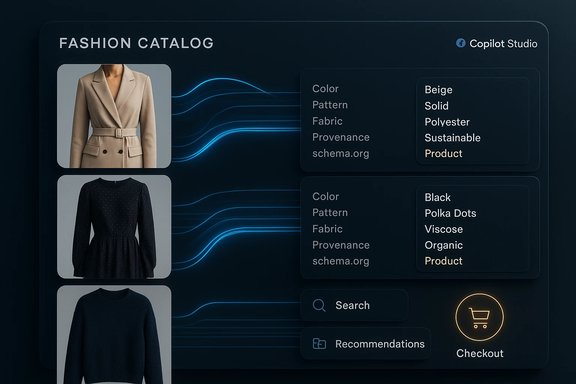
Guess’s pilot of an AI-driven catalog enrichment workflow is the kind of quietly consequential move that marks the difference between a marketing experiment and a foundation for long-term digital commerce transformation, and the company’s decision to run the pilot with Microsoft’s Copilot Studio signals a clear play for machine-readable product metadata, faster product onboarding, and agentic commerce readiness across its global channels.
Background
Apparel and accessories brands have long known that product data — not just creative photography or celebrity endorsements — is the plumbing of modern e‑commerce. For a brand like Guess, founded in 1981 by the Marciano brothers and distributed through branded stores, department-store shop‑in‑shops and direct-to-consumer channels, accurate, structured product information is central to discovery, conversions and returns management. The company’s latest pilot emphasizes automated attribute extraction, templated descriptions and catalog error resolution so that product records become dependable inputs for downstream AI services. At the same time, the broader commerce ecosystem is coalescing around a new term: agentic commerce — an approach in which autonomous AI “agents” can discover products, negotiate constraints (price, delivery window, returns), and, where permitted, initiate tokenized checkout on behalf of consumers. Analysts and consultancies now put agentic commerce’s upside in the hundreds of billions to low‑trillions by 2030, a projection that helps explain why established brands and platform providers are racing to make catalogs agent‑ready.What Guess is actually piloting
The technical core: catalog enrichment and attribute extraction
Guess’s program uses Microsoft’s Copilot Studio templates to automate routine catalog work: image-based attribute extraction, SKU categorization, metadata normalization and the correction of catalog inconsistencies. Where teams previously relied on manual tagging, spreadsheet reconciliation and piece‑by‑piece QA, the pilot converts messy inputs into a canonical Product Information Management (PIM)-style record that can be consumed by search, recommendation engines and conversational agents. This is not merely copywriting automation; it’s a data engineering task framed as product‑data hygiene at scale. Key capabilities demonstrated in the pilot:- Automated extraction of visual attributes (color, pattern, fabric cues) from product imagery.
- Social‑insight enrichment (signals from social posts and reviews used to tag style descriptors).
- Template-driven description generation that standardizes brand voice while keeping factual provenance.
- Error detection and reconciliation workflows that push low‑confidence items to human review.
Why Copilot Studio — and why now
Microsoft’s Copilot Studio supplies prebuilt templates — Brand Agents, Catalog Enrichment, and Store Operations — designed to reduce engineering lift and accelerate pilots. For brands without deep ML operations teams, these templates are attractive because they codify best practices: canonicalization of metadata, provenance logging, and human‑in‑the‑loop quality gates. Microsoft’s public materials and industry briefings outline how tokenized checkout and agent orchestration integrate with payment partners (Stripe, PayPal, Shopify), reinforcing the argument that catalog readiness is now a prerequisite for appearing in in‑chat, agentic purchase flows.How credible are the platform and market claims?
The McKinsey math: big opportunity, conditional on readiness
McKinsey’s industry analysis projects that agentic commerce could orchestrate up to $1 trillion of U.S. B2C retail revenue by 2030 and between $3 trillion and $5 trillion globally — figures widely cited across trade press and financial commentary. Those numbers are directional and based on scenarios that assume moderate merchant adoption, standards for agent‑to‑agent interoperability, and consumer comfort with delegated purchasing. The projections describe potential, not guaranteed outcomes; realizing that upside depends on standardized protocols, merchant data quality, payment tokenization and consumer trust. Independent industry reporting and financial research echo the view that agentic commerce creates meaningful upside but frame adoption as uneven: pilots and proofs‑of‑concept are widespread, while full production deployments remain rarer. That gap is precisely why catalog automation pilots — like Guess’s — matter: agentic experiences require canonical, auditable product inputs to avoid hallucinations, poor recommendations and friction that erode trust.Platform announcements are real and moving fast
Microsoft, Stripe and PayPal have publicly announced integrations that enable in‑conversation checkouts and tokenized delegated payments. Microsoft’s Copilot Checkout (announced in industry briefings and press releases) and partner statements from Stripe and PayPal confirm that the technical plumbing for in‑chat purchases is live in limited scope and rolling out in the U.S. market first. That makes the business case for catalog automation immediate: if Copilot (or competing assistants) can surface a Buy button for a product, only merchants with reliable attributes and live inventory will be able to capture the intent at scale.Why this matters specifically for Guess
Customer experience and conversion
A consistent, structured product catalog improves search relevance, powers outfit-building recommendation flows and reduces the cognitive friction that leads to cart abandonment. For fashion and accessories, where fit, material and styling context are essential, more precise attributes make personalization meaningful rather than generic. Guess’s pilot aims to let shoppers “discover styles in real time” and “explore complete looks” — statements that align with measurable commerce levers like higher average order value (AOV) from bundled outfit recommendations and improved conversion from more relevant search results.Operational speed and cost reduction
Manual product onboarding is labor‑intensive and error‑prone. Automating categorization and description generation reduces time‑to‑market for new SKUs and seasonal assortments, which is a direct lever for product teams that need to react quickly to trend cycles. Faster onboarding also reduces the backlog of incomplete listings that can cause inventory to sit unsold or generate returns due to misdescribed items.Risk control and governance
Guess’s pilot — by design — should include human review gates for low‑confidence outputs, identity binding for agents and audit trails that show the data source for each generated attribute. Industry playbooks recommend these governance elements as non‑negotiable; without them, brands risk publishing inaccurate product claims or exposing customer data. The pilot’s value therefore lies as much in how it governs automation as in how it automates tasks.Strengths and immediate benefits
- Scalability: Automated attribute extraction scales across thousands of SKUs and multiple seasonal updates without linear headcount increases.
- Better personalization: Higher‑fidelity metadata feeds recommendation engines and conversational agents, improving match quality for outfit and look suggestions.
- Faster product launches: Reduced time from product receipt to live listing lowers lost selling days for new drops and collaborations.
- Cross‑channel consistency: Canonical records ensure the same product facts appear on DTC sites, marketplaces, and in-agent results.
- Agentic readiness: With tokenized payment rails and agentic checkouts emerging, having agent‑ready catalogs becomes strategically urgent.
Risks and blind spots
Hallucinations and over‑confident outputs
Generative systems can fabricate specifics (dimensions, care instructions, material certifications). If agents write product claims without proper provenance or human review, the brand can face returns, regulatory scrutiny, and reputational harm. The safe path is conservative automation with clear approval gates for any claim that affects compliance or fit.Data leakage and connector surface area
Agents that integrate with PIMs, ERPs and POS systems create more API surface area. Misconfigured connectors or broad model access can cause leakage of sensitive business or customer data. Enforce least privilege, tenant‑scoped connectors and strong identity binding for agent actions.Return rates and buyer behavior
In‑chat, frictionless purchases can increase impulse buys and mismatch rates in categories like apparel where fit matters. Brands should monitor return metrics closely during pilots and adjust recommendation thresholds or human review filters to manage returns. Historical reporting suggests AI‑originated purchases initially show higher conversion but sometimes also higher return velocity if product descriptions are incomplete or misleading.Vendor lock‑in and portability
Deep binding of brand voice, enrichment outputs and agent memory to a single platform can create migration friction later. Maintain exportable data pipelines and model‑agnostic prompts where feasible to preserve flexibility.Operational playbook: how Guess (and other brands) should pilot and measure
- Define success metrics before code: measure baseline conversion, search‑to‑cart rate, time-to‑publish and return rates.
- Start with two bounded pilots (3–6 months):
- Pilot A: catalog enrichment for a high‑velocity category (e.g., accessories or seasonal apparel) with human review turned on.
- Pilot B: a personalized shopping agent on a single channel (mobile app) and a curated product set.
- Build a minimum viable PIM layer with canonical attributes and provenance tags.
- Implement governance and observability: log prompts, model outputs, confidence scores and action audits.
- Enforce approval workflows: automation writes, humans approve for low‑confidence or compliance‑sensitive attributes.
- Integrate agent telemetry with BI and SIEM/AIOps for cost tracking, drift detection and incident response.
- A/B test agent-driven experiences against a control group and require reproducible vendor benchmarking for model performance.
SEO, discovery and the rise of Generative Engine Optimization (GEO)
As discovery shifts from search engine results pages to conversational answers, product teams must optimize for Generative Engine Optimization (GEO) as well as traditional SEO. Actions include:- Publishing machine‑readable, canonical product records (GTINs, UPCs, schema.org).
- Writing clear, unambiguous attribute text that agents can parse and reuse.
- Encouraging verified reviews and structured Q&A that agents rely on for social proof.
- Keeping local inventory and pickup data current for time‑sensitive assistant queries.
Competitive and regulatory landscape
Large platforms are already building agentic rails: Microsoft’s Copilot Checkout and associated templates, OpenAI’s Instant Checkout experiments, and Shopify’s Agentic Storefronts show the industry moving quickly to embed checkout in conversational surfaces. Payment partners (Stripe, PayPal) have published agentic commerce integrations that enable tokenized checkouts within these assistants. That speed is a double‑edged sword: it opens new distribution channels while concentrating gatekeeper power in platform hands. Brands must read commercial terms carefully; platform fees, data sharing policies, and merchant liability for disputes vary and can materially affect margins. Regulators are also paying attention. The rapid consolidation of discovery and payments into a few assistants raises antitrust and consumer‑protection questions (data portability, fair access, fee transparency). Brands should document data flows and contractual protections to anticipate regulatory scrutiny.Practical recommendations for retail technology leaders
- Treat agents as product initiatives with cross‑functional ownership (merchandising, data, security, legal).
- Insist on provenance: every generated attribute must tie back to a source or a human approval event.
- Implement drift monitoring and monthly audits for model outputs.
- Preserve portability: design exportable datasets and neutral prompt libraries.
- Start small, measure impact, and scale when evidence shows improved conversion and no disproportionate rise in returns.
What remains unverified and where to be cautious
- Any single vendor’s claims about instant conversion uplift should be treated as vendor‑supplied until validated by independent A/B tests. Microsoft’s marketing materials and partner press releases assert conversion gains but do not uniformly publish the underlying test designs or sample sizes; merchants should request reproducible benchmarks.
- Macro projections (McKinsey’s $1T U.S. by 2030 and $3–5T global) are scenario‑based and assume broad adoption of agentic protocols and tokenized payments. The numbers represent potential orchestrated revenue, not guaranteed incremental profit; brands should use these forecasts as directional planning tools rather than firm budget targets.
Bottom line
Guess’s pilot with Microsoft’s Copilot Studio is not a flashy publicity stunt — it is a pragmatic, infrastructure‑level move to turn product images and brittle spreadsheets into machine‑readable, auditable catalog records that emerging agentic experiences will require. The pilot addresses concrete pain points: time‑to‑publish, inconsistent attributes, and the need to control brand voice in AI‑driven recommendations. If executed with the recommended governance, human‑in‑the‑loop checks and telemetry, a catalog enrichment program can yield measurable benefits in search relevance, personalization and speed to market. At the same time, the pilot sits in a rapidly evolving competitive and regulatory environment where platform terms, payment rails and discovery mechanics will shape outcomes. Brands that sprint to adopt agentic capabilities without robust controls risk reputational damage, higher return rates and vendor lock‑in. The prudent path is iterative: pilot, measure, govern, and only then scale.Guess’s move matters because it converts a strategic forecast — that agentic commerce will matter — into concrete operational work. For merchants and technologists, the message is clear: if you want to compete for AI‑driven discovery and in‑chat checkout moments, start by treating your product catalog as the primary product you must perfect.
Source: Consumer Goods Technology Guess Pilots AI-Automated Product Catalog Optimization
