

Halo Studios briefly told players in a June 2026 Halo Waypoint Q&A that Halo: Campaign Evolved split-screen co-op on PlayStation 5 would require both local players to have PlayStation Plus, but the studio later clarified that this was incorrect and that local split-screen does not require PS Plus. The correction matters because the original claim sounded absurd in precisely the way modern platform gaming often sounds absurd. It turned a nostalgia pitch into a live-fire lesson in account sprawl, subscription anxiety, and the fragile trust Microsoft needs as Halo makes its PlayStation debut. The bad news was walked back, but the episode still exposed the weakest seam in Xbox’s multiplatform future.
Halo arriving on PlayStation should be one of the cleanest symbolic wins in Microsoft’s new gaming strategy. The former Xbox standard-bearer is no longer being treated as a console-wall relic; it is being repositioned as a franchise that can travel wherever players are. Halo: Campaign Evolved, a remake of the original campaign, is meant to be both an anniversary product and an onboarding ramp for people who never owned an Xbox.
That is why the split-screen confusion landed so hard. Halo is not merely another shooter with co-op bolted on. Its identity was formed in dorm rooms, living rooms, basements, and LAN parties, where the social friction was low because the technology was simple: plug in another controller and play.
The initial Waypoint language appeared to violate that premise. If two people sitting on the same couch needed two paid PlayStation Plus subscriptions to play a local campaign on one console, then “couch co-op” would have become a marketing phrase wearing the skin of a subscription service. It would not just have been inconvenient; it would have been philosophically backwards.
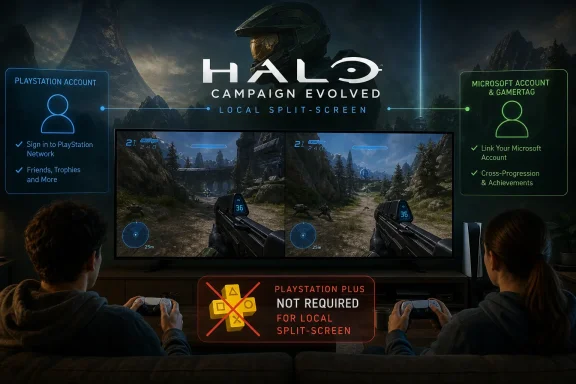
Halo Studios’ clarification defused the most outrageous version of the story. Local split-screen on PS5 requires PlayStation accounts and linked Microsoft accounts, but not PlayStation Plus. That is a much more defensible setup, though still not frictionless. The correction saves the feature from absurdity, but it does not erase the larger lesson: when account requirements are this tangled, even a documentation mistake can look plausible.
That distinction matters. A second local player needing a PlayStation account is not unusual in modern console ecosystems, especially when profiles, saves, achievements, parental controls, and platform identity are involved. A second player needing a Microsoft account is more intrusive, but understandable if Halo Studios is building cross-progression, crossplay identity, and a consistent Xbox gamertag layer across Xbox, PC, Steam, and PlayStation.
Requiring two paid subscriptions would have been in another category entirely. It would have transformed a local feature into a metered service and would have invited every ugly interpretation at once: Sony rent-seeking, Microsoft account harvesting, Xbox trying to make PlayStation feel second-class, or Halo Studios failing to understand the emotional payload of split-screen. The fact that so many players believed it immediately says less about their gullibility than about the industry’s accumulated bad will.
The correction therefore solves the immediate consumer harm but leaves behind a reputational bruise. Players saw a requirement that sounded ridiculous, and many thought: yes, that is exactly the kind of ridiculous thing a 2026 game might do. That is the industry’s problem in miniature.
Publishers often treat couch co-op as a niche feature because telemetry rewards scale. Online multiplayer produces engagement curves, retention cohorts, cosmetics funnels, and subscription justifications. Split-screen produces memories, which are harder to chart in an executive dashboard and harder to monetize after the sale.
Halo’s problem is that its cultural value was built on exactly those memories. The original Halo: Combat Evolved was not just a technical showcase for the Xbox; it was a social machine. Its campaign co-op and local multiplayer helped sell the idea that Microsoft’s black-and-green box belonged under the television, not merely beside a gaming PC.
Campaign Evolved is trying to bottle that history while also modernizing it. It includes two-player split-screen on consoles and up to four-player online co-op with crossplay and cross-progression. That is a sensible modern package. But the moment the local mode appears to depend on the same subscription logic as online play, the nostalgia pitch collapses into bureaucracy.
This is the emerging shape of Microsoft’s games business. Xbox is less a box than an identity layer, a publishing label, a store, a subscription service, and a multiplayer infrastructure. When Forza, Gears, Minecraft, Call of Duty, and Halo move across platforms, they carry pieces of that layer with them.
For IT-minded readers, the analogy is obvious. The endpoint may change, but the tenant follows the user. Identity becomes the product’s spine. Access, entitlement, telemetry, parental controls, friends lists, progression, and compliance all orbit the account.
For players, however, that logic can feel like paperwork invading play. The old ritual was inserting a disc. The new ritual is accepting terms, linking accounts, verifying email, managing subscriptions, and hoping the platform holder, publisher, and game server all agree that you are allowed to do the thing you bought the game to do. Halo’s PS5 split-screen flap became combustible because it touched that nerve.
That era is over, or at least no longer absolute. Microsoft has spent the past few years teaching the market that Xbox games can live elsewhere, especially when the economics of exclusive hardware lock-in collide with the cost of modern development and the scale demanded by blockbuster franchises. Halo: Campaign Evolved on PS5 is a milestone in that transition.
But the milestone comes with risk. A game that launches on a rival platform cannot feel like a grudging port wrapped in account caveats. It has to feel native enough to earn trust from players who may have spent two decades hearing that Halo belonged to the other side.
That is why the original PlayStation Plus wording was so damaging, even as an error. It fed a suspicion that PlayStation users might be treated as guests in someone else’s ecosystem rather than first-class customers. For a franchise trying to grow beyond its historical base, that is exactly the suspicion Microsoft should be trying to avoid.
This is not a trivial communications problem. Storefront language and support copy are now part of the product surface. Players use them to decide whether a game is online-only, whether it supports offline play, whether subscriptions are required, whether a second account is needed, and whether a family purchase will actually work in a living room.
For Halo Studios, the fix needed to be fast because the claim touched money. A vague gameplay detail can wait for a future blog post. A perceived requirement for two paid subscriptions cannot. Every hour of ambiguity creates forum threads, Reddit outrage, news rewrites, and a permanent residue of “I heard this game requires...” that will survive long after the correction.
The industry still underestimates this residue. Corrections travel slower than anger, and platform requirements are exactly the sort of detail people remember imperfectly. By launch, some potential buyers may still believe PS Plus is required for local co-op unless Microsoft repeats the corrected message clearly and often.
Campaign Evolved’s promise to preserve console split-screen is therefore not a throwaway feature. It is part of a repair campaign. It tells longtime players that Halo Studios understands what was lost when the series chased larger online systems and higher production complexity at the expense of the local rituals that made Halo feel communal.
That is also why the PlayStation Plus scare felt bigger than a clerical error. It seemed to suggest that even when split-screen returned, it would return under the logic of the modern account economy. The old feature would be present, but domesticated by sign-ins and subscriptions.
The clarified requirement is far less severe, but it still leaves Halo Studios with a messaging challenge. If the studio wants credit for restoring split-screen, it should be obsessively clear about what works offline, what requires internet access, what requires account linking, and what requires a paid platform subscription. The feature cannot be emotionally restorative if players need a legal reading of an FAQ to understand it.
That line is easy for players to understand because it maps to common sense. If the second player is sitting beside me, the platform should not treat them like a remote network participant. If the second player is connecting over the internet, then subscription and service requirements become expected, whether or not players like them.
The original wording blurred that line. The correction restores it. But the remaining Microsoft account requirement still indicates that even local play may be connected to broader identity infrastructure, at least at setup or sign-in. That may be technically useful, but it needs plain-language explanation.
Microsoft and Halo Studios should resist the temptation to hide behind platform boilerplate. If local split-screen works without PlayStation Plus, say that prominently. If it requires internet access for account linking the first time, say that. If it can later be played offline, say that. If it cannot, say that too.
Cross-platform gaming now depends on account brokerage. A PlayStation player may authenticate with Sony, link to Microsoft, interact with Xbox services, sync progression across PC and console, and play with friends on Steam or Xbox Series X|S. That is powerful when it works and maddening when one requirement is misstated.
The business incentive is obvious. Microsoft wants Halo players to become part of the Xbox ecosystem even when they are not using Xbox hardware. Sony wants online multiplayer to remain part of PlayStation Plus value. Players want the fewest possible gates between purchase and play.
Those incentives are not automatically abusive, but they are in tension. The Campaign Evolved flap became a flashpoint because it appeared to resolve that tension in the most user-hostile way possible. The fact that this was apparently a mistake is good news; the fact that it seemed credible is the warning.
That makes co-op even more central. If the product is literally named Campaign Evolved, then the campaign experience is the whole argument. Split-screen is not competing with Slayer playlists for attention; it is part of the core value proposition.
The remake’s creative challenge is to modernize without sanding off the thing people came to revisit. Halo’s first campaign was spacious, strange, and social. It was a console shooter that made players feel as if they had discovered a world together, not merely completed a content track.
Account systems cannot be allowed to dominate that emotional frame. Players will forgive a lot from remakes if they feel the underlying spirit is intact. They are far less forgiving when the first thing they encounter is an access requirement that feels like it was designed by three departments and understood by none of them.
But it should be treated internally as a near miss. The studio has now seen exactly where the audience’s tripwires are. Paid subscriptions for local play, unclear offline support, mandatory account linking, and platform-specific disparity are all radioactive topics for a franchise whose comeback depends on trust.
Microsoft has an opportunity to turn the correction into a stronger launch message. Campaign Evolved can be positioned as the Halo that finally travels properly: Xbox, PC, and PlayStation; online co-op for the modern world; console split-screen for the old one; shared progression for players who move between devices; and no paid PlayStation subscription for two people sharing a couch.
That message has to be cleaner than the original FAQ. It has to appear on store pages, support articles, trailers, and community posts. The best way to kill a rumor is not one correction; it is consistent wording everywhere a buyer might look.
 Microsoft Accidentally Made the Worst Possible First Impression
Halo arriving on PlayStation should be one of the cleanest symbolic wins in Microsoft’s new gaming strategy. The former Xbox standard-bearer is no longer being treated as a console-wall relic; it is being repositioned as a franchise that can travel wherever players are. Halo: Campaign Evolved, a remake of the original campaign, is meant to be both an anniversary product and an onboarding ramp for people who never owned an Xbox.That is why the split-screen confusion landed so hard. Halo is not merely another shooter with co-op bolted on. Its identity was formed in dorm rooms, living rooms, basements, and LAN parties, where the social friction was low because the technology was simple: plug in another controller and play.
The initial Waypoint language appeared to violate that premise. If two people sitting on the same couch needed two paid PlayStation Plus subscriptions to play a local campaign on one console, then “couch co-op” would have become a marketing phrase wearing the skin of a subscription service. It would not just have been inconvenient; it would have been philosophically backwards.
Halo Studios’ clarification defused the most outrageous version of the story. Local split-screen on PS5 requires PlayStation accounts and linked Microsoft accounts, but not PlayStation Plus. That is a much more defensible setup, though still not frictionless. The correction saves the feature from absurdity, but it does not erase the larger lesson: when account requirements are this tangled, even a documentation mistake can look plausible.
The Correction Fixed the Headline, Not the Anxiety
The most important fact is also the simplest one: PlayStation Plus is not required for local split-screen co-op in Halo: Campaign Evolved on PS5. Online network co-op is a different matter, as console platform subscriptions remain part of the multiplayer economy. But the couch scenario that sparked outrage has now been narrowed to account sign-in and linking rather than dual paid subscriptions.That distinction matters. A second local player needing a PlayStation account is not unusual in modern console ecosystems, especially when profiles, saves, achievements, parental controls, and platform identity are involved. A second player needing a Microsoft account is more intrusive, but understandable if Halo Studios is building cross-progression, crossplay identity, and a consistent Xbox gamertag layer across Xbox, PC, Steam, and PlayStation.
Requiring two paid subscriptions would have been in another category entirely. It would have transformed a local feature into a metered service and would have invited every ugly interpretation at once: Sony rent-seeking, Microsoft account harvesting, Xbox trying to make PlayStation feel second-class, or Halo Studios failing to understand the emotional payload of split-screen. The fact that so many players believed it immediately says less about their gullibility than about the industry’s accumulated bad will.
The correction therefore solves the immediate consumer harm but leaves behind a reputational bruise. Players saw a requirement that sounded ridiculous, and many thought: yes, that is exactly the kind of ridiculous thing a 2026 game might do. That is the industry’s problem in miniature.
Couch Co-op Is Supposed to Be the Escape Hatch
Local multiplayer has always been a small rebellion against the service layer. It is the mode that says the network can go down, the matchmaking pool can thin out, the storefront can be redesigned three times, and the game can still make sense because two people are physically present with controllers in hand. That is why split-screen carries more emotional weight than its usage metrics suggest.Publishers often treat couch co-op as a niche feature because telemetry rewards scale. Online multiplayer produces engagement curves, retention cohorts, cosmetics funnels, and subscription justifications. Split-screen produces memories, which are harder to chart in an executive dashboard and harder to monetize after the sale.
Halo’s problem is that its cultural value was built on exactly those memories. The original Halo: Combat Evolved was not just a technical showcase for the Xbox; it was a social machine. Its campaign co-op and local multiplayer helped sell the idea that Microsoft’s black-and-green box belonged under the television, not merely beside a gaming PC.
Campaign Evolved is trying to bottle that history while also modernizing it. It includes two-player split-screen on consoles and up to four-player online co-op with crossplay and cross-progression. That is a sensible modern package. But the moment the local mode appears to depend on the same subscription logic as online play, the nostalgia pitch collapses into bureaucracy.
Account Linking Is the New Disc Swap
Even after the PlayStation Plus clarification, Halo: Campaign Evolved still asks PlayStation users to step into Microsoft’s identity system. That is no longer shocking, but it is still consequential. A Microsoft account and Xbox gamertag are required across platforms, which means Halo on PS5 is not simply a PlayStation game published by Xbox; it is an Xbox-networked game living on PlayStation hardware.This is the emerging shape of Microsoft’s games business. Xbox is less a box than an identity layer, a publishing label, a store, a subscription service, and a multiplayer infrastructure. When Forza, Gears, Minecraft, Call of Duty, and Halo move across platforms, they carry pieces of that layer with them.
For IT-minded readers, the analogy is obvious. The endpoint may change, but the tenant follows the user. Identity becomes the product’s spine. Access, entitlement, telemetry, parental controls, friends lists, progression, and compliance all orbit the account.
For players, however, that logic can feel like paperwork invading play. The old ritual was inserting a disc. The new ritual is accepting terms, linking accounts, verifying email, managing subscriptions, and hoping the platform holder, publisher, and game server all agree that you are allowed to do the thing you bought the game to do. Halo’s PS5 split-screen flap became combustible because it touched that nerve.
PlayStation Halo Is a Victory With a Catch
Halo on PlayStation would have been unthinkable for most of the franchise’s life. The series was not merely an Xbox exclusive; it was the justification for Xbox as a console business. Master Chief was Microsoft’s answer to the question every platform holder must answer: why buy our machine?That era is over, or at least no longer absolute. Microsoft has spent the past few years teaching the market that Xbox games can live elsewhere, especially when the economics of exclusive hardware lock-in collide with the cost of modern development and the scale demanded by blockbuster franchises. Halo: Campaign Evolved on PS5 is a milestone in that transition.
But the milestone comes with risk. A game that launches on a rival platform cannot feel like a grudging port wrapped in account caveats. It has to feel native enough to earn trust from players who may have spent two decades hearing that Halo belonged to the other side.
That is why the original PlayStation Plus wording was so damaging, even as an error. It fed a suspicion that PlayStation users might be treated as guests in someone else’s ecosystem rather than first-class customers. For a franchise trying to grow beyond its historical base, that is exactly the suspicion Microsoft should be trying to avoid.
The Store Page Era Makes Every Wording Error Dangerous
Modern game launches are mediated through a fog of platform labels, FAQ entries, support pages, storefront badges, social posts, and community screenshots. One inconsistent line can outrun a polished trailer in minutes. The Campaign Evolved episode shows how quickly documentation becomes news when it appears to describe a real consumer restriction.This is not a trivial communications problem. Storefront language and support copy are now part of the product surface. Players use them to decide whether a game is online-only, whether it supports offline play, whether subscriptions are required, whether a second account is needed, and whether a family purchase will actually work in a living room.
For Halo Studios, the fix needed to be fast because the claim touched money. A vague gameplay detail can wait for a future blog post. A perceived requirement for two paid subscriptions cannot. Every hour of ambiguity creates forum threads, Reddit outrage, news rewrites, and a permanent residue of “I heard this game requires...” that will survive long after the correction.
The industry still underestimates this residue. Corrections travel slower than anger, and platform requirements are exactly the sort of detail people remember imperfectly. By launch, some potential buyers may still believe PS Plus is required for local co-op unless Microsoft repeats the corrected message clearly and often.
Split-Screen Has Become a Trust Test
Halo fans are especially sensitive to split-screen promises because the franchise has already mishandled them. Halo 5 dropped campaign split-screen entirely, a decision that became emblematic of the series’ drift away from its roots. Halo Infinite then promised campaign split-screen before that feature was ultimately canceled, turning a technical and scheduling failure into a breach of faith.Campaign Evolved’s promise to preserve console split-screen is therefore not a throwaway feature. It is part of a repair campaign. It tells longtime players that Halo Studios understands what was lost when the series chased larger online systems and higher production complexity at the expense of the local rituals that made Halo feel communal.
That is also why the PlayStation Plus scare felt bigger than a clerical error. It seemed to suggest that even when split-screen returned, it would return under the logic of the modern account economy. The old feature would be present, but domesticated by sign-ins and subscriptions.
The clarified requirement is far less severe, but it still leaves Halo Studios with a messaging challenge. If the studio wants credit for restoring split-screen, it should be obsessively clear about what works offline, what requires internet access, what requires account linking, and what requires a paid platform subscription. The feature cannot be emotionally restorative if players need a legal reading of an FAQ to understand it.
The Real Divide Is Local Versus Networked, Not Xbox Versus PlayStation
The more useful distinction is not between Xbox and PlayStation players. It is between local play and networked play. Local split-screen should be governed by the minimum account requirements necessary for profiles and saves. Online co-op, crossplay, matchmaking, and shared progression naturally involve network services and platform subscriptions on consoles.That line is easy for players to understand because it maps to common sense. If the second player is sitting beside me, the platform should not treat them like a remote network participant. If the second player is connecting over the internet, then subscription and service requirements become expected, whether or not players like them.
The original wording blurred that line. The correction restores it. But the remaining Microsoft account requirement still indicates that even local play may be connected to broader identity infrastructure, at least at setup or sign-in. That may be technically useful, but it needs plain-language explanation.
Microsoft and Halo Studios should resist the temptation to hide behind platform boilerplate. If local split-screen works without PlayStation Plus, say that prominently. If it requires internet access for account linking the first time, say that. If it can later be played offline, say that. If it cannot, say that too.
Where WindowsForum Readers Should See the Bigger Pattern
For sysadmins and IT pros, this story has a familiar shape. A service expands across environments, identity becomes federated, documentation lags implementation, and users blame the most visible interface when entitlements behave strangely. The consumer gaming version has more Master Chief helmets, but the architecture problem is not exotic.Cross-platform gaming now depends on account brokerage. A PlayStation player may authenticate with Sony, link to Microsoft, interact with Xbox services, sync progression across PC and console, and play with friends on Steam or Xbox Series X|S. That is powerful when it works and maddening when one requirement is misstated.
The business incentive is obvious. Microsoft wants Halo players to become part of the Xbox ecosystem even when they are not using Xbox hardware. Sony wants online multiplayer to remain part of PlayStation Plus value. Players want the fewest possible gates between purchase and play.
Those incentives are not automatically abusive, but they are in tension. The Campaign Evolved flap became a flashpoint because it appeared to resolve that tension in the most user-hostile way possible. The fact that this was apparently a mistake is good news; the fact that it seemed credible is the warning.
The Remake Still Has to Prove It Understands the Original
Campaign Evolved is not just a port with prettier textures. Halo Studios has described it as a rebuilt and expanded campaign, with modern visuals, updated cinematics, refined controls, additional weapons and vehicles, new enemies, more Skulls, and three new missions tied to Master Chief and Sgt. Johnson. It is also expected to omit traditional competitive PvP multiplayer, focusing instead on campaign play.That makes co-op even more central. If the product is literally named Campaign Evolved, then the campaign experience is the whole argument. Split-screen is not competing with Slayer playlists for attention; it is part of the core value proposition.
The remake’s creative challenge is to modernize without sanding off the thing people came to revisit. Halo’s first campaign was spacious, strange, and social. It was a console shooter that made players feel as if they had discovered a world together, not merely completed a content track.
Account systems cannot be allowed to dominate that emotional frame. Players will forgive a lot from remakes if they feel the underlying spirit is intact. They are far less forgiving when the first thing they encounter is an access requirement that feels like it was designed by three departments and understood by none of them.
The Subscription Scare Was a Gift, If Microsoft Treats It Like One
There is a generous reading of this episode: Halo Studios made a documentation mistake, listened to the backlash, and corrected it before launch. That is better than digging in, blaming users, or letting confusion rot. In the long arc of a 2026 release, this can still become a footnote.But it should be treated internally as a near miss. The studio has now seen exactly where the audience’s tripwires are. Paid subscriptions for local play, unclear offline support, mandatory account linking, and platform-specific disparity are all radioactive topics for a franchise whose comeback depends on trust.
Microsoft has an opportunity to turn the correction into a stronger launch message. Campaign Evolved can be positioned as the Halo that finally travels properly: Xbox, PC, and PlayStation; online co-op for the modern world; console split-screen for the old one; shared progression for players who move between devices; and no paid PlayStation subscription for two people sharing a couch.
That message has to be cleaner than the original FAQ. It has to appear on store pages, support articles, trailers, and community posts. The best way to kill a rumor is not one correction; it is consistent wording everywhere a buyer might look.
Master Chief’s Couch Co-op Contract Has Been Rewritten
The immediate controversy has a clearer shape now than it did when the first screenshots spread. The frightening version of the requirement has been withdrawn, but the episode still tells buyers what to watch before launch.- Local split-screen co-op on PlayStation 5 does not require PlayStation Plus, according to Halo Studios’ clarification.
- Both local PlayStation players still need PlayStation accounts linked to Microsoft accounts, which keeps identity management in the middle of the experience.
- Online co-op remains separate from local split-screen and is where console subscription requirements are expected to apply.
- Halo: Campaign Evolved is a major symbolic release because it brings Microsoft’s flagship shooter franchise to PlayStation for the first time.
- The confusion shows why platform requirement language now needs the same precision as gameplay promises.
- Microsoft can still turn the episode into a trust win if it makes offline, local, online, and account-linking rules unmistakable before release.
References
- Primary source: Windows Central
Published: 2026-06-20T14:50:08.565804
"Both accounts need PlayStation Plus" — Halo Campaign Evolved’s split‑screen requirement is baffling | Windows Central
Halo's PlayStation debut is exciting, but one couch co-op requirement has left fans questioning what Halo Studios was thinking.www.windowscentral.com - Related coverage: halowaypoint.com
Introducing Halo: Campaign Evolved | Halo - Official Site (en)
<p>Halo: Campaign Evolved arrives on Xbox Series X|S, PC, and PlayStation 5 in 2026.</p>www.halowaypoint.com
- Related coverage: gamesradar.com
Halo Campaign Evolved's PS5 port has strict split-screen co-op requirements: both players need PSN memberships and Xbox accounts | GamesRadar+
Update: Halo Studios says it posted incorrect split-screen requirementswww.gamesradar.com - Related coverage: store.playstation.com
- Related coverage: fandomwire.com
Halo: Campaign Evolved Co-Op Guide: Crossplay, Split-Screen, and Online Play Explained
Halo Campaign Evolved will have crossplay, cross-progression, split-screen, and online co-op multiplayer at launch. Here's all you need to know.fandomwire.com - Related coverage: halopedia.org
Halo: Campaign Evolved - Game - Halopedia, the Halo wiki
Halo: Campaign Evolved is an upcoming first-person shooter game developed by Halo Studios and published by Xbox Game Studios. It is a remake of the original Halo: Combat Evolved, recreated in Unreal Engine 5, following up on the Project Foundry demo...www.halopedia.org
- Related coverage: playstation.com
Halo: Campaign Evolved – PS5 Games | PlayStation (Poland)
Experience where the legend begins with Halo: Campaign Evolved on PlayStation 5. Discover more about the Master Chief’s fight for humanity in Halo’s first campaign, rebuilt for a new era, on the official PlayStation website. Check out gameplay features including multiplayer co-op modes and...www.playstation.com
- Related coverage: blog.es.playstation.com
La campaña de Halo: Campaign Evolved llegará a PS5 en 2026 – PlayStation.Blog en español
La versión modernizada y reconstruida de la campaña original de Halo incluye un modo cooperativo local para dos jugadores y crossplay en línea para cuatro.blog.es.playstation.com - Related coverage: co-optimus.com
Co-Optimus - Halo: Campaign Evolved (PlayStation 5) Co-Op Information
Co-Op gameplay information about Halo: Campaign Evolved on PlayStation 5. Find co-op news, reviews, and more info about this game. Experience the complete campaign in 4-player online co-op, complete with crossplay and shared progression across console and PC or 2-player local splitscreen.www.co-optimus.com
- Related coverage: blog.playstation.com
Halo: Campaign Evolved launches on PS5 in 2026 – PlayStation.Blog
Rebuilt and modernized version of the original Halo campaign includes two-player couch co-op and four-player online crossplay.blog.playstation.com - Related coverage: space.com
Halo: Campaign Evolved: Release date rumors, platforms, and everything else we know about the Halo remake | Space
Master Chief is returning in 2026 with a ground-up remake of the original Halo that's promising new content on top of a totally remade presentation.www.space.com - Related coverage: tomsguide.com
The console war is truly over — Halo is finally coming to PS5 | Tom's Guide
During the Halo World Championship, Microsoft announced Halo: Campaign Evolved. This remake of the original Halo is not only coming to Xbox Series X, but also to PS5.www.tomsguide.com - Related coverage: support.halowaypoint.com
What Is the Difference between “Co-op,” Firefight, and Spartan Ops in Halo: The Master Chief Collection (MCC)? – Halo Support
In Halo: The Master Chief Collection (MCC), most story-based modes can be played either single-player or with friends. Playing any of...support.halowaypoint.com - Related coverage: gamespot.com
Halo: Campaign Evolved - Release Window, PS5 Debut, Trailer, Gameplay Changes, And Everything Else We Know - GameSpot
Microsoft is remaking the first Halo game again, and bringing the franchise to PlayStation for the first time.www.gamespot.com - Related coverage: 3djuegos.com
[Actualización] Microsoft no está poniendo fácil que los jugadores puedan jugar en cooperativo al remake de Halo en PS5
Actualización: Pocas horas después de desatarse la polémica, Halo Studios ha rectificado de urgencia a través de sus redes sociales. El estudio ha admitido en...www.3djuegos.com - Related coverage: thegamer.com
Halo Studios Explains Why Campaign Evolved Won't Have Multiplayer
Would the addition of multiplayer really replace the magic of the original? www.thegamer.com
