

Hanshow has signed a Strategic Partner Agreement with Microsoft aimed at expanding their work on cloud-connected retail systems, particularly Store Digital Twin deployments, Azure infrastructure and joint sales efforts. The deal was announced July 15 at Microsoft’s Executive Briefing Center in Redmond, Washington.
According to Hanshow’s PRNewswire announcement, the agreement formalizes a relationship that has already produced Azure-hosted electronic shelf-label deployments and retail AI work. The companies did not disclose financial terms, customer commitments, implementation dates, or any new Microsoft product availability.
Hanshow sells electronic shelf labels, smart-store hardware and related retail software. Its core pitch is familiar to large retailers: replace paper shelf tickets with centrally managed displays, collect store-floor device data, and use that data to spot pricing, inventory and execution issues more quickly.
The company says more than 200 million of its electronic shelf labels are supported on Azure. Microsoft Marketplace also lists Hanshow’s Azure-based SaaS offering for managing large fleets of in-store IoT devices, so the agreement appears to deepen an established commercial and technical arrangement rather than introduce a new platform from scratch.
Hanshow and Microsoft have collaborated for several years. Hanshow previously participated in Microsoft’s AI and IoT Insider Lab, and its earlier work centered on Azure infrastructure, in-store IoT, data analysis and digital signage. The new agreement puts additional emphasis on connecting those components through a “Store Digital Twin” model: a software representation of a physical store’s shelves, devices, products and operational state.
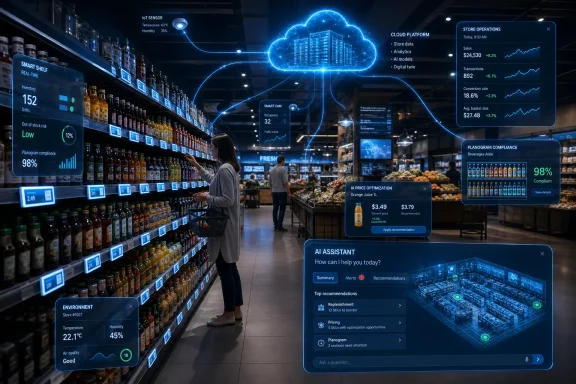
Hanshow describes xPilot as a system that combines store sensing data with retailer business data, then turns identified issues into workflows for store staff or automated actions. In practical terms, it is intended to flag conditions such as missing items, shelf inconsistencies, planogram compliance problems or device alerts, then prioritize what staff should address.
Hanshow has said xPilot uses Azure alongside Microsoft Fabric and AI-agent capabilities. That matters because it places the product in Microsoft’s enterprise data and cloud ecosystem rather than treating it solely as a proprietary in-store appliance stack. For retailers already standardizing on Azure, Fabric or Microsoft identity and management tooling, that may reduce some integration friction.
For IT teams supporting large physical-store estates, however, the announcement reinforces Microsoft’s interest in pairing Azure with edge devices, digital signage, electronic shelf labels and operational AI. The likely practical questions remain the usual ones: how device fleets are managed, where store data resides, how identity and network segmentation are handled, and whether the retailer’s existing data platform can feed the system reliably.
Hanshow and Microsoft say they will now pursue broader cloud-enabled retail innovation, ecosystem development and customer engagement, with xPilot and Store Digital Twin deployments likely to be the first areas to watch.
According to Hanshow’s PRNewswire announcement, the agreement formalizes a relationship that has already produced Azure-hosted electronic shelf-label deployments and retail AI work. The companies did not disclose financial terms, customer commitments, implementation dates, or any new Microsoft product availability.
 More formal backing for an existing Azure relationship
Hanshow sells electronic shelf labels, smart-store hardware and related retail software. Its core pitch is familiar to large retailers: replace paper shelf tickets with centrally managed displays, collect store-floor device data, and use that data to spot pricing, inventory and execution issues more quickly.The company says more than 200 million of its electronic shelf labels are supported on Azure. Microsoft Marketplace also lists Hanshow’s Azure-based SaaS offering for managing large fleets of in-store IoT devices, so the agreement appears to deepen an established commercial and technical arrangement rather than introduce a new platform from scratch.
Hanshow and Microsoft have collaborated for several years. Hanshow previously participated in Microsoft’s AI and IoT Insider Lab, and its earlier work centered on Azure infrastructure, in-store IoT, data analysis and digital signage. The new agreement puts additional emphasis on connecting those components through a “Store Digital Twin” model: a software representation of a physical store’s shelves, devices, products and operational state.
xPilot is the clearest current product outcome
The most tangible element is xPilot, Hanshow’s recently announced real-time store-execution AI assistant. Hanshow launched it in collaboration with Microsoft at NRF 2026 APAC in June.Hanshow describes xPilot as a system that combines store sensing data with retailer business data, then turns identified issues into workflows for store staff or automated actions. In practical terms, it is intended to flag conditions such as missing items, shelf inconsistencies, planogram compliance problems or device alerts, then prioritize what staff should address.
Hanshow has said xPilot uses Azure alongside Microsoft Fabric and AI-agent capabilities. That matters because it places the product in Microsoft’s enterprise data and cloud ecosystem rather than treating it solely as a proprietary in-store appliance stack. For retailers already standardizing on Azure, Fabric or Microsoft identity and management tooling, that may reduce some integration friction.
What it means for Windows and IT teams
This is not a Windows release, an Azure service launch, or a change that Microsoft customers need to deploy. It is a partner announcement focused on retail vertical solutions.For IT teams supporting large physical-store estates, however, the announcement reinforces Microsoft’s interest in pairing Azure with edge devices, digital signage, electronic shelf labels and operational AI. The likely practical questions remain the usual ones: how device fleets are managed, where store data resides, how identity and network segmentation are handled, and whether the retailer’s existing data platform can feed the system reliably.
Hanshow and Microsoft say they will now pursue broader cloud-enabled retail innovation, ecosystem development and customer engagement, with xPilot and Store Digital Twin deployments likely to be the first areas to watch.
References
- Primary source: Morningstar
Published: 2026-07-15T05:44:00+00:00
- Related coverage: hanshow.com
Hanshow Brick-and-Mortar Retail Innovation with Microsoft | Hanshow
Get updated with our Hanshow Brick-and-Mortar Retail Innovation with Microsoft. Contact Hanshow for more.www.hanshow.com
- Related coverage: marketscreener.com
Hanshow Technology Co., Ltd. And Microsoft Corporation Launch xPilot In Collaboration As An AI-Powered Real-Time Store Execution Assistant At NRF 2026 APAC
Hanshow Technology Co., Ltd. announced the launch of xPilot, a real-time store execution AI Assistant powered by Hanshow digital twin technology, in collaboration with Microsoft Corporation at NRF...www.marketscreener.com
- Related coverage: straitstimes.com
Hanshow Launches xPilot to Turn Retail Insights into Real-Time Action | The Straits Times
SINGAPORE, June 3, 2026 /PRNewswire/ -- Hanshow, a global leader in digital store solutions, today announced the launch of xPilot, a one‑stop, real‑ti Read more at straitstimes.com.www.straitstimes.com
- Official source: marketplace.microsoft.com
Microsoft Marketplace | cloud solutions, AI apps, and agents
marketplace.microsoft.com
- Related coverage: uk.marketscreener.com
Hanshow Technology Co., Ltd. And Microsoft Corporation Launch xPilot In Collaboration As An AI-Powered Real-Time Store Execution Assistant At NRF 2026 APAC
Hanshow Technology Co., Ltd. announced the launch of xPilot, a real-time store execution AI Assistant powered by Hanshow digital twin technology, in collaboration with Microsoft Corporation at NRF...uk.marketscreener.com
