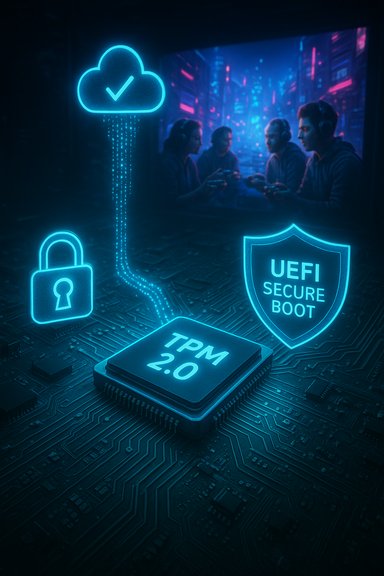
Microsoft’s latest push to harden gaming ecosystems puts familiar platform-level building blocks — TPM 2.0, UEFI Secure Boot, Virtualization‑based Security (VBS) and remote attestation — at the center of its fair‑play story, asking players, OEMs and anti‑cheat vendors to rely on hardware-rooted trust so developers can better distinguish legitimate systems from compromised ones. This is not a single vendor edict; it’s an industry shift in which Microsoft lays out the technical rationale and practical checklist for keeping multiplayer competitive spaces free from low‑level cheats.
Cheating in multiplayer games has evolved beyond simple memory edits and overlay hacks. Today’s sophisticated cheat toolchains reach into the kernel and sometimes even into firmware, making local, user‑mode detection inadequate. To counter this, Microsoft is encouraging — and platforms and publishers are beginning to require — a hardware‑anchored chain of trust that starts in firmware and flows into Windows and the cloud. At the technical core are four complementary protections:
Anti‑cheat systems that rely exclusively on user‑mode telemetry or heuristic detection are increasingly evaded by kernel‑level rootkits, firmware hooks and sophisticated virtualization tricks. By placing trust anchors in hardware and verifying the boot chain cryptographically, server‑side services can obtain stronger evidence that a client hasn’t been stealthily modified before a game or its anti‑cheat runs. That makes persistent, stealthy cheats far more expensive and less reliable for attackers. Practical outcomes include:
Publishers and Microsoft can minimize harms by:
Source: The Tech Outlook Microsoft introduces latest security features to ensure fair play during gaming on Xbiox and Windows 11 - The Tech Outlook
 Background / Overview
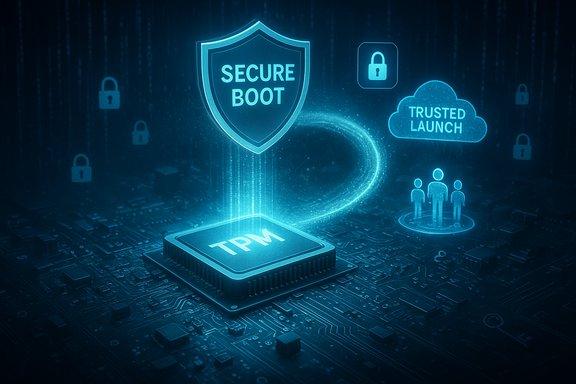
Cheating in multiplayer games has evolved beyond simple memory edits and overlay hacks. Today’s sophisticated cheat toolchains reach into the kernel and sometimes even into firmware, making local, user‑mode detection inadequate. To counter this, Microsoft is encouraging — and platforms and publishers are beginning to require — a hardware‑anchored chain of trust that starts in firmware and flows into Windows and the cloud. At the technical core are four complementary protections:- TPM 2.0: a hardware or firmware module that stores cryptographic keys and records boot measurements.
- Secure Boot (UEFI): firmware enforcement limiting execution at boot to signed, trusted components.
- Virtualization‑based Security (VBS): an isolation mechanism that runs security components in a protected environment separate from the normal OS.
- Remote attestation: cryptographic proof that a device booted in an expected, untampered state, verifiable by a trusted remote service.
Why platform‑level security matters for fair play
Short answer: higher‑integrity signals reduce false negatives and raise the technical bar for cheat authors.Anti‑cheat systems that rely exclusively on user‑mode telemetry or heuristic detection are increasingly evaded by kernel‑level rootkits, firmware hooks and sophisticated virtualization tricks. By placing trust anchors in hardware and verifying the boot chain cryptographically, server‑side services can obtain stronger evidence that a client hasn’t been stealthily modified before a game or its anti‑cheat runs. That makes persistent, stealthy cheats far more expensive and less reliable for attackers. Practical outcomes include:
- Stronger deterrence: cheat authors must bypass firmware checks or obtain valid signing keys — a big leap in complexity.
- Better forensic signals: TPM attestation provides recorded measurements that security teams can analyze.
- Smaller reliance on invasive heuristics: with stronger baseline trust, anti‑cheat systems can reduce false positives that frustrate legitimate players.
What Microsoft announced (official summary)
Microsoft’s Xbox Wire post spells out the company’s message to the gaming community: enable and keep current the platform protections that make an attested, measured boot possible, and developers can more reliably enforce fair play. The post lists the core technologies, practical player actions (enable TPM/Secure Boot, install firmware updates) and links to OEM guidance for enabling these features on a wide range of motherboards and systems. Microsoft explicitly frames these technologies as already used on Xbox and increasingly leveraged on Windows for gaming integrity. Key technical points Microsoft emphasized:- TPM 2.0 is a root of trust for key storage and measured boot values.
- Secure Boot extends the root of trust by allowing only signed early‑boot components to run.
- VBS protects anti‑cheat code by isolating it from attackable parts of the kernel and userland.
- Remote attestation uses TPM‑anchored evidence to create verifiable statements about a device’s boot state that can be checked by cloud services.
Verifying the claims — cross‑checking the technical facts
Microsoft’s technical descriptions align with core platform documentation and independent reporting. The Windows security model, as documented in Microsoft Learn, explicitly ties Secure Boot, measured boot, and TPM‑bound attestations into Windows’ operating‑system security story and notes that remote attestation is the mechanism for proving boot integrity to a verifier. Azure and Microsoft cloud tools likewise describe how vTPM and Trusted Launch enable remote attestation for virtual machines — the same attestation paradigms adapted for PC clients and anti‑cheat backends. This validates Microsoft’s claim that TPM‑based attestation is a well‑documented, industry‑wide approach suitable for remote verification. Independent coverage by mainstream outlets has also reported on publisher-level requirements (for example, Activision and EA tying TPM and Secure Boot into PC prerequisites for major titles), corroborating the industry momentum Microsoft describes. Those reporting threads have also documented the phased rollout approach publishers take to avoid abrupt exclusion.Strengths — what this approach actually achieves
- Raises the technical cost of cheating. Hardware‑anchored attestation and signed‑boot chains force cheat authors into far more complex and less scalable efforts than simple user‑mode hacks. This is a deterrent that scales well against organized cheat vendors.
- Improves signal fidelity for anti‑cheat teams. Cryptographic measurements and attestation mean server checks can act on verifiable evidence rather than heuristics, improving detection quality and reducing collateral damage to legitimate users.
- Leverages existing platform investments. Windows 11 already enshrines TPM 2.0 and UEFI/Secure Boot into its baseline, so aligning game security to the OS’ expectations reduces fragmentation for modern hardware.
- Encourages modern firmware hygiene. Asking players to update UEFI/BIOS and enable platform security nudges the ecosystem toward patched, resilient firmware — a systemic security win beyond gaming.
Risks and trade‑offs — what to watch for
No security architecture is without downsides. The platform‑level approach introduces real operational, privacy and accessibility trade‑offs that require explicit mitigation.- User exclusion and fragmentation. Older PCs, many Linux and Proton users, and handheld systems that don’t expose a compatible Secure Boot/TPM environment may be blocked from playing titles that enforce these checks. This creates a divide between players who can afford or are willing to update hardware and those who cannot. Publishers’ phased rollouts reduce shock, but exclusion remains a practical consequence.
- Support burden and data‑loss hazards. Enabling Secure Boot and toggling disk modes (UEFI/GPT) sometimes forces BitLocker recovery or requires careful disk conversions. Poorly communicated instructions can produce support incidents and data loss; publishers and OEMs must provide clear, step‑by‑step guidance.
- Privileged attack surface. Kernel anti‑cheat drivers and early‑loader components run at the highest privileges. If those components contain bugs or are misconfigured, they can create stability or security vulnerabilities at scale. Independent audits and bug bounties are necessary mitigation.
- Potential for mission creep. Once attestation is in place, there’s a risk of expanding its use beyond anti‑cheat — for DRM, platform gating, or excluding alternate operating systems. Policy guardrails and transparency commitments are essential.
- Privacy and telemetry concerns. Remote attestation produces device state signals. Users and regulators will rightly ask: what measurements are shared? how long are they retained? who can access them? Clear minimization policies are required to avoid mistrust.
The practical checklist — how players, PC builders and admins prepare
Microsoft and publishers have converged on a pragmatic checklist for players who want to avoid being blocked by anti‑cheat enforcement. Follow this sequence to minimize disruption and risk.- Back up everything. Create a full image or at least a comprehensive user‑file backup and ensure BitLocker recovery keys are accessible. Failing to suspend BitLocker before firmware changes is a common cause of recovery prompts.
- Verify current platform state inside Windows:
- Run msinfo32 and confirm BIOS Mode = UEFI and Secure Boot State = On.
- Run tpm.msc and confirm TPM present and Specification Version = 2.0.
- Update firmware and OS:
- Check your motherboard or OEM support pages for UEFI/BIOS updates that fix fTPM/PTT issues.
- Install the latest Windows cumulative updates (some attestation features require recent builds).
- If your disk is MBR, plan a safe conversion:
- Use Microsoft’s MBR2GPT tool only after validating preconditions, and always back up first. Some systems are better served by a clean install if the conversion fails validation.
- Enable TPM & Secure Boot in UEFI, sequence correctly:
- Suspend BitLocker first.
- Enable fTPM/PTT or a discrete dTPM in firmware.
- Switch to UEFI mode and enable Secure Boot.
- Reboot fully (cold shutdown), then re‑enable BitLocker and verify in msinfo32/tpm.msc.
- Confirm with the game‑publisher checklist:
- Many publishers provide specific registration steps (for example, Call of Duty’s enrollaik.exe flow for TPM registration). Follow published guidance if a title presents a registration prompt — the prompt is often a one‑time consent to register the TPM for attestation.
- If you rely on Linux, Steam Deck, or a custom multi‑boot setup:
- Expect possible incompatibilities. Discuss options with the game’s support pages; some vendors may provide Proton/Steam Deck workarounds, but those are not guaranteed. Consider alternative platforms where feasible.
For developers and anti‑cheat teams: implementation and governance checklist
- Prioritize transparency: publish exactly what signals are used, how long they’re retained, and whether attestation results are stored or discarded after verification.
- Use phased enforcement: roll out checks in non‑blocking modes first to gather telemetry and reduce player support friction.
- Harden anti‑cheat code: use rigorous code review, fuzzing and third‑party audits for kernel‑level components; establish prompt CVE response processes.
- Provide recovery flows: supply clear instructions for BitLocker recovery, disk conversion, and firmware updates, including OEM‑specific guides.
- Limit scope: explicitly bind attestation to anti‑cheat purposes; avoid repurposing the mechanism for unrelated DRM gating without explicit policy and community consultation.
Remote attestation: the technical and privacy nuance
Remote attestation is powerful but subtle. It’s not a single “yes/no” check; it’s a set of cryptographic exchanges that rely on TPM‑protected keys and recorded boot measurements. Cloud attestation services (Azure Trusted Launch, Azure Attestation) can validate a device or VM’s boot state by requesting TPM quotes and verifying measured‑boot logs against expected baselines. Microsoft’s documentation and cloud guidance explain how vTPMs, TPM quotes, and certification chains work. Implementers must carefully design what measurements are requested and how to minimize identifiable telemetry. Privacy guardrails to consider:- Collect minimal attestations necessary to prove integrity.
- Avoid collecting or storing unique device identifiers unless strictly required.
- Provide opt‑out or alternative remediation paths where attestation fails for benign reasons. Flag: the exact telemetry schema publishers will use is implementation‑specific and must be reviewed case by case.
Compatibility realities: who’s affected and how much it costs
- Most modern PCs that shipped with Windows 11 support (post‑2018 CPUs, UEFI firmware) will already have TPM 2.0 and Secure Boot available or enabled. For those systems, the user cost is low: a firmware toggle and an update.
- Many older desktops, custom builds without dTPM, or systems with legacy BIOS/MBR will require either a firmware update, disk conversion or hardware replacement. For some user segments, that cost can be meaningful and exclusionary — publishers and platforms must plan for this outreach.
- Linux users, Proton/Steam Deck owners and certain handheld devices may be functionally blocked until anti‑cheat vendors produce compatible solutions that work under Secure Boot and signed kernel models, or until publishers offer server‑side accommodations. Valve’s recent Steam UI changes to surface Secure Boot/TPM status show the industry is trying to reduce surprise for users, but compatibility is still a policy and engineering problem.
Troubleshooting primer — common pitfalls and fixes
- If Secure Boot is greyed out: confirm the system is in UEFI mode and that the boot disk is GPT. Use msinfo32 and Disk Management to check.
- If a game complains about TPM despite enabling it: check TPM manufacturer firmware versions (some AMD and Intel fTPM/PTT variants required updates during recent rollouts). Update motherboard BIOS and consult the publisher’s troubleshooting guides (some games include specific advice and a registration/utility for TPM enrollment).
- BitLocker recovery screens after toggling firmware: this is usually because BitLocker protection wasn’t suspended before firmware changes. Suspend BitLocker before the change, then re‑enable and update protectors after the reboot.
- If MBR2GPT validation fails: inspect partition layouts and primary partition count; in many cases a clean install is the safer path. Always back up first.
The pragmatic verdict for players and the industry
The direction Microsoft and publishers are describing is technically sound: hardware‑anchored attestation and Secure Boot materially raise the bar on persistent, kernel and firmware‑level cheats. For the large majority of modern PCs, the move should be low friction and produces a net improvement in fairness and anti‑cheat fidelity. That said, the approach shifts complexity onto firmware, OEM support channels and publisher help desks — and it raises real governance, privacy and accessibility questions that must be answered publicly.Publishers and Microsoft can minimize harms by:
- Phasing in enforcement and publishing clear conversion and recovery instructions.
- Funding OEM firmware updates and support for common affected platforms.
- Limiting attestation signals to what’s strictly necessary and publishing retention policies.
Final thoughts
Platform‑level security is not a silver bullet, but it is a pragmatic and measurable improvement in the arms race against cheating. Microsoft’s guidance is consistent with the architecture of modern secure boot flows and attestation mechanisms; independent reporting and platform documentation corroborate both the technical viability and the operational challenges of the approach. Implementation quality, clear user communication, robust privacy guarantees and careful governance will determine whether this shift strengthens communities or creates new fault lines. For competitive multiplayer to remain healthy, industry stakeholders must keep the ‘fair’ in fair play — and that requires both strong engineering and thoughtful stewardship.Source: The Tech Outlook Microsoft introduces latest security features to ensure fair play during gaming on Xbiox and Windows 11 - The Tech Outlook