

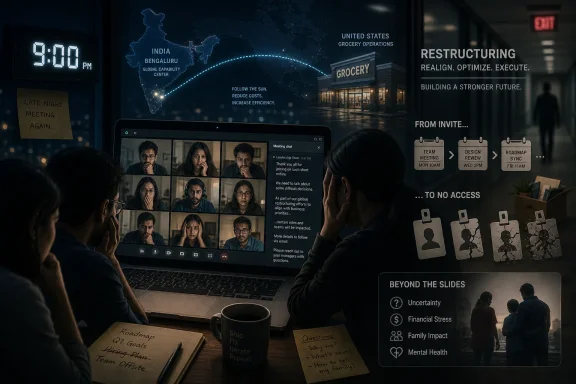
A software engineer claimed on June 29, 2026, that roughly 150 Hy-Vee engineers in India were laid off after a 9 p.m. Microsoft Teams call, with the company’s India engineering center reportedly shut down immediately as part of a restructuring. The allegation, first amplified through Reddit and then through HR and business media, is still not a company-confirmed account. But even with that caveat, the story has already become a useful x-ray of how fragile global engineering jobs can be when they sit inside companies that do not primarily think of themselves as technology firms. The shock is not only that a team may have disappeared overnight; it is that the industry has normalized a language of “restructuring” that often explains everything and accounts for almost nothing.
The public version of the Hy-Vee India story begins with an employee account, not a corporate statement. According to the post, about 150 members of an engineering team were invited to a late-night Microsoft Teams meeting and told the team was being shut down. The employee said the news arrived without warning and without severance, describing the experience as a sudden end to a nearly two-year run that began with an internship and became a full-time role.
That is the kind of account that travels quickly because it is simple, emotionally legible, and painfully familiar. A calendar invite appears. A meeting starts. A manager or executive reads from a script. Access, identity, benefits, and belonging are all converted into administrative tasks.
People Matters reported that Hy-Vee had not publicly commented on the alleged layoffs, the claimed lack of severance, or the reported shutdown of the India engineering center. That matters. The strongest version of the story remains based on public employee accounts and a LinkedIn post from Amit Goel, identified in reports as Hy-Vee’s Director of Engineering in India, who said the Hy-Vee India center had shut down and that affected engineers were immediately looking for new roles.
So the article has to begin with a constraint: this is not yet a fully company-verified narrative. But it is also not merely internet vapor. A named engineering leader reportedly acknowledged the center’s closure, and multiple outlets have treated the employee’s account as newsworthy while noting the missing company confirmation. That combination is enough to make the event important, but not enough to make every detail settled.
The absence of a corporate response has its own gravitational pull. When companies do not speak, the vacuum is filled by employees, recruiters, peers, and former colleagues. That can produce inaccuracies, but it can also reveal what official statements usually sand down: the lived experience of being terminated in a room where the decision has already been made and the explanation has already been compressed into a phrase.
Yet modern retail is software whether retailers admit it or not. Online ordering, inventory optimization, pricing systems, loyalty apps, fulfillment routing, pharmacy platforms, data analytics, cloud infrastructure, cybersecurity, and internal operations all push grocery chains into the business of building and maintaining software. The supermarket is now an edge node with produce.
That is why the India engineering center mattered. It represented the now-common corporate move in which a non-tech company builds a global capability center to bring engineering capacity closer to the business while managing costs. Retailers, insurers, banks, airlines, and manufacturers have all taken the same path: hire software talent directly, distribute it across regions, and try to own more of the digital stack.
In August 2024, Hy-Vee’s India expansion was reported as a long-term commitment, including a 10-year lease for office space in Bengaluru. That kind of detail made the move look structural rather than experimental. A decade-long lease is not how companies usually describe a disposable engineering outpost.
Less than two years later, if the reported shutdown is accurate, that same center became a reminder that “long-term” often means “long-term until the spreadsheet changes.” This is the uncomfortable truth behind many global capability centers: they are sold internally as strategic assets, but they can still be treated externally as cost pools when the company decides to simplify, centralize, or retreat.
The real issue is that remote-work infrastructure has made mass termination operationally frictionless. A company can convene a workforce across cities and countries, deliver a scripted message, and move immediately to access revocation and offboarding. The tools that helped teams collaborate across borders also make it easy to dissolve those teams across borders.
That does not mean every remote layoff is cruel or avoidable. Companies with distributed teams often have no practical way to hold in-person conversations at scale. But the convenience of the channel can become a substitute for the obligations of leadership. If a company can hire globally, onboard globally, and extract work globally, it should also be able to communicate exits with some measure of dignity.
The late-night timing is especially hard to separate from the human impact. For employees in India, a 9 p.m. meeting is not just “after business hours.” It lands in personal time, family time, decompression time. It turns a workday into a cliff edge.
That is why these stories resonate far beyond the people directly affected. The meeting format becomes a symbol for a larger imbalance: companies can plan restructuring for weeks or months, while employees receive the news in minutes. One side has a project plan; the other has a shock.
That said, the claim matters because severance is not just a financial cushion. It is a signal of how a company understands the relationship it has ended. The difference between “your role is gone, here is transition support” and “your role is gone, goodbye” is not cosmetic. It shapes whether employees experience a restructuring as a business decision or a betrayal.
For global engineering teams, severance also becomes a reputational instrument. Companies hiring in India compete for talent against multinationals, startups, services giants, and global capability centers with increasingly sophisticated employer brands. If a shutdown is perceived as abrupt and ungenerous, the cost does not end with the departing workers. It follows the company into future recruiting conversations.
There is also a practical problem for employees with short tenure. The engineer in the reported account said they had been with Hy-Vee for about 1.8 years, beginning as an intern. Early-career workers typically have smaller savings buffers and fewer professional networks. A sudden layoff without meaningful transition support hits them harder than it hits a veteran engineer with a decade of contacts and a deep emergency fund.
This is where corporate ambiguity can look like strategy even when it is merely silence. If Hy-Vee believes the no-severance claim is wrong, the company has every reason to say so. If it is right, the company’s silence lets the harsher interpretation harden.
Some of that language is true. India’s engineering market is not simply a cheaper copy of U.S. tech labor. It is a massive, competitive ecosystem with experienced software developers, cloud architects, data engineers, QA specialists, product managers, and technical leaders. Many global companies build serious products and platforms from Indian engineering centers.
But the Hy-Vee report exposes the weak joint in the model. A center can be strategic in the slide deck and still be peripheral in the boardroom. If the parent company’s core identity is grocery retail, not software, then an overseas engineering team may find itself vulnerable when leadership decides to refocus spending, consolidate technology, outsource differently, or cut capital commitments.
This does not mean non-tech companies should avoid building global engineering teams. It means those teams need clearer charters and stronger integration with the business. If an India center owns mission-critical systems, core product roadmaps, and operational resilience, shutting it down overnight becomes harder. If it is treated as a flexible development pool, it is easier to erase.
The danger for workers is that they cannot always see which version they joined. A job description may promise product ownership, innovation, and scale. The company’s internal accounting may classify the same group as a cost center whose value is measured quarterly.
That mismatch is becoming one of the defining labor stories of the software industry. Engineers no longer work only for software companies. They work for banks, retailers, hospitals, automakers, governments, and logistics firms. Their job security depends not just on technical performance, but on how deeply their employer believes technology is part of the business rather than a service attached to it.
That history gives the 2026 India report a sharper edge. In 2024, when Hy-Vee expanded in India, the company reportedly said work from earlier U.S. layoffs had not been sent overseas and that it was also hiring for its Grimes technology office. That was an important distinction at the time, because overseas expansion after domestic technology layoffs invites an obvious suspicion: that jobs were being relocated rather than added.
Now, the alleged India shutdown complicates the narrative again. If the center was not a simple replacement for U.S. roles, what exactly was it? If it was a long-term expansion of technology capability, why would it reportedly disappear so quickly? If it was experimental, why was it packaged with the permanence of a major office commitment?
There may be reasonable answers. Business needs change. Vendor strategies change. Retail margins are punishing. Digital programs fail. Leadership teams inherit commitments they no longer want. A company can make a defensible decision to close a center and still execute that decision poorly.
But the pattern is what employees and observers notice. First, a company reduces corporate or technology roles. Then it expands overseas. Then the overseas team reportedly gets cut. To management, these may be separate decisions in separate planning cycles. To workers, they look like proof that no location is safe and no strategic story should be believed for very long.
That tension produces unstable technology organizations. During expansion periods, companies hire engineers to build proprietary systems, modernize platforms, and reduce reliance on vendors. During retrenchment, the same companies ask whether they should buy more, outsource more, centralize more, or cut custom development that no longer looks essential.
The result is a pendulum. Build in-house when digital transformation is the mandate. Cut or consolidate when efficiency becomes the mandate. Hire globally when scale matters. Close globally when complexity matters more.
For engineers, this can feel irrational because software work does not map neatly to quarterly restructuring logic. Systems need maintenance. Technical debt accumulates. Integrations break. Security threats evolve. A product team that disappears overnight may leave behind code, documentation gaps, institutional knowledge loss, and operational dependencies that the company still has to manage.
Layoffs are often presented as a reduction in headcount, but in engineering they are also a reduction in memory. The people who know why a system behaves strangely, which migration was postponed, what script nobody should touch, and which vendor promise was never quite true are part of the infrastructure. When they leave abruptly, the org chart gets cleaner and the risk register gets messier.
That contradiction is especially sharp for early-career engineers. The reported employee had been with Hy-Vee for less than two years, including internship time. For someone in that stage of a career, a first or second major role is not just a paycheck. It is a credential, a mentor network, a learning environment, and a bridge into the next tier of opportunity.
A sudden layoff can fracture all of that. The worker has to explain the exit, rebuild routine, manage family expectations, refresh interview skills, and compete in a market already saturated with other laid-off engineers. The emotional labor is real, even if corporate statements prefer the antiseptic language of alignment and restructuring.
There is also a community effect. When a whole center shuts down, employees are not just individually unemployed; they are collectively displaced into the same job market at the same time. Former teammates become each other’s support system and competition. Recruiters receive lists. LinkedIn fills with open-to-work posts. The event becomes both a tragedy and a talent marketplace.
None of this means companies can never cut jobs. It means the way they do it is part of the decision, not a communications footnote. A layoff executed with clarity, notice, severance, and transition support is still painful. A layoff experienced as a surprise video call with no meaningful cushion becomes a reputational scar.
This pipeline is messy but powerful. It can surface events that would otherwise remain invisible, especially inside private companies with no public-market disclosure obligations. Hy-Vee is not a publicly traded software giant filing detailed restructuring charges with investors. Without employee posts, a shutdown like this could pass with little scrutiny outside the affected workforce.
But Reddit is not a court record. It captures immediacy, not completeness. Posts can be emotional, imprecise, missing legal nuance, or based on partial information. A serious reading of this story has to hold two ideas at once: employee accounts are essential evidence of workplace reality, and they are not the same thing as independently verified corporate documentation.
That tension is why the engineering leader’s reported LinkedIn post matters. It appears to corroborate the broad claim that the India center shut down and that engineers were immediately looking for work. It does not, by itself, verify every allegation about severance, notice, or the internal rationale. But it moves the story out of the category of unsupported rumor.
For journalists, IT workers, and forum readers, this is the new literacy requirement. A viral layoff post should not be swallowed whole, but neither should it be dismissed because it began on social media. In 2026, the first signal of a major workplace event may come from the people in the meeting, not the people who scheduled it.
For IT administrators, there is a grim operational side to these events. Layoffs require access control, identity lifecycle management, device recovery, data retention, legal holds, mailbox handling, endpoint wipe decisions, and security monitoring. The cleaner the offboarding automation, the easier it is for the business to execute a sudden cut.
That does not make IT complicit in cruelty. It makes IT part of the machinery that modern organizations use to translate HR decisions into reality. When a layoff happens, identity systems often move faster than human systems. Accounts close before people have fully processed the sentence they just heard.
This is where process design matters. A company can protect systems without humiliating people. It can stage access changes, preserve personal materials, provide clear instructions, and ensure managers are available for real conversations. It can avoid turning the end of employment into a race between the meeting transcript and the identity provider.
The uncomfortable lesson is that humane offboarding is also a systems problem. If the only thing a company has engineered well is account disablement, employees will feel that. They will remember that the machines were ready for the layoff even if the leaders were not ready to explain it.
Notice and severance are usually discussed in moral or legal terms. They also have operational value. They reduce chaos, discourage adversarial behavior, preserve cooperation, and make it more likely that departing employees will document, transfer, and explain what they know. A company that treats workers as disposable may save cash while destroying trust it still needs.
In engineering organizations, knowledge transfer is not a ceremonial checklist. It is the difference between a stable handoff and months of archaeology. Sudden cuts can leave remaining teams guessing at architecture decisions, deployment habits, credentials, vendor relationships, and brittle integrations. The damage may not appear on the day of the layoff. It shows up later, when something breaks and the person who understood it is gone.
This is why the best companies handle reductions as both HR events and reliability events. They map systems to people. They identify single points of human failure. They plan continuity before revoking access. They communicate enough that the remaining workforce can still believe management understands the machine it is cutting into.
If Hy-Vee’s reported shutdown happened as abruptly as employees allege, the question is not only whether the company treated workers fairly. It is whether the company protected its own technical continuity. In software, compassion and competence are more closely related than executives sometimes admit.
The better lesson is to interrogate the business context around the role. Engineers often evaluate a job by stack, compensation, manager quality, remote policy, and brand. They should also ask where the team sits in the company’s power structure. Does it own revenue-critical systems? Is it tied to a board-level transformation program? Is leadership still investing, or merely maintaining? Is the center a strategic hub or a staffing solution?
These questions are not always easy to answer in interviews, and companies have incentives to present every role as mission-critical. But candidates can still look for signals. Long-term product ownership is different from ticket throughput. Direct business stakeholders are different from abstract offshore coordination. A roadmap with accountable executives is different from vague “digital transformation” language.
For early-career engineers, the Hy-Vee report also argues for keeping a public trail of work that is not dependent on an employer’s systems. That does not mean leaking code or violating confidentiality. It means maintaining a current resume, documenting skills, building a network before needing it, contributing where appropriate, and preserving evidence of impact in a professional way.
The harsh truth is that loyalty is not a continuity plan. Companies may value employees, managers may care deeply, and teams may be excellent. But when the restructuring memo arrives, the individual worker needs options that exist outside the company’s badge system.
A strong company response would not need to disclose every confidential detail. It would need to acknowledge the human impact and provide enough factual grounding to prevent rumor from becoming the only archive. If severance was offered, say so. If legal obligations were met in another form, explain that. If the center closure is part of a broader technology strategy, describe the strategy in plain language.
The worst corporate statements in these moments are the ones that confuse abstraction with professionalism. “We regularly evaluate our operations to better serve customers” is not an explanation. It is a placeholder. Workers who lost jobs and customers who rely on the company’s digital systems deserve more than a sentence assembled from compliance-approved fog.
Hy-Vee’s employee-owned identity also raises the reputational stakes. Employee ownership is supposed to signal a different relationship between labor and enterprise, even if not every worker has the same stake or status. When a company with that brand is accused of abrupt layoffs without severance, the contrast becomes part of the story.
The company may have facts that complicate the current narrative. But if it does not provide them, the public narrative will be built from the available material: the Reddit account, the reported LinkedIn post, the media summaries, and the emotional testimony of people who say their team disappeared overnight.
This story sits at the intersection of several trends that now define technology labor. Non-tech companies are becoming software-dependent. Global capability centers are expanding and contracting with alarming speed. Collaboration tools have made mass communication efficient but emotionally blunt. Social media has become the first alert system for private-sector labor shocks. Severance and notice have become tests of corporate character.
It also challenges a comforting myth: that engineers are insulated by indispensability. Software is essential, but individual software workers are not always treated as essential. A company can depend on code while cutting the people who wrote it. It can invest in digital transformation while shedding digital talent. It can praise innovation and still reduce engineering to a line item.
That contradiction is not sustainable forever. Companies that repeatedly cut technical teams without preserving knowledge and trust will pay in outages, vendor dependence, slower delivery, and recruiting skepticism. The bill may arrive later than the savings, but it usually arrives.
 The Layoff Story Arrives Before the Company Does
The public version of the Hy-Vee India story begins with an employee account, not a corporate statement. According to the post, about 150 members of an engineering team were invited to a late-night Microsoft Teams meeting and told the team was being shut down. The employee said the news arrived without warning and without severance, describing the experience as a sudden end to a nearly two-year run that began with an internship and became a full-time role.That is the kind of account that travels quickly because it is simple, emotionally legible, and painfully familiar. A calendar invite appears. A meeting starts. A manager or executive reads from a script. Access, identity, benefits, and belonging are all converted into administrative tasks.
People Matters reported that Hy-Vee had not publicly commented on the alleged layoffs, the claimed lack of severance, or the reported shutdown of the India engineering center. That matters. The strongest version of the story remains based on public employee accounts and a LinkedIn post from Amit Goel, identified in reports as Hy-Vee’s Director of Engineering in India, who said the Hy-Vee India center had shut down and that affected engineers were immediately looking for new roles.
So the article has to begin with a constraint: this is not yet a fully company-verified narrative. But it is also not merely internet vapor. A named engineering leader reportedly acknowledged the center’s closure, and multiple outlets have treated the employee’s account as newsworthy while noting the missing company confirmation. That combination is enough to make the event important, but not enough to make every detail settled.
The absence of a corporate response has its own gravitational pull. When companies do not speak, the vacuum is filled by employees, recruiters, peers, and former colleagues. That can produce inaccuracies, but it can also reveal what official statements usually sand down: the lived experience of being terminated in a room where the decision has already been made and the explanation has already been compressed into a phrase.
Hy-Vee Was Not Supposed to Be a Startup Story
The Hy-Vee angle is what makes this episode more interesting than another grim entry in the tech layoff ledger. Hy-Vee is not a venture-backed software company promising to reinvent logistics with a dashboard and a pitch deck. It is a large, employee-owned U.S. grocery chain with roots in the Midwest, a consumer brand built around stores, pharmacy counters, fuel stations, and retail loyalty.Yet modern retail is software whether retailers admit it or not. Online ordering, inventory optimization, pricing systems, loyalty apps, fulfillment routing, pharmacy platforms, data analytics, cloud infrastructure, cybersecurity, and internal operations all push grocery chains into the business of building and maintaining software. The supermarket is now an edge node with produce.
That is why the India engineering center mattered. It represented the now-common corporate move in which a non-tech company builds a global capability center to bring engineering capacity closer to the business while managing costs. Retailers, insurers, banks, airlines, and manufacturers have all taken the same path: hire software talent directly, distribute it across regions, and try to own more of the digital stack.
In August 2024, Hy-Vee’s India expansion was reported as a long-term commitment, including a 10-year lease for office space in Bengaluru. That kind of detail made the move look structural rather than experimental. A decade-long lease is not how companies usually describe a disposable engineering outpost.
Less than two years later, if the reported shutdown is accurate, that same center became a reminder that “long-term” often means “long-term until the spreadsheet changes.” This is the uncomfortable truth behind many global capability centers: they are sold internally as strategic assets, but they can still be treated externally as cost pools when the company decides to simplify, centralize, or retreat.
The 9 P.M. Teams Call Is the Symbol, Not the System
The detail that caught fire was the 9 p.m. Microsoft Teams call. It has everything a viral layoff story needs: the indignity of the hour, the impersonality of the medium, and the sense that an entire working life can be reduced to a video tile. But the software is not the villain. Teams did what Teams is designed to do: gather distributed workers into a meeting quickly.The real issue is that remote-work infrastructure has made mass termination operationally frictionless. A company can convene a workforce across cities and countries, deliver a scripted message, and move immediately to access revocation and offboarding. The tools that helped teams collaborate across borders also make it easy to dissolve those teams across borders.
That does not mean every remote layoff is cruel or avoidable. Companies with distributed teams often have no practical way to hold in-person conversations at scale. But the convenience of the channel can become a substitute for the obligations of leadership. If a company can hire globally, onboard globally, and extract work globally, it should also be able to communicate exits with some measure of dignity.
The late-night timing is especially hard to separate from the human impact. For employees in India, a 9 p.m. meeting is not just “after business hours.” It lands in personal time, family time, decompression time. It turns a workday into a cliff edge.
That is why these stories resonate far beyond the people directly affected. The meeting format becomes a symbol for a larger imbalance: companies can plan restructuring for weeks or months, while employees receive the news in minutes. One side has a project plan; the other has a shock.
“No Severance” Is the Claim That Needs the Most Scrutiny
The allegation of no severance is the most explosive part of the story, and it is also the part that demands the most careful handling. Severance practices vary by jurisdiction, employment contract, tenure, company policy, and the legal framing of the separation. A Reddit post can describe the employee’s experience, but it cannot by itself resolve what every affected worker was legally owed or ultimately received.That said, the claim matters because severance is not just a financial cushion. It is a signal of how a company understands the relationship it has ended. The difference between “your role is gone, here is transition support” and “your role is gone, goodbye” is not cosmetic. It shapes whether employees experience a restructuring as a business decision or a betrayal.
For global engineering teams, severance also becomes a reputational instrument. Companies hiring in India compete for talent against multinationals, startups, services giants, and global capability centers with increasingly sophisticated employer brands. If a shutdown is perceived as abrupt and ungenerous, the cost does not end with the departing workers. It follows the company into future recruiting conversations.
There is also a practical problem for employees with short tenure. The engineer in the reported account said they had been with Hy-Vee for about 1.8 years, beginning as an intern. Early-career workers typically have smaller savings buffers and fewer professional networks. A sudden layoff without meaningful transition support hits them harder than it hits a veteran engineer with a decade of contacts and a deep emergency fund.
This is where corporate ambiguity can look like strategy even when it is merely silence. If Hy-Vee believes the no-severance claim is wrong, the company has every reason to say so. If it is right, the company’s silence lets the harsher interpretation harden.
The India Center Shows the Risk of “Strategic” Offshoring
Corporate offshoring used to be described mainly as labor arbitrage: move work to lower-cost markets and preserve margin. The newer vocabulary is more flattering. Companies now talk about global capability centers, innovation hubs, digital acceleration, engineering excellence, and access to deep talent pools.Some of that language is true. India’s engineering market is not simply a cheaper copy of U.S. tech labor. It is a massive, competitive ecosystem with experienced software developers, cloud architects, data engineers, QA specialists, product managers, and technical leaders. Many global companies build serious products and platforms from Indian engineering centers.
But the Hy-Vee report exposes the weak joint in the model. A center can be strategic in the slide deck and still be peripheral in the boardroom. If the parent company’s core identity is grocery retail, not software, then an overseas engineering team may find itself vulnerable when leadership decides to refocus spending, consolidate technology, outsource differently, or cut capital commitments.
This does not mean non-tech companies should avoid building global engineering teams. It means those teams need clearer charters and stronger integration with the business. If an India center owns mission-critical systems, core product roadmaps, and operational resilience, shutting it down overnight becomes harder. If it is treated as a flexible development pool, it is easier to erase.
The danger for workers is that they cannot always see which version they joined. A job description may promise product ownership, innovation, and scale. The company’s internal accounting may classify the same group as a cost center whose value is measured quarterly.
That mismatch is becoming one of the defining labor stories of the software industry. Engineers no longer work only for software companies. They work for banks, retailers, hospitals, automakers, governments, and logistics firms. Their job security depends not just on technical performance, but on how deeply their employer believes technology is part of the business rather than a service attached to it.
The Ghost of Earlier Hy-Vee Cuts Haunts the New Report
Hy-Vee has been here before in the broader sense, even if the India details are distinct. In 2022, the company made headlines for corporate layoffs tied to a shift away from pandemic-era projects. Axios reported then that Hy-Vee had reduced hundreds of corporate positions in local offices, including technology-related cuts in the Des Moines area.That history gives the 2026 India report a sharper edge. In 2024, when Hy-Vee expanded in India, the company reportedly said work from earlier U.S. layoffs had not been sent overseas and that it was also hiring for its Grimes technology office. That was an important distinction at the time, because overseas expansion after domestic technology layoffs invites an obvious suspicion: that jobs were being relocated rather than added.
Now, the alleged India shutdown complicates the narrative again. If the center was not a simple replacement for U.S. roles, what exactly was it? If it was a long-term expansion of technology capability, why would it reportedly disappear so quickly? If it was experimental, why was it packaged with the permanence of a major office commitment?
There may be reasonable answers. Business needs change. Vendor strategies change. Retail margins are punishing. Digital programs fail. Leadership teams inherit commitments they no longer want. A company can make a defensible decision to close a center and still execute that decision poorly.
But the pattern is what employees and observers notice. First, a company reduces corporate or technology roles. Then it expands overseas. Then the overseas team reportedly gets cut. To management, these may be separate decisions in separate planning cycles. To workers, they look like proof that no location is safe and no strategic story should be believed for very long.
The Grocery Business Is Learning the Cost of Becoming a Tech Company
Retail technology is no longer optional, but it is also not free. Grocery chains operate in a world of thin margins, volatile supply chains, shifting consumer habits, labor constraints, pharmacy complexity, loyalty competition, and intense pressure from Walmart, Amazon, Target, Costco, Kroger, and regional rivals. Every retailer wants better software. Fewer want to carry the full cost of behaving like a software company.That tension produces unstable technology organizations. During expansion periods, companies hire engineers to build proprietary systems, modernize platforms, and reduce reliance on vendors. During retrenchment, the same companies ask whether they should buy more, outsource more, centralize more, or cut custom development that no longer looks essential.
The result is a pendulum. Build in-house when digital transformation is the mandate. Cut or consolidate when efficiency becomes the mandate. Hire globally when scale matters. Close globally when complexity matters more.
For engineers, this can feel irrational because software work does not map neatly to quarterly restructuring logic. Systems need maintenance. Technical debt accumulates. Integrations break. Security threats evolve. A product team that disappears overnight may leave behind code, documentation gaps, institutional knowledge loss, and operational dependencies that the company still has to manage.
Layoffs are often presented as a reduction in headcount, but in engineering they are also a reduction in memory. The people who know why a system behaves strangely, which migration was postponed, what script nobody should touch, and which vendor promise was never quite true are part of the infrastructure. When they leave abruptly, the org chart gets cleaner and the risk register gets messier.
The Human Cost Is Not a Soft Metric
The viral phrase “one meeting, and it was over” resonates because it captures a structural asymmetry in modern employment. Companies ask employees to identify with mission, culture, ownership, and long-term transformation. Then, when the business changes, the relationship is redefined in the narrowest possible legal and financial terms.That contradiction is especially sharp for early-career engineers. The reported employee had been with Hy-Vee for less than two years, including internship time. For someone in that stage of a career, a first or second major role is not just a paycheck. It is a credential, a mentor network, a learning environment, and a bridge into the next tier of opportunity.
A sudden layoff can fracture all of that. The worker has to explain the exit, rebuild routine, manage family expectations, refresh interview skills, and compete in a market already saturated with other laid-off engineers. The emotional labor is real, even if corporate statements prefer the antiseptic language of alignment and restructuring.
There is also a community effect. When a whole center shuts down, employees are not just individually unemployed; they are collectively displaced into the same job market at the same time. Former teammates become each other’s support system and competition. Recruiters receive lists. LinkedIn fills with open-to-work posts. The event becomes both a tragedy and a talent marketplace.
None of this means companies can never cut jobs. It means the way they do it is part of the decision, not a communications footnote. A layoff executed with clarity, notice, severance, and transition support is still painful. A layoff experienced as a surprise video call with no meaningful cushion becomes a reputational scar.
Reddit Is Now the First Draft of Labor Reporting
The Hy-Vee India report also shows how workplace news now breaks. Employees post anonymously or semi-anonymously. Industry peers amplify. LinkedIn adds named signals. HR publications and mainstream outlets pick it up. The company may respond later, if at all.This pipeline is messy but powerful. It can surface events that would otherwise remain invisible, especially inside private companies with no public-market disclosure obligations. Hy-Vee is not a publicly traded software giant filing detailed restructuring charges with investors. Without employee posts, a shutdown like this could pass with little scrutiny outside the affected workforce.
But Reddit is not a court record. It captures immediacy, not completeness. Posts can be emotional, imprecise, missing legal nuance, or based on partial information. A serious reading of this story has to hold two ideas at once: employee accounts are essential evidence of workplace reality, and they are not the same thing as independently verified corporate documentation.
That tension is why the engineering leader’s reported LinkedIn post matters. It appears to corroborate the broad claim that the India center shut down and that engineers were immediately looking for work. It does not, by itself, verify every allegation about severance, notice, or the internal rationale. But it moves the story out of the category of unsupported rumor.
For journalists, IT workers, and forum readers, this is the new literacy requirement. A viral layoff post should not be swallowed whole, but neither should it be dismissed because it began on social media. In 2026, the first signal of a major workplace event may come from the people in the meeting, not the people who scheduled it.
The Microsoft Teams Detail Should Make IT Leaders Uncomfortable
WindowsForum readers will naturally notice the Microsoft Teams piece, because Teams has become part of the default plumbing of enterprise work. It is the meeting room, phone system, chat archive, webinar platform, file-sharing surface, and occasionally the place where bad news is delivered at scale. No collaboration suite was designed to carry the moral weight of employment termination, but that is where the work world has put it.For IT administrators, there is a grim operational side to these events. Layoffs require access control, identity lifecycle management, device recovery, data retention, legal holds, mailbox handling, endpoint wipe decisions, and security monitoring. The cleaner the offboarding automation, the easier it is for the business to execute a sudden cut.
That does not make IT complicit in cruelty. It makes IT part of the machinery that modern organizations use to translate HR decisions into reality. When a layoff happens, identity systems often move faster than human systems. Accounts close before people have fully processed the sentence they just heard.
This is where process design matters. A company can protect systems without humiliating people. It can stage access changes, preserve personal materials, provide clear instructions, and ensure managers are available for real conversations. It can avoid turning the end of employment into a race between the meeting transcript and the identity provider.
The uncomfortable lesson is that humane offboarding is also a systems problem. If the only thing a company has engineered well is account disablement, employees will feel that. They will remember that the machines were ready for the layoff even if the leaders were not ready to explain it.
Severance, Notice, and Dignity Are Security Controls Too
Technology leaders often separate “people issues” from “security issues,” but abrupt layoffs blur that line. A workforce that feels blindsided and mistreated is a risk surface. Most employees will behave professionally regardless of disappointment, but resentment, confusion, and panic are not conditions any security team should welcome.Notice and severance are usually discussed in moral or legal terms. They also have operational value. They reduce chaos, discourage adversarial behavior, preserve cooperation, and make it more likely that departing employees will document, transfer, and explain what they know. A company that treats workers as disposable may save cash while destroying trust it still needs.
In engineering organizations, knowledge transfer is not a ceremonial checklist. It is the difference between a stable handoff and months of archaeology. Sudden cuts can leave remaining teams guessing at architecture decisions, deployment habits, credentials, vendor relationships, and brittle integrations. The damage may not appear on the day of the layoff. It shows up later, when something breaks and the person who understood it is gone.
This is why the best companies handle reductions as both HR events and reliability events. They map systems to people. They identify single points of human failure. They plan continuity before revoking access. They communicate enough that the remaining workforce can still believe management understands the machine it is cutting into.
If Hy-Vee’s reported shutdown happened as abruptly as employees allege, the question is not only whether the company treated workers fairly. It is whether the company protected its own technical continuity. In software, compassion and competence are more closely related than executives sometimes admit.
The Hy-Vee Story Is a Warning Label for Global Engineering Careers
The most concrete lesson for engineers is not “avoid retail” or “avoid global capability centers.” That would be too simple and probably wrong. Many of the most durable software careers now sit inside non-tech companies that have serious digital needs and large operational footprints.The better lesson is to interrogate the business context around the role. Engineers often evaluate a job by stack, compensation, manager quality, remote policy, and brand. They should also ask where the team sits in the company’s power structure. Does it own revenue-critical systems? Is it tied to a board-level transformation program? Is leadership still investing, or merely maintaining? Is the center a strategic hub or a staffing solution?
These questions are not always easy to answer in interviews, and companies have incentives to present every role as mission-critical. But candidates can still look for signals. Long-term product ownership is different from ticket throughput. Direct business stakeholders are different from abstract offshore coordination. A roadmap with accountable executives is different from vague “digital transformation” language.
For early-career engineers, the Hy-Vee report also argues for keeping a public trail of work that is not dependent on an employer’s systems. That does not mean leaking code or violating confidentiality. It means maintaining a current resume, documenting skills, building a network before needing it, contributing where appropriate, and preserving evidence of impact in a professional way.
The harsh truth is that loyalty is not a continuity plan. Companies may value employees, managers may care deeply, and teams may be excellent. But when the restructuring memo arrives, the individual worker needs options that exist outside the company’s badge system.
The Story Hy-Vee Still Needs to Tell
Hy-Vee can still clarify the record. It can say whether the India engineering center has closed, how many employees were affected, what notice or severance was provided, and what restructuring rationale drove the decision. It can correct inaccuracies in public reporting if they exist. Silence is a choice, but it is rarely a neutral one.A strong company response would not need to disclose every confidential detail. It would need to acknowledge the human impact and provide enough factual grounding to prevent rumor from becoming the only archive. If severance was offered, say so. If legal obligations were met in another form, explain that. If the center closure is part of a broader technology strategy, describe the strategy in plain language.
The worst corporate statements in these moments are the ones that confuse abstraction with professionalism. “We regularly evaluate our operations to better serve customers” is not an explanation. It is a placeholder. Workers who lost jobs and customers who rely on the company’s digital systems deserve more than a sentence assembled from compliance-approved fog.
Hy-Vee’s employee-owned identity also raises the reputational stakes. Employee ownership is supposed to signal a different relationship between labor and enterprise, even if not every worker has the same stake or status. When a company with that brand is accused of abrupt layoffs without severance, the contrast becomes part of the story.
The company may have facts that complicate the current narrative. But if it does not provide them, the public narrative will be built from the available material: the Reddit account, the reported LinkedIn post, the media summaries, and the emotional testimony of people who say their team disappeared overnight.
A Grocery Chain’s Tech Retrenchment Carries an Industry-Sized Lesson
The reported Hy-Vee layoffs are not the largest technology workforce reduction of 2026. They are not even close. But size is not the only measure of significance. A 150-person engineering center can reveal more about the state of work than a 10,000-person megacap layoff wrapped in investor relations choreography.This story sits at the intersection of several trends that now define technology labor. Non-tech companies are becoming software-dependent. Global capability centers are expanding and contracting with alarming speed. Collaboration tools have made mass communication efficient but emotionally blunt. Social media has become the first alert system for private-sector labor shocks. Severance and notice have become tests of corporate character.
It also challenges a comforting myth: that engineers are insulated by indispensability. Software is essential, but individual software workers are not always treated as essential. A company can depend on code while cutting the people who wrote it. It can invest in digital transformation while shedding digital talent. It can praise innovation and still reduce engineering to a line item.
That contradiction is not sustainable forever. Companies that repeatedly cut technical teams without preserving knowledge and trust will pay in outages, vendor dependence, slower delivery, and recruiting skepticism. The bill may arrive later than the savings, but it usually arrives.
The Calendar Invite Became the Corporate Memo
The clearest lessons from the reported Hy-Vee India shutdown are not hidden in the drama of the 9 p.m. call. They are in the gap between strategic language and operational behavior. A company’s technology ambitions are only as credible as the way it treats the technologists asked to build them.- Hy-Vee has not publicly confirmed the full employee account, so the reported lack of severance should be treated as an allegation until the company clarifies it.
- Amit Goel’s reported LinkedIn post appears to support the broader claim that Hy-Vee’s India engineering center shut down and that affected engineers were immediately seeking new roles.
- The reported closure is especially striking because Hy-Vee’s India expansion had been described in 2024 as a significant overseas IT move tied to a long-term Bengaluru office commitment.
- The Microsoft Teams call is less important as a product detail than as a symbol of how remote-work infrastructure can make mass layoffs fast, centralized, and emotionally sterile.
- For engineers, the episode reinforces the need to evaluate not just a role’s tech stack, but the team’s strategic importance inside the employer’s actual business model.
- For IT leaders, abrupt offboarding should be treated as a reliability, security, and knowledge-continuity event, not merely an HR workflow.
References
- Primary source: People Matters - HR News
Published: 2026-06-29T04:42:11.576638
'No warning, no severance': Employee claims 150 engineers were laid off overnight
A Reddit post and a LinkedIn update from a senior engineering leader suggest Hy-Vee has shut its India engineering centre, leaving around 150 engineers searching for new opportunities.www.peoplematters.in - Related coverage: livemint.com
71,000 tech layoffs in 2026: Ankur Warikoo lists warning signs employees should watch | Today News
With over 71,000 layoffs reported in the tech sector in 2026 so far, entrepreneur Ankur Warikoo has outlined key warning signs employees should watch for and practical steps to navigate job uncertainty. www.livemint.com
- Related coverage: timesofindia.indiatimes.com
As layoffs cross 1 lakh across tech industry in 2026, here are AI-proof jobs for engineers - The Times of India
Tech layoffs have crossed 1 lakh in 2026, with LinkedIn the latest big name to join the cull.timesofindia.indiatimes.com - Related coverage: axios.com
Report: Hy-Vee CEO Randy Edeker criticized laid-off employees - Axios Des Moines
The company recently cut more than 100 positions.www.axios.com
