

Informatica from Salesforce announced on May 20, 2026, at Informatica World in Las Vegas that it is deepening its Microsoft partnership by bringing headless data management into Microsoft Foundry and expanding Intelligent Data Management Cloud integration with Microsoft Fabric. The move is not just another cloud alliance press release; it is a sign that the AI platform war is shifting from models to governed access to business data. For WindowsForum readers, the important part is not the branding stack but the operational reality: agents are only as useful as the data they can safely reach. Microsoft wants Foundry and Fabric to become that enterprise surface, and Informatica wants to be one of the trusted plumbing layers underneath it.
For the last two years, the enterprise AI conversation has been dominated by models, copilots, benchmarks, and the increasingly elastic definition of an “agent.” That phase is not over, but it is no longer enough. The hard problem inside most companies is not whether a model can summarize a PDF; it is whether an AI system can answer a customer, trigger a workflow, reconcile conflicting records, and do all of that without inventing facts from stale or poorly governed data.
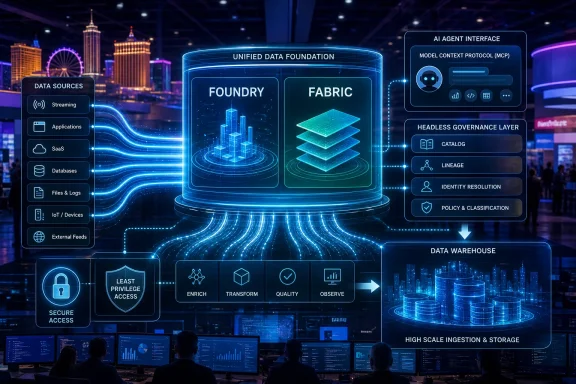
That is where the Informatica-Microsoft announcement lands. Informatica says its headless Intelligent Data Management Cloud capabilities are becoming available through Microsoft Foundry, while its Microsoft Fabric integration is being expanded for large-scale ingestion into Fabric Data Warehouse. Strip away the platform poetry and the pitch is clear: let Microsoft’s AI development environment and analytics stack consume Informatica-managed data services without forcing users to leave the Microsoft workflow.
This matters because Microsoft’s 2026 AI strategy is increasingly organized around a single premise: agents need context. Foundry is the place Microsoft wants developers and enterprises to build and manage AI applications. Fabric is the company’s unified data and analytics platform. Copilot Studio, Microsoft 365, GitHub, Azure, and Windows are all being pulled toward the same gravitational center.
The danger for customers is that “context” can become another word for sprawl. Every vendor now claims to provide the context layer, the trust layer, the semantic layer, or the agent orchestration layer. Informatica’s bet is that the organizations already using it for data cataloging, quality, governance, integration, and master data management will want those controls exposed directly inside Microsoft’s AI surfaces rather than rebuilt from scratch.
In consumer demos, this looks simple. An agent books a table, queries a calendar, or checks a file. In enterprise systems, the same pattern becomes much more treacherous. The agent may need to know which customer record is authoritative, whether personally identifiable information can be exposed, which region’s data residency rules apply, and whether a workflow should be blocked because the underlying data quality score is too low.
Informatica’s MCP servers in Microsoft Foundry are designed to expose data management services directly to agents. That could mean letting an agent find the correct customer identity, request governed data provisioning, or query metadata before taking an action. The technical direction is obvious: instead of treating data governance as a passive compliance dashboard, make it something AI systems can call at runtime.
That is a meaningful shift. Traditional data governance was built for humans moving through reports, tickets, catalogs, and approval flows. Agentic systems compress that chain. A model may reason, retrieve, transform, and act in seconds, and the governance layer has to be available in the same motion.
The word “headless” matters here. Informatica is not merely trying to put another dashboard inside Azure. It is trying to make its data management functions callable from Microsoft’s AI environment. In that world, the interface may be a Copilot, an agent built in Foundry, a Fabric workflow, or a custom application. The data controls sit underneath.
Microsoft launched Fabric as a way to unify analytics experiences that had previously been spread across services such as Power BI, Data Factory, Synapse-style warehousing, real-time analytics, and OneLake storage. The company’s more recent agentic AI messaging gives Fabric a second job: not just reporting on business data, but grounding AI systems in business meaning.
That second job raises the stakes. A dashboard can be wrong and still be caught in a meeting. An agent connected to operational systems can be wrong and cause damage before a human notices. That is why bulk ingestion, lineage, semantic modeling, identity resolution, and policy enforcement are not background chores in the AI era. They are part of the safety envelope.
For smaller businesses, the phrase “billions of rows” may sound distant. Many do not operate at that scale. But the architectural pattern still applies. A 50-person company can have customer records in Microsoft 365, transactions in QuickBooks or Dynamics, support history in Zendesk, marketing activity in HubSpot, files in SharePoint, and ad hoc spreadsheets everywhere. The number of rows is less important than the number of conflicting truths.
Microsoft’s challenge is to make Fabric feel like a practical consolidation point rather than another platform that requires a new priesthood. Informatica’s challenge is to make its enterprise-grade tooling accessible enough that it does not remain the preserve of large data offices. The partnership is compelling precisely because each vendor is trying to borrow the other’s strength: Microsoft’s platform reach and Informatica’s data-management depth.
Salesforce and Microsoft are rivals in CRM, productivity, AI assistants, data platforms, and enterprise application strategy. Yet the enterprise software market has always been messier than vendor keynote charts suggest. Customers run Salesforce and Microsoft together, often deeply. They expect identity, data, automation, and analytics to cross those boundaries because their businesses already do.
For Salesforce, Informatica provides a broader data foundation for Agentforce, Data Cloud, and the company’s trust-centered AI messaging. For Microsoft, working with Informatica helps reassure customers that Foundry and Fabric are not closed gardens requiring every piece of data to be born inside the Microsoft estate. For Informatica, the Microsoft integration is a way to remain relevant in the place where many enterprise developers and data teams now spend their time.
This is the new détente of enterprise AI. Vendors will compete fiercely at the assistant and platform layer while still integrating at the data layer because customers will not tolerate isolated AI islands. The more agentic systems become, the more expensive those islands become.
There is a risk, of course, that every integration becomes a toll booth. Customers could end up paying Microsoft for the platform, Salesforce or Informatica for the data fabric, another vendor for observability, another for security posture management, and consultants to make the pieces talk to one another. The promise is unified intelligence. The procurement reality may be a larger stack of subscriptions.
But there is a tension here. Informatica’s strongest value proposition has historically been in complex, heterogeneous, high-stakes data environments. That is exactly where governance, lineage, master data management, and large-scale ingestion justify their cost. A small business may need trusted data, but it may not need — or be able to absorb — the full enterprise machinery around it.
That does not make the announcement irrelevant to smaller firms. It means the useful question is not “Should a small business buy this?” but “At what level of complexity does this become worth caring about?” A business with a handful of SaaS tools and a few Power BI dashboards may be better served by disciplined data hygiene, sensible permissions, and simpler integration services. A business with regulated data, multiple operating units, serious customer identity problems, or AI workflows touching revenue operations is in a different category.
The AI boom has a way of making every company feel behind. Vendors lean into that anxiety by presenting data modernization as a prerequisite for survival. Sometimes that is true. Sometimes the better first step is less glamorous: define the customer record, clean up access rights, standardize reporting definitions, and stop using shared mailboxes as business systems.
Still, the direction of travel is clear. Capabilities that once belonged to enterprise data platforms will continue moving into midmarket stacks because AI raises the cost of messy data. A flawed spreadsheet used by one analyst is a nuisance. The same flawed data exposed to an autonomous agent is a liability.
An agent’s answer depends on what it can retrieve. Its action depends on which tools it can call. Its risk depends on whether the system understands sensitivity, authorization, lineage, and business context at the moment of use. That makes data governance part of runtime security rather than a quarterly audit exercise.
Microsoft has been moving in this direction across its AI portfolio. Foundry is positioned as an enterprise-grade environment for building and managing AI applications. Fabric is increasingly tied to semantic context and structured business data. Microsoft 365 brings signals about work, identity, and organizational relationships. The broader picture is an AI stack that wants to know not merely what data exists, but what it means and who is allowed to use it.
Informatica’s contribution fits that picture. Its tools are meant to help organizations catalog data, assess quality, manage metadata, resolve identities, and enforce policies across sources. If those capabilities become callable through MCP inside Foundry, they can influence agent behavior before the agent produces an answer or takes an action.
That is the optimistic view. The skeptical view is that complexity is moving from one layer to another. A badly configured governance tool can create false confidence. An MCP server with excessive permissions can widen the blast radius of an AI mistake. A semantic layer that encodes outdated business logic can make wrong answers look authoritative.
This is why IT administrators should treat AI data integrations like privileged infrastructure. They deserve change control, logging, access review, testing, and incident response planning. The fact that the interface is conversational does not make the backend any less powerful.
Those are not model benchmark questions. They are data architecture questions. They require metadata, lineage, access control, quality scoring, identity resolution, and business definitions that survive contact with real systems.
Informatica and Microsoft are responding to that production reality. The announcement is less about making AI smarter in the abstract than about reducing the distance between enterprise data controls and agentic execution. If an agent has to leave the governed environment to get useful context, the control model is already compromised.
Microsoft’s own Build-era messaging reinforces the point. The company is emphasizing context layers, semantic foundations, and agent development surfaces because it knows that raw model capability is becoming only one part of the buyer’s decision. Enterprises want to know whether an AI system can be deployed into messy, regulated, politically complicated organizations.
This is where many AI pilots stall. The prototype works because the dataset is curated, the permissions are simple, and the workflow is narrow. Production fails because the real data estate is fragmented and the ownership model is unresolved. No integration announcement can fix that by itself, but this one is aimed squarely at the bottleneck.
Fabric’s OneLake and Foundry’s agent tooling give Microsoft a strong platform story, but enterprise data gravity remains distributed. That is not a temporary problem. It is the default condition of modern IT.
By working with Informatica, Microsoft can tell customers that Foundry agents and Fabric analytics can reach beyond the Microsoft estate while still respecting enterprise governance patterns. That message is strategically useful. It positions Microsoft as the AI control plane without requiring it to be the sole system of record.
This is also why MCP has become so attractive. A common protocol for connecting models to tools and context allows platform vendors to claim openness while still competing on management, governance, developer experience, and scale. Microsoft benefits if Foundry becomes the preferred place to manage those connections. Informatica benefits if its data services become high-value endpoints in that ecosystem.
The unresolved question is who owns policy when multiple platforms are involved. If Microsoft Entra controls identity, Informatica controls data governance metadata, Salesforce controls customer workflows, and Fabric controls analytics semantics, administrators need clarity about precedence. In AI systems, ambiguous authority is not just annoying. It can produce inconsistent answers and uneven enforcement.
But the economics of AI data architecture are still unsettled. Moving data into Fabric may reduce some costs while increasing dependency on Microsoft’s consumption model. Using Informatica may reduce engineering work while adding licensing costs. Exposing governed services through MCP may accelerate agent development while creating new monitoring and security requirements.
For small and midsize organizations, the financial calculus should be brutally practical. The question is not whether the architecture is elegant. The question is whether it reduces manual work, improves decision quality, lowers risk, or enables revenue-generating workflows enough to justify its operational footprint.
There is also the human cost. Data integration projects fail as often from organizational ambiguity as from technical limitations. Who owns the customer definition? Who approves access to sensitive datasets? Who fixes a source system that emits bad data? Who tells the sales team that their favorite spreadsheet is no longer authoritative?
AI does not eliminate those fights. It makes them harder to postpone. Once an agent starts acting on business data, disagreements over definitions become product behavior.
The practical implications are likely to appear in familiar places. Identity and access policies will matter more. Audit logs will need to capture not just human activity but agent-mediated data access. Data loss prevention rules will have to account for AI workflows that retrieve and summarize governed content. Change management will need to include prompts, tools, connectors, and semantic definitions, not just application code.
This is where the Informatica-Microsoft integration could be valuable if it is implemented cleanly. A governed data service available inside Foundry is easier to monitor than a custom script that quietly copies records into a vector store. A Fabric ingestion path with lineage is easier to defend than a departmental export pipeline. A catalog-aware agent is preferable to one that treats every data source as equally trustworthy.
But admins should resist the idea that vendor integration equals safe deployment. The hard work remains configuration, testing, least privilege, and operational discipline. AI agents should be treated like eager junior employees with API access: useful, fast, and absolutely capable of making a mess if handed broad permissions and vague instructions.
The Microsoft ecosystem is moving quickly enough that documentation, feature names, and preview statuses can shift faster than procurement cycles. IT teams should assume that some of today’s agentic features will change shape before they become routine production defaults. That is not a reason to ignore them. It is a reason to build with reversibility in mind.
If an AI agent knows what “active customer” means, which revenue figure is official, which region owns an account, and which policy applies to a request, it can operate with far more confidence. If it lacks that meaning, it becomes a fluent search box over contradictory systems. The model may sound decisive while being structurally confused.
Microsoft is building toward this with Fabric’s semantic direction and its broader context strategy. Salesforce is building toward it with Data Cloud, Agentforce, and now Informatica. Snowflake, Databricks, ServiceNow, Oracle, SAP, and others are all making related claims in their own domains. Everyone wants to be where business meaning is encoded because that is where AI behavior becomes sticky.
Informatica’s position is interesting because it is not primarily an application vendor in the way Salesforce or Microsoft are. Its value comes from spanning systems, cataloging data, managing quality, and connecting governance to integration. Under Salesforce ownership, however, that neutral-ish data role becomes part of a larger competitive platform strategy.
Customers should welcome the integrations but remain wary of semantic lock-in. The more business definitions live in proprietary layers, the harder it becomes to move workflows later. Open protocols such as MCP help at the connection layer, but they do not automatically make business logic portable.
Still, small businesses should watch these developments because enterprise patterns tend to trickle down. Ten years ago, many small companies did not think much about identity governance, conditional access, endpoint management, or cloud data loss prevention. Today, those concerns arrive bundled into Microsoft 365 plans, cyber insurance questionnaires, customer security reviews, and compliance expectations.
AI data governance is likely to follow the same path. A small firm may not deploy Informatica IDMC directly. But it may use a SaaS product, Microsoft service, or managed provider that incorporates similar ideas: governed connectors, curated semantic models, policy-aware agents, and auditable data access.
The most realistic near-term benefit for smaller organizations is not a grand autonomous AI architecture. It is better connective tissue between the tools they already use. If Fabric, Foundry, and partner integrations make it easier to bring governed data into analytics and AI workflows, the value will show up as fewer manual exports, fewer conflicting dashboards, and fewer AI pilots trapped in sandbox mode.
That outcome is less flashy than the agent demos. It is also more valuable. Most businesses do not need a digital oracle. They need systems that stop arguing with each other.
The useful lesson is that AI success depends less on model selection than many buyers were told in 2023 and 2024. The model matters, but the surrounding system matters more as soon as the AI touches real business processes. Data quality, permissions, lineage, identity, and observability are not optional add-ons. They are the difference between a demo and a deployable service.
That is why Microsoft keeps tying its AI story back to Foundry and Fabric. It wants to sell not just copilots but the factory in which agents are built, grounded, governed, and monitored. Informatica’s role is to bring mature data-management functions into that factory without making customers abandon the systems they already depend on.
The announcement also reinforces a point that IT veterans know instinctively: integration is never “done.” Every new abstraction creates a new place for mismatched assumptions. MCP may standardize how agents connect to tools, but it does not decide whether a customer record is clean. Fabric may centralize analytics, but it does not automatically resolve political disputes over definitions. Foundry may provide an enterprise AI surface, but it does not absolve teams from designing safe workflows.
The best reading of the partnership is therefore neither hype nor dismissal. It is a pragmatic sign that the enterprise AI market is maturing from model spectacle to data plumbing. That is less glamorous, but it is where the durable value will be built.
 Microsoft’s AI Story Now Runs Through the Data Estate
For the last two years, the enterprise AI conversation has been dominated by models, copilots, benchmarks, and the increasingly elastic definition of an “agent.” That phase is not over, but it is no longer enough. The hard problem inside most companies is not whether a model can summarize a PDF; it is whether an AI system can answer a customer, trigger a workflow, reconcile conflicting records, and do all of that without inventing facts from stale or poorly governed data.That is where the Informatica-Microsoft announcement lands. Informatica says its headless Intelligent Data Management Cloud capabilities are becoming available through Microsoft Foundry, while its Microsoft Fabric integration is being expanded for large-scale ingestion into Fabric Data Warehouse. Strip away the platform poetry and the pitch is clear: let Microsoft’s AI development environment and analytics stack consume Informatica-managed data services without forcing users to leave the Microsoft workflow.
This matters because Microsoft’s 2026 AI strategy is increasingly organized around a single premise: agents need context. Foundry is the place Microsoft wants developers and enterprises to build and manage AI applications. Fabric is the company’s unified data and analytics platform. Copilot Studio, Microsoft 365, GitHub, Azure, and Windows are all being pulled toward the same gravitational center.
The danger for customers is that “context” can become another word for sprawl. Every vendor now claims to provide the context layer, the trust layer, the semantic layer, or the agent orchestration layer. Informatica’s bet is that the organizations already using it for data cataloging, quality, governance, integration, and master data management will want those controls exposed directly inside Microsoft’s AI surfaces rather than rebuilt from scratch.
The Model Context Protocol Becomes Enterprise Middleware
The most interesting phrase in the announcement is not “AI-powered” or “trusted data,” both of which now appear in almost every enterprise software press release. It is Model Context Protocol. MCP has quickly become the standard-shaped answer to a practical agent problem: how does an AI system discover, request, and use external tools or data sources in a controlled way?In consumer demos, this looks simple. An agent books a table, queries a calendar, or checks a file. In enterprise systems, the same pattern becomes much more treacherous. The agent may need to know which customer record is authoritative, whether personally identifiable information can be exposed, which region’s data residency rules apply, and whether a workflow should be blocked because the underlying data quality score is too low.
Informatica’s MCP servers in Microsoft Foundry are designed to expose data management services directly to agents. That could mean letting an agent find the correct customer identity, request governed data provisioning, or query metadata before taking an action. The technical direction is obvious: instead of treating data governance as a passive compliance dashboard, make it something AI systems can call at runtime.
That is a meaningful shift. Traditional data governance was built for humans moving through reports, tickets, catalogs, and approval flows. Agentic systems compress that chain. A model may reason, retrieve, transform, and act in seconds, and the governance layer has to be available in the same motion.
The word “headless” matters here. Informatica is not merely trying to put another dashboard inside Azure. It is trying to make its data management functions callable from Microsoft’s AI environment. In that world, the interface may be a Copilot, an agent built in Foundry, a Fabric workflow, or a custom application. The data controls sit underneath.
Fabric Is Becoming the Place Microsoft Wants Data Gravity to Settle
The Fabric side of the announcement is more prosaic, but arguably more important for IT teams. Informatica says its expanded IDMC integration with Microsoft Fabric can support mass ingestion of data from more than 300 enterprise sources into Fabric Data Warehouse. That is the kind of capability that sounds dull until you are the person responsible for stitching together ERP exports, CRM data, operational logs, finance systems, marketing platforms, and decades of inherited databases.Microsoft launched Fabric as a way to unify analytics experiences that had previously been spread across services such as Power BI, Data Factory, Synapse-style warehousing, real-time analytics, and OneLake storage. The company’s more recent agentic AI messaging gives Fabric a second job: not just reporting on business data, but grounding AI systems in business meaning.
That second job raises the stakes. A dashboard can be wrong and still be caught in a meeting. An agent connected to operational systems can be wrong and cause damage before a human notices. That is why bulk ingestion, lineage, semantic modeling, identity resolution, and policy enforcement are not background chores in the AI era. They are part of the safety envelope.
For smaller businesses, the phrase “billions of rows” may sound distant. Many do not operate at that scale. But the architectural pattern still applies. A 50-person company can have customer records in Microsoft 365, transactions in QuickBooks or Dynamics, support history in Zendesk, marketing activity in HubSpot, files in SharePoint, and ad hoc spreadsheets everywhere. The number of rows is less important than the number of conflicting truths.
Microsoft’s challenge is to make Fabric feel like a practical consolidation point rather than another platform that requires a new priesthood. Informatica’s challenge is to make its enterprise-grade tooling accessible enough that it does not remain the preserve of large data offices. The partnership is compelling precisely because each vendor is trying to borrow the other’s strength: Microsoft’s platform reach and Informatica’s data-management depth.
Salesforce’s Informatica Deal Is Already Reshaping the Partner Map
There is also a larger industry story hiding in the wording. Informatica is now being presented as “Informatica from Salesforce,” following Salesforce’s move to acquire the data management company. That makes Microsoft’s cooperation with Informatica more intriguing, not less.Salesforce and Microsoft are rivals in CRM, productivity, AI assistants, data platforms, and enterprise application strategy. Yet the enterprise software market has always been messier than vendor keynote charts suggest. Customers run Salesforce and Microsoft together, often deeply. They expect identity, data, automation, and analytics to cross those boundaries because their businesses already do.
For Salesforce, Informatica provides a broader data foundation for Agentforce, Data Cloud, and the company’s trust-centered AI messaging. For Microsoft, working with Informatica helps reassure customers that Foundry and Fabric are not closed gardens requiring every piece of data to be born inside the Microsoft estate. For Informatica, the Microsoft integration is a way to remain relevant in the place where many enterprise developers and data teams now spend their time.
This is the new détente of enterprise AI. Vendors will compete fiercely at the assistant and platform layer while still integrating at the data layer because customers will not tolerate isolated AI islands. The more agentic systems become, the more expensive those islands become.
There is a risk, of course, that every integration becomes a toll booth. Customers could end up paying Microsoft for the platform, Salesforce or Informatica for the data fabric, another vendor for observability, another for security posture management, and consultants to make the pieces talk to one another. The promise is unified intelligence. The procurement reality may be a larger stack of subscriptions.
Small Businesses Are Being Sold Enterprise Problems in Smaller Packaging
The Small Business Trends framing of the announcement is understandable. Smaller organizations want better decision-making, cleaner analytics, and more practical AI. They also increasingly use cloud services that were once aimed mainly at enterprises. Microsoft 365, Azure, Power BI, Dynamics, and Fabric all reach well below the Fortune 500.But there is a tension here. Informatica’s strongest value proposition has historically been in complex, heterogeneous, high-stakes data environments. That is exactly where governance, lineage, master data management, and large-scale ingestion justify their cost. A small business may need trusted data, but it may not need — or be able to absorb — the full enterprise machinery around it.
That does not make the announcement irrelevant to smaller firms. It means the useful question is not “Should a small business buy this?” but “At what level of complexity does this become worth caring about?” A business with a handful of SaaS tools and a few Power BI dashboards may be better served by disciplined data hygiene, sensible permissions, and simpler integration services. A business with regulated data, multiple operating units, serious customer identity problems, or AI workflows touching revenue operations is in a different category.
The AI boom has a way of making every company feel behind. Vendors lean into that anxiety by presenting data modernization as a prerequisite for survival. Sometimes that is true. Sometimes the better first step is less glamorous: define the customer record, clean up access rights, standardize reporting definitions, and stop using shared mailboxes as business systems.
Still, the direction of travel is clear. Capabilities that once belonged to enterprise data platforms will continue moving into midmarket stacks because AI raises the cost of messy data. A flawed spreadsheet used by one analyst is a nuisance. The same flawed data exposed to an autonomous agent is a liability.
Trusted Data Is Becoming the New Security Boundary
Security teams should pay attention to this announcement because “trusted data” is not just a data quality slogan. It is becoming a control plane. In agentic AI systems, the boundary between data management, security, compliance, and application behavior is beginning to blur.An agent’s answer depends on what it can retrieve. Its action depends on which tools it can call. Its risk depends on whether the system understands sensitivity, authorization, lineage, and business context at the moment of use. That makes data governance part of runtime security rather than a quarterly audit exercise.
Microsoft has been moving in this direction across its AI portfolio. Foundry is positioned as an enterprise-grade environment for building and managing AI applications. Fabric is increasingly tied to semantic context and structured business data. Microsoft 365 brings signals about work, identity, and organizational relationships. The broader picture is an AI stack that wants to know not merely what data exists, but what it means and who is allowed to use it.
Informatica’s contribution fits that picture. Its tools are meant to help organizations catalog data, assess quality, manage metadata, resolve identities, and enforce policies across sources. If those capabilities become callable through MCP inside Foundry, they can influence agent behavior before the agent produces an answer or takes an action.
That is the optimistic view. The skeptical view is that complexity is moving from one layer to another. A badly configured governance tool can create false confidence. An MCP server with excessive permissions can widen the blast radius of an AI mistake. A semantic layer that encodes outdated business logic can make wrong answers look authoritative.
This is why IT administrators should treat AI data integrations like privileged infrastructure. They deserve change control, logging, access review, testing, and incident response planning. The fact that the interface is conversational does not make the backend any less powerful.
The Agent Demo Era Is Colliding With Production Reality
The industry’s agent narrative has matured quickly from cute demos to uncomfortable operational questions. Can the agent distinguish a prospect from an active customer? Can it tell whether a refund policy changed last week? Can it access European customer data while operating under a U.S.-based workflow? Can it explain why it chose one record over another?Those are not model benchmark questions. They are data architecture questions. They require metadata, lineage, access control, quality scoring, identity resolution, and business definitions that survive contact with real systems.
Informatica and Microsoft are responding to that production reality. The announcement is less about making AI smarter in the abstract than about reducing the distance between enterprise data controls and agentic execution. If an agent has to leave the governed environment to get useful context, the control model is already compromised.
Microsoft’s own Build-era messaging reinforces the point. The company is emphasizing context layers, semantic foundations, and agent development surfaces because it knows that raw model capability is becoming only one part of the buyer’s decision. Enterprises want to know whether an AI system can be deployed into messy, regulated, politically complicated organizations.
This is where many AI pilots stall. The prototype works because the dataset is curated, the permissions are simple, and the workflow is narrow. Production fails because the real data estate is fragmented and the ownership model is unresolved. No integration announcement can fix that by itself, but this one is aimed squarely at the bottleneck.
Microsoft Gains Credibility by Not Pretending It Owns Every System
One reason this partnership matters is that Microsoft cannot credibly pretend all important business data lives inside Microsoft services. Even Microsoft-heavy organizations run SAP, Oracle, Salesforce, Workday, ServiceNow, Snowflake, Databricks, custom SQL systems, legacy file shares, and vertical applications that will never be neatly absorbed into a single cloud.Fabric’s OneLake and Foundry’s agent tooling give Microsoft a strong platform story, but enterprise data gravity remains distributed. That is not a temporary problem. It is the default condition of modern IT.
By working with Informatica, Microsoft can tell customers that Foundry agents and Fabric analytics can reach beyond the Microsoft estate while still respecting enterprise governance patterns. That message is strategically useful. It positions Microsoft as the AI control plane without requiring it to be the sole system of record.
This is also why MCP has become so attractive. A common protocol for connecting models to tools and context allows platform vendors to claim openness while still competing on management, governance, developer experience, and scale. Microsoft benefits if Foundry becomes the preferred place to manage those connections. Informatica benefits if its data services become high-value endpoints in that ecosystem.
The unresolved question is who owns policy when multiple platforms are involved. If Microsoft Entra controls identity, Informatica controls data governance metadata, Salesforce controls customer workflows, and Fabric controls analytics semantics, administrators need clarity about precedence. In AI systems, ambiguous authority is not just annoying. It can produce inconsistent answers and uneven enforcement.
The Cost Argument Cuts Both Ways
Informatica’s Fabric integration is being pitched partly around efficiency: faster ingestion, reduced compute time, and the ability to move very large data volumes into Fabric Data Warehouse. That is plausible and important. Data movement can be expensive, especially when pipelines are poorly optimized or repeatedly transform the same information across multiple platforms.But the economics of AI data architecture are still unsettled. Moving data into Fabric may reduce some costs while increasing dependency on Microsoft’s consumption model. Using Informatica may reduce engineering work while adding licensing costs. Exposing governed services through MCP may accelerate agent development while creating new monitoring and security requirements.
For small and midsize organizations, the financial calculus should be brutally practical. The question is not whether the architecture is elegant. The question is whether it reduces manual work, improves decision quality, lowers risk, or enables revenue-generating workflows enough to justify its operational footprint.
There is also the human cost. Data integration projects fail as often from organizational ambiguity as from technical limitations. Who owns the customer definition? Who approves access to sensitive datasets? Who fixes a source system that emits bad data? Who tells the sales team that their favorite spreadsheet is no longer authoritative?
AI does not eliminate those fights. It makes them harder to postpone. Once an agent starts acting on business data, disagreements over definitions become product behavior.
Windows Pros Should Watch the Admin Surface, Not the Sizzle Reel
For WindowsForum’s core audience, the most relevant question is how this will show up in day-to-day administration. Most sysadmins are not choosing global data architectures from scratch. They inherit them. They are then asked to connect them securely to Microsoft 365, Azure, Power Platform, Fabric, Copilot, and whatever new agent framework arrives next quarter.The practical implications are likely to appear in familiar places. Identity and access policies will matter more. Audit logs will need to capture not just human activity but agent-mediated data access. Data loss prevention rules will have to account for AI workflows that retrieve and summarize governed content. Change management will need to include prompts, tools, connectors, and semantic definitions, not just application code.
This is where the Informatica-Microsoft integration could be valuable if it is implemented cleanly. A governed data service available inside Foundry is easier to monitor than a custom script that quietly copies records into a vector store. A Fabric ingestion path with lineage is easier to defend than a departmental export pipeline. A catalog-aware agent is preferable to one that treats every data source as equally trustworthy.
But admins should resist the idea that vendor integration equals safe deployment. The hard work remains configuration, testing, least privilege, and operational discipline. AI agents should be treated like eager junior employees with API access: useful, fast, and absolutely capable of making a mess if handed broad permissions and vague instructions.
The Microsoft ecosystem is moving quickly enough that documentation, feature names, and preview statuses can shift faster than procurement cycles. IT teams should assume that some of today’s agentic features will change shape before they become routine production defaults. That is not a reason to ignore them. It is a reason to build with reversibility in mind.
The Real Competitive Fight Is Over the Business Definition Layer
The deeper strategic battle is not simply Microsoft versus Salesforce, or Informatica versus the other data integration vendors. It is a fight over who gets to define the business meaning that AI systems rely on. That layer may become more valuable than the application interface itself.If an AI agent knows what “active customer” means, which revenue figure is official, which region owns an account, and which policy applies to a request, it can operate with far more confidence. If it lacks that meaning, it becomes a fluent search box over contradictory systems. The model may sound decisive while being structurally confused.
Microsoft is building toward this with Fabric’s semantic direction and its broader context strategy. Salesforce is building toward it with Data Cloud, Agentforce, and now Informatica. Snowflake, Databricks, ServiceNow, Oracle, SAP, and others are all making related claims in their own domains. Everyone wants to be where business meaning is encoded because that is where AI behavior becomes sticky.
Informatica’s position is interesting because it is not primarily an application vendor in the way Salesforce or Microsoft are. Its value comes from spanning systems, cataloging data, managing quality, and connecting governance to integration. Under Salesforce ownership, however, that neutral-ish data role becomes part of a larger competitive platform strategy.
Customers should welcome the integrations but remain wary of semantic lock-in. The more business definitions live in proprietary layers, the harder it becomes to move workflows later. Open protocols such as MCP help at the connection layer, but they do not automatically make business logic portable.
The Announcement Is Bigger Than Small Business, but Smaller Firms Should Still Care
The Small Business Trends article frames the partnership as a boon for small businesses seeking better decision-making and operational efficiency. That is true in a broad sense, but the immediate beneficiaries are more likely to be organizations already deep enough into Azure, Fabric, Informatica, or Salesforce to care about governed AI at scale.Still, small businesses should watch these developments because enterprise patterns tend to trickle down. Ten years ago, many small companies did not think much about identity governance, conditional access, endpoint management, or cloud data loss prevention. Today, those concerns arrive bundled into Microsoft 365 plans, cyber insurance questionnaires, customer security reviews, and compliance expectations.
AI data governance is likely to follow the same path. A small firm may not deploy Informatica IDMC directly. But it may use a SaaS product, Microsoft service, or managed provider that incorporates similar ideas: governed connectors, curated semantic models, policy-aware agents, and auditable data access.
The most realistic near-term benefit for smaller organizations is not a grand autonomous AI architecture. It is better connective tissue between the tools they already use. If Fabric, Foundry, and partner integrations make it easier to bring governed data into analytics and AI workflows, the value will show up as fewer manual exports, fewer conflicting dashboards, and fewer AI pilots trapped in sandbox mode.
That outcome is less flashy than the agent demos. It is also more valuable. Most businesses do not need a digital oracle. They need systems that stop arguing with each other.
The Useful Lesson Is Hiding Beneath the Vendor Vocabulary
The Informatica-Microsoft announcement is packed with the language of the current enterprise AI moment: trusted data, agentic AI, headless platforms, MCP servers, data foundations, semantic context, and cloud-native management. Some of that language is useful. Some of it is camouflage for old integration problems wearing new clothes.The useful lesson is that AI success depends less on model selection than many buyers were told in 2023 and 2024. The model matters, but the surrounding system matters more as soon as the AI touches real business processes. Data quality, permissions, lineage, identity, and observability are not optional add-ons. They are the difference between a demo and a deployable service.
That is why Microsoft keeps tying its AI story back to Foundry and Fabric. It wants to sell not just copilots but the factory in which agents are built, grounded, governed, and monitored. Informatica’s role is to bring mature data-management functions into that factory without making customers abandon the systems they already depend on.
The announcement also reinforces a point that IT veterans know instinctively: integration is never “done.” Every new abstraction creates a new place for mismatched assumptions. MCP may standardize how agents connect to tools, but it does not decide whether a customer record is clean. Fabric may centralize analytics, but it does not automatically resolve political disputes over definitions. Foundry may provide an enterprise AI surface, but it does not absolve teams from designing safe workflows.
The best reading of the partnership is therefore neither hype nor dismissal. It is a pragmatic sign that the enterprise AI market is maturing from model spectacle to data plumbing. That is less glamorous, but it is where the durable value will be built.
The Ground Rules for This New Microsoft-Informatica Stack Are Already Visible
Before organizations rush to wire agentic systems into production data, they should take the announcement as a prompt to revisit fundamentals. The most successful deployments will not be the ones with the most ambitious agent demos. They will be the ones with the clearest ownership model for data, identity, policy, and cost.- Organizations should treat MCP-connected data services as privileged infrastructure, not as harmless developer conveniences.
- Microsoft Fabric becomes more strategically important when it serves as both an analytics platform and a grounding layer for AI agents.
- Informatica’s value is strongest where companies have complex, heterogeneous data estates that cannot be governed adequately with simple connectors alone.
- Small businesses should evaluate whether their data complexity justifies enterprise-grade tooling before buying into the full platform story.
- Administrators should demand auditability, least-privilege access, and clear policy precedence before allowing agents to act on governed data.
- The real measure of success will be whether these integrations reduce conflicting business truths, not whether they add another AI-branded interface.
References
- Primary source: Small Business Trends
Published: Mon, 08 Jun 2026 16:11:00 GMT
- Related coverage: tomsguide.com
Biggest Microsoft Build 2026 announcements — agentic AI, RTX Spark Dev Box, GitHub Copilot app, new MAI models, and more | Tom's Guide
All the big news from Microsoft's AI-focused eventwww.tomsguide.com - Related coverage: techradar.com
From code-first to intent-first: Microsoft Build 2026 could be the end of programming as we know it | TechRadar
Redefining what it means to be a developer with agentic AIwww.techradar.com - Related coverage: salesforce.com
Informatica Deepens Collaboration with Microsoft - Salesforce
Informatica’s Headless Intelligent Data Management Cloud is now available in Microsoft Foundry; expanded Microsoft Fabric integration enhances analytics capabilitieswww.salesforce.com - Related coverage: informatica.com
Informatica from Salesforce Delivers the Trusted Data Foundation Every AI Agent Needs — Now Across Every Surface, Every Platform, Everywhere | Informatica
Introducing headless data access, autonomous data management agents, and the industry's first unified agent and context catalog. www.informatica.com
- Official source: blogs.microsoft.com
Microsoft at NVIDIA GTC: New solutions for Microsoft Foundry, Azure AI infrastructure and Physical AI - The Official Microsoft Blog
Microsoft combines accelerated computing with cloud scale engineering to bring advanced AI capabilities to our customers. For years, we’ve worked with NVIDIA to integrate hardware, software and infrastructure to power many of today’s most important AI breakthroughs. What’s new at NVIDIA GTC...blogs.microsoft.com
- Related coverage: globenewswire.com
Agora, the Denodo Cloud Service, now available on the
Agora, the Denodo Cloud Service, now available on the Microsoft Marketplace to Power Agentic AI Use Cases...www.globenewswire.com - Related coverage: businesswire.com
- Official source: community.fabric.microsoft.com
Fabric June 2026 Feature Summary - Microsoft Fabric Community
Welcome to the June 2026 Fabric update! This month’s release brings a wide mix of improvements across the platform—from core data engineering andcommunity.fabric.microsoft.com - Official source: azure.microsoft.com
Microsoft Build 2026: Building agentic apps with Microsoft Fabric and Microsoft Databases | Microsoft Azure Blog
Microsoft Build 2026 highlights advancements in app development with Microsoft Fabric and Microsoft Databases, emphasizing a unified data and AI platform.azure.microsoft.com - Related coverage: techtarget.com
Microsoft boosts Fabric to make it a foundation for AI | TechTarget
With new features that fuel agents with contextually relevant data, Microsoft is making its Fabric platform a foundation layer for AI.www.techtarget.com - Official source: cdn-dynmedia-1.microsoft.com
- Related coverage: kpmg.com
