

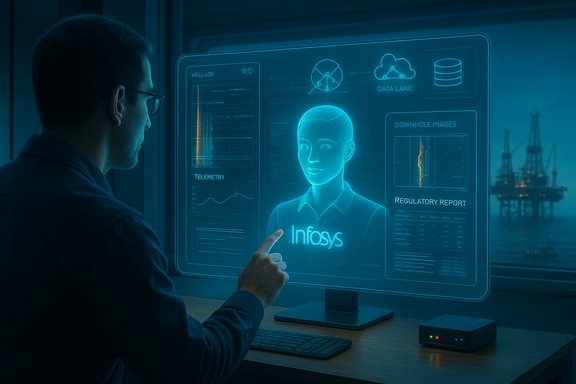
Infosys’ new AI agent for the energy sector signals a purposeful shift from proof-of-concept experiments to agentic, production-ready solutions that promise to turn mountains of field data into conversational, actionable intelligence for drilling, production and field operations. The vendor says the solution stitches together Infosys Topaz, Infosys Cobalt, Microsoft’s Copilot Studio, Azure OpenAI / Foundry-hosted models and multimodal families such as GPT‑4o to ingest well logs, telemetry, images and reports, automatically generate operational paperwork, and surface predictive warnings designed to reduce delays, improve safety and lower non-productive time (NPT).
The energy industry is inherently data-dense and safety-critical: wells, rigs, plants and grid assets produce large volumes of time-series telemetry, downhole logs, lab PDFs and imagery that must be interpreted quickly. That context is why systems integrators and hyperscalers are packaging agentic AI (agents that perceive, plan and act under governance) into vertical offerings for operators seeking faster decisions and standardized knowledge reuse. Infosys’ Topaz and Cobalt product families are explicitly positioned as the orchestration and cloud blueprints for these agents, while Microsoft’s Copilot and Azure Foundry provide the runtime and multimodal models.
However, the most material claims about operational impact—percent reductions in NPT, quantified safety improvements and exact productivity gains—remain company‑reported and are not yet independently verified in the public domain. Operators should therefore treat outcome figures as directional until site pilots publish transparent methodologies, audit trails and reproducible KPIs. Vigilant governance, rigorous validation and careful contractual design will determine whether these agents become reliable decision companions—or costly experiments—in safety‑critical operations.
Conclusion
The Infosys energy Agent packages a sensible, modern architecture for turning multimodal, operational data into conversational insights—and it does so by aligning Topaz and Cobalt with Microsoft’s Copilot and Azure Foundry model stack. For energy operators, the promise is compelling: faster access to evidence, automated reporting and earlier warnings that could reduce delays and improve safety. The path to realizing that promise, however, requires disciplined pilots, thorough validation, ironclad provenance and contractual safeguards that explicitly address safety, liability, security and sustainability. When those elements are in place, agentic AI can move from vendor demos into measurable operational value; without them, it remains a powerful but potentially hazardous tool in complex, human‑critical systems.
Source: Analytics India Magazine Infosys Develops AI Agent to Enhance Operations in the Energy Sector | AIM
 Background
The energy industry is inherently data-dense and safety-critical: wells, rigs, plants and grid assets produce large volumes of time-series telemetry, downhole logs, lab PDFs and imagery that must be interpreted quickly. That context is why systems integrators and hyperscalers are packaging agentic AI (agents that perceive, plan and act under governance) into vertical offerings for operators seeking faster decisions and standardized knowledge reuse. Infosys’ Topaz and Cobalt product families are explicitly positioned as the orchestration and cloud blueprints for these agents, while Microsoft’s Copilot and Azure Foundry provide the runtime and multimodal models.What Infosys announced (short summary)
- A domain-focused AI agent for energy operations that uses conversational AI to transform real-time operational data into actionable insights, automate reporting and provide early warnings.
- The solution leverages Infosys Topaz (agent fabric), Infosys Cobalt (cloud accelerators and compliance templates), Microsoft Copilot Studio (agent building), and Azure OpenAI / Foundry models (multimodal inference, including GPT‑4o family models).
- Claimed benefits include improved safety and reliability, better wellbore quality, optimized operations performance and reduced non-productive time—outcomes framed as the result of faster access to evidence, automated reports and predictive alerts. These outcome claims are presented as vendor‑reported pilot expectations and remain to be validated in independent customer case studies.
Why this matters: the industry context
The push toward agentic AI in energy is not an isolated marketing initiative. Multiple vendors, operators and cloud platforms are converging on the same architectural pattern: a governed knowledge layer (lakehouse/knowledge graph), a retrieval/grounding layer (vector search), agent orchestration (agent fabric), multimodal inference on large models and edge nodes for low-latency safety loops. Infosys’ announcement follows this playbook by packaging Topaz and Cobalt with Microsoft’s agent tooling and Foundry-hosted models—an integration that reduces the engineering lift for operators while raising the bar for governance and operational readiness.The building blocks explained
- Data ingestion and governance: Field telemetry (SCADA), well logs, reports and images are moved into a governed lakehouse or knowledge graph; data contracts and schema alignment are prerequisites.
- Grounding and retrieval: Vector search and document retrieval ground agent outputs in specific documents and past incidents to reduce hallucination and improve provenance.
- Agent orchestration (Topaz): An agent fabric handles prompt engineering, tool invocation, workflow orchestration and observability—managing the agent lifecycle in production.
- Cloud accelerators (Cobalt): Prebuilt cloud patterns and compliance templates accelerate secure, enterprise-grade deployments and support regulated workloads.
- Model runtime (Copilot Studio + Azure Foundry): Copilot Studio simplifies low-code agent creation and Microsoft Azure Foundry hosts multimodal models (GPT‑4o family models among them) for the heavy inference work.
- Edge & safety loops: On-site inference nodes for deterministic alarms and safety interlocks keep critical decision loops low-latency and auditable.
Detailed capabilities claimed by Infosys
Infosys presents the energy Agent as a practical, multimodal assistant for operations teams. The core capabilities the vendor describes are:- Multimodal ingestion: ability to parse and reason across well logs, downhole images, plots and tables.
- Conversational access: a Copilot-style chat and voice interface that returns context-sensitive summaries and recommended next steps.
- Report automation: automated drafting of daily operational reports, regulatory summaries and prefilled technical templates to reduce manual paperwork.
- Predictive insights and early warnings: anomaly detection that surfaces events associated with increased NPT or safety risk and offers prescriptive recommendations.
- Hybrid cloud-edge execution: heavy inference in Azure, deterministic safety checks at the edge; governed model routing and observability.
Critical validation: what’s verified and what remains vendor-reported
A journalist-grade read on the announcement separates two buckets: (A) architectural and technical claims that are verifiable in public product documentation and (B) quantified operational outcomes that are typically company-reported pilot metrics.- Verified/Corroborated:
- Infosys has publicly marketed Topaz as an “AI‑first” agent fabric and Agentic AI Foundry as a repository and lifecycle platform for agents.
- Infosys markets Cobalt as its cloud services and accelerator suite for enterprise workloads and regulated deployments.
- Microsoft’s Copilot Studio and Azure AI Foundry are documented platform offerings that support agent creation, connectors to enterprise knowledge stores, and hosting multimodal models such as the GPT‑4o family.
- Company‑reported / Unverified claims:
- Specific numeric results (for example, exact % reductions in NPT, hours saved, or quantified safety improvements) are presented as vendor outcomes from pilots or expected benefits. These metrics are plausible but not independently verifiable from the announcement materials and should be treated as directional until third‑party audits or published customer case studies appear.
Strengths: where this combination is likely to add value
- Platform completeness: Pairing an agent fabric (Topaz) with cloud accelerators (Cobalt) and a mature agent runtime (Copilot Studio + Azure Foundry) addresses the three common failures in enterprise AI projects: orchestration, secure cloud deployment and scalable model hosting. That reduces time-to-production for regulated customers.
- Multimodal readiness: Field engineering requires image, audio, time-series and document understanding—Foundry-hosted multimodal models (GPT‑4o family) are purpose-built for this mix, simplifying the engineering work of multimodal fusion.
- Hybrid architecture: Running non-deterministic reasoning in the cloud while keeping deterministic safety loops at the edge balances capability with safety and latency needs—exactly the pattern operators require for critical OT/SCADA interfaces.
- Commercial fit: Combining a systems integrator (Infosys) with a hyperscaler (Microsoft) reduces fragmentation—customers can contract for a bundled delivery that includes domain packaging, cloud hosting and long-term support.
Risks and unanswered questions
Deploying agentic AI inside safety-critical energy operations changes the liability landscape and requires rigorous governance. The major risk areas are:- Safety & control boundaries: Public materials do not detail which decisions the agent may automate versus only recommend. Any autonomous action that interfaces with physical systems must be governed by explicit, deterministic, and auditable fail-safes. The announcement lacks granular safety governance specifics and should not be taken as evidence that all safety questions are resolved.
- Model hallucination and provenance: Generative models can produce plausible but incorrect answers. Industrial deployments need grounding, provenance trails, explicit uncertainty estimates and rule-based guardrails for all recommendations. The vendor narrative promotes grounding, but the onus remains on operators to insist on provenance and audit trails in contracts.
- Data sovereignty and sensitivity: Well logs and subsurface models are commercially and geopolitically sensitive. Hybrid architectures and cloud contracts must address data residency, encryption and strict RBAC—especially where customers operate under regulatory constraints.
- Cybersecurity exposure: Adding agent layers and connectors increases the attack surface. Energy operators should demand threat modelling, zero-trust segmentation between OT and agent endpoints, signed agent identities and incident runbooks.
- Liability and compliance: Who is responsible if an agent’s suggestion contributes to an incident? Contracts must define responsibilities, indemnities and audit access; current announcements do not publish standard contractual terms on these points.
- Sustainability trade-offs: While agents can optimize operational efficiency, improved extraction or uptime may increase absolute emissions unless deployment objectives are aligned with decarbonization KPIs. This “enabled emissions” risk requires governance and explicit sustainability KPIs.
Practical implementation checklist for operators
Operators evaluating agentic AI pilots should insist on the following minimum requirements before production rollouts:- Define narrow, measurable pilot KPIs (e.g., reduce NPT by X% on a single rig; shorten mean time to detect a kick by Y minutes).
- Require end‑to‑end data contracts, schema definitions and deterministic ingestion pipelines for telemetry, logs and images.
- Insist that every agent output includes provenance metadata (which document or sensor produced the evidence, model version, confidence score) and a human‑in‑the‑loop approval workflow for high-risk recommendations.
- Run blind validation tests: evaluate the agent against archived incidents to measure recall, precision, false-positive/negative rates and operational utility.
- Build hardened security: zero‑trust segmentation between OT/edge and agent endpoints; encrypted secrets management; and signed identities for agent components.
- Contractual clarity on liability, SLAs, audit access and incident response—including service credits and escalation playbooks.
Commercial and market implications
Infosys’ energy Agent announcement is symptomatic of a broader market dynamic: major systems integrators are productizing agentic AI by combining domain accelerators (industry templates), cloud blueprints and managed services with hyperscaler runtimes. This model reduces integration friction and speeds procurement cycles, but it centralizes responsibility for safety, governance and long-term maintenance on the vendor/partner constellation. Customers will increasingly compare providers not only on feature lists but on published pilot KPIs, auditability, compliance posture and contractual protections.Competitive landscape
Other large integrators and ISVs are pursuing similar vertical stacks (agent fabrics + hyperscaler runtimes), so differentiation will depend on:- Depth of domain content (prebuilt agents, rulesets and engineering templates).
- Proven pilot evidence and transparent measurement.
- Cloud and data governance capabilities including data residency options and managed MLOps.
Short-term outlook and recommended adoption path
Adopting agentic AI in energy should be incremental and evidence-driven. The recommended path:- Start with low-risk, high-value pilots (report automation, document summarization, predictive maintenance alerts).
- Harden governance and provenance from day one—instrument every recommendation with traceability and confidence metrics.
- Iterate on human-in-the-loop thresholds; only expand agent autonomy after exhaustive validation across historical incidents and live shadow-mode trials.
- Negotiate contractual terms that address liability, SLAs, and data residency before wide rollout.
Final assessment: pragmatic optimism with guarded diligence
Infosys’ AI Agent for the energy sector is a credible engineering consolidation of existing platform capabilities: Topaz as an agent fabric, Cobalt as a cloud compliance accelerator, and Microsoft’s Copilot Studio plus Azure Foundry for agent creation and multimodal model hosting. Architecturally, the stack aligns with industry best practices for hybrid cloud/edge, retrieval-grounding and governed agent lifecycles—making the vendor’s technical claims plausible.However, the most material claims about operational impact—percent reductions in NPT, quantified safety improvements and exact productivity gains—remain company‑reported and are not yet independently verified in the public domain. Operators should therefore treat outcome figures as directional until site pilots publish transparent methodologies, audit trails and reproducible KPIs. Vigilant governance, rigorous validation and careful contractual design will determine whether these agents become reliable decision companions—or costly experiments—in safety‑critical operations.
Conclusion
The Infosys energy Agent packages a sensible, modern architecture for turning multimodal, operational data into conversational insights—and it does so by aligning Topaz and Cobalt with Microsoft’s Copilot and Azure Foundry model stack. For energy operators, the promise is compelling: faster access to evidence, automated reporting and earlier warnings that could reduce delays and improve safety. The path to realizing that promise, however, requires disciplined pilots, thorough validation, ironclad provenance and contractual safeguards that explicitly address safety, liability, security and sustainability. When those elements are in place, agentic AI can move from vendor demos into measurable operational value; without them, it remains a powerful but potentially hazardous tool in complex, human‑critical systems.
Source: Analytics India Magazine Infosys Develops AI Agent to Enhance Operations in the Energy Sector | AIM
